i
DO
SOCIAL
NETWORKING
WEBSITE
HAVE
AN
IMPLICATION
ON
MILLENIAL’S
ACADEMIC
AND/OR OCCUPATIONAL PERFORMANCE?
Nataša
Kupusovi
ć
Dissertation
presented
as
partial
requirement
for
obtaining
the
Master’s
degree
in
Information
Management
ii
NOVA Information Management School
Instituto Superior de Estatística e Gestão de Informação
Universidade Nova de Lisboa
DO SOCIAL NETWORKING WEBSITES HAVE AN IMPLICATION ON
MILLENNIAL'S ACADEMIC AND/OR OCCUPATIONAL PERFORMANCE?
by
Nataša Kupusović
Dissertation presented as partial requirement for obtaining the Master’s degree in Information Ma n-agement, with a specialization in Information Systems and Technologies Management
Advisor: Prof. Doutor. Tiago André Gonçalves Félix de Oliveira
iii
DEDICATION
iv
ACKNOWLEDGEMENTS
I would like to show my gratitude to the following people as the writing and completion of this dis-sertation would not have been possible without their support, assistance, and guidance:
Professor Dr. Tiago Oliveira, for his impecable advice and supervision. My family, for their neverending belief in me.
v
ABSTRACT
The purpose of this paper is to identify if there are any implications of Social Networking Website use on academic and/or occupational performance given the staggering number of users of such plat-forms. An online survey assessed the proposed determinants of Social Networking Websites (SNW) Addiction and if it has any repercussions on the user’s academic and/or occupational performance. The collected data (n=451) includes respondents of the Millennial generation from the U.S.A. and Europe, Portugal being the example. The results support some relationships of the proposed model, such as Diminished Impulse Control and Escapism explain SNW Addiction in USA context. In Eurepean context the drivers of SNW Addiction are Diminished Impulse Control and Self-Identity. The role of SNW Addiction in predicting Diminished Performance (Academic/Occupational) is confirmed in both regions. Diminished Impulse Control was the most important factor in determining Social Networking Website Addiction.
KEYWORDS
vi
SUBMISSION
SUBMISSION RESULTING FROM THIS DISSERTATION
PAPER
vii
INDEX
1. Introduction ... 1
2. THEORETICAL BACKGROUND ... 3
2.1. Problematic Internet Use ... 3
2.1.1. What is PIU? ... 3
2.1.2. Factors linked to PIU ... 3
2.1.3. PIU Skepticism ... 4
2.2. Social Networking Websites ... 4
2.2.1. What are SNWs? ... 4
2.2.2.
Let’s talk numbers
... 4
2.2.3. Factors behind continued SNW use ... 5
2.3. Work/School Performance ... 6
2.4. Millennials ... 7
3. Research Model ... 8
4. Methodology ... 11
4.1. Measurement Instruments ... 11
4.2. Data Collection ... 11
5. Results... 12
5.1. Measurement Model ... 12
5.2. Structural Model ... 14
6. DISCUSSION ... 16
6.1. Theoretical contributions ... 16
6.2. Practical Implications ... 17
6.3. Limitations and Future Research ... 17
7. Conclusion ... 19
8. Bibliography ... 20
viii
LIST OF FIGURES
ix
LIST OF TABLES
Table 1 - Top SNWs and the number of user interactions ... 5
Table 2 - Summary of Empirical Research on Related Constructs ... 8
Table 3 - Correlation matrix, composite reliability (CR), and square root of AVEs for full
sample (U.S.A. and Portugal) ... 12
Table 4 - Loadings and cross-loadings for the measurement mode for full sample (U.S.A. and
Portugal) ... 13
Table 5 - Structure model results by country ... 15
Table 6 - Hypotheses Conclusions ... 16
x
LIST OF ABBREVIATIONS AND ACRONYMS
SNW Social Networking Website
PIU Problematic Internet Use
IAD Internet Addiction Disorder
OCS Online Cognition Scale
IAT Internet Addiction Test
IS Information System
IT Information Technology
SEM Structured Equation Modeling
AVE Average Variance Extracted
1
1.
INTRODUCTION
Today’s digital era has shortened distances between people and facilitated a quick and easy flow of information. This “global village” (Aboujaoude, 2010) exceeds 3 billion users of the Internet world-wide as of June 2015 (“Internet World Stats,” 2015). The Internet has become a mechanical part of many people’s day-to-day professional and personal lives; many of those same individuals have diffi-culties recalling a life before the Internet made everything so much simpler. The Internet has also proven to be a valuable instrument in academic and occupational environments. However, an incon-sistency does exist. There has been empirical research showing repercussions at school and/or work due to maladaptive Internet use (Bock & Ho, 2009; Davis, Flett, & Besser, 2002; Mastrangelo, Everton, & Jolton, 2006; Vitak, Crouse, & Larose, 2011; Young, 1998). As information systems (IS) move rapidly towards Internet-based platforms to simplify access and cooperation within the team, it is necessary to understand if and how aspects of the Internet affect the psychology of the users and ultimately, the organization.
The Internet is relevant in many ways, but it is mostly integrated into the social life of the average user. The average person spends over six hours online a day (as of 2014), with almost two hours of that time spent on Social Networking Websites (SNW) (Mander, 2015). With the ability to “repr o-duce” oneself on a SNW (Amichai-Hamburger & Vinitzky, 2010) it is understandable why these plat-forms have risen to high levels of popularity. Considering that 74% of all Internet users are on SNWs, it is logical to assume that they may face the same paradox as general Internet users (Iacovelli & Valenti, 2009; Kim, LaRose, & Peng, 2009; Panicker & Sachdev, 2014; Turel & Serenko, 2012). In other words, a pervasive compulsion to be on SNWs to validate social connections may undermine psycho-logical well-being.
SNWs have become more prevalent in the everyday lives of users - mainly Millennials, of which 89% are on the social platforms - and access to the Internet is taking over offices, classrooms, and even public locations. Therefore, it is of broad interest to find out what the outcomes of SNW Addiction at work or school are, regarding performance. While there is earlier research on the case of Problematic Internet Use (PIU) and its role in academic, occupational, and social impairment - which is highlighted later in this study - there is scarce to no research on how SNWs, in specific, can affect these aspects. Much of the research found on PIU includes traditional Internet activities but fails to address the Web 2.0 activities such as SNWs. Due to the ever evolving advances in Internet technology, research has lagged behind.
3
2.
THEORETICAL BACKGROUND
This section of the study will provide a systematic review of the existing literature on the concepts that are pertinent to understanding the purpose of this study.
2.1.
P
ROBLEMATICI
NTERNETU
SE2.1.1.
What is PIU?
PIU can be defined as a user's maladaptive reliance to online technology that is exhibited through obsessive-compulsive behaviors that overtake other crucial parts of their life (Xu, Turel, & Yuan, 2011) or as an impulse-control disorder (Douglas et al., 2008; Young, 1998). The issue is more appar-ent when a user is psychologically disturbed if their online time or level of interaction is limited by an outside source (Tobin, Vanman, Verreynne, & Saeri, 2014). Users typically progress very gradually by demonstrating no or meek symptoms to then showing very extreme irrational behaviors, making the "disorder" a continuum (Tao et al., 2010).
PIU consumes an immense number of people worldwide who are affected by negative impacts on their academic, financial, occupational, and relationship aspects of life (Panicker & Sachdev, 2014). Davis (2001) characterized PIU into two categories: "Generalized PIU" which involves a general, mul-tidimensional overuse of the Internet such as wasteful online activities which lack a clear objective and "Specific PIU" which involve users who are dependent on a particular function of the Internet, including online gambling and online sexual materials/services. This study will be examining the for-mer of the two categories because PIU is mostly developed in an interactive application, such as chat, or in this case, SNWs (Davis et al., 2002). PIU or Internet addiction is comprised of three subtypes (excessive gaming, sexual preoccupations, and e-mail/text messaging) that share four problematic components (excessive use, tolerance, withdrawal, and negative social ramifications). All of these components potentially lead to distress (Tao et al., 2010) or “technostress” (Young, 2009).
2.1.2.
Factors linked to PIU
There is extensive oeuvre on the subject of psychological factors related to the pathological use of the Internet. Research dates back to as early as the mid-1990's when Young (1998) pioneered the studies on the topic, reporting personal, familial, and occupational problems resulting of PIU. The author found symptoms to be similar to those of pathological gambling, eating disorders, and alco-holism.
4 Sjöberg, 2004), and a lack of good social skills which lead to strong habitual PIU behaviors and harm-ful life outcomes at work and/or school, or with significant relationships (Kim et al., 2009).
2.1.3.
PIU Skepticism
While the research presented above on the subject of PIU is only a fraction of all the available knowledge on the topic, it still seems like it is sufficient to provide probable cause for the existence of the disorder. Nevertheless, a considerable amount of skepticism on the topic still exists within the academic and scientific realms. PIU is often overlooked because the symptoms are easily masked by a legitimate use of the Internet for occupational, academic, or personal reasons (Young, 2009). The Diagnostic and Statistics Manual of Mental Disorders - Fourth Edition (DSM-5), published by the American Psychiatric Association in 1994, specifies a psychiatric disorder of Pathological Gambling that is often related to PIU because both lack a tangible substance to be abused (Aboujaoude, 2010; Xu et al., 2011). There is a push for inclusion of an Internet Addiction Disorder (IAD) in the next edi-tion of the DSM (Pies, 2009) but that has yet to happen. Due to the difficulties in consensus for the definition of PIU and the disagreement of its existence, the research that is necessary to better un-derstand the science behind it is still lagging behind (Aboujaoude, 2010). For a technology that has profoundly changed the everyday lives of many people, its influence on psychological maladjustment remains heavily understudied.
2.2.
S
OCIALN
ETWORKINGW
EBSITES2.2.1.
What are SNWs?
"The Internet is a solitary activity used to increase one's social sphere” (Davis et al., 2002, p. 332). SNWs are a prime example of using the Internet for social contracts as they allow users to create personalized profiles within a network, interact with other users, and mutually share content (Amichai-Hamburger & Vinitzky, 2010; Boyd & Ellison, 2008; Nadkarni & Hofmann, 2012). SNWs al-low for users to present themselves in a controlled way by alal-lowing the construction and editing of the content that represents them online (Iacovelli & Valenti, 2009). The public nature of content posted on a SNW like Facebook can help foster a sense of importance and visibility, which is extreme-ly appealing to its users (Turel & Serenko, 2012). SNWs also provide perpetual connectivity to peers that users can access. However, this constant availability to communication can also result in adverse effects on the user’s psychological well-being (Iacovelli & Valenti, 2009) - the same paradox related to PIU.
2.2.2.
Let’s talk numbers
5 Table 1 - Top SNWs and the number of user interactions
2.2.3.
Factors behind continued SNW use
Previous literature suggests some of the reasons behind what makes SNWs so popular amongst its users. However, it is hard to determine the “typical” user on a SNW. There are some clues of which factors users tend to exhibit: extraversion & conscientiousness (Andreassen, Torsheim, Brunborg, & Pallesen, 2012; Wilson, Fornasier, & White, 2010), neuroticism (Amichai-Hamburger & Vinitzky, 2010; Andreassen et al., 2012), the need to belong, and the need to self-represent (Nadkarni & Hofmann, 2012). There has also been found a positive correlation between self-disclosure and self-referential, seeing as much as 80% of posts to SNW are related to personal experiences (Tamir & Mitchell, 2012). Individuals are absorbed into the systems through their Perceived Enjoyment and enthusiasm of the SNW (Turel & Serenko, 2012). A strong motivation to communicate also drives people to start using SNWs (Ross et al., 2009). Nonetheless, SNWs can present feelings that expedite a habit and reinforce that habit until it forms a maladaptive psychological dependency (Turel & Serenko, 2012) similar to the concerns of PIU. Researchers at the School of Psychology at the University of Queensland ob-served that refraining from generating content on the SNW for merely 48 hours or not receiving feedback from a person’s list of “friends” for the same amount of time made that person’s feeling of belonging vulnerable (Tobin et al., 2014).
Seeing the staggering numbers of users on different SNWs is an implication of the sizable role that they play in people's lives. Since SNWs are a big part of the activities available on the Internet, it is critical to explore how a SNW Addiction (similar to characteristics of PIU) may affect academic and/or occupational lives of the users; both for personal and managerial understanding.
Social Networking
Website (SNW)
Statistics on Users
Source
968 million daily active users on average for June 2015
1.49 billion monthly active users as of June 30, 2015
Stats,” 2015)
YouTube
Over a billion users- almost 1/3 of all Internet users
Billions of views each day
(“YouTube
Statistics,”
2015)
Over 400 million users
More than 80 million photos shared per day
(“Celebrating
a Community
of 400
Million,”
2015)
More than 316 million monthly active users
Over 500 million tweets sent per day
(“About
Twitter,”
2015)
More than 380 million registered users
(“About
LinkedIn,”
6
2.3.
A
CADEMIC AND/
ORO
CCUPATIONALP
ERFORMANCEThe Internet and SNWs have a strong presence in many different aspects of a user's everyday per-sonal and professional life because of the significant benefits they present. Paradoxically, Internet users are more prone to academic and/or occupational predicaments (likely tied to lapses in produc-tivity) than nonusers (Davis et al., 2002). Excessive usage of the Internet can arise with the aim of avoiding cognitive tasks and engaging in activities that distract from academic, work, and domestic responsibilities (Panicker & Sachdev, 2014).
For students, the Internet is an essential and worthy tool for study research, but also one that could be easily misused. A study comprising a sample of 219 university students found that 74% of them claimed that the Internet/SNWs usage had an adverse impact on their lives, viz. “procrastination, distraction, and poor time-management” (Kuss & Griffiths, 2011, p. 3537). Young (1998) reported that 58% of students experience a decline in study habits and grades due to excessive Internet use. In 1998, nearly two decades ago, Young (1998) identified academic problems that users may face from maladaptive Internet use (or the current term - PIU). Schools have integrated technology into their educational plans far more since then, with education turning to computer-based textbooks and programs. The possibilities for misuse of these technologies within a school has, therefore, far in-creased since Young’s (1998) findings.
For employees, the Internet can act as a tool for communication, research, management, logistics, and so forth. The benefits of giving Internet access to employees ultimately prevail over the disad-vantages; still, employers realize the reality of Internet misuse in the workplace (Young, 1999). As a potential distraction for many employees, the use of the Internet (and potentially, SNWs) can reduce work performance (Young, 1998). This distraction is a definite concern to all management (Young, 1999). Companies opt to introduce Internet governance policies to avoid the significant implications PIU may pose, which could potentially result in considerable loss of productivity (Yellowlees & Marks, 2007). These types of policies emerge due to the ease of use and usefulness perception factors influ-encing the effect that the web has on one’s productivity (Leonard & Riemenschneider, 2013).
7
2.4.
M
ILLENNIALSDefining whom the term "Millennials" refers to isn't a simple task. Some researchers define Millenials as adults aged 18 to 33 years in 2014 (Millennials in Adulthood: Detached from Institutions, Networked with Friends, 2014) but also note that there are younger Millennials in their teenage years at the moment of the study. Other researchers (Myers & Sadaghiani, 2010) specify that Millen-nials are those born between 1979 and 1994. Meanwhile, the Merriam-Webster Dictionary defines "Millennials" as those born in the 1980s or 1990s1. Though there may not be a clear consensus on when the Millennials were born, there are many habits and characteristics of this generation that are widely agreed upon. This study will refer to Millennials as those born between 1980 and 1999. As to not get too far deep into all of the personality dynamics of Millennials, it is significant to focus only on their technological habits for relevance to this study. Millennials are seen as "digital natives" (Millennials in Adulthood: Detached from Institutions, Networked with Friends, 2014), insinuating that they are the only generation that did not need to adapt to technologies but were simply born into households with such technologies. They are at ease with communication technologies and are more likely to take full advantage of those, as well as information technologies (Myers & Sadaghiani, 2010). A lot of their time spent online is dedicated to SNWs – specifically, 72% of adults aged 18 to 29 years in 2010 used these platforms (“Social Media Site Usage 2014,” 2014), and that number contin-ues to rise.
The reason so many Millennials are using SNWs is that the increase of these websites has made it easier for people to interact with one another "synchronously and asynchronously" (Deal, Altman, & Rogelberg, 2010, p. 192), which provides a more accessible way to stay relevant amongst peers - a factor whose importance amongst this generation will be examined in this study. Furthermore, ac-cording to a Nielsen report (State of the Media: The Social Media Report, 2012) people aged 18 to 34 years spent an average of 10h40m just on mobile Social Networking for the month of July, 2012. Considering how available Internet access is in most places - work and school included - it is impera-tive to find out how SNW use is affecting Millennial’s academic and/or occupational performance. Seeing as 34% of the United States' workforce is composed of the Millennial generation, the largest percentage of any generation (Fry, 2015), and more than 50% of Millennials enroll in college (Millennials in Adulthood: Detached from Institutions, Networked with Friends, 2014), this becomes an even more important research.
1
8
3.
RESEARCH MODEL
While previous research has focused on the outcomes of PIU and the factors influencing SNW use, empirical work regarding SNW and its potential outcomes of academic and/or occupational perfor-mance ranges from very scarce to non-existent. Therefore, this study introduces a research model that is based on the extensive examination of similar topics to evaluate if and how SNW Addiction relates to academic and/or occupational performance, as well introducing constructs that relate to SNW Addiction.
The literature that backs up the proposed model is based on five empirical studies that demonstrate a holistic review of the related constructs with consideration to the Internet, more precisely SNWs. In
Erro! A origem da referência não foi encontrada. main findings from these studies can be observed. The highest indicators found in each study were not enough by themselves to predict SNW Addiction in this context. However, it is expected that when grouped together they contribute to an integrated model to explain SNW Addiction and academic/occupational performance. The following section outlines the constructs in the proposed research model, past findings for those variables as they re-late to this study, and the hypotheses to be tested in this study.
Table 2 - Summary of Empirical Research on Related Constructs
Title Source Context Findings Sample
“The theory of
planned behavior applied to young
people’s use of social
networking web-sites.” (Pelling & White, 2009) Social Net-work Web-sites
Self-Identity was found to be the highest predictor of behavior, following the Theory of Planned
Behavior model.
233 undergraduate uni-versity students, ages 17
– 24 years, average age of 19.22 years
“Online game addi c-tion among adoles-cents: motivation and
prevention factors”
(Xu et al., 2011)
Online gaming
The need for Escapism and the need for relationship were the motivating factors that had the most impact in predicting
addic-tion.
623 middle school stu-dents, ages 12 – 18,
aver-age aver-age about 15 years
“Validation of a New
Scale for Measuring Problematic Internet Use: Implications for Pre-employment Screening” (Davis et al., 2002) Pro- blema-tic In-ternet use
Diminished Impulse Control was the highest indicator of PIU.
Inter-active applications (e.g. instant messaging) were most related to
PIU and scores on the OCS pre-dicted being reprimanded at school or work for inappropriate
Internet use.
211 undergraduate psy-chology students, 104 men and 107 women, average age of 21.73 (SD
= 4.40 years)
“The benefits and
dangers of enjoy-ment with social
networking websites” (Turel & Serenko, 2012) Social Net-working Web-sites
Perceived Enjoyment has a signifi-cant impact on high engagement – a positive outcome – but is, at the same time, the highest indirect predictor of technology addiction.
194 college students, ages 19 – 40, average age
of 23 years
“Internet Addiction:
The Emergence of a New Clinical
Disor-der” (Young, 1998) Internet Addic-tion
Non-Dependents (on the Internet) reported only poor time
manage-ment due to excessive Internet use; Dependents reported aca-demic and occupational
impair-ment among others.
Case studies of 396 de-pendent Internet users and a control group of 100 non-dependent
9
3.1 Hypotheses
Pelling and White (2009) find that the more a user identifies with a SNW, the more they are prone to use the system. Self-Identity was found significantly to predict intention to engage in high-level SWN use and addictive tendencies towards SNWs; negative consequences are associated with high-level use. Taking what Pelling & White found in their study and applying it to this research, it can be hy-pothesized that:
H1: Self-Identity expression through a SNW positively influences SNW Addiction.
Xu et al. (2011) define Escapism as the “need to avoid thinking about real life problems through i m-mersion in the game”. They found this to be one of the biggest motivators behind adolescents’ online game playing and online game addiction. In the same way, the Internet (SNWs included) may serve the purpose of escape from real-life difficulties (Armstrong et al., 2000). Considering the extent to which online games were present in these adolescents’ lives and the extent to which SNWs are pre-sent in Millennial’s lives, it is probable to assume that a similar result occurs. Therefore, relating this theory to this study, it can be hypothesized that:
H2: The need for Escapism through a SNW positively influences SNW Addiction.
Davis et al. (2002) define Internet-related Diminished Impulse Control (DIM) as involving “obsessive cognitions about the Internet and an inability to reduce Internet use despite the desire to do so”. DIM is a clear indicator of more severe PIU. Regarding SNWs, the user may want to decrease their time spent on the SNW but be unable to do so because of said DIM. The time devoted to a SNW be-cause of this lowered self-control can lead to addiction. Therefore, it is postulated that:
H3: Diminished Impulse Control with regards to a SNW positively influences SNW Addiction.
According to Turel et al. (2011) there is a positive correlation between perceived enjoyment and online auction users’ addiction. Later Turel and Serenko (2012) found an ever higher correlation be-tween the same construct and SNW users’ addiction. In the prior study, the relation between users from the online auction website eBay resemble the habits of SNW users in regards to this construct. It is essential for a user to perceive any Information System (IS) as enjoyable, including SNWs, to use it. When that perceived enjoyment is present, the user tends to put forth more effort into using the system and becoming less apathetic to it (Turel & Serenko, 2012). Amongst other predictors in the Turel and Serenko (2012) study, perceived enjoyment was most highly related to the addictive use of SNWs. For these reasons, it can be postulated that:
H4: Perceived Enjoyment with a SNW positively influences SNW Addiction.
If the user is spending a high amount of time online and in turn avoiding work tasks, productivity for the employer and the organization suffers (Young, 1998). Addictive SNW use may result in counter-productive behaviors in academic and/or occupational circumstances. It can be hypothesized that:
H5: SNW Addiction positively influences Diminished Performance (Academic/Occupational).
11
4.
METHODOLOGY
4.1.
M
EASUREMENTI
NSTRUMENTSAn online questionnaire was developed to test the model presented in Figure 1 - Conceptual Model. The measurement items for the constructs were adapted from existing literature to fit the topic of SNWs. Self-Identity (SI) was adapted from Pelling and White (2009); Escapism (ESC) from Xu et al. (2011); Diminished Impulse Control (DIM) from the online cognition scale developed by Davis et al. (2002); perceived enjoyement (PE) and SNW Addiction from Turel and Serenko (2012); Diminished Performance (Academic/Occupational) was measured using items adapted from the Internet addic-tion test developed by Young (1998).. The quesaddic-tionnaire was developed in English and distributed as such to both respondents in the U.S.A. and Portugal. It was developed using an online survey devel-opment cloud-based website called SurveyMonkey2.
All measurement items for the constructs were measured using a seven-point Likert scale, with an-swers ranging from “not at all” to “completely”, with the exception of the answers for Diminished Performance (Academic/Occupational), which range from “never” to “very frequently”.
4.2.
D
ATAC
OLLECTIONA pilot study (September 2015) was conducted primarily yielding 30 respondents from the U.S.A. and 30 from Portugal with the purpose of refining the content and structure if any complications with clarity of survey and reliability of the scales arose. However, the answers from this pilot study proved that the survey was in fact valid, so data collection proceeded with no changes made to the ques-tionnaire. The data collected during the pilot survey was not included in the overall results. A total of 649 responses were collected at the end of the data collection period (during four weeks in October). Participants were reached through means of various SNW postings (on Facebook, Twitter, and Red-dit), of which 451 were validated.
The data collection yielded 247 responses from the U.S.A. and 204 from Portugal. Of the total num-ber of valid respondents 59% were students and 51% were employed (the overlap comes from spondents who are both employed and students), 49% identified as male, and 51% female. Only re-spondents whose age was in the range of 16 to 35 years old in 2015 (born between 1980 and 1999) were considered in the results as they represent the Millennial generation; the average age was 24. Regarding how much time each day the respondents spent checking their SNW, the results showed that 19% spend less than 1 hour, 31% spent 1-2 hours, 23% spent 2-3 hours, 18% spent 3-4 hours, and 9% spent more than 5 hours.
The Kolmogorov-Smirnov (K-S) test was used to determine nonresponse bias by testing the sample distributions of the full sample (U.S.A. and Portugal) respondents (Ryans, 1974). There was no statis-tically significant (p>0.01) bias found between early (the first two weeks) and later (after the first two weeks) respondents of the full sample. Additionally, the Harman’s one-factor test (Podsakoff, MacKenzie, Lee, & Podsakoff, 2003) was used to measure the common method bias. Indicated the absence of common method bias.
2
12
5.
RESULTS
To assess the casual relations of the conceptualized model, we used structured equation modeling (SEM), a statistical method for testing casual relationships using a mixture of statistical data and qual-itative casual assumptions. Partial least squares (PLS) was the method used to examine the research model. In particular, SmartPLS 2.0.M3 (Ringle, Wende, & Will, 2005) software was used to assess the relationships established by the conceptual model. Since this model has not been tested before, PLS was adequate and fitting testing (Hair, Ringle, & Sarstedt, 2011; Hair, Sarstedt, Ringle, & Mena, 2012).
In the following subsections, the measurement model is examined with the objective to evaluate the reliability and validity followed by assessment of the structural model.
5.1.
M
EASUREMENTM
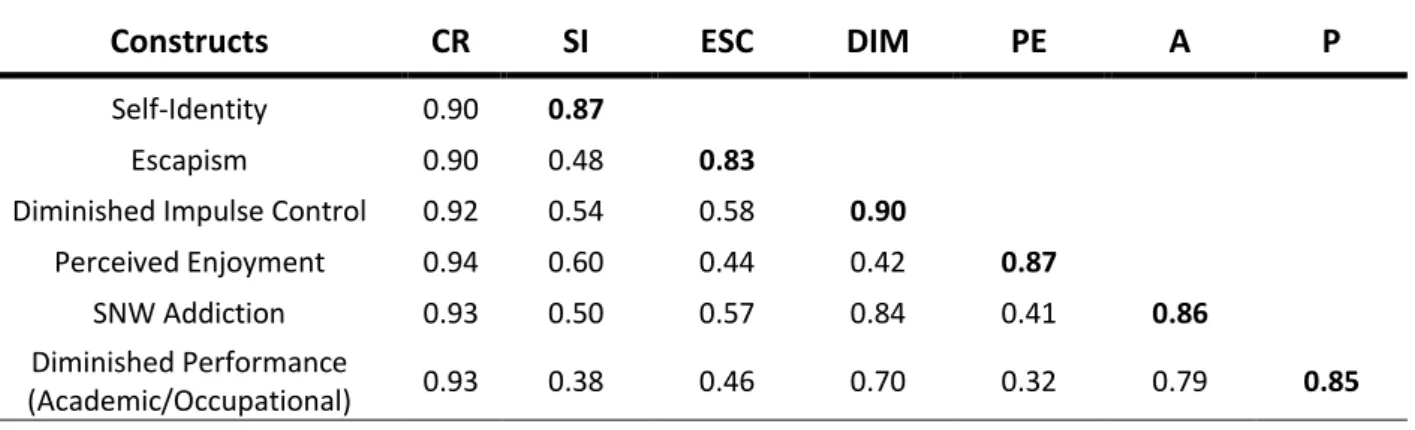
ODELThe construct reliability was tested with the composite reliability coefficient. As it can be seen in Table 3 all of the constructs are higher than 0.7 for the composite reliability. According to Straub (1989), this means that the constructs are reliable.
Constructs
CR
SI
ESC
DIM
PE
A
P
Self-Identity 0.90 0.87
Escapism 0.90 0.48 0.83
Diminished Impulse Control 0.92 0.54 0.58 0.90
Perceived Enjoyment 0.94 0.60 0.44 0.42 0.87
SNW Addiction 0.93 0.50 0.57 0.84 0.41 0.86
Diminished Performance
(Academic/Occupational) 0.93 0.38 0.46 0.70 0.32 0.79 0.85
(1) Second column represents composite reliability (CR)
(2) Diagonal elements represent the square average variance extracted (AVE)
(3) Off-diagonal elements represent correlations
Table 3 - Correlation matrix, composite reliability (CR), and square root of AVEs for full sample (U.S.A. and Portugal)
13
Construct
ITEM
SI
ESC
DIM
PE
A
P
Self-Identity SI1 0.89 0.44 0.50 0.51 0.46 0.34
SI2 0.90 0.45 0.52 0.53 0.48 0.37
SI3 0.82 0.35 0.39 0.54 0.36 0.26
Escapism ESC1 0.40 0.89 0.52 0.36 0.50 0.41
ESC2 0.46 0.65 0.38 0.50 0.34 0.29
ESC3 0.38 0.92 0.53 0.36 0.53 0.44
ESC4 0.37 0.84 0.49 0.31 0.48 0.39
Diminished Impulse Control DIM1 0.52 0.54 0.86 0.44 0.72 0.59
DIM4 0.48 0.50 0.92 0.38 0.75 0.63
DIM5 0.47 0.53 0.91 0.32 0.78 0.64
Perceived Enjoyment PE1 0.54 0.40 0.32 0.89 0.33 0.25
PE2 0.56 0.42 0.39 0.90 0.38 0.31
PE3 0.53 0.39 0.33 0.89 0.32 0.24
PE4 0.52 0.39 0.44 0.86 0.42 0.34
PE5 0.45 0.33 0.32 0.82 0.30 0.24
SNW Addiction A1 0.46 0.53 0.73 0.37 0.88 0.71
A2 0.41 0.45 0.69 0.32 0.89 0.76
A3 0.46 0.50 0.69 0.37 0.87 0.68
A4 0.44 0.51 0.74 0.36 0.80 0.55
A5 0.39 0.44 0.75 0.33 0.85 0.68
Diminished Performance (Aca-demic/Occupational)
P1 0.29 0.40 0.57 0.24 0.66 0.90
P2 0.32 0.39 0.58 0.27 0.71 0.90
P3 0.43 0.45 0.67 0.33 0.76 0.85
P4 0.27 0.35 0.49 0.30 0.54 0.77
P5 0.27 0.38 0.62 0.24 0.65 0.81
Table 4 - Loadings and cross-loadings for the measurement mode for full sample (U.S.A. and Portu-gal)
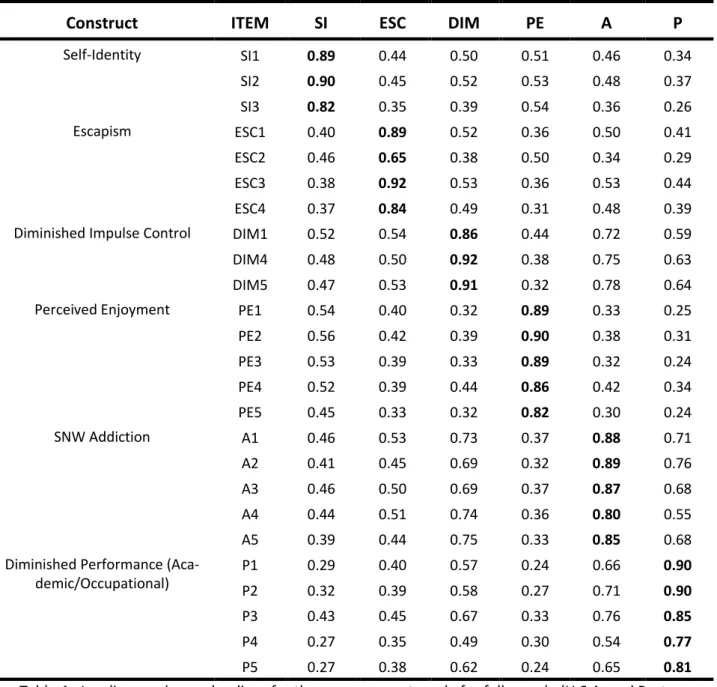
The discriminant validity of the constructs was evaluated using two measures: Fornell-Larcker and cross-loadings criteria. The first criterion hypothesizes that the square root of AVE should be higher that correlations between the construct (Fornell & Larcker, 1981). The second criterion states that the loading of each construct should be higher than all cross-loadings (Chin, 1998; Götz, Liehr-Gobbers, & Krafft, 2010; Grégoire & Fisher, 2006). As it is shown in Table 3, the square roots of AVEs (the diagonal elements) are greater than the correlation between each pair of constructs (corre-sponding to the off-diagonal elements). The patterns of loadings are higher than cross-loadings as it can be seen in Table 4. Therefore, both measures are fulfilled.
14
5.2.
S
TRUCTURALM
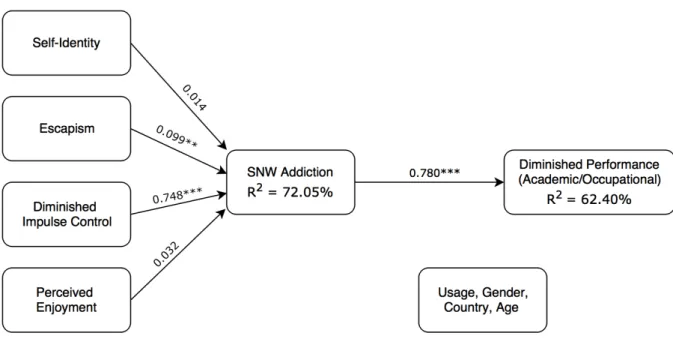
ODELThe structural model was evaluated using the level of significance of the path coefficients and R2 measures. The model results for the full sample (USA and Portugal) are shown in Figure 2. The con-ceptual model explain 72.1% and 62.4% of the variation in SNW Addiction and Diminished Perfor-mance (Academic/Occupational), respectively. The path coefficient significance was evaluated through a bootstrapping method (Hair et al., 2011; Henseler et al., 2009), with 5000 resamplings(Chin, 1998). Figure 2 also includes t-value results and path coefficients.
Note: * Significant at 0.1; ** Significant at 0.05; *** Significant at 0.01
Figure 2 - Structural Model (full sample)
This study found that Self-Identity ( =0.014; p>0.10) and Perceived Enjoyment ( =0.034; p>0.10) were not statistically significant. Therefore, hypotheses H1 and H4 were not supported. Escapism ( =0.099; p<0.05) and Diminished Impulse Control ( =0.748; p <0.01) were found to be statistically significant. Therefore, hypotheses H2 and H3 were supported. Regarding the Diminished Performanc, SNW Addiction had a statistically significant ( =0.780); p<0.01) and positive path to explain Dimin-ished Performance (Academic/Occupational). Hypothesis H5 was therefore supported.
15
Independent
variables
USA (n=247)
Europe (n=204)
Hypothesis Path Coeff. T-values
R
2Path Coeff. T-values
R
2SNW Adiction 75.3% 67.9%
Self-Identity H1 -0.058 1.356 0.113 1.944*
Escapism H2 0.136 2.434** 0.053 1.022
Diminished
Impulse Control H3 0.772 17.564*** 0.718 15.488***
Perceived
Enjoyment H4 0.033 0.764 0.018 0.389
Diminished Performance 68.1% 55.6%
SNW Addiction H5 0.846 29.426*** 0.705 16.653***
16
6.
DISCUSSION
6.1.
T
HEORETICAL CONTRIBUTIONSTheoretically, this study suggests that SNW Addiction has a significant predictive power of Dimin-ished Performance (Academic/Occupational). While not all of the constructs were supported (name-ly, Perceived Enjoyment), this study accounts for 72.05% (R2) of SNW Addiction variance. Turel and Serenko (2012) explained the duality of high engagement with a SNW - how high engagement or habit potentially creates a bad habit or pathological addiction. Furthermore, this study also accounts for 62.40% (R2) of Diminished Performance (Academic/Occupational), a step forward that Turel et al. (2012) suggested for future research - some insight into the academic and/or occupational outcomes of SNW Addiction.
This study also contributes to the conversation about SNW use at school and/or work and the possi-ble outcomes related to the performance of the user. While previous literature explained the poten-tial consequences of Problematic Internet Use (PIU) in academic and/or occupational settings, re-search for newer technological activities such as SNW was found lacking. Given the staggering num-bers of SNW users, this study provided some supporting evidence to help fill the gap between SNW Addiction and a user’s academic and/or occupational performance outcomes.
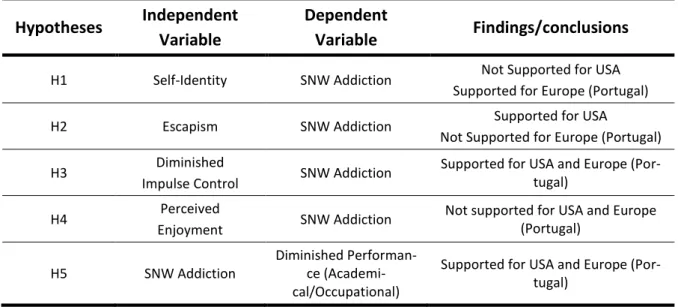
The results of this study indicated that Perceived Enjoyment was not statistically significant for either country in explaining SNW Addiction. This suggests that this study’s respondents might not perceive SNW platforms as being fun or pleasurable to use. The constructs that differed in significance and support between USA and Portugal respondents (Escapism and Self-Identity) could give some insight into the cultural differences between the two. The supported hypothesis results (found in Table 6) show which constructs (Diminished Impulse Control and Escapism) influence SNW Addiction for USA and that there is statistical significance between SNW Addiction and one’s academic and/or occup a-tional performance fr both regions USA and Europe (Portugal).
Hypotheses
Independent
Variable
Dependent
Variable
Findings/conclusions
H1 Self-Identity SNW Addiction Not Supported for USA
Supported for Europe (Portugal)
H2 Escapism SNW Addiction Supported for USA
Not Supported for Europe (Portugal)
H3 Diminished
Impulse Control SNW Addiction
Supported for USA and Europe (Por-tugal)
H4 Perceived
Enjoyment SNW Addiction
Not supported for USA and Europe (Portugal)
H5 SNW Addiction
Diminished Performan-ce (Academi-cal/Occupational)
Supported for USA and Europe (Por-tugal)
17
6.2.
P
RACTICALI
MPLICATIONSNowadays, most modern jobs require the use of a computer/Internet connected device and an In-ternet connection. At the same time, students have become completely reliable on computers and the Internet for academic research. This alone does not imply that either group is using SNWs at the same level, however it does provide the fundamentals necessary for SNW use: a device and an Inter-net connection. Managers and professors should understand how SNWs are a habitual part of most Millennial users’ lives and how that may take away from academic and/or occupational activities. Cyberslacking (Bock & Ho, 2009; Mastrangelo et al., 2006; Vitak et al., 2011) has long been a term used to describe procrastination due to the general use of the Internet. This study, however, demon-strates that the use of SNWs, as a sole activity, should be taken into consideration when striving for optimum performance at work or school.
Considering that the two highest predictors of SNW Addiction were Diminished Impulse Control for both regions, and Escapism for USA, and Self-Identity for Europe (Portugal), some occupational relat-ed insights can be formrelat-ed: (i) managers should take measures to control the usage of SNW platforms at the workplace; (ii) improving the workplace morale could reduce one’s need “to escape”; (iii) proving the dynamics between employees to encourage sharing of knowledge could reduce the im-pulse to excessively use SNWs. Information Systems such as Accenture’s One Global Network (Barfield, 2011) or Slack (Rosenberg, 2015), a renowned messaging service for use within the compa-ny, are innovative ways to introduce collaboration and sharing within the organization. This type of business software is a new outlook on the traditional IS and makes the exchange between employees smoother and, in the end, more rewarding. Integrating programs like this while also limiting the ac-cess to SNWs could reduce one’s Diminished Impulse Control, Escapism, and Self-Identity, and thus, SNW Addiction, ultimately, increasing the academic and/or occupational performance.
The results of this study are a fair representation of the respondents who are students or employees. Therefore, the practical implications for schools and professors also indicate that SNW access should be regulated in order to reduce the Diminished Impulse Control, Escapism, and Self-Identity con-structs that the users of this study demonstrate. However, the practical results of such regulation may be limited and should be further investigated.
6.3.
L
IMITATIONS ANDF
UTURER
ESEARCHThere are some noteworthy limitations that should be addressed. For one, the existence of an addic-tion with technology is still disputed amongst the medical community (Block, 2008). However, the results of this study do provide additional basis for this psychological disorder regardless of using the debatable terminology (addiction). Conversely, future studies could introduce new or different con-structs to the model to achieve more holistic results. While the study aimed to focus on the Millenni-al generation for its relevance to the timeline of SNW development, other generations could Millenni-also be investigated.
18 surveyed both students and employees. The habits of the two groups individually were not tested; this is another area that could be further discussed.
Furthermore, an important limitation is within the Diminished Impulse Control construct. This con-struct has been used as an characteristic resulting of PIU (Davis et al., 2002). However, Diminished Impulse Control is seen as a “double-edged sword” as it can also be a factor that leads to increased SNW use, in this case. The lack of supporting research for the duality of Diminished Impulse Control proves to be a limitation as it can contribute to misleading evidence.
19
7.
CONCLUSION
20
8.
BIBLIOGRAPHY
Aboujaoude, E. (2010). Problematic Internet Use: An Overview. World Psychiatry, 9, 85–90.
About LinkedIn. (2015). Retrieved October 1, 2015, from https://press.linkedin.com/about-linkedin About Twitter. (2015). Retrieved October 1, 2015, from https://about.twitter.com/company Amichai-Hamburger, Y., & Vinitzky, G. (2010). Social network use and personality. Computers in
Human Behavior, 26(6), 1289–1295. http://doi.org/10.1016/j.chb.2010.03.018
Andreassen, C. S., Torsheim, T., Brunborg, G. S., & Pallesen, S. (2012). Development of a Facebook Addiction Scale. Psychological Reports, 110(2), 501–17.
http://doi.org/10.2466/02.09.18.PR0.110.2.501-517
Armstrong, L., Phillips, J. G., & Saling, L. L. (2000). Potential determinants of heavier internet usage. International Journal of Human-Computer Studies, 53(4), 537–550.
http://doi.org/10.1006/ijhc.2000.0400
Barfield, T. (2011). Sharing & Collaboration - The Power Behind Accenture’s One Global Network. Retrieved November 18, 2015, from https://www.youtube.com/watch?v=ssZPn1r5O6c Beranuy, M., Oberst, U., Carbonell, X., & Chamarro, A. (2009). Problematic Internet and mobile
phone use and clinical symptoms in college students: The role of emotional intelligence. Computers in Human Behavior, 25(5), 1182–1187. http://doi.org/10.1016/j.chb.2009.03.001 Block, J. J. (2008). Issues for DSM-V: Internet addiction. American Journal of Psychiatry, 165(3), 306–
307. http://doi.org/10.1176/appi.ajp.2007.07101556
Bock, G.-W., & Ho, S. L. (2009). Non-work related computing (NWRC). Communications of the ACM, 52(4), 124. http://doi.org/10.1145/1498765.1498799
Boyd, D. M., & Ellison, N. B. (2008). Social Network Sites: Definition, History, and Scholarship. Journal of Computer-Mediated Communication, 13(1), 210–230.
http://doi.org/10.1111/j.1083-6101.2007.00393.x
Caplan, S. E. (2002). Problematic Internet use and psychosocial well-being: development of a theory-based cognitive–behavioral measurement instrument. Computers in Human Behavior, 18(5), 553–575. http://doi.org/10.1016/S0747-5632(02)00004-3
Celebrating a Community of 400 Million. (2015). Retrieved October 1, 2015, from http://blog.instagram.com/post/129662501137/150922-400million
Chin, W. W. (1998). Issues and Opinion on Structural Equation Modeling. MIS Quarterly, 22(1), 1. http://doi.org/Editorial
Churchill, G. A. (1979). A Paradigm for Developing Better Measures of Marketing Constructs. Journal of Marketing Research, 16(1), 64. http://doi.org/10.2307/3150876
21 Davis, R. A., Flett, G. L., & Besser, A. (2002). Validation of a new scale for measuring problematic
internet use: implications for pre-employment screening. Cyberpsychology & Behavior : The Impact of the Internet, Multimedia and Virtual Reality on Behavior and Society, 5(4), 331–45. Retrieved from http://www.ncbi.nlm.nih.gov/pubmed/12216698
Deal, J. J., Altman, D. G., & Rogelberg, S. G. (2010). Millennials at Work: What We Know and What We Need to Do (If Anything). Journal of Business and Psychology, 25(2), 191–199.
Douglas, A. C., Mills, J. E., Niang, M., Stepchenkova, S., Byun, S., Ruffini, C., … Blanton, M. (2008). Internet addiction: Meta-synthesis of qualitative research for the decade 1996–2006. Computers in Human Behavior, 24(6), 3027–3044. http://doi.org/10.1016/j.chb.2008.05.009 Engelberg, E., & Sjöberg, L. (2004). Internet use, social skills, and adjustment. Cyberpsychology &
Behavior : The Impact of the Internet, Multimedia and Virtual Reality on Behavior and Society,
7(1), 41–7. http://doi.org/10.1089/109493104322820101
Facebook Stats. (2015). Retrieved October 1, 2015, from http://newsroom.fb.com/company-info/ Fornell, C., & Larcker, D. F. (1981). Evaluating Structural Equation Models with Unobservable
Variables and Measurement Error. Journal of Marketing Research, 18(1), 39. http://doi.org/10.2307/3151312
Fry, R. (2015). Millennials surpass Gen Xers as the largest generation in U.S. labor force. Retrieved October 1, 2015, from http://www.pewresearch.org/fact-tank/2015/05/11/millennials-surpass-gen-xers-as-the-largest-generation-in-u-s-labor-force/
Götz, O., Liehr-Gobbers, K., & Krafft, M. (2010). Evaluation of Structural Equation Models Using the Partial Least Squares (PLS) Approach. In Handbook of Partial Least Squares (pp. 691–711). http://doi.org/10.1007/978-3-540-32827-8_30
Grégoire, Y., & Fisher, R. J. (2006). The effects of relationship quality on customer retaliation. Marketing Letters, 17(1), 31–46. http://doi.org/10.1007/s11002-006-3796-4
Hair, J. F., Ringle, C. M., & Sarstedt, M. (2011). PLS-SEM: Indeed a Silver Bullet. The Journal of
Marketing Theory and Practice, 19(2), 139–152. http://doi.org/10.2753/MTP1069-6679190202 Hair, J. F., Sarstedt, M., Ringle, C. M., & Mena, J. A. (2012). An assessment of the use of partial least
squares structural equation modeling in marketing research. Journal of the Academy of Marketing Science, 40(3), 414–433. http://doi.org/10.1007/s11747-011-0261-6
Henseler, J., Ringle, C. M., & Sinkovics, R. R. (2009). Advances in International Marketing. (J. Henseler, C. M. Ringle, & R. R. Sinkovics, Eds.) (Vol. 20). Bingley: Emerald Group Publishing.
http://doi.org/10.1108/S1474-7979(2009)0000020014
Iacovelli, A., & Valenti, S. (2009). Internet addiction’s effect on likeability and rapport. Computers in Human Behavior, 25(2), 439–443. http://doi.org/10.1016/j.chb.2008.10.006
Internet World Stats. (2015). Retrieved September 15, 2015, from http://www.internetworldstats.com/stats.htm
22 use: the relationship between Internet use and psychological well-being. Cyberpsychology &
Behavior : The Impact of the Internet, Multimedia and Virtual Reality on Behavior and Society,
12(4), 451–5. http://doi.org/10.1089/cpb.2008.0327
Kuss, D. J., & Griffiths, M. D. (2011). Online social networking and addiction--a review of the psychological literature. International Journal of Environmental Research and Public Health, 8(9), 3528–52. http://doi.org/10.3390/ijerph8093528
Lavoie, J. A. A., & Pychyl, T. A. (2001). Cyberslacking and the Procrastination Superhighway: A Web-Based Survey of Online Procrastination, Attitudes, and Emotion. Social Science Computer Review, 19(4), 431–444. http://doi.org/10.1177/089443930101900403
Leonard, L. N. K., & Riemenschneider, C. K. (2013). The Web: Testing Impact on Individual Productivity of Users. Journal of Internet Commerce, 12(3), 247–267.
http://doi.org/10.1080/15332861.2013.859037 Mander, J. (2015). GWI Social. Retrieved from
http://www.globalwebindex.net/hubfs/Reports/GWI_Social_Report_-_Q3_2015_Summary.pdf?t=1447696064551&utm_campaign=Insight+Reports&utm_source=hs
_automation&utm_medium=email&utm_content=22078263&_hsenc=p2ANqtz--YdnA5HqmJLS3NwBxBwjAoGGd0YR89I5plsoDRyPXyOJIEU9
Mastrangelo, P. M., Everton, W., & Jolton, J. A. (2006). Personal use of work computers: distraction versus destruction. Cyberpsychology & Behavior : The Impact of the Internet, Multimedia and Virtual Reality on Behavior and Society, 9(6), 730–41. http://doi.org/10.1089/cpb.2006.9.730 Millennials in Adulthood: Detached from Institutions, Networked with Friends. (2014). Retrieved from
http://www.pewsocialtrends.org/2014/03/07/millennials-in-adulthood/
Myers, K. K., & Sadaghiani, K. (2010). Millennials in the Workplace: A Communication Perspective on Millennials’ Organizational Relationships and Performance. Journal of Business and Psychology, 25(2), 225–238. http://doi.org/10.1007/s10869-010-9172-7
Nadkarni, A., & Hofmann, S. G. (2012). Why Do People Use Facebook? Personality and Individual Differences, 52(3), 243–249. http://doi.org/10.1016/j.paid.2011.11.007
Panicker, J., & Sachdev, R. (2014). Relations Among Loneliness , Depression , Anxiety , Stress and Problematic Internet Use, 2(9), 1–10.
Pelling, E. L., & White, K. M. (2009). The theory of planned behavior applied to young people’s use of social networking Web sites. Cyberpsychology & Behavior : The Impact of the Internet,
Multimedia and Virtual Reality on Behavior and Society, 12(6), 755–9. http://doi.org/10.1089/cpb.2009.0109
Pies, R. (2009). Should DSM-V Designate “Internet Addiction” a Mental Disorder? Psychiatry, 6. Podsakoff, P. M., MacKenzie, S. B., Lee, J.-Y., & Podsakoff, N. P. (2003). Common method biases in
23 Raykov, T. (2007). Reliability if deleted, not “alpha if deleted”: Evaluation of scale reliability following
component deletion. British Journal of Mathematical and Statistical Psychology, 60(2), 201– 216. http://doi.org/10.1348/000711006X115954
Ringle, C. M., Wende, S., & Will, A. (2005). SmartPLS 2.0. Retrieved from http://www.smartpls.de Rosenberg, S. (2015). Shut Down Your Office. You Now Work in Slack. Retrieved November 21, 2015,
from https://medium.com/backchannel/shut-down-your-office-you-now-work-in-slack-fa83cb7cce6c#.7fhu6hwch
Ross, C., Orr, E. S., Sisic, M., Arseneault, J. M., Simmering, M. G., & Orr, R. R. (2009). Personality and motivations associated with Facebook use. Computers in Human Behavior, 25(2), 578–586. http://doi.org/10.1016/j.chb.2008.12.024
Ryans, A. B. (1974). Estimating consumer preferences for a new durable brand in an established product class. Journal of Marketing Research, XI(November), 434–443.
http://doi.org/10.2307/3151290
Social Media Site Usage 2014. (2014). Retrieved September 11, 2015, from http://www.pewinternet.org/2015/01/09/social-media-update-2014/ Social Networking Fact Sheet. (2014). Retrieved September 15, 2015, from
http://www.pewinternet.org/fact-sheets/social-networking-fact-sheet/ State of the Media: The Social Media Report. (2012). Retrieved from
http://www.nielsen.com/us/en/insights/reports/2012/state-of-the-media-the-social-media-report-2012.html
Straub, D. W. (1989). Validating Instruments in MIS Research. MIS Quarterly, 13(2), 147. http://doi.org/10.2307/248922
Tamir, D. I., & Mitchell, J. P. (2012). Disclosing information about the self is intrinsically rewarding. Proceedings of the National Academy of Sciences of the United States of America, 109(21), 8038–43. http://doi.org/10.1073/pnas.1202129109
Tao, R., Huang, X., Wang, J., Zhang, H., Zhang, Y., & Li, M. (2010). Proposed diagnostic criteria for internet addiction. Addiction (Abingdon, England), 105(3), 556–64.
http://doi.org/10.1111/j.1360-0443.2009.02828.x
Tobin, S. J., Vanman, E. J., Verreynne, M., & Saeri, A. K. (2014). Threats to belonging on Facebook: lurking and ostracism. Social Influence, 1–12. http://doi.org/10.1080/15534510.2014.893924 Turel, O., & Serenko, A. (2012). The benefits and dangers of enjoyment with social networking
websites. European Journal of Information Systems, 21(5), 512–528. http://doi.org/10.1057/ejis.2012.1
Turel, O., Serenko, A., & Giles, P. (2011). Integrating Technology Addiction and Use: An Empirical Investigation of Online Auction Users. MIS Quarterly, 35.
24 http://doi.org/10.1016/j.chb.2011.03.002
Werts, C. E., Linn, R. L., & Joreskog, K. G. (1974). Intraclass Reliability Estimates: Testing Structural Assumptions. Educational and Psychological Measurement, 34(1), 25–33.
http://doi.org/10.1177/001316447403400104
Wilson, K., Fornasier, S., & White, K. M. (2010). Psychological predictors of young adults’ use of social networking sites. Cyberpsychology, Behavior and Social Networking, 13(2), 173–7. Retrieved from http://www.ncbi.nlm.nih.gov/pubmed/20528274
Xu, Z., Turel, O., & Yuan, Y. (2011). Online game addiction among adolescents: motivation and prevention factors. European Journal of Information Systems, 21(3), 321–340.
http://doi.org/10.1057/ejis.2011.56
Yellowlees, P. M., & Marks, S. (2007). Problematic Internet use or Internet addiction? Computers in Human Behavior, 23(3), 1447–1453. http://doi.org/10.1016/j.chb.2005.05.004
Young, K. S. (1998). Internet Addiction: The Emergence of a New Clinical Disorder. CyberPsychology & Behavior, 1(3), 237–244. http://doi.org/10.1089/cpb.1998.1.237
Young, K. S. (1999). Internet Addiction: Symptoms, Evaluation, And Treatment. Innovations in Clinical Practice, 17.
Young, K. S. (2009). Internet Addiction: Diagnosis and Treatment Considerations. Journal of Contemporary Psychotherapy, 39(4), 241–246. http://doi.org/10.1007/s10879-009-9120-x Young, K. S., & Rogers, R. C. (1998). The Relationship Between Depression and Internet Addiction.
CyberPsychology & Behavior, 1(1), 25–28. http://doi.org/10.1089/cpb.1998.1.25
1
9.
APPENDIX
Construct
Items
Source
Self-Identity (SI)
To engage in Social Networking Websites is an important part of who I am. SI1
(Pelling & White, 2009) I would feel at a loss if I were forced to give up Social Networking Websites. SI2
I am the type of person who uses Social Networking Websites. SI3
Escapism (E)
I usually go on Social Networking Websites so I can avoid thinking about some of real-life problems or worries. ESC1
(Xu et al., 2011) I usually go on Social Networking Websites in order to relax from the day's work or study stress. ESC2
I often use Social Networking Websites to escape from real world problems. ESC3
I often use Social Networking Websites to alleviate my depression. ESC4
Diminished Impulse Control (DIM)
When I am not on Social Networking Websites, I often think about it. DIM1
"Online Cognition
Scale” (OCS) (Davis et al., 2002)
The offline world is less exciting than what you can do online.* DIM2
I can't stop thinking about Social Networking Websites.* DIM3
Even though there are times when I would like to, I can't cut down on my use of Social Networking Websites DIM4
My use of Social Networking Websites sometimes seems beyond my control. DIM5
Perceived Enjoyment (PE)
Using Social Networking Websites is enjoyable. PE1
(Turel & Serenko, 2012)
Using Social Networking Websites is pleasurable. PE2
Using Social Networking Websites is fun. PE3
Using Social Networking Websites is exciting. PE4
Using Social Networking Websites is interesting. PE5
Addiction (A)
I sometimes neglect important things because of my interest in Social Networking Websites A1
(Turel & Serenko, 2012) My work/school life has sometimes suffered because of me interacting with Social Networking Websites A2
Using Social Networking Websites sometimes interfered with other activities. A3
When I am not using Social Networking Websites, I often feel agitated. A4
2
Construct
Items
Source
Diminished Performance (Work/School)
How often do you neglect schoolwork or work to spend more time online? P1
"Internet Addiction
Test” (IAT)
(K. S. Young, 1998) How often does your schoolwork or work performance suffer because of the amount of time you spend
online? P2
How often does your job performance or productivity suffer because of Social Networking Websites? P3
How often do you find yourself saying ‘‘just a few more minutes” when online? P4