online | memorias.ioc.fiocruz.br
Immunoregulation in human malaria:
the challenge of understanding asymptomatic infection
Vitor R de Mendonça1, Manoel Barral-Netto1,2/+
1Fundação Oswaldo Cruz, Centro de Pesquisas Gonçalo Moniz, Salvador, BA, Brasil 2Universidade Federal da Bahia, Faculdade de Medicina, Salvador, BA, Brasil
Asymptomatic Plasmodium infection carriers represent a major threat to malaria control worldwide as they are silent natural reservoirs and do not seek medical care. There are no standard criteria for asymptomatic Plasmo-diuminfection; therefore, its diagnosis relies on the presence of the parasite during a specific period of symptomless infection. The antiparasitic immune response can result in reduced Plasmodium sp. load with control of disease manifestations, which leads to asymptomatic infection. Both the innate and adaptive immune responses seem to play major roles in asymptomatic Plasmodiuminfection; T regulatory cell activity (through the production of
interleu-kin-10 and transforming growth factor-β) and B-cells (with a broad antibody response) both play prominent roles. Furthermore, molecules involved in the haem detoxification pathway (such as haptoglobin and haeme oxygenase-1) and iron metabolism (ferritin and activated c-Jun N-terminal kinase) have emerged in recent years as potential bio -markers and thus are helping to unravel the immune response underlying asymptomatic Plasmodiuminfection. The
acquisition of large data sets and the use of robust statistical tools, including network analysis, associated with well-designed malaria studies will likely help elucidate the immune mechanisms responsible for asymptomatic infection.
Key words: asymptomatic infection - immune response - biomarkers - networks
doi: 10.1590/0074-02760150241
Financial support: FIOCRUZ (407734/2012-0), CNPq (478527/2013-6) MB-N is a senior investigator from CNPq.
+ Corresponding author: [email protected] Received 29 June 2015
Accepted 23 October 2015
It is estimated that two-three billion people are at risk of contracting malaria, and nearly one million people die from this disease each year (WHO 2014). The spectrum of malarial disease can range from severe complications to a mild symptomatic infection to an asymptomatic car-rier infection. Such distinct manifestations result from a combination of factors, including parasite virulence, host susceptibility, host immune response, disease toler-ance mechanisms, and environmental factors (Andrade & Barral-Netto 2011, Medzhitov et al. 2012).
Although there is no standard definition of asymp-tomatic plasmodial infection (API), individuals with API harbour the parasite as evidenced by positive para-sitaemia. However, these individuals do not develop any symptoms during a defined period of time (Andrade & Barral-Netto 2011, Lindblade et al. 2013). API is an sig-nificant obstacle to malaria eradication efforts and rep-resents a serious healthcare problem for the following reasons: (i) serve as parasite reservoirs, which allow ma-larial disease to be maintained within a population over time as they can still transmit Plasmodium sp. to unin-fected persons (Gouagna et al. 2004, Alves et al. 2005, Schneider et al. 2007, White 2008), (ii) asymptomatic carriers represent a serious risk to blood bank safety as
API carriers can transmit malaria through blood trans-fusions (Najem & Sulzer 2003, Fugikaha et al. 2007, Scuracchio et al. 2011, Anthony et al. 2013, Brouwer et al. 2013), and (iii) human immunodeficiency virus (HIV)-infected individuals with API sometimes exhibit increased viral load, which may enhance HIV transmis-sion and accelerate disease progrestransmis-sion and severity in endemic countries (Verhoeff et al. 1999, Whitworth et al. 2000, French et al. 2001, Kublin et al. 2005).
API can be attributed to several factors, including differences among Plasmodium sp. and host protective mechanisms. API is frequently associated with older people living in endemic areas as they are likely to have greater exposure to malaria and its vector in endemic set-tings over time, thus acquiring a partial immunity (An-drade et al. 2009, Ladeia-An(An-drade et al. 2009, Mendonça et al. 2013). In the same context, individuals who have had several previous episodes of symptomatic malaria are more likely to become asymptomatic carriers upon Plasmodium sp. infection (Andrade et al. 2009, Barbosa et al. 2014). Therefore, the immune response underlying asymptomatic infection still needs to be elucidated.
to reduce levels of parasitaemia; this phenomenon is de-scribed as disease tolerance (Medzhitov et al. 2012).
Immunity to malaria does not necessarily prevent infection; however, it does limit parasite density and symptoms (Tran et al. 2013). API individuals can remain infected for long periods even though asymptomatic subjects can develop symptomatic disease if they have a dysregulated immune response (Barbosa et al. 2014). Several studies have reported very low parasitaemia in individuals with API (Perkins et al. 2005, Minigo et al. 2009, Andrade et al. 2010b, Villasis et al. 2012), and many of them exhibited subpatent infections (i.e., infec-tions undetected by microscopy) (Barbosa et al. 2014). Asymptomatic carriers who are not diagnosed with con-ventional malaria are a major challenge for malaria erad-ication in low-endemicity settings (Bousema et al. 2014). Taken together, these data illustrate the interaction be-tween malarial immunity, parasitaemia, exposure, and malaria outcomes in endemic areas (Fig. 1).
The immune system seems to play a major role in malaria outcomes, and our object herein is to uncover the partial protective immune response to infection in API to unravel the mechanisms of disease resistance. Here, we review both innate and adaptive immune responses to Plasmodium infection as well as new approaches to understand API immunity.
Although not the main focus of this review, it is im-portant to highlight that pathogen-related infections can modulate the immune response of individuals with ma-laria. In this context, asymptomatic infections have been reported to be composed of multiple genetically distinct Plasmodium sp. clones; multiclonal infections may be a marker of immunity and confer protection against ma-laria by inducing a broader immune response and toler-ance to infection (Ntoumi et al. 1995, Felger et al. 1999, Smith et al. 1999, Rono et al. 2013). Regarding others pathogens, hepatitis B co-infection has been associated with Plasmodium vivax asymptomatic infection and may also boost the protective immune response (Andrade et al. 2011). Additionally, individuals co-infected with P. vivax and hepatitis B virus (HBV) have an increased HBV viraemia yet a decreased malaria parasitaemia (Andrade et al. 2011). These patients also have lower lev-els of pro-inflammatory tumour necrosis factor (TNF) and a lower interferon (IFN)-γ/interleukin (IL)-10 ratio with higher levels of regulatory IL-10 (Andrade et al. 2011). Pre-existent filarial infection also seems to atten-uate immune responses associated with severe Plasmo-dium falciparum malaria and protects against anaemia (Dolo et al. 2012). Co-infections with Ascaris lumbricoi -des or Schistosoma hematobium exhibit a trend towards a protective effect, whereas infections with hookworm or Schistosoma mansoni lead to aggravation of pathol-ogy and a higher incidence of malaria (Adegnika & Kremsner 2012, Lemaitre et al. 2014).
Haemoglobinopathies, including haemoglobin S (HbS), haemoglobin C (HbC), and α-thalassaemia, have been associated with protection from malaria (Mendonça et al. 2012a). API children with HbS and persistently posi-tive smears exhibit a reduced median time for conversion to smear-negative responses (spontaneous clearance) than
do children without the haemoglobinopathy (Billo et al. 2012). Mechanisms by which haemoglobinopathies may attenuate the pathogenesis of malaria caused by P. falci-parum include modulation of the inflammatory response and enhancement of cell-mediated and humoural immune responses through pathways that may include haeme oxy-genase-1 (HO-1), reduced levels of cerebral chemokines, increased levels of nitric oxide, and higher IgG seroreac-tivity to P. falciparum antigens (Taylor et al. 2013). Other host erythrocyte polymorphisms also seem to influence the susceptibility to malaria. It has been demonstrated that α+-thalassaemia (Oppenheimer et al. 1984, Enevold et al. 2007), southeast Asian ovalocytosis (Cattani et al. 1987, Foo et al. 1992), glucose-6-phosphate dehydroge-nase (Mombo et al. 2003), and blood group O polymor-phisms (Facer & Brown 1979, Martin et al. 1979, Shimizu et al. 2005) are associated with protection from malaria by reducing parasitic densities.
Innate immunity
tigen-specific IgGs was extracellular and indicated a key role for CD32/FcγRII; however, the production of ROS in response to whole merozoites was almost completely within the cell, suggesting that the underlying mecha-nism was phagocytosis (Kapelski et al. 2014). The innate response to infected red blood cells (RBC) is also related to the functional activity of monocytes (MO) through their phagocytic activity, parasite killing through anti-body-dependent cellular inhibition (ADCI), and supply-ing of peripheral tissues with macrophage and dendritic cells (DCs) (Chimma et al. 2009). Further, individuals with the CD14hiCCR2+CX3CR1+ MO subset and the
highest mean levels of ADCI activity had lower blood parasitaemia levels, suggesting an antiparasitic activity associated with protection against malaria (Chimma et al. 2009). The induction and maintenance of B and T-cell responses requires functional DCs; these cells also have an important role in malaria immunity, and it was re-cently described that DCs from individuals with asymp-tomatic Plasmodium infection have higher expression of human leukocyte antigen-DR, which is required for an-tigen presentation (Kho et al. 2015). In a similar manner in a rodent model, DCs from nonlethal infections were fully functional and capable of secreting cytokines and stimulating T-cells compared to DCs from lethal infec-tions, suggesting a major role for this cell in disease out-come and immunity (Wykes et al. 2007). Cells of the innate immune response are the first line of human de-fence against pathogens and may be important in control of the parasitaemia underlying cases of API.
Adaptive immunity
The innate immune system also helps direct the re-sponse of adaptive immune cells (B and T-cells) in rec-ognising and binding diverse antigens through a reper-toire of cell surface receptors (Palm & Medzhitov 2009). It has been demonstrated that CD4+ and CD8+ T-cells
are important for malarial immunity in humans as well as in mouse models (Nussenzweig et al. 1967, Clyde et al. 1973, Schofield et al. 1987, Romero et al. 1989, Ro-drigues et al. 1993, Tsuji et al. 1998, Hoffman & Dool-an 2000, Stephens et al. 2005, Overstreet et al. 2008, Schmidt et al. 2008, Roestenberg et al. 2009, 2011, Ste-phens & Langhorne 2010, Friesen et al. 2010). In a clini-cal trial of the RTS,S/AS01E antimalarial vaccine, CD4+
T-cell production of TNF, with or without IFN-γ, was a potential immunologic correlate of protection against disease in individuals from an endemic area (Olotu et al. 2011). CD4+ cells from individuals with fewer previous
episodes of malaria were more inflammatory and had greater TNF production, whereas responses from CD4+
T-cells from subjects with more frequent previous epi-sodes of malaria were more typical of regulatory T-cells in that they produced IL-10 (Jagannathan et al. 2014). In this report, the absence of pro-inflammatory CD4+
T-cells producing TNF was associated with asymptomatic infection (Jagannathan et al. 2014). Thus, it suggests that IL-10 production by T-helper 1 T-cells may help prevent immunopathology by dampening the pro-inflammatory response (TNF) and preventing the development of clin-ical disease (Jagannathan et al. 2014).
T regulatory (Treg) cells (CD4+CD25+FOXP3+)
ap-pear to mediate their effects by direct cell contact or by induction of the regulatory cytokines IL-10 or transform-ing growth factor (TGF)-β (Thornton & Shevach 2000, Powrie et al. 2003). Treg cells are induced following P. falciparum and P. vivax infection and are associated with a burst of TGF-β production and decreased pro-inflammatory cytokine production (Walther et al. 2005, Gonçalves et al. 2010). Nevertheless, exposed asymptom-atic controls (with or without parasitaemia) in a malaria-endemic region of Indonesia had a lower frequency of Treg cells (CD4+CD25+Foxp3+CD127lo) than did patients
with uncomplicated and severe malaria, suggesting a role for Treg reduction in malaria protection (Minigo et al. 2009). Intriguingly, increased expression of TNFRII, a marker of Treg activation, was found in Treg cells from API subjects when compared with uninfected individu-als, a feature that might be important for survival of the parasites in asymptomatic carriers; however, TNFRII expression was not measured in patients with mild or se-vere malaria (Wammes et al. 2013). Congolese children with asymptomatic infection have a higher prevalence of polymorphisms in regulatory genes (STAT6 and IL10RA), which may influence Treg cells and malaria protection (Koukouikila-Koussounda et al. 2013).
protein-1, P. falciparum merozoite protein (C-terminal 10 kD), P. falciparum CLAG 9 (composed of 3 subunits named RhopH1, RhopH2, and RhopH3), and malaria-infected erythrocyte variant surface antigens, includ-ing P. falciparum erythrocyte membrane protein 1, P. falciparum merozoite surface protein 1 3D7 (MSP142), P. falciparum VarO rosetting variant, and P. falciparum erythrocyte binding-like and reticulocyte binding-like proteins (Alifrangis et al. 1999, Braga et al. 2002, Ab-del-Latif et al. 2003, Kinyanjui et al. 2004, Villasis et al. 2012, Costa et al. 2013, Moormann et al. 2013, Sagna et al. 2013). Further, high antibody levels against glyco-sylphosphatidylinositols, the anchor molecules of some membrane proteins of Plasmodium species, is also ob-served more frequently in children with asymptomatic infections than in children with symptomatic infections in The Gambia (de Souza et al. 2002). Asymptomatic malaria carriers were also associated with high antibody levels against human brain antigens and Escherichia coli proteins as a result of polyclonal immunoglobin reactivity (Fesel et al. 2005). Furthermore, our group described that higher titre of IgG antibody against Anopheles darlingi mosquito saliva is also associated with immunity in as-ymptomatic P. vivax individuals from the Brazilian Ama-zon Region as a result of higher exposure to the malaria vector (Andrade et al. 2009). The intense production of antibodies in asymptomatic malaria carriers represents an active immune response and highlights the role of the hu-moural immune response in mediating disease resistance.
Biomarkers
A biomarker is any parameter that can be used as an indicator of a particular disease state or other physiological state and can be generally classified as either biomarkers for diagnosis or for disease severity (Andrade & Barral-Netto 2011). In the context of API, biomarkers can help investigators understand disease pathology by measur-ing important parameters in various immune pathways and may also be useful as markers of prognosis in either clinical or silent infection after Plasmodium sp. exposure (Laishram et al. 2012). In recent years, our group and oth-ers have been searching for human genetic factors and plasma measures related to the immune response associ-ated with asymptomatic infection. However, none of these factors was sufficiently powerful to be a prognostic surro-gate marker of clinical protection or disease susceptibility (Andrade & Barral-Netto 2011, Mendonça et al. 2012b).
Laboratory measures are commonly used in medical practice as organ dysfunction parameters; individuals with asymptomatic P. vivax malaria have lower levels of aspartate aminotransferase (AST), alanine aminotrans-ferase (ALT), indirect bilirubin, and serum creatinine as well as higher levels of Hb than do individuals with mild or severe symptomatic P. vivax malaria (Andrade et al. 2010b). TNF is a pro-inflammatory cytokine that has attracted special interest because of its ambiguous activ-ity in host defence and in the pathogenesis of cerebral malaria and other severe complications (Kwiatkowski 2000). An increased TNF concentration is associated with symptoms of mild malarial pathogenesis (i.e., fever) as well as severe forms of infection, such as cerebral
ma-laria (Kwiatkowski et al. 1990, Karunaweera et al. 1992). However, TNF-α has also been associated with the pres-ence of potent antiparasitic activity as persistently ele-vated levels of this cytokine lead to rapid improvement of fever and reduction of parasitaemia (Mordmüller et al. 1997, Depinay et al. 2011). It is also noteworthy that patients with asymptomatic P. vivax malaria have lower levels of pro-inflammatory TNF and IFN-γ and higher levels of IL-10, a trend which is proportional to disease severity (asymptomatic, mild, and severe) and which may explain the immunological control of clinical disease. However, parasite burden control may involve a more complex host response in addition to the moderation of TNF levels (Andrade et al. 2010b, Mendonça et al. 2013). In another setting in the Brazilian Amazon, it was found that asymptomatic carriers of low P. vivax parasitaemias also had lower levels of TNF and IFN-γ than did symp -tomatic P. falciparum or P. vivax subjects (Gonçalves et al. 2012). Furthermore, certain combinations of geno-types in inflammatory-related genes (DDX39B, TNF and IL6) are associated with a decreased risk of mild malaria compared to asymptomatic infection by reducing plasma levels of IL-6 and TNF (Mendonça et al. 2014).
The immune and organ dysfunction response during malaria may be a result, at least in part, of the harmful effects of free haem in the human host (Gozzelino et al. 2010). During parasite-induced intravascular haemolysis, great amounts of Hb are liberated; in the presence of su-peroxide and other ROS, Hb releases its haem prosthetic group (Bunn & Jandl 1968, Hebbel et al. 1988, Pamplona et al. 2007, Ferreira et al. 2008). Free haem is a harm-ful molecule and can cause cytotoxicity, inflammation, oxidative stress, and even cell death (Ferreira et al. 2008, Gozzelino & Soares 2011). Free haem levels exhibit a linear increase according to disease severity in asymp-tomatic P. vivax-infected subjects with the lowest haem plasma concentrations (Andrade et al. 2010a). In addi-tion, haem is also elevated with malaria severity by P. fal-ciparum, especially for cerebral malaria and acute renal failure subjects (Dalko et al. 2015). In addition to enhanc-ing pro-inflammatory mechanisms, free haem durenhanc-ing P. vivax malaria also impairs prostaglandin E2 (PGE2) and TGF-β production through superoxide dismutase (SOD)-1-dependent mechanism (Andrade et al. 2010a). SOD-1 is also elevated proportionally with disease severity in malaria patients and is useful for distinguishing mild and asymptomatic P. vivax cases by ROC curve analysis (An-drade et al. 2010c). In addition, asymptomatic carriers have higher concentrations of regulatory cytokines such as TGF-β and PGE2 compared with mild and severe P. vivax patients, and TGF-β and PGE2 are negatively cor -related with SOD-1, which may be an additional defence mechanism against disease manifestation (Andrade et al. 2010a). In P. falciparum malaria, bicyclo-PGE2 is also el-evated in asymptomatic patients compared with patients who have symptomatic disease (Perkins et al. 2005).
complex Hp-Hb is recognised by CD163 on the macro-phage and hepatocyte surfaces in the spleen and liver, respectively (Philippidis et al. 2004, Quaye 2008). Free haem can also be scavenged by haemopexin, albumin, α1-microglobulin, and high and low-density lipoproteins (Bunn & Jandl 1966, Miller & Shaklai 1999, Paoli et al. 1999, Allhorn et al. 2002, Fasano et al. 2007, Tolo-sano et al. 2010). Different Hp phenotypes are known to have different binding affinities for cell-free Hb (Hp1.1>Hp1.2>Hp2.2) and CD163 (Hp2.2>Hp1.2>Hp1.1) (Kristiansen et al. 2001). Our group has reported that individuals with the Hp2 allele are more likely to have symptomatic P. vivax malaria, and this group also has higher levels of Hp when compared with those of pa-tients with asymptomatic infection. This probably repre-sents a compensatory mechanism against the low bind-ing affinity of Hp2 to free Hb (Mendonça et al. 2012b). The Hp2.2 phenotype has also been associated with a higher susceptibility to P. falciparum infection in the Dogon ethnic group living in Mali (Perdijk et al. 2013). Furthermore, soluble CD163 (sCD163) (marker of recep-tor activation) is also lower in asymptomatic patients when compared with that in symptomatic subjects, and a cut-off value of sCD163 may be used to distinguish be-tween symptomatic and disease-free individuals (Men-donça et al. 2012b). In Mali, sCD163 was increased in P. falciparum infected individuals compared to uninfected subjects (Perdijk et al. 2013). Inside the cell, haem is de-graded by HO-1 to produce carbon monoxide (CO), la-bile iron, and biliverdin. In murine models, HO-1 affords protection against cerebral malaria by reducing neuroin-flammation (including CD8+ T-cell brain sequestration),
and exposure to CO may reduce severe complications (Pamplona et al. 2007). HO-1 also seems to be one of the mechanisms by which sickle cell disease confers protec-tion against experimental malaria (Ferreira et al. 2011). HO-1 plasma levels are higher in symptomatic cases (as compared to asymptomatic individuals) as a regulatory defence, and a microsatellite polymorphism (GT)n in HMOX1 regulates the expression of this enzyme (Men-donça et al. 2012b). In addition, high HO-1 levels and this microsatellite polymorphism were associated with severe malaria, including death, in another study (Wal-ther et al. 2012). However, o(Wal-ther studies also have dem-onstrated conflicting results and no association between this HMOX1 microsatellite polymorphism and malaria severity (Kuesap et al. 2010, Hansson et al. 2015).
Iron is produced by haem catabolism and also ob-tained by dietary uptake; this metal is necessary for com-plete Plasmodium development (Gozzelino et al. 2010). However, intracellular labile iron is dangerous because it converts to a free radical unless it is scavenged by fer-ritin, which acts as a vital antioxidant molecule in several experimental models (Balla et al. 1992, Cozzi et al. 2000, Berberat et al. 2003). Ferritin serum levels are decreased and associated with anaemia in a population from the Brazilian Amazon exposed to P. vivax malaria; symp-tomatic individuals from this group infected with P. vivax have lower levels of ferritin, which are directly propor-tional to the hepatic damage score (Cardoso et al. 1994, Gozzelino et al. 2012). It has been reported that ferritin
promotes disease resistance to malaria by preventing la-bile intracellular iron from sustaining pro-apoptotic c-Jun N-terminal kinase activation, and this tolerance requires the expression of HO-1 (Gozzelino et al. 2012). Interest-ingly, malarial tolerance mediated by ferritin production is independent of the parasitaemia rate and represents a host defence strategy to limit the fitness costs of infection irrespective of pathogen burden (Medzhitov et al. 2012).
New approaches to understanding asymptomatic infection
In recent years, large amounts of data have become available as a result of the progress in technological meth-ods, such as multiplex measurements, genome-wide ge-notyping, microarrays, RNAseq, and multicolour flow cytometry (Tran et al. 2012). Genome-wide studies al-lowed the discovery of important loci related to malaria resistance and low parasitaemia. Linkage of asymptomat-ic parasitaemia to 5q31-q33 has been reported in humans (Rihet et al. 1998, Timmann et al. 2007) and, recently, chromosomes 6p21.3 and 17p12 were correlated with re-sistance in individuals from Burkina Faso (Brisebarre et al. 2014). Equally important, the field of engineered hu -moural immunity (with the production of human mono-clonal antibodies) has allowed a better understanding of the malaria immune response by facilitating several labo-ratory methods (i.e., multiparameter flow cytometry).
analysis for placental malaria and malarial anaemia, but none analysed asymptomatic infection (Ong’echa et al. 2011, Sikora et al. 2011). In this context, cohort studies with a large sample size and an extensive bioinformatics approach are highly necessary to better understand the interactions among the immune response pathways as-sociated with asymptomatic infection tolerance.
Concluding remarks
It is noteworthy that API is related to clinical dis-ease tolerance (i.e., absence of symptomatology) but is not associated with immunity and inflammatory tol-erance. Asymptomatic P. vivax infection is an active and acquired state, and it can control parasitaemia and limit organ dysfunction by an as yet poorly understood immune mechanism. Asymptomatic individuals
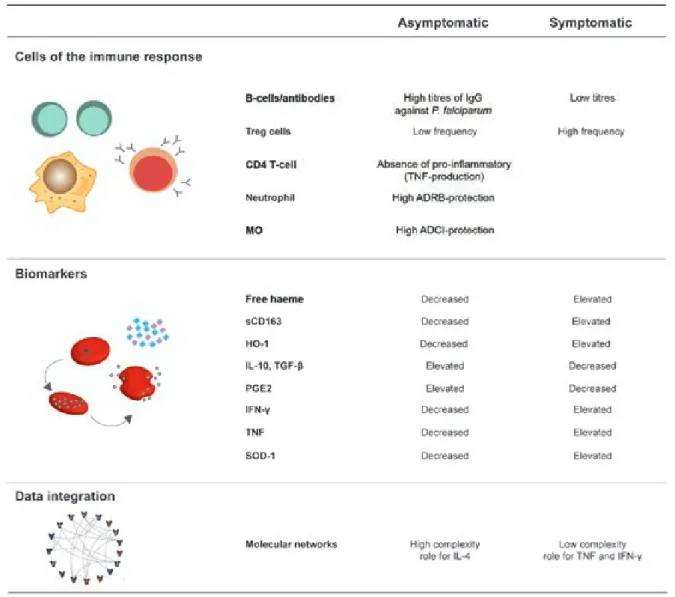
car-rying the parasite are natural reservoirs representing a challenge for malaria eradication, primarily in low and moderate-endemic countries. The use of mass drug ad-ministration or mass screening and treatment schemes is controversial (Tada et al. 2012). Overall, biomarkers related to the haem pathway and iron metabolism have emerged in recent years as potential clues to unravel the immune response of API. Despite this progress, there is no reliable marker of prognosis in API. Immune cells, es-pecially Tregs and B-cells, seem to play an important role in protection from disease manifestation. Furthermore, it has been observed that the immune response in individ-uals with asymptomatic infection is usually associated with a lower pro-inflammatory and a higher regulatory production of biomarkers and host genetic alterations that may contribute to malaria tolerance. Nevertheless, Fig. 2: the immune response underlying asymptomatic infection. Aspects of the immune response of asymptomatic malaria carriers were compared to symptomatic patients. This response was didactically divided into immune cells including T regulatory (Treg) cells, CD4+ T-cells, B-cells,
the acquisition of large-scale biological data along with the use of robust bioinformatics tools, including a net-work approach, will help investigators to understand the immune response behind asymptomatic infection. The major topics described here are summarised in Fig. 2. Longitudinal studies of sequential episodes of malaria in the same individual are necessary to better understand the immune response of individuals with API who are able to clear their parasitaemia compared with those who are more likely to have a symptomatic disease or remain symptomless despite the presence of Plasmodium sp. With this understanding, better medical management of API carriers, the development of malarial vaccines, and strategies for malaria eradication will be facilitated.
REFERENCES
Abdel-Latif MS, Dietz K, Issifou S, Kremsner PG, Klinkert M-Q 2003. Antibodies to Plasmodium falciparum rifin proteins are associated with rapid parasite clearance and asymptomatic infec-tions. Infect Immun 71: 6229-6233.
Adegnika AA, Kremsner PG 2012. Epidemiology of malaria and hel -minth interaction: a review from 2001 to 2011. Curr Opin HIV AIDS7: 221-224.
Alifrangis M, Lemnge MM, Moon R, Theisen M, Bygbjerg I, Rid-ley RG, Jakobsen PH 1999. IgG reactivities against recombinant rhoptry-associated protein-1 (rRAP-1) are associated with mixed Plasmodium infections and protection against disease in Tanza-nian children. Parasitology119: 337-342.
Allhorn M, Berggård T, Nordberg J, Olsson ML, Akerström B 2002. Processing of the lipocalin alpha(1)-microglobulin by hemoglo-bin induces heme-hemoglo-binding and heme-degradation properties. Blood99: 1894-1901.
Alves FP, Gil LHS, Marrelli MT, Ribolla PEM, Camargo EP, da Silva LHP 2005. Asymptomatic carriers of Plasmodium spp as infec-tion source for malaria vector mosquitoes in the Brazilian Ama-zon. J Med Entomol42: 777-779.
Andrade BB, Araújo-Santos T, Luz NF, Khouri R, Bozza MT, Ca-margo LMA, Barral A, Borges VM, Barral-Netto M 2010a. Heme impairs prostaglandin E2 and TGF-beta production by human mononuclear cells via Cu/Zn superoxide dismutase: insight into the pathogenesis of severe malaria. J Immunol185: 1196-1204.
Andrade BB, Barral-Netto M 2011. Biomarkers for susceptibility to infection and disease severity in human malaria. Mem Inst Os-waldo Cruz106 (Suppl. I): 70-78.
Andrade BB, Reis-Filho A, Souza-Neto SM, Clarêncio J, Camargo LMA, Barral A, Barral-Netto M 2010b. Severe Plasmodium vivax malaria exhibits marked inflammatory imbalance. Malar J9: 13.
Andrade BB, Reis-Filho A, Souza-Neto SM, Raffaele-Netto I, Ca-margo LMA, Barral A, Barral-Netto M 2010c. Plasma superox-ide dismutase-1 as a surrogate marker of vivax malaria severity.
PLoS Negl Trop Dis4: e650.
Andrade BB, Rocha BC, Reis-Filho A, Camargo LMA, Tadei WP, Moreira LA, Barral A, Barral-Netto M 2009. Anti-Anopheles dar-lingi saliva antibodies as marker of Plasmodium vivax infection and clinical immunity in the Brazilian Amazon. Malar J8: 121.
Andrade BB, Santos CJN, Camargo LM, Souza-Neto SM, Reis-Filho A, Clarêncio J, Mendonça VRR, Luz NF, Camargo EP, Barral A, Silva AAM, Barral-Netto M 2011. Hepatitis B infection is associ-ated with asymptomatic malaria in the Brazilian Amazon. PLoS One6: e19841.
Anthony CN, Lau Y-L, Sum J-S, Fong M-Y, Ariffin H, Zaw W-L, Jeya-jothi I, Mahmud R 2013. Malaysian child infected with Plasmo-dium vivax via blood transfusion: a case report. Malar J12: 308.
Bachtiar LR, Unsworth CP, Newcomb RD 2013. Application of artificial neural networks on mosquito olfactory receptor neurons for an olfac-tory biosensor. Conf Proc IEEE Eng Med Biol Soc2013: 5390-5393.
Balla G, Jacob HS, Balla J, Rosenberg M, Nath K, Apple F, Eaton JW, Vercellotti GM 1992. Ferritin: a cytoprotective antioxidant strategem of endothelium. J Biol Chem267: 18148-18153.
Barbosa S, Gozze AB, Lima NF, Batista CL, Bastos M da S, Nico-lete VC, Fontoura PS, Gonçalves RM, Viana SAS, Menezes MJ, Scopel KKG, Cavasini CE, Malafronte R dos S, da Silva-Nunes M, Vinetz JM, Castro MC, Ferreira MU 2014. Epidemiology of disappearing Plasmodium vivax malaria: a case study in rural Amazonia. PLoS Negl Trop Dis 8: e3109.
Bejon P, Mwacharo J, Kai O, Mwangi T, Milligan P, Todryk S, Keat-ing S, Lang T, Lowe B, Gikonyo C, Molyneux C, Fegan G, Gilbert SC, Peshu N, Marsh K, Hill AVS 2006. A Phase 2b randomised trial of the candidate malaria vaccines FP9 ME-TRAP and MVA ME-TRAP among children in Kenya. PLoS ClinTrials 1: e29. Berberat PO, Katori M, Kaczmarek E, Anselmo D, Lassman C, Ke B,
Shen X, Busuttil RW, Yamashita K, Csizmadia E, Tyagi S, Ot-terbein LE, Brouard S, Tobiasch E, Bach FH, Kupiec-Weglinski JW, Soares MP 2003. Heavy chain ferritin acts as an antiapop-totic gene that protects livers from ischemia reperfusion injury.
FASEB J 17: 1724-1726.
Billo MA, Johnson ES, Doumbia SO, Poudiougou B, Sagara I, Diawara SI, Diakité M, Diallo M, Doumbo OK, Tounkara A, Rice J, James MA, Krogstad DJ 2012. Sickle cell trait protects against Plasmodi-um falciparPlasmodi-um infection. Am J Epidemiol176 (Suppl.): S175-S185.
Bousema T, Okell L, Felger I, Drakeley C 2014. Asymptomatic ma-laria infections: detectability, transmissibility and public health relevance. Nat Rev Microbiol 12: 833-840.
Braga EM, Barros RM, Reis TA, Fontes CJF, Morais CG, Martins MS, Krettli AU 2002. Association of the IgG response to Plas-modium falciparum merozoite protein (C-terminal 19 kD) with clinical immunity to malaria in the Brazilian Amazon Region.
Am J Trop Med Hyg66: 461-466.
Brisebarre A, Kumulungui B, Sawadogo S, Atkinson A, Garnier S, Fumoux F, Rihet P 2014. A genome scan for Plasmodium falci-parum malaria identifies quantitative trait loci on chromosomes 5q31, 6p21.3, 17p12, and 19p13. Malar J13: 198.
Brouwer EE, van Hellemond JJ, van Genderen PJ, Slot E, van Lieshout L, Visser LG, Wismans PJ 2013. A case report of trans-fusion-transmitted Plasmodium malariae from an asymptomatic non-immune traveller. Malar J12: 439.
Bunn HF, Jandl JH 1966. Exchange of heme among hemoglobin mol-ecules. Proc Natl Acad Sci USA56: 974-978.
Bunn HF, Jandl JH 1968. Exchange of heme among hemoglobins and between hemoglobin and albumin. J Biol Chem 243: 465-475.
Cardoso MA, Ferreira MU, Camargo LM, Szarfarc SC 1994. Anae-mia, iron deficiency and malaria in a rural community in Brazil-ian Amazon. Eur J Clin Nutr48: 326-332.
Cattani JA, Gibson FD, Alpers MP, Crane GG 1987. Hereditary ovalocytosis and reduced susceptibility to malaria in Papua New Guinea. Trans R Soc Trop Med Hyg81: 705-709.
Clyde DF, Most H, McCarthy VC, Vanderberg JP 1973. Immunization of man against sporozite-induced falciparum malaria. Am J Med Sci 266: 169-177.
Cohen S, McGregor IA, Carrington S 1961. Gamma-globulin and ac-quired immunity to human malaria. Nature192: 733-737.
Costa JDN, Zanchi FB, Rodrigues FLS, Honda ER, Katsuragawa TH, Pereira DB, Taborda RLM, Tada MS, Ferreira RGM, Pereira-da-Silva LH 2013. Cross-reactive anti-PfCLAG9 antibodies in the sera of asymptomatic parasite carriers of Plasmodium vivax. Mem Inst Oswaldo Cruz108: 98-105.
Cozzi A, Corsi B, Levi S, Santambrogio P, Albertini A, Arosio P 2000. Overexpression of wild type and mutated human ferritin H-chain in HeLa cells: in vivo role of ferritin ferroxidase activity.
J Biol Chem275: 25122-25129.
da Cunha GB, Luitgards-Moura JF, Naves ELM, Andrade AO, Pereira AA, Milagre ST 2010. Use of an artificial neural network to predict the incidence of malaria in the city of Cantá, state of Roraima. Rev Soc Bras Med Trop43: 567-570.
Dalko E, Das B, Herbert F, Fesel C, Pathak S, Tripathy R, Cazenave P-A, Ravindran B, Sharma S, Pied S 2015. Multifaceted roles of heme during severe Plasmodium falciparum infections in India. Infect Immun83: 3793-3799.
Daubersies P, Sallenave-Sales S, Magne S, Trape JF, Contamin H, Fandeur T, Rogier C, Mercereau-Puijalon O, Druilhe P 1996. Rapid turnover of Plasmodium falciparum populations in asymp-tomatic individuals living in a high transmission area. Am J Trop Med Hyg54: 18-26.
Day KP, Marsh K 1991. Naturally acquired immunity to Plasmodium falciparum. Immunol Today12: A68-71.
de Souza JB, Todd J, Krishegowda G, Gowda DC, Kwiatkowski D, Riley EM 2002. Prevalence and boosting of antibodies to Plas-modium falciparum glycosylphosphatidylinositols and evalu-ation of their associevalu-ation with protection from mild and severe clinical malaria. Infect Immun70: 5045-5051.
Depinay N, Franetich JF, Grüner AC, Mauduit M, Chavatte J-M, Luty AJF, van Gemert G-J, Sauerwein RW, Siksik J-M, Hannoun L, Mazier D, Snounou G, Rénia L 2011. Inhibitory effect of TNF-α on malaria pre-erythrocytic stage development: influence of host hepatocyte/parasite combinations. PLoS One6: e17464.
Dolo H, Coulibaly YI, Dembele B, Konate S, Coulibaly SY, Doumbia SS, Diallo AA, Soumaoro L, Coulibaly ME, Diakite SAS, Guin -do A, Fay MP, Metenou S, Nutman TB, Klion AD 2012. Filaria-sis attenuates anemia and proinflammatory responses associated with clinical malaria: a matched prospective study in children and young adults. PLoS Negl Trop Dis6: e1890.
Dorfman JR, Bejon P, Ndungu FM, Langhorne J, Kortok MM, Lowe BS, Mwangi TW, Williams TN, Marsh K 2005. B-cell memory to 3 Plasmodium falciparum blood-stage antigens in a malaria-endemic area. J Infect Dis191: 1623-1630.
Enevold A, Alifrangis M, Sanchez JJ, Carneiro I, Roper C, Børsting C, Lusingu J, Vestergaard LS, Lemnge MM, Morling N, Riley E, Drakeley CJ 2007. Associations between alpha+-thalassemia and Plasmodium falciparum malarial infection in northeastern Tanzania. J Infect Dis196: 451-459.
Facer CA, Brown J 1979. ABO blood groups and falciparum malaria. Trans R Soc Trop Med Hyg73: 599-600.
Fasano M, Fanali G, Leboffe L, Ascenzi P 2007. Heme binding to albuminoid proteins is the result of recent evolution. IUBMB Life 59: 436-440.
Felger I, Irion A, Steiger S, Beck HP 1999. Genotypes of merozoite surface protein 2 of Plasmodium falciparum in Tanzania. Trans R Soc Trop Med Hyg93 (Suppl. 1): 3-9.
Ferreira A, Balla J, Jeney V, Balla G, Soares MP 2008. A central role for free heme in the pathogenesis of severe malaria: the missing link? J Mol Med (Berl)86: 1097-1111.
Ferreira A, Marguti I, Bechmann I, Jeney V, Chora A, Palha NR, Re-belo S, Henri A, Beuzard Y, Soares MP 2011. Sickle hemoglobin confers tolerance to Plasmodium infection. Cell 145: 398-409.
Fesel C, Goulart LF, Silva Neto A, Coelho A, Fontes CJF, Braga EM, Vaz NM 2005. Increased polyclonal immunoglobulin reactivity toward human and bacterial proteins is associated with clinical protection in human Plasmodium infection. Malar J 4: 5.
Foo LC, Rekhraj V, Chiang GL, Mak JW 1992. Ovalocytosis protects against severe malaria parasitemia in the Malayan aborigines. Am
J Trop Med Hyg47: 271-275.
French N, Nakiyingi J, Lugada E, Watera C, Whitworth JA, Gilks CF 2001. Increasing rates of malarial fever with deteriorating immune status in HIV-1-infected Ugandan adults. AIDS15: 899-906.
Friesen J, Silvie O, Putrianti ED, Hafalla JCR, Matuschewski K, Borrmann S 2010. Natural immunization against malaria: causal prophylaxis with antibiotics. Sci Transl Med 2: 40ra49.
Fugikaha E, Fornazari PA, Penhalbel R de SR, Lorenzetti A, Maroso RD, Amoras JT, Saraiva AS, Silva RU da, Bonini-Domingos CR, Mattos LC de, Rossit ARB, Cavasini CE, Machado RLD 2007. Molecular screening of Plasmodium sp. asymptomatic carriers among transfusion centers from Brazilian Amazon Region. Rev Inst Med Trop Sao Paulo49: 1-4.
Gonçalves RM, Salmazi KC, Santos BAN, Bastos MS, Rocha SC, Bos-cardin SB, Silber AM, Kallás EG, Ferreira MU, Scopel KKG 2010. CD4+CD25+Foxp3+ regulatory T-cells, dendritic cells, and
circu-lating cytokines in uncomplicated malaria: do different parasite species elicit similar host responses? Infect Immun78: 4763-4772.
Gonçalves RM, Scopel KKG, Bastos MS, Ferreira MU 2012. Cy-tokine balance in human malaria: does Plasmodium vivax elic-it more inflammatory responses than Plasmodium falciparum? PLoS One7: e44394.
Gouagna LC, Ferguson HM, Okech BA, Killeen GF, Kabiru EW, Beier JC, Githure JI, Yan G 2004. Plasmodium falciparum malaria disease manifestations in humans and transmission to Anopheles gambiae: a field study in Western Kenya. Parasitology128: 235-243.
Gozzelino R, Andrade BB, Larsen R, Luz NF, Vanoaica L, Seixas E, Coutinho A, Cardoso S, Rebelo S, Poli M, Barral-Netto M, Darshan D, Kühn LC, Soares MP 2012. Metabolic adaptation to tissue iron overload confers tolerance to malaria. Cell Host
Mi-crobe12: 693-704.
Gozzelino R, Jeney V, Soares MP 2010. Mechanisms of cell protection by heme oxygenase-1. Annu Rev Pharmacol Toxicol50: 323-354.
Gozzelino R, Soares MP 2011. Heme sensitization to TNF-mediated programmed cell death. Adv Exp Med Biol 691: 211-219.
Hansson HH, Maretty L, Balle C, Goka BQ, Luzon E, Nkrumah FN, Schousboe ML, Rodrigues OP, Bygbjerg IC, Kurtzhals JAL, Ali-frangis M, Hempel C 2015. Polymorphisms in the haem oxygen-ase-1 promoter are not associated with severity of Plasmodium falciparum malaria in Ghanaian children. Malar J 14: 153.
Hebbel RP, Morgan WT, Eaton JW, Hedlund BE 1988. Accelerated autoxidation and heme loss due to instability of sickle hemoglo-bin. Proc Natl Acad Sci USA85: 237-241.
Hoffman SL, Doolan DL 2000. Malaria vaccines-targeting infected hepatocytes. Nat Med6: 1218-1219.
IL-10 co-producing cells dominate the CD4 response to malaria in highly exposed children. PLoS Pathog10: e1003864.
Jallow M, Teo YY, Small KS, Rockett KA, Deloukas P, Clark TG, Kivinen K, Bojang KA, Conway DJ, Pinder M, Sirugo G, Sisay-Joof F, Usen S, Auburn S, Bumpstead SJ, Campino S, Coffey A, Dunham A, Fry AE, Green A, Gwilliam R, Hunt SE, Inouye M, Jeffreys AE, Mendy A, Palotie A, Potter S, Ragoussis J, Rogers J, Rowlands K, Somaskantharajah E, Whittaker P, Widden C, Don-nelly P, Howie B, Marchini J, Morris A, SanJoaquin M, Achidi EA, Agbenyega T, Allen A, Amodu O, Corran P, Djimde A, Dolo A, Doumbo OK, Drakeley C, Dunstan S, Evans J, Farrar J, Fer-nando D, Hien TT, Horstmann RD, Ibrahim M, Karunaweera N, Kokwaro G, Koram KA, Lemnge M, Makani J, Marsh K, Michon P, Modiano D, Molyneux ME, Mueller I, Parker M, Pe-shu N, Plowe C V, Puijalon O, Reeder J, Reyburn H, Riley EM, Sakuntabhai A, Singhasivanon P, Sirima S, Tall A, Taylor TE, Thera M, Troye-Blomberg M, Williams TN, Wilson M, Kwiat-kowski DP 2009. Genome-wide and fine-resolution association analysis of malaria in West Africa. Nat Genet41: 657-665.
Jayavanth S, Singh M 2003. Artificial neural network analysis of ma-laria severity through aggregation and deformability parameters of erythrocytes. Clin Hemorheol Microcirc29: 457-468.
Joos C, Marrama L, Polson HEJ, Corre S, Diatta A-M, Diouf B, Trape J-F, Tall A, Longacre S, Perraut R 2010. Clinical protection from falciparum malaria correlates with neutrophil respiratory bursts induced by merozoites opsonized with human serum antibodies. PLoS One5: e9871.
Kapelski S, Klockenbring T, Fischer R, Barth S, Fendel R 2014. As-sessment of the neutrophilic antibody-dependent respiratory burst (ADRB) response to Plasmodium falciparum. J Leukoc Biol 96: 1131-1142.
Karunaweera ND, Grau GE, Gamage P, Carter R, Mendis KN 1992. Dynamics of fever and serum levels of tumor necrosis factor are closely associated during clinical paroxysms in Plasmodium vivax malaria. Proc Natl Acad Sci USA89: 3200-3203.
Kho S, Marfurt J, Noviyanti R, Kusuma A, Piera KA, Burdam FH, Kenangalem E, Lampah DA, Engwerda CR, Poespoprodjo JR, Price RN, Anstey NM, Minigo G, Woodberry T 2015. Preserved dendritic cell HLA-DR expression and reduced regulatory T cell activation in asymptomatic Plasmodium falciparum and P. vivax infection. Infect Immun83: 3224-3232.
Kiang R, Adimi F, Soika V, Nigro J, Singhasivanon P, Sirichaisin-thop J, Leemingsawat S, Apiwathnasorn C, Looareesuwan S 2006. Meteorological, environmental remote sensing and neural network analysis of the epidemiology of malaria transmission in Thailand. Geospat Health1: 71-84.
Kinyanjui SM, Mwangi T, Bull PC, Newbold CI, Marsh K 2004. Pro-tection against clinical malaria by heterologous immunoglobulin G antibodies against malaria-infected erythrocyte variant sur-face antigens requires interaction with asymptomatic infections.
J Infect Dis190: 1527-1533.
Koukouikila-Koussounda F, Ntoumi F, Ndounga M, Tong H V, Abena A-A, Velavan TP 2013. Genetic evidence of regulatory gene var-iants of the STAT6, IL10R and FOXP3 locus as a susceptibility factor in uncomplicated malaria and parasitaemia in Congolese children. Malar J12: 9.
Kristiansen M, Graversen JH, Jacobsen C, Sonne O, Hoffman HJ, Law SK, Moestrup SK 2001. Identification of the haemoglobin scavenger receptor. Nature409: 198-201.
Kublin JG, Patnaik P, Jere CS, Miller WC, Hoffman IF, Chimbiya N, Pendame R, Taylor TE, Molyneux ME 2005. Effect of Plas-modium falciparum malaria on concentration of HIV-1-RNA in the blood of adults in rural Malawi: a prospective cohort study. Lancet365: 233-240.
Kuesap J, Hirayama K, Kikuchi M, Ruangweerayut R, Na-Bangchang K 2010. Study on association between genetic polymorphisms of haem oxygenase-1, tumour necrosis factor, cadmium exposure and malaria pathogenicity and severity. Malar J9: 260.
Kwiatkowski D 2000. Genetic susceptibility to malaria getting com-plex. Curr Opin Genet. Dev10: 320-324.
Kwiatkowski D, Hill A V, Sambou I, Twumasi P, Castracane J, Manogue KR, Cerami A, Brewster DR, Greenwood BM 1990. TNF concen-tration in fatal cerebral, non-fatal cerebral, and uncomplicated Plasmodium falciparum malaria. Lancet336: 1201-1204.
Ladeia-Andrade S, Ferreira MU, Carvalho ME de, Curado I, Coura JR 2009. Age-dependent acquisition of protective immunity to malaria in riverine populations of the Amazon Basin of Brazil.
Am J Trop Med Hyg 80: 452-459.
Laishram DD, Sutton PL, Nanda N, Sharma VL, Sobti RC, Carlton JM, Joshi H 2012. The complexities of malaria disease manifes-tations with a focus on asymptomatic malaria. Malar J11: 29.
Lemaitre M, Watier L, Briand V, Garcia A, Hesran JY Le, Cot M 2014. Coinfection with Plasmodium falciparum and
Schistoso-ma haeSchistoso-matobium: additional evidence of the protective effect of schistosomiasis on malaria in Senegalese children. Am J Trop Med Hyg90: 329-334.
Lindblade KA, Steinhardt L, Samuels A, Kachur SP, Slutsker L 2013. The silent threat: asymptomatic parasitemia and malaria trans-mission. Expert Rev Anti Infect Ther11: 623-639.
Martin SK, Miller LH, Hicks CU, David-West A, Ugbode C, Deane M 1979. Frequency of blood group antigens in Nigerian children with falciparum malaria. Trans R Soc Trop. Med Hyg73: 216-218.
Medzhitov R, Schneider DS, Soares MP 2012. Disease tolerance as a defense strategy. Science335: 936-941.
Mendonça VR, Souza LC, Garcia GC, Magalhães BM, Lacerda MV, An-drade BB, Gonçalves MS, Barral-Netto M 2014. DDX39B (BAT1), TNF and IL6 gene polymorphisms and association with clinical out-comes of patients with Plasmodium vivax malaria. Malar J13: 278.
Mendonça VRR de, Goncalves MS, Barral-Netto M 2012a. The host genetic diversity in malaria infection. J Trop Med 2012: 940616.
Mendonça VRR, Luz NF, Santos NJG, Borges VM, Gonçalves MS, Andrade BB, Barral-Netto M 2012b. Association between the haptoglobin and heme oxygenase 1 genetic profiles and soluble CD163 in susceptibility to and severity of human malaria. Infect Immun80: 1445-1454.
Mendonça VRR, Queiroz ATL, Lopes FM, Andrade BB, Barral-Net-to M 2013. Networking the host immune response in Plasmodium vivax malaria. Malar J12: 69.
Milet J, Nuel G, Watier L, Courtin D, Slaoui Y, Senghor P, Migot-Na-bias F, Gaye O, Garcia A 2010. Genome wide linkage study, using a 250K SNP map, of Plasmodium falciparum infection and mild malaria attack in a Senegalese population. PLoS One5: e11616.
Miller YI, Shaklai N 1999. Kinetics of hemin distribution in plasma reveals its role in lipoprotein oxidation. Biochim Biophys Acta 1454: 153-164.
Minigo G, Woodberry T, Piera KA, Salwati E, Tjitra E, Kenangalem E, Price RN, Engwerda CR, Anstey NM, Plebanski M 2009. Par-asite-dependent expansion of TNF receptor II-positive regulatory T-cells with enhanced suppressive activity in adults with severe malaria. PLoS Pathog5: e1000402.
Moormann AM, Sumba PO, Chelimo K, Fang H, Tisch DJ, Dent AE, John CC, Long CA, Vulule J, Kazura JW 2013. Humoral and cellular immunity to Plasmodium falciparum merozoite surface protein 1 and protection from infection with blood-stage para-sites. J Infect Dis208: 149-158.
Mordmüller BG, Metzger WG, Juillard P, Brinkman BM, Verweij CL, Grau GE, Kremsner PG 1997. Tumor necrosis factor in Plasmo-dium falciparum malaria: high plasma level is associated with fever, but high production capacity is associated with rapid fever clearance. Eur Cytokine Netw8: 29-35.
Najem GR, Sulzer AJ 2003. Transfusion-induced malaria from an asymptomatic carrier. Transfusion16: 473-476.
Ntoumi F, Contamin H, Rogier C, Bonnefoy S, Trape JF, Mercereau-Puijalon O 1995. Age-dependent carriage of multiple Plasmodi-um falciparPlasmodi-um merozoite surface antigen-2 alleles in asympto-matic malaria infections. Am J Trop Med Hyg52: 81-88.
Nussenzweig RS, Vanderberg J, Most H, Orton C 1967. Protective immunity produced by the injection of x-irradiated sporozoites of
Plasmodium berghei. Nature 216: 160-162.
Olotu A, Moris P, Mwacharo J, Vekemans J, Kimani D, Janssens M, Kai O, Jongert E, Lievens M, Leach A, Villafana T, Savarese B, Marsh K, Cohen J, Bejon P 2011. Circumsporozoite-specific T-cell responses in children vaccinated with RTS,S/AS01E and protec-tion against P. falciparum clinical malaria. PLoS One6: e25786.
Ong’echa JM, Davenport GC, Vulule JM, Hittner JB, Perkins DJ 2011. Identification of inflammatory biomarkers for pediatric malarial anemia severity using novel statistical methods. Infect Immun79: 4674-4680.
Oppenheimer SJ, Higgs DR, Weatherall DJ, Barker J, Spark RA 1984. Alpha thalassaemia in Papua New Guinea. Lancet 1: 424-426.
Overstreet MG, Cockburn IA, Chen Y-C, Zavala F 2008. Protective CD8 T-cells against Plasmodium liver stages: immunobiology of an “unnatural” immune response. Immunol Rev225: 272-283.
Palm NW, Medzhitov R 2009. Pattern recognition receptors and con-trol of adaptive immunity. Immunol Rev227: 221-233.
Pamplona A, Ferreira A, Balla J, Jeney V, Balla G, Epiphanio S, Cho-ra A, Rodrigues CD, Gregoire IP, Cunha-Rodrigues M, Portugal S, Soares MP, Mota MM 2007. Heme oxygenase-1 and carbon monoxide suppress the pathogenesis of experimental cerebral malaria. Nat Med13: 703-710.
Paoli M, Anderson BF, Baker HM, Morgan WT, Smith A, Baker EN 1999. Crystal structure of hemopexin reveals a novel high-affin-ity heme site formed between two beta-propeller domains. Nat Struct Biol 6: 926-931.
Perdijk O, Arama C, Giusti P, Maiga B, Troye-Blomberg M, Dolo A, Doumbo O, Persson J-O, Boström S 2013. Haptoglobin pheno-type prevalence and cytokine profiles during Plasmodium fal-ciparum infection in Dogon and Fulani ethnic groups living in Mali. Malar J12: 432.
Perkins DJ, Hittner JB, Mwaikambo ED, Granger DL, Weinberg JB, Anstey NM 2005. Impaired systemic production of prostaglandin E2 in children with cerebral malaria. J Infect Dis191: 1548-1557. Philippidis P, Mason JC, Evans BJ, Nadra I, Taylor KM, Haskard
DO, Landis RC 2004. Hemoglobin scavenger receptor CD163 mediates interleukin-10 release and heme oxygenase-1 synthesis: antiinflammatory monocyte-macrophage responses in vitro, in resolving skin blisters in vivo, and after cardiopulmonary bypass surgery. Circ Res94: 119-126.
Portugal S, Doumtabe D, Traore B, Miller LH, Troye-Blomberg M, Doumbo OK, Dolo A, Pierce SK, Crompton PD 2012. B-cell analysis of ethnic groups in Mali with differential susceptibility to malaria. Malar J 11: 162.
Portugal S, Tipton CM, Sohn H, Kone Y, Wang J, Li S, Skinner J, Virtaneva K, Sturdevant DE, Porcella SF, Doumbo OK, Doumbo S, Kayentao K, Ongoiba A, Traore B, Sanz I, Pierce SK, Cromp-ton PD 2015. Malaria-associated atypical memory B-cells exhibit markedly reduced B-cell receptor signaling and effector func-tion. Elife doi: 10.7554/eLife.07218.
Powrie F, Read S, Mottet C, Uhlig H, Maloy K 2003. Control of im-mune pathology by regulatory T-cells. Novartis Found Symp252: 92-98; discussion 98-105, 106-114.
Quaye IK 2008. Haptoglobin, inflammation and disease. Trans R Soc Trop Med Hyg102: 735-742.
Rihet P, Traoré Y, Abel L, Aucan C, Traoré-Leroux T, Fumoux F 1998. Malaria in humans: Plasmodium falciparum blood infection levels are linked to chromosome 5q31-q33. Am J Hum Genet63: 498-505.
Rodrigues M, Nussenzweig RS, Zavala F 1993. The relative contribu-tion of antibodies, CD4+ and CD8+ T-cells to sporozoite-induced
protection against malaria. Immunology 80: 1-5.
Roestenberg M, McCall M, Hopman J, Wiersma J, Luty AJF, van Ge-mert GJ, van de Vegte-Bolmer M, van Schaijk B, Teelen K, Arens T, Spaarman L, Mast Q de, Roeffen W, Snounou G, Rénia L, van der Ven A, Hermsen CC, Sauerwein R 2009. Protection against a malar-ia challenge by sporozoite inoculation. N Engl J Med361: 468-477.
Roestenberg M, Teirlinck AC, McCall MBB, Teelen K, Makamdop KN, Wiersma J, Arens T, Beckers P, van Gemert G, van der Vegte-Bolmer M, van der Ven AJAM, Luty AJF, Hermsen CC, Sauerwein RW 2011. Long-term protection against malaria af-ter experimental sporozoite inoculation: an open-label follow-up study. Lancet377: 1770-1776.
Romero P, Maryanski JL, Corradin G, Nussenzweig RS, Nussenz-weig V, Zavala F 1989. Cloned cytotoxic T-cells recognize an epitope in the circumsporozoite protein and protect against ma-laria. Nature 341: 323-326.
Rono J, Osier FHA, Olsson D, Montgomery S, Mhoja L, Rooth I, Marsh K, Färnert A 2013. Breadth of anti-merozoite antibody re-sponses is associated with the genetic diversity of asymptomatic Plasmodium falciparum infections and protection against clinical malaria. Clin Infect Dis57: 1409-1416.
Sabchareon A, Burnouf T, Ouattara D, Attanath P, Bouharoun-Tay-oun H, Chantavanich P, Foucault C, Chongsuphajaisiddhi T, Druilhe P 1991. Parasitologic and clinical human response to im-munoglobulin administration in falciparum malaria. Am J Trop Med Hyg45: 297-308.
Sagna AB, Gaayeb L, Sarr JB, Senghor S, Poinsignon A, Boutoua-ba-Combe S, Schacht A-M, Hermann E, Faye N, Remoue F, Riveau G 2013. Plasmodium falciparum infection during dry season: IgG responses to Anopheles gambiae salivary gSG6-P1 peptide as sensitive biomarker for malaria risk in Northern Sen-egal. Malar J12: 301.
Schmidt NW, Podyminogin RL, Butler NS, Badovinac VP, Tucker BJ, Bahjat KS, Lauer P, Reyes-Sandoval A, Hutchings CL, Moore AC, Gilbert SC, Hill A V, Bartholomay LC, Harty JT 2008. Mem-ory CD8 T-cell responses exceeding a large but definable thresh-old provide long-term immunity to malaria. Proc Natl Acad Sci
USA105: 14017-14022.
Schneider P, Bousema JT, Gouagna LC, Otieno S, Vegte-Bolmer M van de, Omar SA, Sauerwein RW 2007. Submicroscopic Plasmo-dium falciparum gametocyte densities frequently result in mos-quito infection. Am J Trop Med Hyg76: 470-474.
Schofield L, Villaquiran J, Ferreira A, Schellekens H, Nussenzweig R, Nussenzweig V 1987. Gamma interferon, CD8+ T-cells and
Scuracchio P, Vieira SD, Dourado DA, Bueno LM, Colella R, Ramos-Sanchez EM, Lima GFMC, Inoue J, Ramos-Sanchez MCA, Santi SM Di 2011. Transfusion-transmitted malaria: case report of asympto-matic donor harboring Plasmodium malariae. Rev Inst Med Trop Sao Paulo 53: 55-59.
Shimizu H, Tamam M, Soemantri A, Ishida T 2005. Glucose-6-phos-phate dehydrogenase deficiency and Southeast Asian ovalocyto-sis in asymptomatic Plasmodium carriers in Sumba island, Indo-nesia. J Hum Genet50: 420-424.
Sikora M, Laayouni H, Menendez C, Mayor A, Bardaji A, Sigauque B, Netea MG, Casals F, Bertranpetit J 2011. A targeted associa-tion study of immunity genes and networks suggests novel asso-ciations with placental malaria infection. PLoS One6: e24996.
Smith T, Felger I, Tanner M, Beck HP 1999. Premunition in Plasmodi-um falciparPlasmodi-um infection: insights from the epidemiology of mul-tiple infections. Trans R Soc Trop Med Hyg 93 (Suppl. 1): 59-64.
Stephens R, Albano FR, Quin S, Pascal BJ, Harrison V, Stockinger B, Kioussis D, Weltzien H-U, Langhorne J 2005. Malaria-specific transgenic CD4(+) T-cells protect immunodeficient mice from lethal infection and demonstrate requirement for a protective threshold of antibody production for parasite clearance. Blood106: 1676-1684.
Stephens R, Langhorne J 2010. Effector memory Th1 CD4 T-cells are maintained in a mouse model of chronic malaria. PLoS Pathog 6: e1001208.
Tada MS, Ferreira RGM, Katsuragawa TH, Martha RCD, Costa JDAN, Albrecht L, Wunderlich G, da Silva LHP 2012. Asymp-tomatic infection with Plasmodium falciparum and Plasmodium vivax in the Brazilian Amazon Basin: to treat or not to treat? Mem Inst Oswaldo Cruz107: 621-629.
Taylor SM, Cerami C, Fairhurst RM 2013. Hemoglobinopathies: slic-ing the Gordian knot of Plasmodium falciparum malaria patho-genesis. PLoS Pathog 9: e1003327.
Thornton AM, Shevach EM 2000. Suppressor effector function of CD4+CD25+ immunoregulatory T-cells is antigen nonspecific. J
Immunol164: 183-190.
Timmann C, Evans JA, König IR, Kleensang A, Rüschendorf F, Len-zen J, Sievertsen J, Becker C, Enuameh Y, Kwakye KO, Opoku E, Browne ENL, Ziegler A, Nürnberg P, Horstmann RD 2007. Genome-wide linkage analysis of malaria infection intensity and mild disease. PLoS Genet3: e48.
Timmann C, Thye T, Vens M, Evans J, May J, Ehmen C, Sievertsen J, Muntau B, Ruge G, Loag W, Ansong D, Antwi S, Asafo-Adjei E, Nguah SB, Kwakye KO, Akoto AOY, Sylverken J, Brendel M, Schuldt K, Loley C, Franke A, Meyer CG, Agbenyega T, Ziegler A, Horstmann RD 2012. Genome-wide association study indicates two novel resistance loci for severe malaria. Nature489: 443-446.
Tolosano E, Fagoonee S, Morello N, Vinchi F, Fiorito V 2010. Heme scavenging and the other facets of hemopexin. Antioxid Redox Signal12: 305-320.
Tran TM, Li S, Doumbo S, Doumtabe D, Huang C-Y, Dia S, Bathily A, Sangala J, Kone Y, Traore A, Niangaly M, Dara C, Kayentao K, Ongoiba A, Doumbo OK, Traore B, Crompton PD 2013. An intensive longitudinal cohort study of Malian children and adults reveals no evidence of acquired immunity to Plasmodium falci-parum infection. Clin Infect Dis57: 40-47.
Tran TM, Samal B, Kirkness E, Crompton PD 2012. Systems immu -nology of human malaria. Trends Parasitol28: 248-257.
Trape JF, Rogier C, Konate L, Diagne N, Bouganali H, Canque B, Legros F, Badji A, Ndiaye G, Ndiaye P 1994. The Dielmo Project: a longitudinal study of natural malaria infection and the mecha-nisms of protective immunity in a community living in a holoen-demic area of Senegal. Am J Trop Med Hyg51: 123-137.
Tsuji M, Bergmann CC, Takita-Sonoda Y, Murata K, Rodrigues EG, Nussenzweig RS, Zavala F 1998. Recombinant Sindbis viruses expressing a cytotoxic T-lymphocyte epitope of a malaria para-site or of influenza virus elicit protection against the correspond-ing pathogen in mice. J Virol72: 6907-6910.
Verhoeff FH, Brabin BJ, Hart CA, Chimsuku L, Kazembe P, Broad-head RL 1999. Increased prevalence of malaria in HIV-infected pregnant women and its implications for malaria control. Trop Med Int Health4: 5-12.
Villasis E, Lopez-Perez M, Torres K, Gamboa D, Neyra V, Bendezu J, Tricoche N, Lobo C, Vinetz JM, Lustigman S 2012. Anti- Plas-modium falciparum invasion ligand antibodies in a low malaria transmission region, Loreto, Peru. Malar J11: 361.
Walther M, Caul A De, Aka P, Njie M, Amambua-Ngwa A, Walther B, Predazzi IM, Cunnington A, Deininger S, Takem EN, Ebonyi A, Weis S, Walton R, Rowland-Jones S, Sirugo G, Williams SM, Conway DJ 2012. HMOX1 gene promoter alleles and high HO-1 levels are associated with severe malaria in Gambian children. PLoS Pathog8: e1002579.
Walther M, Tongren JE, Andrews L, Korbel D, King E, Fletcher H, Andersen RF, Bejon P, Thompson F, Dunachie SJ, Edele F, de Souza JB, Sinden RE, Gilbert SC, Riley EM, Hill AVS 2005. Upregulation of TGF-beta, FOXP3, and CD4+CD25+ regulatory
T-cells correlates with more rapid parasite growth in human ma-laria infection. Immunity23: 287-296.
Wammes LJ, Wiria AE, Toenhake CG, Hamid F, Liu KY, Suryani H, Kaisar MMM, Verweij JJ, Sartono E, Supali T, Smits HH, Luty AJ, Yazdanbakhsh M 2013. Asymptomatic plasmodial infec-tion is associated with increased tumor necrosis factor receptor II-expressing regulatory T-cells and suppressed type 2 immune responses. J Infect Dis 207: 1590-1599.
Weiss GE, Crompton PD, Li S, Walsh LA, Moir S, Traore B, Kayentao K, Ongoiba A, Doumbo OK, Pierce SK 2009. Atypical memory B-cells are greatly expanded in individuals living in a malaria-endemic area. J Immunol183: 2176-2182.
White NJ 2008. The role of anti-malarial drugs in eliminating ma-laria. Malar J7 (Suppl.1): S8.
Whitworth J, Morgan D, Quigley M, Smith A, Mayanja B, Eotu H, Omoding N, Okongo M, Malamba S, Ojwiya A 2000. Effect of HIV-1 and increasing immunosuppression on malaria parasi-taemia and clinical episodes in adults in rural Uganda: a cohort study. Lancet356: 1051-1056.
WHO - World Health Organization 2014. World Malaria Report 2014. Available from: who.int/malaria/publications/world_malaria_re-port_2014/en/.