
Corresponding Author: Fabiana Cristina Nascimento Borges Received on:21/08/2014
10.1590/S1517-707620150001.0016
Accepted on: 06/09/2014
Mechanical, structural and tribological
properties of superaustenitic stainless
steel submitted at solution heat treatment
Fabiana Cristina Nascimento Borges1, Willian Rafael de Oliveira 1, Jonas Kublitski 1
1 Laboratório de Espectroscopia Mössbauer – DEFIS/UEPG CP: 84030-900, Ponta Grossa, PR e-mail: [email protected]
RESUMO
O aço inoxidável superasutenítico apresenta diversas aplicações tecnológicas, principalmente em ambientes corrosivos. A precipitação de diferentes fases pode alterar algumas de suas propriedades mecânicas. Tais alterações afetam vários fatores, incluindo a vida útil do material diante de condições de trabalho adversas. Neste estudo, medidas de Indentação Instrumentada, Tribologia e Difração de Raios X (DRX) foram utiliza-das para avaliar possíveis alterações em regiões próximas à superfície em amostras tratautiliza-das termicamente. Os parâmetros analisados foram: dureza e módulo de elasticidade, coeficiente de atrito e alterações estruturais na célula unitária nas fases identificadas. Os resultados foram comparados com aço austenítico comum da famí-lia AISI 304. A presença das fases (grupo espacial P42mnm) e austenita- (grupo espacial Fm3m) foram detectadas. Os dados analisados indicaram que a presença da fase intermetálica contribuiu para pequenas alterações na dureza em regiões próximas à superfície e no coeficiente de atrito. Para regiões mais profundas (bulk) as propriedades analisadas foram semelhantes aos aços inoxidáveis comerciais.
Palavras-chave: aço austenítico, aço superaustenitico, refinamento Rietveld.
ABSTRACT
The superaustenitic stainless steel presents several technological applications, mainly in corrosive environ-ments. The different phase precipitation might alter some of its mechanical properties. Such alterations affect several factors, including the working life of the material under adverse working conditions. In this study, Instrumented Indentation techniques, Tribology and X-ray diffraction (XRD) were used to evaluate altera-tions in regions close to the surface. The parameters analyzed were: hardness and elastic modulus (instru-mented indentation), friction coefficient (tribology) and structural alterations of the unit cell of the identified phases (XRD – Rietveld Refinement). All properties analyzed were compared with those of common austen-itic steel. The presence of -phase (space group P42mnm) and -austenite (space group Fm3m) were detect-ed. Data analyzed indicated that the presence of -phase caused small alteration in properties such as hard-ness in regions close to the surface. In the regions farther from the surface (material bulk) data can be com-pared to that of conventional austenitic steel.
Keywords: austenitic steel, superaustenitic steel, Rietveld refinement.
1. INTRODUCTION
161 Cr favor the precipitation of secondary phases. In terms of microstructure, different intermetallic phases and carbides can be identified. Carbides of the kind M23C6 and M6C are formed due to the high presence of car-bon, and the most common intermetallic phases are: sigma phase (), Laves and Chi phase () [3], [4], many times studied from TTT diagrams. Several works in the literature aimed to investigate the presence of such phases and their effects [5], [6], [7].
This study presents a set of complementary data to the research started at Unicamp [8], [9], [10] coordinated by Prof. Dr. Paulo R. Mei and collaborators in the ASTMA 744 Gr. CN3MN steel. Profiles of hardness, elas-tic modulus and nanoscratch were studied through instrumented indentation. Tribological (friction coeffi-cient) and structural properties also complemented this study.
2. MATERIALS AND METHODS
2.1 Materials
The superaustenitic steel ASTM A 744 Gr. CN3MN presents chemical composition (percentage in weight %): 0.019 C, 0.88 Mn, 0.69 Si 0.02 P, 0.006 S, 21.98 Cr, 24.84 Ni, 6.35 Mo, 0.010 C, 0.23 N and Fe. Sam-ples were submitted, in previous studies, to solubilization thermal treatment at 1200oC (sample A) and 1240oC (sample B) with water cooling. The objective was to dilute precipitates formed during the solidifica-tion process [8], [9], [10].
2.2 Methods
For the instrumented indentation, tribology and Rietveld refinement analyses, samples were embedded using cold resin, and later on prepared with mechanical polishing up to 1/4 diamond paste.
Nanomechanical properties (hardness and elastic modulus) were analyzed at depths near the surface using a diamond indenter (Berkovich). Loads of 400 mN were used. Nanoscratch tests were carried out using increasing loads from 0 to 400 nM and the scratch length was programmed to 1mm. The penetration profile indenter-surface was monitored before, during and after the scratch.
Tribological tests (room temperature) were carried using a WC ball (Co) with 6 mm diameter, 5.0 N load and 9.0 m distance corresponding to 2.25 x 10³ cycles. Three scratches were made on the surface of each sample.
X-ray data (XRD) was collected at the interval 20o 2 100o using CuK (=1.5406 Å) radiation with 5s counting. Structural data were analyzed for surface samples. Crystalline plans corresponding to the phases analyzed were indexed using the Joint Committee on Powder Diffraction Standards (JCPDS) data basis. Structural variations were assessed using the Rietveld Refinement.
3. RESULTS
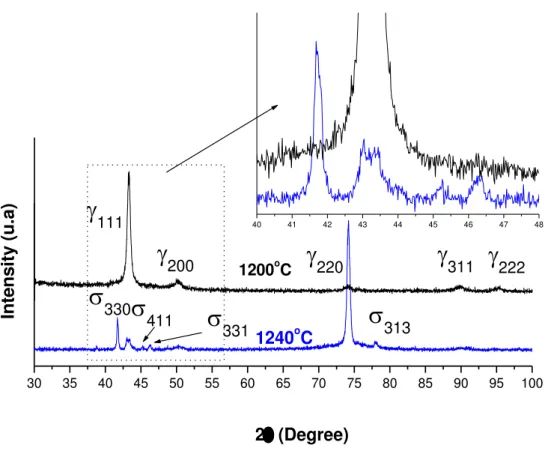
162 Figure 1: Identification of -phase and -phase present in samples submitted at solution heat treatment (1200oC and 1240oC)
Figure 1 at the interval 37o 2 56o marked by dashed line indicates the presence of -phase in the treated sample 1240oC. This region was enlarged inset in Figure 1 in order to better visualize above.The re-flections (330), (411), (311) and (313)corresponding to the intermetallic phase, space group P42/mnm were identified presenting the following lattice parameters: a = 8.721(3) Å and c = 4.553(1) Å. The phase and M6Ccarbides were detected in previous studies [8]. According to literature [8] the volume fraction of
-phase was approximately 2% and 7% for samples A and B respectively.
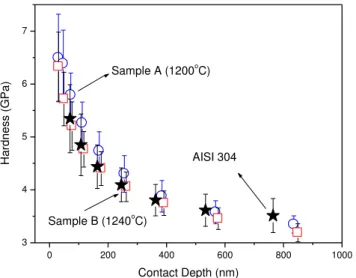
The microstructure and mechanical properties (HB-hardness) before heat treatment and for different heat treatment temperatures were investigated by Ritorni and co authors [9]. The results indicated that the hard-nesschanged with heat treatment above 1200oC as a result of the fine distribution precipitates formed during cooling [9]. In this work, the nano hardness variation in samples A and B are presented in Figure 2. The superaustenitic stainless steel presented hardness around 5.8 GPa in regions close to the surface (contact sur-face < 200 nm). On average, samples (A and B) presented very close hardness values on the sursur-face, indicat-ing that the presence of other phases did not alter the material superficial hardness. The hardness at depths higher than 2000 nm (bulk) is not shown in Figure 2 as it was evaluated in a previous study [11] in which it presented value close to 2.8 GPa. This region was compared to the hardness of a commercial austenitic stain-less steel AISI 304 [12] which presented hardness (bulk) around 3.5 GPa. It can be seen from Figure 2 that the values present a significant dispersion band in regions very close to the surface. This behavior is common in instrumented indented measurements as they reflect the surface effects [13].
30 35 40 45 50 55 60 65 70 75 80 85 90 95 100
40 41 42 43 44 45 46 47 48
313
331
411
330
111
In
te
n
s
it
y
(
u
.a
)
2
(Degree)
1240
oC
222
311
220
200
1200
o163
0 200 400 600 800 1000
3 4 5 6 7 AISI 304 Sample A (1200oC)
Sample B (1240oC)
H ard ne ss (G Pa)
Contact Depth (nm)
Figure 2: Comparison of hardness profile of the superaustenitic steel treated at 1200oC and 1240oC and the austenitic steel AISI 304.
The presence of a phase did not alter the superaustenitic steel elastic modulus value, Figure 3, when compared to the common commercial steel [14], presenting a value of approximately 210 GPa. In Figure 3, the variation of the elastic modulus and hardness after the solubilization thermal treatments are shown.
0 500 1000 1500 2000 2500
2 3 4 5 6 7 200 210 220 230 240 250 260 Hardness
1240oC 1200oC
H a rd n e s s a n d E la s ti c M o d u lu s ( G P a )
Contact Depth (nm)
Elastic Modulus
1200oC
1240oC
Figure 3: Variation of hardness and elastic modulus in samples A and B.
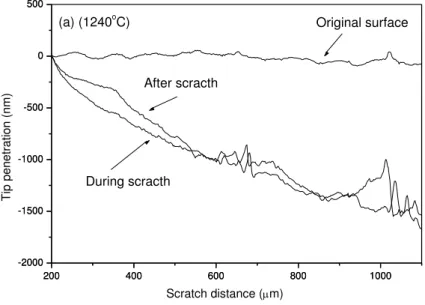
The surface profile was evaluated with nanoscratch measurements in both samples. Results were very similar not indicating significant difference as a function of the solubilization treatment temperatures. Sample B, the highest treatment temperature, (Figure 4a) was chosen as the representative of the superaustenitic steel in this work and compared to the austenitic steel AISI 304 (Figure 4b).
Higher fluctuation was observed in the curves during and after the scratch in the reference sample, (Fig. 4b). This behavior, typical of steel, indicates an irregular surface, which is not in this case directly related to the presence of other phases, once there were no significant alterations in other properties, such as hardness. The indenter penetration depth is very alike in both steel samples (superaustenitic – Figure 4a and austenitic
164
200 400 600 800 1000
-2000 -1500 -1000 -500 0 500
200 400 600 800 1000
-2000 -1500 -1000 -500 0 500
After scracth
During scracth
Original surface
Scratch distance (m)
(a) (1240oC)
T
ip p
en
etrati
on
(
nm
)
200 400 600 800 1000
-2000 -1500 -1000 -500 0 500
During scratch
After scratch Original surface
T
ip
p
e
n
e
tra
ti
o
n
(n
m
)
Scratch distance (m)
(b) AISI 304 [Ref. 16]
Figure 4: Evaluation of the surface profile, using nanoscratch in: (a) superaustenitic steel sample and (b) austenitic steel AISI 304.
165
1 2 3 4 5 6
0,50 0,55 0,60 0,65 0,70 0,75 0,80 0,85
AISI 304
1240
oC
F ri c tt io n c o e fi c ie n t
Sliding distance (m)
1200
oC
Figure 5: Steel AISI 304, and superaustenitic steel (samples A and B) friction coefficient.
Table 1: Comparison of mechanical and structural properties of superaustenitic steel and common austenistic steels.
Mechanical and tribological properties
Steel Hardness (GPa)
(hc 115 nm)
Elastic modu-lus(GPa)
Friction coeffi-cient
Reference
AISI 304 5.0 ~200 0.60 [15]
AISI 316 4.0 ~200 0.60 ---
AISI 304L 4.2 ~200 0.60 ----
AISI 316L 4.0 ~200 --- [16, 17]
*Sample A (1200oC) 5.3 ~ 210 0.68 ---
* Sample B (1240oC) 4.8 ~210 0.72 ---
Structural properties
Steel Phases Lattice parameters (Å) Space group
JCPDS
Reference
AISI 304 fcc a = b = c = 3.5918(1) Å Fm-3m 33-0397 [15]
AISI 316 fcc a = b = c = 3.5935(1) Å Fm-3m 33-0397 ---
AISI 304L fcc a = b = c = 3.5822(4) Å Fm-3m 33-0397 ---
AISI 316L fcc a = b= c = 3.5822(2) Å Fm-3m 33-0397 [16]
Sample A
(1200oC)
fcc
bcc
bct
a = b= c = 3.5720(3) Å Fm-3m
I43mSA P42 mnm
33-0397
---
Sample B
(1240oC)
fcc
bcc
bct
a = b= c = 3.5526(8) Å Fm-3m
I43mSA P42mnm
33-0397
166
Images presented in Figure 6(a-f) reveal the impression of tribological tests carried out on the superaustenitic steel surface of samples A and B. The same characteristics observed in sample B were seen in the reference sample (AISI 304).
The tests comprised three scratches, as it can be seen from the optical microscopy shown in Figure 6a (sample A). From the three scratches presented in this image, the first scratch (from top to bottom, inter-rupted line) was chosen to discuss some interesting details. In Figure 6b (sample A), some flaws can be seen which correspond to a small portion of material taken out during the tests. This characteristic, in the propor-tion presented in this figure is common in steel, not altering the material fricpropor-tion coefficient values.
In Figures 6c (sample A) and 6d (sample B) details of the wider end of the scratch (higher loads) are observed. Comparing these figures, it can be seen that Figure 6d presented a wider scratch at one end, proba-bly due to the lower hardness value (Table 1). All scratches presented similar characteristics. The difference in color refers to the interaction between the surface and deeper regions of the sample, not indicating interac-tion with other phases in this region. In Figure 6d (sample A) and 6f (sample B) the scratch central region is observed. No difference was observed.
Figure 6: Tribology test [11]: (a) sample A optical microscopy, general view of scratches, (b) enlarged region – scratch center – sample A (c) SEM – end region – sample A, (d) SEM – sample B, (e) SEM – central region – sample A, (f) SEM – central region – sample B.
4. CONCLUSIONS
167
samples studied. The nanoscratch tests did not detect significant influence due to the presence of phase . Regarding friction coefficient, a difference of 5% was observed when samples A and B are compared.
Finally, it was concluded that the presence of the phase after the solubilization thermal treatment does not affect mechanical properties (hardness, elastic modulus and friction coefficient) in regions close to the surface. These results are related to the fact that there was no significant structural change (cell volume), below 2%.
5. ACKNOWLEDGEMENT
To CNPq, Prof. Dr. Carlos M. Lepienski (Depto. de Física-UPFR), Prof. Dr. Carlos J. de M. Siqueira (Dep-to. de Eng. Mecânica-UFPR) and Prof. Dr. Paulo R Mei, (Unicamp).
6. BIBLIOGRAPHY
[1] FRANSON, I. A., GRUBB, J. F. “Superaustenitic stainless steels”, Practical Handbook of stainless steels & nickel alloys”, ASM International, Materials Park, OH, USA, pp. 243-285, 2000.
[2] DAVIS J. R. “ASM Specialty Handbook Stainless Steels”, ASM International, Materials, Park, OH, USA, 1994.
[3]PADILHA, A. F., PLAUT, R. L., RIOS, P. R. “Stainless steels heat treatment” , In: Totten GE (editor),
“Steel heat treatment handbook”, 2 ed., Boca Raton (FL, USA), CRC Press, pp. 695-739, 2007.
[4] PLAUT, R. L., HERRENA, C., ESCRIBA, D. M. “A Short review on wrought austenitic stainless steels at high temperatures: processing, microstructure, properties and performance”, Materials Research, v.10, n. 4, pp.453-460, 2007.
[5] KOUTSOUKIS, T., REDJAÏMIA, A., FOURLARIS, G. “Phase transformations and mechanical proper-ties in heat treated superaustenitic stainless steels”, Materials Science and Engineering A, v. 561, pp. 477- 485.
[6] ANBURAJ, J., MOHAMED, S.S., NAZIRUDEEN, R., et al., “Ageing of forged superauastenitic stain-less steel: precipitate phases and mechanical properties”, Materials Science and Engineering A, v.535, pp. 99- 107, 2012.
[7] NATHANIEL, S. L., PHILLIPS, L., CHUMBLEY, L. S., et al., “Phase transformations in cast superaustenitic stainless steels”, Journal of materials engineering and performance, v. 18, pp. 1285-1293, 2009.
[8] RITONI, M., MARTINS, M., MEI, P. R. “Efeito do tratamento térmico de solubilização na microestrutu-ra e propriedades de impacto do aço inoxidável supemicroestrutu-raustenítico ASTM A 744 Gr. CN3MN”, Revista Escola de Minas, v. 63, n. 1, pp. 13-20, 2010.
[9] RITONI, M., MEI, P. R., MARTINS, M. “Efeito do tratamento térmico de envelhecimento na microestru-tura e nas propriedades mecanicas de um aço inoxidável superaustenitico ASTM A 744 Gr. CN3MN”, Revis-ta Escola de Minas, v. 60, n. 1, pp. 155-161, 2007.
[10] RITONI, M., MARTINS, M., NASCIMENTO, F.C., et al., Phase transformations on ASTM A 744 Gr. CN3MN superaustenitic stainless steel after heat treatment, Defect and Diffusion Forum, v. 312-315, pp. 56-63, 2011.
[11] NASCIMENTO, F. C., MEI, P. R. “Caracterização das propriedades estruturais, mecânicas e tribológi-cas do aço superaustenítico ASTM A 744Gr.CN3Mn”, In: XI Seminário Brasileiro do Aço Inoxidável, São Paulo, pp. 1-10, 2012.
[12] NASCIMENTO, F. C., LEPIENSKI, C. M., FOERSTER, C. E., et al., “Structural, mechanical and tribo-logical of AISI 304 and AISI 316L steels submitted to nitrogen-carbon glow discharge”, Journal of Materi-als Science, v. 44, pp. 1045-1053, 2009.
[13] LEPIENSKI, C. M., FOERSTER, C. E. Nanomechanical properties by nanoindentation. In: Hari Singh Nalwa. (Org.). Encyclopedia of Nanoscience and Nanotechnology, Stevenson Ranch: American Scientific Publishers, v. 7, pp. 1-20, 2004.
[14] Alloy phase diagrams, ASM-HANDBOOK , v. 3, 1995.
168
[16] NASCIMENTO F.C., FOERESTER C. E., LEPIENSKI, et al., “Structural, mechanical and tribological properties of AISI 304 and AISI 316L steels submitted to nitrogen carbon glow discharge”, Journal of Mate-rials Science, v. 44, pp.1045-1053, 2009.

![Figure 6: Tribology test [11]: (a) sample A optical microscopy, general view of scratches, (b) enlarged region – scratch center – sample A (c) SEM – end region – sample A, (d) SEM – sample B, (e) SEM – central region – sample A, (f) SEM – central region](https://thumb-eu.123doks.com/thumbv2/123dok_br/18873870.420849/7.892.180.624.398.898/figure-tribology-optical-microscopy-general-scratches-enlarged-scratch.webp)
