SOME RESULTS ABOUT THE CONNECTIVITY OF TREES
Lilian Markenzon
1, Nair Maria Maia de Abreu
2*and Luciana Lee
3Received October 8, 2012 / Accepted March 15, 2013
ABSTRACT.The second smallest Laplacian eigenvalue of a graph G is called algebraic connectivity, denoteda(G). The ordering of trees via this graph invariant is frequently studied in the literature. In this paper, we present a new invariant, theInternal Degree Sequence (I D S), that also supports an accurate evaluation of the connectivity of trees. We compare theI D Switha(G)for all elements in six classes of trees known to have the largest algebraic connectivity and we show that theI D S provides a strict total ordering of the elements of these classes. This result is also proved for a subclass of trees of diameter 4.
Keywords: trees; internal degree sequence, algebraic connectivity.
1 PRELIMINARIES
LetG =(V,E)be a simple graph,n = |V| its order andm = |E|its size. The degree of a vertexvis denoted byd(v). A graph is connected if for any two verticesu, v∈V there is a path fromu tov. The graph is said to be disconnected if it has two or more connected components. The cut-vertex (or cutpoint) is a vertex whose removal increases the number of components ofG.
The Laplacian matrixL(G)= [ℓi j]is defined as follows:ℓi j =di, fori = j;ℓi j = −1 if(vi, vj)
is an edge ofGandℓi j =0 otherwise. The spectrum of the Laplacian ofGis the sequence of
their eigenvalues(μ1, . . . , μn−1, μn), given in non-increasing order,μ1 ≥ ∙ ∙ ∙ ≥ μn−1 ≥ μn.
SinceL(G)is a semidefinite positive singular matrix,μn =0. It is well known thatμn−1 =0
if and only if G is a disconnected graph. Due to that, Fiedler [3] called μn−1 the algebraic
connectivity ofG, denoteda(G). For a survey abouta(G)see Abreu [1]. The relation between the algebraic connectivity and the cutpoints of a graph has been addressed by Kirkland [6].
In this paper, we introduce a new concept for the connectivity of trees, the Internal Degree Sequence (I D S), taking into account the number of connected components obtained after the
*Corresponding author
1NCE – Universidade Federal do Rio de Janeiro, Brazil. E-mail: [email protected]
in six classes of trees known to have the largest algebraic connectivity, presented by Yuan et al.[8], and we show that theI D Sprovides a strict total ordering of the elements of these classes. This result is also proved for a subclass of trees of diamenter 4 in Section 4.
2 THE NEW INVARIANT
In this section, we present a new invariant, the internal degree sequence (I D S), taking into account the number of connected components obtained after the removal of each cut-vertex of the tree. TheI D Sallows us to differentiate the connectivity of trees, providing an extra resource to compare them. Another important feature to highlight is the simplicity of the determination of the invariant.
Thedegree sequenceof a graph is the non-increasing sequence of its vertex degrees. LetT = (V,E)be a tree and [d1,d2, . . . ,dn]its degree sequence. Let V = {v1, v2, . . . , vn}be the
ordered set of vertices ofT, beingdi =d(vi).
A vertexv of T such thatd(v) > 1 is called aninternal vertex ofT. It is acut-vertexof T. A vertexvsuch thatd(v)=1 is called aleafor anexternal vertexofT.
LetT = (V,E)be a tree and let L ⊂ V be the set of leaves of T. The removal of a vertex v∈V−Lresults in a disconnected tree; observe that there ared(v)components in the resulting tree. It is not difficult to see that the degree of an internal vertex is directly related with its relevance in the analysis of the connectivity. The next definition takes this fact into consideration.
Definition 1.The non-increasing sequence of degrees of the internal vertices of a tree T is called theinternal degree sequence(I D S) of a tree T . It is denoted
I D S(G)=d1,d2, . . . ,dp.
Definition 2.Let s= [d1,d2, . . . ,dp]be a non-increasing sequence of integers; s is avalidI D S for a tree T if T has n=Pi=1,pdi−p+2vertices, p internal vertices and di 6=1,1≤i ≤ p.
It is known that a stringtis preceded by a stringsin lexicographic order if
– sis a prefix oft, or
– ifcandd are respectively the first characters ofs andt in whichs andt differ, thenc
precedesdin character order.
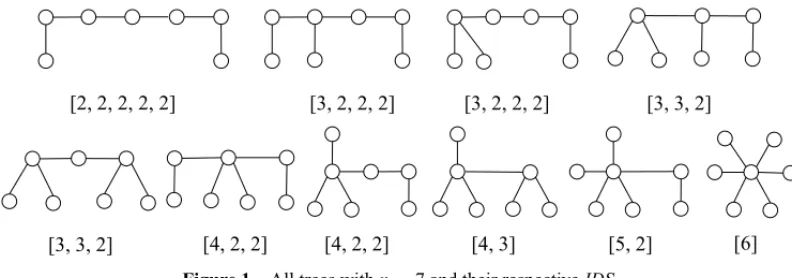
It is possible to perform a lexicographic comparison of theI D Svalues of two trees. For instance, Figure 1 shows all trees with 7 vertices with their respectiveI D Sin lexicographic order.
[6] [5, 2]
[4, 3] [4, 2, 2]
[4, 2, 2] [3, 3, 2]
[3, 3, 2] [3, 2, 2, 2]
[3, 2, 2, 2] [2, 2, 2, 2, 2]
Figure 1– All trees withn=7 and their respectiveIDS.
It is possible to generate all valid I D Sfor a tree with n vertices. The sequences can be build recursively, computing each element of the sequence from the first one. Proposition 1 provides some necessary results to build the sequences.
Proposition 1. Let T be a tree with order n and I D S(T) = [d1, . . . ,dp]its internal degree sequence. Let S=Ppi=1di. Then
1. the maximum value for diis
di =
n−p, i =1
minnS−Pij−=11dj
−2(p−i),di−1 o
, 1<i≤ p;
2. the minimum value for di is
di = l S p m
, i =1
S−Pij−=11dj p−(i−1)
, 1<i ≤ p.
Proof. LetT be a tree of ordernand let[d1,d2, . . . ,dp]be theI D SofT. It is known that the
sum of the degrees of the vertices ofV is 2(n−1). The sum of the degrees of the p internal vertices ofT isS=Ppi=1di =n+p−2.
1. The maximum degree of the first vertex of the sequence occurs when all the others have the minimum degree for an internal vertex (i.e. 2). SinceS=n+p−2, the first element
d1has valueS−2(p−1)=n−p.
When computing di, 1 < i ≤ p, the previous elements d1, . . . ,di−1 are already
de-termined. It is possible to consider a sequence [di, . . . ,dp] with sum of degrees S −
Pi−1
remainder is zero thend1=S/p. Otherwise, letrbe the remainder. The positionsd1,d2, . . . ,dr will have the valueS/P+1. The minimum value ofd1is⌈S/p⌉.
As in item(1), we consider[d1, . . . ,di−1]already determined, and the sum of the degrees
S−Pij−=11dj. So, the result is obtained.
The next proposition shows how any sequence realizes a tree that obeys a specific condition.
Proposition 2.Given a non-increasing sequence of integers s= [d1,d2, . . . ,dp], di 6=1, there exists always a tree T with n=Ppi=1di−p+2vertices such that I D S(T)=s.
Proof. The proof is constructive. By the definition of a valid sequence it is known thatT has
n =Ppi=1di−p+2 vertices and pinternal vertices. The following steps build iteratively the
treeT:
• Step 1: LetT be a tree with a central vertexvandd1vertices, w1, . . . , wd1, all adjacent tov.
• Step 2: Fori =2, . . . ,pdo
Adddi −1 new vertices, all adjacent to a leafwj ofT.
The graphT, resulting from Step 1, is a tree; as so, it has at least two leaves. Step 2 adds, at each iteration,di −1 new vertices, all adjacent to the same vertexwj. At this point, vertexwj is no
more a leaf, but at least one new leaf is created, maintaining the graphT as a tree. So, treeT has
d1+Pi=2,p(di−1)leaves andpinternal vertices.
It is interesting to note that if the leafwj chosen in Step 2 is the most recently added leaf, the
resulting tree is a caterpillar (a tree such that if all leaves and their incident edges are removed, the remainder of the graph forms a path).
Since the lexicographic order provides a total ordering for all the valid sequences of graphs with a givenn, the proof of the following proposition is immediate.
Proposition 3.The invariant I D S provides a total ordering for trees with n vertices.
3 I D SAND ALGEBRAIC CONNECTIVITY
Proposition 4. [2]Let Pd−1be a path with length d−2labeled from1to d−1. Let Td(k, ℓ)be a tree with n vertices and diameter d, obtained from Pd−1by adding k pendant vertices adjacent to vertex1andℓpendant vertices adjacent to vertex d−1. Then
a(Td(k, ℓ)) <a(Td(k−1, ℓ+1)),1≤k≤
n−d+1 2
.
The internal vertices ofTd(k, ℓ)are the vertices of the path. So, the I D SofTd(k, ℓ)hasd−1 elements and can be easily determined:
I D S(Td(k, ℓ))=ℓ+1,k+1,2,2, . . . ,2
| {z } d−3
.
For this class, it is easy to prove that the ordering provided by I D S is a strict total ordering. Moreover, the orders given bya(G)andI D Sare isomorphic. However, this behavior of the two measures does not occur in general.
Yuanet al.[8] introduced six classes of trees and show that, for n ≥ 15, a(Ti) > a(Tj)if
1≤i < j ≤6 andTi is any tree in the classCi andTj is any tree in the classCj. These classes
are defined below and we show theI D Sof their elements.
Definition 3.Let n, k, p and q be nonnegative integers with3k+2p+q =n−1. Let T(k,p,q)
be the tree of order n which contains a vertexvsuch that T(k,p,q)−v=k K1,2∪p K1,1∪q K1.
LetT be the class of all treesT(k,p,d). The following subclasses ofT were defined in [8]:
– C1= {T(0,0,n−1)};
– C2= {T(0,1,n−3)};
– C3= {T(0,p,q)| p≥2};
– C4= {T(1,0,n−4)};
– C5= {T(1,p,q)| p≥1};
– C6= {T(k,p,q)|k≥2}.
Notice that{T(k,p,q)|n =3k+2p+q+1} = ∪i=1,6Ci.
For eachn, classesC1,C2andC4consist of only one tree. The trees belonging toC3andC6
have the same algebraic connectivity, proved by Zhang [9] and Yuanet al.[8], respectively. Two important results about the ordering of all these trees are also presented by Yuanet al. [8] in Theorem 1.
2. For n≥15and T ∈ ∪/ i=1Ci, a(T) <a(T6)=2− 3.
For the six classes it is possible to establish the I D Sof their elements. And more, since sev-eral trees have the same algebraic connectivity, the I D Sprovides a good insight to distinguish accurately between them.
LetTi be a tree such thatTi ∈Ci,n≥8. So, we have,
– I D S(T1)= [n−1];
– I D S(T2)= [n−2,2];
– I D S(T3)= [n−p−1,2,2, . . . ,2
| {z } p
], p≥2;
– I D S(T4)= [n−3,3];
– I D S(T5)= [n−p−3,3,2,2, . . . ,2
| {z } p
], p ≥1;
– I D S(T6)= [n−2k−p−1,3,3, . . . ,3
| {z } k
,2,2, . . . ,2
| {z } p
], k≥2.
The next proposition presents the comparison of the trees belonging to the six classes taking into account theirI D S.
Proposition 7.Let Ti be any tree of order n, n≥8, such that Ti ∈Ci. Then
1. I D S(T1) > I D S(T2) > I D S(T4);
2. I D S(T4) > I D S(T3);
3. I D S(T4) > I D S(T5);
4. I D S(T4) > I D S(T6).
Proof.
1. Each classC1,C2andC4has just one element. It is immediate to state that
I D S(T1) >I D S(T2) >I D S(T4).
2. The treeT ∈ C3 with the greatest I D S has p = 2 and I D S(T) = [n−4,2,2]. As
I D S(T4)= [n−3,3],
3. Similar reasoning can be made for classesC5andC6.
The treeT′ ∈C5with the greatestI D Shas p =1. The treeT′′ ∈C6with the greatest
I D Shask=2 and p =0. So,I D S(T′)= [n−4,3,2]andI D S(T′′)= [n−5,3,3]. Comparing with theI D SofT4
I D S(T4) > I D S(T5)andI D S(T4) > I D S(T6).
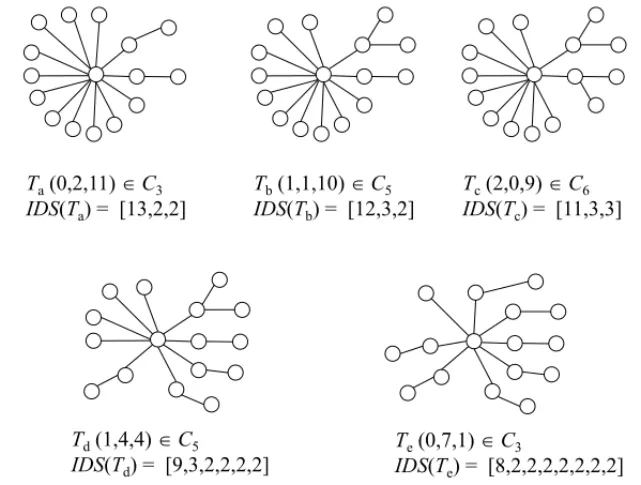
It is impossible to compare the trees belonging to classesC3,C5andC6as a whole. Figure 2 shows how theI D Sof the elements of these classes depend only on the types of their subtrees.
Ta (0,2,11) C3
IDS(Ta) = [13,2,2]
Tb (1,1,10) C5
IDS(Tb) = [12,3,2]
Tc (2,0,9) C6
IDS(Tc) = [11,3,3]
T
d (1,4,4) C5
IDS(T
d) = [9,3,2,2,2,2]
Te (0,7,1) C3 IDS(T
e) = [8,2,2,2,2,2,2,2]
Figure 2– Examples of trees belonging to classesC3,C5andC6.
However a very interesting result can be stated, showing an advantage of the invariant when the trees have the same algebraic connectivity.
Theorem 2.Given n, the I D S of the elements of the classes Ci, i =1, . . . ,6, determine a strict total ordering of the trees T(k,p,d).
Proof. We must prove that the trees belonging toC3,C5andC6have differentI D Svalues, both within and among classes.
LetTi = T(ki,pi,qi),Tj = T(kj,pj,qj) ∈ C3. We know that, for T3 ∈ C3, I D S(T3) =
[n−p−1,2,2, . . . ,2
| {z } p
], p≥2. So,
The proof is analogous whenTi,Tj ∈C5andTi,Tj ∈C6.
We must now show that trees belonging to different classes have different I D S. It is known that
I D S(T3)= [n−pi −1,2, . . . ,2
| {z } p
],
I D S(T5)= [n−pj−3,3,2, . . . ,2 | {z }
p
]and
I D S(T6)= [n−2k−p−1,3,3, . . . ,3
| {z } k
,2,2, . . . ,2
| {z } p
], k≥2.
LetT ∈C3. The treeT cannot have the same I D Sas a tree belonging toC5orC6because the treeT has no internal vertex of degree 3 which is mandatory in the two other classes.
LetT′ ∈C5. The treeT′cannot have the sameI D Sas a tree belonging toC6becauseT′has exactly one internal vertex of degree 3 while the trees ofC6have at least two vertices with such condition.
So, the invariant I D Sprovides a strict total ordering for trees belonging to the classesCi,i =
1, . . . ,6.
4 TREES WITH DIAMETER 4
An important observation about the trees belonging toT, presented in the previous section, is that all of them have diameter less or equal 4. The approach of looking at trees with small diameter was taken up again by Wang & Tan [7]. They give continuity to the work of Yuanet al.[8], show-ing all trees of ordern≥45 with algebraic connectivity in the interval
h
(5−√21)/2,2−√3
.
The subclass of trees of diameter 4 is defined as follows by Zhang [10].
Definition 4.Let p1,p2, . . . ,pk be integers such that
p1≥ p2≥. . .≥ pk ≥0, p1≥ p2>0, k≥2, k+1+p1+. . .+pk =n.
Let T(n,k,p1,p2, . . . ,pk)be a tree with diameter4, N(c)= {v1, . . . , vk}, being c the unique center of the tree, d(v1) = p1+1, . . . ,d(vk) = pk +1. Let T be the class of all trees T(n,k,p1,p2, . . . ,pk).
Wang & Tan[7] defined new subclasses of trees as follows:
– C1′ = {S(3,n−5)}, the tree of ordernobtained by joining the center ofK1,3to the center ofK1,n−5with an edge;
– C′
– C3′ = {T(n,k,3,2,p3, . . . ,pk)};
– C4′ = {T(n,k,3,3,p3, . . . ,pk)};
Notice thatC1′ is not a subclass ofT.
Wang & Tan [7] proved interesting results about these classes:
Proposition 8.Let T be a tree of order n≥45. If T ∈/T∪(∪4i
=1Ci′), then a(T) < (5−
√ 21)/2.
Theorem 3. If T is a tree of order n≥45, then(5−√21)/2≤a(T) <2−√3if and only if T ∈ ∪4i=1Ci′.
The authors were able to provide the three trees with the first, second and third largest algebraic connectivity inTn\T. However few results are presented about the ordering of all trees with diameter 4.
Using theI D S, an interesting result can be shown. We define a subclass ofT. LetT′be the class of allT(n,k,p1,p2, . . . ,pk)such thatk > p1, i.e., the set of all trees of diameter 4 such that the center of the tree has the greatest degree. It is possible to determine theI D Sof a treeT ∈T′
directly from its notation.
Definition 5. Let T(n,k,p1, . . . ,pz, . . . ,pk)with k > p1. Let pz,2 ≤ z ≤ k, be the last non-zero element of the notation. Then
I D S(T)= [k,p1+1,p2+1, . . . ,pz+1].
Theorem 4.Given n, the I D S of the elements of the classT′determine a strict total ordering of the trees T(n,k,p1,p2, . . . ,pk)with k >p1.
Proof. LetT(n,k,p1,p2, . . . ,pk)∈T′. LetSbe the sequence[n,k,p1,p2, . . . , pz, . . . ,pk]. It is immediate to conclude thatSis a non-increasing sequence. The sequenceI D S(T)is build fromS and its elements obey exactly the original ordering. So, givenn, there is a unique tree
with this sequence asI D S.
Analogous result can be shown for all trees of diameter 4 such that the central vertex has the smallest degree.
ACKNOWLEDGMENTS
This work was supported by grants 305372/2009-2, 305016/2006-7, CNPq, Brazil and project 027/CAP/2011, Universidade Federal do Mato Grosso, Brazil.
REFERENCES
[3] FIEDLER M. 1973. Algebraic connectivity of graphs. Czechoslovak Mathematical Journal, 23: 298–305.
[4] GRONER & MERRISR. 1987. Algebraic connectivity of trees.Czechoslovak Mathematical Journal,
37: 660–670.
[5] GRONER & MERRISR. 1990. Ordering trees by algebraic connectivity.Graphs and Combinatorics,
6: 229–237.
[6] KIRKLAND S. 2001. Un upper bound on algebraic connectivity of graphs with many cutpoints. Electronic Journal Linear Algebra,8: 94–109.
[7] WANGX-K & TAN S-W. 2012. Ordering trees by algebraic connectivity.Linear Algebra and its Applications,436: 3684–3691.
[8] YUANX, SHAOJ & ZHANGL. 2008. The six classes of trees with the largest algebraic connectivity. Discrete Applied Mathematics,156: 757–769.
[9] ZHANGXD. 2004. On the two conjectures of Graffiti.Linear Algebra and its Applications,385: 369–379.