*e-mail: [email protected]; [email protected]
Presented at the International Symposium on High Temperature Corrosion in Energy Related Systems, Angra dos Reis - RJ, September 2002.
Simulating Steam Oxidation of High Temperature Plant Under
Laboratory Conditions: Practice and Interpretation of Data
Steve Osgerby*, Tony Fry*
National Physical Laboratory,United Kingdom NPL Materials Centre,National Physical Laboratory Teddington, Middlesex, TW11 0LW United Kingdom
Received: September 2, 2002; Revised: September 4, 2002
Specimens of ferritic and martensitic steels have been exposed to steam atmospheres at 550 °C using three different experimental procedures. Slight differences in scale growth kinetics were observed but the major differences were in the morphology of the oxide scales that were formed. The microstructures of the scales have been compared with those formed on similar materials during service.
Keywords: ferritic steels, martensitic steels, steam oxidation, kinetics, microstructure
1. Introduction
During service components such as boiler, superheater and reheater tubes are exposed to steam at high pressure, flowing at high rates and often in the presence of heat flux. The precise conditions are difficult if not impossible to re-produce in the laboratory and some degree of simplifica-tion is necessary. Several exposure procedures are in com-mon use in the laboratory - in ascending order of complex-ity these are:
• Water vapour in a carrier gas (usually argon); • Flowing steam at atmospheric pressure; • Static steam at high pressure;
• Flowing steam at high pressure.
None of these laboratory procedures include heat flux for which exposure in pilot plant is the main route available to assess its influence. Pilot plant exposure is normally the final stage in material selection.
A recent review1 has highlighted the scatter in data
aris-ing from the use of different exposure procedures. The pur-pose of the current work is to identify any differences in oxidation kinetics and scale microstructure arising from the exposure procedure that is used. The materials investigated were two low alloy ferritic steels (T22 and T23) and three batches of a 9Cr1Mo martensitic steel.
2. Experimental
Material was supplied in the form of plate for the ferritic steels and tube for the 9Cr1Mo martensitic steel. The com-position (nominal for T22 and T23, actual for 9Cr1Mo) of each material is given in Table 1.
For the ferritic steels, specimens were machined in the form of rectangular blocks and the surface was prepared by abrasion using 600 grit SiC paper. The 9Cr1Mo tube was cut into segments and the surface was left in the as-received condition. All the specimens were cleaned using industrial alcohol prior to exposure.
The specimens were exposed to steam at 550 °C for durations up to 1000 h using three procedures.
1. Gaseous argon and liquid water were passed into the furnace at rates of 100 ml/min and 0.0736 ml/min re-spectively. The water is gasified on entry to the fur-nace to give the desired argon/50% H2O by volume. 2. Water in a reservoir is boiled outside the furnace and
the steam flows naturally through the furnace. 3. Steam is generated in a sealed pressure vessel. A
de-aer-ated prior to conversion to steam. For the exposures under flowing steam and the argon/50% H2O mixture, water was taken from a de-ionised supply and distilled, de-aerated by bubbling nitrogen through the reservoir before final con-version to steam by boiling. In the autoclave the water was de-aerated during leak testing of the system under high-pressure nitrogen prior to heating.
After exposure the specimens were plated with nickel to retain the oxide, sectioned and mechanically polished. Oxide scale thickness was measured at 24 positions, evenly spaced along the specimen surface, using a calibrated eye-piece graticule in the optical microscope. The resolution of these measurements is 1 µm.
3. Results and Discussion
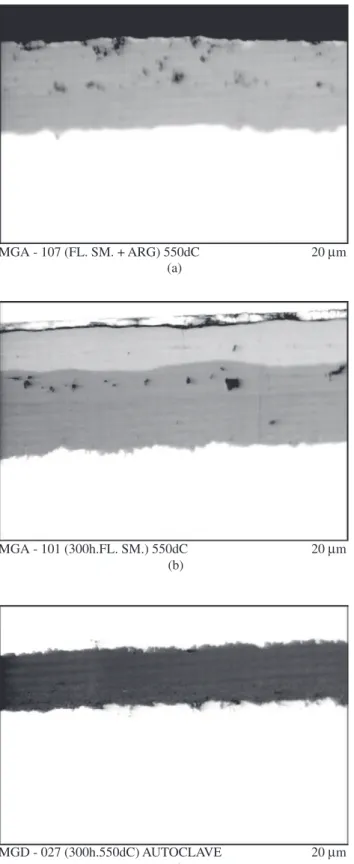
In general the oxide scale formed in two layers – an outer layer of magnetite and an inner layer of iron-chro-mium spinel. In some cases internal oxidation was also served. Some spallation of the outer oxide scale was ob-served for T23 but not in the other materials. This is be-lieved to be largely a function of the higher creep strength of T23 compared to T22. Figure 1, which is taken from the work of Masuyama et al.2, shows that T23, referred to in
Fig. 1 by its alternative nomenclature, HCM2S, has rupture lives ~5 times that of T22 for the same stress at 550 °C. Stresses that are developed in the scale during cooling relax more slowly than in the weaker T22 material and hence spallation occurs in thinner scales when cooled to room tem-perature. This mechanism is described in more detail by Evans and Lobb3.
Oxide scale thickness as a function of time and expo-sure procedure is shown in Fig. 2 for both material classes. Although there is scatter in the data some general observa-tions can be made. The scales grown under flowing steam are thicker than those grown in static high-pressure steam in the autoclave. The scales grown under argon/50% H2O were intermediate in thickness between these extremes.
The 9Cr material exhibited lower growth rates than ei-ther of the 2¼Cr steels. This is an expected result and
con-firms the well-known beneficial influence of Cr on steam oxidation resistance4. There were no significant differences
in behaviour between T22 and T23 indicating that the pres-ence of Nb and W in T23 had no influpres-ence on the steam oxidation properties.
The three 9Cr1Mo steels showed fairly consistent be-haviour with the oxidation rate in 9Cr1Mo(1) greater than that in 9Cr1Mo(2) which in turn was greater than that in 9Cr1Mo(3). This ranking is probably a result of the slightly lower Cr and Si content in 9Cr1Mo(1) in comparison with the other two materials and the lower C content of 9Cr1Mo(3) compared to 9Cr1Mo(2). It is suggested that C affects the oxidation resistance through tying up Cr in the form of carbides: this Cr would otherwise be available for oxidation resistance.
In contrast the scale grown under high-pressure static steam is compact throughout although there is some evidence of roughening at the surface of the outer scale.
Similar diversity in the scales grown under different conditions is observed in the 9Cr1Mo steels (Fig. 4). Two additional features in the scales grown on these materials are the presence of internal oxidation below the spinel un-der all conditions and the development of wavy scale/subs-trate interface and surface in the scales grown under flow-ing steam and static high pressure steam.
The growth mechanisms that cause this change in micro-structure of the oxide scale between the different exposure techniques are not apparent: the differences in the activity Figure 2. Scale growth kinetics for materials grown using differ-ent laboratory procedures: a) low alloy ferritic steels; b) 9Cr1Mo martensitic steel.
Figure 3. Microstructure of oxide scales grown on T22 ferritic steel at 550 °C for 300 h using different laboratory procedures: a) argon/50% H2O; b) flowing steam; c) static high pressure steam.
MGA - 107 (FL. SM. + ARG) 550dC 20 µm
MGA - 101 (300h.FL. SM.) 550dC 20 µm
MGD - 027 (300h.550dC) AUTOCLAVE 20 µm
(a)
(b)
the slope of the data generally increases with increasing exposure time (black- and gray-filled symbols). Secondly the data from scales grown under argon/50% H2O are much more homogeneous in thickness than those grown under flowing steam or in the autoclave.
Specimens were cut from pipes that had been exposed to steam during service. The piece of T22 had been in serv-ice for 19000 h at 550 °C and the 9Cr1Mo material had been at 590 °C for 28000 h. The steam pressure during serv-ice was unknown. Cross sections of these materials were prepared and examined in the optical microscope. The struc-ture of the oxides is shown in Fig. 6. The scales are signifi-cantly thicker that those formed in the laboratory, due to the much longer exposure time, and do not appear to have spalled. In both cases the outer magnetite layer shows some porosity whilst the inner spinel has a fully dense structure. Rather surprisingly it is the structure of the scales formed
Figure 4. Microstructure of oxide scales grown on 9Cr1Mo(2) steel at 550 °C for 300 h using different laboratory procedures: a) ar-gon/50% H2O; b) flowing steam; c) static high pressure steam.
MGD - 103B (FL SM. + ARG 550d 300h. 20 µm
MGD - 7B.(300h.) FL.SM 20 µm
MGD - 5B (300h. 550d.C) AUTOCLAVE 20 µm
(a)
(b)
(c)
under the argon/50% H2O mixture that is most similar to that which is formed in service. This procedure is the most dissimilar to the actual service conditions so it would be
expected to produce the least representative scales. Future work will attempt to determine the different oxi-dation mechanisms that operate in each laboratory proce-dure and to explain how the different scale morphologies are produced.
4. Conclusions
Specimens of ferritic and martensitic steels have been exposed to steam environments at 550 °C using three dif-ferent laboratory procedures. Although the scale thicknesses measured after a given time were similar for all the proce-dures, there were significant differences in the microstruc-ture of the scales that were grown under the various condi-tions.
Examination of material that had been retired from serv-ice, showed that using an argon/50% H2O mixture produced the scale most similar in morphology to that grown in service.
Acknowledgements
This work was carried out under the Life Performance of Materials Programme, a programme of underpinning re-search funded by the United Kingdom Department of Trade and Industry.
The authors wish to express their thanks to British En-ergy who supplied the three batches of 9Cr1Mo material and to Powergen who supplied the service exposed tubes.
References
1. Fry, A.; Osgerby, S.; Wright, M. Oxidation of Alloys in Steam Environments, A Review, NPL Report MATC (A)90, National Physical Laboratory, UK, July 2002. 2. Masuyama, F.; Yokoyama, T.; Sawaragi, Y.; Yokoyama,
T. Materials for Advanced Power Engineering, Eds D Coutsouradis et al., Kluwer Academic Publishers, p. 173-181, 1994.
3. Evans, H.E.; Lobb, R.C. Corros. Sci., v. 24, n. 209, 1984. 4. Manning, M.I.; Metcalfe, E. Oxidation of Ferritic Steels in Steam, in Proc Conf Ferritic Steels for Fast Reactor Steam Generators”, BNES, London, p. 378-382, 1978. Figure 6. Morphology of oxide scales formed in service in a steam
environment: a) T22 after 19000 h at 550 °C; b) 9Cr1Mo after 28000 h at 590 °C.
5MEA 200 µm
6MEA 100 µm
(a)