Resumo
Estudou-se a utilização da escória de cobre de uma fundição do Chile na fabri-cação de argamassas de cimento. A escória foi caracterizada através de análise quí-mica, mineralógica e granulométrica. Também foram usados diferentes padrões para se conhecerem alguns parâmetros importantes da escória e se fazerem os ensaios de compressão e de lexão das argamassas. Os resultados mostraram que as argamassas feitas com escória de cobre apresentaram maior resistência à compressão e à lexão que as preparadas com areia. O estudo conclui que esse resíduo metalúrgico poderia ser utilizado na construção civil.
Palavras-chave: Escórias de cobre, argamassas, compressão, lexão, construção civil.
Abstract
The use of a Chilean copper smelter slag in the manufacture of cement mortars was studied. Copper slag was characterized from the chemical, mineralogical and size distribution point of view. In addition, different Chilean standards were used to determine some important parameters of the waste and to perform compression and lexural assays of the cement mortars. The results obtained showed that the mortars manufactured with copper slag present a higher resistance to compression and lex-ural than those manufactured with river sand. It is concluded that this metallurgical residue can be used in civil construction.
Keywords: Copper slag, mortars, compression, lexural, civil construction.
Metalurgia e materiais
Metallurgy and materials
Use of copper slag
in cement mortar
Uso de escória de cobre na fabricação de
argamassas de cimento
Amin Salvador Nazer
Doctor, InstitutoTecnologico, Universidad de Atacama, Chile [email protected]
Osvaldo Pavez
Doctor, Department of Metallurgy, Universidad de Atacama, Chile
Regional Centre for Research and Sustainable Development of Atacama - CRIDESAT [email protected]
Freddy Rojas
Engineer, Department of Metallurgy, Universidad de Atacama, Chile [email protected]
1. Introduction
Copper slag is a massive metallurgi-cal residue obtained from the transfor-mation of copper ore concentrates into metallic copper in the smelters (Figure 1). Slags are deposited in landills that oc-cupy large areas of land. Their chemical composition is rich in iron, silicon and aluminium oxides and in their mineralogi-cal composition, the presence of fayalite and magnetite, among other compounds is common (Gorai, Jana, Premchand, 2003). The main environmental impact produced by slag disposition is a change in land use and the visual pollution of the landscape
(Figure 2). On the other hand, under certain weather conditions, leaching can occur, depending on the characteristics of the solution, the composition, and the inal crystalline structure of the solid slag. (Demetrio et al., 2000).
Potrerillos, Caletones, Chuquicamata and Altonorte. These metallurgical centers produced 2,360,000 metric tons of cop-per slag in the year 2002 (Goonan, 2005), leaving this waste deposited indeinitely as a hard loor, without current industrial utility. However, global experiments for the use of copper slag have been going on in various sectors of production and the results have been published with very good prospects. In particular, there
is the use of this metallurgical waste in the construction industry, where one of the studied applications is its use as a substitute for aggregates, both in cement mortar and concrete (Goñi, Lorenzo, Sagrera, 1994), (Resende, Cachim, Bas-tos, 2008), (Al - Jabri et al., 2006), (Shi, Meyer, Behnood, 2008), (Wu, Zhang, Ma, 2010a), (Wu, Zhang, Ma, 2010b), (Moura et al., 1999). In this context, various worldwide experiences point to
the appropriate use of the copper slag in the manufacture of concrete and cement mortars, generating a recycling opportu-nity for what would otherwise be massive metallurgical liabilities.
This article describes an experimental study performed to determine possibilities for the use of copper slag as a substitute for the traditional sand in the manufacture of cement mortar. For this purpose, the slag from a Chilean copper smelter was used.
2. Materials
Having been solidified by slow outdoor cooling, discarded copper slag from the Hernán Videla Lira smelter, lo-cated in the Atacama Region (Chile), was used, Daily, the smelter pours 600 tons of slag containing 0.8% of copper into
the designated open-air area. Samples were prepared with cement belonging to the puzolanic class, current degree, ac-cording to standard NCh 148, Of.1968 (INN, 1968), containing 67% of clinker, 30% of pozzolana and 3% of gypsum
approximately, with a Blaine Index in the order of 3900 ± 150 cm2/g. Shot sand purchased from a supplier of Copoiapó River aggregates and used as the ine aggregate. Drinking water supply was used in the preparation of the samples.
Figure 1
Pyrometallurgical and electrometallurgical processes for the production of copper cathodes.
Figure 2
Copper slag deposit minimizing the cultivation area in the Valley of Copiapó, Atacama Region (courtesy Google Maps).
slag
slag gases
gases
Conversion Fusion Drying and toasting
of concentrate
cobre blister Pyro-refining
anodes Moulding anodes
Eletro-refining
cathodes
slag dump Slag treatment white metal
Acid plant
sulfuric acid and calcium arsenite
3. Methods
Design of mixing and preparation of the samples in the laboratory
The copper slag and river sand em-ployed were characterized in the Material Strength Laboratory of the Universidad de Atacama and in the Cement Mixture Labo-ratory of INACESA, a company located in Antofagasta. Test tubes of mortar were built according to the standard NCh2260. Of1996 (INN, 1996a) in the form of pris-matic bars having dimensions of 40 x 40 x 160 mm (width, height and length) with
mixtures of cement, water and sand. The reference mortar was manufactured using only river sand (100%) as the agglomerate, while the mortar of this study was manu-factured with only copper slag (100%) as the agglomerate. Constituents were weighed separately and then in the lab, were mixed in an electric mortar mixer to ensure ho-mogeneity. This mixture was poured into metal molds and subsequently compacted
according to the Chilean standard NCh158. Of1967 (INN, 1967). Within 24 hours, the molds were removed from the hardened mixture which formed the prismatic bars and underwent a process of "curing", which consisted of immersing them in water satu-rated in lime at a temperature of 23°C until it was the time for their compression and bending test, according to Chilean standard NCh158.Of1967 (INN, 1967).
Compression and bending tests
After curing, each sample was identiied, measured and weighed with a scale. Nine test tubes were tested for compression and nine for bending. For
each of these tests, three of tubes had been cured for 3 days, three for 7 days and three for 28 days. The compression and bending tests were carried out
according to the Chilean standard NCh158.Of1967 (INN, 1967). All tests were conducted on a “Controls” brand hydraulic press.
4. Results and discussion
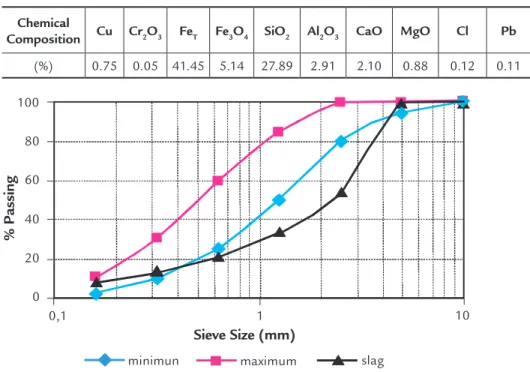
The chemical composition of the main components of the copper slag is presented in Table 1. Notice that the major components are Iron (Fe) and Silica (SiO2).
Mineralogical analysis to the copper slag showed the presence of the following phases: 51% of 2FeO. SiO2 (fayalite), 10.2% of 2MgO.SiO2 (magnesium
fayalite) and 38.8% of magnetite. On the other hand, the copper slag presented a real density of 3,817 (kg/m3), by which it is considered a heavy aggregate.
The granulometry of the copper slag sand was analyzed taking into consideration the g ranulometric requirements according to Chilean standard NCh163.Of1979 (INN, 1979).
In all analyzed cases, the slag sand presented an excess in size fractions of 0.6 mm, 1.18 mm and 2.36 mm, ultra-passing the limits imposed on sand used as an aggregate in construction and causing the distribution curve to be left out of the graph (Figure 3). However, the present study was conducted without modifying the initial grain size of slag.
Chemical
Composition Cu Cr2O3 FeT Fe3O4 SiO2 Al2O3 CaO MgO Cl Pb
(%) 0.75 0.05 41.45 5.14 27.89 2.91 2.10 0.88 0.12 0.11
Table 1 Chemical composition with the main
components of the copper slag.
Figure 3 Granulometric requirements and grading distribution of copper slag.
Table 2 presents the compressive strength results for mortars prepared with copper slag and river sand for 3, 7 and 28 days of curing times.
Table 3 shows the results of the bend-ing resistance with mortars prepared with
copper slag and river sand, for curing times of 3, 7 and 28 days.
It can be seen from Tables 2 and 3 that the compressive strength of the mortar using copper slag is higher than the values achieved in mortars using river sand. This
was proven for 3, 7 and 28 day curing times: the mortars with copper slag presented higher compressive strengths, 114%, 66% and 44%, respectively, in relation to the resistance achieved in mortars using river sand. Also, it was found that the slag mor-0
0,1
minimun maximum slag 1
Sieve Size (mm)
tars that had curing times of 3, 7 and 28 days presented bending resistance superior to 97%, 44% and 35%, respectively, when
compared to the bending resistance of mor-tars using river sand. The high resistance differences at an early curing age (3 days)
suggest that this material may be in used warm geographical areas and/or in works requiring rapid hardening of the mortar.
Table 2
Compressive strength of mortars prepared with 100% river sand and 100% copper slag.
Table 3
Resistance to the bending of mortars prepared with river sand and 100% copper slag.
Time (days)
Resistance to the compression of river sand mortars (MPa)
Resistance to the compression of copper slag mortars (MPa)
3 13.75 29.38
7 22.58 37.38
28 32.71 47.08
Time (days)
Resistance to the compression of river sand mortars (MPa)
Resistance to the compression of copper slag mortars (MPa)
3 0.19 0.38
7 0.31 0.44
28 0.37 0.50
5. Conclusions
The results obtained in this study indicate that the use of copper slag in mor-tars as a substitute material for river sand gives options for the employment of this massive waste as an alternative material that is environmentally sustainable and
appropriate for the construction industry. Mortars manufactured with copper slag presented greater resistance to both compression and bending as compared to mortars manufactured with river sand. This was verified at different curing
ages: 3, 7 and 28 days, and highlighted the importance of the increase in initial resistance, which would recommend its use in warm climates and/or in situa-tions that demand quick hardening of the mortar.
6. Acknowledgements
The authors appreciate the help of the smelter of Hernán Videla Lira, the
company INACESA of Antofagasta and Miss Evelyn Cardenas by the correction
of the text in English.
7. Bibliographical references
AL-JABRI, K.S., TAHA, R.A., AL-HASHMI, A., AL-HARTHY, A.S. Effect of copper slag and cement by-pass dust addition on mechanical properties of concrete.
Construction and Building Materials, v. 20, n. 5, p. 322-331, 2006.
DEMETRIO, S., AHUMADA, J., DURAN, M. A, MAST, E., et al. Slag cleaning: the chilean copper smelter experience. JOM, v. 52, n. 8, p. 20-25, 2000.
GOÑI, S., LORENZO, MA.P., SAGRERA, J. L. Durability of hydrated portland cement with copper slag addition in NaCL + Na2SO4 medium. Cement and Concrete Research, v.24, n. 8, p. 1403-1412., 1994.
GOONAN, T.G. Flows of selected materials associated with world copper smelting. Vir-ginia, 2005 [online] disponible em: http://pubs.usgs.gov/of/2004/1395/2004-1395.pdf. GORAI, B., JANA, R. K., PREMCHAND. Characteristics and utilisation of copper
slag - a review, resources. Conservation and Recycling, v. 39, n. 4, p. 299-313, 2003. INN NCH 2257/1.Of1996: Morteros- determinación de la consistencia - Parte 1: método
del extendido en la mesa de sacudidas. Instituto Nacional de Normalización, 1996. INN NCH1327.Of1977: Áridos para morteros y hormigones - determinación de
partículas desmenuzables. Instituto Nacional de Normalización, 1977.
INN NCH148.Of1968 Cemento - terminología, clasiicación y especiicaciones generales. Instituto Nacional de Normalización, 1968.
INN NCH158.Of1967: Cementos - ensayo de lexión y compresión de morteros de cemento. Instituto Nacional de Normalización, 1967.
INN NCH163.Of1979: Áridos para morteros y hormigones - requisitos generales. Instituto Nacional de Normalización, 1979.
INN NCH165.Of2009: Áridos para morteros y hormigones - tamizado y determinación de la granulometría. Instituto Nacional de Normalización, 2009. INN NCH2260.Of1996: Morteros - preparación de mezclas de prueba y mezclas
comparativas en el laboratorio. Instituto Nacional de Normalización, 1996. MOURA, W., MASUERO, A., MOLIN, D., DAL VILELA, A. Concrete performance
RESENDE, C., CACHIM, P., BASTOS, A.M. Copper slag mortar properties.
Materials Science Forum, v. 587-588, p. 862-866, 2008.
SHI, C., MEYER, C., BEHNOOD, A. Utilization of copper slag in cement and con-crete. ResourcesConservation and Recycling, v. 52, n. 10, p. 1115-1120, 2008. WU, W., ZHANG, W., MA, G. Mechanical properties of copper slag reinforced
concrete under dynamic compression. Construction and Building Materials, v.24, n. 6, p. 910-917, 2010.
WU, W., ZHANG, W., MA, G. Optimum content of copper slag as a ine aggregate in high strength concrete. Materials & Design, v. 31, n. 6, p. 2878-2883, 2010. Artigo recebido em 30 de novembro de 2010. Aprovado em 11 de outubro de 2011.