Concrete is the second most used material on the planet. Due to strong growth in emerging economies, there is an expectation of greater consumption of material in the coming years. Due to this growth, we can observe that the environment is being greatly damaged by the genera-tion of waste. There are several sectors that generate these wastes, among them stands out the steel, the water treatment and the extracgenera-tion of gravel as raw material for concrete producers. Therefore, this paper presents a study on the use of alternative solid waste as aggregates for the manufacture of concrete. The residues used are: sludge Water Treatment Station (WTS), Manufactured Sand and Steel Slag. For both concrete mixtures were used to replace all or part of the fractions of coarse aggregate (crushed) and ine aggregate (sand). This substitution was made in mass. To benchmark adopted a trait that is standard with the use of 100% of the constituents of concrete by concrete adopted in the region. The admisture corresponds to a standard adopted characteristic compression strength of 25 MPa and a water/cement ratio of 0,61. The concrete were analyzed for physical properties according to ABNT normes. The results of concrete tests made with artiicial sand and steel slag show as eficient material for structural applications. However, the concrete with the addition of WTS can be used for non-structural, such as illing element in projects that require low resistance to compression. These data were statistically analyzed by ANOVA and the results indicate that with judicious use, waste studied here, may be alternative to the traditional use of aggregates for concrete manufacture.
Keywords: concrete, sludge from water treatment plant, artiicial sand, steel slag, aggregates.
O concreto é o segundo material mais utilizado no planeta. Devido ao crescimento acentuado das economias emergentes, existe uma expectativa de consumo deste material ainda maior nos próximos anos. Em função deste crescimento, pode-se observar que o meio ambiente está sendo extremamente prejudicado com a geração de resíduos. Vários são os setores que geram estes resíduos, dentre estes, destacam-se os siderúrgicos, os de tratamento de água e o de extração de brita para matéria prima para as concreteiras. Sendo assim, este trabalho apresenta um estudo sobre a utilização de resíduos sólidos como agregados alternativos para a manufatura de concreto. Os resíduos utilizados são: Lodo de Estação de Tratamento de Água (LETA), Areia Artiicial e Escória de Aciaria. Para tanto foram adotados traços de concreto com substituição total ou parcial das frações de agregados graúdos (brita) e miúdo (areia). Esta substituição foi feita em massa. Para parâmetro de comparação adotou-se um traço padrão com a utilização de 100% dos constituintes do concreto adotados pelas concreteiras da região. O traço padrão adotado corresponde a uma resistência característica a compressão de 25 MPa e uma relação água/cimento de 0,61. Os concretos foram caracterizados quanto às propriedades físicas segundo as normas da ABNT. Os resultados dos ensaios de concretos com os resíduos de areia artiicial e escória de aciaria apresentaram-se como eicientes para aplicações estruturais. Porém, os concretos com adição de LETA podem ser utilizados para ins não estruturais, tal como, elemento de enchimento em projetos que exijam baixa resistência à compressão. Estes dados foram tratados estatisticamente, por meio da análise de variância ANOVA e os resultados indicam que, com a utilização criteriosa, os resíduos aqui estudados, podem ser alternativos à utilização dos agregados tradicionais para manufatura de concretos.
Palavras-chave: concreto, lodo de estação de tratamento de água, escoria de aciaria, areia artiicial, agregados.
Speciic mass and water absorption from concrete
manufactured with alternate aggregates
Massa especíica e absorção de água de concretos
manufaturados com agregados alternativos
E. C. ARAUJO a [email protected] F. M. DIAS b [email protected]
a Centro Universitário do leste de Minas Gerais – Unileste MG, Mestrado em Engenharia Industrial, [email protected], Av. Minas Gerais, 175,
Bairro Canaã, CEP 35164-192, Ipatinga, MG.
b Centro Universitário do leste de Minas Gerais – Unileste MG, Mestrado em Engenharia Industrial, [email protected], Av. Tancredo Neves, 3500,
Bairro Universitário, CEP 35170-056, Coronel Fabriciano, MG.
Received: 06 Jan 2011 • Accepted: 28 Jul 2011 • Available Online: 28 Nov 2011
Abstract
1. Introduction
Most of what is produced and respectively consumed is still ex-tracted from nature nowadays, from raw material to the garment industry, metallurgy, and consumption of goods, construction and other industries in various sectors.
Among the sectors that generate waste, there is the metal industry that generates a signiicant amount of waste, with the most varied features in all stages of its process. Some of this waste,known as melt shop waste, with the most diverse granulometric characteristics, from waste powder to waste of larger granulometry, in particle shapes. Another sector, the Water Treatment Plant, generates a waste classiied as sludge , which has the appearance of a clay material after it is dry.
The concrete producers use sand as a basic raw material , taken from rivers and streams, gravel from explosions of rock, among other constituents of concrete inputs such as cement, which also come from natural resources. In the extraction of gravel stone pow -der with various grain sizes is generated.
The solid waste from the mentioned sectors are generated in large quantities as shown below:
Manufactured Sand: The amount of material generated can reach 20% of the crushed material, Prudencio, Coelho, Gutstein, [1]. Water Treatment Station Sludge (WTSS): According to Hoppen [2], a conventional WTA that can treat 2400 l / s produces about 1.8 t / of sludge per day. In Brazil, the amount of sludge produced in water treatment is often not measured due to non-management of waste produced.
Melt shop Slag: in Brazil, according to the IAB-Brazil Steel Institute [3] steel production in 2008 reached 33.7 million tons, which is produced in average 120 kg of steel slag per ton of crude steel, a total of 4 million tons of slag was generated, which makes this product one of highest volumes of waste, among those generated in the steel industry.
Researches have been encouraged to use waste as by-products for different industrial sectors. This stimulation is mainly due to
de-renewable resources of nature.
Therefore, this paper presents the physical characterization of con-crete manufactured with aggregate alternatives: water treatment station Sludge , artiicial Sand and Melt shop Slag with respect to water absorption and density tests, comparing them to reference values obtained using aggregates of normal use as quartz sand and gneiss gravel for concrete characteristic resistance of 25 MPa.
1.1 Concrete
In the construction industry, the most commonly used material is concrete, a product that uses natural resources in its composition, such as sand and gravel, Isaia [4]. Researches have been under-taken with the objective of minimizing the removal of these natural resources. Thus, it seems that there is a great need to promote the treatment of these wastes, adding value to them, so they are transformed into raw materials for concrete production.
1.2 Agregates
According to Isaia [4], aggregates are materials that take place of about 70% to 80% of the volume in conventional concrete, so they all should be chosen with care and technical criteria, for they are the elements in greater quantity in the concrete..
2. Materials and experimental program
The methodology was developed in 03 steps, as described below.
2.1 Step 01: Selection of Materials
We used 03 types of waste from the region of the Steel Valley, besides the inputs normally used and marketed in the region. The wastes are: Water Treatment Station Sludge (WTSS), Manufac-tured Sand and Steel Slag.
crushed from the gneiss rock. The material was from Pedreira Um Valemix, located in the city of Timoteo, MG. The material used in the study was collected from the storage yard of the crushing plant, in a quantity of 0.5 m³. All the material has gone through a natural drying process and then properly stored in a laboratory environment. Waste used as alternative aggregates:
The aggregate produced with the WTSS has its origin in the stages of water puriication, involving chemical reactions associated with the transport of organic material in settling ponds and disposal We used Portland cement CP III E 40 and - Cauê / Camargo Cor
-rea. The option was due to the widespread use of the product in the local construction sites.
The natural sand source used is quartz, derived from Doce river. 0.5 m³ of the material was stored at Doce river storage yard, lo -cated at Rua A , No. 465, Parque do Rio Doce, Caratinga, MG. The sand went through natural drying process is then stored in a laboratory environment.
The gravel used during the research is of metamorphic origin and
Figure 2 – Pedreira um valemix – crushing
plant, located in the city of Timóteo-MG
courtyard of Reciclos company in Timóteo-MG
Figure 3 – Melt shop Slag , deposited in the
Table 1 – measures for the concrete mix proposed for aggregates replacements
MassRange - 25 MPa - w / c ratio 0.61
Mixes
Agglomerates
Fine Aggregates
(Kg)
Coarse aggregate
(Kg)
Water
(l)
Weight
(Kg)
Discrimination
Reference
Cement
(Kg)
Artificial
Sand
Natural
Sand
WTSS
Gneiss
Slag
Total
Mix 1
standard
6
12,7
15,37
3,7
34,07
Mix 2
LERE1
6
8,8
3,77
0,13
15,37
3,7
34,07
Mix 3
LERE2
6
8,45
3,62
0,64
15,37
3,7
34,07
Mix 4
LERE3
6
8
3,43
1,27
15,37
3,7
34,07
Mix 5
LERE4
6
8,89
3,77
0,13
7,69
7,69
3,7
34,07
Mix 6
LERE5
6
8,45
3,62
0,64
7,69
7,69
3,7
34,07
Mix 7
LERE6
6
8
3,43
1,27
7,69
7,69
3,7
34,07
Mix 8
LERE7
6
8,8
3,77
0,13
15,37
3,7
34,07
Mix 9
LERE8
6
8,45
3,62
0,64
15,37
3,7
34,07
Mix 10
LERE9
6
8
3,43
1,27
15,37
3,7
34,07
the process of mixing and homogenization. Then the “Slump Test” was done to verify the projected value.
The molding and curing process was in accordance with NBR 5738 [11], and the testing of the specimens performed in the periods of 03, 07 and 28 days. Due to the amount of WTSS provided to use in the experimental mixes, we adopted the lower limit for the production of 10 specimens per mix. In carrying out the molding, we used cylindrical structures with dimensions of 10 cm x 20 cm, in which the manual densifi-cation was made. After molding procedures, the specimens were kept in a laboratory environment for approximately 24 hours, then unmolded and brought to a moist chamber, under conditions of relative humidity above 95% and temperature of 23 ° C ± 2 ° C.
2.3 Step 03: Tests for determining the speciic
mass and water absorption of concrete
Tests were conducted according to ABNT rules. The tests are: • Determination of speciic mass
The procedure for obtaining the speciic mass of concrete was re-searched based on the proportioning of the materials determined by the mixes in the following steps, according to NBR 9833 [12]. a) A container of known volume was weighed;
b) The container was illed with the sample of concrete using the corresponding manual densiication with rods, applying uni -form strokes in 03 layers of 30 blows per layer, then the shal-lowing of the surface;
c) The container illed with concrete was subjected to reweigh; d) The speciic mass was calculated using equation 1.
(1)
µ = m/V
in which: μ is the speciic mass; m is the concrete mass in kg; V is the volume of the container. • Determination of water absorption
The determination of water absorption followed the guidelines of ISO 9778 [13], in which samples of concrete molded into cylindrical shapes Ø 10 cm x 20 cm, were dried in an oven for 24 hours and then cooled and weighed and recorded their dry mass. Then the samples were subjected to complete immersion for a period of 24 hours, and the surface of the CP’s slightly wiped with a dry cloth and re-weighed, therefore obtaining wet mass values of the tested series. The mathematical calculations to obtain the results were made by using equation 2.
(2)
%
humidity= (m
wet- m
dry)/ m
dryx 100
• Determination of resistance to axial compression
The resistance to axial compression of the concrete under study was determined following the method described by NBR 5739 [14]. its origin in the Water Treatment station (WTS) that supplies the
city of Santana do Paraíso, MG, as shown in Figure [1].
We collected 1200 liters of WTSS, this material was dried in an oven for 72 hours at 100 ° C and stored in plastic containers in the laboratory.
The added artiicial sand is a waste of metamorphic origin obtained from the processing of gneiss rock. It was collected from the crush-ing plant of Pedreira Um Valemix, located in the city of Timoteo-MG, as shown in Figure [2].
The reason for the use of this material was in terms of its physical and textural characteristics, but mainly because it helps reduce en-vironmental impacts. It was subjected to natural drying processes, and soon after, properly stored in a laboratory environment. The residue called melt shop slag was obtained after being pro-cessed by Reciclos company, located in the city of Timoteo, MG. The material was in the storage yard of the company, after being transported from the waste yard of ArcellorMittal company where it remained for 05 years after reactive stabilization . Figure [3]. The amount collected was 2 cubic meters of the material that had already been dried naturally.
2.2 Step 02: Dosage of materials and preparation
of specimens
10 mixes were prepared as presented in table [1].
The procedures for preparing the concrete mix proportions fol-lowed the committee’s report described in ACI 211 [5].
We adopted the mass dosage method, justiied by the accessibility to information and the facilitated applications in the lab.
The adjustment in the mixtures presented below followed the recom -mendations of Mehta and Monteiro [6]. This step was taken so that the working control was assured for the conditions in which the con-crete met the set standards. We adopted the procedure of rational dosage from a standard mix “conventional concrete” 1: 2.72: 3.19: 0.61 and characteristic resistance to compression (FCK) of 25 MPa. To perform the control of workability, we used the value of 100 ± 20 mm for the “Slump Test” according to ABNT NBR NM 67 [7]. The addition of WTSS followed a proportioning pattern in the 03 steps in the theoretical elaboration of the mixes. Steps 02 (mixes 5, 6 and 7) and 03 (mixes 8, 9 and 10) presented changes in the pro -portioning of coarse aggregate which is characterized by replace-ment of 50% of gneiss by 50% of slag and 100% of slag in step 02. According to Souza [8] the addition of WTSS to replace the ine aggregate up to 4%, shows similar characteristics to conventional concrete. Therefore, we present a variation of replacement of sand for WTSS of 1%, 5% and 10%.
The proposed replacement of natural sand for artiicial sand of 70% was based on experiments at Pedreira Um Valemix ,According to Sabino [9], it is recommended in the manufacturing of concrete. According to Neville [10] the excellent proportion for coarse ag-gregate replacement by slag is of 50% without loss of resistance to compression.
We used an inclined axis mixer with capacity of 145 l, made by CSM, where prior priming with mortar was made. With the machine moving, the material was placed in the following order:
- 100% coarse aggregate plus 20% of the water, - 100% cement plus 30% of the water,
3. Results and discussions
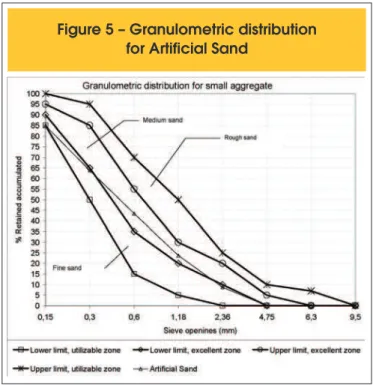
Table [2] shows the granulometric and physical characterization of natural sand. It is observed that the sand is classiied as medium, according to NBR 7211 [15], with ineness module MF = 2.552 and maximum diameter dm = 2.40 mm, in the excellent zone limits (2.20 to 2.90). It can be seen in igure [4] that the cumulative per -centage retained exceeded the upper limit in the 0.15 and 0.3 mm sieves and was below the lower limit in the 1.18 mm sieve. The natural sand presents ineness module of MF = 2.552. It is worth to mention that this sand is used in Vale do Aço as medium sand. Table [3] shows the granulometric and physical characterization of Artiicial Sand. According to NBR 7211 [15] the artiicial sand is classiied as medium sand, with dm = 4.75 RS = 2.247 mm and, in the excellent zone limits (2.20 to 2.90). By observing igure [5] note that the percentage retained in the sieves 0.15, 0.3 and 2.36 mm does not it the established range for medium sand, according to NBR 7211 [15]. However, the substantial percentage of material retained in these sieves has stimulated the use of all of the mate-rial in all granulometric range.
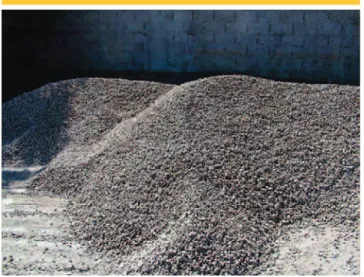
Table [4] shows the granulometric and physical characterization of the gravel. We can observe the values of dm = 12.5 mm and MF = 5.545 determined in accordance to NBR 7211 [15]. In the characteristic curve of the gravel which is shown in igure [6], the percentage in the sieves 2.36 to 6.3 mm do not match the estab -lished range according to NBR 7211 [15], but it was set as gravel
Table 2 – Granulometric and physical Characterization of Natural sand
Sieve
Weight Retained
Percentage
(mm)
(g)
Retained
Accumulated
9,5
6,3
4,75
%
%
2,36
%
%
1,18
58,9
11,78
%
11,78
%
0,6
204,9
40,98
%
52,76
%
0,3
195,1
39,02
%
91,78
%
0,15
35,5
7,1
%
98,88
%
FUND
5,6
1,12
%
100
%
TOTAL
500
100
%
Description
Results
Unit mass
(NBR 52)
1,444 Kg/dm³
Specific Mass
(NBR 52)
2,618 Kg/dm³
Materials In Powder Form
(NBR NM 46)
0,22%
Module of Fineness
(NBR 7211)
2,552
Maximum Diameter
(NBR 7211)
2,4mm
Coefficient of empties
44,84%
0 (zero) due to its vast use all over the region.
Table [5] shows the granulometric and physical characterization of the slag. According to NBR 7211 [15], we ind dm = 19 and MF = 6.742 mm. The granulometric distribution of the slag is plotted in igure [7], the percentage retained in the sieves regard this residue as gravel 1, according to NBR 7211 [15].
The WTSS presented powdery characteristics after processing in hammer mill and was not possible to draw a granulometric curve. It has also presented similar clay characteristics due to color, tex -ture and grain size.
Table [6] shows the values of physical properties (speciic mass) for the fresh concrete.
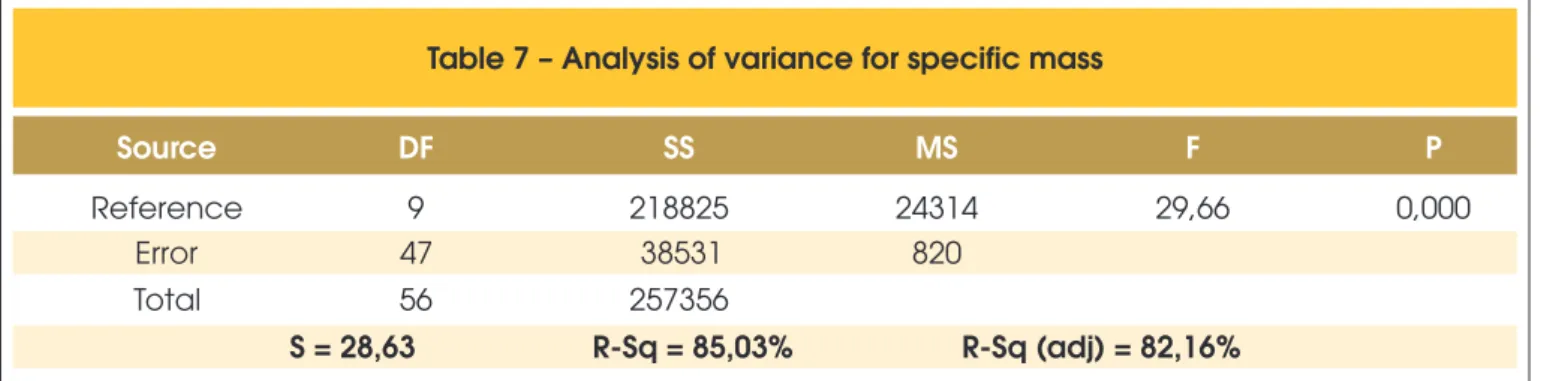
The speciic mass is intrinsic to the porosity of the material, NEV-ILLE [10]. The speciic mass values for mix 2, 3 and 4 (with addi-tion of WTSS) showed a decrease compared to the standard mix, due to the dificulty of mixing this product with powdery character -istics. As the slag was added, mix 5 had an increase of speciic mass. Mix 6 and 7, showed a decrease in speciic mass, due to the composition with the slag and WTSS. Mixes 8, 9 and 10 presented the highest values, as expected the speciic weight of the slag. Table [7] presents the results for the analysis of variance (ANOVA) for the speciic mass variable response, due to the mix that was used. By analyzing the inluence of the mixes in the speciic mass, the P value was less than 0.05, with an adjustment of R-Sq = 82.16%. The P value was less than α of 0.05, so the results of speciic mass are signiicantly different in the many evaluated mixes.
Table 3 – granulometric and physical Characterization of Artificial Sand
Sieve
Weight Retained
Percentage
(mm)
(g)
Retained
Accumulated
9,5
6,3
4,75
%
%
2,36
%
%
1,18
%
%
0,6
%
%
0,3
%
%
0,15
%
%
FUND
%
%
TOTAL
%
Description
Results
Unit mass
(NBR 52)
Specific Mass
(NBR 52)
Materials In Powder Form
(NBR NM 46)
Module of Fineness
(NBR 7211)
Maximum Diameter
(NBR 7211)
Coefficient of empties
48,3
8,71
8,71
83,2
15
23,72
109,5
19,75
43,46
112,9
20,36
63,82
117,3
21,15
84,98
83,3
15,02
100
554,5
100
1,444 Kg/dm³
2,674 Kg/dm³
0,22%
2,247
4,75mm
46%
Table 4 – Granulometric and physical characterization of gravel
Sieve
Weight Retained
Percentage
(mm)
(g)
Retained
Accumulated
%
%
%
%
%
%
%
%
%
%
%
%
%
%
%
Description
Results
Unit mass
(NBR 52)
Specific Mass
(NBR 52)
Materials In Powder Form
(NBR NM 46)
Module of Fineness
(NBR 7211)
Maximum Diameter
(NBR 7211)
Coefficient of empties
19
12,5
9,5
110,66
9,5
9,5
6,3
436,57
37,7
47,2
4,75
329,5
28,43
75,64
2,36
211,2
18,22
93,86
FUND
71,2
6,14
100
TOTAL
1159,21
100
1,444 Kg/dm³
2,632 Kg/dm³
0,42%
5,545
12,5mm
45,12%
Table 5 – Granulometric and physical characterization of slag
Sieve
Weight Retained
Percentage
(mm)
(g)
Retained
Accumulated
%
%
%
%
%
%
%
%
%
%
%
%
%
%
%
Description
Results
Unit mass
(NBR 52)
Specific Mass
(NBR 52)
Materials In Powder Form
(NBR NM 46)
Module of Fineness
(NBR 7211)
Maximum Diameter
(NBR 7211)
Coefficient of empties
19
12,5
9,5
6,3
4,75
2,36
FUND
TOTAL
68
2,8
2,8
1643
68,3
71,1
469
19,5
90,6
140
5,8
96,4
3
0,12
96,55
7
0,29
96,84
76
3,16
100
2406
100
3
1,41 Kg/dm
3
2,632 Kg/dm
Table [8] shows the values of water absorption for the concrete. The monitoring of water absorption determines the amount of per-meable pores in the structure, knowledge of this pore structure
allows one to predict the durability of a concrete, Wirquin [16]. It was observed that within the dosage sequences 1%, 5% and 10% for the WTSS, the absorption behavior followed a pattern of growth in the compositions that only coarse aggregate was used. The melt shop slag aggregate showed results of higher values in relation to the composition in which we used the natural aggregate gneiss rock “Gravel 0”. In this sequence, the mix LERE5 with re -placement of 5%WTSS presented results of higher values of ab-sorption in relation to the mixes in the comparison group and also in the other compositions, except for mix 10.
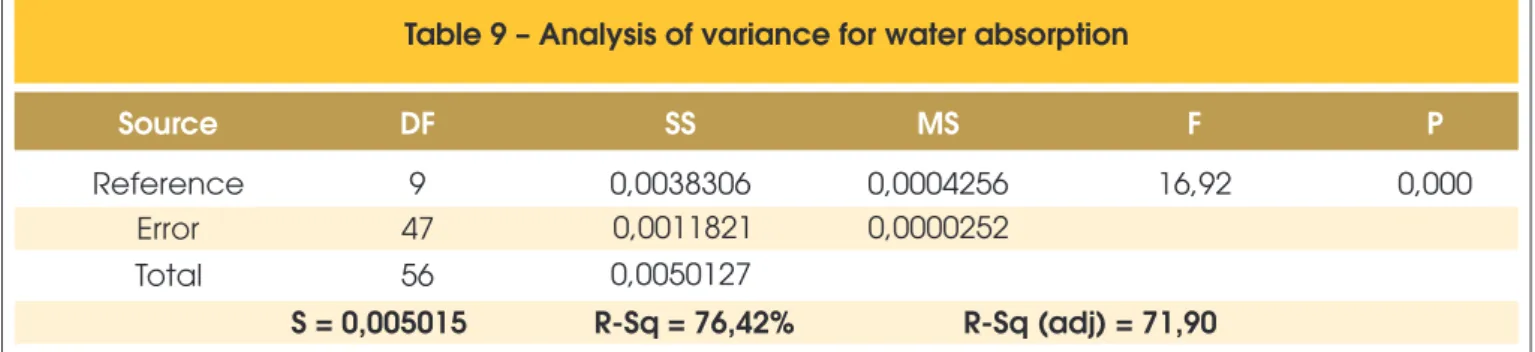
Table [9] presents the results for the analysis of variance (ANOVA) for the water absorption variable response.
Absorption showed signiicant value since its P-value is less than 0.05, with an adjustment of R-Sq = 71.90%, validating the analysis. The various mixes of the directly inluence in the different results. Table [10] shows the values of resistance to simple axial compres-sion, for all the mixes of the concrete at 28 days. In the study of this issue, it was veriied that in general, the values obtained show values directly proportional to the ages within the same substitu-tion pattern.
As the WTSS replacement increases, the resistance to compression happens in a decreasing order when the proportion goes from 1% to 5%, decreasing even more with the compositions of 5% and 10%. In cases where the compositions were fully dosed with coarse ag-gregate replaced 100% by melt shop slag, an increase of the re-sistance was found.
Figure 6 – Granulometric distribution
for gravel
Figure 7 – Granulometric distribution
for slag
Table 6 – Specific mass values
of fresh concrete
Discrimination
Reference
Specific mass
(kg/m )
3Mix 1
Standard
2230,37
Mix 2
LERE1
2178,12
Mix 3
LERE2
2213,69
Mix 4
LERE3
2168,9
Mix 5
LERE4
2213,41
Mix 6
LERE5
2069,53
Mix 7
LERE6
2081,22
Mix 8
LERE7
2246,84
Mix 9
LERE8
2235,01
Mix 10
LERE9
2234,65
Table 7 – Analysis of variance for specific mass
Source
DF
SS
MS
F
P
Reference
9
218825
24314
29,66
0,000
Error
47
38531
820
Total
56
257356
4. Conclusions
Results for the concretes manufactured from waste: water treat -ment station sludge, artiicial sand and steel slag allow us to con-clude that:
The values of the speciic mass of concrete compared with the standard mix: for mix 2, 3 and 4, with the addition of WTSS, showed a decrease. As the slag was added, mix 5, showed an increase in speciic mass. Traces 6 and 7 showed a decrease in speciic mass, due to the composition of the slag and WTSS. Mixes 8, 9 and 10 showed the highest values, since the slag is an aggre -gate of greater density.
For the water absorption in concrete manufactured with waste, only mix 2 showed lower value. It was observed that by increas-ing the percentage of WTSS, the capacity of water absorption in-creased. The concrete with the addition of melt shop slag as ag-gregate showed higher values of water absorption in relation to the composition, in which the natural gneiss rock “Gravel 0” was used. Mix 5 with replacement of 5% of WTSS showed higher values of water absorption in relation to all the other mixes, except mix 10. For the compression resistance it was observed that the concrete with larger fractions of WTS S presented lower values in relation to
the concrete adopted as a standard. This compression resistance happens in a decreasing order when the proportion goes from 1% to 5%, decreasing the even more with the compositions of 5% and 10% of WTSS
For the mixes that presented in their composition the substitution of coarse aggregate (gravel) by 100% for melt shop slag, there was an increase in resistance.
5. Acknowledgements
We are grateful to Mr. Roberto from RECICLOS company, and col -leagues at COPASA and VALEMIX for the availability of resources for doing this research.
Thiago Comrade, for the designing and manufacturing of the mixes and the analyzes of the results, and Mr. Luiz Eugenio, for his patience and for making his company lab available (Solução Engenharia).
6. References
[01] PRUDÊNCIO JR, L.R.; COELHO, A.H.; GUTSTEIN, D. Methodology for obtaining artiicial ine aggregate from processing the powder-stone. In: ENTAC 95, 1995, Rio de Janeiro.
[02] HOPPEN, C. Co-disposal of sludge centrifuged Water Treatment Plant (WTP) in concrete matrix: alternative method of environmental preservation. Ceramics, Jun 2005, vol.51, no.318, p.85-95. ISSN 0366-6913
[03] Brazil Steel Institute. <http://www.acobrasil.org.br/ site/portugues/biblioteca/Folder_Institucional_ AcoBrasil.pdf>, acesso 23/01/2009.
[04] ISAIA, G. C. Building Materials and Principles of Materials Science and Engineering. Volumes 1 and 2. São Paulo, IBRACON, 2008.
[05] AMERICAN CONCRETE INSTITUTE . ACI Standard 211.1, Standard Pratice for Selecting Proportions for Normal, Heavyweight, and Mass Concrete, ACI Manual of Concrete Practice, Part 1, Concrete Institute, Farmington Hills, MI, 2005.
[06] MEHTA, P. K.; MONTEIRO, P.J.M. Concrete, Microstructure, Properties and Materials. São Paulo, IBRACON, 2008.
[07] BRAZILIAN ASSOCIATION OF TECHNICAL STANDARDS. NBR NM 67 – Determination of
Table 8 – Table of water absorption
of concrete
Discrimination
Reference
Absorption (%)
Mix 1
Standard
Mix 2
LERE1
Mix 3
LERE2
Mix 4
LERE3
Mix 5
LERE4
Mix 6
LERE5
Mix 7
LERE6
Mix 8
LERE7
Mix 9
LERE8
Mix 10
LERE9
2,61
2,57
3,24
3,92
4,06
4,75
4,67
4,23
3,89
5,05
Table 9 – Analysis of variance for water absorption
Source
DF
SS
MS
F
P
Reference
9
Error
47
Total
56
S =
0,005015
R-Sq =
76,42
%
R-Sq (adj) = 71,90
0,0038306
0,0004256
16,92
0,000
0,0011821
0,0000252
Table 10 – Table of resistance to axial
compression for the concrete at 28 days
Discrimination
Reference
Tension (MPa)
Rupture
Mix 1
Standard
Mix 2
LERE1
Mix 3
LERE2
Mix 4
LERE3
Mix 5
LERE4
Mix 6
LERE5
Mix 7
LERE6
Mix 8
LERE7
Mix 9
LERE8
Mix 10
LERE9
25,06
20,43
18,54
17,90
22,13
21,60
17,97
26,34
24,55
21,52
consistency by the truncated cone rebate - Brazilian Speciication. Rio de Janeiro. 1998.
[08] SOUZA, FRANCIS RODRIGUES DE. Study of eco-eficiency of mortar and concrete with recycled waste water treatment plants and construction and
[09] SABINO, E.S. Use of stone dust as artiicial sand. CBT - Materials Engineering, UnilesteMG-2008. [10] NEVILLE, A.M. Properties of concrete. Harlow:
Longman, 1995.
[11] BRAZILIAN ASSOCIATION OF TECHNICAL
STANDARDS. NBR 5738 - Procedure for molding and curing of test specimens - Brazilian Speciication. Rio de Janeiro. 2003.
[12] BRAZILIAN ASSOCIATION OF TECHNICAL STANDARDS. NBR 9833 - Determination of density, yield and air content by gravimetric method - Brazilian Speciication. Rio de Janeiro. 2008.
[13] BRAZILIAN ASSOCIATION OF TECHNICAL STANDARDS. NBR 9778 - Hardened mortar and concrete - Determination of water absorption, void ratio and density - Brazilian Speciication. Rio de Janeiro. 2005.
[14] BRAZILIAN ASSOCIATION OF TECHNICAL STANDARDS. NBR 5739 - Concrete - Compression tests of body-of-proof cylindrical. Rio de Janeiro. 2007. [15] BRAZILIAN ASSOCIATION OF TECHNICAL
STANDARDS. NBR 7211 - Aggregates for concrete - Speciication Brazilian. Rio de Janeiro. 2005.

![Table [4] shows the granulometric and physical characterization of the gravel](https://thumb-eu.123doks.com/thumbv2/123dok_br/18859634.417695/5.892.66.436.722.1078/table-shows-granulometric-physical-characterization-gravel.webp)