ISSN 1517-7076 artigo e-11919, 2017
Autor Responsável: Dardania Aparecida Evangelista Rodrigues Data de envio: 15/04/2017 Data de aceite: 30/07/2017 10.1590/S1517-707620170005.0255
Efeito da adição de metacaulim na absorção
capilar e carbonatação do concreto
Effect of metakaolin addition on capillary
absorption and carbonation of concrete
Dardania Aparecida Evangelista Rodrigues1, Abdias Magalhães Gomes2, Vanessa de Freitas Cunha Lins3
1 Companhia Brasileira de Trens Urbanos – CBTU, Belo Horizonte, MG e-mail: [email protected]
2Laboratório de Corrosão – Universidade Federal de Minas Gerais - UFMG, Belo Horizonte, MG e-mail:[email protected]
3
Departamento de Materiais da Construção Civil, Universidade Federal de Minas Gerais - UFMG, Belo Horizonte, MG e-mail: [email protected]
RESUMO
Este estudo avalia os efeitos da adição de metacaulim (MK) ao concreto com resistência à compressão de 30 MPa e 40 MPa, na absorção capilar e na profundidade da carbonatação. Para o teste de absorção capilar, as amostras foram secas no forno, pesadas, imersas em água por períodos de 1, 2, 3 e 24 horas. Após cada perí-odo, as amostras foram secas e pesadas, e esses valores foram utilizados para se obter a curva Abrams. O teste de carbonatação foi realizado após curar as amostras em uma câmara úmida, padronizando a umidade por duas horas e permanecendo na câmara de carbonatação por 30 dias com 5% de CO2 a 23 ± 2 °C. Após este período, as amostras foram cortadas ao meio, pulverizadas com uma solução de fenolftaleína e uma aná-lise de imagem foi feita. Para as amostras preparadas com cimento CPIII com um ou dois agregados, a adição de MK aumentou a absorção capilar. Para as amostras fabricadas com cimento CPV, a amostra sem adição de MK mostrou maior absorção capilar. O menor valor de profundidade de carbonatação foi observado para amostras fabricadas com cimento CPV e dois agregados. A maior profundidade de carbonatação foi observa-da para a amostra com cimento CPIII, pedra trituraobserva-da 1, com adição de MK.
Palavras-chave: matacaulim, concreto, absorção capilar, carbonatação
ABSTRACT
This study evaluates the effects of metakaolin (MK) addition to concrete with compressive strength of 30MPa and 40MPa, on capillary absorption and depth of carbonation. For the capillary absorption test, the samples were oven dried, weighed, immersed in water for periods of 1, 2, 3 and 24 hours. After each period, the samples were dried and weighed, and these values were used to obtain the Abrams curve. The carbona-tion test was carried out after curing the specimens in a moist chamber, standardizing the humidity for two hours and remaining in the carbonation chamber for 30 days with 5% CO2 at 23±2°C. After this period, the specimens were cut in half, sprayed with a solution of phenolphthalein and an image analysis was performed. For samples prepared with CPIII cement with one or two aggregates, the MK addition increased the capillary absorption. For the samples manufactured with CPV cement, the sample without MK addition showed a higher capillary absorption. The lowest value of carbonation depth was observed for samples manufactured with CPV cement and two aggregates. The highest carbonation depth was observed for the sample with CPIII cement, crushed stone 1, with metakaolin addition.
Keywords: metakaolin, concrete, capillary absorption, carbonation
1. INTRODUCTION
and durability [1-7]. The utilization of calcined clay, in the form of metakaolin (MK), as a pozzolanic materi-al for mortar and concrete has received considerable attention in recent years. This interest is part of the widely spread attention directed towards the utilization of wastes and industrial by-products in order to min-imize Portland cement (PC) consumption, the manufacture of which being environmentally damaging. Mor-tar and concrete, which contain pozzolanic materials, exhibit considerable enhancement in durability proper-ties [8-26]. Literature demonstrates that MK is an effective pozzolan which causes significant improvement in the pore structure and hence the resistance of the concrete to the action of harmful solutions [17].
Metakaolin improves the engineering properties of concrete because of its double effect on cementi-tious matrix (filler effect and pozzolanic properties). Moreover, MK can reduce impact of concrete on the environment due to its lower carbon dioxide emission than clinker. The development of a slurry form of MK opens new fields of investigations, such as its incorporation into self-compacting concrete (SCC) [8].
Kou et al [26] reported that MK contributed to both the short and long-term properties of concrete. As far as compressive strength is concerned, the replacement of cement by 15% of MK improved both the me-chanical and durability performance. MK contributes to the short and long-term properties of concrete be-cause the calcium hydroxide of cement reacts with the silica of the MK producing a more resistant compound [26].
Batis et al [15] concluded that metakaolin improves the compressive strength and the 10 wt.% addi-tion shows the optimum contribuaddi-tion to the strength development. In addiaddi-tion, the use of MK, either as a sand replacement up to 20 wt.% , or as a cement replacement up to 10 wt.%, improves the corrosion behavior of mortar specimens, while when MK is added in greater percentages there is no positive effect [15].
Metakaolin is a valuable admixture for concrete/cement applications that can enhance the performance of cementitious composites through high pozzolanic reactivity such as silica fume (SF). While SF concrete is characterized by superior mechanical and durability performance, concrete containing MK achieves compa-rable properties at a lower price and with better workability. Highly ducompa-rable self-compacting concrete (SCC) mixtures can be produced using a high MK content with an optimum percentage of 20 wt.% [9]. Results have also shown that the durability of SCC, especially with high MK content, is higher than that of SCC contain-ing SF [9].
Badogrannis and Tsivilis [12] reported that MK concrete exhibits a lower chloride permeability, gas permeability and sorptivity. The addition of metakaolin refines the pore system of concrete, leading to a de-creased mean pore size and improved uniformity of the pore size distribution [12].
Badogiannis et al [13] concluded that MK has a very positive effect on cement strength after 2 days and specifically at 28 and 180 days. The blended cements demand significantly more water than the relative-ly pure cement [13]. With the addition of MK to concrete, the pozzolanic reaction is accelerated between 7 and 28 days, accompanied by a steep decrease of Ca(OH)2 content [13]. Finally, it is concluded that a 10 wt.% metakaolin content seems to be, generally, more favorable than 20 wt.% [13].
This study evaluates the effects of the addition of metakaolin to concrete on capillary absorption and depth of carbonation. Two types of concrete were used, CPV and CPIII cement, with different particle size, and two types of aggregates were utilized, generating a study which was not found in literature. This study, as already mentioned, has academic and technological importance, and contributes to the development of a durable and environmentally friendly product.
2. MATERIALS AND METHODS
The capillary absorption and depth of carbonation were measured in concrete with a compression strength of 30MPa and 40MPa, which are widely used in civil works of medium and large size.
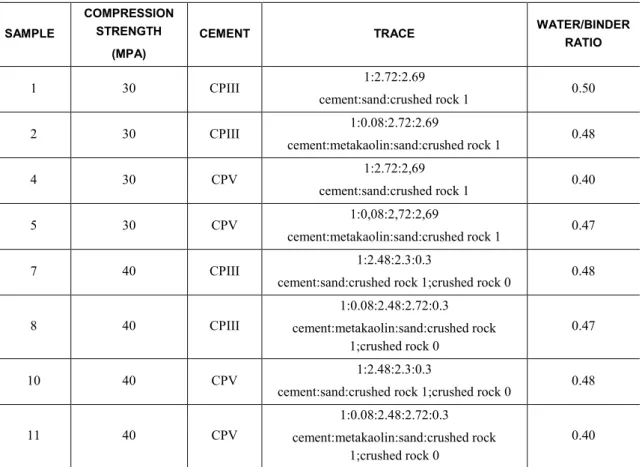
The samples were differentiated by the type of coarse aggregate (crushed rock 0 and 1) and the presence of metakaolin addition, plus two types of cement (CPIII and CPV), as shown in Table 1.
Table 1: Chemical composition of concrete samples.
SAMPLE
COMPRESSION STRENGTH
(MPA)
CEMENT TRACE WATER/BINDER
RATIO
1 30 CPIII 1:2.72:2.69
cement:sand:crushed rock 1 0.50
2 30 CPIII 1:0.08:2.72:2.69
cement:metakaolin:sand:crushed rock 1 0.48
4 30 CPV 1:2.72:2,69
cement:sand:crushed rock 1 0.40
5 30 CPV 1:0,08:2,72:2,69
cement:metakaolin:sand:crushed rock 1 0.47
7 40 CPIII 1:2.48:2.3:0.3
cement:sand:crushed rock 1;crushed rock 0 0.48
8 40 CPIII
1:0.08:2.48:2.72:0.3
cement:metakaolin:sand:crushed rock 1;crushed rock 0
0.47
10 40 CPV 1:2.48:2.3:0.3
cement:sand:crushed rock 1;crushed rock 0 0.48
11 40 CPV
1:0.08:2.48:2.72:0.3
cement:metakaolin:sand:crushed rock 1;crushed rock 0
0.40
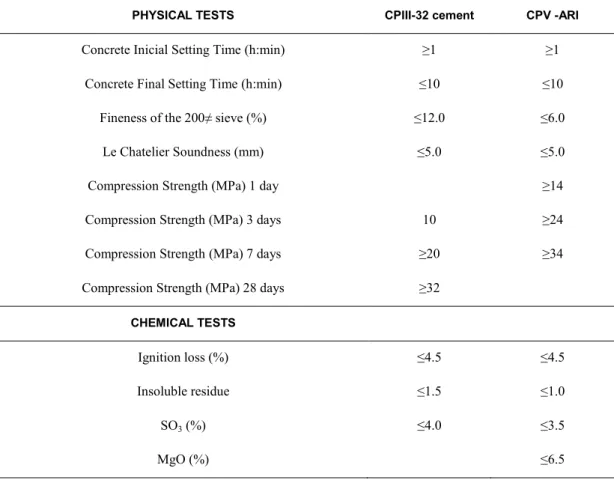
Table 2: Physical and chemical properties of CPIII and CPV cement.
PHYSICAL TESTS CPIII-32 cement CPV -ARI
Concrete Inicial Setting Time (h:min) ≥1 ≥1
Concrete Final Setting Time (h:min) ≤10 ≤10
Fineness of the 200≠ sieve (%) ≤12.0 ≤6.0
Le Chatelier Soundness (mm) ≤5.0 ≤5.0
Compression Strength (MPa) 1 day ≥14
Compression Strength (MPa) 3 days 10 ≥24
Compression Strength (MPa) 7 days ≥20 ≥34
Compression Strength (MPa) 28 days ≥32
CHEMICAL TESTS
Ignition loss (%) ≤4.5 ≤4.5
Insoluble residue ≤1.5 ≤1.0
SO3 (%) ≤4.0 ≤3.5
MgO (%) ≤6.5
For the capillary absorption test, the samples were oven dried and weighed to obtain the initial weight. After this procedure, they were immersed in containers with blades 3 cm of water for periods of 1, 2, 3 and 24 hours. After each period, the samples were dried and weighed, and these values were used to obtain the curve:
Abs = A / Bx (1)
where Abs is the value of capillary absorption equation, A and B are constants, and x is the value of compression strength. This equation is known as the Abrams equation.
The carbonation test was carried out after curing the specimens in a moist chamber. The samples were placed in an incubator to standardize the humidity for two hours and placed in the carbonation chamber for 30 days with 5% CO2 at 23±2°C chamber. After this period, the specimens were cut in half, sprayed with a solution of phenolphthalein and the images were registered. The images were used in a design program, Au-toCAD, where three measurements were taken on the four sides of the samples and put in a spreadsheet for removal of medium and the value of the depth of carbonation was determined for each sample. The method used is similar to that used in a previous research [27].
Figure 1: Measurement of carbonation depth.
3. RESULTS
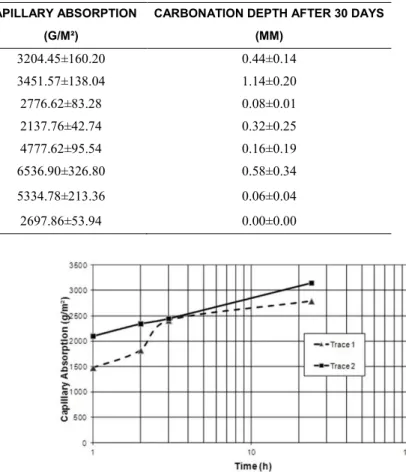
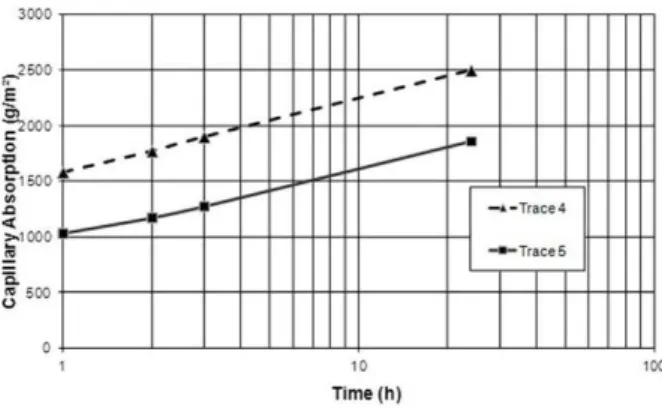
Table 3 and Figures 2 to 5 show the results of capillary absorption for the samples studied.
Table 3: Capillary absorption and carbonation depth results.
TRACE CAPILLARY ABSORPTION (G/M²)
CARBONATION DEPTH AFTER 30 DAYS
(MM)
01 3204.45±160.20 0.44±0.14
02 3451.57±138.04 1.14±0.20
04 2776.62±83.28 0.08±0.01
05 2137.76±42.74 0.32±0.25
07 4777.62±95.54 0.16±0.19
08 6536.90±326.80 0.58±0.34
10 5334.78±213.36 0.06±0.04
11 2697.86±53.94 0.00±0.00
Figure 3: Capillary absorption versus time for traces 4 and 5.
Figure 4: Capillary absorption versus time for traces 7 and 8.
Figure 5: Capillary absorption versus time for traces 10 and 11.
Comparing samples 1 and 2, prepared with the same cement (CPIII) and crushed stone 1, sample 2 with MK addition showed a higher capillary absorption. For samples prepared with CPIII cement and crushed stone 0 and 1, sample 8 with MK addition also showed a higher capillary absorption.
In the case of Trace 1, without metakaolin addition, a higher rate of capillary absorption was identified between two and three hours of testing. After 3 hours of testing, the capillary absorption of the samples with and without metakaolin was the same. For times above 3 hours, the capillary absorption of the samples with-out metakaolin increased at a lower rate than the samples with MK. After 20 hours of testing, the capillary absorption of the concrete with MK addition was higher than the absorption of concrete without metakaolin. For the samples manufactured with CPV cement, the sample without MK addition showed a higher capillary absorption, for the samples prepared with crushed stone 1, and with both crushed stones.
Figure 6: Carbonation depth of traces 1 (CPIII cement without MK), 2 (CPIII cement with MK), 4 (CPV cement without MK), and 5 (CPV cement with MK).
Figure 7: Carbonation depth of traces with two aggregates: 7 (CPIII cement, without MK), 8 (CPIII cement with MK), 10 (CPV cement without MK), and 11 (CPV cement with MK).
aggre-gate, with MK addition. Changing only the type of cement, the use of cement CPV reduced the depth of car-bonation due to the finer grinding of CPV cement.
The lowest value of carbonation depth was observed for samples 10 and 11, manufactured with CPV cement and two aggregates.
4. DISCUSSION
For samples with CPIII cement, the addition of metakaolin refines the pore system of concrete, leading to a decreased mean pore size and improved uniformity of the pore size distribution [12]. The refinement of pores generates an increase of capillary force, increasing the capillary absorption, as observed.
The CPV cement has the peculiarity to achieve high resistance in the first days of application. The development of high early strength is achieved by using the finer grinding of the cement (Table 2), so that in reaction with water, it acquires a higher resistance with a higher speed. The clinker is the same used for the manufacture of conventional cement, but remains in the mill for a longer time. The lower particle size of the CPV cement than the conventional cement generates a lower pore size, and the effect of MK of pore refine-ment become less significant. The addition of MK may even have clogged the fine pores of the concrete and caused the reduction of capillary absorption. Therefore, the cement CPV with MK addition showed a reduc-tion in capillary absorpreduc-tion and is less susceptible to penetrareduc-tion of aggressive agents. Capillary absorpreduc-tion is directly related to the pore refinement, which occurs in samples of CPV cement. In addition, the pozzolanic reactions in CPV cement samples with MK addition occur faster than in samples of CPIII cement generating a higher compactness and hindering capillary absorption. The SiO2 of MK reacts with the calcium hydroxide of cement generating a calcium silicate hydrate, stratlingite (C2ASH8), and tetra calcium aluminium hydrate (C4AH13) the main phases formed at ambient temperature. These hydraulic products alter the pore structure of the lime and cement pastes and greatly improving its resistance to the transport of water [28].
MK addition increased the carbonation depth. MK is a material produced by calcination of kaolinitic clays or special clays (kaolin, high purity), and induces pozzolanic reactions in concrete. These reactions in-duce the reduction of the content of Ca(OH)2 in the pore solution of the concrete, causing it to need a smaller quantity of CO2 to react with Ca(OH)2 producing carbonates. Thus, the rate of carbonation increases due to the lower amount of Ca(OH)2 to react with the CO2 diffusing in the pores. The concrete with pozzolan addi-tions are more susceptible to the effects of reinforcement corrosion than concrete made with cement without mineral addition [28].
High resistance concrete showed a higher resistance to external attack such as carbonation process due to the lower particle size of CPV cement than the CPIII cement. The samples with two types of aggregates (0 and 1) showed a lower carbonation depth, once the presence of both aggregates reduced the porous size or increased compaction, enhancing the concrete quality.
5. CONCLUSIONS
For samples prepared with CPIII cement with one or two aggregates, the metakaolin addition increased the capillary absorption. For the samples manufactured with CPV cement, with a lower particle size, the sample without MK addition showed a higher capillary absorption, for the samples prepared with crushed stone 1, and with both crushed stones.
The lowest value of carbonation depth was observed for samples manufactured with CPV cement and two aggregates. The highest carbonation depth was observed for the sample prepared with CPIII cement, crushed stone 1, and MK addition.
6. BIBLIOGRAPHY
[1] NASIR, M., BAGHABRA AL-AMOUDI, O. S., MASLEHUDDIN, M.,“Effect of placement temperature
and curing method on plastic shrinkage of plain and pozzolanic cement concretes under hot weather”,
Con-struction and Building Materials, v. 152, pp. 943-953, 2017.
[2] KEPPERT, M., URBANOVÁ, M., BRUS, J., et al., “Rational design of cement composites containing
pozzolanic additions”, Construction and Building Materials, v. 148, pp. 411-418, 2017.
[3] PAIVA, H., SILVA, A.S., VELOSA, A., et al., “Microstructure and hardened state properties on pozz
o-lan-containing concrete”, Construction and Building Materials, v. 140, pp. 374-384, 2017.
[4] DEMBOVSKA, L., BAJARE, D., PUNDIENE, I., et al., “Effect of Pozzolanic Additives on the Strength
[5] KUMAR, B.M.V., ANANTHAN, H., BALAJI, K.V.A., “Experimental studies on cement stabilized m a-sonry blocks prepared from brick powder, fine recycled concrete aggregate and pozzolanic materials”, Jour-nal of Building Engineering, v. 10, pp. 80-88, 2017.
[6] ZEYAD, A.M., JOHARI, M.A.M., TAYEH, B.A., et al., “Pozzolanic reactivity of ultrafine palm oil fuel ash waste on strength and durability performances of high strength concrete”, Journal of Cleaner Production, v. 144, pp. 511-522, 2017.
[7] SETINA, J., GABRENE, A., JUHNEVICA, I., “Effect of Pozzolanic Additives on Structure and Chem
i-cal Durability of Concrete”, Procedia Engineering, v. 57, pp. 1005-1012, 2013.
[8] PERLOT, C., ROUGEAU, P., DEHAUDT, S. “Slurry of metakaolin combined with limestone addition
for self-compacted concrete. Application for precast industry”, Cement and Concrete Composites, v. 44, pp. 50-57, 2013.
[9] HASSAN, A.A.A., LACHEMI, M., HOSSAIN, K.M.A. “Effect of metakaolin and silica fume on the durability of self-consolidating concrete”, Cement and Concrete Composites, v. 34, n. 6, pp. 801-807, 2012.
[10] WILD, S., KHATIB, J.M., JONES, A. “Relative strength, pozzolanic activity and cement hydration in
superplasticised metakaolin concrete”, Cement and Concrete Research, v. 26, n. 10, pp. 1537-1544, 1996.
[11] SHA, W., PEREIRA, G.B. “Differential scanning calorimetry study of ordinary Portland cement paste
containing metakaolin and theoretical approach of metakaolin activity”, Cement and Concrete Composites, v. 23, n. 6, pp. 455-461, 2001.
[12] BADOGIANNIS, E., TSIVILIS, S. “Exploitation of poor Greek kaolins: Durability of metakaolin co
n-crete”. Cement and Concrete Composites, v. 31, n. 2, pp. 128-133, 2009.
[13] BADOGIANNIS, E., KAKALI, G., DIMOPOULOU, G., et al., “Metakaolin as a main cement constit u-ent Exploitation of poor Greek kaolins”, Cement and Concrete Composites, v. 27, n. 2, pp. 197-203, 2005. [14] MOULIN, E., BLANC, P., SORRENTINO, D. “Influence of key cement chemical parameters on the properties of metakaolin blended cements”, Cement and Concrete Composites, v. 23, n. 6, pp. 463-469, 2001. [15] BATIS, G., PANTAZOPOULOU, P., TSIVILIS, S., et al., “The effect of metakaolin on the corrosion behavior of cement mortars”, Composites Cement and Concrete, v. 27, n. 1, pp. 125-130, 2005.
[16] VANCE, K., AGUAYO, M., OEY, T., et al., “Hydration and strength development in ternary portland cement blends containing limestone and fly ash or metakaolin”, Cement and Concrete Composites, v. 39, pp. 93-103, 2013.
[17] SABIR, B.B., WILD, S., BAI, J. “Metakaolin and calcined clays as pozzolans for concrete: a review”.
Cement and Concrete Composites, v. 23, n. 6, pp. 441-54.
[18] BROOKS, J.J., JOHARI, M.A.M. “Effect of metakaolin on creep and shrinkage of concrete”, Cement and Concrete Composites, v. 23, n. 6, pp. 495-502, 2001.
[19] POON, C.S., AZHAR, S., ANSON, M., et al., “Performance of metakaolin concrete at elevated tempe
r-atures”, Cement and Concrete Composites, v. 25, n. 1, pp. 83-89, 2003.
[20] GAMEIRO, A., SANTOS SILVA, A., FARIA, P., et al., “Physical and chemical assessment of lime– metakaolin mortars: Influence of binder:aggregate ratio”, Cement and Concrete Composites, v. 45, pp. 264-271, 2014.
[21] CASSAGNABÈRE, F., DIEDERICH, P., MOURET, M., et al., “Impact of metakaolin characteristics on the rheological properties of mortar in the fresh state”, Cement and Concrete Composites, v. 37, pp. 95-107, 2013.
[22] BAI, J., WILD, S. “Investigation of the temperature change and heat evolution of mortar incorporating
PFA and metakaolin”, Cement and Concrete Composites, v. 24, n. 2, pp. 201-209, 2002.
[23] AQUINO, W., LANGE, D.A., OLEK, J. “The influence of metakaolin and silica fume on the chemistry
of alkali–silica reaction products”, Cement and Concrete Composites, v.23, n. 6, pp. 485-493, 2001.
[24] FORTES-REVILLA, C., MARTÍNEZ-RAMÍREZ, S., BLANCO-VARELA, M.T. “Modelling of slaked lime–metakaolin mortar engineering characteristics in terms of process variables”, Cement and Concrete Composites, v. 28, n. 5, pp. 458-467, 2006.
[25] KOU, S.C., POON, C.S., AGRELA, F. “Comparisons of natural and recycled aggregate concretes pr
[26] CAFANGE, D.M.P.J., Estudo de Métodos auxiliares para o controle da resistência à carbonatação de concretos estruturais de Cimento Portland, Dissertação de M.Sc., Universidade de São Paulo, São Paulo, SP, Brasil, 2011.
[27] GAMEIRO, A.L., SILVA, A.S., VEIGA, M.R., et al., “Lime-metakaolin hydration products: a
micros-copy analysis”, MTAEC9, v.46, n. 2, 145-148, 2012.