Atomic Absorption Spectrophotometric
Determination of Lead in White Rice
Sherryl M. Montalbo1, Shirley G. Cabrera2
Batangas State University, Batangas City, Philippines [email protected], [email protected]
Date Received: September 26, 2015; Date Revised: October 27, 2015
Asia Pacific Journal of Multidisciplinary Research
Vol. 3 No. 4, 24-28 November 2015 Part IV P-ISSN 2350-7756 E-ISSN 2350-8442
www.apjmr.com
Abstract –Recent studies on the heavy metal content of rice from various parts of the world have alarmed rice-eating nations, including the Philippines. In 2013, Philippine Rice Research Institute (PhilRice) reported that rice in the Philippines needs to be evaluated to determine whether these contain heavy metals such as lead.
This research aimed to assess the presence of lead in the three highest selling rice varieties harvested in Oriental Mindoro and sold in Batangas City public markets. It was done to asses if the lead concentration in the raw and cooked rice samples conform to the maximum acceptable level in food established by Joint FAO/WHO Expert Committee on Food Additives (JECFA) Program Codex Alimentarius Commission.
Survey analysis showed that the three highest selling rice varieties during the period when this study was conducted were Sinandomeng, Dinorado and C-4 Dinorado respectively. Lead analysis of rice samples was carried out using Flame Atomic Absorption Spectroscopy. The lead content in both the raw and cooked rice samples were not detected, meaning that the lead concentration were either not present or may be present but is less than the detection limit of the instrument used. The lead concentration in the rice samples from Oriental Mindoro conformed to the standards for food safety for lead content in rice, which is 0.2 mg/kg or 0.2 ppm, set by the Codex Alimentarius Commission.
Keywords –flame atomic absorption spectroscopy, heavy metals, lead, Oriental Mindoro, rice
INTRODUCTION
For centuries, rice has remained the staple food of Filipinos. The United States Department of Agriculture reported that the Philippine milled rice consumption in year 2012 was 12 850 000 metric tons [1].
Rice is a common crop cultivated all throughout the Philippine archipelago. They are planted on paddies with constant supply of water and as translocators, they will absorb whatever is in their surroundings, whether naturally occurring substances or caused by pollution. With the heavy industrialized world, different anthropogenic activities have generated various pollutants in the environment, most serious of which is the incorporation of heavy metals in soil, air and water resources. Many research studies have reported trace element concentrations, especially, arsenic, cadmium, mercury, and lead in rice grains from different countries around the world. These four ubiquitous trace elements are known to have a harmful effect on human health.
In 2013, Tongesayi found out that rice imported from Asia, Europe and South America contains levels of lead that are 20 to 60 times higher than what is permitted by the US Food and Drug Administration.
Moreover, the research claimed that since the staple food of Asians is rice, the higher rice consumption will translate to 60 to 120 times higher exposure of lead for infants and children [2].
In another report published in the international global rice web site, Oryza.com (May, 2013), the levels of cadmium in about 44.44 percent of rice samples in Guangzou City in Southern China were high, as determined by their Food and Drug Administration [3].
Recent studies on the heavy metal content of rice from various parts of the world have alarmed rice-eating nations, including the Philippines. Philippine Rice Research Institute (PhilRice) reported that rice in the Philippines needs to be evaluated to determine whether these contain heavy metals such as lead. Likewise, to limit exposure to these toxins, the agency recommends to rinse rice thoroughly with water before cooking. It is further advised to pour off the water after boiling.
Most of the rice available in Batangas City public markets is supplied from Oriental Mindoro, an island province located on the south-western part of Batangas City. Oriental Mindoro is recognized as the “Rice Granary of Southern Tagalog.” For many years, the province has continuously produced one to two million cavans as surplus in rice production [4].
In addition to being an agricultural land, Mindoro island also contains deposits of minerals like gold, iron and nickel. The nickel resources in Mindoro was assessed to be over 300 million tons and is believed to be the largest nickel laterite deposit worldwide.
At present, no large-scale mining activities are in operation in Mindoro. It is the small scale miners who have been mining in the province for a long period of time already. These miners are often unaware of the environmental impact of their mining procedures, like the input of different substances like heavy metals to the air, soil and water. In addition, there are no government offices to check the environmental compliance of these small-scale mining operations, making them unauthorized and unregulated.
In response to the aforementioned circumstances, this research aimed to assess the amount of lead in cooked and uncooked rice sourced from Oriental Mindoro and sold in different authorized retailers in Batangas City using Atomic Absorption Spectroscopy and determine whether the amount of lead in the rice samples conform to the maximum acceptable level in food permitted by Joint FAO/WHO Expert Committee on Food Additives (JECFA) Program Codex Alimentarius Commission. The three highest selling rice varieties were selected as samples in this study because they will have the greatest impact to the consuming public.
The analysis of lead in rice grains obtained from this study can also serve as baseline data for future comparative studies on the lead levels in rice during the time when there are no mining operations in Oriental Mindoro and in future time when the anticipated large scale mining industries will be in full operation in the said province. It is to be noted that the province has the largest laterite nickel deposit in the world, located within the municipality of Victoria in Oriental Mindoro and the municipality of Sablayan, Occidental Mindoro.
MATERIALS AND METHODS
The researcher utilized the descriptive research design in determining the concentration of lead in selected rice varieties harvested from Oriental Mindoro
and sold in Batangas City public markets. Flame Atomic Absorption Spectrophotometer was the instrument used in analysing the lead content of the rice samples.
Gathering of Samples
A survey questionnaire to determine the three highest selling rice varieties from Mindoro were distributed to rice dealers in Batangas City public markets. A total of 31 rice stall owners/sellers out of the total 81 rice stall owners in both Batangas City Old and New Public Markets participated in the survey. The respondents were asked to list down the top five highest selling rice varieties sourced from Oriental Mindoro. The sales ranking was based on the frequency tally obtained from their given list. Based on the result of this survey, the top three highest selling rice varieties were purchased from rice stalls in Batangas City public markets by convenience sampling. Cooked and uncooked composite rice samples of each rice variety were prepared.
Sample Preparation of Rice for Lead Analysis The researcher adopted the AOAC Official Method 999.10. in determining the Pb content for both cooked and uncooked rice samples. The cooked samples were prepared at Batangas State University – GPB Main Campus I Chemistry laboratory. The researcher used distilled water in washing and cooking the rice samples. One cup of rice was added to 1 ¾ - 2 cups water, was covered, and brought to boiling. Then the heat was set to low for 20 minutes. After 20 minutes, the beaker was removed from heat and was allowed to steam for 5 minutes. The cooked rice samples together with the uncooked rice samples were brought on the same day to Lipa Quality Control Center Laboratory for laboratory analysis of lead.
Analysis of Lead
The lead concentration in the rice samples were determined using AOAC Official Method 999.10.
Ashing. Into a crucible, forty grams of sample was weighed and ignited in a furnace at 550oC for three hours until a light gray ash was produced and it was then cooled to room temperature.
acid-digestion, the samples were cooled to room temperature.
Determination of Lead. The rice samples were analysed for lead concentration using Shimadzu Flame Atomic Absorption Spectrophotometer 700 Model.
RESULTS AND DISCUSSION
1.The Three Highest Selling Rice Varieties from Oriental Mindoro Sold in Batangas City Public Markets
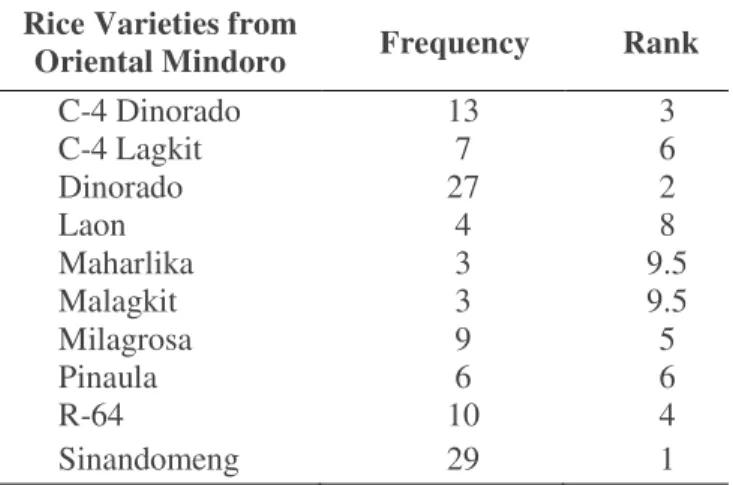
Table 1 shows the result of the survey to determine the three highest selling rice varieties cultivated in Oriental Mindoro and sold in Batangas City public markets. From the table it can be seen that the three highest selling rice varieties were Sinandomeng, Dinorado and C-4 Dinorado, with frequencies of 29, 27 and 13 respectively.
Table 1. Survey on the Frequency of Sales of Rice Varieties from Oriental Mindoro in Batangas City Public Markets
Rice Varieties from
Oriental Mindoro Frequency Rank
C-4 Dinorado 13 3
C-4 Lagkit 7 6
Dinorado 27 2
Laon 4 8
Maharlika 3 9.5
Malagkit 3 9.5
Milagrosa 9 5
Pinaula 6 6
R-64 10 4
Sinandomeng 29 1
In the Philippine setting, rice is classified as special, ordinary and NFA. The three highest selling rice varieties from Oriental Mindoro and sold in Batangas City public markets all belong to special, well-milled commercial varieties of rice and are more expensive than ordinary and NFA rice.
Based on the 2006 Family Income and Expenditure Survey (FIES), ordinary rice has the biggest consumption with an average consumption of 463 kg per family per year or 8.9 kg a week. It was followed by special rice, with an average consumption of about 329 kg per family annually, or 6.3 kg a week. NFA rice has the lowest consumption with an average of 255 kg per family per year or 4.9 kg a week [5].
Unlike the result of 2006 FIES, this survey showed that Batangueños preferred special rice over ordinary and NFA rice, even though they are more expensive. It shows that they are willing to spend more to get better quality of what is considered as the staple food of Filipinos.
2. Analysis of Lead in Rice Cultivated from Oriental Mindoro
The results of the lead analysis in rice from Oriental Mindoro using Flame Atomic Absorption Spectrophotometer were presented in Table 2.
Table 2. Lead Concentration in Uncooked and CookedRice Varieties from Oriental Mindoro
As can be seen in Table 2, the lead concentration in the three rice varieties were not detected by the instrument used. It means that the lead content in the Sinandomeng, Dinorado, and C-4 Dinorado rice samples were way below the detection limit of the instrument and hence, it can be said that these rice samples have very low lead content.
This is the same with the results of the study conducted by Yap et al., (2009) on the uptake of cadmium (Cd), chromium (Cr), copper (Cu), iron (Fe), manganese (Mn), lead (Pb), and zinc (Zn) by paddy plants in Malaysia. Their research showed that all the studied metals except for Pb, were present in all the plant parts, i.e. leaves, stems, roots and grains. Their study revealed that the heavy metals in the soil were mainly derived from the basic rocks found in the study area and the availability of toxic metals to the paddy plants were found to be quite low [6].
The absence of lead in rice in the present study also implied that the soil from which these rice plants were planted were still free from lead contamination. Various studies showed that trace elements are introduced into the soil from different sources. Mining, manufacturing and the use of synthetic products (like pesticides and fertilizers) can result in heavy metal contamination of agricultural soils [7]-[9].
Mousavi et al., (2010) investigated the lead and cadmium availability and uptake by rice plant in
Rice Varieties Lead Concentration (ppm)
Uncooked Rice Cooked Rice
Sinandomeng Not Detected Not Detected
Dinorado Not Detected Not Detected
C-4 Dinorado Not Detected Not Detected
response to different biosolids and inorganic fertilizers using split plot arrangement based on randomized complete block design with three replications in 2008. Their study concludes that municipal solid waste, vermicompost and inorganic fertilizers could affect the Pb and Cd concentration and their subsequent uptake by rice plant. The highest available Pb and Cd in soil occurred when 40 ton of solid waste + ½ inorganic fertilizers were added to soil for 3 continuous years (about 84.5% enhancement compared to control treatment). Lead uptake by grain increased to 59% in 3 continuous years of application of 40 ton per hectare municipal solid waste compost and the most Pb content in root (71% enhanced compared to control) measured in 3 continuous years application of 20 ton per hectare municipal solid waste compost + ½ inorganic fertilizer. They also stated that with increasing the application periods from 1-3 years, Pb and Cd concentration increased in soil and crop tissues, as well [10].
Relative to this, as evidenced by the result of the Pb analysis in rice in the present study, we can say that farming methods like the use of fertilizers and pesticides in Oriental Mindoro do not cause lead contamination in soil since there were no detectable lead uptake in the rice varieties examined.
3. Conformance of the Rice Samples with the Standards for Food Safety in terms of Lead Content in Rice set by the Joint FAO/WHO Expert Committee on Food Additives (JECFA) Program Codex Alimentarius Commission.
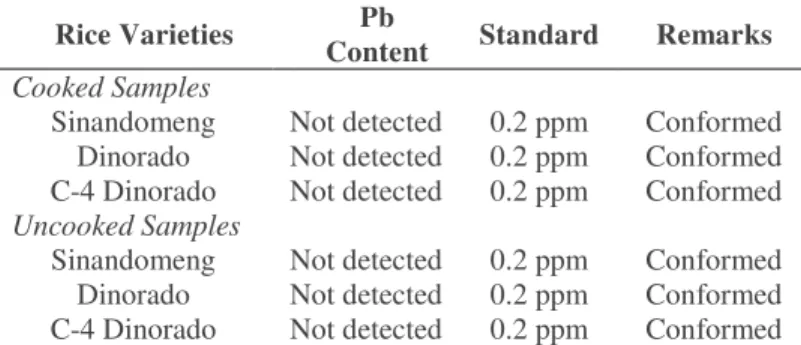
Table 3. Conformance of the Rice Samples with the Standards for Food Safety in terms of Lead Content in Rice
Rice Varieties Pb
Content Standard Remarks
Cooked Samples
Sinandomeng Not detected 0.2 ppm Conformed
Dinorado Not detected 0.2 ppm Conformed
C-4 Dinorado Not detected 0.2 ppm Conformed
Uncooked Samples
Sinandomeng Not detected 0.2 ppm Conformed
Dinorado Not detected 0.2 ppm Conformed
C-4 Dinorado Not detected 0.2 ppm Conformed
*Not Detected means < 0.06 ppm, DL of the instrument
As what can be seen from Table 3, the lead concentration in all of the rice samples were not detected by the instrument used, which has a detection limit of 0.06 ppm.
As cited by Frimpong (2013), Head of the Food and Agriculture Department of the Ghana Standards Authority, the Codex Alimentrius Commission (CAC) set the tolerable limits of lead in rice at 0.2 mg/kg or 0.2 ppm. Likewise, the Codex committee on food additives and contaminants of the joint FAO/WHO food standards program has proposed draft levels for typical daily exposure and theoretical tolerable weekly intake (PTWI) for some of heavy metals in cereals such as rice. JECFA has set the Provisional Tolerable Weekly Intake (PTWI) for Pb equal to 25 µg/kg of body weight [11].
As lead content was not detectable in rice, hence, it can be said that the rice samples cultivated in Oriental Mindoro and sold in Batangas City public markets conformed to the standards for food safety for lead content in rice set by the Codex Alimentarius Commission. Given the foregoing statements, the rice samples from Oriental Mindoro do not pose as a threat for lead poisoning and are safe for human consumption, especially for children who are more susceptible to the negative health effects of lead due to their small body weights.
CONCLUSION AND RECOMMENDATION
The three highest selling rice varieties cultivated in Mindoro and sold in Batangas City public markets during the period when this study was conducted were Sinandomeng, Dinorado and C-4 Dinorado. The lead content in both the uncooked and cooked rice samples in this study were not detected, meaning that the lead concentration in the rice samples were either not present or may be present but is less than the detection limit of the instrument used.The lead concentration in the rice samples conformed to standards for food safety for lead content in rice allowed by Joint FAO/WHO Expert Committee on Food Additives (JECFA) Program Codex Alimentarius Commission.
determine the lead content of all available rice in the Philippine market.
REFERENCES
[1] Philippines Milled Rice Domestic Consumption by
Year, URL: http://www.indexmundi.com/agriculture, date retrieved: 15 September 2013.
[2] American Chemical Society - High levels of lead
detected in rice imported from certain
countries. URL:www.sciencedaily.com/releases/2013/ 04/130410201824.htm,date retrieved: 10 October 2013
[3] Excessive Cadmium Detected in Rice in Southern
China Restaurants, URL: http://www.oryza.com
/content/excessive-cadmium-detected-rice-southern-china-restaurants, date retreived: 09 September 2013.
[4] M38 reaches Oriental Mindoro - the Rice Granary of
Southern Tagalog, URL:
http://philscat.orgfree.com/news.php, date retreived: 15 September 2013
[5] 2006 Family Income and Expenditure Survey (Final
Results) – Philippine Statistics Authority, URL:
https://psa.gov.ph/content/2006-family-income-and-expenditure-survey-final-results, date retreived: 15 September 2013
[6] Yap, D., Adezrian J., Khairiah J., Ismail B. &
Ahmad-Mahi R. (2009), The Uptake of Heavy Metals by Paddy Plants (Oryza sativa) in Kota Marudu, Sabah, Malaysia.,American-Eurasian Journal of Agriculture and Environmental Science, 6(1),pp. 16-19.
[7] Zazouli M., Bandpei A., Ebrahimi M. &Izanloo, H.
(2010), Investigation of Cadmium and Lead Contents in Iranian Rice Cultivated in Babol Region, Asian Journal of Chemistry, 22(2)pp.1369-1376.
[8] Liu, M., Liu X., Li, J., & Li, T. (2012), Estimating
Regional Heavy Metal Concentrations in Rice by Scaling Up a Field-Scale Heavy Metal Assessment Model, International Journal of Applied Earth Observation and Geoinformation, 19, pp. 12-23.
[9] Orisakwe O., Nduka J., Amadi C., Dike D. & Bede O.
(2012), Heavy Metal Health Risk Assessment for Population Via Consumption of Food Crops and Fruits inOwerri, South Eastern, Nigeria, Chemistry Central Journal, 6(77), pp. 22-31
[10] Mousavi S., Bahmanyar M. &Pirdashti H. (2010),
Lead and Cadmium Availability and Uptake by Rice Plant in Response to Different Biosolids and Inorganic Fertilizers, American Journal of Agricultural and Biological Sciences, 5(1), pp. 25-31.
[11] Lead Levels in Imported Rice Conforms to
International Standards – GSA, URL:
http://www.ghanaweb.com/GhanaHomePage/NewsAr
chive/artikel.php?ID=273844, date retrieved: 15
September 2015
Copyrights