An Analytical Treatment of the Energy Spectrum of Hydrogen-Like Atoms Perturbed by a
Generalized van der Waals Potential
M.E. Amin
Mathematics Department, Faculty of Science, Minia University, El-Minia, Egypt
M.A El-Aasser
Physics Department, Faculty of Science, Ain Shams University, Cairo, Egypt
(Received on 26 January, 2009)
Hydrogen-like atoms are two-particle systems governed with spherically symmetric potentials, their non-relativistic Schr¨odinger equations can be solved analytically yielding exact information about their spectra. Vigorous interest in the investigation of their behavior under the influence of external fields has been increased over the years. The main goal of the present work is to investigate the effect of a generalized van der Waals potential on the energy spectra of the hydrogen-like atoms. Our treatment is based on the Oscillator Represen-tation Method (ORM). The energy spectrum is studied for various parameters over an atom-surface distance 50nm-300nm for different hydrogen-like atoms, likeH,He+,Li2+,Be3+,B4+, etc.
Keywords: Hydrogen-like atoms, Generalized van der Waals Forces, Oscillator Representation Method.
1. INTRODUCTION
It is well known that a hydrogen-like atom is composed of a single electron of charge – e moving around a positive nu-cleus of charge+Ze. It is one of few exactly solvable quan-tum mechanical problems, whose eigenvalues and eigenfunc-tions can be determined exactly. However, in the presence of external fields the atom shows a variety of nonlinear phenom-ena depending upon the nature of perturbations (see Series 1988). By using the method of images, the Hamiltonian of the hydrogen-like atom can be written as
H=1
2P 2−Z
r − Z2 4D+
Z q
ρ2+ (2D+z)2
− 1
4(D+z), (1)
where (x;y;z) are the electron coordinates relative to the nu-cleus, 2Dis the distance between the nucleus and the image nucleus, Zis the charge of the nucleus andris the distance between the electron of the atom and the nucleus. The cylin-drical coordinatesρ,ϕandzare related to the Cartesian co-ordinates by: x =ρcosϕ,y=ρsinϕandz=z. The used units are Hartree atomic units in terms of whichh = e=m = 1, whereeis the charge of the electron, m is its mass, and h is planck’s constant. In the special case of Z = 1, when the nucleus is a proton, the hydrogen-like atom is an ordinary hydrogen atom.
Assuming that the atom is at a distance from the surface much larger than the size of atom i.e.D2>>r2and by using the binomial expansion, retaining only the quadratic terms, the generalized van der Waals Hamiltonian is obtained by
H = 1
2P 2−Z
r −
(1−Z)2
4D +
(1−Z)z 4D2 −
1 16D3×
×
Zρ2+β2z2(2−Z)
(2)
Furthermore, the energy spectrum of the instantaneous van der Waals potentials (Z=1) at arbitrary values of the param-eter βhas been considered by some authors (see Alhassied 1987 and Ganesan and Taylor 1996). Many level crossings have been found, but the dynamics of these crossings are not clear.
In the present paper, we extend the previous works (Gane-san and Taylor 1996) to include not only the energy spectrum of the hydrogen atoms but also that of hydrogen-like atoms using the Hamiltonian defined by Eq. (2) in terms of the pa-rametersβandDof the van der Waals potential. The Oscil-lator Representation Method (ORM) (Dineykhan and Efimov 1994) of the Schr¨odinger equation is employed for calculat-ing the energy spectrum of the axially symmetric potentials. Moreover, the crossing behavior of the Rydberg states has been investigated.
The material of the paper is organized as follows: In sec-tion 2, the basic formulas of ORM are given. In secsec-tion 3, the method is employed for calculating the energy spectrum of the generalized van der Waals Hamiltonian defined by Eq. (2). The energy spectrum results are studied and discussed for the hydrogen-like atoms in section 4.
2. DERIVATION OF THE ORM FOR AXIALLY
SYMMETRIC POTENTIALS
representation condition (ORC). Our starting point is to con-sider the Hamiltonian with an axially symmetric potential
H=P
2
2 +V(r,cosθ). (3) Axially symmetric potential has been used to study positron (electron) - diatomic molecules scattering (El-Aasser and Abdel-Raouf 2007). This kind of potentials were used for studying many quantum mechanical systems subjected to var-ious perturbations such as Zeeman effect (Ruder et al 1994). They were also employed for investigating the behavior of quantum dots under magnetic fields (Dineykhan and Nazmit-dimov 1997), and for calculating the energies and the eigen-functions of deformed nuclei (Bohr and Mottelson 1975) and metallic clusters (de Heer 1993). In all these systems, Schr¨odinger equations could not be solved exactly and we are obliged to deal with approximations.
Our main goal in the present work is to study a quantum mechanical system governed by the axially symmetric poten-tial defined at Eq. (3). The Schr¨odinger equation of this sys-tem can be written as
−1
2 ∂2
∂x2+
∂2
∂y2+
∂2
∂z2
+V(r,cosθ)
Ψ(~r) =EΨ(~r),
(4) The wavefunctionΨ(~r)can be represented by
Ψ(~r) =Φν,m(r)Yν,m(θ,φ). (5)
The Spherical Harmonics are defined by
Yν,m(θ,φ) = (−1)m eimφ
√
2π
s
(2ν+1)
2
Γ(ν−m+1)
Γ(ν+m+1)P
m
ν (cosθ).
(6) Pνm(cosθ)’s are the associated Legendre polynomials, m = 0,±1,±2,. . . are the azimuthal quantum numbers.νis an ar-bitrary parameter which takes integer values only when the potential of the given system is spherically symmetric. Thus, the violation of the spherical symmetry property of the system is controlled by the parameterν, i.e. whenνassumes integer values, the functionsYν,m(θ,φ)are the spherical harmonics. The effects of the angular momentum operators ˆlz,l±, and ˆl2 on these functions are defined as
ˆ
lzYν,m=mYν,m,lˆ±Yν,m=− p
ν(ν+1)−m(m±1)Yν,m±1,
ˆ
l2Yν,m=ν(ν+1)Yν,m (7) Let us rewrite Schr¨odinger’s equation (4) in the form
Z
d~rΨ(~r)
−1
2∆+V(r,cosθ)−E
Ψ(~r) =0 (8)
Substituting from (5) into (8) and taking (7) into account, we obtain
Z ∞
0
dr(rΦν,m(r))×
×
"
−1
2 d
dr 2
+ν(ν+1)
2r2 + V˜(r,ν)−Em
#
×
×(rΦν,m(r)) =0; (9)
˜
V(r,ν) = 1
N2 m(ν)
Z 1
−1
dxPνm(x)V(r,x)Pνm(x), (10) Nm(ν)is a normalization constant determined by
Nm2(ν) =
Z 1
−1
dxPνm(x)Pνm(x). (11) The first step in the ORM is to modify the variablerin the ra-dial equation (9) and the wavefunctionΦν,m(r) in order to de-rive a modified Schr¨odinger equation having a solution with Gaussian asymptotic behavior. For this purpose we put, (see Dineykhan and Evmov 1994 for more details)
r=q2ρ and Φν,m(r) =q2ρνΦ˜ν,m q2
(12)
Substituting into equation (9) yields
Z ∞
0
dqqd−1Φ˜ν,m q2
−1
2 ∂2
∂q2+
d−1 q
∂
∂q
+
+W(q,ν,Em)}Φ˜ν,m q2
=0 (13)
whered= 2 + 2ρ+ 4ρνand the potentialW(q,ν, Em) is given by
W(q,ν,Em) =4ρ2q4ρ−2 ˜
V(r,ν)−Em
. (14)
The first step towards the required solution is to consider the Schr¨odinger equation
HΦ˜ν,m q2
=ε(E)Φ˜ν,m q2
, (15)
such that
ε(E) =0, (16)
which provides us with the energy spectrumE.
The second step is to represent the canonical variables (i.e. the coordinates and the momenta) in normal forms. For this purpose, the HamiltonianHshould be written as
H=1
2 P
2+ω2q2
+
W(q)−1
2ω 2q2
, (17)
whereωis the unknown oscillator frequency. In terms of the creation and annihilation operator’sa+j anda+j, respectively, theq’sand p’s can be expressed by
qj= 1
√
2ω
aj+a+j
, pj=
√
ω
i√2
aj−a+j
.
Therefore, the Hamiltonian given at equation (17) could be split to
H=H0+HI+ε0 (18)
where
H0=ω a+a, (19)
HI=
Z dk
2π
d ˜
Wd k2exp
−k
2
4ω
:eikq−1+k
2q2 2d :,
and
ε0=
dω
4
Z dk
2π
d ˜ Wd k2
exp
−k
2
4ω
, (21)
where : * : is the symbol of normal ordering,kq=
∑
j kjqj. From the ORM, it follows that the frequencyωsatisfies the equation
ω2−
Z dk
2π
d ˜ Wd k2
exp
−k
2
4ω
k2
d =0. (22) Thus, the condition of the oscillator representation can be written as
∂
∂ωε0(E;ω,d) =0 (23)
This equation determines the parameter ω=ω(E,d) as a function ofE, dand other parameters included in the potential
˜
V(r,ν)defined at equation (10).
In the next section, the rules formulated above are used for calculating the energy spectrum of the generalized van der Waals potential.
3. THE ENERGY SPECTRUM OF THE GENERALIZED
VAN DER WAALS POTENTIAL
The generalized van der Waals Hamiltonian given by (2) can be rewritten in the form
H = 1
2P 2
−Zr −(1−Z)
2
4D +
(1−Z)
4D2 rcosθ−γr 2
×
×
Z+ β2(2−Z)−1cos2θ
(24)
whereγ=1
16D3. For this kind of potentials we putρ= 1 in the transformation (12).
Some of the physically meaningful and interesting situa-tions of the Hamiltonian (24) (in the caseZ=1 i.e. hydrogen atom) are as follows:
(i) For γ=0 andβ=0 , Eq. (24) represents the standard hydrogen atom problem (Goldstein 1980).
(ii) The case γ6=0 andβ=0 corresponds to quadratic Zee-man problem (Kleppner 1991).
(iii) The case where γ6=0 andβ=1 represents the so-called spherical quadratic Zeeman problem (Silva 1984) .
(iv) Whenγ=1
16D3andβ=√2, the system corresponds to the instantaneous van der Waals potential problem (Alhassid 1987).
After some simplifications, the modified Schr¨odinger equa-tion takes the form
−1
2
∂2
∂q2+
d−1 q
∂
∂q
−4Z−4E q2−4F q2−4G q6
×
×Φ˜ν,m q2=0 (25)
whered= 4 + 4ν;F=41D(1−Z)2; G = γ
Z+ β2(2−Z)−1Am(ν) andAm(ν) =
1 N2
m(ν)
Z1
−1
dx[xPνm(x)]2 . (26)
150 200 250 300
-0.025 -0.02 -0.015 -0.01 -0.005
D (nm)
l = 0
l = 12
Enl
FIG. 1: The energy spectrum of then=20 manifold of the hydrogen atom (see equation (30)) over atom-surface distance range from 100 nm to 300 nmatβ=0.
Then after some calculations, the three components of the Hamiltonian presented at equation (18) take the forms
H0=ω a+a
,
HI=−
6G(d+4)
ω :q
4:−4G:q6:, (27)
ε0=
ωd
4 −
2dE
ω −
2dF
ω −4Z−
Gd(d+2) (d+4)
2ω3 ,
Furthermore, the condition of the oscillator representation (23) can be written as
ω2=−4(E+F) +
q
16(E+F)2−6G(d+2) (d+4)
(28) The term proportional toγcould be considered as a min-imal perturbation correction, so thatG<<1. In this limit, or the zero approximation of OR, the parameterνtakes only integer values, i.e. ν=l. The energy spectrum in the lowest approximation of the oscillator representation is determined by
ε0(E) +2nrω+hnr|HI |nri=0. (29)
The details of calculating the matrix elements hnr|HI |nri were presented previously by Dineykhan (1997).
Considering equations (27-29) provides us, after some analyses, with the energy spectrum
Enl=− Z2 2n2−
(1−Z)2
4D −
Gn2
2 ×
×
5n2−5(l+1)2+ (2l+3) (l+2)
3 Z2−2
+O γ2 (30)
where n= 1 +l+nris the principle quantum number.
4. DISCUSSION
150 200 250 300
-0.03 -0.025 -0.02 -0.015 -0.01 -0.005
D (nm)
l = 0
l = 12 Enl
FIG. 2: The same as in Fig. 1,atβ=1.
150 200 250 300
-0.04 -0.03 -0.02 -0.01
β
β
≤ ≤
D (nm)
l = 0
l = 12
β Enl
FIG. 3: The same as in Fig. 1,atβ=√2.
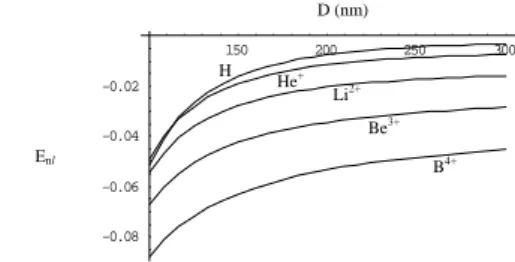
are calculated analytically (see equation (30)). The results of the energy spectrum of the hydrogen-like atoms are repre-sented in Figs. (1-11) for the Rydberg states n=20 of the hydrogen-like atoms over atom-surface distance Dranging from 50 to 300 nm for some values of the orbital quantum numberl in the interval from 0 to 12 and arbitrary values of the parameterβfalling in the range 0≤β≤4. In Figs. (1-3), the spectrum of then=20 mainfold of the hydrogen atom (Z=1) is plotted versus D for various values of the parameterβfor the statesl= 0 tol=12. It is clear that the states are crossing at some values ofβand some values ofD between 100 and 300 nm. Out of these distances, we notice that there is a wide shift between the states. To clarify the crossing effect, which occurs between the states, we plotted in Figs. (4,5) only the two statesl=1 andl=12. andl=2 andl=10 respectively. The dynamics of these crossings can be interpreted as follows: From the expression (30), letl0be the fixed value ofl, then by increasingβwe obtain the energy spectrumE0(β,l0)of the statel0. Whenl=l0+1 we obtain
FIG. 4: The energy spectrum of the hydrogen atom for the levels
l=1 andl=12, at 0≤β≤3.
FIG. 5: The energy spectrum of the hydrogen atom for the levels
l=1 andl=12, at 0≤β≤3.
β
1 2 3 4
-0.05 -0.04 -0.03 -0.02 -0.01
Enl
H He+
Li2+
Be3+
B4+
FIG. 6: The energy spectrum versusβfor d = 300 andl= 0.
β
1 2 3 4
-0.06 -0.05 -0.04 -0.03 -0.02 -0.01
Enl
H He+
Li2+
Be3+
B4+
FIG. 7: The energy spectrum versusβford=200 andl=0.
1 2 3 4
-0.1 0.1 0.2
β Enl
H He+ Li2+ Be3+
B4+
150 200 250 300
-0.15 -0.125 -0.1 -0.075 -0.05 -0.025
β
β D (nm)
Enl
H He+
Li2+
Be3+
B4+
FIG. 9: The energy spectrum versus D forβ=1 andl= 0. β
150 200 250 300
-0.08 -0.06 -0.04 -0.02
β D (nm)
Enl
H He+
Li2+
Be3+
B4+
FIG. 10: The energy spectrum versus D forβ= 2 andl= 0.
the energy spectrumE1(β,l0+1)of the statel0+1 and on increasing β; E1(β,l0+1)increases but with rate less than the rate of increasingE0(β,l0). Therefore the two states are crossing at a definite value ofβ=β0. On increasing further the value ofl, e.g. tol =l0+2, we obtain a crossing be-tween the two statesE2(β,l0+2)andE0(β,l0)at some val-ues ofβ=β1, and also between the statesE2(β,l0+2)and E1(β,l0+1)there is a crossing at some values ofβ=β2. For the other values ofl, the crossing between every two states occurs at other values ofβ. Consequently, at fixed value of
βin theEDplane, there is only one crossing between all the states. This result agrees quite well with the results obtained by other authors. The energy does not change significantly with the variation ofβin figures (6) and (7) untilβexceeds 2.5 where we get level crossings between the atomsH,He+, Li2+,Be3+,B4+forl=0. We may notice that with decreas-ing the value of D the energies become more negative i.e. the atoms are more bounded due to a stronger attractive poten-tial. In Fig. (8), the energies remains constant untilβexceeds 2 where we get level crossings after which we may get un-bounded atoms where the repulsive part of the potential ex-ceeded the attractive one (see Eq. (2)). Figs (6, 7, 8) show that He ion does not change withβbecause it is one of the noble gases, the most stable atomic systems. In Figs. (9) and (10), for constant values ofβ, as D increases the energies also
β
150 200 250 300
-0.08 -0.06 -0.04 -0.02
β D (nm)
Enl
H He+
Li2+
Be3+
B4+
FIG. 11: The energy spectrum versus D forβ=3 andl= 0. increase and saturate. The atoms get less bounded due to the less attractive potential. In Fig. (11), at small values of D we may get unbounded atoms atβ = 3 however by increasing D all atoms get bounded due to the balance between the two parts of the potential where the attractive one supersedes.
[1] Alhassied Y, Hinds E A, and Meschede D 1987, Phys.Rev.Lett.
591545.
[2] Bohar A, and Mottelson B R 1975, Nuclear Structure,vol 2
(New York: Benjamin).
[3] de Heer W A 1993, Mod.Phys. 65 611; Barck M 1993, Rev. Mod. Phys.65677.
[4] Dineykhan M and Efimov G V 1994, Few-Body Systems16
59;
[5] Dineykhan M and Nazmitdinov R G 1997, Phys.Rev.B2020. [6] Dineykhan M 1997, Z.Phys.D4177.
[7] El-Aasser M A and Abdel-Raouf M A 2007, J. Phys. B: At. Mol. Opt. Phys.401801.
[8] Goldstein H 1980, classical mechanics (London: Addison-Wesly).
[9] Ganesan K and Taylor K T 1996, J.Phys.B: At.Mol.Opt.Phys.
291293.
[10] Kleppner D 1991, Phys.Today449; Friedrich H 1992, Phys. World5(4) 32.
[11] Ruder H, Wunner G, Herold H, and Geyer F 1994, Atoms in Strong Magnetic Fields (Berlin: Springer).
[12] Series G W, 1988, The Spectrum of Atomic Hydrogen Ad-vances (Singapore: World Scientific).