J. Dassow, G. Pighizzini, B. Truthe (Eds.): 11th International Workshop on Descriptional Complexity of Formal Systems (DCFS 2009) EPTCS 3, 2009, pp. 111–120, doi:10.4204/EPTCS.3.10
c
P. Frisco, O. H. Ibarra
P/T Systems Composed of
joins
Pierluigi Frisco
School of Mathematical and Computer Sciences – Heriot-Watt University EH14 4AS Edinburgh – UK
Oscar H. Ibarra
Department of Computer Science – University of California Santa Barbara – CA 93106 – USA
Recently, some studies linked the computational power of abstract computing systems based on mul-tiset rewriting to models of Petri nets and the computation power of these nets to their topology. In turn, the computational power of these abstract computing devices can be understood by just looking at theirtopology, that is, information flow.
Here we continue this line of research introducingJ languagesand proving that they can be accepted by place/transition systems whose underlying net is composed only ofjoins. Moreover, we investigate how J languages relate to other families of formal languages. In particular, we show that every J language can be accepted by alog nspace-bounded non-deterministic Turing machine with a one-way read-only input. We also show that every J language has a semilinear Parikh map and that J languages and context-free languages (CFLs) are incomparable. For example, the CFL,
{x#xR
|x∈ {0,1}+}, is not a J language, but there are non-CFLs that are J languages.
1
Introduction
In [1] a study on models of Petri nets linking their topological structure to the families of languages they can accept/generate was started. In particular this study concentrated on Petri nets whose topological structure (that is, their underlying net) was composed only of specificbuilding blocks(motifs), that is, little nets connected to each other.
The following question was raised and partially answered in [1]: What is the computational power
of networks composed of specific building blocks? The answer to this question was pursued in [2, 3]. As shown in [1, 2, 3] such research can help the study of the computational power of systems based on multiset rewriting. GivenS1, a formal system based on multiset rewriting, the study of its computational
power is normally done by proving that it can be simulated by another formal system, sayS2, of known
computational power. IfS2can also simulateS1, then we can say that the two systems have equivalent
computational power. There is a new way to analyse the computational power ofS1 [1]. This new way
depends on how the system stores and manipulates information and it deduces the computational power
ofS1. The way information is stored and manipulated by systems based on multiset rewriting can be
easily represented with Petri nets. From here then the link between the computational power of formal system based on multiset rewriting and the topological structure of Petri nets.
In the present paper we continue to answer the above question introducing J languagesand proving that they can be accepted by place/transition systems (a model of Petri nets) whose underlying net is
composed only ofjoins(a kind of building block). We study how J languages relate to other families
of formal languages and show how these relationships allow us to derive the computational power of a model of P systems.
Because of page limit restrictions, several proofs have been omitted.
2
Basic definitions
We assume the reader to have familiarity with basic concepts of formal language theory [6], and in particular with the topic of place/transition systems [11, 10]. In this section we recall particular aspects relevant to our presentation.
We denote byN1the set of natural numbers{1,2, . . .}whileN=N1∪ {0}.
Definition 1. Aplace/transition system(P/T system) is a tuple
N = (P, T, F, W, K, Cin)
where:
i) (P, T, F)is anet:
1. P andT are sets withP∩T =∅;
2. F⊆(P×T)∪(T×P);
3. for everyt∈T there existp, q∈P such that(p, t),(t, q)∈F;
ii) W :F →N1is aweight function;
iii) K:P→N1∪ {+∞}is acapacity function;
iv) Cin:P →Nis theinitial configuration(orinitial marking).
We consider P/T systems in which the weight function returns always 1 and the capacity function
returns always +∞. We introduced these functions in the previous definition for consistency with the
(for us) standard definition of P/T systems and for consistency with the definition in [1, 2, 3]. We follow the very well established notations (places are represented by empty circles, transitions by full rectan-gle’s, tokens by bullets, etc.), concepts and terminology (configuration, input set, output set, sequential configuration graph, etc.) relative to P/T systems [11, 10].
In this paper we consider P/T systems as accepting computing devices. The definition of accepting P/T systems includes the indication of a setPin⊂P ofinput places, oneinitial placepinit∈P\Pinand
onefinal placepfin∈P\Pin. The places inP\Pinare calledwork places.
Anaccepting P/T systemNwith inputCinis denoted by
N(Cin) = (P, T, F, W, K, Pin, pinit, pfin)
where Cin :(Pin∪ {pinit})→N, Cin(pinit) =1, is the initial configuration of the input places. So, in
the initial configuration some input places can have tokens and the work placepinit has one token. All
the remaining places are empty in the initial configuration. A configuration Cfin∈CN, the set of all reachable configurations of N, is said to befinal(ordead state) if no firing is possible fromCfin.
We say that a P/T system N(Cin) = (P, T, F, W, K, Pin, pinit, pfin) with Pin = {pin,1, . . . , pin,k},
• Cfin(pfin)>0;
• there is at least one path fromCintoCfin;
• no other configurationDin the paths fromCintoCfinis such thatD(pfin)>0.
Theset of vectors acceptedbyN is denoted byNk(N)and it is composed by the vectors
(Cin(pin,1), . . . , Cin(pin,k))
accepted byN. The just given definition of (vector) acceptance for P/T systems is new in Petri nets.
Normally, the language generated by Petri nets is given by the concatenation of the labels in firing sequences. We discuss this point in Section 7.
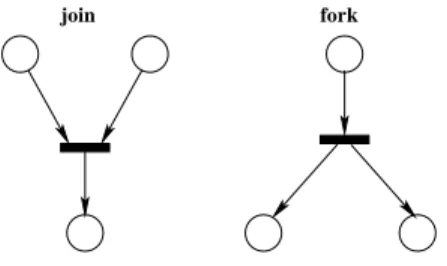
As in [2] we call the netsjoinandfork building blocks, see Figure 1, where the places in each building block are distinct.
join fork
Figure 1: Building blocks:joinandfork.
Also from [2] we take:
Definition 2. Letx, y∈ {join, f ork}be building blocks and let ¯txand ˆty be the transitions present inx andyrespectively.
We say thaty comes after x(orx is followed by y, orx comes before yorx and y are in sequence) if ¯
t•
x∩•tˆy6=∅and•t¯x∩•tˆy =∅. We say thatx and y are in parallelif•t¯x∩•tˆy 6=∅and ¯t•x∩•tˆy=∅. We say that a net iscomposed ofbuilding blocks (it iscomposed of x) if it can be defined by building blocks (it is defined byx) sharing places but not transitions. So, for instance, to say that a net iscomposed of joinsmeans that the only building blocks present in the net arejoin.
In this paper we consider accepting P/T systems (in which the weight functions returns always 1
and the capacity function returns always+∞) whose underlying net is composed of joins. Moreover,
ifN = (P, T, F, W, K, Pin, pinit, pfin)is such a P/T systems, then for eacht∈T,•t∈(Pin×P\Pin)and
t•∈P\P
in. Informally, this means that for each transitiont∈T the input set is given by an input place
and a work place, while the output set is a work place. We call these systemsJ P/T systems.
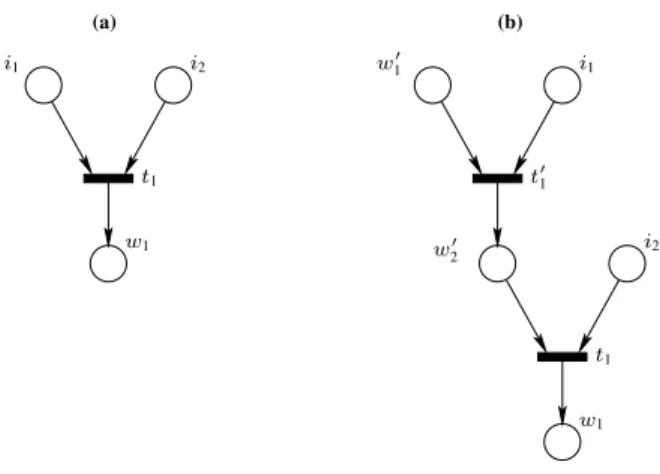
It should be clear that J P/T systems are a normal form of accepting P/T systems: for each accepting P/T system there is a J P/T systems accepting the same language. Such J P/T systems has, eventually, more places and transitions than the original P/T system. For instance, let us assume that the net depicted in Figure 2.a is part of the net underlying an accepting P/T systemNwithPas set of places,Pin⊂P as
set input places andT as set of transitions. The net depicted in Figure 2.b belongs to a J P/T systemNJ withP∪ {w′
1, w2′}as set of places,Pin as set of input places andT∪ {t′1}as set of transitions. The two
i1
i2
w1 i2
w1
t1 t′
1
t1
i1 w′
1
w′ 2
(a) (b)
Figure 2:(a)a net of an accepting P/T system and(b)a net of a J P/T system.
3
J languages and P/T systems
In this section we prove the main result of the present paper. In order to do this, we need to introduce a new family of formal languages.
Definition 3. LetΣbe an alphabet, then:
• ε(theempty string) is a J expression; • for eachv∈Σ, vis a J expression;
• ifαandβ are J expressions, then(α∪β)is a J expression (union, in this caseαandβ are called
union-terms);
• ifαandβare J expressions such thatα, β6=εbut they can containε(e. g.,α=a∪ε), then(αβ)
(concatenation), and(α+)(positive closure) are J expressions;
• ifβj,1≤j≤k, k∈N1,are J expressions such that none of them contains the operator union and
the operator positive closure (the reason for this is explained at page 115), thenβn1
1 . . . β
nk k (
expo-nentiationin this caseβj are calledexponentiation-terms) is a J expression where eachnj ∈N1,
calledexponent, is either a fixed positive integer or an integer variable (representing all numbers inN1). We can specify that some of the exponents are equal. For example, ifk=8 it can be that
n1=n3=n7=p, n2=n6=q, p, q∈N1(pandqare integer variables),n4=n8=5 andn5=3
(n4, n5and n8are fixed positive integers). In this case we would haveβ=β1pβ2qβ3pβ45β53β6qβ7pβ85.
It is important to note that some of theβjs can beε.
The language defined by a J expressionαis aJ languageand it is indicated withL(α). For instance, L(a∪ε) ={a, ε}andL(apb3ap) ={apb3ap|p≥1}.
Ifαis a J expression over the alphabetΣ, then thelengthofα is defined as the number of symbols ofΣ∪ {ε}present inα. The length of a J expression is indicated withkαk.
The reason why we call these languagesJis because this letter is the initial one injoin, the building block composing the nets considered in this paper.
Remark 4. Ifβ is an exponentiation with fixed positive integer exponents, we can construct another exponentiationβ′such thatL(β) =L(β)′ andβ′has fixed positive integer constants that are all 1’s.
The previous remark is clearly true: for eachβkexponentiation-term inβhavingnkas fixed positive
exponent, β′ can be obtained concatenating n
ktimes βk. So, for instance, ifβ=ap(bc)qc3apb2(cd)q, thenβ′=ap(bc)qcccapbb(cd)q.
IfΣis a set, then|Σ|denotes thecardinalityofΣ, that is the number of elements inΣ. The following follows from Definition 3:
Lemma 5. Letβbe an exponentiation-term. Then:
• ifε∈L(β), thenL(β) ={ε};
• if|L(β)|>1, thenε6∈L(β).
The proof of the following lemma is rather long but not particularly difficult. The basic idea is to have a J P/T system in which input places are associated to the J expression defining the language accepted by the J P/T system, work places are associated with the possible union, concatenations, positive closure and exponentiations of the J language. The J P/T system repeatedly “consumes” (accepts) one token per time from the input places and passes one token from a work place to another. The J P/T system is non-deterministic (because it “guesses” to what part of the J expression a token can be matched).
Lemma 6. Every J language is accepted by a J P/T system.
Before presenting the next results we explain why exponentiation-terms have to be different than union and positive closure. Letβ =βn1
1 β n2 2 β n1 3 β n2
4 be an exponentiation withβ
n1
1 , β
n2
2 , β
n1
3 , β
n2
4
expo-nentiation terms. There is no meaning in having (for instance) β1=α+, whereα is a J expression, as
βn1
1 =α+
n
1
=α+. So,β =α+βn2
2 β
n1
3 β
n2
4 is the concatenation ofα+ to an exponentiation. A similar
argument holds if an exponentiation term contains a positive closure, that is, for instance,β=αγ+where
αandγ are J expressions.
The reason why exponentiation-terms cannot be union depends on the fact that J P/T systems do not have memory. Letβbe defined as in the above, letn2>1 and let (for example)β2=α1∪α2, whereα1
andα2are J expressions. This means thatβ=β1n1(α1∪α2)n2β3n1β
n2
4 . Let us assume that in the initial
configuration of the J P/T system acceptingβthere are some tokens in the input places associated toα1
and toα2. We know from Lemma 6 that the check of the presence of symbols inβ2 andβ4 is done in
passages: first checking the occurrence of symbols inβ2, then the one inβ4, then (second passage) the
one inβ2again, and so on. It can be that (as the J P/T system does not have memory) in the first passage
tokens related toα1 are checked, while in the second passage tokens related toα2 are checked. This
would not be a desired behaviour.
The fact that exponentiation-terms cannot be union is not a big limit as we can rewriteβas
βn1
1 α n2 1 β n1 3 β n2
4 ∪β
n1 1 α n2 2 β n1 3 β n2 4 .
Here a concept that we need in the following:
Definition 7. LetNbe a J P/T system. We say thatNcontains cycles if and only if some firing sequences ofN are of the kindαβnγ ∈T∗, whereT is the set of transitions ofN andn >1. Acycle is a cyclic
path in the net underlyingN havingβ as sequential transitions in a firing sequence.
We denote cycles with the sequence of pairs of places and transitions belonging to it. Thelength of
Here the converse of the previous lemma:
Lemma 8. Every language accepted by a J P/T system is a J language.
Proof: We only provide a sketch of the proof a detailed proof would be tedious. It is very important to recall that:
• the underlying topological structure of J P/T systems is composed byjoinand that for each transi-tion the input set is given by an input place and a work place;
• the initial configuration sees tokens in input places and in only one work place (the initial place).
LetN be a J P/T system and let its input places be associated to symbols in an alphabetΣ. IfN
con-tains no cycle, thenN accepts concatenations of symbols and unions of symbols and their concatenation.
If insteadN contains cycles, then this means that concatenations of symbols can be repeatedly checked.
This means thatN can accept the positive closure of symbols, concatenations and their union.
Now we prove thatN can accept exponentiations. Let us assume thatN acceptsβ1+β2+ withβ1=
β1,1β1,2. . . β1,k1,β2=β2,1β2,2. . . β2,k2,β1,i, β2,j∈Σ
+, 1≤i≤k
1, 1≤j≤k2. In order to simplify the
proof we assume thatk1=k2. With slight modifications the result holds also ifk16=k2.
It is possible to define another J P/T systemN′acceptingβn1
1,1 β
n2
1,2 . . . β
nk
1
1,k1 βn1
2,1β
n2
2,2. . . β
nk
1
2,k1. The systemN
′ is very similar toN. It is made such that when the last symbol ofβ 1,1
is checked, then the first symbols ofβ2,1 is checked. When the last symbol ofβ2,1 is checked, then the
system can either check the first symbol ofβ1,1or the first symbol of β1,2 and so on. The same result
holds if eitherβ1orβ2is not a positive closure (but just a concatenation). Informally: for J P/T systems
exponentiation is a shuffling of concatenations.
Now we prove that nothing else can be accepted by J P/T systems. By contradiction, let us assume that there is a set of vectors accepted by a J P/T system havingPinas set of initial places such that it cannot
be represented by a J expression overPin. Clearly, the set of vectors has to have an infinite number of
elementents. If not, then a J expression given by the union of the concatenations of the different elements in each of the finite number of vectors would represent this set.
As the number of places and transitions is finite, then the number of cycles in the J P/T system is finite, too. Depending on the number and the length of the cycles present in the J P/T system, there is a finite set of accepted initial configurations (calledborder configuration) such that for each of them there are vectors (calledadded vector) such that the (vector) sum of one border configuration to any multiple of any of its added vector leads to an accepted initial configuration. Informally, the acceptance of any border configuration needs some cycles to be traversed. Given a border configuration, its added vectors allow these cycles to be traversed other times. But then, there is a J expression that can represent the set of vectors accepted by the J P/T system. This J expression is given by the union of J expressions representing border configurations where each place is concatenated with the respective place in the added vectors to the power of an integer variable. A contradiction.
For instance, let Pin ={p1, p2}, (4,6) be a border configuration, and let(2,0) and (1,3)be added
vectors for the border configuration. The J expression is then: p4
1(p1p1)k1p62∪p41p
k2
1 p62(p2p2p2)k3 where
k1, k2, k3∈N1are integer variables.
From the previous two lemmas we have:
4
Semilinearity of J languages
In this section, we show that the Parikh map of every J languages is semilinear. We also prove a “con-verse” (this is made more precise later) of this result.
LetN be the set of non-negative integers andnbe a positive integer. A subsetS ofNnis alinear
setif there exist vectorsv0, v1, . . . , vtinNnsuch that
S={v|v=v0+i1v1+· · ·+itvt, ij∈N}.
The vectorsv0(referred to as theconstant vector) andv1, v2, . . . , vt(referred to as theperiods) are called thegeneratorsof the linear setS. The setS⊆Nnissemilinearif it is a finite union of linear sets.
The empty set is a trivial (semi)linear set, where the set of generators is empty. Every finite subset of
Nnis semilinear – it is a finite union of linear sets whose generators are constant vectors. It is also clear that the semilinear sets are closed under (finite) union.
LetΣ={a1, a2, . . . , an}be an alphabet. For each wordwinΣ∗, define the Parikh map ofwto be
ψ(w) = (|w|a1,|w|a2, . . . ,|w|an).
where|w|ai denotes the number of occurrences of symbolai inw. For a language L⊆Σ∗, the Parikh map ofLisψ(L) ={ψ(w)|w∈L}. The languageLis semilinear ifψ(L)is a semilinear set.
There is a simple automata characterisation of semilinear sets. LetM be a non-deterministic finite
automatonwithout an input tape, but with ncounters (for somen≥1). The computation ofM starts
with all the counters zero and the automaton in the start state. An atomic move ofM consists of
in-crementing at most one counter by 1 and changing the state (decrements are not allowed). Ann-tuple
v= (i1, . . . , in)∈Nnis generated byM ifM, when started from its initial configuration, halts withvas the contents of the counters. The set of alln-tuples generated byM is denoted byG(M). We call this automaton afinite-state generator.
The following result was shown in [5]:
Theorem 10. Letn≥1. A subsetS⊆Nnis semilinear if and only if it can be generated by a finite-state generator withncounters.
Using Theorem 10, we can then prove the following result.
Theorem 11. The Parikh map of every language denoted by a J expression is semilinear.
For the “converse” of Theorem 11, we need the following definition.
Definition 12. LetS⊆NnandΣ={a1, . . . , an}. Define the language
LS={as11as22· · ·ansn|(s1, . . . , sn)∈S}.
Theorem 13. IfSis a semilinear set, thenLSis a J language.
5
Complexity of J Languages
Here, we briefly discuss the (TM) space complexity of J languages. We will show that every J language can be accepted by a non-deterministic Turing machine (NTM) with a one-way read-only input and a
by a one-way non-deterministic finite automaton augmented with a finite number of counters. In each computing step each counter can be incremented/decremented by 1 and tested for zero. The counters start with zero value, and we assume (without loss of generality) that the machine accepts when in the final state and when all counters store zero. During the computation, the (non-negative) integer value in each counter never exceeds the length of the one-way read-only input. We call this machine a
linear-space multicounter machine, or simply, LCM. Clearly, an LCM can be simulated by a one-waylog n
space-bounded NTM, since the values in the counters can be stored and managed on alog nread-write
work-tape.
The next two results can be shown.
Theorem 14. Every J language can be accepted by an LCM.
Corollary 15. Every J language can be accepted by a one-waylog nspace-bounded NTM.
It is well-known and, actually easily shown, that L={x#xR | x∈ {0,1}+} (R denotes reverse)
cannot be accepted by a one-waylog nspace-bounded NTM, hence, cannot be accepted by an LCM.
(For an inputx#xRof length 2n+1, a one-way NTM withlog n space can only differentiate a linear
number of strings ofx’s before the symbol #. But there are 2ndifferentx’s.)
Corollary 16. There are context-free languages that are not J languages.
6
A grammatical characterisation of J languages
In this section, we provide a grammatical characterisation of J languages. The grammar is an extension of the right-linear simple matrix grammar studied in [7].
LetΣbe the set of terminal symbols. The non-terminal symbols are partitioned into two disjoint sets, QandR. There is a unique start non-terminalS0∈ Qfrom which all derivations start from. The rules
are of two types:
Basic Rules:
1. S→w, where w∈Σ∪ {ε} and S ∈ Qdoes not appear on the RHS of any basic rule, but can
appear in a matrix rule 6 below.
2. S→S1|S2, whereS, S1, S2are distinct non-terminals inQ, andSdoes not appear on the RHS of
any basic rule, but can appear in a matrix rule 6 below.
3. S→S1S2, where S, S1, Sk are distinct non-terminals in Q, andS does does not appear on the RHS of any basic rule, but can appear in a matrix rule 6 below.
4. S→SS, whereS∈ Qdoes not appear on the RHS of any basic rule (except in this rule), but can
appear in a matrix rule 6 below.
5. S→(A11A12· · ·A1m, . . . , Ak1Ak2· · ·Akm), wherem≥1,k≥1, eachAij is a non-terminal inR andS∈ Qcan appear on the RHS of basic rules 2, 3, 4, but cannot appear in a matrix rule 6 below.
Right-Linear Simple Matrix Rules:
6. [A1→S1A1, . . . , Ak→SkAk], wherek≥1, eachAia non-terminal inR, and eachSi∈ Q(subject to the restriction in rule 5 above).
7. [A1→w1, . . . , Ak→wk], wherek≥1, eachAia non-terminal inR, eachwi inΣ∗.
The derivation of a stringw∈Σ∗in the language starts from the non-terminalS
0. If at some point during
the derivation, an intermediate string is reached that contains a non-terminalSfor which a rule of form 5 is applied, thisS will be replaced by ann-tuple(A11A12· · ·A1m, . . . , Ak1Ak2· · ·Akm). Next, a rule of form 6 is applied in parallel, i. e., application of the rule rewrites the leftmost non-terminal of each of the
k-coordinates. Application of rule 6 is doner≥0 times, whereris chosen non-deterministically; after which rule 7 is applied. The process is repeated for the next leftmost non-terminal of each coordinate. At
the end, when allkcoordinates are non-null strings inQ+, we “merge” thekcomponents into a single
string. Then the derivation continues untilwis reached. We can prove the following result.
Theorem 17. The languages generated by ERLSMGs are exactly the J languages, which allow union and positive closure in exponentiation.
Corollary 18. The languages generated by ERLSMG’s in which the S’s on the left-hand-side of rules of forms 2 and 4 do not appear on the right-hand-sides of rules of form 6 are exactly the J languages.
7
Final remarks
In Section 2 we said that the way to accept languages (sets of vectors) considered by us differs from the standard one used in Petri nets (concatenations of the labels of firing sequences) [4, 8]. The reason why we did not consider this standard way in the present paper is because we wanted here to focus only on the topology. (We are in the process of writing a paper discussing the relations between these two different ways of accepting languages).
In [3, 2] it is shown how the results obtained from the computational power of P/T system whose
underlying net is composed of joins and fork can facilitate the study of the computational power of
models ofmembrane systems (also known asP systems) [9] based on multiset rewriting. These results
use a definition ofequivalence(also present in [3, 2]). This is the “new way to analyse the computational power of a formal system” we mentioned in Section 1.
In a nutshell, the idea is the following: if a formal systemScan simulatefork,joinand their compo-sition, then the results on the computational power of P/T systems whose underlying net is composed of
joinsandforkare also valid toS.
In [3, 2] it is shown that P systems with catalysts can simulate aforkusing rules of the kinda→b1b2,
while the simulation of a join does not require the use of such rules. So, knowing from [3, 2] how
P systems with catalysts can simulate join and Theorem 9, we can say that the family of languages
generated by P systems with catalysts not using rules of the kinda→b1b2is J.
Using the definitions and results of P systems with catalysts in [3, 2] we can be more precise and state:
Corollary 19.
• The family of languages accepted by P systems with catalysts of degree 2 and 2 catalysts not using rules of the kinda→b1b2is J;
We end this paper with an open problem. In the rule of form 6, we had a restriction that if
[A1→S1A1, . . . , Ak→SkAk]and[A1→S1′A1, . . . , Ak→Sk′Ak]
are both matrix rules, then Si =Si′ for 1≤i≤k. Suppose we remove this restriction. Is there an
extension of the J P/T systems that can characterise these grammars?
References
[1] P. Frisco (2006): P systems, Petri nets, and Program machines. In: R. Freund, G. Lojka, M. Oswald & G. P˘aun, editors: Membrane Computing. 6th
International Workshop, WMC 2005, Vienna, Austria, July 18–21, 2005, Revised Selected and Invited Papers,LNCS3850. Springer-Verlag, Berlin, Heidelberg, New York, pp. 209–223.
[2] P. Frisco (2008): A hierarchy of computational processes. Technical Report HW-MACS-TR-0059, Heriot-Watt University.http://www.macs.hw.ac.uk:8080/techreps/index.html.
[3] P. Frisco (2009): Computing with Cells. Advances in Membrane Computing. Oxford University Press. To appear.
[4] M. Hack (1976):Petri Net Language. MIT-Cambridge, MA.
[5] T. Harju, O. H. Ibarra, J. Karhumaki & A. Salomaa (2002):Some decision problems concerning semilinearity and commutation.Journal of Computer and System Science65, pp. 278–294.
[6] J. E. Hopcroft & D. Ullman (1979): Introduction to Automata Theory, Languages, and Computation. Addison-Wesley.
[7] O. H. Ibarra (1970):Simple matrix languages.Information and Control17, pp. 359–394.
[8] M. Jantzen (1987): Language theory of Petri nets. In: Advances in Petri nets 1986, part I on Petri nets: central models and their properties. Springer-Verlag, Berlin, Heidelberg, New York, pp. 397–412.
[9] G. P˘aun (2000):Computing with membranes.Journal of Computer and System Science1, pp. 108–143. [10] W. Reisig (1985): Petri Nets: An Introduction,Monographs in Theoretical Computer Science4.
Springer-Verlag, Berlin, Heidelberg, New York.