Pierre Auger Observatory: Status Report
M. A. L. de Oliveira
Depto. de Raios C´osmicos e Cronologia, Instituto de F´ısica Gleb Wataghin
Universidade Estadual de Campinas, Cx.P. 6165, CEP 13084-971, Campinas, SP, Brasil
(Representing the Pierre Auger Collaboration)
Received on 8 December, 2003
The Pierre Auger Observatory is a large international effort to provide measurements of extensive air showers (EAS) initiated in the upper atmosphere by cosmic rays with energies above1018eV, the Ultra High Energy Cosmic Rays (UHECR’s). The explanations for the origin, acceleration processes and composition of the UHECR’s face theoretical and experimental difficulties, due to the extremely low flux in this energy region. The full observatory will consist of a hybrid detector using an array of 1600 water ˇCerenkov tanks spread over an area of3000km2
overlooked by a set of 4 air fluorescence detectors per site. The southern site is being instrumented in Argentina and I will discuss its present status in this paper.
1
Introduction
The Pierre Auger Observatory [1] is nowadays the world lar-gest array of detectors exploring the energy spectrum, arrival distributions and composition of cosmic rays above1018
eV. The UHECR’s are one of the most puzzling mysteries of na-ture that has appeared in the last times. They are subatomic particles going through the universe and reaching the Earth with macroscopic energy (1020
eV ∼16J). The first ob-servation of cosmic rays with energies above5×1019eV
was done in 1962 by Linsley [2] in the Volcano Ranch ar-ray. See the reference [3] for a very detailed overview of this subject. Since then, several events with energy above 1020
eV have been observed [4] [5] [6]. However, the pre-vious arrays, with collecting area< 100km2
, do not pro-vide enough statistics, due to the extremely low flux (1 event century−1
km−2
) in this energy region [7] [8]. The expla-nation of these events also face theoretical difficulties, since it is believed to exist a cutoff in the spectrum of cosmic rays around5×1019eV due to the interaction with the microwave
cosmic background photons, the GZK cutoff [9] [10]. The-refore, the scientific objectives of the observatory are to un-derstand the nature, origin and propagation of UHECR’s: how can these particles gain such tremendous energies? Are there point sources or are the arrival directions isotropic? Does the GZK cutoff exists or is there a continuing spec-trum? Are the UHECR’s accelerated or results of the de-cay of exotic particles? What are the primary masses? To answer these questions, the observatory will detect cosmic rays with an aperture greater than7000km2
srat1019
eV
providing high statistics. It will fully cover the sky with uni-form exposure and angular resolution of 1 degree.
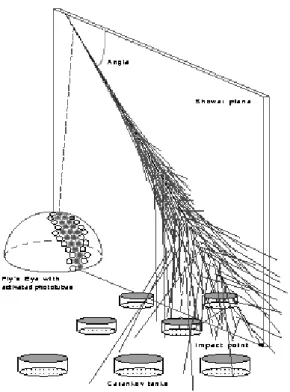
The observatory is a hybrid giant detector using two dif-ferent techniques (see Fig. 1): water ˇCerenkov tanks, the Surface Detector (SD), and fluorescence telescopes, the Flu-orescence Detector (FD). The first technique consists of an array of 1600 tanks separated by1.5kmspread over an area
of3000km2
. The UHECR’s are so rare that even with such a large area, extrapolating the AGASA spectrum [11] below 1020
eV, we will have approximately 103 events per year. Some advantages of the ˇCerenkov tanks are their low cost and the fact that this kind of detector can operate continu-ously with any kind of weather. The ground array samples the lateral distribution of the shower generated by the pri-mary UHECR’s. The second technique consists of 24 teles-copes overseeing the array of tanks. These telesteles-copes ob-serve the fluorescence light emitted by the air nitrogen mo-lecules when they are excited by the particles of an EAS. They operate with clean weather in moonless nights. This condition corresponds to only 10% of the available time, but this disadvantage is compensated by the crucial infor-mation that the fluorescence detector gives to us: the longi-tudinal distribution profile of the EAS. This information is used in order to determine the energy, the arrival direction and to estimate the composition of the UHECR that origina-ted the showers. Each one of the 24 telescopes is composed by a spherical mirror with 30◦×30◦ field of view reflec-ting the fluorescence light on an array of 440 photomulti-plier tubes (PMT’s). The system adopts Schmidt optics [12] in order to reduce coma aberration. The basic setup is an aperture box with110cmof diaphragm radius with an ex-ternal ring of corrector lenses and a band pass filter passing the300nm < λ <410nmband, which contains the main emission peaks of the nitrogen fluorescence.
2
The Surface Detector
Water ˇCerenkov detectors has been selected as the techno-logy for the ground array. In Fig. 2, we can see the detail of a unity of the SD. These are polyethylene resin tanks with capability of storage of12000lof water (10×1.2m3). The
chemi-Figure 1. Illustration of the hybrid technique.
cal and biological activities, are controlled by separating the rusting component from the water by using a plastic bar-rier of Tyvek-polyethylene. Three PMT’s Photonis XP1805 are positioned1.2mabove the bottom water level looking downward. A very good proportionality between ˇCerenkov light and photoelectron yield is obtained for the PMT’s pla-ced at120o interval on a circle. Instead of connecting the detectors (which would be too costly), it has been decided to operate each detector in a stand-alone mode.
Figure 2. The water ˇCerenkov tank.
The power is obtained from solar panels while data are synchronized in time using GPS receivers. The trigger data is sent to the central station using a wireless local area network (LAN) radio link operating in 915 M Hz. The power consumption of an SD station is below10W.
Figure 3. The three PMT’s flash ADC traces for single muon signals.
Figure 4. Signals from a auto trigger operation in units of VEM.
3
The Fluorescence Detector
Around the perimeter of the SD there will be four stations of the FD (Los Leones, Cohiueco, Morados and Pocitos). Each station is divided in six bays with telescopes covering a field of view of30◦×30◦ (see Fig. 5). The telescope consists of a set of spherical mirrors of340cmof curvature radius, where the aperture is limited by a diaphragm of220cmof diameter put in the plane of the mirror curvature center (see Fig. 6). Half of the FD mirrors will be made from solid aluminum milled of a cast aluminum backing to the appro-priate radius and protected by electromechanical indication. The other half will be made from high quality hexagonal glass segments, with an reflective aluminum layer deposited in vacuum and covered by aSiO2layer. In front of the
mir-rors curvature center, acting as the window of the bay, there is a broadband pass MUG-6 filter glass (by Schott-Desag) 3.25mmthick. It transmits light efficiently in the near UV wavelength region (300nm < λ < 410nm), thus selec-ting the main emission peaks of the nitrogen fluorescence in the atmosphere, while attenuates visible light reducing the background noise. In order to correct the rays far apart from the main optical axis, a corrector lens ring of25cmof width is installed [14]. The idea of a corrector lens appeared as a way to increase the telescope area, increasing the spot lumi-nosity, without increasing the spot size in excess. The shape of a ring has been chosen instead of a in filled lens to reduce the final cost and because the simulations showed that it was needed to correct only the rays beyond85cmfrom the main optical axis. The lens segments are made of BK7 borosili-cate glasses and are ground and polished with an appropriate profile (given by simulation [15]). The resulting spot size is about0.5o
in the focal surface, approximately one third of the pixel diameter. The light is captured at the focal surface by a camera of 440 PMT’s Phillips XP3062 in an array of 20×22tubes. To increase uniformity, in the space between
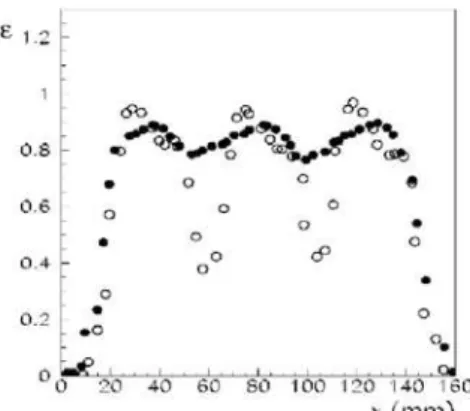
the hexagonal tubes, is inserted light reflectors (the Merce-des). The increase in the light capture efficiency can be seen in Fig. 7. Pixel trigger rates are kept close to100Hzand the candidates for cosmic ray events are selected by a power-ful pattern recognition system which sends to CDAS an or-der to initiate a SD trigger. This procedure stamps a flag in hybrid events, which are very important for cross checking the reconstructions results of each technique. The telesco-pes track the paths of the charged particles along the shower axis, sampling its longitudinal development. This informa-tion is used to calculate the energy, the arrival direcinforma-tion and the mass composition of the shower primary. For the FD there is also the possibility of having stereo events, observed by at least two stations. The absolute calibration is achieved by a set of three procedures:
1. Pulse led lights into diffusers at three different positi-ons of the telescope (piecewise calibration).
2. Pulse led into a diffuser drum with the same size of the aperture diaphragm, generating a plane wave which impinges on the mirror (end-to-end calibration). 3. Shoot laser in the atmosphere and recording the
res-ponse to Rayleigh scattering (absolute calibration).
Recently, it has been reported [16] the calibration of4.1 photons at the front of the aperture per FADC count. The un-certainty in this measurement was estimated to be12%. A Central Laser Facility (CLF) is operational since 2003 near the center of the SD array to provide regular laser shots.
Figure 5. Upper view of a FD station.
Figure 6. Schematic view of a FD telescope optics.
3.1
The Atmosphere Monitoring
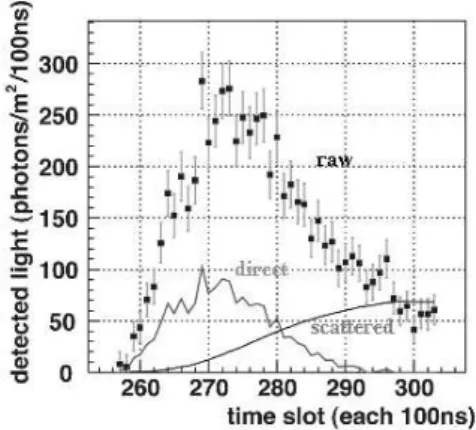
The atmosphere conditions must be precisely monitored. The photons produced by the nitrogen fluorescence in shower axis must travel through the air to reach the teles-copes. In their way, they will be scattered by air molecules (Rayleigh) and by aerosols (Mie) and be lost. In the coun-terpart, ˇCerenkov photons may be scattered toward the teles-cope. All these processes are dependent on the atmosphere conditions like density, temperature, pressure, humidity and dust concentration. The total light profile and the contributi-ons due to direct and scattered ˇCerenkov radiation is plotted in Fig. 8. In order to accurately measure the number of par-ticles in the shower axis, one has to discount the ˇCerenkov contributions. LIDAR systems have been used to monitor the atmospheric conditions [18]. Using a frequency tripled Nd:YAG laser able to transmit up 15 shots per second of 4nsduration and output power of∼6mJ, emitting in the
wavelength of 355nm within the fluorescence band. The receiver is made of a 90cmparabolic mirror and64.5cm
of focal length, the mirror is made of aluminum coated py-rex protected withSiO2 (formerly the EASTOP ˇCerenkov
setup [17]). The backscattered light is detected by a Ham-mamatsu R7400 PMT with voltage set to1000V and a broad band UG-1 filter is used in order to reduce background. The distance between laser beam and mirror center is fixed to 1mand the system is fully steerable with0.1o angular re-solution. A recent extensive analysis of over 20hours of atmospheric data taking (∼1.9GB) has been reported [19],
concluding that the LIDAR station is able to produce stable data with quality and can probe the atmosphere up to20km
altitude following reasonable signal to noise constraints.
Figure 8. FD raw data and ˇCerenkov contaminations.
4
The Engineering Array
Before constructing the full size observatory, a smaller sub-set of it, the Engineering Array (EA) [20], has been built and operated to evaluate materials and methods of the pro-posed designs. For the SD, the EA permitted the testing of PMT’s, electronics, cables, solar panels, batteries, liners and tank plastics and rotomoldings. Water production and quality as well as deployment strategies have been studied.
Softwares, triggers, monitoring packages, telecommunicati-ons and data acquisititelecommunicati-ons were tested.40SD units were de-ployed and32completely instrumented, covering an area of 46km2
. For the FD, the EA permitted the testing of mirrors, corrector rings, UV-pass filters, camera of PMT’s, aperture boxes, shutters and slow control. Also, it was possible to test triggers, acquisition systems and softwares, calibration procedures and communications. Two FD units were instru-mented at Los Leones building (10kmto the south of the surface EA center, see Fig. 9). Near the center of EA array an extra detector was placed11mfrom an existing one, for-ming a pair (Carmen and Miranda) used to measure tifor-mings and densities from essentially the same distance from the shower core. Another two detectors were placed at860m
from the nearest neighbors of the Carmen-Miranda pair al-lowing lower energies showers triggering. The EA was ope-rational from the beginning of 2003 to mid 2002, the SD ta-kes data continuously since then, while the FD was switched off to be upgraded with the final hardwares. The EA phase was greatly successful, some improvements have been made to the original proposals, but essentially the experiment and the individual components worked satisfactorily.
Figure 9. The Engineering Array map.
5
Event Reconstructions
Up till now more than600000SD triggers have been recor-ded. A typical event above1019
eV is shown in Fig. 10. The shower geometry is given by time-of-flight technique. This event has a zenith angle of48.8o
and azimuth angle of−167.1o. In the upper left of the figure, one can see the
list of triggered stations with respective VEM signals, these stations are represented in the site map (lower left) by the green circles, whose radii are proportional to their signals, and the red arrow represents the projection of the recons-tructed shower axis and the impact point of the shower core. In the upper right, one can see the fit of the lateral distri-bution function through the stations densities, this fit allows the calculation of the signal far from the core, theS(1000), where the fluctuations of the density of shower particles are quite small and hence the signal depends only on primary energy. This signal is used as energy estimator through a relation like: E0=α S(1000)β
(1) where the parametersαandβare calculated by simulation. The highest multiplicity event recorded during the EA phase is shown in Fig. 11. It fired 11 stations, the primary energy is calculated around5×1019eV and the large zenith angle
(82o
) is the cause of its high multiplicity. Recently, it has been reported [21] an even higher multiplicity event: 15-fold event with energy above5×1019eV and zenith angle
Figure 10. The display of SD event 370974.
Figure 11. The highest multiplicity event for the EA phase: event 204272.
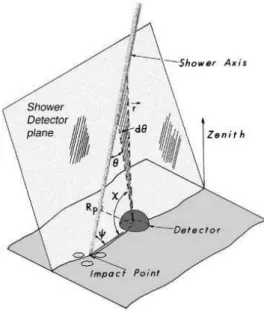
The events recorded by the FD are reconstructed in fol-lowing way (see Fig. 12):
1. The fluorescence track projection into the PMT ca-mera (see Fig. 13) defines the Shower Detector Plane (SDP).
2. From the angular velocity through the PMT camera, one deduces the shower geometry (Rpandψ), since the track travels at constant light speed.
3. From the pulse height distribution is calculated the longitudinal profile of particles at the shower axis (see Fig. 14), taking into account the atmosphere lost and
ˇ
Cerenkov contaminations, as discussed before. One example of a reconstructed event of energy1019
eV
is shown in Fig. 14, the maximum of the shower develop-ment is at the depth of750g/cm2
. The resolution on the determination of the shower maximum is important for the knowledge of the primary composition, since showers from heavier nuclei develop higher in the atmosphere. The energy of the particle which initiated the cascade is obtained from the track length integral of the longitudinal distribution:
Eem=
Ec
λr
N e(X)dX (2)
whereEem is the energy dissipated in the atmosphere by the electromagnetic component, Ec/λr is the ratio of the critical energy to the radiation length andN(X)is the ob-served number of electrons as a function of the atmospheric
depth. An upward correction of10%must be made in order to account for the missing energy of the muon, neutrino and hadronic components. A very detailed study of the missing energy was given by [22].
Figure 12. FD geometry reconstruction.
Figure 13. The SDP seen by a PMT camera.
TABLE I. Comparison between surface only and hybrid accuracies [1], pp. 144.
Energy 1019
eV 1019
eV 1020
eV 1020
eV Method Surface Hybrid Surface Hybrid
∆θ 2.00o 0.35o 1.00o 0.36o
∆core 80m 29m 40m 29m
∆E/E 18% 4.2% 7% 2.5%
∆Xmax 17g/cm2 15g/cm2
An important aspect of the observatory is the possibility of observing hybrid events, allowing cross-calibration of the SD and FD reconstructions. The energy reconstruction in SD, for instance, are known to be model dependent, while in FD not. Thus, hybrid events allow to test models at Auger energies. However, many hybrid events are below the ar-ray threshold having less than three triggered stations. This fact difficulty’s the direct comparison of both reconstructi-ons, but may help in FD geometry reconstruction. Taking the arrival time at one tank, for example, one can constrain the core position in some tenths of meters [23]. Then, the in-formation that comes from the particle density can be used to check if the model used to generate the lateral distribution function is well behaved for the SD. In table I is summarized the reconstruction errors for various quantities in two given energy levels for the surface array only and the improvement expected for hybrid events.
Besides the possibility of hybrid reconstruction, for the FD there is also the possibility of stereo events, i.e., events seen by (at least) two FD eyes. In these events, the calcu-lation of the shower geometry is done by the intersection of two SDP’s. A detailed study of the trigger performances for stereo and hybrid configurations using four telescopes and the present SD array has been made [24]. Using 1500 simulations [25] of 1019
eV showers spread over an area 1,257km2
, it has been found an increasing in the trigger rate of 86% for stereo events (with two telescopes at Los Leones and two telescopes at Cohiueco), compared whith another configuration (three telescopes at Los Leones and one telescope at Cohiueco). This last configuration increa-sed the hybrid trigger rate in30%.
Several events have been reported lately [26]: a very interesting event can be seen in Fig. 15. With energy of 2.54×10¹⁹eV and zenith angle of56.5o, this event fired 13
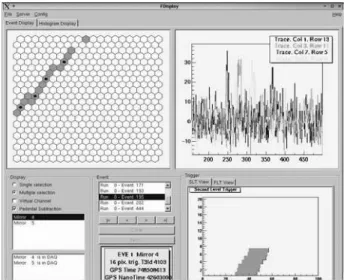
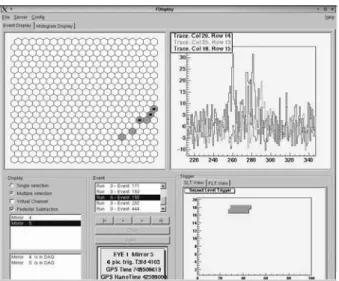
SD stations and the FD. In the event map, one can see the direction of the SDP plane given by the FD (symbolized by the dashed red line) which lies right on the SD reconstruc-ted impact point on the ground. Another interesting event is shown in Figs. 16 and 17, this is a hybrid event as well, but in particular, it is one which could be seem by2adjacent te-lescopes, notice its track finishing at one mirror and stating exactly in the same elevation in the other mirror.
The observatory entered the Pre-Production phase: an array of 100 tanks and 2 FD eyes with 6 telescopes will become operational by the beginning of 2004. Since Fri-day October 3rd, after the SD Station Stroustrup woke up to CDAS and joined the Array as the 100th running station, the Auger is the largest running array in the world. The Southern Pierre Auger Observatory completion is expected for the end of 2005.
Figure 15. The SD event 574023.
Fi 16 D bl i b i 4 f L L Figure 16. Double mirror event as seen by mirror 4 of Los Leones.
6
Conclusion
Figure 17. Double mirror event as seen by mirror 5 of Los Leones.
Figure 18. Integrated aperture of several experiments along the years [27].
events as expected and then dismantled for the assembling of of the final systems, while the SD is continuously growing and running. The Pre-Production phase has begun and by 2004 is expected300SD units and2 fully installed FD te-lescopes. The Southern site will be finished by the end of 2005 and the construction of the Northern site will begin by 2006. The completion of the full sky coverage is expected by the year 2010 and afterwards. In the Fig. 18, we can see the increase of the integrated aperture as a function of time for several cosmic ray experiments in comparison with the Pierre Auger Observatory, in the right column is plot the ex-pected number of events per year above 1020
eV. A flux grater than1000per year will be available sometime after 2012, which is enough statistics to provide some answers to the puzzle of the UHECR’s.
Acknowledgments
The author would like to thank to the organizing com-mittee of the XXIV Brazilian National Meeting on Particles and Fields and express his gratitude to Prof. Carlos Escobar from Unicamp for his support during all these years. This work is supported by Fapesp and CNPq (Brazil).
References
[1] Pierre Auger Design Report, Fermilab (1997), http://www.auger.org/admin/DesignReport/index.html
[2] J. Linsley,Phys. Rev. Lett.,34,146 (1963).
[3] M. Nagano and A. A. Watson,Rev. of Modern Phys.,72,689 (2000).
[4] D. J. Birdet al,Astrophys. J.,441,144 (1995).
[5] N. Hayashidaet al,Phys. Rev. Lett.,73,3491 (1994).
[6] M. A. Lawrence, R. J. O. Reid, and A. A. Watson,J. Phys., G17,733 (1991).
[7] M. Takedaet al, Astro/ph-0209422, Nov. (2002).
[8] D. J. Birdet al,Phys. Rev. Lett.,71,3401 (1993).
[9] K. Greisen,Phys. Rev. Letters,16,748 (1966).
[10] G. T. Zatsepin and V. A. Kuz’min,JETP Lett.,4,78 (1966).
[11] S. Yoshidaet al,Astroparticle Phys.,3,105 (1995).
[12] M. Born and E. Wolf,Principles of Optics, Cambridge Uni-versity Press (1980).
[13] J. Knapp,Proc. of 2nd Int. Workshop on EHE Cosm. Rays, Nov. 5 (2002), Tokyo, Japan.
[14] M. A. L. de Oliveira, H. C. Reis, R. Sato, and V. de Souza, Manufacturing the Schmidt Corrector Lens for the Pierre Au-ger Observatory, accepted for publication inNuclear Instru-ments and Methods A.
[15] R. Sato, J.A. Bellido C., and H.C. Reis,Improving the S/N Ratio for the Auger Fluorescence Detector, GAP Note 2000-009, http://www.auger.org/admin-cgi-bin/woda/gap notes.pl
[16] M. D. Roberts, P. Sommers, and B. Fick,Absolute calibration of the Auger fluorescence detectors using atmosphere laser beams, GAP Note 2003-010, http://www.auger.org/admin-cgi-bin/woda/gap notes.pl
[17] M. Agliettaet al.,Astrop. Phys.,6,143 (1997).
[18] A. Filipic, M. Horvat, D. Verberic, D. Zavrtanik, and M. Za-vrtanik,Analysis of Lidar Measurements at the Pierre Auger Observatory,GAP Note 2003-002,
http://www.auger.org/admin-cgi-bin/woda/gap notes.pl
[20] J. Abraham et al., Properties and Performance of the Pro-totype Instrument for the Pierre Auger Observatory, submit-ted to Nucl. Instr. and Meth.A(2003).
[21] X. Bertou, Communication at the Auger e-mail list: au-ger [email protected], Dec. 1st (2003).
[22] H. M. J. Barbosa, F. Catalani, C. Dobrigkeit, and J. A. Chinellato, Study of the Energy Deposit in the Atmosphere by UHECR: The Missing Energy, GAP Note 2003-069, http://www.auger.org/admin-cgi-bin/woda/gap notes.pl
[23] V. de Souza, C. Dobrigkeit, and B. Dawson,A hybrid recons-truction program and the hybrid resolution,, GAP Note 2003-069, http://www.auger.org/admin-cgi-bin/woda/gap notes.pl
[24] Luis Prado Jr, Study of Hybrid and Stereo Trigger Perfor-mance for Different Detector Configurations with 4 Telesco-pes and the Pre-production Array, GAP Note 2003-044, http://www.auger.org/admin-cgi-bin/woda/gap notes.pl
[25] Luis Prado Jr,FDSim User’s Manual - PreProd v2r0, GAP Note 2003-084,
http://www.auger.org/admin-cgi-bin/woda/gap notes.pl
[26] A. Letessier-Selvon,Communication at the Auger e-mail list: auger [email protected], Oct. 2nd (2003).