SIGHTINGS AND BYCATCH OF SMALL PELAGIC CETACEANS, NEW
INFORMATION REGISTERED BY VOLUNTEER FISHERMEN
OFF SÃO PAULO, BRAZIL
Juliana Marigo1* and Bruno de BarrosGiffoni2
1Projeto BioPesca, Centro Golfinho Rotador, PE (Rua Lorena 27, Itaguá, 11680-000 Ubatuba, SP, Brazil)
*Corresponding author E-mail: [email protected]; [email protected] 2Fundação Pró-TAMAR
(Rua Antônio Athanazio 273, Itaguá, 11680-000 Ubatuba, SP, Brazil) E-mail: [email protected]
In Brazil, marine mammals and turtles are legally protected and are of no commercial value to the fisheries of São Paulo State. Mortality in fishing nets is probably the most serious threat to the conservation of marine vertebrates throughout the world, where a large number of species is accidentally captured during fishing activities (SICILIANO, 1994; BERTOZZI; ZERBINI, 2002; MAJLUF et al., 2002; LÓPES et al., 2003; TUDELA et al., 2005; CARRETA et al., 2005). The evaluation and monitoring of the impact of this mortality is considered a priority action by The Brazilian Aquatic Mammals Action Plan (IBAMA, 2001). Since 1998, the Projeto BioPesca systematically monitors coastal artisanal fishery communities of the São Paulo State coast (BERTOZZI; ZERBINI, 2002). In Ubatuba (22º53’S, 45º08’W), through collaboration with the Projeto TAMAR (Brazilian National Sea Turtles Conservation Program), researchers were also able to access the pelagic fleet landing at Saco da Ribeira port.
Pelagic fleets operating surface driftnets are an acknowledged cause of considerable marine mammal mortality and are of particular concern because they are relatively less known and more difficult to monitor than other more coastal-operating fleets (ZERBINI; KOTAS, 1998). The Ubatuba driftnet fleet consists of boats of an average length of 12 meters, operating from October to March, mainly dedicated to shark fishing but also incidentally catching other elasmobranches, teleosts, turtles and cetaceans (ZERBINI; KOTAS, 1998; KOTAS et al., 2005). It is also important to mention that the fleet alternates seasonally between bottom (to catch Micropogonias furnieri) and surface nets depending on the target species. Consequently, there is a high variation in the number of boats operating over the year (with each kind of net) (KOTAS et al., 2005).
Data collected in 1997 showed that fishing trips ranged from 8-15 days, usually at 50-100 miles from the coast, and operated normally at depths of between 30 and 417 m (ZERBINI; KOTAS, 1998;
KOTAS et al 2005). Data collected about 10 years later, between 2005 and 2006, showed that the duration of the fishing trips had increased, the fishing area covered had expanded and the depths fished had increased to 2000 m, suggesting that fishermen needed to go further to find fish (SALES et al., 2003; KOTAS et al., 2005).
Disposable cameras were given to fishermen to voluntarily register sightings and/or captures of dolphins during two fishing trips. The first trip was in November 2005; fishing activity lasting for 18 days. The second trip took place in February 2006, there being 16 days of fishing. The sets began in the afternoon and the nets were hauled out the next morning, after an average total of 12 hours´ immersion. The sets during the first trip (November 2005) were made at depths ranging from 30-500 meters, while the sets of the second trip (February 2006) occurred within a range of from 200-1000 meters, with only one set being made in waters deeper than 1000 meters (Fig. 1).
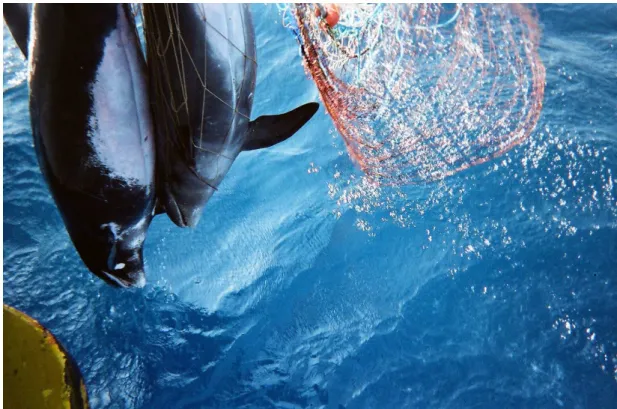
Four species of small cetaceans were sighted: Stenella frontalis, Stenella longirostris, Tursiops truncatus and one non-identified small cetacean. Four species were captured accidentally: S. frontalis, S. longirostris, Peponocephala electra and Feresa attenuata (Table 1).
Fig. 1. Map showing the location and depths of sets performed during two fishing operations of boat from Saco da Ribeira, Ubatuba, São Paulo State, November 2005 and February 2006.
Table 1. Sightings and incidental captures of small cetaceans registered by fisherman of the Saco da Ribeira fleet during two fishing trips carried out in São Paulo waters in November 2005 and February 2006.
1st trip: Nov 2005 2nd trip: Feb 2006
Species Sighting Bycatch Sighting Bycatch
Stenella frontalis x 1 x
Stenella longirostris x 1 1
Peponocephala electra 2 1
Feresa attenuatta 1
Tursiops truncatus x
Non-identified cetacean x ? x ?
Figure 2: Stenella longirostris accidentally captured during the first
Fig. 3. The “black dolphins” accidentally captured in the same set during the first trip in November 2005. The net holds two specimens of P. electra and one F. attenuata is already in the boat.
On the second trip, P. electra, once again, (data not shown) and S. longirostris (data not shown) were captured. In addition, one more group of S. frontalis were sighted swimming close to the boat (data not shown).
Scientific knowledge of the distribution, abundance and biology of many cetaceans occurring on the Brazilian coast is still incomplete, most of the species still being considered “data deficient” by The Brazilian Aquatic Mammals Action Plan (IBAMA, 2001; ZERBINI et al., 2004).
T. truncatus is a delphinid cosmopolitan species of worldwide distribution but showing morphotypic variation among regions. Distinctions between coastal and pelagic populations have been documented throughout the species range (LEATHERWOOD; REEVES, 1990; NATOLI et al., 2004). We cannot be sure whether the specimens sighted on the first trip (data not shown) belonged to a coastal or a pelagic population because we do not have their exact sight location or any other morphological information.
Stenella frontalis and S. attenuata had been previously reported as having been accidentally captured by driftnets. In one case, S. frontalis was captured by the same Ubatuba fleet, also fishing for sharks (ZERBINI; KOTAS, 1998; IBAMA, 2001).
Although we only have evidence of the capture of a few specimens, we agree that given their wide distribution and high relative abundance, S. frontalis are possibly taken in great numbers throughout their range in southern Brazil and S. longirostris may be more susceptible to captures when fisheries operate in deeper waters (ZERBINI; KOTAS, 1998). According to our data the Ubatuba driftnet fleet are in fact operating at greater depths nowadays and capturing both species. The Brazilian Aquatic Mammals Action Plan (IBAMA, 2001), further, place S. longirostris among the species under high anthropogenic pressure, the main concern being related to bycatches in driftnets.
the coast of São Paulo and a skull was found on the coast of Maranhão (ROSSI-SANTOS et al., 2006; SICILIANO et al., 2007). Both species are considered “data deficient” by the The Brazilian Aquatic Mammals Action Plan (IBAMA, 2001). Prey taken by a stranded animal suggests that feeding occurred over the outer continental shelf and slope but also that the animal had foraged close to the coast before stranding occurred (ZERBINI; SANTOS, 1997). F. attenuatta could use the edge of the continental shelf occasionally for resting or feeding, just as several other pelagic species frequently do, e.g. Stenella attenuata off south-eastern Brazil (MORENO et al., 2005; SICILIANO et al., 2007).
This is the first record, as far as we know, of F. attenuatta and P. electra as bycatch on the Brazilian coast. This represents not only new data on the occurrence but also on the identification of a potential threat to these little known species given that bycatch, according to fishermen, may take place repeatedly in that area. Further, the fact that the fleet is now operating at greater depths suggests that the more pelagic dolphin species such as these are more vulnerable to being caught as bycatch than ever before.
Zerbini and Kotas (1998) reported ten cetacean species interacting with driftnet fisheries off southern Brazil and mention that most cetaceans are found dead but that others are sometimes released alive. The authors pointed out that the capture of more than one individual on the same trip is common and, sometimes, occurs in the same set, which is corroborated by the report of the fishermen interviewed in this study.
Fishing vessels using driftnets are known to operate from at least nine ports along the southern Brazilian coast, however the total number of boats operating is unknown (ZERBINI; KOTAS, 1998). From previous reports and our results it is clear that bycatch may occur at high levels during these fishing activities and, as stated by Zerbini and Kotas (1998), is not negligible.
Siciliano (1994) comments that reported mortality appears to be greatest where a combination of factors occurs: regular fishing effort; relatively high cetacean abundance; and, of course, the presence of an observer. Our results show that it is possible to work in partnership with fishermen and even a small disposable camera can provide, at low cost, useful information about marine mammal interactions with fisheries.
A
CKNOWLEDGEMENTSFirst of all the authors wish to thank the fishermen who voluntarily presented data on fishing effort and took the pictures, as also Fabio A.F. de
Oliveira who introduced us to the boat crew. We are grateful to A.Zerbini, L.Flach, E.R.Secchi, C.Petta and other researchers who gave their opinion on the identification of the “black dolphins” as also to the Projeto TAMAR/ICMBio-Base Ubatuba, and the Yaqu Pacha and Cetacean International Society, the main sponsors of Projeto BioPesca.
R
EFERENCESBERTOZZI, C. P.; ZERBINI, A. N. Incidental mortality of franciscana, Pontoporia balinvillei, in the artisanal fishery of Praia Grande, São Paulo State, BRAZIL.
LAJAM , v. 1, n. 1, p. 153-160, 2002.
CARRETA, J. V.; PRICE, T.; PETERSEN, D.; READ, R. Estimates of marine mammal., sea turtle, and seabird mortality in the California Drift Gillnet Fishery for Swordfish and Thresher Shark, 1996–2002. Mar. Fish. Rev., v. 66, n. 2, p. 21-30, 2005.
IBAMA. Plano de ação para mamíferos aquáticos do Brasil, II. Instituto Brasileiro do Meio Ambiente e dos Recursos Naturais Renováveis. Brasília, DF, 2001. 102p.
KOTAS, J. E.; JUNIOR, M. P.; AZEVEDO, V. G.; SANTOS, S. dos. A pesca de emalhe e espinhel-de-superfície na Região Sudeste-Sul do Brazil. São Paulo: Instituto Oceanográfico, Universidade de São Paulo. São Paulo: 2005. (Série Documentos
Revizee-Score Sul, 2).
KOTAS, J. E.; SOUZA, N. L.; FIEDLER, F. N.; GIFFONI, B. B.; SALES, G.; CONSULIM, C. E. N.; DIEGUES, R. Diagnóstico das pescarias com rede de emalhe no Sudeste/Sul do Brasil, com frotas sediadas em Ubatuba (SP), Itajaí, Navegantes e Porto Belo (SC), entre os anos de 2005 e 2006. In: CONGRESSO LATINO AMERICANO DE CIÊNCIAS DO MAR - COLACMAR, 5. Florianópolis, 2007. p. 21.
LEATHERWOOD, S.; REEVES, R. R. The Bottlenose Dolfin. Academic Press, San Diego. 1990.
LÓPES, A.; PIERCE, G.J.; SANTOS, M.B.; GRACIA, J.; GUERRA, A. Fishery by-catches of marine mammals in Galician waters: results from on-board observations and an interview survey of fishermen. Biol. Conserv.,
v.111, p. 25–40, 2003.
MAGALHÃES, F. A.; GARRI, R. G.; TOSI, C. H.; SICILIANO, S.; CHELLAPA, S.; SILVA, J. L. First confirmed record of Feresa attenuata (Delphinidae) for the Northern Brazilian Coast. BiotaNeotrop. , v. 7, n. 2,
2007. http://www.biotaneotropica.org.br/v7n2/en/abstract? article+bn03407022007
MAJLUF, P.; BABCOCK, E. A.; RIVEROS, J. C.; SCHREIBER, M. A.; ALDERETE, W. Catch and by-catch of seabirds and marine mammals in the small-scale fisheries off Punta San Juan, Peru. Conserv. Biol., v. 16,
n. 5, p.1333-1343, 2002.
MORENO, I. B.; ZERBINI, A. N.; DANILEWICZ, D.; SANTOS, M. C. D.; SIMÕES-LOPES, P. C.; LAILSON-BRITO, J.; AZEVEDO, A. F. Distribution and habitat characteristics of dolphins of the genus Stenella (Cetacea: Delphinidae) in the southwest
NATOLI, A.; PEDDEMORS, V. M.; HOELZEL, A. R. Population structure and speciation in the genus Tursiops
base don microsatellite and mitochondrial DNA analyses. J. Evol. Biol., v. 17, p.363-375. 2004
ROSSI-SANTOS, M., BARACHO, C. B., SANTOS NETO, E.; MARCOVALDI, E. First sightings of the pygmy killer whale, Feresa attenuata, for the Brazilian coast.
JMBA2-Biod. Rec. 2006. Available: <http://www.mba.ac.uk/jmba/jmba2biodiversityrecords.php> SALES, G.; GIFFONI, B. B.; MAURUTTO, G.; BRUNZIN,
M. Captura incidental de tartarugas marinhas pela frota de emalhe de deriva sediada em Ubatuba, São Paulo- Brasil. In: JORNADAS DE CONSERVACIÓN Y USO SUSTENTABLE DE LA FAUNA MARINA, 2.; Reunión de Investigación y Conservación de Tortugas Marinas del Atlántico Sur Ocidental., 1. Montevideo, Uruguai, 2003. p. 65.
SICILIANO, S. Review of small cetaceans and fishery interactions in coastal waters of Brazil. In: Gillnets and cetaceans. PERRIN, W. F.; DONOVAN, G. P.; BARLOW, J. (Ed.). ReptInt. Whale Comm., Special
Issue n. 15, p. 241-250, 1994.
SICILIANO, S.; MORENO, I. B.; SILVA, E. D. Early sightings of the pygmy killer whale (Feresa attenuata) off the Brazilian coast: a correction to Rossi-Santos et al. (2006). JMBA2 – Biodiversity Records (5799):1-2. 2007.
TUDELA, S.; KAI KAI, A.; MAYNOU, F.; EL ANDALOSSI, M.; GUGLIELMI, P. Driftnet fishing and biodiversity conservation: the case study of the large-scale Moroccan driftnet fleet operating in the Alboran Sea (SW Mediterranean). Biol. Conserv., v. 121, p. 65-78, 2005.
ZERBINI, A. N.; SANTOS, M. C. O. First record of the pygmy killer whale Feresa attenuata (Gray, 1874) for the Brazilian coast. Aquat. Mamm., v. 23, p. 105–109, 1997.
ZERBINI, A. N.; KOTAS, J. E. A note on cetacean bycatch in pelagic driftnetting off Southern Brazil. ReptInt. WhaleComm., v. 48, p. 519-523, 1998.
ZERBINI, A. N; SECCHI, E. R.; BASSOI, M.; DALLA-ROSA, L.; HIGA, A.; SOUSA, L.; MORENO, I. B.; MOLLER, L.; CAON, G. Distribuição e abundância relativa de cetáceos na Zona Econômica Exclusiva na Região Sudeste-Sul do Brasil. Revizee-Score Sul. Instituto Oceanográfico, Universidade de São Paulo, 2004. 40 p. (Série Documentos REVIZEE-Score Sul).