O
RIGINALA
RTICLE ©Revista Brasileira de FisioterapiaClinical, functional and inflammatory factors
associated with muscle fatigue and self-perceived
fatigue in elderly community-dwelling women
Fatores clínicos, funcionais e inflamatórios associados à fadiga muscular e à fadiga
autopercebida em idosas da comunidade
Juscelio P. Silva1, Daniele S. Pereira1, Fernada M. Coelho2, Lygia P. Lustosa3, João M. D. Dias1, Leani S. M. Pereira1
Abstract
Background: Fatigue is a common and nonspecific symptom associated with chronic health problems in the elderly. The modifications and adaptations of the aging process associated with complex and multidimensional nature of fatigue favors the interaction of multiple factors in the genesis of this phenomenon. Objectives: To investigate the association of clinical, functional and inflammatory factors with muscle fatigue and self perceived fatigue in elderly women. Methods: Participated in the study one hundred and thirty five community elderly women, all sedentary, with a mean age of 71.2±4.57. A structured questionnaire and functional testing were used to evaluate clinical and functional characteristics. Plasma concentrations of inflammatory mediators (IL-6 and sTNFR1) were measured by ELISA method. Muscle fatigue was measured by isokinetic dynamometer and self-perceived fatigue was measured by a visual analog scale. Statistical analysis was performed by multiple linear regression and Spearman correlation coefficient with statistical significance of 5%. Results: The regression models showed that the variables age, body mass index, physical activity level, functional capacity and peak torque were associated with muscle fatigue (R2=0.216, p<0.01). Self-perceived fatigue was associated with number of comorbidities, depression, physical activity level, functional capacity, peak torque and perceived health (R2=0.227, p<0.01). Conclusion: This study showed a psychophysical interaction of the fatigue, by identifying the main factors associated with muscle fatigue and self-perceived fatigue in elderly women. These findings demonstrate the importance of evaluation and treatment of modifiable factors in both muscle fatigue and self-perceived fatigue, seeking a better physical and functional performance of elders.
Key words: Muscle fatigue; self-perceived fatigue; aging; elderly.
Resumo
Contextualização: A fadiga é um sintoma comum e inespecífico associado aos problemas crônicos de saúde nos idosos. As alterações e adaptações do processo de envelhecimento associadas à natureza complexa e multidimensional da fadiga favorecem a interação de múltiplos fatores na gênese desse fenômeno. Objetivos: Investigar a associação dos fatores clínicos, funcionais e inflamatórios com a fadiga muscular e a autopercebida em idosas. Métodos: Participaram 135 idosas sedentárias da comunidade, com média de idade de 71,2±4,57. Questionário estruturado e teste funcional foram utilizados para avaliar as características clínicas e funcionais. As concentrações plasmáticas dos mediadores inflamatórios (IL-6 e sTNFR1) foram dosadas pelo método ELISA. A fadiga muscular foi mensurada pelo dinamômetro isocinético, e a fadiga autopercebida, pela Escala Visual Analógica (EVA). A análise estatística foi realizada pela regressão linear múltipla e pelo Coeficiente de Correlação de Spearman, com nível de significância de 5%. Resultados:
Os modelos de regressão demonstraram que os fatores idade, índice de massa corporal (IMC), nível de atividade física, capacidade funcional e pico de torque foram associados à fadiga muscular (R2=0,216, p<0,01). A fadiga autopercebida foi associada ao número
de comorbidades, estado depressivo, nível de atividade física, capacidade funcional, pico de torque e saúde percebida (R2=0,227,
p<0,01). Conclusão: O presente estudo mostrou uma interação psicofísica da fadiga, identificando os principais fatores associados à fadiga muscular e à autopercebida em idosas. Esses achados demonstram a importância da avaliação e tratamento dos fatores modificáveis tanto na fadiga muscular quanto na autopercebida, buscando um melhor desempenho físico-funcional dos idosos.
Palavras-chave: fadiga muscular; fadiga autopercebida; envelhecimento; idosos.
Received: 23/08/2010 – Revised: 23/02/2011 – Accepted: 13/04/2011
1 Physical Therapy Department, Universidade Federal de Minas Gerais (UFMG), Belo Horizonte, MG, Brazil 2 Department of Biochemistry and Immunology, UFMG
3 Physical Therapy Department, Centro Universitário de Belo Horizonte (Uni-BH), Belo Horizonte, MG, Brazil
Introduction
Fatigue is a nonspeciic symptom associated with chronic health problems and with functional deterioration, and its construct has a complex and multidimensional nature1. he
word fatigue has been used to describe several physiological and psychological phenomena; therefore, it is frequent the misunderstanding and controversy in its deinitions2. From the
physiological perspective, fatigue is related to the functional failure of one or several organs. Whereas from a psychological perspective, it is associated to the conscious, subjective and in-dividual state of reduced motivation, involving physical, men-tal and/or emotional alterations1. Ahsberg2 in an operational
division, distinguished three forms of fatigue: physiological, objective and self-perceived2.
Regarding physiological fatigue, the focus is the muscle and its capacity to generate and maintain muscle power3. Muscle
fatigue can be deined as the reduction, induced by the capac-ity of the neuromuscular system to generate strength, work or power1,3,4. Its setup may be related to neurological, metabolic,
electrophysiological, mechanical, subjective among others, which interfere in the synchronous functioning between the central nervous system (CNS) and the peripheral paths5,6.
Objective fatigue is related to a modiied performance during the execution of a certain type of task2. Individual
al-terations in the performance might be inluenced by the type of activity or work5. he performance of subjects at the work
environment is the focus. In this context, fatigue represents a reduction in the performance, a loss of eiciency and/or a lack of interest in working2.
he self-perceived fatigue can be understood as a conscious and unpleasant symptom, encompassing sensations that involve the whole body1. It is a subjective symptom that can
be inluenced by internal or external features of the subject2,7.
Fatigue sensation may be related to physical alterations and modiications to mental and emotional status. he context of this approach is multifactorial1,8. he conscious self-report of
tiredness is the most important information for the evaluation of fatigue under the psychological and subjective perspective2.
he variety of descriptions on fatigue illustrates its diverse meanings, among which it is not always possible to obtain a clear diferentiation. his multifactorial nature shall be consid-ered in the assessment of the fatigue symptoms in the elderly. he neuromuscular alterations associated to sarcopenia pro-duce quantitative and qualitative deiciencies on movements and muscle function, predisposing to signiicant impairment on functionality and fatigue symptoms9-11. Otherwise, the
di-versity of health problems that afects elderly people can also inluence fatigue onset12.
he diverse alterations related to the aging process, as well as the multidimensional nature of fatigue create a propi-tious condition for the interaction among several factors in its manifestations in the elderly population12,13. Clinical, physical,
functional, psycho-emotional, lifestyle, alterations in the con-centration of inlammatory mediators, among others inherent to senescence and senility, may be associated to fatigue10,12-14.
However, fatigue symptoms, considered under a multifactorial perspective, have been scarcely documented in elderly people. None comparative investigation was identiied in the literature, with regards to the major factors associated to physical and self-perceived fatigue.
To investigate fatigue with emphasis in the multifactorial aspects will provide scientiic advances for a better compre-hension of these symptoms in the elderly people. It will also ofer evidence for comprehension of the major mechanisms involved in this phenomena, supporting the understanding of the relations and interactions between fatigue symptoms and functionality and morbid-mortality. In this context, the pur-pose of the present study was to investigate the association of clinical, functional and inlammatory factors muscle and self-perceived fatigue in community-dwelling older adults.
Methods
his is an observational, cross-sectional study, approved by the Ethics Committee of Research of the Universidade Federal de Minas Gerais (UFMG), Belo Horizonte, MG, Brazil, under the protocol nº ETIC 321/07 – Amendment 01/08.
Sample
he present study used a convenience sample composed of 135 sedentary, community-dwelling older women, recruited from the Center of Reference for the Elderly People of the UFMG; at the Centro Universitário de Belo Horizonte (UNIBH), Belo Horizonte, MG, Brazil; in the Network Studies on Frailty in Brazilian Older Adults - REDE FIBRA; from the waiting list of the Project Physical Education for the hird Age of the UFMG and through advertisements in local newspapers. All voluntar-ies agreed to participate and signed a free informed consent.
he inclusion criteria were: being female, aged from 65 years-old or older, living in the community and walking without aid devices. Older women with sequel of neurologic diseases, history of recent fractures in the lower limbs, active neoplasic in the last ive years, cognitive impairment detectable in the Mini-Mental State Exam15, acute inlammatory diseases and
use of immune-reactive medication were excluded.
he sample size was based on a pilot study with 15 partici-pants and from literature information16. A statistical power of
90% and α value of 5% was previously deined. After the use of statistical tables of power, the minimal sample number was deined as 92 older women17.
Measuring instruments
All participants were required to answer a structured mul-tidimensional questionnaire for characterizing the sample with regards to their clinical and socio-demographic aspects, such as age, marital status, levels of education, number of co-morbidities, body mass index (BMI) and perceived health. In order to quantify depressive status, the short version of the Geriatric Depressive Scale (GDS)18, the level of physical activity
was assessed through the Human Activity Proile (HAP)19
ques-tionnaire. All the instruments were administered by previously trained examiners.
Muscular fatigue
Muscular fatigue of knee extensors was assessed through an isokinetic dynamometer (Biodex System 3 Pro®
). Partici-pants performed 21 maximal repetitions of knee extension in an angular velocity of 180º/s and a range of motion (ROM) of 90º. he muscular fatigue index (MFI) represents the percent-age of work (W) declined during the test and was calculated by the software of the isokinetic dynamometer based on the following equation: MFI = 100 - (W latter ⅓ / W former ⅓ x 100). Higher MFI indicate a higher level of muscular fatigue of the muscle assessed. he protocol used for the isokinetic dyna-mometer was administered by a single trained examiner. All procedures for test execution were performed following the manufacturer’s reccomendations20.
Self-perceived fatigue
Tiredness or fatigue sensations reported by the participants for the execution of the usual daily activities was assessed by an Visual Analogue Scale for fatigue (VAS-F), with gradu-ation in colors, ranging from light blue (minimal) to intense red (maximal), and a numerical scale ranging from 0 to 10 cm, which quantiied the level of fatigue reported. he procedures for such assessment were standardized and administered by a single trained evaluator21.
Functional capacity
he assessment of functional performance was performed through the sit-to-stand test. he time taken for each participant
to stand up and sit back down in a standardized chair for ive times, with arms crossed on the trunk, was recorded. his test presents acceptable reliability and validity to assess functional performance among older adults22.
Inflammatory mediators
Plasma concentrations of the inlammatory mediators interleucin-6 (IL-6) and soluble receptor of tumor necrosis fac-tor α (sTNFR1) were measured by the method Enzyme-Linked Immuno Sorbent Assay (ELISA). To dose IL-6 and sTNFR1, high sensibility kits were used (Quantikine®
HS, R&D Systems, Mineapolis, USA). All the tests were performed according to recommendations from the manufacturers. Samples’ reading was performed by a microplate reader adjusted for 490 nm and correction of wave length in 650 nm.
Statistical analysis
To describe the sample characteristics, measures of fre-quency and central tendency were used. Analysis of normality distribution was performed by Kolmogorov-Smirnov test.
(SPSS) for Windows (Version 15.0), and the level of signiicance adopted was 5%.
Results
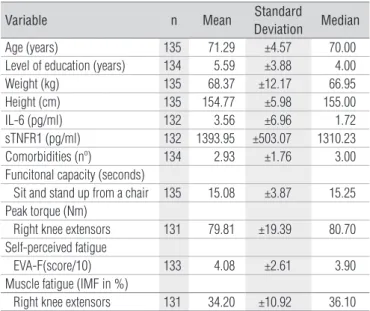
One hundred thirty-ive old women participated in this study. hey were sedentary, living in the community, with good functionality levels, and with absence of apparent inlamma-tory signs. he descriptive characteristics of the sample are shown in Tables 1 and 2.
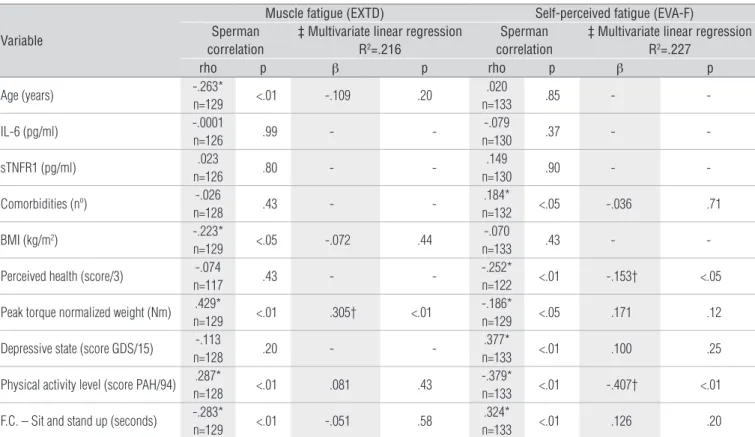
he variables plasma concentrations of IL-6 (Rho=0.001; p=0.999) and sTNFR1 (Rho=0.23; p=0.798), number of comor-bidities (Rho=-0.26; p=0.770), depressive state (Rho=-0.113; p=0.204) and perceived health (Rho=-0.074; p=431) did not correlate signiicantly with the variable muscle fatigue and were not included in the regression model. he inal model demonstrated that the factors age, BMI, level of physical ac-tivity, functional capacity and peak torque explained 21.6% (R2=0.216, p<0.01) of muscle fatigue variability, and the peak
torque was the variable that most explained the muscle fa-tigue (Table 3).
For the self-perceived fatigue, there was no signiicant cor-relation with the variables plasma levels of IL-6 (Rho=-0.790; p=0.370), sTNFR1 (Rho=0.149; p=0.090), age (Rho=0.017; p=0.847) and BMI (Rho=-0.070; p=0.425). hese variables were not included in the regression model. he inal model showed association of the self-perceived fatigue with the factors num-ber of comorbidities, depressive state, levels of physical activity, functional capacity, peak torque and perceived health. hese
variables explained 22.7% (R2=0.227, p<0.01) of the variability
of subjective fatigue. Levels of physical activity and perceived health were the factors which most explained self-perceived fatigue (Table 3). he results from the present study also in-dicated a negative and signiicant correlation between self-perceived fatigue and muscular fatigue from knee extensors (Rho=-0.185; p<0.05).
Discussion
In this exploratory investigation, there were analyzed the relationships between fatigue and muscular fatigue with the major clinic, functional and inlammatory factors in
IL-6=interleukin 6; sTNFR1=sobuble receptor tumor necrosis factor α; VAS-F=visual analogue scale of fatigue; IMF=index of muscle fatigue.
Table 1. Descriptive characteristics of sample: continuous variables.
Variable n Mean Standard
Deviation Median
Age (years) 135 71.29 ±4.57 70.00
Level of education (years) 134 5.59 ±3.88 4.00
Weight (kg) 135 68.37 ±12.17 66.95
Height (cm) 135 154.77 ±5.98 155.00
IL-6 (pg/ml) 132 3.56 ±6.96 1.72
sTNFR1 (pg/ml) 132 1393.95 ±503.07 1310.23
Comorbidities (nº) 134 2.93 ±1.76 3.00
Funcitonal capacity (seconds)
Sit and stand up from a chair 135 15.08 ±3.87 15.25
Peak torque (Nm)
Right knee extensors 131 79.81 ±19.39 80.70
Self-perceived fatigue
EVA-F(score/10) 133 4.08 ±2.61 3.90
Muscle fatigue (IMF in %)
Right knee extensors 131 34.20 ±10.92 36.10 GDS=geriatric depression scale; HAP=human activity profile; LL=lower limbs; BMI=body
mass index, * CUT off points for categories according to criteria of World Health Organi-zation; † AAS=adjusted activity score.
Table 2. Descriptive characteristics of sample: categorical variables.
Variable n Frequency Percentage
Marital status (score/4) 134
Married/partner 45 33.6
Single 16 11.9
Divorced 12 9.0
Widowed 61 45.5
*Body mass index - BMI (kg/m2) 135
Underweight (BMI <18.5) 2 1.48
Normal weight (18.5≤ BMI ≤24.9) 26 19.26
Overweight (25.0≤ BMI ≤29.9) 56 41.48
Obesity (BMI ≥30.0) 51 37.78
Class I (30.0≤ BMI ≤34.9) 38 28.15
Class II (35.0≤ BMI ≤39.9) 12 8.89
Class III (BMI ≥40.0) 1 0.74
Perceived health (score/3) 123
Poor 6 4.9
More or less 57 46.3
Good 60 48.8
Life satisfaction (score/3) 123
Little 3 2.4
More or less 41 33.3
Very 79 64.2
Depressive state (score GDS/15) 133
0-3 points 67 50.37
4-6 points 44 33.08
7-9 points 18 13.53
10-15 points 4 3.01
†Physical activity level (score HAP/94) 134
Inactive (AAS<53) 21 15.67
Moderately active (53≤AAS≤74) 76 56.72
Activity (AAS>74) 37 27.61
Dominance LL (score/2) 135
Right 133 98.5
Left 2 1.5
community-dwelling older women. Demographic data indicate a growing in feminization of old age, justifying the relevance of the investigations involving old female population23.
he factors age, BMI, level of physical activity, functional capacity and peak torque presented signiicant association with muscle fatigue of knee extensors. Peak torque was the factor that best explained the variability of the muscle fatigue, remaining associated negatively and independently even after adjustment for the other explanatory variables. Peak torque represents the maximal muscle strength of an individual, re-lecting the point of maximal muscle performance during a isokinetic test, besides of being the most frequently described parameter in isokinetic assessments of muscular perfor-mance24. Our results demonstrated that the increase on peak
torque was associated to an increase on muscular fatigue. Katsiaras et al.16, assessing muscular fatigue of knee extensors
in a sample of 1512 older adults, with age ranging from 70 to 79 years, good functionality, recruited from a cohort of the Health ABC Study, with 3075 participants, also found similar results regarding the variable peak torque and knee extensors muscular fatigue16. A plausible explanation for this association
may be the increased use of the oxidative path for the produc-tion of adenosine triphosphate (ATP) during muscular con-traction and strength generation by the older adults25,26. his
aerobic path presentes more metabolic economy and lower fatigue rate when compared to the glicolitic/anaerobic me-tabolism, which is less used as a source of energy in muscle contraction of the elders25,27. he deinition of muscle fatigue
used in the present study, represented by the MFI, indicates the reduction of the capacity of the neuromuscular system to generate power over time and shall be considered for a bet-ter comprehension of the results. Neuromuscular albet-terations of the aging process cause decrease of the number of type II muscle ibers in relation to the type I ibers and, thus, muscu-lar power production in the elders become more dependent of type I ibers, which are more resistant to fatigue, nevertheless produce less power than type II ibers. From this perspective, in this sample, it might be that those older women with higher muscle strength presented a greater proportion of type II i-bers and, consequently, a higher fatigue rate, since, theoreti-cally and proportionally, they had more type II ibers, which are stronger and less resistant to fatigue28. his argument is in
accordance with the literature which indicate higher muscle fatigue rate in young adults, whom possess relatively higher muscle strength and higher proportion of type II ibers, when compared to older adults25-27.
Spearman’s Correlation Coeicient indicated that, un-expectedly, there was a negative correlation of the features
Table 3. Relationship of muscle fatigue and self-perceived fatigue with clinical, functional and inflammatory.
* Significant correlation with the dependent variable; † significant independent association in the regression model adjusted for other variables; ‡ n=113 for all variables in the regression; BMI=body mass index; IL-6=interleukin 6; sTNFR1=soluble receptor tumor necrosis factor α; IMF=index of muscle fatigue; GDS=geriatric depression scale; HAP=human activity profile; F.C.=functional capacity; EXTD=right knee extensor muscles; VAS-F=visual analogue scale of fatigue.
Variable
Muscle fatigue (EXTD) Self-perceived fatigue (EVA-F)
Sperman correlation
‡ Multivariate linear regression
R2=.216
Sperman correlation
‡ Multivariate linear regression
R2=.227
rho p β p rho p β p
Age (years) -.263*
n=129 <.01 -.109 .20
.020
n=133 .85 -
-IL-6 (pg/ml) -.0001
n=126 .99 -
--.079
n=130 .37 -
-sTNFR1 (pg/ml) .023
n=126 .80 -
-.149
n=130 .90 -
-Comorbidities (nº) -.026
n=128 .43 -
-.184*
n=132 <.05 -.036 .71
BMI (kg/m2) -.223*
n=129 <.05 -.072 .44
-.070
n=133 .43 -
-Perceived health (score/3) -.074
n=117 .43 -
--.252*
n=122 <.01 -.153† <.05
Peak torque normalized weight (Nm) .429*
n=129 <.01 .305† <.01
-.186*
n=129 <.05 .171 .12
Depressive state (score GDS/15) -.113
n=128 .20 -
-.377*
n=133 <.01 .100 .25
Physical activity level (score PAH/94) .287*
n=128 <.01 .081 .43
-.379*
n=133 <.01 -.407† <.01
F.C. – Sit and stand up (seconds) -.283*
n=129 <.01 -.051 .58
.324*
age, BMI and functional capacity. In other words, the older the subjects were, the higher their BMI, the poorer their BMI as well as their levels of physical activity and the lower were their FMI. hese variables are pointed in the literature as rel-evant aspects in the evaluations of physical and functional performances of the older adults and presented associations with the changes in muscular strength, reduction of mobility and functional decline12-14,29, but not with fatigue. In a irst
glance, the results from the present study seem discrepant from the remaining literature. he irst impression would be that the older adults, obese, with low levels of physical activ-ity and with poorer functional capacactiv-ity, would have higher FMI, but the results from the present study evidenced the opposite situation. It is valuable to highlight that the results relative to muscle fatigue relect the decline of muscle per-formance of the older women along the time of execution of the isokinetic test. he evidence consulted indicated an association between lower muscle strength with a functional decline28-30, but not with the increase on muscle fatigue
among the elders.
hese indings can be explained by the higher proportion of type I ibers in aged muscles, since they are more resistant to fatigue, but generate lower peak torque and, therefore, lower muscular strength28. Moreover, it should be noted that muscle
function is complex and is associated with other variables6, in
addition to the peak torque during isokinetic testing.
he results for self-perceived fatigue showed a signiicant association between higher perception of fatigue with the larg-est number of comorbidities, worse depression status, poorer health perception, lower levels of physical activity, poorer physical functioning and lower peak torque. Self-perceived health and level of physical activity were the factors that most explained the variation in self-perceived fatigue. hese associa-tions are in agreement with the literature, suggesting multifac-torial relationships in self-perceived symptoms of fatigue in older adults12,14. In this sample, there was also an association
between physical and emotional factors with the symptoms of self-perceived fatigue.
he results of this study are corroborated by the literature. Polur et al.12 in a review of fatigue in the elderly population,
observed an association of fatigue symptoms with chronic diseases, health problems, depressive symptoms, psychologi-cal problems and physipsychologi-cal disability12. Avlund et al.30 studying
factors associated with tiredness in a sample of approxi-mately 1000 elders observed associations between the num-ber of comorbidities, muscle weakness, depression status, social status and pain with symptoms of tiredness30. Recent
evidences indicated the association of self-perceived fatigue with poorer functional capacity, worse physical functioning, muscle weakness, changes in mobility, among others10,14.
he self-perceived fatigue was negatively associated with muscle fatigue in the older women evaluated. he indings of the literature on the subject are conlicting; Bautmans et al.21 studying a sample of older adults, found negative and
sig-niicant correlation of self-perceived fatigue with the manual muscle fatigue21. However, the same group of researchers, in
another study in 2008, investigating a sample of elderly sub-jects, found no correlation between self-perceived fatigue and manual muscle fatigue31. he comparison of our results with
the two studies of Bautmans et al.21,31 was not possible due
to the methodological diferences. In this study we assessed the knee extensors using an isokinetic protocol of dynamic muscle contractions, while in the studies of Bautmans, a hand dynamometer and a protocol of isometric contraction of wrist’s muscles were used21,31. he samples of the studies of
Bautmans et al.21,31 were varied; in one study, it was composed
of community-dwelling older adults without inlammation21
and, in the other, by institutionalized elderly afected by evident inlammatory process31. In both cases, no
informa-tion was provided regarding the levels of physical activity; therefore, it may be a confounding factor in comparing the results. It is noteworthy that the sample studied in this study consisted of community-dwelling older women, sedentary, with good functionality and without evidence of inlamma-tion processes.
he results of this study showed no associations between self-perceived fatigue and muscle fatigue with plasma IL-6 and sTNFR1 levels. he evidences from the literature are con-troversial. While there are reports of correlation of elevated levels of IL-6 with low levels of manual muscle fatigue21, there
are evidence of correlation of high concentrations of IL-6 and TNF- α with worse resistance to muscle fatigue31. However,
the interpretation of the results of previous studies and of this study regarding the release of inlammatory mediators should be cautious. It is necessary to consider the multiple factors and mechanisms responsible for the production and release of IL-6 and TNF-α, as well as its soluble receptor (sTNFR1). Studies have shown that the production and release of inlammatory mediators in the elderly is a complex process regulated by dif-ferent mechanisms32,33.
Another important aspect of the results of this study is that the level of physical activity, functional capacity and peak torque were predictive variables for the two types of fatigue. Such data are particularly important if there were observed diferences between the determinant factors for each of the studied fatigues. here is evidence that the me-chanical principles related to the onset of muscle fatigue in older adults involve, mainly, physiological neuromuscular changes25, whereas for self-perceived fatigue, the mechanisms
involved are more complex and inluenced by multiple factors,
including physiological, psychological, individual and subjec-tive factors12,14. his evidence support the hypothesis that, in
elderly, healthy, community-dwelling women, the FMI of knee extensors are mainly a relection of the deterioration of the physiological capacity of the neuromuscular system to main-tain maximal contractions and are less associated with the subjective aspects. On the other hand, analyzing the charac-teristics of the variables associated with self-perceived fatigue, it is possible to suggest a psychophysical interaction to explain their subjective symptoms. In the elderly adults evaluated, there were inluences from both physiological factors and subjective and psychological factors. However, to demonstrate these relationships in studies with humans seems to be a dif-icult task, considering the several factors that may be involved with the inal outcome6.
Some limitations of this study should be considered. he possible bias in sample selection can compromise the inter-pretation and the generalisability of our results, thus limiting their external validity. he absent evaluation of the aspects re-lated to metabolic muscle fatigue is another point that should be mentioned; since there is evidence that the metabolic changes of the muscles are the main determinant factors for the muscle fatigue25.
he lack of a multidimensional instrument for assessing self-perceived symptoms of fatigue, which is known to be afected by multiple factors1, may also have inluenced the results.
his study provided a general and expanded overview on fatigue, investigating the main factors behind this symptom in
community-dwelling older adults. Maximal muscle strength, represented in this study for peak torque, was the predictive factor that best explained muscular fatigue, which also showed associations with physical activity level, functional capac-ity, age and BMI. Predictive factors of greatest impact on the self-perceived fatigue were the levels of physical activity and perceived health. In this sample, this type of fatigue was also associated with the factors functional capacity, peak torque, number of comorbidities and depression status.
hese results support the evidence10,12,13 that pointed for
the multifactorial relationships in the onset of fatigue in the elderly. Physical therapists and other professionals in the ield of rehabilitation should consider these aspects in clini-cal practice, being useful the combination of diverse factors for measuring and classifying fatigue in the elderly. hus, the approach of fatigue symptoms in the elderly population, both in interventions and in evaluations, should consider the multifactorial nature and the psychophysical construct of the fatigue.
Acknowledgments
To the Conselho Nacional de Desenvolvimento Cientíico e Tecnológico (CNPq), to the Coordenação de Aperfeiçoamento de Pessoal de Nível Superior (CAPES) and to the Fundação de Amparo à Pesquisa do Estado de Minas Gerais (FAPEMIG), for the inancial support.
References
1. Aaronson LS, Teel CS, Cassmeyer V, Neuberger GB, Pallikkathayil L, Pierce J, et al. Defining and measuring fatigue. J Nurs Schol. 1999;31(1):45-50.
2. Ahsberg E. Perceived fatigue related to work [dissertation]. Departament of Psycology, University of Stockholm; 1998.
3. Vollestad NK. Measurement of human muscle fatigue. J Neurosci Methods. 1997;74(2):219-27.
4. Enoka RM, Duchateau J. Muscle fatigue: what, why and how it influences muscle function. J Physiol. 2008;586(1):11-23.
5. Enoka RM, Stuart DG. Neurobiology of muscle fatigue. J Appl Physiol. 1992;72(5):1631-48.
6. Kumar S. Localized muscle fatigue: review of three experiments. Rev Bras Fisioter. 2006;10(1): 9-28.
7. Ahsberg E. Dimensions of fatigue in different working populations. Scand J Psychol. 2000;41(3):231-41.
8. Boksem MA, Tops M. Mental fatigue: costs and benefits. Brain Res Rev. 2008;59(1):125-39.
9. Doherty TJ. Invited review: Aging and sarcopenia. J Appl Physiol. 2003;95(4):1717-27.
10. Vestergaard S, Nayfield SG, Patel KV, Eldadah B, Cesari M, Ferrucci L, et al. Fatigue in a representative population of older persons and its association with functional impairment, functional limitation, and disability. J Gerontol A Biol Sci Med Sci. 2009;64(1):76-82.
11. Faulkner JA, Larkin LM, Claflin DR, Brooks SV. Age-related changes in the structure and function of skeletal muscles. Clin Exp Pharmacol Physiol. 2007;34(11):1091-6.
12. Poluri A, Mores J, Cook DB, Findley TW, Cristian A. Fatigue in the elderly population. Phys Med Rehabil Clin N Am. 2005;16(1):91-108.
13. Tralongo P, Respini D, Ferrau F. Fatigue and aging. Crit Rev Oncol Hematol. 2003;48(Suppl): S57-64.
14. Lim W, Hong S, Nelesen R, Dimsdale JE. The association of obesity, cytokine levels, and depressive symptoms with diverse measures of fatigue in healthy subjects. Arch Intern Med. 2005;165(8):910-5.
15. Bertolucci PH, Brucki SMD, Campacci SR, Juliano Y. O mini-exame do estado mental em uma população geral: impacto da escolaridade. Arq Neuropsiquiatr. 1994;52(1):1-7.
16. Katsiaras A, Newman AB, Kriska A, Brach J, Krishnaswami S, Feingold E, et al. Skeletal muscle fatigue, strength, and quality in the elderly: the Health ABC Study. J Appl Physiol. 2005;99(1):210-6.
17. Porteney LG, Watkins MP. Foundations of clinical research: Applications to practice. 3th ed.
Prentice Hall Health; 2008.
18. Paradela EMP, Lourenço RA, Veras RP. Validação da escala de depressão geriátrica em um ambulatório geral. Rev Saúde Pública. 2005;39(6):918-23.
19. Souza AC, Magalhães LC, Teixeira-Salmela LF. Adaptação transcultural e análise das propriedades psicométricas da versão brasileira do Perfil de Atividade Humana. Cad Saúde Pública. 2006;22(12):2623-36.
21. Bautmans I, Gorus E, Njemini R, Mets T. Handgrip performance in relation to self-perceived fatigue, physical functioning and circulating IL-6 in elderly persons without inflammation. BMC Geriatr. 2007;7:5.
22. Whitney SL, Wrisley DM, Marchetti GF, Gee MA, Redfern MS, Furman JM. Clinical measurement of sit-to-stand performance in people with balance disorders: validity of data for the Five-Times-Sit-to-Stand Test. Phys Ther. 2005;85(10):1034-45.
23. Nasri F. O envelhecimento populacional no Brasil. Einstein. 2008;6(Supl 1):S4-6.
24. Aquino Mde A, Leme LE, Amatuzzi MM, Greve JM, Terreri AS, Andrusaitis FR, et al. Isokinetic assessment of knee flexor/extensor muscular strength in elderly women. Rev Hosp Clin Fac Med Sao Paulo. 2002;57(4):131-4.
25. Kent-Braun JA. Skeletal muscle fatigue in old age: whose advantage? Exerc Sport Sci Rev. 2009;37(1):3-9.
26. Lanza IR, Befroy DE, Kent-Braun JA. Age-related changes in ATP-producing pathways in human skeletal muscle in vivo. J Appl Physiol. 2005;99(5):1736-44.
27. Tevald MA, Foulis SA, Lanza IR, Kent-Braun JA. Lower Energy Cost of Skeletal Muscle
Contractions In Older Humans. Am J Physiol Regul Integr Comp Physiol. 2010;298(3):R729-39.
28. Roos MR, Rice CL, Vandervoort AA. Age-related changes in motor unit function. Muscle Nerve. 1997;20(6):679-90.
29. Buchman AS, Wilson RS, Boyle PA, Tang Y, Fleischman DA, Bennett DA. Physical activity and leg strength predict decline in mobility performance in older persons. J Am Geriatr Soc. 2007;55(10):1618-23.
30. Avlund K, Rantanen T, Schroll M. Tiredness and subsequent disability in older adults: The role of walking limitations. J Gerontol A Biol Sci Med Sci. 2006;61(11):1201-5.
31. Bautmans I, Njemini R, Predom H, Lemper JC, Mets T. Muscle endurance in elderly nursing home residents is related to fatigue perception, mobility, and circulating tumor necrosis factor-alpha, interleukin-6, and heat shock protein 70. J Am Geriatr Soc. 2008;56(3):389-96.
32. Krabbe KS, Pedersen M, Bruunsgaard H. Inflammatory mediators in the elderly. Exp Gerontol. 2004;39(5):687-99.
33. Petersen AM, Pedersen BK. The anti-inflammatory effect of exercise. J Appl Physiol. 2005;98(4):1154-62.