Article
Printed in Brazil - ©2008 Sociedade Brasileira de Química0103 - 5053 $6.00+0.00
*e-mail: [email protected]
Synthesis, Characterization and Biological Activity of
2-Methyl-3-aminoquinazolin-4(3H)-ones Schiff Bases
S. K. Sahu,*
,aMd. Afzal Azam,
bM. Banerjee,
aS. Acharrya,
dC. C. Behera
aand S. Si
caUniversity Department of Pharmaceutical Sciences, Utkal University, Vani Vihar, Bhubaneswar-751004, Orissa, India
bDepartment of Pharmaceutical Chemistry, J. S. S., College of Pharmacy, Ootacamund-643001,Tamil Nadu, India
cSchool of Pharmaceutical Sciences, ITER, Bhubaneswar, Orissa, India
dInstitute of Pharmacy and Technology, Salipur, Orissa, India
O tratamento de 3-amino-2-metilquinazolina/6-bromo-2-metilquinazolina-4(3H)-onas,2a,b, com 2,3-indolinediona na presença de traços de ácido acético glacial forneceu 3-{(2 -oxo-1 ,2 -di-hidroindol-3 -ilideno)amino}-2-metilquinazolina/6-bromo-2-metilquinazolina-4-(3H)-onas,3a,b, as quais foram condensadas com várias aminas secundárias e formaldeído em etanol para originar compostos do tipo 3-{(1 -alquil/arilaminometil-2 -oxo-1 ,2 -di-hidroindol-3 -ilideno)amino}-2-metil-6-quinazolin-4-(3H)-onas,4a1-6 e 4b1-6.Os compostos sintetizados foram caracterizados por análise elementar, espectroscopia no infravermelho, RMN 1H e espectrometria de massas. Adicionalmente, foram investigadas suas atividades antimicrobiana, analgésica, anti-inflamatória e anti-helmíntica. Os resultados das atividades biológicas revelaram que os compostos 4a3,4a4
e4b6 exibiram atividades analgésica e anti-inflamatória significativas. Os compostos 4b5 e 4b6
apresentaram atividade anti-helmíntica, quando testados frente a Pheretima posthuma.
The 3-amino-2-methylquinazoline/6-bromo-2-methylquinazoline-4(3H)-ones,2a,b, on tre-atment with 2,3-indolinedione in the presence of traces of glacial acetic acid yielded 3-{(2 -oxo-1 ,2 -dihydroindole-3 -ylidene)amino}-2-methylquinazolin/6-bromo-2-methylquinazolin-4-(3H )-ones,3a,b, which on condensation with various secondary amines and formaldehyde in ethanol afforded title compounds 3-{(1 -alkyl/arylaminomethyl-2 -oxo-1 ,2 -dihydroindole-3 -ylidene) amino}-2-methyl-6-quinazolin-4-(3H)-ones, 4a1-6 and 4b1-6. C, H, N analysis, infrared spectros-copy, 1H NMR, and mass spectroscopy allowed the identification of the synthesized compounds, which were investigated for their antimicrobial, analgesic, anti-inflammatory and antihelmintic activities. The results of the biological activities revealed that the compounds 4a3,4a4 and 4b6
exhibited significant analgesic and anti-inflammatory activities. Compounds 4b5 and 4b6 showed antihelmintic activity when tested against Pheretima posthuma.
Keywords: 2-methylquinazolin-4(3H)-one, bromoderivative, 2,3-indolinedione, Mannich base, antimicrobial
Introduction
In recent years there has been an increased interest in the chemistry of quinazoline-4(3H)-ones because of their biological significance. Different types of quinazoline-4(3H)-ones exhibit a wide spectrum of biological activities including antihelmintic, antimicrobial and anti-inflammatory activity.1-4 Certain Schiff and Mannich bases of 2,3-indolinedione derivatives have been reported to possess significant antimicrobial and anti-inflammatory
and screened for their antimicrobial, analgesic, anti-inflammatory and antihelmintic activities.
Results and Discussion
Chemical synthesis
The starting material 3-amino-2-methylquinazolin-6-bromo-2-methylquinazolin-4(3H)-ones2a,b were prepared according to literature methods,10,11 from the corresponding anthranilic acid. 3-Aminoquinazolinone derivatives 2a,b were used as precursors for further reaction with the purpose of synthesizing several heterocyclic compounds attached to the 3-methylquinazolin-4(3H)-one moiety. Thus, condensation of 2a,bwith 2,3-indolinedione in the presence of trace amount of glacial acetic acid, furnished the corresponding Schiff bases 3a,b. The Schiff bases thus obtained were treated in ethanol with formalin and various secondary amines to afford the corresponding Mannich bases 4a
1-6 and 4b1-6. Analytical data, FT-IR,
1H NMR and mass spectra confirmed the structures of the
new compounds 4a
1-6and 4b1-6. Compounds 3a,b showed
absorption bands at 3472 cm-1 for NH group and at 1727 and 1670 cm-1due to C=O stretching vibrations. Also, the 1H NMR spectra of compounds 3aand 3b showed a singlet at G 10.63 and 10.53 ppm, respectively for the NH hydrogens, confirming the formation of Schiff bases 3a,b.
The mass spectra of 3ashowed molecular ion peak M+ at m/z 304 corresponding to the molecular formula C17H12N4O2. The infrared spectra of compounds 4a1-6 and 4b1-6 were characterized by the disappearance of the NH absorption band. Also, the 1H NMR spectra of title compounds 4a1-6 and4b1-6showed the presence of methylene group and the aromatic hydrogens all appeared at the expected chemical shifts (see Experimental). The mass spectra of 4a1showed the molecular ion peak M+ at m/z 361 corresponding to the molecular formula C20H19N5O2.
Biological study
Antimicrobial activity
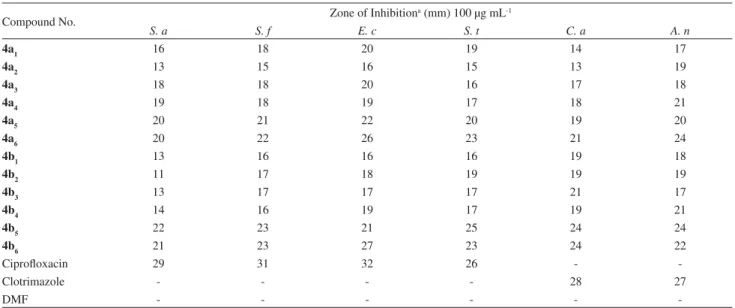
Compounds 4a1-6 and 4b1-6 were assayed for their antibacterial activity against Staphylococcus aureus, Staphylococcus faecalis, Escherichia coli, and Salmonella typhi and for antifungal activities against Candida albicans and Aspergillus niger by cup plate method.12Further, their minimum inhibitory concentration values against these microorganisms were determined by serial dilution method.13 The test microorganisms were obtained from Department of Microbiology, OUAT, Orissa, India. Muller Hinton agar plates (37 oC, 24 h) and Sabouraud’s dextrose agar plates (26 oC, 48-72 h) were used for the cultivation of bacteria and fungi, respectively. The results of antibacterial and antifungal activity tests are summarized in Tables 1 and 2 with standard drugs ciprofloxacin and clotrimazole for comparison. Most of the synthesized compounds were found to possess varied degrees of antibacterial activities as evident from their minimal inhibitory concentration (MIC). Compounds 4b5and4b6 were found to possess moderate activity against all the tested bacteria while all the tested compounds except 4b5 and 4b6 showed lower activity against Escherichia coli. Most of the synthesized compounds were found to possess moderate activity against tested fungi. However, no correlation was observed between different substituents at 1 position of 2,3-indolinedione ring and antifungal activity. It is noted that bromination at 6 position of 2-methylquinazolin-4(3H)-one ring does not have any significant effect on antimicrobial activity.
Analgesic and anti-inflammatory activity
form of a suspension (1% carboxymethyl cellulose as vehicle) by oral route. The study of analgesic activity was done by tail immersion method,14 using wistar albino mice. The percent analgesic activity was calculated and listed in Table 3 with a standard drug indomethacin for comparison. Compounds4a
2,a4, and 4b2,b4having diethylaminomethyl
and dihexylaminomethyl groups, respectively at 1 position of 2,3-indolinedione nucleus showed significant percent analgesic activity ranging from 50 to 54.96 after 1 h of administration. Moreover, diethylaminomethyl group was found to be optimum for analgesic activity in comparison to
other groups. It was noted that bromination at 6 position of 3-methylquinoxaline-4(3H)-one ring decreases the analgesic activity. Remaining compounds showed less analgesic activity in comparison to standard drug indomethacin.
In the present investigation the anti-inflammatory activity of test compounds 4a
1-6 and 4b1-6 in acute
conditions was evaluated using the carrageenan induced rat paw edema method of Winter et al.15 The carrageenan induced inflammation model is a cyclooxygenases(COX) dependent reaction and is used to determine COX inhibition. For anti-inflammatory evaluation, adult Table 1.In vitro antimicrobial activities of compounds 4a1-6and 4b1-6against various bacteria and fungi
Compound No. Zone of Inhibition
a (mm) 100 µg mL-1
S. a S. f E. c S. t C. a A. n
4a1 16 18 20 19 14 17
4a2 13 15 16 15 13 19
4a3 18 18 20 16 17 18
4a4 19 18 19 17 18 21
4a5 20 21 22 20 19 20
4a6 20 22 26 23 21 24
4b1 13 16 16 16 19 18
4b2 11 17 18 19 19 19
4b3 13 17 17 17 21 17
4b4 14 16 19 17 19 21
4b5 22 23 21 25 24 24
4b6 21 23 27 23 24 22
Ciprofloxacin 29 31 32 26 -
-Clotrimazole - - - - 28 27
DMF - - -
-aAverage of three readings; S. a: Staphylococcus aureus; S. f: Staphylococcus fecalis;E. c:Escherichia coli;S. t:Salmonella typhi; C. a: Candida
albicans; A. n: Aspergillus niger.
Table 2. Minimum inhibitory concentrations of compounds 4a1-6and 4b1-6against various bacteria and fungi
Compound No. MIC values
a µg mL-1
S. a S. f E. c S. t C. a A. n
4a1 25 25 50 25 25 25
4a2 25 25 50 25 25 25
4a3 25 50 50 25 50 25
4a4 25 50 25 50 25 25
4a5 50 25 50 25 25 25
4a6 25 25 50 50 25 25
4b1 50 25 50 25 25 50
4b2 25 25 50 25 50 25
4b3 25 25 50 25 25 50
4b4 50 25 50 25 50 25
4b5 25 25 25 25 25 25
4b6 25 25 25 25 25 25
Ciprofloxacin 0.50 0.50 0.50 1.00 --
--Clotrimazole -- -- -- -- 1.00 3.00
DMF -- -- -- -- --
--aAverage of three readings; S. a:Staphylococcus aureus;S. f:Staphylococcus fecalis;E. c:Escherichia coli;S. t:Salmonella typhi; C. a:Candida albicans;
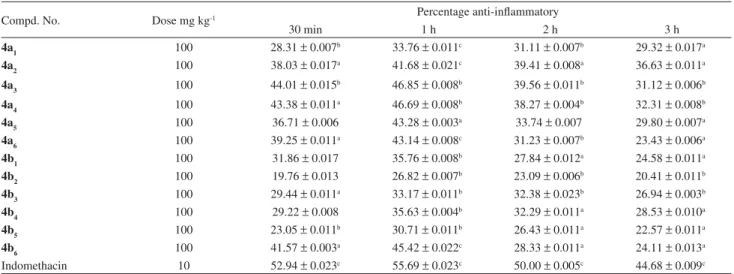
albino rats of either sex were divided in groups of 6. The percent anti-inflammatory activity with indomethacin as a standard drug is presented in Table 4. Compounds 4a2-a4and 4a6 exhibited significant percent anti-inflammatory activity ranging from 43.14 to 46.85 after 1h of administration while remaining compounds showed lower activity in comparison to indomethacin. It was observed that compounds 4a3 and 4a4 having bulky diphenylaminomethyl and dihexylaminomethyl groups, respectively at 1 position of 2,3-indolinedione nucleus showed maximum activity. It is evident from Table 4 that bromination at 6 position of 3-methylquinoxalin-4(3H )-one nucleus decreases the anti-inflammatory activity.
Some of the compounds tested produced significant analgesic and anti-inflammatory effects. These compounds may exhibit both central and peripheral actions because
analgesia and inflammation are central and peripheral processes, respectively. The compounds show suppressant activity on acute inflammation model of carrageenan induced inflammation in rats paw and produced significant analgesic activity. From these observations it can be indeed inferred that the endogenous chemical substances liberated during pain and inflammation like histamine, serotonin and arachidonic cascade metabolites are inhibited to produce analgesic and anti-inflammatory activities.
Antihelmintic activity
The antihelmintic activity of the synthesized compounds4a1-6and 4b1-6 were evaluated on adult Indian earthworm, Pheretima posthuma due to its anatomical and physiological resemblance with the intestinal roundworm Table 3. Analgesic activities of orally administered compounds 4a1-6and 4b1-6by tail immersion method
Compd. No. Dose mg kg-1 Percentage analgesic activity
30 min 1 h 2 h 3 h
4a1 100 27.33 ± 0.017
a 37.20 ± 0.125 22.01 ± 0.008 16.72 ± 0.014a
4a2 100 50.45 ± 0.017
a 53.58 ± 0.011c 34.52 ± 0.005a 23.46 ± 0.011
4a3 100 44.22 ± 0.010
c 47.06 ± 0.007c 26.46 ± 0.011b 18.30 ± 0.011c
4a4 100 47.32 ± 0.012a 52.41 ± 0.009a 29.05 ± 0.011b 17.87 ± 0.006c
4a5 100 46.01 ± 0.012a 49.87 ± 0.013a 32.11 ± 0.004a 21.52 ± 0.008a
4a6 100 32.12 ± 0.016a 36.01 ± 0.005a 25.40 ± 0.010b 14.72 ± 0.008a
4b1 100 29.44 ± 0.017a 35.55 ± 0.017a 21.45 ± 0.015a 19.21 ± 0.032a
4b2 100 53.74 ± 0.006
a 54.96 ± 0.012b 28.10 ± 0.008b 21.04 ± 0.008b
4b3 100 43.15 ± 0.008
a 49.71 ± 0.015b 30.12 ± 0.011b 21.58 ± 0.012a
4b4 100 47.12 ± 0.011 50.05 ± 0.008
b 25.82 ± 0.013b 24.33 ± 0.017b
4b5 100 46.87 ± 0.012
b 49.38 ± 0.014b 30.27 ± 0.007c 20.73 ± 0.011c
4b6 100 39.55 ± 0.031b 47.34 ± 0.010b 26.32 ± 0.006a 20.12 ± 0.012a
Indomethacin 10 58.57 ± 0.020c 78.53 ± 0.061c 72.02 ± 0.073c 73.27 ± 0.004c
Results are expressed in mean ± SEM (n = 6). Significance levels aP < 0.05, bP < 0.01, and cP < 0.001 as compared with respective control.
Table 4. Anti-inflammatory activities of orally administered compounds 4a1-6and 4b1-6by carrageenan induced rat paw edema method
Compd. No. Dose mg kg-1 Percentage anti-inflammatory
30 min 1 h 2 h 3 h
4a1 100 28.31 0.007
b 33.76 0.011c 31.11 0.007b 29.32 0.017a
4a2 100 38.03 0.017a 41.68 0.021c 39.41 0.008a 36.63 0.011a
4a3 100 44.01 0.015b 46.85 0.008b 39.56 0.011b 31.12 0.006b
4a4 100 43.38 0.011
a 46.69 0.008b 38.27 0.004b 32.31 0.008b
4a5 100 36.71 0.006 43.28 0.003
a 33.74 0.007 29.80 0.007a
4a6 100 39.25 0.011a 43.14 0.008c 31.23 0.007b 23.43 0.006a
4b1 100 31.86 0.017 35.76 0.008b 27.84 0.012a 24.58 0.011a
4b2 100 19.76 0.013 26.82 0.007b 23.09 0.006b 20.41 0.011b
4b3 100 29.44 0.011a 33.17 0.011b 32.38 0.023b 26.94 0.003b
4b4 100 29.22 0.008 35.63 0.004
b 32.29 0.011a 28.53 0.010a
4b5 100 23.05 0.011
b 30.71 0.011b 26.43 0.011a 22.57 0.011a
4b6 100 41.57 0.003
a 45.42 0.022c 28.33 0.011a 24.11 0.013a
Indomethacin 10 52.94 0.023c 55.69 0.023c 50.00 0.005c 44.68 0.009c
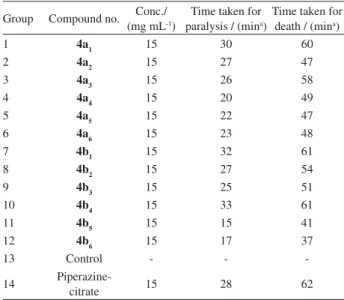
parasites of human beings.16-18The method of Dash et al.19 was followed and the results are presented in Table 5. Piperazine citrate, which is used in the treatment of roundworm and threadworm (cestoda) infections was selected as a reference standard. The antihelmintic activity data revealed significant activity of all the test compounds against the tested Pheretima posthuma. In the present study compounds 4a3-6and4b5,6were found to be more potent than piperazine citrate. It is evident from results that compounds containing dihexylaminomethyl, piperazinylmethyl and morpholinomethyl groups at 1 position of 2,3-indolinedione ring are more active. It is also noted that bromination at 6 position of 2-methylquinazolin-4(3H)-one derivatives slightly increases the antihelmintic activity. The principal aim of the present study was to modify and optimize the structural features of 2, 3, 6-trisubstituted quinazolin-4(3H)-ones.
Conclusions
Generally, it can be concluded that 3-{(1 -aryl/ alkylaminomethyl-2 -oxo-1 ,2 -dihydroindole-3 -ylidene) amino}-2-methyl-6- quinazolin-4-(3H)-ones 4a
1-6 and
4b1-6 represent a new distinct classes of analgesic and anti-inflammatory agents with antimicrobial activity. The dibenzylaminomethyl 4a3, dihexylaminomethyl 4a4 and morpholinomethyl 4b
6analogs appeared to be more active
analgesic and anti-inflammatory agents in comparison to other synthesized Schiff bases. Compound 4b
6, which contain
morpholinomethyl moiety at 1 position, was found to be the most active compound as analgesic, anti-inflammatory and antimicrobial agent. Antihelmintic study results revealed that
the presence of piperazinylmethyl and morpholinomethyl groups at 1 position of 2,3-indolinedione nucleus and a bromine atom at 6 position of 2-quinazolin-4(3H)-one ring are optimum for the antihelmintic activity (4b5and 4b6).
Experimental
Melting points were determined on a Tempstar apparatus and are uncorrected. Infrared spectra were recorded on a Jasco (410) FT-infrared spectrophotometer, measured as KBr disks.1H NMR were recorded on a Bruker DPX-300 MHz spectrometer in deuteriochloroform with trimethylsilane as internal standard (chemical shift in G ppm). The mass spectral data were obtained with a Perkin-Elmer Hitachi RMU-6L MS-30 spectrometer at 70 eV and a 90 oC inlet temperature. Purity of all the compounds was checked on silica gel plates and spots were located in iodine vapours. Elemental analysis was performed on EURO EA (Italy) analyzer and the results were within 0.3% of calculated values.
General method for the preparation of Schiff bases (3a,b)
To a solution of 2,3-indolinedione (0.005 mol) in ethanol (50 mL) was added the appropriate 3-amino-2-methylquinazolin-4(3H)-one2a,b(0.005 mol) and a few drops of acetic acid. The reaction mixture was refluxed for 17 h on a water bath and then allowed to cool. The solid thus separated was filtered, washed with aqueous ethanol and recrystallized from appropriate solvent. The following Schiff bases were prepared in this manner:
3-{(2 -Oxo-1 ,2 -dihydroindole-3 -ylidene)amino}-2-methylquinazolin-4-(3H)-one (3a)
Recryst. solvent: Benzene, Yield (1.110 g, 73%), mp 112 oC. Elemental Analysis Calculated for C
17H12N4O2 (304.30): 61.10% C; 3.97% H; 18.41% N. Found: 60.97% C; 4.22% H; 18.03% N. 1H NMR G2.50 (s, 3H, CH
3), 6.21-8.57 (m, 8H, ArH), 10.63 (s, 1H, NH). MS m/z 304 (M+). FT-IR (KBr), vmax/cm-1: 3472 (N-H), 3076(Ar-H), 1727 (C=O), 1670 (C=O), 1616 (C=N), 1588 (C=N), 1300 (C-N).
6-Bromo-3-{(2 -oxo-1 , 2 -dihydroindole-3 -ylidene) amino}-2-methylquinazolin-4-(3H)-one (3b)
Recryst. solvent: Benzene, Yield (1.379 g, 72%), mp 121oC. Elemental Analysis Calculated for C
17H11N4O2Br (383.19): 53.28% C; 2.89% H; 14.62% N. Found: 53.47% C; 3.09% H; 14.23% N. 1H NMR G 2.48 (s, 3H, CH
3), 6.38-8.49 (m, 7H, ArH), 10.53 (s, 1H, NH). MS (m/z) 383 (M+). FT-IR (KBr), v
max/cm
-1: 3472 (N-H), 3076(Ar-H),
1727 (C=O), 1670 (C=O), 1616 (C=N), 1588 (C=N), 1300 (C-N).
Table 5. Antihelmintic activities of compounds 4a1-6and 4b1-6
Group Compound no. Conc./ (mg mL-1)
Time taken for paralysis / (mina)
Time taken for death / (mina)
1 4a1 15 30 60
2 4a2 15 27 47
3 4a3 15 26 58
4 4a4 15 20 49
5 4a5 15 22 47
6 4a6 15 23 48
7 4b1 15 32 61
8 4b2 15 27 54
9 4b3 15 25 51
10 4b4 15 33 61
11 4b5 15 15 41
12 4b6 15 17 37
13 Control - -
-14
Piperazine-citrate 15 28 62
General method for the preparation of Mannich bases
4a1-6and 4b1-6
To a mixture of 3a,b (0.005 mol) and 37% formalin (1 mL) in ethanol (20 mL) was added drop wise appropriate secondary amines (0.005 mol) with stirring over 15 min. The stirring was continued for 1h at room temperature and the reaction mixture then warmed for 15 min on a water bath. The mixture was poured into ice-cold water and stored in a refrigerator. The solid thus separated was filtered, washed with water, dried and recrystallized from appropriate solvent. The following title compounds were prepared as just described:
3{(1 Dimethylaminomethyl2 oxo1 ,2 dihydroindole3 -ylidene)amino}-2-methyl-6- quinazolin-4-(3H)-one (4a1)
Recryst. solvent: Ethanol, Yield (1.138 g, 63%), mp 150 oC. Elemental Analysis Calculated for C
20H19N5O2 (361.39): 66.47% C; 5.30% H; 19.38% N. Found: 66.32% C; 5.41% H; 19.31% N. 1H NMR G1.12 (s, 3H, CH
3), 2.5 (s, 6H, N (CH3)2), 4.43 (s, 2H, CH2), 6.5-8.98 (m, 8H, ArH ). MS (m/z) 361.39 (M+). FT-IR (KBr), v
max/cm -1:
3026 (Ar-H), 2816 (CH2), 1733 (C=O), 1662 (C=O), 1570 (C=N), 1317 (C-N).
3{(1 Diethylaminomethyl2 oxo1 ,2 dihydroindole3 -ylidene)amino}-2-methyl-6-quinazolin-4-(3H)-one (4a2)
Recryst. solvent: Ethanol,Yield (1.479 g, 76%), mp 142 oC. Elemental Analysis Calculated for C
22H23N5O2 (389.45): 67.85% C; 5.95% H; 17.98% N. Found: 67.88% C; 5.87% H; 18.10% N. 1H NMR G1.09 (s, 3H, CH
3), 2.55 (q, 10H, N(C2H5)2), 2.88 (s, 3H,CH3), 4.32 (s, 2H, CH2), 6.57-8.22 (m, 8H, ArH). MS (m/z) 389.40 (M+). FT-IR (KBr), vmax/cm-1: 3030 (Ar-H), 2855 (CH
2), 1717 (C=O), 1661 (C=O), 1609 (C=N), 1350 (C-N).
3-{(1 -Diphenylaminomethyl-2 -oxo-1 ,2 -dihydroindole-3 -ylidene)amino}-2-methyl-6-quinazolin-4-(-dihydroindole-3H)-one (4a3)
Recryst. solvent: Ethanol, Yield (10.769 g, 52%), mp 140 oC. Elemental Analysis Calculated for C
30H23N5O2 (485.53): 74.21% C; 4.77% H; 14.42% N. Found: 74.13% C; 4.74% H; 14.45% N. 1H NMR G1.09 (s, 3H, CH
3), 5.10 (s, 2H, CH2), 6.36-8.20 (m, 18H, ArH). Mass spectrum (m/z) 485.50 (M+). FT-IR (KBr), v
max/cm
-1: 3032 (Ar-H),
2841 (CH2), 1742 (C=O), 1689 (C=O), 1636 (C=N), 1334 (C-N).
3{(1 Dihexylaminomethyl2 oxo1 ,2 dihydroindole3 -ylidene)amino}-2-methyl-6-quinazolin-4-(3H)-one (4a4)
Recryst. solvent: Ethanol, Yield (1.517 g, 61%), mp
152 oC. Elemental Analysis Calculated for C
30H35N5O2 (497.63): 72.41% C; 7.09% H; 14.07% N. Found: 72.49% C; 6.97% H; 14.21% N. 1H NMR G 1.59 (s, 3H, CH
3), 1.73 (t, 2H, CH2), 3.91 (s, 22H, CH2), 7.00-8.66 (m, 8H, ArH). MS (m/z) 497.63 (M+). FT-IR (KBr), v
max/cm
-1: 3076 (Ar-H),
2881 (CH2), 1733 (C=O), 1670 (C=O), 1607 (C=N), 1307 (C-N).
3-{(1 -Piperazinylaminomethyl-2 -oxo-1 ,2 -dihydroindole-3 -ylidene)amino}-2-methyl-6-quinazolin-4-(-dihydroindole-3H)-one (4a5)
Recryst. solvent: Ethanol, Yield (1.817 g, 59%), mp 154 oC. Elemental Analysis Calculated for C
22H22N6O2 (402.44): 65.66% C; 5.51% H; 20.88% N. Found 65.42% C; 5.80% H; 20.67% N. 1H NMR G1.21 (s, 3H, CH
3 , 2.63 (s, 2H, CH2), 4.00 (t, 4H, CH2), 4.49 (m, 4H, CH2), 6.70-8.20 (m, 8H, ArH), 8.37(s, 1H, NH). MS (m/z) 402.39 (M+). FT-IR (KBr), vmax/cm-1: 3361 (NH), 3013 (Ar-H), 2888 (CH
2), 1687 (C=O), 1652 (C=O), 1602 (C=N), 1325 (C-N).
3-{(1 -Morpholinoaminomethyl-2 -oxo-1 ,2 -dihydroindole-3 -ylidene)amino}-2-methyl-6-quinazolin-4-(-dihydroindole-3H)-one (4a6)
Recryst. solvent: Ethanol, Yield (1.35 g, 67%), mp 141oC. Elemental Analysis Calculated for C
22H21N5O3Br (403.42): 65.50% C; 5.25% H; 17.36% N. Found 65.75% C; 5.55% H; 17.06% N. 1H NMR G 1.06 (s, 3H, CH
3), 2.37 (s, 2H, CH2), 3.40 (t, 4H, CH2), 5.75 (t, 4H, CH2), 6.66-8.36 (m, 8H, ArH ), 8.58(s,1H, NH). MS (m/z) 403.42 (M+). FT-IR (KBr), v
max/cm
-1: 3066 (Ar-H), 2818 (CH 2), 1726(C=O), 1675 (C=O), 1604 (C=N), 1314 (C-N) 1128 (COC), 632(C-Br).
6Bromo3{(1 dimethylaminomethyl2 oxo1 ,2 -dihydroindole-3 -ylidene)amino}-2-methyl-6-quinazolin-4-(3H)-one (4b1)
Recryst. solvent: Ethanol, Yield (1.089g, 69%), mp 165oC. Elemental Analysis Calculated for C
20H18N5O2Br (440.29): 54.56% C; 4.12% H; 15.91% N. Found: 54.83% C; 4.10% H; 15.78% N. 1H NMR G1.06 (s, 3H, CH
3), 2.37 (t, 3H, CH3), 3.40 (t, 3H, CH3), 5.57 (s, 2H, CH2), 6.70-8.20 (m, 7H, ArH ), 8.37 (s,1H, NH). MS (m/z) 440.29 (M+). FT-IR (KBr), vmax/cm-1: 3066 (Ar-H), 2818 (CH
2), 1726 (C=O), 1675 (C=O), 1604 (C=N), 1314 (C-N).
6Bromo3{(1 diethylaminomethyl2 oxo1 ,2 -dihydroindole-3 -ylidene)amino}-2-methyl-6-quinazolin-4-(3H)-one (4b2)
Recryst. solvent: Ethanol , Yield (1.428 g, 61%), mp 162oC. Elemental Analysis Calculated for C
C; 4.83% H; 15.17% N. 1H NMR G 1.11 (s, 3H, CH 3), 2.50-2.87 (q, 10H, N(C2H5)2), 4.29 (s, 2H, CH2), 6.65-8.34 (m, 7H, ArH). MS (m/z) 468.34 (M+). FT-IR (KBr, vmax/cm-1): 3032 (Ar-H), 2853 (CH
2), 1717 (C=O), 1663 (C=O), 1609 (C=N), 1353 (C-N).
6Bromo3{(1 diphenylaminomethyl2 oxo1 ,2 -dihydroindole-3 -ylidene)amino}-2-methyl-6-quinazolin-4-(3H)-one (4b3)
Recryst. solvent: Ethanol , Yield (1.777 g, 63%), mp 144oC. Elemental Analysis Calculated for C
30H22N5O2Br (563.43): 63.84% C; 3.93% H; 12.41% N. Found 64.10% C; 4.22% H; 12.27% N. 1H NMRG 1.07 (s, 3H, CH
3) 4.98 (s, 2H, CH2), 6.25-8.15 (m, 17H, ArH). MS (m/z) 563.43 (M+). FT-IR (KBr, v
max/cm
-1): 3032 (Ar-H),
2845 (CH2), 1745 (C=O), 1690 (C=O), 1636 (C=N), 1334 (C-N).
6Bromo3{(1 dihexylaminomethyl2 oxo1 ,2 -dihydroindole-3 -ylidene)amino}-2-methyl-6-quinazolin-4-(3H)-one (4b4)
Recryst. solvent: Ethanol, Yield (1.643 g, 57%), mp 168oC. Elemental Analysis Calculated for C
30H34N5O2Br (576.52): 62.50% C; 5.94% H; 12.15% N. Found 62.41% C; 5.73% H; 12.37% N. 1H NMR G 1.06 (s, 3H, CH
3), 1.62 (t, 2H,CH2), 3.84 (s, 22H, CH2), 7.22-8.56 (m, 7H, ArH ). MS (m/z) 576.52 (M+). FT-IR (KBr, v
max/cm -1):
3078 (Ar-H), 2883 (CH2), 1730 (C=O), 1665 (C=O), 1605 (C=N), 1307 (C-N).
6Bromo3{(1 piperazinylminomethyl2 oxo1 ,2 -dihydroindole-3 -ylidene)amino}-2-methyl-6-quinazolin-4-(3H)-one (4b5)
Recryst. solvent: Ethanol, Yield (1.492 g, 62%), mp 164oC. Elemental Analysis Calculated for C
22H21N6O2Br (481.34): 54.90% C; 4.40% H; 17.46% N. Found: 54.83% C; 4.62% H; 17.16% N. 1H NMR G 1.17 (s, 3H, CH
3, 2.55 (s, 2H, CH2), 4.12 (t, 4H, CH2), 4.39 (t, 4H, CH2), 6.71-8.24 (m, 7H, ArH), 8.58 (s, 1H, NH). MS (m/z) 481.34 (M+). FT-IR (KBr, vmax/cm-1): 3357 (NH), 3017 (Ar-H), 2876 (CH
2), 1687 (C=O), 1643 (C=O), 1600 (C=N), 1317 (C-N).
6Bromo3 {(1 morpholinoaminomethyl2 oxo1 ,2 -dihydroindole-3 -ylidene)amino}-2-methyl-6-quinazolin-4-(3H)-one (4b6)
Recryst. solvent: Ethanol, Yield (1.615 g, 67%), mp 160oC. Elemental Analysis Calculated for C
22H20N5O3Br (482.32): 54.78% C; 4.18% H; 14.52% N. Found 54.53% C; 4.34% H; 14.29% N. 1H NMR G1.06 (s, 3H, CH
3), 2.37 (s, 2H, CH2), 3.40 (t, 4H, CH2), 5.75 (t, 4H, CH2), 6.66-8.36 (m, 7H, ArH), 8.58 (s, 1H, NH). MS (m/z) 482.32
(M+). FT-IR (KBr), v max/cm
-1: 3056 (Ar-H), 2822 (CH 2), 1720(C=O), 1666 (C=O), 1608 (C=N), 1321 (C-N),1124 (COC), 625 (C-Br).
Conclusions
Various 3{(1 aryl/alkylaminomethyl2 oxo1 ,2 -dihydroindole-3 -ylidene)amino}-2-methyl-6-quinazolin-4-(3H)-ones4a1-6and 4b1-6were prepared with the objective of developing better anti-inflammatory compounds with antimicrobial activities. Among these, 6Bromo3{(1 morpholinoaminomethyl2 oxo1 ,2 dihydroindole3 -ylidene)amino}-2-methyl-6-quinazolin-4-(3H)-one (4b6) presented maximum activity. It also showed maximum antihelmintic activity. SAR studies and evaluation of more potent analogs are under way.
Acknowledgments
The authors are grateful to the authorities of University Department of Pharmaceutical Sciences, Utkal University, Bhubaneswar and Institute of Pharmacy and Technology, Salipur, Cuttack, Orissa, India for providing the necessary facility to carry out this research work. We are also thankful to Prof. A. C. Dash and Prof. C. S. Panda NISER, Bhubaneswar, India for valuable suggestions.
References
1. El-Shareif, A. M. S; Ammar, Y. A.; Zahran, M. A.; Ali, A. H.; El-Gaby, M. A.; Molecules2001,6, 267.
2. Sayyed, M. A.; Mokle, S. S.; Vibhute, Y. B.; Arkivoc2006,11, 221.
3. El-Barbary, A. A.; Abou El-Ezz, A. Z.; Sharaf, A. M.; Nielson, C.;Phosphorus, Sulfur, Silicon Relat. Elem.2006,18, 1895. 4. Srivastava, B.; Shukla, J. S.; Indian J. Chem.1991,30B,332.
5. Pandeya, S. N.; Yogeeswari, P.; Ram, D. S.; Nath, G.; Boll. Chim. Farm. 1998,137, 321.
6. Pandeya, S. N.; Sriram, D.; Nath, G.; De Clercq, E.; Pharm. Acta. Helv.1999,74, 11.
7. Pandeya, S. N.; Sriram, D.; Nath, G.; De Clercq, E.; Indian J. Pharm. Sci.1999,61, 358.
8. Sridhar, S. K.; Ramesh, A.; Biol. Pharm. Bull.2001,24,
1149.
9. Sriram, D.; Bal, T. R.; Perumal, Y.; J. Pharm. Pharmaceut. Sci.
2005,8, 565.
10. Wasfy, A. A. F; Indian J. Chem.2003,42B, 3102.
11. Yassin, F. A.; Eissa, A. M. F.; Wasfy, A. A. F.; Indian J. Chem.
1994,33B, 1193.
13. Dastidar, S. G.; Chaudhary, A.; Annadurai, S.; Roy, S.; Mookerjee, M.; Chakrabarty, A. N.; J. Chemother.1995,7, 201.
14. Di Stasi, L. C.; Costa, M.; Mendacolli, S. L. J.; Kirizawa, M.; Gomes, C.; Trolin, G.; J. Ethnopharmacol.1988,24, 205. 15. Winter, C. A.; Risly, E. A.; Nus, G. N.; Proc. Soc. Exp. Biol.
1962,111, 544.
16. Thorn, G. W.; Adams, R. D.; Braunwald, E.; Isselbacher, K. J.; Petersdorf, R. G.; Harrison’s principle of internal medicine, Mc Graw Hill Co.: New York, 1977, pp.1088.
17. Vigar, Z.; Atlas of Medicinal Parasitology, 2nd ed., P. G. Publishing House: Singapore, 1984, pp. 216.
18. Szewczuk, V. D.; Mongelli, E. R.; Pamillio, A. B.; Mol. Med. Chem.2003,1, 54.
19. Dash, K. G.; Suresh, P.; Sahu, K. S.; Kar, D. M.; Ganapaty, S.; Panda. B. S.; J. Nat. Remedies2002,2, 182.
Received: September 22, 2007