Predictors of extubation failure and reintubation in
newborn infants subjected to mechanical ventilation
INTRODUCTION
Mechanical ventilation (MV) is a life support procedure that contributes to increasing the survival of premature and full-term infants and is one of the therapeutic resources most widely used in neonatal intensive care units (NICU).(1,2)
Despite its crucial role in reducing the mortality rate, MV is associated with morbidity, risks and complications, prominently including bronchopulmonary dysplasia and periventricular hemorrhage.(3,4)
To minimize such risks and complications, it is recommended to discontinue MV as soon as infants are able to maintain spontaneous breathing and achieve appropriate gas exchange with minimal respiratory efort.(2)
he ideal time for weaning from MV is frequently established based on clinical and laboratory parameters assessed at the time extubation is proposed for consideration. However, such parameters are not very objective, which makes MV discontinuation in NICUs a trial-and-error approach.(2,5)
Based on the damage associated with the inappropriate duration of MV in newborn infants, there is a clear need to establish objective criteria for extubation, Ana Cristina de Oliveira Costa1, Renata de
Carvalho Schettino1, Sandra Clecêncio Ferreira1
1. Hospital Sofia Feldman - Belo Horizonte (MG), Brazil.
Objective: To identify risk factors for extubation failure and reintubation in newborn infants subjected to mechanical ventilation and to establish whether ventilation parameters and blood gas analysis behave as predictors of those outcomes.
Methods: Prospective study conducted at a neonatal intensive care unit from May to November 2011. A total of 176 infants of both genders subjected to mechanical ventilation were assessed after extubation. Extubation failure was deined as the need to resume mechanical ventilation within less than 72 hours. Reintubation was deined as the need to reintubate the infants any time after the irst 72 hours.
Results: Based on the univariate analysis, the variables gestational age <28 weeks, birth weight <1,000g and
Conflicts of interest: None.
Submitted on August 22, 2013 Accepted on January 14, 2014
Corresponding author:
Renata de Carvalho Schettino Hospital Sofia Feldman
Rua Antônio Bandeira, 1.060 - Tupi
Zip code: 31844-130 - Belo Horizonte (MG), Brazil E-mail: [email protected]
Fatores preditivos para falha de extubação e reintubação de
recém-nascidos submetidos à ventilação pulmonar mecânica
ABSTRACT
Keywords: Infant, newborn; Infant; premature; Respiration, artiicial; Intubation, intratracheal/adverse efects; Ventilator weaning/adverse efects; Treatment failure
low Apgar scores were associated with extubation failure and reintubation. Based on the multivariate analysis, the variables length of mechanical ventilation (days), potential of hydrogen (pH) and partial pressure of oxygen
(pO2) remained associated with
extubation failure, and the ive-minute Apgar score and age at extubation were associated with reintubation.
Conclusion: Low ive-minute Apgar scores, age at extubation, length of mechanical ventilation, acid-base disorders and hyperoxia exhibited associations with the investigated outcomes of extubation failure and reintubation.
which would help to avoid undesirable outcomes, such as extubation failure(3,5,6) and reintubation, which bear direct associations with morbidity and mortality.(7,8)
For these reasons, the aims of this study were to identify risk factors for extubation failure and the need for reintubation in newborn infants and to establish whether ventilation parameters and blood gas analysis behave as predictors of extubation failure and the need for reintubation.
METHODS
his work was a prospective study based on the collection of data regarding newborn infants admitted to the NICU of
Hospital Soia Feldman (HSF) from May 1, 2011 to November 1, 2011 who were subjected to MV and extubation. he study was approved by the Research Ethics Committee of HSF under opinion CAAE 0014.0.439.308.11 (Certiicate
of Presentation for Ethical Appraisal/Certiicado de
Apresentação para Apreciação Ética - CAAE), with waivers of informed consent. Newborn infants of both genders born at HSF and subjected to MV and extubation during the data collection period were included in the study, whereas infants referred from other institutions and infants with heart and lung malformations were excluded.
Mechanical ventilation was performed using Inter 3 and Inter 5 (Intermed brand) ventilators. he infants' gestational age (GA) was established by means of ultrasound or calculated based on the date of the mother's last menstrual period (LMP). he infants' weight at birth (BW) was measured using the Filizola BP Baby scale.
Assessment included the occurrence of extubation failure in addition to clinical and treatment-related variables. Extubation was considered successful when the infants were able to remain without invasive ventilatory support for 72 hours; extubation failure was deined as the need for reintubation for any reason within 72 hours after extubation, while reintubation occurred when the infants needed to be reintubated any time after 72 hours without MV. Accidental extubation followed by immediate reintubation and the use of noninvasive ventilatory support were not considered as extubation failure. he time for extubation was determined by the medical staf based on, at minimum, the presence of clinical and hemodynamic stability, regular respiratory drive and the behavioral status of reactivity.
he data were recorded using an HSF standard form by two healthcare professionals. he variables analyzed included the following: date of birth, GA, chronological age, BW, one- and ive-minute Apgar scores, gender, antenatal corticosteroids, postnatal corticosteroids, exogenous surfactant, postnatal xanthines, date of extubation, length of MV (days), orotracheal tube (OT) brand, last blood gas test before extubation, ventilation parameters at the time of extubation, extubation failure and reintubation. he samples for blood gas
were immediately analyzed using a model Abl5 radiometer (Radiometer Copenhagen).
he data were entered into tables and analyzed using the software Statistical Package for the Social Sciences (SPSS). To achieve 95% reliability with a margin of error of ±7.5%, the sample should comprise at least 161 infants subjected to MV.
Descriptive analysis was performed to identify the main treatment-related characteristics of the participants. he association of the participants and treatment-related variables with extubation failure and reintubation was investigated using a bivariate logistic regression model. Multiple logistic regression was used to assess the multiple relationships between extubation success and failure, need for reintubation or not and the participants' characteristics. he variables included in the multiple logistic regression analysis were the ones that exhibited minimal relationships with the investigated outcome, whose signiicance level was set to 0.25.
In addition to the logistic regression mode, regression analysis stratiied by confounding factors was performed to assess the direct relationship between exposure to MV and outcome (extubation failure/reintubation) in addition to the causal relationship between exposure and outcome.
Based on the logistic regression model, the strength of the association between the participants' characteristics that exerted signiicant impact on the outcomes was assessed by calculating odds ratios (OR) and corresponding 95% conidence intervals (95%CI). hose data were used to analyze and interpret the inal model, for which purpose diferences and associations were considered signiicant when the p-value was ≤0.05.
RESULTS
A total of 433 infants were admitted to the HSF-NICU during the study period. Among them, 224 were subjected to MV, of whom 176 were eligible for this study. he exclusions corresponded to 34 infants who died, 5 who were transferred from another institution and 9 who had not been extubated by the end of the data collection period.
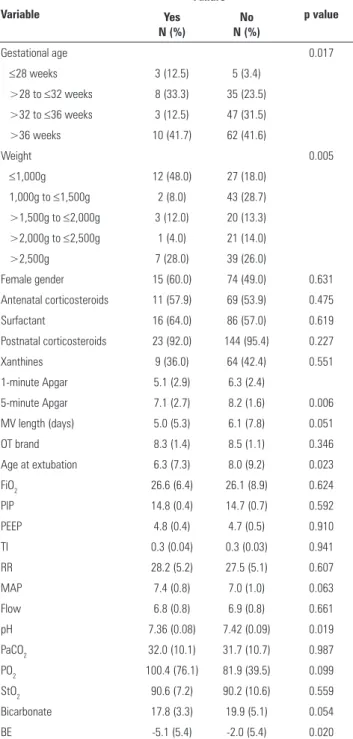
Regarding the risk factors for extubation failure, univariate analysis showed that the infants with lower one-minute Apgar scores exhibited higher odds of failure (p=0.049). he same was true for the infants with lower ive-minute Apgar scores (p=0.006). he infants with lower chronological age and shorter length of MV at the time of extubation exhibited a greater propensity for extubation failure.
Table 1 - Demographic and treatment-related characteristics of the study population as predictors of extubation failure, controlled for gestational age and birth weight
Variable
Failure
p value Yes
N (%)
No N (%)
Gestational age 0.017
≤28 weeks 3 (12.5) 5 (3.4)
>28 to ≤32 weeks 8 (33.3) 35 (23.5)
>32 to ≤36 weeks 3 (12.5) 47 (31.5)
>36 weeks 10 (41.7) 62 (41.6)
Weight 0.005
≤1,000g 12 (48.0) 27 (18.0)
1,000g to ≤1,500g 2 (8.0) 43 (28.7)
>1,500g to ≤2,000g 3 (12.0) 20 (13.3) >2,000g to ≤2,500g 1 (4.0) 21 (14.0)
>2,500g 7 (28.0) 39 (26.0)
Female gender 15 (60.0) 74 (49.0) 0.631
Antenatal corticosteroids 11 (57.9) 69 (53.9) 0.475
Surfactant 16 (64.0) 86 (57.0) 0.619
Postnatal corticosteroids 23 (92.0) 144 (95.4) 0.227
Xanthines 9 (36.0) 64 (42.4) 0.551
1-minute Apgar 5.1 (2.9) 6.3 (2.4)
5-minute Apgar 7.1 (2.7) 8.2 (1.6) 0.006
MV length (days) 5.0 (5.3) 6.1 (7.8) 0.051
OT brand 8.3 (1.4) 8.5 (1.1) 0.346
Age at extubation 6.3 (7.3) 8.0 (9.2) 0.023
FiO2 26.6 (6.4) 26.1 (8.9) 0.624
PIP 14.8 (0.4) 14.7 (0.7) 0.592
PEEP 4.8 (0.4) 4.7 (0.5) 0.910
TI 0.3 (0.04) 0.3 (0.03) 0.941
RR 28.2 (5.2) 27.5 (5.1) 0.607
MAP 7.4 (0.8) 7.0 (1.0) 0.063
Flow 6.8 (0.8) 6.9 (0.8) 0.661
pH 7.36 (0.08) 7.42 (0.09) 0.019
PaCO2 32.0 (10.1) 31.7 (10.7) 0.987
PO2 100.4 (76.1) 81.9 (39.5) 0.099
StO2 90.6 (7.2) 90.2 (10.6) 0.559
Bicarbonate 17.8 (3.3) 19.9 (5.1) 0.054
BE -5.1 (5.4) -2.0 (5.4) 0.020
MV - mechanical ventilation; OT - orotracheal tube; FiO2 - fraction of inspired oxygen; PIP - peak inspiratory pressure; PEEP - positive end-expiratory pressure; TI - inspiration time; RR - respiratory rate; MAP - mean airway pressure; pH - potential of hydrogen; PaCO2 - partial pressure of carbon dioxide; PO2 - partial pressure of oxygen; StO2 - oxygen saturation; BE - base excess.
he independent variables associated with increased risk of extubation failure identiied through multivariate analysis were as follows: pH (p=0.016), PO2 (p=0.024) and length of MV (p=0.021) (Table 2). In this regard, the higher the pH, the lower the risk of failure, the latter being 99.9% lower for each increase by one pH unit. he same relationship was found for the length of MV, as the risk of failure decreased 16% per day of MV use. An increase of one PO2 unit was found to increase the risk of failure by 1.2%.
Table 2 - Risk factors for extubation failure, controlled for gestational age and birth weight
Independent variable Categories OR 95%CI OR p value
Constant - - - 0.015
MV length (days) - 0.843 0.728-0.975 0.021
pH - 0.001 0.001-0.220 0.016
PO2 - 1.012 1.002-1.023 0.024
OR - odds ratio; 95%CI - 95% confidence interval; MV - mechanical ventilation; pH - potential of hydrogen; PO2 - partial pressure of oxygen.
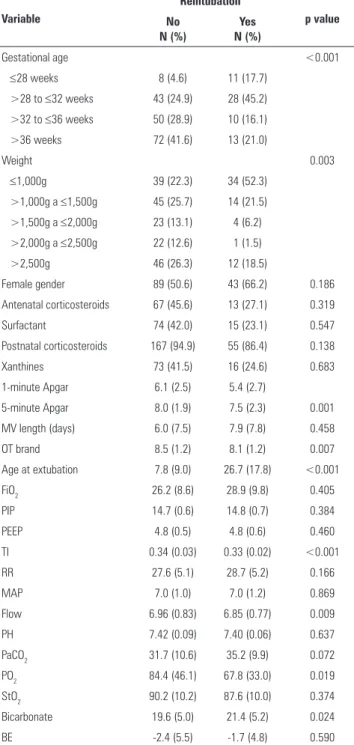
With regard to the risk factors for reintubation, GA (p<0.001) and BW (p=0.003) exhibited signiicant associations with reintubation according to univariate analysis. Table 3 describes the results regarding the impact of clinical and treatment-related characteristics on reintubation. he infants with the lowest values of OT ixation tended to exhibit greater odds of reintubation (p=0.007), as was also the case for the infants with the lowest one- and ive-minute Apgar scores (±7.5). However, the one-minute Apgar score was not retained in the model following multivariate analysis. Shorter inspiration time (IT), lower low and lower PO2 were most frequently found among the infants who required reintubation (p=0.019). he bicarbonate concentration was higher among the infants who required reintubation (p=0.024).
Table 4 - Risk factors for reintubation, controlled for gestational age and birth weight
Independent variable Categories OR 95%CI OR p value
Constant - - - 0.631
Table 3 - Demographic and treatment-related characteristics of the study population as predictors of reintubation, controlled for gestational age and birth weight
Variable
Reintubation
p value No
N (%)
Yes N (%)
Gestational age <0.001
≤28 weeks 8 (4.6) 11 (17.7)
>28 to ≤32 weeks 43 (24.9) 28 (45.2)
>32 to ≤36 weeks 50 (28.9) 10 (16.1)
>36 weeks 72 (41.6) 13 (21.0)
Weight 0.003
≤1,000g 39 (22.3) 34 (52.3)
>1,000g a ≤1,500g 45 (25.7) 14 (21.5)
>1,500g a ≤2,000g 23 (13.1) 4 (6.2) >2,000g a ≤2,500g 22 (12.6) 1 (1.5)
>2,500g 46 (26.3) 12 (18.5)
Female gender 89 (50.6) 43 (66.2) 0.186
Antenatal corticosteroids 67 (45.6) 13 (27.1) 0.319
Surfactant 74 (42.0) 15 (23.1) 0.547
Postnatal corticosteroids 167 (94.9) 55 (86.4) 0.138
Xanthines 73 (41.5) 16 (24.6) 0.683
1-minute Apgar 6.1 (2.5) 5.4 (2.7)
5-minute Apgar 8.0 (1.9) 7.5 (2.3) 0.001
MV length (days) 6.0 (7.5) 7.9 (7.8) 0.458
OT brand 8.5 (1.2) 8.1 (1.2) 0.007
Age at extubation 7.8 (9.0) 26.7 (17.8) <0.001
FiO2 26.2 (8.6) 28.9 (9.8) 0.405
PIP 14.7 (0.6) 14.8 (0.7) 0.384
PEEP 4.8 (0.5) 4.8 (0.6) 0.460
TI 0.34 (0.03) 0.33 (0.02) <0.001
RR 27.6 (5.1) 28.7 (5.2) 0.166
MAP 7.0 (1.0) 7.0 (1.2) 0.869
Flow 6.96 (0.83) 6.85 (0.77) 0.009
PH 7.42 (0.09) 7.40 (0.06) 0.637
PaCO2 31.7 (10.6) 35.2 (9.9) 0.072
PO2 84.4 (46.1) 67.8 (33.0) 0.019
StO2 90.2 (10.2) 87.6 (10.0) 0.374
Bicarbonate 19.6 (5.0) 21.4 (5.2) 0.024
BE -2.4 (5.5) -1.7 (4.8) 0.590
MV - mechanical ventilation; OT - orotracheal tube; FiO2 - fraction of inspired oxygen; PIP - peak inspiratory pressure; PEEP - positive end-expiratory pressure; TI - inspiration time; RR - respiratory rate; MAP - mean airway pressure; pH - potential of hydrogen; PaCO2 - partial pressure of carbon dioxide; PO2 - partial pressure of oxygen; StO2 - oxygen saturation; BE - base excess.
DISCUSSION
his study analyzed risk factors that behave as predictors of extubation failure and reintubation, as determining the ideal time to perform extubation in newborn infants is quite diicult and a subject of controversy, where clinical judgment is required to balance the beneits of extubation with the damaging efects of reintubation.(2,6)
he results of this study show that the greater the chronological age, the greater the likelihood of reintubation as a function of the risk of complications, such as bronchopulmonary dysplasia,(4) hospital-acquired infection, airway injury and longer hospital stay.(3,8) Shorter MV length and older chronological age increased the odds of extubation failure. According to Kurachek et al.,(8) both shorter MV length and extubation failure are related to a lack of resolution of the underlying problem that required intubation. For Hermeto et al.,(9) in turn, prematurity is one of the causes of extubation failure, as a function of the immaturity of the muscle and lung systems. Danan et al.(10) hypothesized that in extubated premature infants who are subjected to MV for a shorter time, there is not enough time for maturation of the respiratory system function and alveolar stabilization.
he lowest one- and ive-minute Apgar scores exhibited a positive association with extubation failure and the need for reintubation, whereas only the ive-minute Apgar score remained associated with the need for reintubation based on multivariate analysis. Similar results were reported by Hermeto et al.,(11) who found that the infants with extubation success exhibited higher scores compared to the cases with extubation failure.
Low pH, BE and bicarbonate are indicators of metabolic acidosis, leading to changes in the cell metabolism, and all three exhibited association with extubation failure. Metabolic acidosis might account for low or normal PaCO2 levels, as a reduction in PaCO2 is a response to metabolic acidosis.(12) High bicarbonate levels were associated with the risk of reintubation; such an increase might be a post-hypercapnic efect because while the PaCO2 might be corrected by adjusting the ventilation parameters, the renal response requires a longer time, and thus, the bicarbonate level remains initially high.(13)
Hyperoxia, i.e., the condition de ined by PO2>80 mmHg, causes oxidative stress, inlammation and bronchopulmonary dysplasia in premature infants due to the deiciency of the antioxidative system,(14) which depends on maturation and nutritional factors,(10) and thus accounts for the association of hyperoxia with extubation failure.
associations. Furthermore, the investigator who performed the data collection was not blinded to the infants' outcomes. In addition, the minimum period of time between sample collection for blood gas analysis and extubation was not standardized, which is relevant, as although the samples were collected when the infants were clinically stable, factors such as crying, irritability and instability caused by pain might have interfered with the results. Finally, only survivors were analyzed, which is an intrinsic limitation of the object under study but might also be a source of bias.
CONCLUSION
he variables ive-minute Apgar score, MV length, acid-base disorders and hyperoxia exhibited association with the investigated outcomes of extubation failure and reintubation. hese data might contribute to decision-making regarding favorable time and conditions for extubation success and non-reintubation in newborn infants.
Objetivo: Identiicar os fatores de risco para falha de extubação e reintubação em recém-nascidos submetidos à ventilação pulmonar mecânica, e determinar se parâmetros ventilatórios e dados gasométricos são fatores preditores desses eventos.
Métodos: Estudo prospectivo, realizado no período entre maio a novembro de 2011, em uma unidade de terapia intensiva neonatal. Foram avaliados 176 recém-nascidos de ambos os gêneros, submetidos à ventilação pulmonar mecânica posterior à extubação. Considerou-se falha na extubação se o retorno à ventilação pulmonar mecânica ocorresse antes de 72 horas. A reintubação ocorreu quando, em algum momento após as 72 horas, os recém-nascidos necessitassem de ser reintubados.
Resultados: Na análise univariada, idade gestacional <28 semanas, peso <1.000g e valores baixos de Apgar estiveram associados a falha de extubação e a reintubação. Já na análise multivariada, as variáveis que se mantiveram associadas à falha na extubação foram dias de ventilação mecânica, potencial hidrogeniônico e pressão parcial de oxigênio, e, para a reintubação, foram Apagar no 5º minuto e idade na extubação.
Conclusão: Menores Apgar no 5º minuto, idade na extubação e tempo de ventilação mecânica, além da presença de distúrbios ácido-base e hiperóxia foram variáveis que apresentaram relação com os eventos analisados.
RESUMO
Descritores: Recém-nascido; Prematuro; Respiração artiicial; Intubação intratraqueal/efeitos adversos; Desmame do respirador/ efeitos adversos; Falha de tratamento
instability that hinder successful extubation.(11) Similarly, although in contrast to the results of the multivariate analysis in the present study, infants with BW<1,000 g exhibit high morbidity rates, which increase their energy expenditure and nutritional requirements, thus impairing the respiratory function, which is nutrition dependent.(16)
he postnatal use of corticosteroids or xanthines did not exhibit a signiicant association with extubation failure and the need for reintubation. Other studies found that postnatal corticosteroids improve lung function and reduce the incidence of chronic pulmonary disease in newborns.(17) Similarly, other studies have indicated the efectiveness of xanthines in the prevention of prematurity-related apnea and the reduction of extubation failure through the stimulation of the central nervous system.(18,19)
Some of the limitations of this study derive from the fact that it was conducted at a single center and had an observational nature, and thus, it does not allow for any causal inference but only for the identiication of signiicant
REFERENCES
1. Fávero RA, Schuster RC, Wojahn VW, Tartari JL. Incidência e principais fatores associados à falha na extubação em recém-nascidos prematuros. Pediatria (São Paulo). 2011;33(1):13-20.
2. Davidson J, Miyoshi MH, Santos AM, Carvalho WB. Medida da frequência respiratória e do volume corrente para prever a falha na extubação de recém-nascidos de muito baixo peso em ventilação mecânica. Rev Paul Pediatr. 2008;26(1):36-42.
3. Cruces P, Donoso A, Montero M, López A, Fernández B, Díaz F, et al. Predicción de fracaso de extubación en pacientes pediátricos: experiencia de dos años en una UCI polivalente. Rev Chil Med Intensiv. 2008;23(1):12-7.
4. Victor S; Extubate Trial Group. EXTUBATE: a randomised controlled trial of nasal biphasic positive airway pressure vs. nasal continuous positive airway pressure following extubation in infants less than 30 weeks’ gestation: study protocol for a randomised controlled trial. Trials. 2011;12:257. 5. Newth CJ, Venkataraman S, Willson DF, Meert KL, Harrison R, Dean
JM, Pollack M, Zimmerman J, Anand KJ, Carcillo JA, Nicholson CE; Eunice Shriver Kennedy National Institute of Child Health and Human Development Collaborative Pediatric Critical Care Research Network. Weaning and extubation readiness in pediatric patients. Pediatr Crit Care Med. 2009;10(1):1-11.
7. Johnston C, Piva JP, Carvalho WB, Garcia PC, Fonseca MC, Hommerding PX. Preditores de falha da extubação em crianças no pós-operatório de cirurgia cardíaca submetidas à ventilação pulmonar mecânica. Rev Bras Ter Intensiva. 2008;20(1):57-62.
8. Kurachek SC, Newth CJ, Quasney MW, Rice T, Sachdeva RC, Patel NR, et al. Extubation failure in pediatric intensive care: a multiple-center study of risk factors and outcomes. Crit Care Med. 2003;31(11):2657-64. Erratum in Crit Care Med. 2004;32(7):1632-3. Scanlon Mathew [corrected to Scanlon Matthew].
9. Hermeto F, Martins BM, Ramos JR, Bhering CA, Sant’Anna GM. Incidence and main risk factors associated with extubation failure in newborns with birth weight < 1,250 grams. J Pediatr (Rio J). 2009;85(5):397-402. 10. Danan C, Durrmeyer X, Brochard L, Decobert F, Benani M, Dassieu G. A
randomized trial of delayed extubation for the reduction of reintubation in extremely preterm infants. Pediatr Pulmonol. 2008;43(2):117-24. 11. Hermeto F, Bottino MN, Vaillancourt K, Sant’Anna GM. Implementation of
a respiratory therapist-driven protocol for neonatal ventilation: impact on the premature population. Pediatrics. 2009;123(5):e907-16.
12. Aschner JL, Poland RL. Sodium bicarbonate: basically useless trerapy. Pediatrics. 2008;122(4):831-5.
13. Sociedade Portuguesa de Neonatologia. Acidose e alcalose: consenso nacional. [citado 2012 Dez 15]. Viseu, Portugal; 2008. Disponível em: http:// www.lusoneonatologia.com/admin/ficheiros_projectos/201107201805-acidose_e_alcalose__2008.pdf
14. Teixeira AB, Xavier CC, Lamounier JA, Tavares EC. Hiperóxia e risco aumentado de displasia broncopulmonar em prematuros. Rev Paul Pediatr. 2007;25(1):47-52.
15. Oliveira CH, Moran CA. Estudo descritivo: ventilação mecânica não invasiva em recém-nascidos pré-termo com síndrome do desconforto respiratório. ConScientiae Saúde. 2009;8(3):485-9.
16. Martin CR, Brown YF, Ehrenkranz RA, O’Shea TM, Allred EN, Belfort MB, McCormick MC, Leviton A; Extremely Low Gestational Age Newborns Study Investigators. Nutritional practices and growth velocity in the first month of life in extremely premature infants. Pediatrics. 2009;124(2):649-57. 17. Halliday HL, Ehrenkranz RA, Doyle LW. Early (< 8 days) postnatal
corticosteroids for preventing chronic lung disease in preterm infants. Cochrane Database Syst Rev. 2010;(1):CD001146.
18. Zhao J, Gonzalez M, Mu D. Apnea of prematurity: from cause to treatment. Eur J Pediatr. 2011;170(9):1097-105