Is the ICU staf satisied with the computerized
physician order entry? A cross-sectional survey study
Renata Rego Lins Fumis1, Eduardo Leite Vieira Costa1,Paulo Sergio Martins1, Vladimir Pizzo1, Ivens Augusto Souza1, Guilherme de Paula Pinto Schettino1
1. Adult Intensive Care Unit, Hospital Sírio-Libanês - São Paulo (SP), Brazil.
Objective: To evaluate the
satisfaction of the intensive care unit staf with a computerized physician order entry and to compare the concept of the computerized physician order entry relevance among intensive care unit healthcare workers.
Methods: We performed a
cross-sectional survey to assess the satisfaction of the intensive care unit staf with the computerized physician order entry in a 30-bed medical/surgical adult intensive care unit using a self-administered questionnaire. he questions used for grading satisfaction levels were answered according to a numerical scale that ranged from 1 point (low satisfaction) to 10 points (high satisfaction).
Results: he majority of the
respondents (n=250) were female (66%) between the ages of 30 and 35 years of age (69%). he overall satisfaction with the computerized physician order entry scored 5.74±2.14 points. he satisfaction was lower among physicians (n=42) than among nurses, nurse technicians, respiratory therapists, clinical pharmacists and diet specialists (4.62±1.79 versus 5.97±2.14, p<0.001); satisfaction decreased with Conflicts of interest: None.
Submitted on October 18, 2013 Accepted on February 3, 2014
Corresponding author:
Renata Rego Lins Fumis Rua Dona Adma Jafet, 91
Zip code: 01308-050 - São Paulo (SP), Brazil E-mail: [email protected]
A equipe da UTI está satisfeita com o prontuário eletrônico do
paciente? Um estudo transversal
ABSTRACT
Keywords: Medical order entry system; Physician practice patterns; Health care surveys; Attitude of health personnel; Job satisfaction
age (p<0.001). Physicians scored lower concerning the potential of the computerized physician order entry for improving patient safety (5.45±2.20 versus 8.09±2.21, p<0.001) and the ease of using the computerized physician order entry (3.83±1.88 versus 6.44±2.31, p<0.001). he characteristics independently associated with satisfaction were the system's user-friendliness, accuracy, capacity to provide clear information, and fast response time.
Conclusion: Six months after its implementation, healthcare workers were satisied, albeit not entirely, with the computerized physician order entry. he overall users' satisfaction with computerized physician order entry was lower among physicians compared to other healthcare professionals. he factors associated with satisfaction included the belief that digitalization decreased the workload and contributed to the intensive care unit quality with a user-friendly and accurate system and that digitalization provided concise information within a reasonable time frame.
INTRODUCTION
In the intensive care unit (ICU), medication errors commonly occur because of the severity of illnesses, the complexity of care, and the frequency of daily changes in
medication orders.(1-3) Medication errors are associated
with increases in mortality and morbidity, length of hospital stay, costs, stress of the healthcare professional implicated in this situation, and can potentially ruin an institution's reputation.(4-6)
Errors can occur at any stage of the medication process, from ordering the medications to administering the medications; therefore, any healthcare professional involved with patients' medications can be liable.(3,5,6) he
computerized physician order entry (CPOE) reduces, by
more than 50%, the incidence of medication errors,(7,8)
especially when the CPOE uses bar-code technology to verify that the correct medication is administered to the
correct patient.(9) he CPOE also allows information to
be presented in a structured format (dose, administration route, and interval) and to be readable and electronically accessible to all of the staf members. Additionally, healthcare professionals can easily check the order for drug interactions, dose errors, side efects and allergic reactions.(10)
Despite these potential beneits, changing from the paper medication orders to the CPOE is complex and can be perturbing because the transition requires efort and engagement among all of the professionals who are involved in the medication process. Resistance, dissatisfaction, conlict, and stress can exist among the healthcare professionals during the adaptation phase.(11,12)
To implement the CPOE, hospitals must commit large inancial investments for acquiring or developing the required technology.
Few studies in the literature evaluate user satisfaction with the CPOE, particularly concerning all users'
evaluation in an ICU environment.(13-16) he primary
objectives of this study were to evaluate the satisfaction of the ICU physician staf and other healthcare workers (nurses, nurse technicians, respiratory therapists, clinical pharmacists and diet specialists) with a CPOE and to compare the concept of the CPOE's relevance among the ICU healthcare workers after six months of CPOE implementation in an ICU.
METHODS
he present study was conducted in a 30-bed, adult medical-surgical ICU in a tertiary private hospital in São
Paulo, Brazil, six months after implementing a CPOE (Tasy -Wheb Sistemas/Philips, Blumenau, SC, Brazil) in January 2011. he around-the-clock professional/bed ratios in the ICU are as follows: nurse 1:4; nurse-technician 1:2; physician 1:6 (work hours) and 1:10 (night shifts).
All of the ICU professionals who used the CPOE and took care of patients were invited to participate in the study (physicians, nurses, nurse technicians, respiratory therapists, clinical pharmacists, and diet specialists). hey were excluded from the study if they worked for less than six months in the ICU. Participation was voluntary, and the self-administered questionnaire was anonymously returned in a sealed envelope. Informed consent to participate in the study was given by all professionals using the standardized hospital consent form, including the consent to publish. he study was approved by
the Research and Ethics Committee of the Hospital
Sírio-Libanês (protocol #HSL 2011/18).
his CPOE comprises various stages of the medication process: medical order; pharmaceutical evaluation; medication preparation and dispensing; administration of the medications by a nurse or a nurse technician; and use of a bar code system by the pharmacist, nurse and nurse technician. he details of the medication process are described in the electronic supplementary materials (ESM).
We used an adapted satisfaction questionnaire(17)
to evaluate the satisfaction of physicians and other healthcare workers using the CPOE system. he questions for grading the satisfaction levels were answered in a numerical scale that ranged from 1 point (low satisfaction) to 10 points (high satisfaction). he questionnaire was composed of 10 general questions that applied to all professionals, 10 speciic questions applied only to physicians, and 4 speciic questions applied only to nurses and nurse technicians (available in the ESM). Age was categorized as <30, 30-35, 36-50 and >50 years old. he healthcare professionals were asked about the frequency of computer use outside of the work environment: daily, weekly, monthly, or not at all.
Statistical analysis
Numerical variables were expressed as the mean and standard deviation, and categorical variables were expressed as frequencies and percentages. he diferences in the satisfaction scores between groups were tested by ANOVA
followed by a Bonferroni post hoc test. A t-test was used
evaluate which aspects determined the CPOE satisfaction, univariate linear regressions were performed using age category, gender, profession, computer use outside of work hours, and each question. he questions associated with the CPOE satisfaction (p<0.10) were incorporated into the multivariate linear regression model. We used a backward stepwise selection to identify which questions were independently associated with CPOE satisfaction. he analyses were performed using Statistical Package for the Social Sciences (SPSS) software version 11.1 and R version 2.9.2 (R Development Core Team).
RESULTS
Between July 2011 and November 2011, all of the ICU healthcare workers were invited to participate in the study, and all of them answered the questionnaire. he majority of the respondents were female (66%), ranging in age between 30 years and 35 years (69%), and used computers every day at home (81%). On average, the satisfaction level decreased with age (efect size=-0.55; p<0.001).
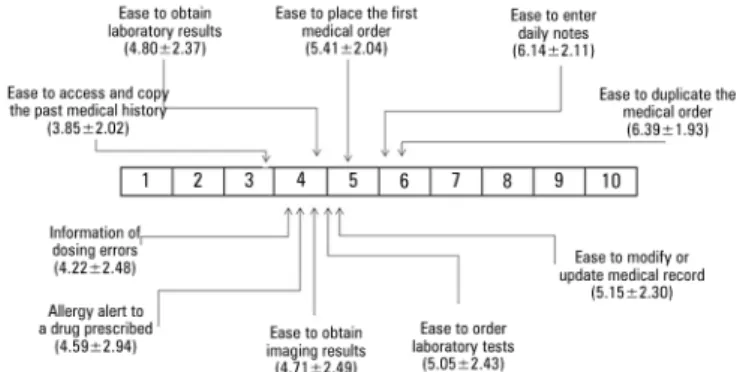
Figure 1 shows the mean scores from the diferent groups regarding the global satisfaction with the CPOE. Notably, when all of the respondents were computed together, the overall satisfaction with the CPOE scored 5.74±2.14 points. he physicians gave the highest score to the ease of duplicating the medical order (6.39±1.93) and the lowest score to the ease of accessing and copying the patients' previous medical histories (3.85±2.02) (Figure 2).
Figure 1 - Global satisfation with the computerized physician order entry. The figure presents the scores for each individual group and for all intensive care units professionals computed together. ICU - intensive care unit. 1=low satisfaction and 10=high satisfaction.
he nurses and nurse technicians gave automatic medication scheduling a score of 5.99±2.58 and gave a score of 5.95±2.51 to the electronic checking of medication administration using the bar code scanner. he system's
Figure 2 - Visualization of the scores given by physicians to specific factors related to the satisfaction with the computerized physician order entry system. 1=low satisfaction and 10=high satisfaction.
ability to provide clear and correct information scored 5.86±2.46, and the reception in the unit of the items dispensed by the pharmacy scored 5.37±2.32.
Table 1 shows the comparison of mean scores between the physicians and other healthcare professionals. he satisfaction score was lower among physicians, who found the system to be less user-friendly. Table 1 in the ESM shows the diferences in the satisfaction scores between groups. he ICU staf gave the highest score to the increase in patients' safety after the CPOE implementation (7.64±2.42 points).
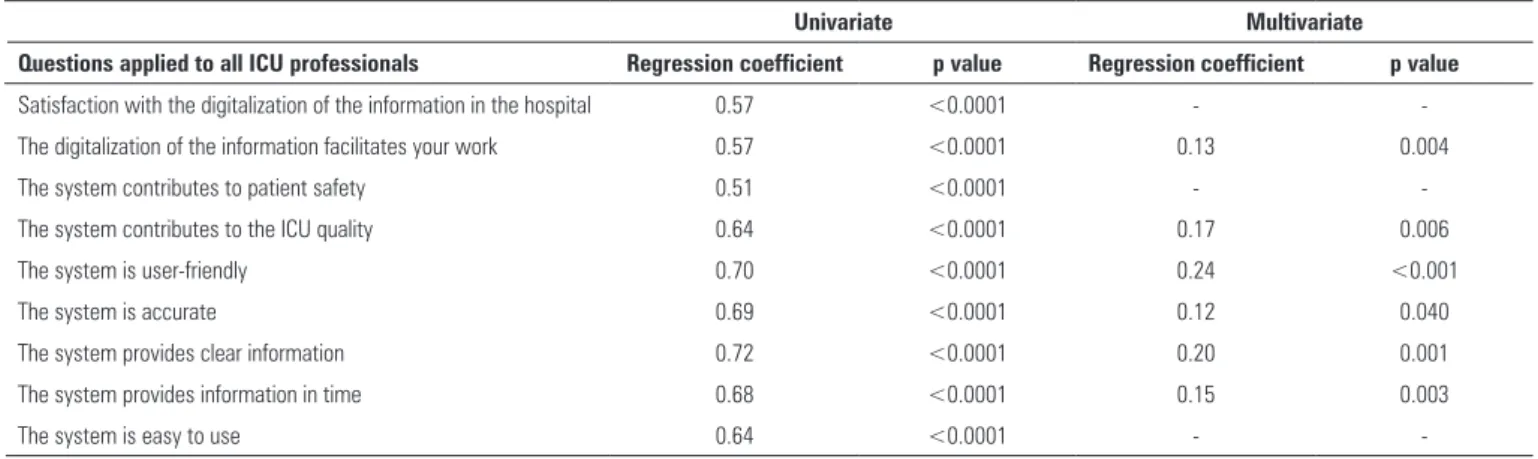
Table 2 shows the factors that were signiicantly associated with satisfaction with the CPOE in the univariate analyses. After multivariate adjustment, the factors that remained signiicant were the belief that digitalization decreased the workload and contributed to ICU quality and a user-friendly and accurate system and that digitalization provided concise information within a reasonable time frame.
DISCUSSION
his study was conducted six months after implementing the electronic system in our medical/ surgical adult ICU. We noted that health care professionals were neither extremely dissatisied nor entirely satisied with the CPOE according to the values used for categorizing satisfaction in the literature: 1-3 correspond to extreme dissatisfaction, 4-6 correspond to dissatisfaction, 7-8 correspond to satisfaction, and 9-10 correspond to
entire satisfaction.(18) he respondents identiied the most
Table 1 - Comparison of mean scores between the physicians and all other professionals for the assessment of the satisfaction with the computerized physician order entry system
Physicians (N=42) Mean (SD) All other professionals (N=208) Mean (SD) t-test
Satisfaction with the digitalization of the information in the hospital 5.88±1.85 7.14±1.81 <0.001
Satisfaction with the digitalization of the information in the ICU 5.71±1.93 7.01±1.95 <0.001
Satisfaction with the computerized physician enter ordering system 4.62±1.79 5.97±2.14 <0.001
Does the CPOE make the daily workflow easier or more difficult? 5.98±2.45 7.31±2.37 0.001
The system provides security for the patient 5.45±2.20 8.09±2.21 <0.001
The system contributes to the quality of care in the ICU 5.40±2.18 7.53±2.31 <0.001
The system is user-friendly 3.88±1.85 6.40±2.29 <0.001
The system is accurate 5.17±1.77 6.77±2.34 <0.001
The system provides clear information 4.76±1.72 6.36±2.28 <0.001
Do you get the information you need in time? 4.69±1.96 5.97±2.36 0.001
The system is easy to use 3.83±1.89 6.44±2.31 <0.001
SD - standard deviation; ICU - intensive care unit; CPOE - computerized physician order entry. 1=low satisfaction to 10=high satisfaction.
Table 2 - Univariate and multivariate analysis of factors associated with satisfaction with the computerized physician order entry system
Univariate Multivariate
Questions applied to all ICU professionals Regression coefficient p value Regression coefficient p value
Satisfaction with the digitalization of the information in the hospital 0.57 <0.0001 -
-The digitalization of the information facilitates your work 0.57 <0.0001 0.13 0.004
The system contributes to patient safety 0.51 <0.0001 -
-The system contributes to the ICU quality 0.64 <0.0001 0.17 0.006
The system is user-friendly 0.70 <0.0001 0.24 <0.001
The system is accurate 0.69 <0.0001 0.12 0.040
The system provides clear information 0.72 <0.0001 0.20 0.001
The system provides information in time 0.68 <0.0001 0.15 0.003
The system is easy to use 0.64 <0.0001 -
-ICU - intensive care unit.
Although there are many beneits for using of CPOE in an ICU, diiculties may occur during and after CPOE implementation. Studies conducted in diferent countries regarding the use of diverse CPOE systems have demonstrated that the number of medication errors can increase in the initial months after implementing
the system during the adaptation period.(19) Health
care professionals, especially physicians, are resistant to changing their routines; the majority of professionals continue to be adamant against using electronic systems in the hospital, which constitutes one of the barriers
to CPOE adoption.(20) Physicians are likely to be not
as satisied as non-physicians because they fear that the change from paper to CPOE might afect patient care, particularly because the medical order constitutes the core of the medication process.
We found an inverse relationship between satisfaction and age. his inding is in agreement with the indings of others, who have shown that older users have more diiculties adapting to new technologies and are thus
more resistant to changing routines.(13) Moreover, using
the computer outside of work hours tends to be less common with age (p=0.107, data not shown), which may afect the capacity to adapt to the CPOE, thus having an impact on satisfaction.
Our study is the irst to assess the impact on end-user satisfaction of the combined implementation of CPOE and bar-coding with comparisons between diferent user groups in an ICU. CPOE is a technology with the most potential for improving medication safety in ICUs(3,8,10,11)
because the majority of serious errors in ICUs are related to
Objetivo: Avaliar a satisfação da equipe da unidade de terapia intensiva com o prontuário eletrônico do paciente e comparar a relevância do conceito de registro eletrônico de ordens médicas entre os proissionais de saúde da unidade de terapia intensiva.
Métodos: Estudo transversal de levantamento para avaliar a satisfação da equipe da unidade de terapia intensiva com o prontuário eletrônico do paciente em uma unidade de terapia intensiva clínica e cirúrgica para pacientes adultos com 30 leitos, utilizando um questionário de autopreenchimento. As questões utilizadas para graduar os níveis de satisfação foram respondidas segundo uma escala numérica, que variava de 1 (baixo grau de satisfação) a 10 pontos (elevado grau de satisfação).
Resultados: As pessoas que responderam ao questionário (n=250) eram, em sua maioria, do gênero feminino (66%) com
idades entre 30 e 35 anos (69%). O grau geral de satisfação com o prontuário eletrônico do paciente foi de 5,74±2,14 pontos. O grau de satisfação foi mais baixo entre os médicos (n=42) do que entre enfermeiros, técnicos de enfermagem, terapeutas respiratórios, farmacêuticos clínicos e nutricionistas (4,62±1,79 em comparação com 5,97±2,14; p<0,001); o grau de satisfação decresceu com a idade (p<0,001). Os médicos tiveram níveis mais baixos de satisfação com relação ao potencial do sistema de registro eletrônico de ordens médicas de melhorar a segurança do paciente (5,45±2,20 em comparação com 8,09±2,21; p<0,001) e facilidade de uso do sistema de registro eletrônico de ordens médicas (3,83±1,88 em comparação com 6,44±2,31; p<0,001). As características com associação independente com satisfação foram sistema amigável ao usuário, precisão, capacidade de fornecer informação clara, e tempo de resposta rápido.
RESUMO
reader at the bedside, it is possible to ensure that the correct medication is administered to the correct patient, at the correct dose and at the correct time. Furthermore, the CPOE systems can alert physicians to patient allergies, medication dosing and duplicity. Medication errors can be potentially life-threatening in critically ill patients who are more vulnerable and more susceptible to those errors because their commonly decreased level of consciousness impairs their capacity to oversee the treatment delivered to them. Additionally, several medications are administered out of schedule, and many medications are intravenously administered with the need for frequent changes in dose or in the rate of administration.(22,23) he immediate beneit of
CPOE is the accuracy of the medication order, improving patient safety in addition to saving nurses and pharmacists
from deciphering a doctor's poor handwriting.(10,24)
We showed a lower satisfaction level with the CPOE among physicians compared to other health care professionals. his inding is in contrast to other studies in which physicians were more satisied with the CPOE
than nurses.(14,15) In our opinion, this inconsistency can
be explained by the various levels of interaction with the system depending on the user category. In our hospital, the majority of the workload related to the CPOE lies on the physicians who are responsible for the daily notes, prescription orders, and ordering of laboratory and imaging tests. Similarly, it is not surprising that nurse technicians were the most satisied with the CPOE because the bar-code system makes the worklow easier, generates more patient safety, and reduces the likelihood of errors with minimal additional work.
here are limitations in our study. First, the study was conducted in a single center, and the results may relect characteristics of this particular ICU. Second, the questionnaire was not previously validated for this speciic use. hird, our survey was performed in the irst six months after the CPOE implementation, and some of the dissatisfaction might be related to the initial adaptation period. Finally, the time each healthcare professional spent using the system for his or her daily tasks was not quantiied; therefore, we could not consider our satisfaction analyses.
CONCLUSIONS
In summary, six months after its implementation, health care workers were satisied, albeit not entirely, with the computerized physician order entry. he characteristics independently associated with satisfaction were the system's user-friendliness, accuracy, capability of providing clear information, and fast response time. Users want a system that can decrease the workload and improve the intensive care unit quality.
Authors' contributions
Descritores: Prontuário eletrônico do paciente; Conduta na prática dos médicos; Pesquisas sobre serviços de saúde; Atitude do pessoal de saúde; Satisfação no trabalho
REFERENCES
1. Cullen DJ, Sweitzer BJ, Bates DW, Burdick E, Edmondson A, Leape LL. Preventable adverse drug events in hospitalized patients: a comparative study of intensive care and general care units. Crit Care Med. 1997;25(8):1289-97.
2. Rothschild JM, Landrigan CP, Cronin JW, Kaushal R, Lockley, Burdick E, et al. The Critical Care Safety Study: The incidence and nature of adverse events and serious medical errors in intensive care. Crit Care Med. 2005;33(8):1694-700.
3. Poon EG, Keohane CA, Yoon CS, Ditmore M, Bane A, Levtzion-Korach O, et al. Effect of bar-code technology on the safety of medication administration. N Engl J Med. 2010;362(18):1698-707.
4. Classen DC, Pestotnik SL, Evans RS, Lloyd JF, Burke JP. Adverse drug events in hospitalized patients. Excess length of stay, extra costs, and attributable mortality. JAMA. 1997;277(4):301-6.
5. Colpaert K, Claus B, Somers A, Vandewoude K, Robays H, Decruyenaere J. Impact of computerized physician order entry on medication prescription errors in the intensive care unit: a controlled cross-sectional trial. Crit Care. 2006;10(1):R21.
6. Bates DW, Boyle DL, Vander Vliet MB, Schneider J, Leape L. Relationship between medication errors and adverse drug events. J Gen Intern Med. 1995;10(4):199-205.
7. Kaushal R, Shojania KG, Bates DW. Effects of computerized physician order entry and clinical decision support systems on medication safety: a systematic review. Arch Intern Med. 2003;163(12):1409-16. Review. 8. Bates DW, Teich JM, Lee J, Seger D, Kuperman GJ, Ma’Luf N, et al.
The impact of computerized physician order entry on medication error prevention. J Am Med Inform Assoc. 1999;6(4):313-21.
9. Marini SD, Hasman A. Impact of BCMA on medication errors and patient safety: a summary. Stud Health Technol Inform. 2009;146:439-44. 10. Kuperman GJ, Bobb A, Payne TH, Avery AJ, Gandhi TK, Burns G, et al.
Medication-related clinical decision support in computerized provider order entry systems: a review. J Am Med Inform Assoc. 2007;14(1):29-40. Review. 11. Maslove DM, Rizk N, Lowe HJ. Computerized physician order entry in the
critical care environment: a review of current literature. J Intensive Care Med. 2011;26(3):165-71.
12. Morrison C, Jones M, Blackwell A, Vuylsteke A. Electronic patient record use during ward rounds: a qualitative study of interaction between medical staff. Crit Care 2008;12(6):R148.
13. Ghahramani N, Lendel I, Haque R, Sawruk K. User satisfaction with computerized order entry system and its effect on workplace level of stress. J Med Syst. 2009;33(3):199-205.
14. Hoonakker PL, Carayon P, Walker JM. Measurement of CPOE end-user satisfaction among ICU physicians and nurses. Appl Clin Inform. 2010;1(3):268-85.
15. Lee F, Teich JM, Spurr CD, Bates DW. Implementation of physician order entry: user satisfaction and self-reported usage patterns. J Am Med Inform Assoc. 1996;3(1):42-55.
16. Khajouei R, Wierenga PC, Hasman A, Jaspers MW. Clinicians satisfaction with CPOE ease of use and effect on clinicians’ workflow, efficiency and medication safety. Int J Med Inform. 2011;80(5):297-309.
17. Laerum H, Faxvaag A. Task-oriented evaluation of electronic medical records systems: development and validation of a questionnaire for physicians. BMC Med Inform Decis Mak. 2004;4:1.
18. Portugal. Ministério da Saúde. Administração Central do Sistema de Saúde - ACSS. Sistema de avaliação da qualidade apercebida e da satisfação do utente dos hospitais EPE e SPA. Resultados globais de 2009. Disponível em: http://www.acss.minsaude.pt/Portals/0/Rel_Global_ AvaliacaoSatisfacaoUtentes_2009.pdf
19. Shulman R, Singer M, Goldstone J, Bellingan G. Medication errors: a prospective cohort study of hand-written and computerised physician order entry in the intensive care unit. Crit Care. 2005;9(5):R516-21. 20. Jha AK, DesRoches CM, Campbell EG, Donelan K, Rao SR, Ferris TG,
et al. Use of electronic health records in U.S. hospitals. N Engl J Med. 2009;360(16):1628-38.
21. Moreno RP, Rhodes A, Donchin Y; European Society of Intensive Care. Patient safety in intensive care medicine: the Declaration of Vienna. Intensive Care Med. 2009;35(10):1667-72.
22. Summa-Sorgini C, Fernandes V, Lubchansky S, Mehta S, Hallett D, Bailie T, et al. Errors associated with IV infusions in critical care. Can J Hosp Pharm. 2012;65(1):19-26.
23. Rambhade S, Chakarborty A, Shrivastava A, Patil UK, Rambhade A. A survey on polypharmacy and use of inappropriate medications. Toxicol Int. 2012;19(1):68-73.
24. Sokol DK, Hettige S. Poor handwriting remains a significant problem in medicine. J R Soc Med. 2006;99(12):645-6.
Conclusão: Depois de 6 meses da implantação do sistema, os proissionais de saúde estavam satisfeitos, embora não totalmente, com o prontuário eletrônico do paciente. O grau geral de satisfação entre os usuários do prontuário eletrônico do paciente foi mais baixo entre os médicos do que entre os demais proissionais de saúde. Os fatores associados com o grau de satisfação incluíram a crença de que a digitalização reduziria