UNIVERSIDADE FEDERAL DE MINAS GERAIS
PROGRAMA DE PÓS-GRADUAÇÃO EM MÚSICA
THAÍS FERNANDES RODRIGUES DOS SANTOS
THE RELATIONSHIP BETWEEN ANCILLARY
GESTURES AND MUSICAL PHRASE ORGANIZATION:
APPLICATION TO FLUTE PERFORMANCE
THAÍS FERNANDES RODRIGUES DOS SANTOS
The Relationship Between Ancillary Gestures and Musical
Phrase Organization: application to flute performance
Submitted in partial fulfilment of the require-ments for the degree of Doctor in Music. Trabalho apresentado ao Programa de Pós-Graduação em Música da Universidade Federal de Minas Gerais - UFMG, como requisito para a obtenção do título de Doutor.
Linha de pesquisa: Performance Musical
Supervisor: Prof. Dr. Maurício Loureiro
Co-supervisor: Prof. Dr. Marcelo Wanderley
S231r Santos, Thaís Fernandes Rodrigues dos
The relationship between ancillary gestures and musical phrase organization [manuscrito] : application to flute performance. / Thaís Fernandes Rodrigues dos Santos. - 2017.
84 f., enc.; il. + 1 CD
Orientador: Maurício Loureiro. Coorientador: Marcelo Wanderley.
Área de concentração: Performance Musical.
Tese (doutorado) – Universidade Federal de Minas Gerais, Escola de Música.
Inclui bibliografia.
ACKNOWLEDGEMENTS
Agradeço primeiramente à minha família que, mesmo muitas vezes distante, esteve tão presente, em especial à minha mãe Magdalena.
Ao Nilton, que esteve ao meu lado em todos os momentos, sempre me incentivando a continuar.
Ao meu orientador, Maurício Loureiro, por acreditar no meu trabalho e por me aceitar neste curso.
Ao meu coorientador, Marcelo Wanderley, por sua dedicação, paciência e amizade durante este processo de aprendizado.
Aos professores do Programa de Pós-Graduação em Música, pelas aulas enriquecedoras. Aos funcionários do Programa, pela paciência e compreensão durante esses quatro anos.
Aos colegas de laboratório (CEGeME), pela troca de ideias e por nunca medirem esforços para sanar minhas intermináveis dúvidas.
Aos amigos que conquistei em Montreal, que sem o apoio não teria tido um ano de tanto aprendizado e alegrias. Aos colegas do IDMIL, por serem sempre solícitos nas trocas de ideias.
À Carolina Brum, que me ensinou que, com esforço e disposição, podemos realizar nossos sonhos. E por me mostrar que a Matemática pode ser um mundo muito divertido.
Aos meus queridos professores de flauta ao longo de toda a minha vida acadêmica, que me ensinaram o verdadeiro valor da música, em especial ao professor Maurício Freire, pelas aulas enriquecedoras durante este curso de doutorado.
Aos músicos participantes desta pesquisa, pelo talento e disposição durante toda a coleta e análise dos dados.
Aos músicos com os quais tive a oportunidade de dividir o palco durante os recitais: Raquel Carneiro, Alexandre Silva, Marcelo Pereira, Thelma Lander e Rodrigo Miranda.
Technique doesn’t exist, the technique is something...
it’s how to use your body in order to produce something what you want to do, and this is every
moment changing.
So, because it’s always changing, you can’t consider it a technique.
It’s an art of using the body!
Of course, you can see dancers have a technique, musicians have a technique, but it’s our words
to explain it, because in the end it’s not technique. If it’s a technique it’s not good anymore.
ABSTRACT
The process through which musical communication occurs varies broadly. Empirical researchers have shown evidence that performers consciously manipulate different acoustical parameters, with the goal of expressing their ideas to the audience and other musicians. The physical gestures produced by players during their performance are other aspects that have been observed by a broad group of researchers.
Although body movements are essential to the sound production of the instrument, gestures, in many cases, are closely related to the musicians’ artistic intentions. The term ancillary gestures designates those gestures that are part of performance but are not intended to produce sound. Ancillary movements appear along with musical performance and, consequently, assume the intentionality of communication.
In this study, we observe musical phrase boundaries through the analysis of physical gestures. Considering that motion is associated with musical communication, our hypothesis is that gestures can express the way which performers understand musical structure and convey the direction of a musical phrase.
For this reason, we designed an experiment involving four professional flutists who were asked to play in three experimental conditions, four times each: (1) playing solo, (2) playing following a previous recording of the clarinet, (3) performing in duet with a recording of the bassoon. The motion and audio of flutists’ performances were analyzed to evaluate the relationship between physical gestures and musical phrase organization.
The results point to a complex interrelationship between musicians’ gestures and the manipulation of acoustical parameters through which performers express their interpretative intentions. This work also demonstrates that ancillary movements are not random, given that they are recurrent and stable in all experimental conditions.
The methodology presented in this study can be used in future works assuming ancillary gestures as a result of the process of musical thinking.
RESUMO
O processo no qual a comunicação musical ocorre varia amplamente. Pesquisas empíricas vêm apresentando evidências de que os músicos manipulam, conscientemente, diferentes parâmetros acústicos, objetivando expressar suas ideias musicais para os ouvintes e os outros músicos. O gesto físico produzido pelos performers, durante suas interpretações, vem sendo observado, com o propósito de analisar sua relação com a organização das ideias musicais.
Embora o movimento do corpo seja essencial para a produção de som, no instrumento musical, gestos, muitas vezes, possuem estreita relação com as intenções artísticas dos músicos. O termo “gesto auxiliar" caracteriza os gestos que fazem parte da performance mas, que não
necessari-amente produzem o som. Gestos aparecem ao longo da performance e, consequentemente, assumem a intenção de comunicar.
Neste estudo, analisamos as delimitações das frases musicais através do gesto físico. Con-siderando que o movimento está associado com a comunicação musical, a hipótese é que o gesto possa expressar a maneira na qual os músicos compreendem a estrutura de uma obra e como eles comunicam suas frases musicais.
Para este fim, desenvolvemos um experimento contando com quatro flautistas profissionais que foram convidados a executarem uma obra em três condições experimentais diferentes, quatro vezes em cada formação: (1) tocando solo; (2) seguindo a gravação, anteriormente coletada, de um clarinetista; (3) seguindo a gravação de um fagote. O movimento e o som das performances dos flautistas foram analisados com o objetivo de estudar uma possível relação entre o gesto físico e a organização das frases musicais.
Os resultados apontam para uma complexa inter-relação entre os gestos performados pelos músicos e os parâmetros acústicos manipulados por eles para expressar suas intenções musicais. Este trabalho mostra também que os gestos auxiliares não são aleatórios, uma vez que os mesmos são recorrentes e estáveis, em todas as condições experimentais.
A metodologia apresentada aqui também pode ser utilizada em futuros estudos de outras áreas do conhecimento, assim como nos estudos envolvendo a comunicacão musical e em trabalhos tendo a música como linguagem. Esperamos que este trabalho seja o primeiro passo para mais estudos que envolvam o gesto auxiliar como parte do processo de pensar musicalmente.
LIST OF FIGURES
Figure 1 – Schematic diagram illustrating the experiment’s design. Firstly, the flutists play solo expressing their interpretative intentions of musical phrases result-ing in Action 1. Secondly, flute players were asked to follow other different interpretation in performing Action 2. . . 6 Figure 2 – Second movement of Wind Quartet No. 2, in G major by Gioachino Rossini.
The example above shows only the three instruments in unison. . . 8 Figure 3 – Data acquisition setting, from the motion capture tracker viewpoint in 3D (x,
y, z). The participant signed a consent form allowing the reproduction of this picture. . . 11 Figure 4 – Areas used to calculate theLegato index. Where energy RMS is the energy
envelope; L is the ideal legato; A represents the different areas, such as A1 and A2. . . 16 Figure 5 – Parameters used to calculate the sustain index of sound. Where energy RMS
is the energy envelope; DR is note duration; IOI is the inter-onset-interval. . 17 Figure 6 – Note inter-onset intervals for the performances of Rossini’s excerpt by the
flutist 1. The IOI was normalized to the quarter-note. The horizontal dashed line exhibits the canonical values. . . 18 Figure 7 – The mirror images of a flutist playing a selected musical passage, where the
flute’s trajectories are the blue curve in three distinct parts of the performance. 20 Figure 8 – Movement segmentation method: grey curve shows the pitch (Hz), and the
black curve shows the tangential velocity of flute [mm/s]. The vertical black dashed lines illustrate the motion segments. . . 22 Figure 9 – Figure illustrating the musical segmentation of the Rossini’s excerpt. The
grey stars mark the goal-point, and the vertical dashed lines indicate the musical segments or the chunks. . . 24 Figure 10 – Schematic diagram illustrating the flute performances analysis methodology.
The analysis sequence is based on methods process from audio recordings, motion capture, and flute performances. . . 26 Figure 11 – Woodwind Quartet by G. Rossini, beginning ofAndante(bars 1 - 4). . . 29 Figure 12 – Four selected shapes: full circle (circle in clockwise direction), forward and
backward, up and down (vertical motion), and half circle motions (also in clockwise direction. . . 31 Figure 13 – Allegro meno mossoof Woodwind Quartet by H. Villa-Lobos. . . 32 Figure 14 – Cyclical motion performed by flutist 2 during the performance of Villa-Lobos’
Figure 15 – Forward and backward motion performed by flutist 4 during the performance of Villa-Lobos’ excerpt. The triangle registers the initial point of gesture. . . 33 Figure 16 – Up and down motion performed by flutist 4 during the performance of
Rossini’s excerpt. The triangle registers the beat of tempo. . . 34 Figure 17 – Half circle motion performed by flutist 2 during the performance of musical
motif 1 by Rossini. The triangle registers the initial point of each gesture. . . 35 Figure 18 – Grouping musical ideas by flutists. The short demarcated part, the musical
motif in red and a longer sub-phrase in green. A and B sections in grey lines. 36 Figure 19 – Gestures with tendency to return (blue shape) and gestures without tendency
to return (orange shape). . . 38 Figure 20 – The 3D trajectory of the flute performed by flutist 1 in his fourth interpretation
during the solo condition. Gesture grouped in sub-phrases considering the two musical motifs. The black triangles mark the initial point of the gesture (musical motif 1), and the black stars marked the second part of the gesture (musical motif 2). . . 40 Figure 21 – Legato Index, the transition between the notes performed by flutist 1. Rows:
From top to bottom: notes 4-5 and notes 12-13 in all takes (T1 T2 T3 and T4). Columns: Left to right: Playing solo, playing following the clarinet, and playing following the bassoon. . . 41 Figure 22 – Legato Index, the transition between the notes performed by flutist 2. Rows:
From top to bottom: notes 4-5 and notes 12-13 in all takes (T1 T2 T3 and T4). Columns: Left to right: Playing solo, playing following the clarinet, and playing following the bassoon. . . 41 Figure 23 – The 3D trajectory of the flute in the musical motif 1 performed by flutist 1
during all experimental conditions. Rows: From top to bottom: playing solo, playing following the clarinet and playing following the bassoon. Columns: Left to right: musical Motif 1.1, musical motif 1.2, and musical motif 1.3. The four takes performed by the musician: (1) blue, (2) red, (3) pink, and (4) green. The black triangles mark the beginning of gesture. . . 43 Figure 24 – The 3D trajectory of the flute performed by flutist 2 in his fourth interpretation
during the solo condition. Gesture grouped in sub-phrases considering the two musical motifs. The black triangles mark the initial point of the gesture (musical motif 1), and the black stars marked the second part of the gesture (musical motif 2). . . 45 Figure 25 – Means and standard deviation of the four takes in each condition for each
Figure 26 – Comparing time-warped graphs of vertical movement for flutist 2’s flute during all experimental conditions. Rows: From top to bottom: playing solo, playing following the clarinet and playing following the bassoon. . . 48 Figure 27 – The 3D trajectory of the flute in the musical motif 1 performed by flutist 2
during all experimental conditions. Rows: From top to bottom: playing solo, playing following the clarinet and playing following the bassoon. Columns: Left to right: musical Motif 1.1, musical motif 1.2, and musical motif 1.3. The four takes performed by the musician: (1) blue, (2) red, (3) pink, and (4) green. The black triangles mark the beginning of gesture. . . 50 Figure 28 – Comparing time-warped graphs of vertical movement for flutist 3’s flute
during all experimental conditions. Rows: From top to bottom: playing solo, playing following the clarinet and playing following the bassoon. Grey circles point to parts rhythm involving motion in each sixteenth-note. . . 51 Figure 29 – The 3D trajectory of the flute performed by flutist 3 in his fourth interpretation
during the solo condition. Gesture grouped in sub-phrases considering the two musical motifs. The black triangles mark the initial point of the gesture (musical motif 1), and the black stars marked the second part of the gesture (musical motif 2). . . 53 Figure 30 – The 3D trajectory of the flute in the musical motif 1 performed by flutist 3
during all experimental conditions. Rows: From top to bottom: playing solo, playing following the clarinet and playing following the bassoon. Columns: Left to right: musical Motif 1.1, musical motif 1.2, and musical motif 1.3. The four takes performed by the musician: (1) blue, (2) red, (3) pink, and (4) green. The black triangles mark the beginning of gesture. . . 54 Figure 31 – Comparing time-warped graphs of vertical movement for flutist 4’s flute
during all experimental conditions. Rows: From top to bottom: playing solo, playing following the clarinet and playing following the bassoon. . . 55 Figure 32 – The 3D trajectory of the flute performed by flutist 4 in his fourth interpretation
during the solo condition. Gesture grouped in sub-phrases considering the two musical motifs. The black triangles mark the initial point of the gesture (musical motif 1), and the black stars marked the second part of the gesture (musical motif 2). . . 56 Figure 33 – The 3D trajectory of the flute in the musical motif 1 performed by flutist 4
Figure 34 – Comparing time-warped graphs of vertical movement of the flute, during the performance of Rossini’s piece. Rows: From top to bottom: flutist 3 and flutist 4. The vertical dashed lines mark the bars, and the triangles indicate the beat. . . 61 Figure 35 – Comparing time-warped graphs of vertical movement of the flute, during the
performance of Rossini’s piece. The green curve was performed by flutist 2 and the red curve was performed by. The vertical dashed lines mark the bars, and the triangles indicate the beat. Green (flute player 2) and red (flute player 1) markers on the score represent the grouping of note of each performer. . . 62 Figure 36 – Note inter-onset intervals for the performances of Rossini’s excerpt by the
clarinetist. The IOI was normalized to the quarter-note. The horizontal dashed line exhibits the canonical values, and the rectangle shows the last bar. . . . 65 Figure 37 – Note inter-onset-intervals performed by flutist 3 in three experimental
LIST OF TABLES
CONTENTS
1 INTRODUCTION . . . 1
2 MUSICAL COMMUNICATION . . . 3
3 METHODS . . . 8
3.1 Experimental Design . . . 8
3.2 Data Acquisition . . . 10
3.3 Self-Report . . . 12
4 ANALYSIS METHODOLOGY . . . 14
4.1 Acoustical analysis methodology . . . 14
4.1.1 Articulation . . . 15
4.1.2 Timing . . . 17
4.2 Movement analysis methodology . . . 19
4.2.1 Visual analysis of video recordings . . . 19
4.2.2 Movement Segmentation . . . 20
4.2.3 Gestural features . . . 24
5 ANALYSIS . . . 26
5.1 Musical Analysis . . . 26
5.2 Visual Analysis . . . 29
5.3 Individual Analysis . . . 36
5.3.1 Flutist 1 . . . 37
5.3.2 Flutist 2 . . . 44
5.3.3 Flutist 3 . . . 51
5.3.4 Flutist 4 . . . 55
6 DISCUSSION . . . 59
6.1 Comparison of performances . . . 59
6.2 Ensemble Performance . . . 63
7 CONCLUSION . . . 68
1
1 INTRODUCTION
Musical communication has been observed by a broad group of researchers focusing on the manipulation of sound (GABRIELSSON, 2003; JUSLIN, 1997; JUSLIN, 2000) and physical gestures produced by musicians (WANDERLEY et al., 2005; CARAMIAUX; WANDERLEY; BEVILACQUA, 2012; TEIXEIRA et al., 2015; CADOZ; WANDERLEY, 2000), during their performance. Studies have demonstrated that body movements, other than being essential to sound production on the instrument, in many cases, are also closely related to the performers’ artistic intentions (WANDERLEY, 2002).
According to Marcelo Wanderley and Eduardo Miranda (2006), the study of gesture in music is an important area of research that raises many issues about perception, performance, and emotional communication. The authors point out that movements are part of performance but not necessarily produce sound. These gestures have been considered essential to the instrumentalist’s performance, and some of them are stable and reproducible, even after extended periods of time. Therefore, the repeatable movement patterns seem to be intimately connected to the structure of the music being performed. It should be regarded that these movements might also have a communicative function in enhancing the perceivers’ experience of the sound’s phrasing (JENSENIUS et al., 2010).
This study involves instrumental ensemble performance, focusing on how flutists adjust their sound and gestures during different duet situations. By observing modifications in the musical phrases and physical gestures which are communicated by musicians during sound production in performance, a strategy to understand the relationship between physical gestures and musical gestures can become clear. Considering that gestures in speakers come about as a by-product of changes in speech (GOLDIN-MEADOW, 2005), we believe that this work can be useful to understanding the organization of musical ideas through the physical gestures.
The data collection involved four flutists playing solos and subsequently playing along to recordings done by other musicians, namely a clarinetist and a bassoonist. In the first step of the analysis, we observed the video of the flutists’ performance and examined the commonalities and idiosyncrasies among them. In the second part, the movement analysis was expanded upon using detailed, three dimensional motion analysis.
Chapter 1. Introduction 2
in which subjects follow the partner’s recording, we can facilitate the analysis of the influence exerted by the instrumentalists’ audio recordings only and can discard the possible impact made by the performance of the flutists. In other words, flutists were only influenced by the recordings.
The primary hypothesis is that different conditions (musicians playing solo or following other’s perceptions of the same piece) change the musical discourse, and consequently these new musical phrases can be reflected in these physical gestures. Mota and colleagues (2014) suggest that musicians have a "musical signature," observed within acoustical parameters and consequently, a "gestural signature" related to the manipulation of their sound.
Gestures tend to be stable, and are not random, carrying a significant relationship with the players expressing their artistic interpretation, and consequently the musicians’ individualities. The results of motion and audio analysis of flutists’ performances will be studied to assess our assumption.
3
2 MUSICAL COMMUNICATION
According to Margulis (2014), music is a vital human function, and essential to brain, emotional, and social activity. Music and language, considering human communication, occupy a similar level of importance and meaning to human beings. Kofi Agawu points to the importance of music, and the occurrence of language, music, and religion in all human societies.
Setting aside for now evidence that nonhumans sometimes engage in these activ-ities, we can state that in all known societies, humans make music, communicate through spoken language, and maintain prescribed sets of beliefs and practices. There are, of course, languages in which the wordmusicis not found, but the
presence in such societies of a species of rhythmic and tonal behavior that we may characterize as music making is rarely in serious contention. (AGAWU, 2009, p.21)
However, cognitive science only considers language as important to studying the human mind, and only just recently has music received considerable attention.
Musical communication is a process that involves musicians expressing and communi-cating ideas to an audience or other musicians. Performance planning and practicing include adjusting acoustic parameters such as note durations, intensity, pitch, timbre, and note articula-tion. These modifications are methods or strategies with which musicians convey their musical intentions (GABRIELSSON, 2003; JUSLIN, 1997; JUSLIN, 2000). By changing parameters of sound, a performer can completely alter the performance of a musical piece through the way it is expressed (FRIBERG; BATTEL, 2002).
The process in which musical communication occurs and the strategies within this process, vary broadly. A pre-existing condition to ensure a convincing musical performance is the way in which the structure of music is expressed. Recent works have focused on methods that describe the expressive intentions in music performance, by analyzing variations of sound (REPP, 1992; FRIBERG; BATTEL, 2002), given that researchers have pointed out that musicians perform small deviations in note durations, articulations, timbre and intensity to convey their musical intentions (GABRIELSSON, 2003; JUSLIN, 1997; JUSLIN, 2000).
The term "communication" suggests that speech and music have many properties in common. According to Dahl and Friber (2007), it is probable that this similar idea can be applied to musical communication as well. Communication in other areas such as linguistics explores the speech and gestures produced by speakers during a conversation. Researchers (GOLDIN-MEADOW, 2005; MCNEILL, 2005) suggest that ignoring gestures during a dialogue is ignoring part of the communication.
Chapter 2. Musical Communication 4
the analysis of movements. The body movements executed by the performers while playing have been studied by several researchers (WANDERLEY, 2002; TEIXEIRA et al., 2015) and their findings indicate that physical gestures are part of musical performance.
Although body movements are essential to the sound production of the instrument, gestures, in many cases, are closely related to the musicians’ artistic intentions (WANDERLEY, 2002) and these movements have been considered essential to the instrumentalist’s performance.
In 1988, Delalande studied the musical and physical gestures during Glenn Gould’s performances and detailed an order for these. The instrumental gestures themselves were analyzed a priori in three levels, ranging from purely functional to purely symbolic. Effective gestures (1) are those that mechanically produce the sound. Accompanist gestures (2) are those that musicians associate with essential movements (instrumental gestures) but apparently are less necessary, such as movements of the shoulders or knees, or breathing for a pianist. Finally, figurative gestures (3) are those recognized by the audience.
Delalande (1988) explained that the accompanist gestures are probably as helpful to the mind as to the actual production of sound. Cadoz and Wanderley (2000) compared several definitions and pointed out the specificity of the conceptgesturein the musical field as related to communication. They also lead to different representations of gestures performed by musicians while playing and proposed a classification, such as instrumental gestures and ancillary gestures.
Instrumental gestures are produced during a physical interaction and are a similar mode of communication to empty-handed gestures. The authors suggested three types of hand actions or hand gesture functions: ergotic (1), involving the energy’s transfer between the hand and the object; epistemic (2), including of the capacity of muscle and touch; semiotic (3), affecting the meaning or communicative intent. On the other hand ancillary gestures, although not produced intentionally to generate or modulate sound, are present and part of expert performances.
Having said that, the terms “accompanist gestures" and “ancillary gestures" have been used to classify the actions produced by musicians during a musical performance but that are not producing sound. However, Jane Davidson (1993) used the name “expressive movements", and Sofia Dahl and Anders Friberg considered the expression “body language" to denote the same idea. It is interesting to note that the ancillary gestures are usually present in professional performers (WANDERLEY; DEPALLE; WARUSFEL, 1999), and these gestures appear as non-lexical elements of communication during speech (MCNEILL, 2005).
By analyzing the relation of physical movements and sound’s manipulation during a musical performance by listeners, Jane Davidson (1993) was able to point out that the audience can recognize the musician’s expressiveness in both modalities: acoustical and visual. The most important result is that participants considered the image as important as the sound.
Chapter 2. Musical Communication 5
(1992) gestures and speech are tightly connected with the conversation in timing, meaning, and function.
The concept “gesture” was defined by McNeill (1992) and replaced the previous term “gesticulation” used by Adam Kendon (1980). Gesticulation can be proclaimed as a conven-tionalized sign, such as thumbs-up for “OK" and occurs with or without speech. Also, as co-articulation, it signifies a fusion of micro-gestures into more super-ordinate gestures. Gestures during the musical performance also appear as a gesticulation or common sign in the musical ideas’ organization. The physical gesture can emerge as a co-articulation within a larger phrasing or to express a single musical idea.
Goldin-Meadow (2005) explains that “although speakers may not be completely aware of having produced hand movements, they are very aware of having spoken. Their gestures are in the service of communication and, in this sense, are deliberated." (GOLDIN-MEADOW, 2005, p.4). The author demonstrates that gestures are produced as part of an intentional communicative act and are formed during speaking as a participation in communication.
Although the gestures appear to serve an important function for audiences (communica-tion), the mechanism by which we produce do not necessarily involve communication and the listener. Susan Goldin-Meadow (2005) points out that people provide gestures independently of any listener’s presence, similarly to speakers gesturing while on the telephone with no visual contact with the audience. Likewise, instrumentalists still move while practicing in their private room. According to the researcher, an alternative possibility is that we produce gestures as part of the process of thinking.
Studies involving human communication compare gestures and speech, intending to comprehend the relationship between movements and talking, and taking into consideration the fact that speakers can modify the structure and content of their speech and that those alterations can cause changes in gestures.
This approach to gestures is of interest to us, given that, in musical performance, the instrumentalists produce similar motion as part of a communicative act. Some studies have shown that ancillary gestures have a relationship with the metrical structure, grouping of phrasing (WANDERLEY et al., 2005), and/or key musical moments (TEIXEIRA et al., 2015).
Chapter 2. Musical Communication 6
Marc Leman (2008) explains the concept of music “embodiment” in which the human body is a mediator between the musical mind and the physical environment, and the gestures can be the way in which this body extends itself in space and time. According to Leman (2008), the gestures are part of synchronization and entrainment of the body and the meaning of the emotional engagement as well as deliberate actions.
Comparing the artistic research and studies that involve gestures and speech, we perceive a similarity between them, mainly how gestures embody discourse information. In a recent study (MAES et al., 2014), researchers proposed a theoretical frame that obtains the forms in which the human motor practice and its effects can reciprocally affect the perception of music. The authors explained that it is not about how the body resonates with the music, but how predicted sensory outcomes of planned or performed actions can be projected onto the learned music. The integration of action and perception in this internal pattern is defined as a result of associative learning processes.
The schema of our experiment (figure 1) involves the flutists playing solo and, conse-quently, expressing their musical phrases. These actions were based on flute player’s perception of the score, resulting in a particular action. In the next step, the flutists were asked to play with the recordings of other instrumentalists, leading to various forms of adjustment in a duet situation. This resulted in a change of perception and therefore a new action.
Input!
!
Own Perception!
Playing solo and expressing!
their interpretative intentions
Output!
! Action 1
Input!
!
New Perception!
Following the performance by!
other musicians
Output!
! Action 2
Chapter 2. Musical Communication 7
8
3 METHODS
3.1 Experimental Design
Six professional musicians (four flutists, one clarinetist, and one bassoonist) from Brazil were invited to participate in the research. All of them had at least 30 years of musical training. Various constraints, the level of difficulty, and demands for a certain level of excellence usually create a need for more anticipation and more ancillary gestures from the performer, especially for beginners. Experienced performers acquire tricks throughout the years to achieve high goals without the need for spurious gestures.
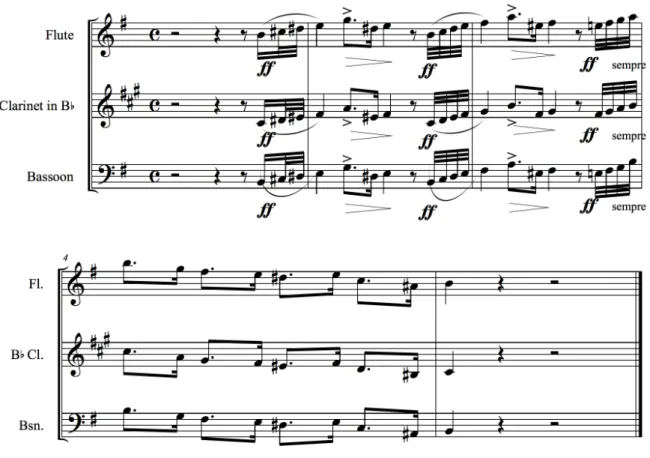
The musicians were asked to play a particular excerpt: the second movement of Wind Quartet No. 2, in G major by Gioachino Rossini (Figure 2). Although the selected piece was composed for four musicians, we chose just three instruments (flute, clarinet and bassoon) and organized them in duets.
Chapter 3. Methods 9
The piece, in which wind instruments play in unison, was chosen because it presents a real performance situation that requires adaptation at every musical note and phrase. When musicians play together in unison (same pitch or an octave apart), they immediately need to adjust various acoustical parameters with ensemble partners. Manipulations may also occur in the way they group notes in musical phrases. Thus, one way to study the player’s musical intentions is with these musical groupings.
Additionally, musicians were asked to play another piece under different musical condi-tions,stretto, composed by Heitor Villa-lobos. The objective is to include other possibilities, in the case of comparison with Rossini’s piece. However, the complete analysis will only be on the piece inunison.
The experiment was realized in two sections. In the first part, each instrumentalist played the excerpt solo with his/her interpretative intention, four times. In the next section, the flutists were asked to play the musical passage, four times each, with a headphone in one ear, while the clarinet and the bassoon were recorded in the first session. The clarinetist and the bassoonist were asked to indicate the preferred recordings to be followed by the flutist’s in the second session. For reference, a metronome produced a steady tempo at 67 bpm (beats per minute), before each take.
The only instruction given was to accompany both instruments in the best way they could. A total of 48 takes were recorded: 32 takes in duet, and 16 solo takes. The use of the headphone was necessary to be able to record each instrument separately.
In a previous study (SANTOS; OLIVEIRA; LOUREIRO, 2014) we simulated ensemble performance by asking flutists to follow recordings of different instruments played through headphones in one ear. The paper aimed to discuss timbre modification, due to coupling inter-pretation of ensemble performance and investigate the timbre’s perception through headphone in one ear. We compared the sound quality of solo performances of orchestral excerpts played by professional flutists, with their own performances when following the clarinet and bassoon playing the same excerpt in unison. During this study, timbre was represented by two of the descriptors discussed by McAdams and colleagues (MCADAMS et al., 1995; MCADAMS, 1999), the logarithm of attack time and spectral centroid. We were able to observe that flute players tend to modify their timbre when following clarinet and bassoon with different tendencies for each instrument. In other words, flutists perceived the modification of the timbre manipulated by different musicians through headphones in one ear.
Chapter 3. Methods 10
When playing solo in the first session, the musicians played as if in a real practice or rehearsal situation by themselves, in which she/he chose to express their interpretative intentions. Whereas, in the second session, the performers were required to adjust themselves to the way the ensemble partner interprets the score.
The assumptions behind these experimental conditions demand of musicians constant adjustment while they were expected to follow different perceptions of the musical piece. The process of perceiving and acting provides acoustical and physical manipulation by musicians in different performances, and we intend to analyze these changes.
3.2 Data Acquisition
The data was collected at the laboratory of CEGeME - Center for Study on Musical Gesture and Expression, at the School of Music of the Federal University of Minas Gerais. The audio was captured by an omnidirectional microphone (M-Audio Solaris) at a sampling rate of 44.1 kHz, using an M-audio Firewire 1814 interface. The microphone was located approximately 1 to 1.5 - meter, relative distance, from the source, given that flutists could move during their performances. In the second session, the previously recorded clarinet and bassoon tracks were played back through an Audio-Technica ATH-M50 headphone in only one ear, leaving the other ear free for the flutist to listen to his/her sound, creating a semi-closed situation. The software program Audacity was used for recording and playback. All musicians used their own instruments during the performances.
Motion tracking was done with the NDI Optotrak Certus motion capture device, at a sampling rate of 100 frames per second. Markers were positioned on the musicians’ bodies and instruments. The Optotrack cameras were placed vertically, three meters away from the musicians. Two rigid bodies were used, one on the flutists’ head and another on the flute. Figure 3 shows the data acquisition setting with the adopted coordinate system: x-axis is the lateral displacement, y-axis is the height, and z-axis is the depth.
The collected data by Optotrack was analyzed into Matlab arrays and, when necessary, coordinate transformations were implemented. Interpolation was applied to the data in order to estimate possible occluded markers during performances. Additionally, we used the MoCap Toolbox plugin for visualizing data parsing (BURGER; TOIVIAINEN, 2013). The MoCap Toolbox is a set of functions written in Matlab dedicated to the analysis and visualization of motion capture data. We used a clapper-board during the experiment in order to synchronize data sources, sound and movement.
Chapter 3. Methods 11
the musical structure.
Chapter 3. Methods 12
3.3 Self-Report
The flutists also were asked to participate in a listening test in which each musician selected the musical phrases while listening to the recorded takes of all flutists, including her/himself, under the experimental conditions. The goal of this test was to identify the musical intentions of all flute players using the flutists’ perceptions. Musicians segmented how they perceived the musical phrase organization, delimiting the musical motifs or phrases through listening.
In addition, the flutists were submitted to a semistructured interview1, explaining how they identified the organization of the musical ideas during the listening test, and discoursed about grouping their phrases while playing the excerpt. Finally, we presented the research hypothesis to flute players, in which the physical gesture is concerned with the grouping of musical motifs to musicians. The following questions were asked:
1. How did you organize your musical ideas? What is your idea about grouping the notes in this excerpt?
2. Which aspects did you consider to separate the musical phrase when you listened to the recorded takes?
3. Do you believe that movements are related to musical ideas?
Responses indicated that performers are aware of their artistic intentions and the way in which they organized the piece played. Given that, they identified the boundaries of phrases performed and consequently, the relationship with their intentions. The flutists revealed some aspects which they considered to segment the phrases while listening to it, such as, differences in sound’s energy and articulation. According to Friberg and Battel (2002), there are cues to identify idea boundaries such as variations in timing, decreasing of sound energy, bending of timbre, the strength of notes, and in some cases, changes in the articulation. In fact, these manipulations in the sound broadly change an interpretation. However, it is not possible to define one rule to determine the limits of an idea, but there can be strategies used by musicians to identify the limitation of musical phrases.
Concerning the last question, some flutists were surprised when identified the relationship between physical gestures and the way how they organized their musical phrases. Considering that they are aware of the manipulation of their sound to express their intentions, but not entirely conscious about the possible relationship their movements have with their musical phrase organization. One performer stated: "I’m surprised, I’m not aware of performing these gestures." Furthermore, flutists agreed that movements affect their performance, and often they use the gestures to express musical conduction and to communicate with the audience or other musicians.
1 According to the authors Christian Laville and Jean Dione, which consisted of questions offered verbally in a
Chapter 3. Methods 13
14
4 ANALYSIS METHODOLOGY
Musicians are aware of normative aspects of musical structure and they are subordinated to them. However, during musical communication, performers express their individual choices. Our goal in this study is to observe both aspects, individuality and commonality, that may emerge in ensemble musical performance, analyzing the sound and the gestures performed. Therefore, in order to compare the different musical performance situations, we conducted an analysis in both modalities, sound and motion.
In this chapter, we will report both analysis methodologies: acoustical and gestural. During the individual analysis of flutists and consequently, the comparison among them, we will use different strategies which will be explained in detail.
4.1 Acoustical analysis methodology
Firstly, we segment the recorded audio into musical notes. We used a combination of pitch and amplitude values to detect note onset and offset, end of attack, and beginning of release. This process was accomplished automatically with the use of EXPAN, a tool developed at CEGeME for musical expressiveness analysis (CAMPOLINA; LOUREIRO; MOTA, 2009).
A Sonic Visualizer plugin (CANNAM; LANDONE; SANDLER, 2010) developed within the EXPAN toolbox was also used for inspection and adjustment of the segmentation parameters. After that, the audio vector of each performance was processed, and acoustical descriptors of each note were obtained.
The current investigation regarding communication of musical structure in performance focuses on the analysis of variation in acoustical descriptors. Loureiro (2006) points to method-ology approaches exploring the musical expressiveness due to the sound’s information and identifying descriptors capable of analyzing the artistic content of a musical performance. The process of performance planning and execution involves the manipulation of sound with which the musicians can emphasize or minimize various aspects of a piece.
Chapter 4. Analysis Methodology 15
4.1.1 Articulation
Nancy Toff (1996) explains that the articulation is a technique of connecting musical tones, determining the relationships between single notes and the surrounding notes. According to the author, the articulation is similar to what we think of as phrasing and not just tonguing. TheLegato, on the flute, is produced by a single blow sustaining the air flow during the transition of tones, without using the tongue. In other words, regularity and continuity of sound must be obtained by a blending of constant breath, support and flexible embouchure synchronized with finger motion.
According to Maestre and Gómez (2005), theLegatodescriptor indicates how clearly two notes are separated. The authors explain that when there is no silence between two consecutive notes, we can consider that a note transition segment begins at the first note’s release and ends at the attack of the following one. Both the energy envelope and the fundamental frequency contour during transitions are studied to extract this descriptor’s information.
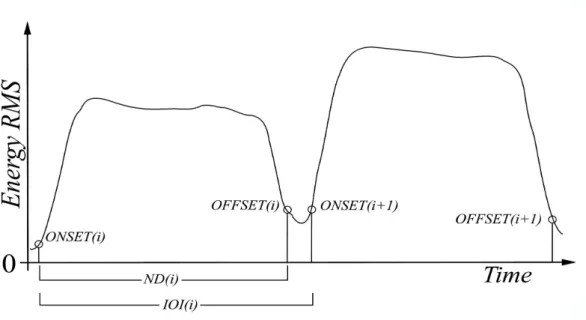
Figure 4 shows the ideallegatowith the dashed line from the beginning of the release of the first note to the end of following note’s attack, and the areas used to calculate thelegato index. In this work, we use thelegato indexto represent the quality of legato and to analyze the tendency to segment notes and consequently the fragmentation of musical ideas.
Chapter 4. Analysis Methodology 16
Figure 4 – Areas used to calculate theLegato index. Where energy RMS is the energy envelope; L is the ideal legato; A represents the different areas, such as A1 and A2.
LI(i) =1−
A1 A1+A2
=1−
EA(i+1)
∑
t=BR(i)
|L(t)−RMS(t)|
EA(i+1)
∑
t=BR
L(t)
(1)
Another descriptor is the sustain index of sound which measures the duration of a single note and the relation with the following one. The descriptor’s measurement is based on the note onsets and offsets extraction from the audio signal, estimated as the ratio between note duration (ND) and the Inter-Onset-Interval (IOI), as shown in Equation 2. We will use this descriptor to demonstrate when flutists expanded the notes and consequently the boundary of the phrases. The observation of this sound descriptor can show the intentional manipulation of note duration by the flutists (figure 5).
to f f seti −tonseti
Chapter 4. Analysis Methodology 17
Figure 5 – Parameters used to calculate the sustain index of sound. Where energy RMS is the energy envelope; DR is note duration; IOI is the inter-onset-interval.
4.1.2 Timing
Sundberg (2000) considers the two most important principles for communicating musical structure: (1) differentiation of pitch and duration; (2) grouping of notes in phrasing, metrical units, or harmonic areas. Furthermore, the author explains that the perception is enhanced by increasing the difference between categories, such as stretching notes or playing short notes even shorter (duration contrast), beyond the variation of the sound’s energy as changing dynamics of the sound.
According to Keller (2014), the timing deviation can have horizontal and vertical relations between sounds. The vertical timing variations affect the degree of synchronization of sound in separate parts within the ensemble texture. Meanwhile, the horizontal relations concern the timing of successive sounds within each voice or instrumental part. Both aspects work to modify the harmonic and melodic music features.
A standard mode of horizontal deviation requires intentionally varying the length of metric inter-beat intervals to produce systematic modulations in local tempo (GABRIELSSON, 2003). Todd (1985) suggested that often in the phrasing endings occur a decrease in thetempo, reflecting hierarchical relations and the boundaries of musical ideas.
Chapter 4. Analysis Methodology 18
dynamics.
During the ensemble performance, the vertical deviation directly affects the temporal relationship between sounds. Playing simultaneous notes is not only impossible but also undesir-able in human music making. As pointed out by Rasch (1988), not synchronizing notes should be considered one of the substantial interpretations in the performance of music. Vertical timing deviations have multiple determinants apart from perceptual and motor limitations. However, it also can involve the musician’s choice to stretch or to shorten some note generating tension or release as part of the musical interpretation. Other factors such as tempo, musical structure, style, and leader–follower relations, may affect the vertical timing deviations. That said, the variation of timing can be a useful method to compare different expressive intentions of musicians, and it will be discussed in chapters 5 and 6.
In this study, the timing has been analyzed through the descriptor IOI (Inter-Onsets-Intervals). The variation of the length of metric inter-beat intervals to produce systematic modulations in local tempo or timing is measured by the change of Inter-Onsets-Intervals (IOI). The inter-onset-intervals are based on only the note onsets obtained from the audio signals. In this study, the IOI’s are normalized to the quarter-note. Figure 6 represents the manipulation of timing. The variation from this line indicates a note duration manipulation by the instrumentalists, which, above the line shows a longer note and below the line means a shorter note.
Note Number
0 5 10 15 20 25
Normalized IOI (s)
0 0.5 1 1.5 2
3 4
2 1
Bars
Note Number: 1 5 10 15 20 25 28
Chapter 4. Analysis Methodology 19
4.2 Movement analysis methodology
Our movement analysis is based on two parts. First, we perform gestural analysis based on observation of video recordings, and secondly, using information obtained from a high-accuracy three-dimensional optical movement tracker. The visual analysis of video recordings proposes to perceive and to identify flute players’ gestural features, for observers without formal training in motion, using the Laban-Bartenieff system. The movement analysis tracker data aims to expand it with a detailed evaluation of the action.
4.2.1 Visual analysis of video recordings
The Laban-Bartenieff Movement Fundamentals was created by Rudolph Laban (1879 – 1958) and Irmgard Bartenieff (1900 – 1981) and consists of a framework for describing, recording, and developing movement. Although intense training is needed to understand the system, an adequate knowledge of Laban-Bartenieff Movement Fundamentals can be learned and used to observe movements.
Note that in the study of human behavior using methods like Laban-Bartenieff Movement Analysis, the observer plays a significant role in interpreting the subject’s motion. The researcher brings in their set of biases based on their experience and expertise. Thus, if any one of these factors changes, the resulting observations may change as well. The choice of this procedure was the first step to recognizing possible patterns or commonalities between flutists before expanding it with a detailed evaluation of the movement tracker data.
Chapter 4. Analysis Methodology 20
Figure 7 shows a flutist playing the selected musical passage. The plots were created through movement tracker data. Note that the mirror image makes possible a visualization of flute’s trajectory. We will expand on the details about this analysis in the next chapter.
Figure 7 – The mirror images of a flutist playing a selected musical passage, where the flute’s trajectories are the blue curve in three distinct parts of the performance.
4.2.2 Movement Segmentation
Previous studies have shown the clarinet bell movement has been the object of analysis (WANDERLEY, 2002; WANDERLEY et al., 2005; CARAMIAUX; WANDERLEY; BEVILAC-QUA, 2012; TEIXEIRA et al., 2015) and the authors have considered that the instrument’s motion can be a significant indicator of artistic movements made by the players. Teixeira and colleagues (TEIXEIRA et al., 2015) explained the movement of the clarinet bell relative to a static reference: the origin of the Cartesian coordinate system. The authors explained that the static reference is located in the centre of the Optotrak. Consequently, the instrument bell movement can be regarded as a general sign of the clarinetists’ movements.
In this study, we analyze the relative motion of the flute. Considering marker in the headjoint and footjoint, representing several actions performed by flutists. An important part of the flute is located in the headjoint, the embouchure plate or lip plate, where players position their lips, while footjoint is another extremity of the instrument.
Chapter 4. Analysis Methodology 21
position, given that the trajectory can be more intuitive to interpret than spherical coordinates. Although the flutists adjust their lips and chin to change the pitch and to maintain intonation the flute’s motion is constant in this spherical coordinates (radius, horizontal position), given that the flute is a rigid body and consequently both extremities have the same movement.
Given that musical audio segmentation is facilitated by the onset and offset detection, there is no straight forward method for segmenting movement is available. Teixeira et al. (2015) suggest that the tangential velocity and local minima can be significant in the process to the segmentation of this data. The authors explain that the procedure uses the local minima as a basis for the movement segmentation, assuming that these particular points correspond to inflection points of the musician’s movement. Therefore, the movement sessions will be between successive local minima in the tangential velocity curve (Figure 8).
The procedure consists in the estimation of flute’s relative motion as a first step. Af-terward, the Euclidian distance was measured between 2 subsequent spatial positions. Finally, estimating the tangential velocity, we used a low-pass filtering for smoothing. This process aimed to define viable similarities among the gestures and potential association of gestural features. The gestures involve one or more movement segments grouped. In this work, we arranged the movement sections through the association with onset notes in seconds. This association was performed to consider the local minima before the onset notes, and consequently, we can observe the preparation of the physical gesture. The beginning of notes which performed the grouping was defined by musical analysis and the analysis of musical intention of each flutist. It will be described in details upcoming.
Teixeira and colleagues (2010) confirmed that the tangential velocity is a particular uni-dimensional parameter which apprehends essential information from the musician’s movements. However, a gesture can be constituted by one or more segments represented by local minima in the tangential velocity curve.
Chapter 4. Analysis Methodology 22
Time (ms)
0 200 400 600 800 1000 1200
Tangential Velocity (black curve)
Pitch Hz (grey curve)
0 200 400 600 800 1000 1200
Figure 8 – Movement segmentation method: grey curve shows the pitch (Hz), and the black curve shows the tangential velocity of flute [mm/s]. The vertical black dashed lines illustrate the motion segments.
Rolf Godoy (2010) suggests that the continuous stream components and temporal aspects such as sound, need to be considered during the segmentation in the research that involves the idea of perception-action interaction in human activity. The author proposes segmenting the stream of sound into chunks to determine the sonic events and the gestures that correspond to these acoustic parts. This approach offers a definition of the gesture units.
Godoy (2013) explains that the chunks are based on the perception of musical sound related with body movement. The term "chunk" not only means a segmentation or method of analysis but it also becomes more stable in our minds “to something that does not exist at the timescale of continuous sensory streams.” (GODOY, 2013, p.368).
Chapter 4. Analysis Methodology 23
particular streams, such as sound.
Regarding that, physical gestures can be classified as (1) interactive gestures (of two people or things) influencing or having an effect on each other, (2) impulsive gestures (discontin-uous effort or the rapid accent) and, (3) sustained gestures (contin(discontin-uous effort). This purpose has relation with the theory of embodied cognition which explains our tendency to unconsciously imitate the gestures that we see other people making or movements that we believe other people are performing.
The chunks are based on the holistic perception of musical sound and the relation of musical, physical gestures. The chunks are classified in three different categories related to duration interval: (1) micro timescale, 0.5 seconds duration limits, (2) meso timescale, 0.5 - 5 seconds duration range, (3) macro timescale, longer than the continuation range of the meso timescale.1The musical phrases, as well as sequences of chunks, can present a fusion of small-scale segments whose parts are the end of gestures and the beginning of a new part, namely, co-articulation.
To establish a correspondence between physical gesture and musical structure, we proposed a method for gestural segmentation through the sub-division the musical structure into short motifs or sub-phrases. Therefore, our first action was to determine the goal-points in the score according to goal-directed sound (Figure 9) through the musical analysis. The selected fragments support the idea of chunks corresponding to the acoustic events which show clear musical direction towards the goal-point notes.
Considering that we can determine the notes onset, and consequently the time of each musical motif, we looked for the corresponding local minima in the velocity curve, in seconds. This method ensures that each unit is segmented in both streams. Hence we analyzed the sound and gestures at each particular segment. Therefore, each grouped gesture represents an approximation involving note onset motifs and the subsequent motif.
1 Rolf Godoy explains and suggests some examples for this classification. Micro timescale results in a duration
Chapter 4. Analysis Methodology 24
Note Number: 1 5 10 15 20 25 28
Figure 9 – Figure illustrating the musical segmentation of the Rossini’s excerpt. The grey stars mark the goal-point, and the vertical dashed lines indicate the musical segments or the chunks.
4.2.3 Gestural features
The segmentation process defined the parts, hence it is possible to perform a gestural analysis. It is important to explain that we adjusted the means in each gesture to zero, equalizing the center of the trajectories at the same point.
Due to the requirements in comparing different flutists, time-warping algorithms (SENIN, 2008) were applied to the performances so that any time coordinate would correspond to the same musical event in all takes. Using the notes onsets as reference points in the timing model, we ensured a proper temporal alignment between the signals following the musical structure. This strategy was implemented to compare gestures across performances, independent of original tempo.
Chapter 4. Analysis Methodology 25
26
5 ANALYSIS
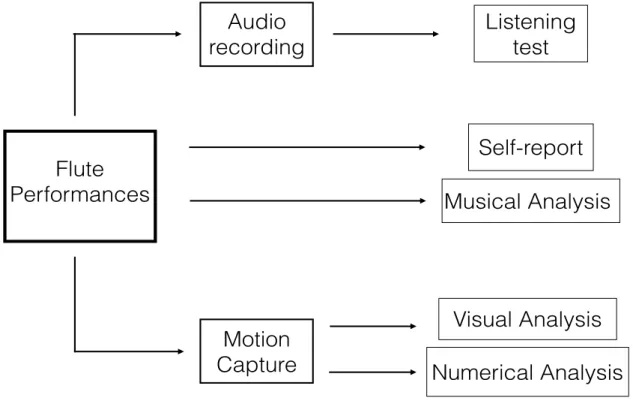
In this research, we use some complementary analysis to study ancillary movements: (1) visual analysis, from video recordings made with a (consumer) digital video camera; (2) numerical analysis, from a high-accuracy three-dimensional optical movement tracker; (3) auditive test involving all participating flutists analyzing how notes are grouped in musical phrases during different performances; and (4) self-report with flute players discussing their interpretative choices about Rossini’s excerpt. We also performed a musical analysis to understand the Rossini’s excerpt and the interpretative choices of flutists following this piece. Figure 10 shows the sequence which we following during the study. In this chapter, we will examine the decision of each flutist using the approach of all analysis’s process.
Flute
Performances
Audio
recording
Motion
Capture
Listening
test
Self-report
Musical Analysis
Visual Analysis
Numerical Analysis
Figure 10 – Schematic diagram illustrating the flute performances analysis methodology. The analysis sequence is based on methods process from audio recordings, motion capture, and flute performances.
5.1 Musical Analysis
Chapter 5. Analysis 27
According to Steen (2010), Rossini was a member of the Accademia Filarmonica of Bologna where he studied cello, piano, counterpoint and in particular the music of Haydn and Mozart. Rossini also was employed as a continuo player andrépétiteur, and sang in an opera in Bologna when he was a child.
His best-known works are operas, such asThe Barber of Seville,Otello,La Gazza Ladra, andGuillaume Tell. However, Rossini also composed vocal music, such asPetite messe solenelle, and chamber music.
The studied piece was composed for wind quartet, and the selected excerpt is the beginning (bars 1-4) of the second movement, Andante, of Wind Quartet No. 2, in G major. Although the musical analysis includes the beginning, middle, and end of a piece, beyond all voices involved, we decided to analyze just the excerpt performed by musicians in this study, given that it is the only part that the musicians played. Upcoming analysis suggests a harmonic analysis and its melodic relations, considering that the passage is composed of all three players playing the same melody. We will use the analysis description suggested by Kofi Agawu1.
The excerpt begins with the sounding of voices of the upbeat leading into the tonic on the downbeat of bar 1 (E minor, as I). This description is the moment which we consider the first motif2. The second motif also shares this sense of directness in time, and it aims to achieve the tonic, E minor. The presence of D-sharp creates a sense of anticipation given that it is the seventh of E minor (Figure 11). In our analyses, we consider two main musical motifs: (1) upbeat and downbeat motif, Bars: 0 - 11/ 14- 21/ 24- 31; (2) accentuated note motif, Bars: 12- 13/ 22- 23, and the grouping of two motifs, which we call sub-phrases.
The second sub-phrase also presents the destination to the downbeat, dominant (B major), in which F sharp is the fifth note. Also, in the next motif, there is a conduction to B major, in which the E sharp is a seventh of F sharp, the secondary dominant (V/V). This kind of context is relevant because although flutists grouped the musical phrase in different ways, they kept respecting these melodic features.
The upbeat of the second bar also conducts to the tonic, with B as the fifth note. The repetition, in this case, seems a constructed force as progression III (G) - IV (A) - V (B) (figure 11, blue markers). However, the last upbeat of this progression incorporates the function of co-articulation. Thus, the motion of recent upbeat lets us recognize that the destination will be different. The end of progression (B - note 20) represents an attained goal and the beginning of a new musical idea. In bars 24- 31, Rossini repeats the upbeat’s idea and extends it, leading finally
1 According to Agawu (2009), the superscripts are utilized to locate a particular beat within the bar. Consequently,
21indicates beat 1 of bar 2, 22is beat 2 of bar 2, and so on.
2 Oxford Dictionary of Music (www.oxfordmusiconline.com) defines motif as “a short musical idea, melodic,
Chapter 5. Analysis 28
to a cadence to the dominant (B major) in which the notes E, C, A sharp (figure 11, red marker) is the Italian sixth chord.
The melodic progression constitutes the norm of coherent and meaningful tonal order which may be noted as movement from one stable note (G) to another, more stable point (B).
Other material identified in Rossini’s piece was ascendent and descendent chromatic pitches. The recurrence of these intervals (figure 11, purple markers) generates the idea of tension and arouses expectations. The repetition of these intervals seem to generate the idea ofArsisand Thesis3. The flutists’ intentions emphasized the notesthesiswhich were performed through their sound and motion, and they are recurrent during the excerpt’s performances.
Elizabeth Margulis (2014) has studied the repetition and its implications to listeners, musicians, and composers. The author explains that learning/level-shifting, segmentation, and expectation are primary roles identified in studies on musical auditory repetition for the audience. According to Margulis, the insertion of repetition can create an impression of intentionality. Therefore, the repetition draws out the signature of the individual as well as his/her connection to the surrounding.
Bars 0 - 11= conduction to the tonic, E minor.
Bar 12- 13= conduction to the tonic.
Bars 14- 21= conduction to the dominant, B Major.
Bar 22- 23= conduction to the dominant.
Bars 24- 31= upbeat in V (B Major) to tonic (E minor).
Bars 33- 34= Italian sixth chord.
Bars 33- 41= cadence to dominant.
3 Arsis and thesis, in prosody, means an accented (arsis) and unaccented parts (thesis) of the metre of a poem.
Chapter 5. Analysis 29
Note Number: 1 5 10 15 20 25 28
Figure 11 – Woodwind Quartet by G. Rossini, beginning ofAndante(bars 1 - 4).
5.2 Visual Analysis
This discussion here is part of a continuing effort to quantify and analyze the gestures of musicians in order to understand their origins and communicative utility. The considered hypotheses is the relation between the manipulation of sound and grouping of notes by musicians and their ancillary gestures.
Chapter 5. Analysis 30
capture data.
We consider it appropriate to observe the class of shape of these movements, considering them as gestures. According to Chagnon et al. (2005), the “shape” could be extremely useful for observation of musicians as a performer’s musical intent, recurrently expressed simultaneously in sound and gesturing qualities. Also, the characteristics of opening and closing actions can be more precisely described by showing the direction and plane through which the body is moving or changing.
There are three modes of shape changing: (1) flow, (2) direction, and (3) carving. The shaping qualities are primarily related to breath, given that both are separated by opening (inhaling) and closing (exhale) actions. The shaping features are extensions or reflections of the motion as in the breath. The opening-closing shaping qualities are (1) rising-sinking, vertical (2) advancing-retreating, horizontal, and (3) widening-narrowing, sagittal, through the manipulation of the body.
Opening and closing actions can be explained by showing the direction and plane through which the body is moving. The directional shape can be a cyclical or linear motion, which the body is moving in space aiming to achieve the particular point. Finally, the carving shape involves the interaction between two bodies in mutual adaptation.
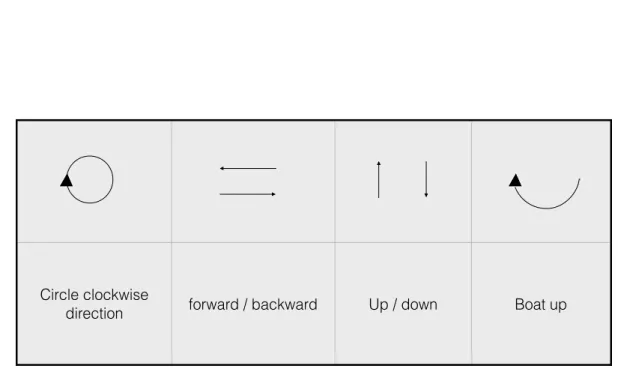
During the visual observation, we analyzed all recorded excerpts, given that each one presents a particular feature and we considered it necessary to include all of them. We recognized different shapes in the flute’s trajectory, such as cyclical patterns, a motion forward/backward, up/down, and half of the cyclical gesture (figure 12). We also perceived that each shape could be related to the performer’s musical intentions, given that some gestures seemed similar among flutists.
Chapter 5. Analysis 31
Circle clockwise
direction forward / backward Up / down Boat up
Chapter 5. Analysis 32
The shape in figure 14 was segmented using the same procedure as Rossini’s piece and the all movement segments were grouped in a unique gesture.
Note Number: 1 5 10 15 18
Figure 13 –Allegro meno mossoof Woodwind Quartet by H. Villa-Lobos.
X[mm]
1 0,8 0,6 0,4 0,2 0 0 0.2
Z[mm] 0.4 0.6
0.8 1
0 0,2 0,4 0,6 0,8 1
Y[mm]
Chapter 5. Analysis 33
It is important to explain that it is only one viable idea for grouping this excerpt in phrases. There are others possibilities. Flutist 4, during his interpretation of the same excerpt, performed gestures with a rhythmic sense, given that the motion of the flute corresponds to the specific instance of the pulse. Figure 15 represents the shape, forward and backward, and the possible relationship of this gesture and the time sense of music, demonstrating another interpretive choice. We perceived that the shape, forward and backward, also presents relation with the sense of time, given that the position of the flute in the fore front corresponds with the pulse of this piece.
X[mm]
1 0,8 0,6 0,4 0,2 0 0 0,2
Z[mm] 0,4 0,6
0,8 1
1
0,8
0,6
0,4
0,2
0
Y[mm]
Figure 15 – Forward and backward motion performed by flutist 4 during the performance of Villa-Lobos’ excerpt. The triangle registers the initial point of gesture.
Chapter 5. Analysis 34
time[ms]
0 200 400 600 800 1000 1200
movement[mm]
0.4 0.45 0.5 0.55 0.6 0.65 0.7 0.75 0.8 0.85 0.9
Bars: 1 2 3 4
Figure 16 – Up and down motion performed by flutist 4 during the performance of Rossini’s excerpt. The triangle registers the beat of tempo.
Chapter 5. Analysis 35
X[mm]
1 0.8 0.6 0.4 0.2 0 0 0.2
0.4
Z[mm]
0.6 0.8
1 0 0,2 0,4 0,6 0,8 1
Y[mm]
X[mm]
1 0,8 0,6 0,4 0,2 0 0 0.2
0.4
Z[mm] 0.6 0.8
1 0 0,2 0,4 0,6 0,8 1
Y[mm]
Figure 17 – Half circle motion performed by flutist 2 during the performance of musical motif 1 by Rossini. The triangle registers the initial point of each gesture.
Marc Leman (2008) reported that the narrative and experimental viewpoints may be integrated through a particular approach to the concept of embodiment. The human body is thereby understood as a mediator between the musical mind and the physical environment, and gestures can be perceived as the way in which this mediator deploys itself in space and time.
Chapter 5. Analysis 36
5.3 Individual Analysis
Based on the listening test and acoustical analysis, we perceived that flutists often grouped the musical ideas (figure 18) in short motifs (red markers) or longer sub-phrase (green markers). Because of these attempts, we decided to divide the excerpt into two musical segments: (1) a short demarcated part, a musical motif; (2) a longer sub-phrase. Besides this, we separated the excerpt into two sections: A and B (grey markers). The intention was to verify future recurrence of gestures when musicians play short motifs, as well as individuality on gesture patterns related to musical phrases that may produce original interpretative intentions.
A section
B section
Note Number: 1 5 10 15 20 25 28
Figure 18 – Grouping musical ideas by flutists. The short demarcated part, the musical motif in red and a longer sub-phrase in green. A and B sections in grey lines.




![Figure 8 – Movement segmentation method: grey curve shows the pitch (Hz), and the black curve shows the tangential velocity of flute [mm/s]](https://thumb-eu.123doks.com/thumbv2/123dok_br/15586721.607349/36.892.138.829.176.564/figure-movement-segmentation-method-curve-shows-tangential-velocity.webp)