REVIEw Of BuSINESS MANAGEMENT © FECAP
RBGN
Received on February 7, 2014 Approved on January 7, 2015
1. Jose Alejandro Cano Master in Administrative Engineering Universidad Nacional de Colombia [[email protected]]
2.Jose Jaime Baena
Law and Political Science PhD (c) Universidad de Barcelona (Spain)
Revista Brasileira de Gestão e Negócios
DOI:10.7819/rbgn.v17i54. 1901
Impact of Information and
Communication Technologies in
International Negotiation Performance
Jose Alejandro Cano and Jose Jaime Baena
Universidad de Medellin, Economy and Business School, Colombia
Editor in charge: João Maurício Gama Boaventura, Dr. Evaluation process: Double Blind Review
ABstRACt
Objective – his article establishes relations between the level of importance of Information and Communication Technologies (ICT), the frequency of use of these tools, and the eiciency and eicacy achieved in the international negotiation processes.
Design/methodology/approach – A research study is carried out in 180 import and / or export irms in Medellin city, and the proposed relations are explained through a theoretical model. With the information obtained, correlation and comparative analysis of eiciency and eicacy indicators are made.
Findings – ICT are essential to perform international processes, therefore the increase in the importance level and frequency of use of these technologies allows perceiving better results about eiciency and eicacy increase.
Practical implications – Increasing the application of ICT to the international negotiation processes generates a reduction of cost and time in negotiation and an increase of international sale contract, however ICT must be complemented by other elements such as attitude, training and experience of the negotiator to obtain satisfactory results.
Originality/value – he article proposes an original model to study the efect of the importance level and frequency of use of ICT on the performance of international negotiation process.
1 INtRODuCtION
Overtime, enterprises have tried to experiment several changes not only in the way they perform their intern processes but also in the way they accomplish their negotiation operations. It is in this sense that organizations seek diferent alternatives that can support the negotiation process to obtain results that generate diferent beneits. his reality makes itself visible when companies increase the use of the Information and Communication Technologies (ICT) and also recognize the level of importance of these tools, given that they could inluence directly in time reduction and total cost of negotiation processes, and in the increase of imports and exports volume, as well as increasing the number of international sale contracts.
It is important to highlight that according to oicial statistics of the World Bank (2011), currently the ICT imports are equivalent to 11.2% globally and 8.5% of Colombia’s imports, this is evidence that Colombia is not outside of the trade dynamics and the use of the ICT. In addition to that, 32.7% of the world population has access to the internet; particularly, Colombia has a rate of 40.4%, 7.7% above the world’s average. hese numbers ofer an idea of how important such technologies have become in international trade and speciically in the efectiveness of the international trading and other transactional processes of organizations and irms.
Due to the rise of ICT in the Colombian corporate sector, is carried out a research study into 180 import and export companies from Medellín, considering a theoretical model to explain relationships between the level of importance of ICT and the market performance as Bayo-Moriones, Billon & Lera-López (2013) suggest. hese also contrast the frequency of use of those tools and the eiciency and eicacy achieved in international negotiation processes. Consequently, to achieve the stated objective, a literature review is proposed on issues such as the contribution of ICT in solving business
problems and the relationship and impact of them on the efectiveness of international trading. hen, the methodology to collect and process the information is explained, posing and testing the formulated theoretical model of market performance and exposing the results with their respective analyses. Finally, overall conclusions and future lines of work will be presented.
2 CONtRIButION AND ImPACt OF the ICt IN the INteRNAtIONAl NeGOtIAtION
2.1 Contribution of the ICt in solving business problems
he fast development and growth of ICT in the last few years has been of great importance to businesses, especially at the beginning of the XIX century, where trading between organizations and/ or companies gained more and more beneits for using informatics tools (Gomez, 2013). herefore, a new concept around the implementation of ICT within companies operations has appeared. In consequence, this type of speciic tools has been developed to support trading; tools that seek the eicient solution of complex problems (Kersten & Lai, 2007; Bichler, Kersten, & Strecker, 2003) and ended boosting the electronic markets, becoming a dominant way of negotiation in commercial operations (Strobel & Weinhardt, 2003). hus, within the context of economic globalization, it is logic for the companies to adapt their processes to electronic commerce trend and behaviors; this has forced countries to establish ideal conditions to promote and ease the development of those activities throughout the Internet (Tumbas, Matkovic, & Pupovac, 2011).
established a unique model of on-line interaction which is consolidated with the growing number of mobile phone and internet users around the world. his also represents a great potential for negotiations in the international trade, especially considering that according to studies of Aguilar, Bustamante and Cano (2013) there are still many companies that, despite of their knowledge and occasionally use of some ICT, haven’t yet mastered them, ergo using them rationally and consequently exploiting all their attributes in the best way possible.
It is important to highlight that there are several models supported in the use of ICT that can inluence the solution of several problems, making easier the process designing of the communication mechanisms, data transfer and knowledge sharing in the company’s negotiations (Ren, Yang, Bouchlaghem, & Anumba, 2010). hanks to ICT, computer simulations and tools of this kind have become a desirable alternative based on multi-criteria analysis methodologies that study the most suitable options to find meeting points and appropriate agreements between the parties involved in the negotiation. hese methodologies have been developed as a base for building computer systems that support decision making in order to help in the search of efective consensus in international commercial negotiations (Kruś, 1996).
Following this logic, companies producing goods and/or providing services - which belong to a wide variety of sectors - increasingly tend to be classiied as virtual organizations due to intensive use of ICT, allowing them not to be necessarily linked to speciic geographic regions and even to have an active role in international markets. In that order of ideas, this is the trend adopted by most of the companies and particularly by Small and Medium Enterprises (SMEs), who see greater opportunities in those tools because of their easy access, portraying them as competitive and dynamic entities (Afsarmanesh, Camarinha-Matos & Msanjila, 2009).
Overall, ICT can potentially beneit any kind of company, as it is happening with SMEs; for example, recent case studies conducted by Mbatha (2013) showed the impact of the Internet in the services sector, presenting that this informatics tool ofers a platform which can easily plan their business processes in diferent markets and also allows them to associate with other companies in an easier and simpliied way. Even in those studies conducted in the service industry, a tendency to increasingly use of ICT for electronic commerce is found, due to these tools efectiveness in reaching new customers, and eiciency for increasing sales and improve trading.
In fact, Bernal-Jurado and Moral-Pajares (2010) showed that industries with higher import and export activities are those that adopt within their business more e-commerce methods, where the ICT tools become essential as the Internet itself uses applications like the Electronic Data Interchange (EDI) for on-line shopping. It is under this logic that research studies such as Antlová (2009) emphasizes the adoption of ICT as a strategic alternative, as this contributes to the growth of the company in general - including the SMEs -, besides enabling the development of competitive advantages for better company performance, knowledge and employees’ skills, among other beneits.
accordingly, developing competitive beneicial advantages to the companies.
ICT are important tools to support the achievement of objectives in the negotiation processes; however, according to Pires and Aisbett (2003), the mix of the e-business and e-commerce models might require to simultaneously adopting new strategies inside the same company. his demands preparation in order to absorb all the changes and guarantee the success in the implementation of the ICT to the international negotiation process.
2.2 Relationship and impact of ICt on the efectiveness of international negotiation
As many aspects of the ICT operation improve every day, computational methods have managed to be in the spotlight in recent years, especially in optimization and revenue generation for the international negotiation (Shi, Luo & Lin, 2006). Also regarding the perception of improved international negotiation processes, authors like Swaab, Postmes, Neijens, Kiers and Dumay (2002) conducted a study where they suggest that ICT can eiciently reach agreement, generating more satisfaction among the negotiators, especially because they ind objective conirmation from the counterpart and perceive a sense of equality and control in a collaborative atmosphere (Wang, Lim & Guo, 2010).
In relation to the eiciency in international business trading, Jean, Sinkovics and Cavusgil (2010) have researched how the ICT improved multinational clients’ businesses relations, which can legitimize the important role played by these tools. herefore, this case study highlighted how deinitive it is for SMEs to have access to those types of computer resources in order to obtain all the beneits that ICT can ofer to companies, promoting e-commerce. here is no doubt that international trading is based in the use of ICT and this can ofer more eicient negotiations avoiding getting into topics and discussions that are irrelevant and commonly happen in
face-to-face negotiations; as consequence of this, the time invested in a negotiation is considerably reduced. In addition, mediating communication through ICT represents alternative ways to contact international clients/suppliers, which increase the opportunity to obtain more sale agreements, and unleash a growth of contracts volume, a reduction of business trips, a decrease in costs, among other variables (hompson & Nadler, 2002).
In fact, according to Yushkova (2013), the use of ICT has a direct impact on the increase of trade low; also the use of these technologies in the business sector may lead to a reduction in costs. Regarding the expansion of international trade and, therefore, the relationship improvement between countries, Bayo-Moriones et al. (2013) airm that ICT can have a positive inluence in companies market share and hence in their better proit margin. In this study, a positive relationship between the adoption of ICT and the company’s performance is also evident; furthermore, these tools improve internal and external communication alone with the operational performance of organizations. Consequently, Rangan and Sengul (2009) said that thanks to the deployment of the ICT in the international negotiation, costs associated with transactions and production have been reduced in the internationalization process.
It is possible then to say that the use of ICT is necessary in the international negotiation process for diferent beneits, among them, the reduction in distance and time in these processes (Pauleen & Yoong, 2001). About this, Low & Ang (2011) comment that most companies perceive that negotiations mediated through ICT have advantages with regard to cost savings, time reduction, shortening of distances and facilitating gather people in a speciic event, especially for emergencies that may arise in the process.
Moen, Madsen and Aspelund (2008) argue in their research that in some cases ICT inside sales have little impact because the face-to-face interaction could be beneicial to establish commitment and trust with the business counterpart. Alongside, Hatta and Ken-Ichi (2008) conclude in their study that negotiations mediated with ICT promote visual anonymity, and remoteness inhibit the activation of the ongoing rule, which means that negotiators tend to abandon the current negotiation. At the same time, Johnson and Cooper (2009) found that those negotiations mediated with ICT such as computers and applications as instant messenger reduce the affection shown, diminishing the probability of reaching an agreement.
However, the contributions of Corsaro and Snehota (2012) must be taken into account; they suggest that the strategy for implementing ICT as support tools for negotiation must be consistent and appropriate to achieve results, since it is also evident that the inappropriate implementation might jeopardize trade relations between parties involved in a business negotiation, which would also end up afecting the participation of companies in the market. In this sense, Jean et al. (2010) highlighted in their research that to access the beneits of the ICT, companies must be sure that their staf is obtaining the adequate levels of knowledge for the use of such technologies. In relation to that, Corsaro and Snehota (2012) draw attention to how the right knowledge for the use of the ICT may be understood as a strategy that allows a better accomplishment of relationships
between companies and even with the employees themselves. herefore, considering the role played by knowledge of ICT in business relationships and dynamics for the development of business networks, it becomes the key topic within companies and, as consequence, deserves more attention. Moen et al. (2008) declare that the intensive use of ICT helps to get information and rapport building that increase awareness of new markets and facilitates the company’s penetration.
The lack of knowledge about ICT is possibly one of the many reasons why companies fail to operate properly the great multitude of beneits ofered by those tools, as they can promote not only the companies operations, but also their access to markets. In fact, Wresch and Fraser (2012) agreed with this statement, their research studies revealed how some companies in developing countries are not finding the same success through e-commerce as they expected due to problems of knowledge. On this matter, a case study into 23 companies in the Caribbean illustrates the speciic experiences of small entrepreneurs who have encountered many frustrations and diiculties associated with appropriate ICT management.
All those discussions motivated this research to study how efectiveness increases in international negotiation processes due to the frequency in the use and level of importance given to these technologies into companies in Medellin, Colombia, and, thereby, identify whether indicators of eiciency or eicacy depend on the use and implementation of ICT.
2.3 ICt, are they tools with increasingly growing importance to companies?
supply chain. However, this is only possible if businesses operations are generally adapted and prepared in an ICT platform model according to the circumstances and requirements for each company, as well as the hardware, software and personnel availability to support the performance of information technology (Jevtic, Dedjanski, Beslac, Grozdanic, & Damnjanovic, 2013). In this sense, Jonkers et al. (2004) argue that unfortunately there is not a standardized model that allows the companies to establish precise informatics requirements for them, because they use their own modeling techniques, concepts, tool support etc. to satisfy their own needs.
his is one of the main reasons why ICT are not always accepted by companies, due to all the requirements needed, as well as a series of essential background knowledge for their full adaptation to a business environment. In fact, Cano and Baena (2013) add that other greatest impediments to implementing ICT in organizations relate to the ignorance regarding all these technologies, the non-recognition of the need for ICT, as well as the perception in the cost of acquisition and proper functioning of these technologies.
hus, under this logic, it can be concluded that the level of education of employees involved in organizations is crucial, since within SMEs and businesses in general, their operators, owners, and managers are those who manage to delineate the general strategies and particularly are those who recognize the perceived beneits in adopting new technologies and identify the importance of conducting ICT investment, innovation and development for businesses. All facing signiicant speed with which all these technologies change, since trends and advances in this section are remarkable year after year (Chibelushi & Costello, 2009).
According to Winter, Gaglio and Rajagopalan (2009), ICT have accomplished the facing of new challenges for the SMEs and companies in general as they are becoming increasingly important for their own survival and successful management; in fact it is also important to maintain their credibility in the markets. his precisely happens by inluencing the awareness of potential buyers through ICT; those tools enable the wider dissemination and recognition of their products in the markets. Consequently there is no doubt that despite the diiculties for some companies to adopt ICT, all becomes in a key tool for organizations looking to develop competitive advantages and seeking success in today’s markets. It is even more especial for SMEs, whose survival depends on several factors, but particularly by the level of use and appropriation of ICT; all this in order to achieve the development of new organizational models and compete in new markets while improving internal and external relationships (Barba-Sánchez, Martínez-Ruiz, & Jiménez-Zarco, 2007).
ICT, as an organizational tool, tends to play an important role, and unquestionably drives the growth of enterprises contributing directly to proitability, providing foundations for improving operations in a variety of areas, favoring internal and external companies processes; this through better management of environmental, technical and human factors (Matthews, 2007).
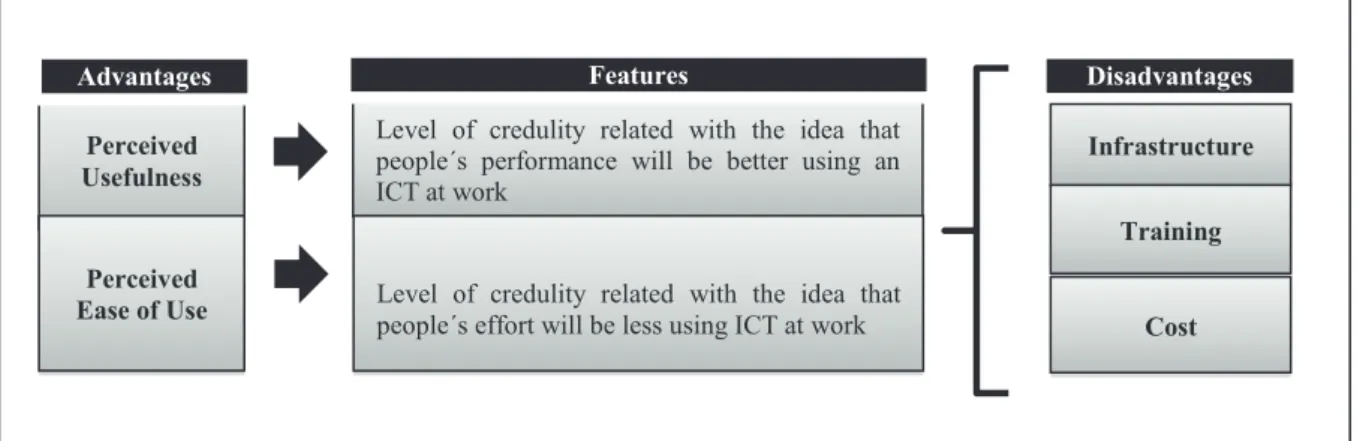
To identify impact of ICT on companies’ performance in the market, telephone surveys on
Perceived Usefulness
Perceived Ease of Use
Level of credulity related with the idea that people´s performance will be better using an ICT at work
Level of credulity related with the idea that people´s effort will be less using ICT at work
Advantages Features Disadvantages
Infrastructure
Training
Cost
FIGuRe 1 – TAM and Factors Afecting the Use of ICT.
source: he authors based in Davis, F. (1989). Perceived usefulness, perceived ease of use, and acceptance of information technology. Mis Quarterly, 13(3), 319-340; Young, L. (2004). Modelo de Aceptación Tecnológica (TAM) para determinar los efectos de las dimensiones de cultura nacional en la aceptación de las TIC. Revista Internacional de Ciencias Sociales y Humanidades, SOCIOTAM, 14(1), 131-171; and Cano, J., & Baena, J. (2013). Retos en la implementación de las TIC para el proceso de negociación internacional. Cuadernos de Administración, 29(50),142-152.
Given that companies weigh perceived usefulness and perceived ease of use, all within reason to implement ICT; it is crucial to note that these tools generate signiicant organizational changes and, regardless of it, changes will be inevitably evident within the company from the moment these new practices with ICT are implemented. Besides, this situation will also lead inally to a positive yield, that will display a greater market share and better proit margins for the organization (Bayo-Moriones et al., 2013).
In this order of ideas, conventional and specialized ICT are tools that help in clear and positive ways negotiations within companies. Besides, they facilitate various activities and ofer advantages associated with a positive rapport building, obtaining alternative contact and eiciency between customers and suppliers, as well as reducing frequency of travels and expenses associated to it (Baena & Cano, 2014).
3 methODOlOGy
To identify impact of ICT on companies’ performance in the market, telephone surveys
on 180 companies were conducted along with the Center for Public Opinion help (at the University of Medellín). his statistical sample is achieved with a stratiied random sampling that attains a representation of Medellin city’s business population, as this sample represents SMEs (93%) and large companies (7%) from diferent business sectors, engaged in the importing and/ or exporting of goods and services.
hose companies who answered the survey were previously supplied with a list of ICT used at every stage of international negotiations/trading (preparation, dialogue and closure), some of which we can mention here: web portals, web pages and directories, e-mail, phone, instant messaging, video conferencing, social networking, scenario building softwares, NSS, software for classifying and evaluating suppliers, business management software, spreadsheets, word processors, VoIP, e-procurement, e-sourcing, e-bidding, translation software, text and image digitization software, audio and/or video recorders, cloud computing, among others.
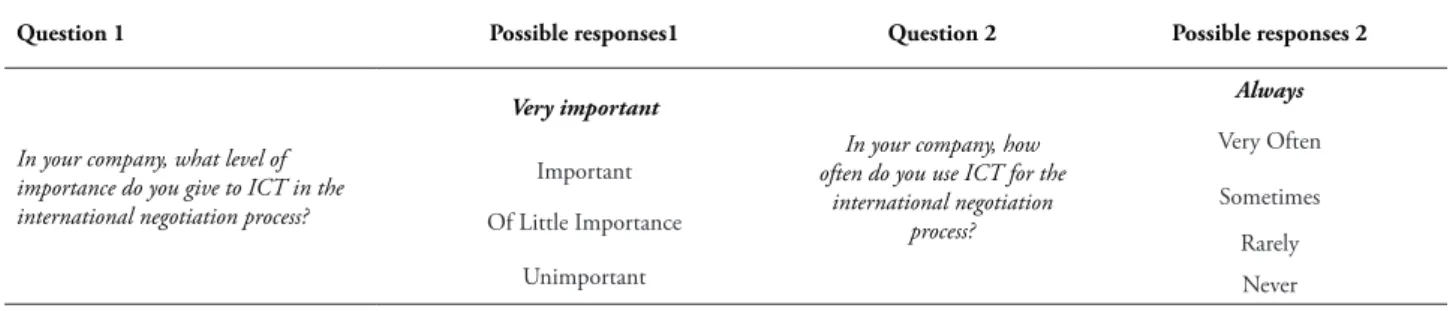
those ICT and the frequency of their use during international negotiations (this as shown in Table 1). To measure the market performance, questions shown in Table 2 were asked, which are based on
the companies’ perception of ive indicators that measure the eiciency and eicacy obtained in international negotiation processes.
tABle 1 – Questions About the Level of Importance and Frequency of Use of ICT for International Negotiation
Question 1 Possible responses1 Question 2 Possible responses 2
In your company, what level of importance do you give to ICT in the international negotiation process?
Very important
In your company, how often do you use ICT for the
international negotiation process?
Always Very Often Important
Sometimes Of Little Importance
Rarely
Unimportant Never
tABle 2 – Questions of Market Performance in International Negotiations for ICT
According to your perceptions, how would you score the impact on the following items in relation to negotiating with international clients/suppliers through the use of ICt?
Items %
eiciency Indicators
Total reduction of time of negotiation process
-Total reduction of cost of negotiation process
-efectiveness Indicators
International sale contracts increase
-Exports volume increase
-Imports volume increase
-The indicators in Table 2 reflect components of eiciency and eicacy, which together measure the international negotiation efectiveness. In relation to this, the increase in the number of international sale contracts, the rise in the imports and exports volume, and the volume increase relect the trade agreements that are carried out and the deals that are successfully closed to generate international trade transactions in goods and services (Thompson & Nadler, 2002; Swaab et al., 2002; Bichler et al., 2003); therefore, these are the international negotiation’s goals. he reduction in resources as total time
and costs relects the eiciency of international negotiation processes, demonstrating the main reasons for implementing ICT in these operations (Thompson & Nadler, 2002; Angeles, 2006; Parida et al., 2006).
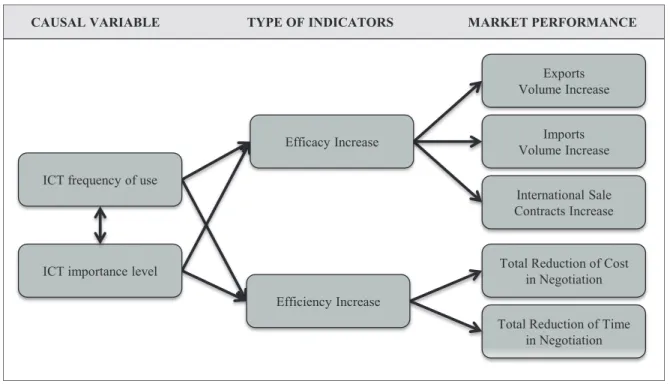
Once the sample for the research study was collected, a model called ICT Market Performance Model for International Negotiation (ICTPEMOIN) is proposed, trying to understand the impact of the use of ICT in the companies’ market performance. This model establishes a series of relationships where the ICT’ use frequency and importance level generate eiciency and eicacy for international negotiation process, which results in an increase of companies’ markets performance.
Figure 2 represents the ICTPEMOIN scheme where casual variables generate an impact on the efficiency and efficacy’s performance indicators that exposes a reduction in total costs and trading times, and increased sales contracts and the volume of imports and exports. he hypotheses for ICTPEMOIN are listed below:
hypothesis 1: A higher level of importance of ICT promotes greater frequency of use of these technologies, and a higher use frequency of ICT in international
negotiation results in a greater level of importance of these technologies in the companies.
hypothesis 2: As a company gives a higher level of importance for ICT in international negotiations, the company will have better eiciency results.
hypothesis 3: As a company uses ICT more frequently for international negotiations, the company will have better eiciency results.
hypothesis 4: As a company gives a higher level of importance for ICT in international negotiations, the company will have better eicacy results.
hypothesis 5: As a company uses ICT more frequently for international negotiations, the company will have better eicacy results.
CAUSAL VARIABLE TYPE OF INDICATORS MARKET PERFORMANCE
International Sale Contracts Increase
Total Reduction of Time in Negotiation Total Reduction of Cost
in Negotiation Exports Volume Increase
Imports Volume Increase
Efficiency Increase Efficacy Increase
ICT importance level ICT frequency of use
4 Results
Once the information analysis of interviews collected in the phone was made, none of the companies from the validated sample selected the “Never” option for the variable use frequency of ICT. his allows concluding that companies in Medellin need to use, at least occasionally, ICT to carry out their international negotiation processes;
in other words, ICT are essential to carry out such processes.
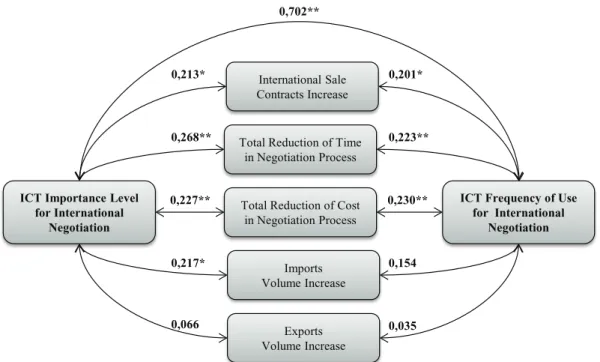
Similarly, to get the results from the case study, a statistical correlation analysis using SPSS 18 software was made, with which it is possible to describe the relationships indicated in the ICTPEMOIN; the results from this correlations are shown in Figure 3.
International Sale Contracts Increase
Total Reduction of Time in Negotiation Process
Total Reduction of Cost in Negotiation Process
Imports Volume Increase
Exports Volume Increase ICT Importance Level
for International Negotiation
ICT Frequency of Use for International
Negotiation 0,201*
0,223**
0,230**
0,154
0,035 0,213*
0,268**
0,227**
0,217*
0,066
0,702**
**. Correlation is significant at the 0.01 level (bilateral). *. Correlation is significant at the 0.05 level (bilateral).
FIGuRe 3 – Correlation Between Level of Importance and Frequency of Use of ICT Indicators of Eiciency and Eicacy.
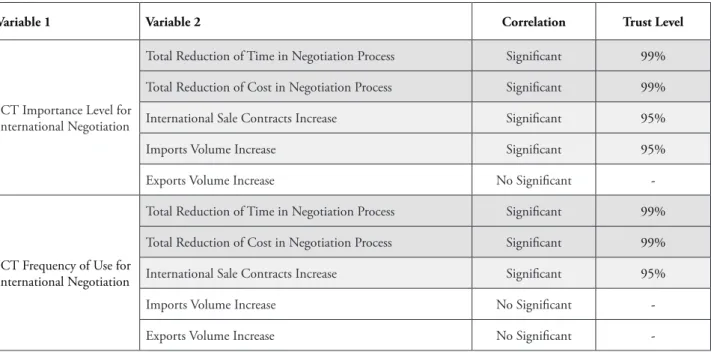
With the results in Figure 3, it is observed that there is a signiicantly positive correlation between the level of importance of ICT and their frequency of use for international negotiation, validating hypothesis 1 proposed in ICTPEMOIN. Based on Figure 3, Table 3 was created to set the ive indicators of efectiveness in two correlations groups according to the importance level of ICT and frequency of use for international negotiation.
According to Table 3, one might conclude that there is a high positive correlation between
tABle 3 – Levels in the Correlations Between Level of Importance and Frequency of Use of ICT With the Eiciency and Eicacy Indicators
Variable 1 Variable 2 Correlation trust level
ICT Importance Level for International Negotiation
Total Reduction of Time in Negotiation Process Signiicant 99%
Total Reduction of Cost in Negotiation Process Signiicant 99%
International Sale Contracts Increase Signiicant 95%
Imports Volume Increase Signiicant 95%
Exports Volume Increase No Signiicant
-ICT Frequency of Use for International Negotiation
Total Reduction of Time in Negotiation Process Signiicant 99%
Total Reduction of Cost in Negotiation Process Signiicant 99%
International Sale Contracts Increase Signiicant 95%
Imports Volume Increase No Signiicant
-Exports Volume Increase No Signiicant
-Regarding performance indicators, it is worth highlighting a signiicant correlation among the ICT level of importance, the increase in the number of sales contracts and the increase in imports volume; however, there is not a signiicant correlation between the increase in exports, which cannot fully validate hypothesis 4 proposed in the ICTPEMOIN. his behavior can be explained because of the possible constraints (barriers to entry from Colombia to other countries) currently present in the international trade, which directly interferes with international negotiations and therefore in the achievement of export contracts. Likewise, export operations affront different challenges such as opening international markets, adaptation to business conditions and techniques in destination countries, implying concessions by the exporter to its counterpart.
It is valid to say that there is a signiicant correlation between the frequency of ICT use with the increase in number of sale contracts, however, there is not a signiicant correlation with the increase in imports and exports; thus, hypothesis 5 presented in the ICTPEMOIN cannot be
completely validated. According to this, although ICT are used frequently, it does not mean they can always be used strategically to penetrate markets or to supply from them; and even if ICT are used quite frequently and properly, it is required other essential skills associated with marketing to ensure the success of international negotiation.
In the case of imports increased, it is revealed that the use of ICT for international negotiation is regarded as important for businesses, but this does not necessarily mean that these companies make use of these tools properly or that these organizations complement their processes with skills and competencies to make better purchases in international negotiations.
CAUSAL VARIABLE TYPE OF INDICATORS MARKET PERFORMANCE
Total Reduction of Time in Negotiation Total Reduction of Cost
in Negotiation
International Sale Contracts Increase Efficiency Increase
Efficacy Increase
ICT Importance Level
ICT Frecuency of Use
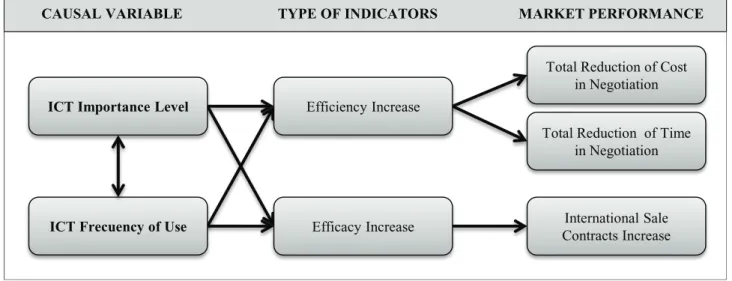
FIGuRe 4 – Scheme of ICTPEMOIN Validated Model.
To analyze deeper the relationships identified in Figure 4 through the validated ICTPEMOIN, Figure 5 and Figure 6 are presented, in which the relationships between
indicators of eiciency and eicacy are described, making an individual analysis with the level of importance and frequency of use of ICT for international negotiation.
28%
56%
46%
63%
13%
47%
59%
66%
10%
25%
47%
53%
0% 10% 20% 30% 40% 50% 60% 70% 80% 90% 100%
Unimportant Of Little Importance Important Very important
Costs Reduction Time Reduction Contracts Increase
According to Figure 5, the perception of reductions in the costs of international negotiation process shows that these are more signiicant when ICT are considered very important to the process; it represents a reduction of 63% on average to the companies. It is also visible that on average the most signiicant reductions in time for international negotiation explains that these are more signiicant when ICT are considered important and very important, in which case reductions around 59% and 66%, respectively, are visible.
Regarding performance indicators, companies in the research study perceived most
signiicant increases in the number of international sale contracts as they give more importance to those ICT in international negotiation process. In the case of companies where ICT are considered important or very important, increases around 50% of international sale contracts are found.
he relationships analyzed in Figure 5 may be caused by the seemly fact that while ICT show positive results in eiciency and eicacy during international negotiations, it will make businesses more aware of the usefulness and functionality of those technologies, and they will encourage businesses to apply until these technologies become key tools for achieving strategic goals.
30%
58% 57%
62%
41%
49%
65% 66%
25%
33%
54% 53%
0% 10% 20% 30% 40% 50% 60% 70% 80% 90% 100%
Rarely Sometimes Very Often Always
Costs Reduction Time Reduction Contracts Increase
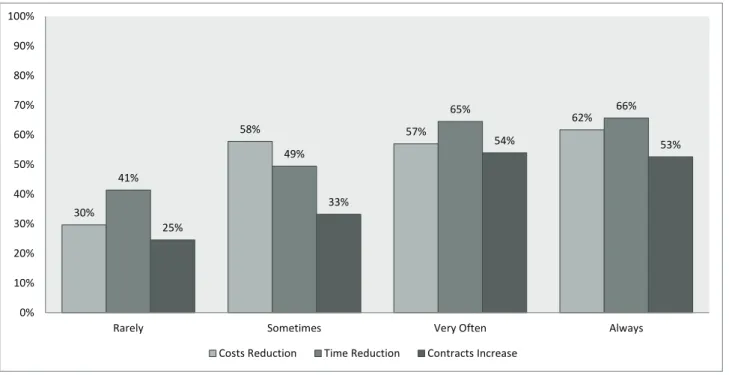
According to Figure 6, generally more significant costs reductions are perceived by the increased use of ICT in the international negotiation processes, representing around 60% of the cost reductions for those companies that use ICT sometimes, almost always or always. Regarding time reductions during international negotiation business process, companies in general perceive greater reductions by frequently use of ICT in international negotiations. Such reductions are ranging between 41% and 66%, increasing in line with the use of these technologies. here is also average increase in the number of international sale contracts, as in previous cases; as ICT are used more frequently in international negotiations, more international sale contracts are obtained, especially when these technologies are almost always or always used, obtaining an increase of 65% to 66%, respectively, in number of contracts.
he relationships analyzed in Figure 5 and Figure 6 allow to say that some companies where ICT are not frequently used or does not receive importance for the international negotiation process might be depriving themselves of large beneits such as the reduction in the cost and total time of the negotiation process and the increase in the number of contracts of sale; in other words, depriving themselves of eiciency (appropriate use of resources) and efficacy (achieving business goals).
5 CONClusIONs
he conducted research study, in the irst instance, allows to conclude that companies in Medellin use ICT at least occasionally to carry out their international negotiation processes, therefore, it could be suggested that ICT are essential to perform those processes.
Based on the statistical analysis and with the ICTPEMOIN’s approach, it seems that there is a trend in suggesting that as long as companies
give more importance to ICT and as far as they are more frequently used in international negotiations, they may achieve greater reductions in time and costs in their process. his assertion suggests that higher eiciency will be achieved because of the optimal use of resources. However, this research study fails to identify strong enough those relationships between the ICT level of importance and their frequency of use with the efficacy indicators, excepting the number of international sale contracts indicator. All of this suggests that companies should complement their frequency of use and the importance of ICT with marketing skills and abilities, this with the aim of achieving an increase in volume of imports and exports, as ICT on their own cannot generate such beneits in eicacy.
Therefore, it indicates that the ICT use generates better results regarding the eiciency in international negotiation process (appropriate use of resources), while, regarding the eicacy (achieving objectives), ICT must be complemented with other types of elements that are directly dependent on the attitude, training and experience of negotiators.
Clearly, there is a need for enterprises to implement ICT within the international negotiation process, due to the benefits and advantages associated with their use. As companies give more importance to these technologies, more efectiveness in the process is obtained, which will trigger an increase in the use of those tools to achieve the objective of international negotiation processes and, therefore, generate international agreements and satisfactory contracts for imports and/or exports.
5.1 Future lines of research
to obtain the greater benefits in efficiency (reduction of time and costs) and eicacy (number of contracts, volume of imports and exports), considering the negotiation stage, the product or service to negotiate, and cultural and business characteristics of the counterparty.
Likewise, interested researchers are invited to test the ICTPEMOIN in other business environments, performing more detailed studies aimed to validate the relationships and assumptions made in this article, and contrast results with those obtained taking into account the speciic characteristics of the samples analyzed to validate the model.
ReFeReNCes
Afsarmanesh, H., Camarinha-Matos, L., & Msanjila, S. (2009). On management of 2nd generation virtual organizations breeding environments. Annual Reviews in Control, 33(2), 209-219. doi: 10.1016/j.arcontrol.2009.05.007
Aguilar, S., Bustamante, L. F., & Cano, J. (2013). Uso y apropiación de la tecnología de información y comunicación: dos conceptos para la negociación internacional en organizaciones productivas. Revista Escuela de Administración de Negocios, 75, 56-69.
Angeles, R. (2006). Business-To-Business E-Procurement Corporate Initiative: A Descriptive Empirical StudyY. In International Conference on Electronic Commerce - ICEC, Fredericton, NB, Canada, 8.
Antlová, K. (2009). Motivation and barriers of ict adoption in small and medium-sized enterprises. E + M Ekonomie a Management, 2009(2), 140-155.
Baena, J., & Cano, J. (2014). Uso de tecnologías de información y comunicación para la negociación internacional ¿ventaja para las empresas
colombianas? Revista Ciencias Estrategicas, 22(32), 1-29.
Barba-Sánchez, S., Martínez-Ruiz, M., & Jiménez-Zarco, A. (2007). Drivers, beneits and challenges of ict adoption by small and medium sized enterprises (SMEs): a literature review. Problems and Perspectives in Management, 5(1), 103-114.
Bayo-Moriones, A., Billon, M., & Lera-López, F. (2013). Perceived performance effects of ICT in manufacturing SMEs. Industrial Management & Data Systems, 113(1), 117-135. doi: 10.1108/02635571311289700
Bernal-Jurado, E., & Moral-Pajares, E. (2010). Internet and international trade by manufacturers: an approach using industrial sectors data. Revista Innovar Journal Revista de Ciencias Administrativas y Sociales, 20(38), 191-202.
Bichler, M., Kersten, G., & Strecker, S. (2003). Towards a structured design of electronic negotiations. Group Decision And Negotiation, 12(4), 311-335. doi: 10.1023/A:1024867820235
Boeck, H., Bendavid, Y., & Lefebvre, E. (2009). Evolving B2B e-commerce adaptation for SME suppliers. Journal of Business & Industrial Marketing, 24(8), 561-574.
Cano, J., & Baena, J. (2013). Retos en la implementación de las TIC para el proceso de negociación internacional. Cuadernos de Administración, 29(50),142-152.
Chibelushi, C., & Costello, P. (2009). Challenges facing w. midlands ICT-oriented Smes. Journal of Small Business and Enterprise Development, 16(2), 210-239. doi: 10.1108/14626000910956029
Davis, F. (1989). Perceived usefulness, percived ease of use, and aceptance of information technology. Mis Quarterly, 13(3), 319-340.
Gomez, R. (2013). he changing ield of ICTD: growth and maturation of the ield, 2000-2010. Electronic Journal of Information Systems in Developing Countries, 58(1),1-21. Recovered from http://www.ejisdc.org/ojs2/index.php/ejisdc/ article/view/1155/473
Hatta, T., & Ken-ichi, O. (2008). Efects of visual cue and spatial distance on exitability in electronic negotiation. Computers In Human Behavior, 24(4), 1542-1551. doi: 10.1016/j. chb.2007.05.008
Hidalgo, A., & Lopez, V. (2009). Drivers and Impacts of ICT Adoption on Transport and Logistics Services. Asian Journal Of Technology Innovation, 17(2), 27-47.
International Telecommunication Union. (2013). Statistics: Global ICT developments, 2001-2013. New York, NY: Author. Recovered from http:// www.itu.int/en/itu-d/statistics/pages/stat/default. aspx#
Jean, R., Sinkovics, R., & Cavusgil, S. (2010). Enhancing international customer-supplier relationships through IT resources: a study of Taiwanese electronics suppliers. Journal Of International Business Studies, 41(7), 1218-1239. doi: 10.1057/jibs.2010.4
Jean, R., Sinkovics, R., & Kim, D. (2008). Information technology and organizational performance within international business to business relationships: a review and an integrated conceptual framework. International Marketing Review, 25(5), 563-583. doi: 10.1108/02651330810904099
Jevtic, B., Dedjanski, S., Beslac, M., Grozdanic, R., & Damnjanovic, A. (2013). Sme technology capacity building for competitiveness and
export-evidence from balkan countries. Metalurgia International, 18(4),162-170.
Johnson, N., & Cooper, R. (2009). Media, afect, concession, and agreement in negotiation: IM versus telephone. Decision Support Systems, 46(3), 673-684 doi: 10.1016/j.dss.2008.10.007
Jonkers, H., Lankhorst, M., Van buuren, R., Hoppenbrouwers, S., Bonsangue, M., & Van der torre, L. (2004). Concepts for modeling enterprise architectures. International Journal of Cooperative Information Systems,13(3), 257-287. doi: 10.1142/S0218843004000985
Kersten, G., & Lai, H. (2007). Negotiation support and e-negotiation systems: an overview. Group Decision And Negotiation, 16(6), 553-586. doi: 10.1007/s10726-007-9095-5
Kruś, L. (1996). Multicriteria decision support in negotiations. Control and Cybernetics, 25(6), 1245-1260.
Low, P., & Ang, S. (2011). Information C o m m u n i c a t i o n Te c h n o l o g y ( I C T ) f o r negotiations. Journal of Research in International Business and Management, 1(6), 183-196.
Matthews, P. (2007). ICT assimilation and SME expansion. Journal of International Development, 19(6), 817-827. doi: 10.1002/jid.1401
Mbatha, B. (2013). Exploring the potential of electronic commerce tools in South African SME tourism service providers. Information Development, 29(1), 10-23. doi: 10.1177/0266666912452270
Moen, O., Madsen, T., & Aspelund, A. (2008). he importance of the internet in international business-to-business markets. International Marketing Review, 25(5), 487-503.
Conference on Emergent Business Phenomena in the Digital Economy, Tampere, Finland, 7.
Pauleen, D., & Yoong, P. (2001). Relationship building and the use of ICT in boundary-crossing virtual teams: a facilitator’s perspective. Journal Of Information Technology,16(4), 205-220. doi: 10.1080/02683960110100391
Pires, G., & Aisbett, J. (2003). he relationship between technology adoption and strategy in business-to-business markets: the case of e-commerce. Industrial Marketing Management, 3 2( 4 ) , 2 9 1 3 0 0 . d o i : 1 0 . 1 0 1 6 / S 0 0 1 9 -8501(02)00237-7
Rangan, S., & Sengul, M. (2009). Information technology and transnational integration: heory and evidence on the evolution of the modern multinational enterprise. Journal Of International Business Studies,40(9), 1496-1514. doi: 10.1057/ jibs.2009.55
Ren, Z., Yang, F., Bouchlaghem, N., & Anumba, C. (2010). Multi-disciplinary collaborative building design: a comparative study between multi-agent systems and multi-disciplinary optimisation approaches. Automatitation in Construction, 20(5), 537-549. doi: 10.1016/j. autcon.2010.11.02
Shi, C., Luo, J., & Lin, F. (2006). A agent negotiation model applied in multi-objective optimization. In Zhong-Zhi, Shi, & Sadananda, Ramakoti (Eds.), Lecture Notes in Computer Science: Vol. 4088. Agent Computing and Multi-Agent Systems (pp. 305-314). doi: 10.1007/11802372_30
Sokolova, M., Szpakowicz, S., & Nastase, V. (2004). Using language to determine success in negotiations: a preliminary study. Advances in Artiicial Intelligence, 3060, 449-453.
Strobel, M., & Weinhardt, C. (2003). The Montreal taxonomy for electronic negotiations.
Group Decision And Negotiation, 12(2), 143-164. doi: 10.1023/A:1023072922126
Swaab, R., Postmes, T., Neijens, P., Kiers, M., & Dumay, A. (2002). Multiparty negotiation support: the role of visualization’s inluence on the development of shared mental models. Journal Of Management Information Systems, 19(1), 129-150.
hompson, L., & Nadler, J. (2002). Negotiating via information technology: theory and application. Journal of Social Issues, 58(1), 109-124. doi: 10.1111/1540-4560.00251
Tumbas, P., Matkovic, P., & Pupovac, L. (2011). Factors inluencing the potential of the e-market in the country. Technics Technologies Education Management-TTEM, 6(4), 1265-1275.
Wang, Z., Lim, J., & Guo, X. (2010). Negotiator satisfaction in NSS-Facilitated negotiation. Group Decision And Negotiation, 19(3), 279-300. doi: 10.1007/s10726-009-9181-y
Winter, S., Gaglio, C., & Rajagopalan, H. (2009). The value of information systems to small and medium-sized enterprises: information and communications technologies as signal and symbol of legitimacy and competitiveness. International Journal of E-business Research, 5(1), 65-91. doi: 10.4018/jebr.2009010104
World Bank. (2013). World development indicators: the information society. Washington, USA. Recovered from http://wdi.worldbank.org/ table/5.12
Wresch, W., & Fraser, S. (2012). ICT enabled market freedoms and their impacts in developing countries: opportunities, frustrations, and surprises. Information Technology For Development, 18(1), 76-86. doi: 10.1080/02681102.2011.643196
aceptación de las TIC. Revista Internacional de Ciencias Sociales y Humanidades, SOCIOTAM, 14(1), 131-171.
Yushkova, E. (2013). Impact of ICT on trade in different technology groups: analysis and