A Just World is a Closer World?
Luis Filipe Martins
Dissertation written under the supervision of David L. Patient
Dissertation submitted in partial fulfilment of requirements for the
Master In Applied Management, at the Universidade Católica
II ABSTRACT
Title: A Just World is a Closer World? Author: Luis Filipe Martins
The organizational justice literature and in particular group-oriented conceptualizations of organizational justice, recognize the importance of procedural justice signs as indicators of individuals’ inclusionary status within groups and organizations. Similarly, both the relationships between justice and human need for belonging and the impacts of physical distance on the strength of relational ties are documented findings. Nevertheless, the effect of justice salience on individuals’ preferred physical distance and on individuals’ motivation to develop interpersonal bonds has not been investigated. In three studies, justice salience related to preferred physical distance, though not with the proposed mediator: individuals’ motivation to develop interpersonal bonds. Using a novel task for accessing the dependent variable, in Study 1 reflecting about the concept of justice affected negatively individuals’ preferred physical distance from a human resembling cue (occupied seat). However, in both studies 2 and 3, justice salience did not impact significantly participants’ expressed desire to connect with others. Although the mechanisms involved may not be explain by increased motivation to develop interpersonal bonds, evidences suggest that companies and groups should guarantee proximal interactions in matters that implicate justice judgments.
Keywords: organizational justice, group-oriented conceptualizations of organizational justice, physical distance, need for belonging, interpersonal bonds
III RESUMO
Titulo: Um Mundo Justo é um Mundo mais Próximo? Autor: Luis Filipe Martins
A literatura no campo da justiça organizacional, em particular as conceptualizações de justiça organizacional orientadas a grupos, reconhecem a importância dos sinais de justiça procedimental como indicadores do nível de inclusão dos indivíduos no seio dos grupos e organizações. Igualmente, tanto as relações entre justiça e a necessidade humana de pertença, como os impactos da distância física na força dos laços relacionais, foram já documentados. No entanto, o efeito da saliência da justiça na distância física preferida e na motivação dos indivíduos para desenvolver laços interpessoais, não foram ainda investigados. Em três estudos, a saliência da justiça relacionou-se com a distância física preferida embora não com o mediador proposto: a motivação dos indivíduos para desenvolver laços interpessoais. Usando uma nova tarefa para medição da variável dependente, no Estudo 1, refletir sobre o conceito de justiça afetou negativamente a distância física dos indivíduos relativamente a uma pista humana (lugar ocupado). No entanto, nos estudos 2 e 3, a saliência da justiça não impactou significativamente o desejo expresso dos participantes em conectar-se com outros. Embora os mecanismos envolvidos possam não ser explicados pelo aumento da motivação para desenvolver laços interpessoais, evidências sugerem que empresas e grupos devem garantir interações próximas em questões que impliquem julgamentos de justiça.
Palavras-chave: justiça organizacional, conceptualizações de justiça organizacional orientadas a grupos, distância física, necessidade de pertença, laços interpessoais
IV TABLE OF CONTENTS
Acknowledgments ... IX
Introduction ... 1
Academic and Managerial Relevance ... 2
Problem Statement ... 3 Research Questions ... 3 Methodology ... 4 Study 1 ... 4 Study 2 ... 4 Study 3 ... 4 Thesis Organization ... 4 What is Justice? ... 6
Defining Organizational Justice ... 6
Distributive Justice ... 8
Procedural Justice ... 9
Interactional Justice ... 10
Integrative Wave ... 11
Group Value Model ... 11
Relational Model ... 12
Group Engagement Model ... 12
The Different Faces of Organizational Justice - Concluding Remarks ... 13
Human Concerns with Justice and Group Living ... 13
A Just World is a Closer Word? ... 17
Overview of the Present Research ... 18
Study 1 ... 19
Method ... 19
V
Procedure ... 19
Results ... 22
Positive and Negative Affect Schedule (PANAS) ... 22
Edinburgh Handedness Inventory ... 23
Distance of Chosen Seat from the Occupied Seat ... 23
Study 2 ... 30
Method ... 30
Participants ... 30
Procedure ... 30
Results ... 31
Positive and Negative Affect Schedule (PANAS) ... 31
Expressed Desire to Connect with Others ... 32
Study 3 ... 33
Method ... 33
Participants ... 33
Procedure ... 33
Results ... 33
Positive and Negative Affect Schedule (PANAS) ... 33
Expressed Desire to Connect with Others ... 34
General Discussion ... 35 Theoretical Contribution ... 36 Managerial Implications ... 36 Limitations ... 37 Future Research ... 38 Conclusion ... 39 References ... 41 Appendices ... 49 Appendix A ... 49
VI Appendix B ... 50 Appendix C ... 51
VII LIST OF FIGURES
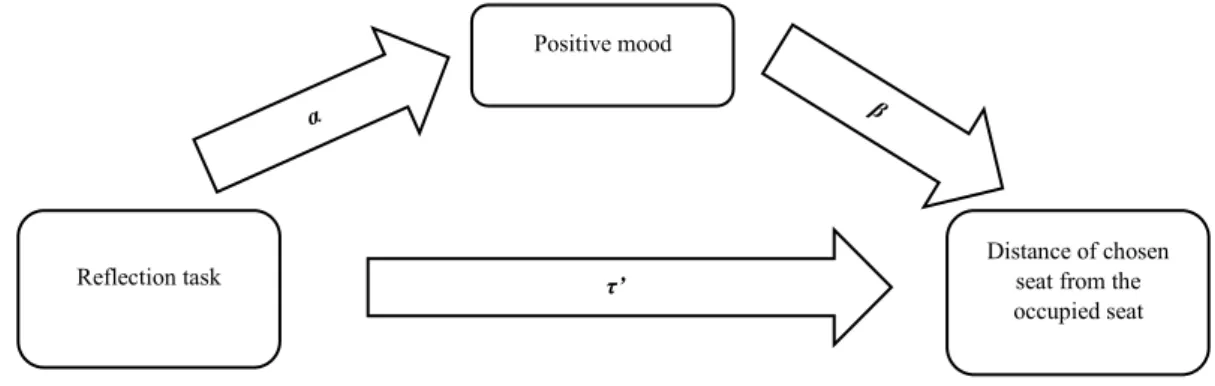
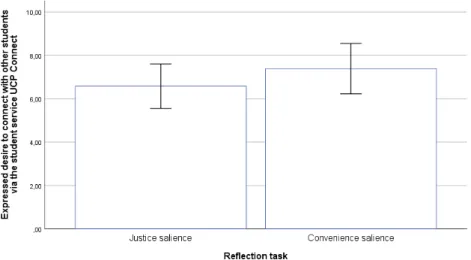
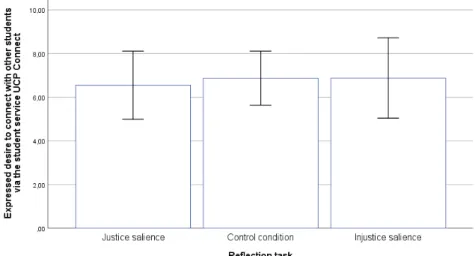
Figure 1: Occupied seat position: far left side vs far right side ... 21 Figure 2: Manipulation check ... 21 Figure 3: Histogram for distance of chosen seat from the occupied seat (n= 83) ... 24 Figure 4: Estimated marginal means for distance of chosen seat from the occupied seat per condition (Error bars: 95% C.I.) ... 26 Figure 5: Positive mood mediation model ... 27 Figure 6: Positive mood mediation analysis results ... 29 Figure 7: Average expressed desire to connect with other students via the student service UCP Connect, per condition (Error bars: 95% C.I.) - Study 2 ... 32 Figure 8: Average expressed desire to connect with other students via the student service UCP Connect, per condition (Error bars: 95% C.I.) - Study 3 ... 34
VIII LIST OF TABLES
Table 1: Descriptives for distance of chosen seat from the occupied seat ... 24 Table 2: Number of participants per condition ... 25 Table 3: Tests of between-subjects effects (dependent variable: distance of chosen seat from the occupied seat) ... 26 Table 4: Coefficients for dependent variable distance of chosen seat from the occupied seat 28 Table 5: Coefficients for dependent variable positive mood ... 28
IX ACKNOWLEDGMENTS
Being just, in many ways several people have contributed to the current thesis. First of all, I would like to refer Cláudia, my family and close friends, to whom I apologize for my absence during these last months. My advisor David L. Patient, I am very grateful for all your support and inspiring thoughts which have accompanied this thesis development, from its initial ideas to its ending lines. A special recognition to Sofia Murtinheira and Tatiana Marques for the assistance that made this work possible and to my friend João Croft de Moura for all discussions provided and materials developed. My sincere recognition extends to Professor Jon K. Maner for his generous sharing of the questionnaire used in two of this thesis studies.
Lastly but most of all, I would like to refer each one of the anonymous participants who made this work possible.
INTRODUCTION
In 2011, human population reached the milestone of seven billion. According to the United Nations (2018), by 2050 68,00% of people will live in urban areas. Paradoxically, modern urban community actors seem to be progressively distant from one another (Eurostat, 2018; Olson & Olson, 2000). This reality looks quite different from that faced by our ancestors, who subsisted in smaller communities grounded on face-to-face interactions (Carporael, 1997). In fact, humans have limitations when it comes to processing larger groups (Barrett, Dunbar, & Lycett, 2002). One of the aspects deeply connected with human cooperation and group living is justice and research shows that from an early age people are sensitive to it (Schmidt & Sommerville, 2011). According to De Cremer and Tyler (2005, p.152) (…) “procedural justice is key aspect of groups that defines the degree to which people within those groups will be motivated to engage in cooperation (…)”. In addition, justice appears to be engrained in the moral foundations of distinct cultures (Haidt & Joseph, 2007) with roots established prior to human self-consciousness (O’Manique, 2003).
As a fundamental variable for explaining human cooperation and behavior, the perceptions of fairness (Rupp, Shapiro, Folger, Skarlicki, & Shao, 2017) gave birth to an extensive body of research in the organizational arena, including predictors and consequences for individuals and their organizations performance (e.g., Colquitt, Conlon, Wesson, Porter, & Ng, 2001; Viswesvaran & Ones, 2002). Group-oriented conceptualizations of organizational justice assume that group members evaluate their social status, their membership plus develop their identities, based on perceptions of group’s procedural fairness (e.g., Tyler & Blader, 2003; Tyler & Lind, 1992). Thus, individuals’ interpersonal bonds with close ones are profoundly related with the justice phenomena. Nevertheless, a dimension capable of influencing the strengths of these ties is physical distance (William & Bargh, 2008). And though new technologies allow individuals to connect in diverse ways, “there are characteristics of face-to-face human interactions, particularly the space-time contexts in which such interactions take place, that the emerging technologies are either pragmatically or logically incapable of replicating” (Olson & Olson, 2000, p.140). For example, evidence suggest that trust among individuals can be negatively affected by electronic contexts (read distance) when compared to face-to-face interactions (Rocco, 1998). Justice may as well still need our close others.
“(…) Needs specify innate psychological nutriments that are essential for ongoing psychological growth, integrity, and well-being” (Deci & Ryan, 2000, p.229). Literature “In both its nasty and nurturing characters, it was always an interaction among individuals-in-community. The isolated life was and is a fiction devoid of meaning. Developing communities were relational and social” (O’Manique, 2003, p.113).
2 recognizes the need for belonging, to say the “need to form and maintain at least a minimum quantity of interpersonal relationships” (Baumeister & Leary, 1995, p.499), as humans’ core social motive (Fiske, 2000, 2002; Fiske & Fiske, 2007). Being fundamental to survival, automatic mechanisms have evolved to constantly monitor individuals’ inclusion levels within their groups (Leary, Tambor, Terdal, & Downs, 1995; Pickett, Gardner, & Knowles, 2004).
Past studies and theoretical models of organizational justice literature have suggested a close relationship between the need for belonging and justice perceptions (Cropanzano, Byrne, Bobocel, & Rupp, 2001; De Cremer & Blader, 2006). As well, just practices per se seem to be associated with proximity among people, with relational bonds development and group living. Contrarily, injustice and punishment appear to relate with increments in distance between individuals (consider for example imprisonment or exile) (Baumeister & Leary, 1995; Cropanzano, Bowen, & Gilliland, 2007). In addition, and in the domain of justice, evidences suggest that defendant proximity from the jury could positively influence decision-making in (mock) court settings (Winter, Daguna, & Matlock, 2018). Being so, does justice salience impel individuals to seek others’ proximity? Could the effect be explained by the influence of justice concerns on individuals’ motivation to develop interpersonal bonds? Thus, the current thesis aims to explore the impact of justice salience on individuals’ preferred physical distance and on individuals’ motivation to develop interpersonal bonds.
Academic and Managerial Relevance
All humans want to be valued as humans and are sensitive to the decision-making processes in groups to which they belong, including companies and other organizations (Kim & Mauborgne, 2003). Justice (and lack of) has been directly associated with several relevant outcomes, including performance (Bloom, 1999), turnover (Hendrix, Robbins, Miller, & Summers, 1999), commitment and job satisfaction (Viswesvaran & Ones, 2002). The current studies extend the contemporary literature by examining the influence of justice salience on individuals’ preferred physical distance and on individuals’ motivation to develop interpersonal bonds. From a managerial perspective, this line of research reinforces the importance of involving participants in organizational procedures, explaining outcome distribution criteria and developing relations. As well, given that group-oriented conceptualizations of organizational justice are mostly centered on intragroup dynamics, the current work is additionally relevant in aiming to evaluate if justice salience could impel individuals to reduce the physical distance existing among them, even prior to joining groups or in the absence of
3 group membership. Lastly, the current thesis (Study 1) proposes and tests a physical-distance measure that can be replicated in real settings; “The literature on procedural fairness often does not include behavioral reactions as part of the fairness construct (…)” (De Cremer & Tyler, p.155).
Problem Statement
Group-oriented conceptualizations of organizational justice highlight individuals’ continuous monitoring of group procedures for assessment of inclusion-related information (Tyler & Blader, 2003; Tyler & Lind, 1992); humans have developed cognitive mechanisms specially designed for that purpose (Leary et al., 1995; Pickett et al., 2004). With the objective of contributing to a better comprehension of the relationship between justice and group living (including participation in organizations), the current research focuses on understanding the impacts of justice salience on individuals’ preferred physical distance and on individuals’ motivation to develop interpersonal bonds.
Research Questions
If on the one hand, justice is deeply associated with cooperation, belonging and interpersonal bonds development (Cropanzano et al., 2001; De Cremer & Blader, 2006; De Cremer & Tyler, 2005; O’Manique, 2003), on the other hand the effect of physical-distance cues in the strength of relational ties has been documented (Williams & Bargh, 2008). Accordingly, in the current thesis, justice salience is hypothesized to impact negatively individuals’ preferred physical distance, thus inducing closeness. In addition, literature has suggested a proximal relationship between justice and need for belonging (Baumeister & Leary, 1995; Cropanzano et al., 2001; De Cremer & Blader, 2006), the humans’ core need (Fiske, 2000, 2002; Fiske & Fiske, 2007). Therefore, in the current thesis, justice salience is hypothesized to impact positively individuals’ motivation to develop interpersonal bonds. To the author’s knowledge, the direct impact of justice salience on individuals’ preferred physical distance and on individuals’ motivation to develop interpersonal bonds has not been previously investigated.
4 Methodology
Three experimental studies were conducted.
Study 1. Design: factorial design 2 x (reflection task: justice salience vs absent) 2 x (occupied seat position: far left side vs far right side). Dependent variable: distance of chosen seat from the occupied seat.
Study 2. Design: single-factor with two levels (reflection task: justice salience vs convenience salience (neutral control condition)) between-subjects design. Dependent variable: expressed desire to connect with other students via the student service UCP Connect, a fictitious service with the purpose of establishing connections among Universidade Católica Portuguesa students.
Study 3. Design: single-factor with three levels (reflection task: justice salience vs injustice salience vs control condition) between-subjects design. Dependent variable: expressed desire to connect with other students via the student service UCP Connect, a fictitious service with the purpose of establishing connections among Universidade Católica Portuguesa students.
Thesis Organization
A review of the relevant organizational justice literature is presented in the introductory section (What is Justice?). Within the contemporary integrative wave, group-oriented conceptualizations of organizational justice are described in more detail. Departing from different research backgrounds ranging from social and organizational psychology to morality literature and evolution, human general concern with justice and its group origins is discussed, in particularly the relationship between justice and human innate need for belonging. The literature review closes with the proposal of two hypotheses. In the subsequent sections (Study 1, Study 2 and Study 3, respectively), the three experimental studies are reported. All use variations of a reflection task adapted from Karremans and Van Lange (2005) in which participants are requested (or not) to reflect about the concept of justice. The dependent measures though vary across the three studies. In Study 1, individuals’ preferred physical distance was operationalized as the distance of chosen seat from the occupied seat, using a novel physical-distance measure. In Study 2 and Study 3, the motivation to develop
5 interpersonal bonds was operationalized as the expressed desire to connect with others via the student service UCP Connect, a measure adapted from Maner, DeWall, Baumeister and Schaller (2007). Results of each study follow each study method section respectively. Theoretical and practical implications of the current studies are presented in the General Discussion, including limitations and future research directions.
6 WHAT IS JUSTICE?
Defining Organizational Justice
“Let the oppressed man who has a cause come into the presence of my statue and read carefully my inscribed stele”; written concerns about justice can be traced back to Hammurabi’s code and its aim of assuring justice (Roberts, 2007, p.62). But justice was as well a topic of philosophical interest and debate in moral philosophy, from Plato to Aristotle. It continued through the work of thinkers such as Marx, Lock and Rawls (Colquitt, Greenberg, & Zapata-Phelan, 2005) and was conceptualized in several different forms: from natural law to consequence of the economic system or human virtue (Fortin & Fellenz, 2008 for a review) or as a moral foundation used by different cultures (Haidt & Joseph, 2007). The term justice is (and was) colloquially used as a synonymous of "oughtness" and "righteousness" (Colquitt et al., 2001).
Although earlier considerations of justice included a strongly normative perspective (prescriptive), dictating how people and societies should treat each other, formulate rules and allocate resources, it evolved to a social science aimed at understanding how judgments about those norms are made and how people react to their perceived violations (Cropanzano & Ambrose, 2015; Rupp et al., 2017). “Unlike the work of philosophers and attorneys, managerial scientists are less concerned with what is just and more concerned with what people believe to be just” (Cropanzano et al., 2007, p.35). Over time justice, fairness and ethics were brought to the forefront of debate (Viswesvaran & Ones, 2002). Even though, according to Byrne and Cropanzano (2001) and Colquitt et al. (2005) the concept of organizational justice was only advanced by Jerald Greenberg in A Taxonomy of Organizational Justice Theories of 1987, thus being a very recent topic within organizational behavior literature. In fact, most of the studies have been published since 1990 (Cohen-Charash & Spector, 2001). Applied to organizational context, Relative Deprivation is commonly considered the first theory of organizational justice (Virtanen & Elovainio, 2018). For Pettigrew (2015, p.12) and remaining loyal to Samuel Stouffer’s original conceptualization, relative deprivation is “a judgment that one or one’s ingroup is disadvantaged compared to a relevant referent and that this judgment invokes feelings of anger, resentment, and entitlement”.
7 According to Rupp et al. (2017, p.940) within the last 20 years most of organizational justice literature “defines organizational justice as employees’ perceptions of the fairness of outcomes, procedures, and interactions (measured collectively and indirectly via rule compliance)”. Colquitt et al. (2005) highlighted that the understanding of justice and fairness involves the comprehension of what individuals perceive to be fair. Similarly, for Byrne and Cropanzano (2001) organizational justice is a field of psychology that studies the perceptions of fairness within organizational contexts (workplaces). Cropanzano et al. (2007) go further by assuming that organizational justice is the glue allowing people to work together and the roots of relationship to employers, that contrast with the hurtful injustice, the “corrosive solvent that can dissolve bonds within the community” (p.34). For these authors, organizational justice is the evaluation of ethical and moral standing of managerial conduct made by individuals. Although the terms justice and fairness are commonly used interchangeably in the literature (Cohen-Charash & Spector, 2001), Colquitt and Rodell (2015, p.188) define justice “as the perceived adherence to rules that reflect appropriateness in decision contexts” and the downstream fairness as the “global perception of appropriateness”. According to Byrne and Cropanzano (2001, p.3) there are “few organizational practices that escaped scrutiny from the lens of organizational justice”.
A considerable body of literature have been developed regarding the impacts of justice on significant organizational variables such as job satisfaction, trust, turnover intentions, productivity or organizational citizenship behaviors (Cohen-Charash & Spector, 2001; Colquitt et al., 2001; Viswesvaran & Ones, 2002). For example, in the context of major league baseball, player and organizational performance has been negatively associated to higher levels of hierarchical pay dispersion (Bloom, 1999). As well, procedural justice (interpersonal treatment) was identified as an indirect predictor of commitment, attendance motivation and turnover, due to its relationship with intrinsic job satisfaction (Hendrix et al., 1999).
Although presenting different maturity stages, in the last decades, the diverse theoretical perspectives of organizational justice and their respective empirical research lines have been mostly focused on the predictors and consequences of two subjective perceptions (Colquitt et al., 2001): the fairness of outcome distributions (distributive justice) and the fairness of allocation procedures (procedural justice), including its interpersonal aspects (interactional justice). Colquitt et al. (2005) proposed three waves of the organizational justice theory, corresponding to investigations of the above three faces of justice. A fourth integrative wave
8 has moved beyond investigating specific types of justice, to exploring how justice judgments - of all three types - are formed. These different phases are briefly discussed below.
Distributive Justice. From the 1950s through the 1970s, the first wave of organizational justice research (Cohen-Charash & Spector, 2001; Colquitt et al., 2005) focused on the fairness of resource allocation. Distributive justice was originally based on Adams (1965), markedly influenced by Relative Deprivation, Social Exchange, Social Comparison and Cognitive Dissonance models (Rupp et al., 2017). Equity Theory assumes that individuals compare ratios of own perceived results and inputs with the ratios of referent others, which can be another person, what was promised or even themselves at another point in time. “These inputs, let us emphasize, are as perceived by their contributor and are not necessarily isomorphic with those perceived by the other party to the exchange. This suggests two conceptual distinct characteristics of inputs, recognition and relevance” (Adams, 1965, p.277). Problems of inequity are expected when the attribute owner is the only interaction partner recognizing its relevance for the exchange interaction or when other interaction partner considers the attribute irrelevant and reacts accordingly. That is, “inequity exists for Person whenever he perceives that the ratio of his outcomes to inputs and the ratio of Others’s outcomes to Others’s inputs are unequal” (Adams, 1965, p.280). Perceived inequalities lead to perceptions of injustice, which in turn results in psychological tension or distress. Since individuals are motivated to “balance the equation”, perceived injustice can prompt subjects to increase or decrease their individual inputs. Equitable outcomes are only achieved when the ratios (one’s own versus a referent) are in equilibrium (Adams, 1965; Byrne & Cropanzano, 2001; Cropanzano et al., 2007; Virtanen & Elovainio, 2018).
Distributive justice has been defined as the (perceived) fairness of the organizational outcomes themselves (Cohen-Charash & Spector, 2001; Viswesvaran & Ones, 2002). Even though equity (to each in accordance with his or her contribution) is usually considered the most appropriate allocation norm, depending on the context, organizational goal or personal motives, other norms may be understood as fair (Colquitt et al., 2001; Cropanzano et al., 2007). These are for example, equality or need (Deutsch, 1975; Leventhal, 1976). For integrating this perspective, “distributive justice has been defined as the degree to which the appropriate allocation norm is followed in a given decision-making context” (Colquitt, 2012, p.1).
Independently of the definition proposed, initial conceptions of organizational justice focused on results themselves. Employees were compensated with distinguished outcomes,
9 being individuals’ concerns related with receiving or not their fair portion (Cropanzano et al., 2007). Since the allocation of limited resources is a central aspect of organizational life, it is perhaps not surprising that the initial focus of organizational justice as a scientific field, has been on understanding how people judge and react to the allocations per se (Rupp et al., 2017). However, subsequent research on organizational justice has shown that outputs are not always as important to judgments of and reactions to fairness, as the process followed. These new views contrasted drastically with original organizational justice literature, highly influenced by Relative Deprivation Theory. “Outcome remained important, of course, but the interactions among individuals began to share the spotlight” (Byrne & Cropanzano, 2001, p.10).
Procedural Justice. The procedural justice wave began in the seventies and continued through the nineties of the 20th century, shifting the focus to the procedures involved in
determining outcomes. Greater perceived fairness is achieved when affected parties in dispute resolution procedures are given voice. The emergence of procedural justice is mostly due to the works of John Thibaut, Laurens Walker, Morton Deutsch and Gerald Leventhal. While comparing the Anglo-American legal system to its European counterpart, Thibaut and Walker (1975) concluded that disputants’ process control and voice in the former was the reason for it being regarded as more just than its European equivalent. Processes were perceived as fairer when disputants were given control over the process, in terms of being able to express their concerns and potentially influence their outcomes. In addition, Leventhal (1980) proposed six procedural rules that could influence the perceptions of fairness: (1) consistency, (2) bias-suppression, (3) accuracy, (4) correctability, (5) representativeness and (6) ethicality. In the same line, Deutsch (1975) called attention to alternative procedural rules such as equality; though appropriate for individual productivity, equity rule may be less effective in non-economic contexts as social relations (Cohen-Charash & Spector, 2001; Colquitt et al., 2005; Virtanen & Elovainio, 2018).
Even though procedural justice moved organizational justice research beyond examinations of outcome allocation rules, the relational side of procedures was still underexplored. Besides the decisions and processes followed, the interpersonal dynamic involved was then recognized as a potential influencer of individuals’ justice perceptions. That is, it became clear that people do not react only to distributive and procedural inputs but also to how just the interpersonal interactions were (Bies, 2001; Cunha, Rego, Cunha, & Cabral-Cardoso, 2004). In addition to the outcomes and procedures, interpersonal aspects of justice
10 were recognized in the third wave of organizational justice research, following seminal work by Robert Bies (Bies, 1987; Bies & Moag, 1986).
Interactional Justice. Interactional justice focused on the interpersonal side of organizational practices, in particular on the explanations and interpersonal treatment provided by managers to employees (Cohen-Charash & Spector, 2001). This wave of research proposes that individuals distinguish the fairness of formal procedures from the fairness of interpersonal interactions. These are recognized as influencing distinct attitudes and behaviors from individuals (Bies, 2001). In addition, interactional justice and procedural justice perceptions differ in their targets, with procedural justice reactions more focused on the organization and interactional justice reactions more targeted to the manager (Masterson, Lewis, Goldman, & Taylor, 2000).
Interactional justice is promoted when relevant authorities (1) communicate procedural details in a respectful and proper manner and (2) provide explanations that are sincere, timely and based on truthful information. The former reflects the degree of politeness, dignity and respect individuals receive from authorities and is sometimes referred to as interpersonal justice. The latter reflects the quality of information plus explanations provided and is sometimes referred to as informational justice (Cropanzano et al., 2007).
Although the distinction between distributive and procedural justice receives broad agreement within the literature (Cohen-Charash & Spector, 2001), with substantial unique variance associated with each (Viswesvaran & Ones, 2002), some authors consider interactional justice as an extension of procedural justice. According to Cunha et al. (2004), there is a tendency to over-evaluate distributive justice and to neglect the procedural and interactional facets, though one cannot understand peoples’ reactions without taking into consideration the three perspectives. In addition, according to Cropanzano et al. (2007), in order to effectively promote justice in the workplace it is useful to consider these different facets separately, as each one is developed through different activities from management. In the same line, the meta-analysis of Cohen-Charash and Spector (2001) identified distributive, procedural and interactional justice as strongly related, though as distinct constructs.
With the addition of interactional justice, the third wave of organizational justice was complete. Subsequently, research began to focus on developing models and theories that
11 combined the three original perspectives of justice. This constitutes the fourth and latest integrative wave (Colquitt et al., 2005).
Integrative Wave. Within contemporary models of organizational justice, three distinct theoretical currents can be identified: (1) counterfactual conceptualizations, (2) heuristic conceptualizations (3) and group-oriented conceptualizations of organizational justice. Counterfactual conceptualizations are mostly concerned with the what might have been cognitions of the person evaluating justice. In contrast, the heuristic conceptualizations focus their attention on the heuristics used by individuals in reaching justice judgments. Lastly, group-oriented conceptualizations approach justice “in terms of the importance of acceptance by (and identification with) the groups to which individuals belong” (Colquitt et al., 2005, p.39). These latter conceptualizations have recently been receiving considerable attention, as contemporary procedural justice research has more strongly focused on prosocial outcomes such as how to promote cooperation (Tyler & Blader, 2003). As well, social perception is traditionally understood as providing the foundation for social survival within one’s group (Fiske & Fiske, 2007).
In group-oriented conceptualizations of organizational justice, group membership is viewed as an important source of individuals’ sense of self-worth and identity. A group member who is fairly treated by his or her group is likely to have a more positive relationship with group’s authority and other group members (Tyler & Blader, 2003; Tyler & Lind, 1992). Within this theoretical current, three models have already been proposed: (1) the Group Value Model, (2) the Relational Model and (3) the Group Engagement Model.
Group Value Model. Individuals are particularly sensitive to their status within groups they belong to and to the treatment received from fellow group members. Procedural justice perceptions will depend on the impacts that procedures have on individuals’ feelings of self-worth and on their faith of group functioning. As cited by Tyler and Lind (1992) the Group Value Model of Lind and Tyler suggests that individuals evaluate procedures considering (1) their implications for group values and (2) the information they transmit regarding how a given justice recipient is seen within the group (status). Regarding the former, when procedures and interactions are in line with group fundamental values, fair treatment is assumed. Procedures are especially relevant because they are relatively stable over time and thus present in numerous interactions. Regarding the latter, the Group Value Model proposes that the quality of treatment
12 received is used by individuals to infer their position within the group and whether they are respected as full members. A procedure indicating positive full status membership is perceived as fair (Tyler & Lind, 1992). Since fair treatment is an informational source (relational) concerning individual’s value within his or her group, information received when interacting with authority figures is of added importance. “In particular, respectful treatment by a key group representative indicates whether other group members respect the person” (Smith, Tyler, Huo, Ortiz, & Lind, 1998, p.472).
Relational Model. More focused on the legitimacy of authority figure than the Group Value Model, the Relational Model (Tyler & Lind, 1992; Tyler, 1994) proposes as well that a given procedure is perceived as fair when carrying a message (expressed or symbolic) that the perceiver is a full member of the group administering the procedure. That is, procedures are fair when they offer assurance that individuals will not be excluded from full group membership nor diminished within their status hierarchy (Lind, Tyler, & Huo, 1997). In this sense, procedures provide information concerning to what extent a given individual is regarded as belonging to the group (De Cremer & Tyler, 2005). “(…) A key factor affecting legitimacy across a variety of settings is the person’s evaluation of the fairness of the procedures used by the authority in question” (Tyler & Lind, 1992, p.133). When a person believes that an authority figure considers him or her as a full member of the group, believes in the authority’s trustworthy intentions and believes in the authority’s neutrality, this person is likely to voluntarily comply. One should note that individuals are concerned with their relationship with authority for two reasons: (1) they care about the decision itself (consequences) and (2) they care about the symbolic side: their group and their position on it. Again here, this particular relationship is an indicator of the quality of one’s ties with the entire group (Lind et al., 1997; Tyler & Lind, 1992).
According to Tyler (1994, p.851), the fundamental proposition of the Relational Model “is that people are predisposed to belong to social groups and that they are very attentive to signs and symbols that communicate information about their position within groups. People want to understand, establish, and maintain social bonds”.
Group Engagement Model. The most recent theoretical model within group-oriented conceptualizations of organizational justice is the Group Engagement Model. It aims at explaining individuals’ engagement with groups and individuals cooperative behaviors
13 (Colquitt et al., 2005). For De Cremer and Tyler (2005), it has broadened the focus of procedural fairness models (group-oriented conceptualizations) by proposing a framework of the relationship between individuals and their groups. A core assumption of the model is the role of social identity in the engagement process. Tyler and Blader (2003) proposed that identity evaluations mediate the relationship between justice judgments and group engagement. Social identity is influenced by the processes and treatment individuals encounter in their group and will be then shaping their resulting judgments of procedural fairness. “(…) Because procedural justice communicates to them whether the group is likely to help them develop and maintain a satisfying, positive social identity” (Blader & Tyler, 2009, p.447), individuals will use the collected justice-related information to evaluate if a given group is a secure option.
The Different Faces of Organizational Justice - Concluding Remarks
Together with the group-oriented conceptualization of organizational justice, different perspectives have been presented regarding how organizational justice (and/or fairness) was conceived over the past five decades. Though marked by its initial normative influences, alternative perspectives, definitions and models have been advanced when experimental evidence underlined the importance of considering not only the rules involved in outcome distribution, but also the role of procedures and interactions in the perceptions of justice. That recognition made the field focus migrate from instrumental explanations to relational oriented perspectives. Today literature already recognizes that individuals not only reason about justice issues or procedures but also feel justice (Colquitt et al., 2013, for a review). Though in the end and apart from the perspective departed from, why do people care so much about justice? The same idea was expressed by De Cremer and Tyler (2005, p.158); “In effect, fairness can be considered one of the most important guidelines in our lives, leading both scholars and lay people to frequently pose the question (…)”. Departing from different theoretical backgrounds, the following section will be devoted to the origins of human concerns with justice.
Human Concerns with Justice and Group Living
15-month-old infants are already sensitive to fairness violations, looking longer at unfair versus impartial allocations made by third-party (Schmidt & Sommerville, 2011). This suggests a considerable influence of innate mechanisms on justice perceptions. As well, regardless of demographic characteristics such as age or gender, and across cultures, individuals tend to
14 perceive justice similarly (Cohen-Charash & Spector, 2001) just as implicitly using a lingua franca. In Moral Foundation Theory, the human preoccupation with fairness, reciprocity and justice (Graham, Haidt, & Nosek, 2009; Haidt & Joseph, 2007) is considered one of the five innate moral foundations widely present across human cultures.
Justice is frequently associated with doing the “right” thing (Colquitt et al., 2001); according to Sagan (1994,p.188):
Almost without exception, all human languages were formed on the basis of an internal polarity, a tendency to the right. The right is associated with legality, correct behavior, high moral principles, firmness and masculinity; the left with weakness, cowardice, lack of determination, evil, femininity. In English, for example, there are the expressions rectitude, rectify, righteous, right-hand man (in the sense of someone who is indispensable), dexterity, adroit (from the French à droite), rights, as in the expression rights of man and in the sentence in his right mind. Even ambidextrous means in the end, with two right hands1.
Although altruistic and uninterested moral concerns are possible reasons for human concerns with justice (Cropanzano et al., 2001), organizational justice theory has traditionally proposed two alternatives. First, according to the instrumental view, individuals are concerned with justice due to economic reasons, and motivated by procedures that protect present and future self-interest (Tyler, Degoey, & Smith, 1996). Second, according to the relational view, individuals are concerned with justice due to relational reasons, in particular to confirm their sense of self-worth and identity within valued groups (Cropanzano et al., 2001; Tyler & Lind, 1992), and use justice cues to evaluate their inclusionary status (group-oriented conceptualizations of organizational justice).
1 Original translation: Quase sem excepção, todas as linguagens humanas se formaram com base numa polaridade interna, numa tendência para a direita. A «direita» está associada à legalidade, ao comportamento correcto, a elevados princípios morais, à firmeza e à masculinidade; a «esquerda», à fraqueza, à cobardia, à falta de determinação, ao mal, à feminilidade. Em inglês, por exemplo, existem os termos rectitude («rectidão»), rectify («rectificador»), righteous («justo»), right-hand man («o braço direito» de uma pessoa, no sentido de alguém que lhe é indispensável), dextrety («destreza»), adroit («dextro», do francês à droite), rights («direitos»), como na expressão rights of man («direitos do homem») e na frase in his right mind («em pleno uso das suas faculdades»). Mesmo ambidextrous («ambidextro») significa, em última análise, com duas mãos direitas.
15 Independently of any instrumental-relational dichotomy, from an evolutionary perspective the mechanisms involved in the production of human sense of justice are assumed to have emerged slowly, through the modification of primitive mechanisms. Articulated with symbolic language, perspective taking, sophisticated forms of intelligence and capacities, it was later translated in moral judgments and norms. In the end, humans developed the ability for proposing ideal social systems, for reflecting over moral issues and ideal conceptions of justice (Krebs, 2008). For O’Manique (2003), the emergence of justice was deeply shaped by the prosocial versus proself conflict of social individuals, i.e., individuals within communities. This recognition attributes a great deal of importance to groups and communities for the emergence of justice reasoning. In fact, and differently from other species, humans use the social group as the basis for satisfying most of their survival needs (Stillman & Baumeister, 2009).
There are strong reasons for individuals to affiliate and cooperate; groups are better able to increase the survival of offspring through protecting members and sharing resources (Leary, 2010). According to Fiske (2000, p.305):
People need other people for survival. Over human history, being banished from the group has amounted to a death sentence. People’s evolutionary environment one might argue, is located in other people (not so much in the immediate savannah, forest, tundra, or jungle).
These predispositions to belonging and affiliation served not only individual interests but also group interests (Fiske, 2002). Thus, human cultures have adapted in ways that enable individuals to satisfy the psychological need of living in groups (Baumeister & Leary, 1995). Being universal and innate, the need for belonging - the need “to form and maintain at least a minimum quantity of interpersonal relationships” (Baumeister & Leary, 1995, p.499) - is recognized as humans’ most fundamental need. For Fiske (2000, 2002) and Fiske and Fiske (2007) BUCET Model2, it is from the need to gain social acceptance and avoid interpersonal
rejection that the remaining core social motives emerged. Similarly, Deci and Ryan (2000) proposed relatedness (the desire to feel connected to others - to love and care, and to be loved and cared for) as one of the three human universal needs. Individuals are inclusively assumed to possess cognitive tools specifically designed for monitoring their inclusion levels within groups (Leary et al., 1995; Pickett et al., 2004). Due to its relevance for survival, when a
16 person’s inclusionary status is threatened, individuals become more open to others, more attentive, more willing to conform and comply, more servile and friendly (Williams, 2009). For example, Maner et al. (2007) demonstrated that the experience of social exclusion elicits a desire for affiliation; when the need for belonging was thwarted individuals behaved in the direction of satisficing their need.
Taken together, the human obsession with fairness and affiliative predispositions combine well in group-oriented conceptualizations of organizational justice, where individual concerns with justice are associated with satisfying belonging and inclusion needs (De Cremer & Blader, 2006; De Cremer & Tyler, 2005; Tyler & Blader, 2003; Tyler & Lind, 1992). People are concerned with justice because they want to belong, they want to establish ties with fellow group members. As well, independently of whether allocations are by equity (“justice in due proportion of what each person deserves”), as in market pricing relations or by “what is mine is yours” norms of communal sharing relations, in Relational Models Theory (Fiske & Fiske, 2007), concerns about justice appear to presuppose the existence of a social relationship. In addition, the centrality attributed to belonging motives and the recognition that individuals are particularly sensitive to belonging cues as social survival determines physical survival (Fiske, 2000), goes side by side with the relevance attributed to procedural justice cues within group-oriented conceptualization of organizational justice; guarantee and monitor the acceptance by (and identification with) the groups to which individuals belong to. Thus, monitoring of fairness information can function as an inclusion maintenance tool (Van Prooijen, Van den Bos, & Wilke, 2004). De Cremer and Blader (2006) have demonstrated that individuals with higher need for belonging are more sensitive to procedural fairness information, and that need for belonging apart from the desire to affiliate, impacts individuals’ fairness evaluations. The relationships between voice and negative affect and between voice and organizational identification were stronger for individuals with higher need for belonging. In addition, higher need for belonging was associated with deeper processing of procedural fairness information. Thus, justice seems to be associated with a human motivation to develop interpersonal bonds.
Apart from this particular motivation, one might expect a relationship between physical distance and justice perceptions, regardless of justice being an abstract concept (Landau, Meier, & Keefer, 2010) and irrespective of distance associations with abstractness (Fujita, Henderson, Eng, Trope, & Liberman, 2006). For example, Cropanzano and colleagues’ (2001, p.177) Multiple Needs Model denotes that “(…) injustice tends to separate people from others, and
17 justice brings them closer together”. Justice as opposed to injustice is assumed to function as a social glue (read closeness) and as a promotor of interpersonal bonds (Cropanzano et al., 2007; Tyler, 1994; Tyler & Blader, 2003; Tyler & Lind, 1992). As well, many civilizations throughout history have associated justice violations with physical distance and exclusion (e.g., exile) and modern societies use imprisonment (physical isolation) for punishment (Baumeister & Leary, 1995). In addition, proximity has been associated with the strength of interpersonal ties, which seems to be relevant when one considers not only justice emergence within small and close relational communities (O’Manique, 2003) but also the role of procedural justice within group-oriented conceptualizations of organizational justice. Williams and Bargh (2008) reported that individuals primed with a sense of spatial distance as opposed to closeness have shown weaker bond to their close partners such as their siblings, parents or hometown. “Thus, people’s judgments of the strength of their emotional attachments to important aspects of their social world are directly influenced by simple physical-distance cues” (p.306). Therefore, as opposed to closeness, higher psychical distance would mean weaker bonds thus less concerns regarding the integrative value of procedural justice. That is, justice per se should be associated with proximity (lower physical distance).
In Jones, Freemon, and Goswick (1981) loneliness (read distance from others) has been shown to correlate with the belief that the world is an unjust place. In addition, while studying the relation between social distance and social reasoning in legal contexts, Winter et al. (2018) found evidence that spatial setups of courtrooms could affect decision-making. In particular, participants believed that defendants were more likely to win a dispute when the defendant table was closer to the jury box and further from the prosecutor’s table.
A Just World is a Closer Word?
In the previous sections, a relationship between justice and group living, including organizational life, has been established. Although remarkably important in complex contemporary societies as it has been throughout written history, justice initially emerged within small communities in order to respond to problems of cooperation. Justice seems to have innate bases, in addition to cultural influences (De Cremer & Tyler, 2005; Haidt & Joseph, 2007; Krebs, 2008; O’Manique, 2003; Schmidt & Sommerville, 2011). As well, the previous sections have shown strong connections between justice and human innate need for belonging or relatedness (Baumeister & Leary, 1995; Cropanzano et al., 2001; Deci & Ryan, 2000; De Cremer & Blader, 2006), understood as human’s core social motive (Fiske, 2000, 2002; Fiske
18 & Fiske, 2007). Within valued groups, individuals continuously monitor the fairness of decisions, procedures and relations, vigilant to signs regarding their inclusionary status (Leary et al., 1995; Pickett et al., 2004; Tyler & Blader, 2003; Tyler & Lind, 1992). Justice, belonging and favorable outcomes also have been shown to relate to physical proximity from others (Baumeister & Leary, 1995; Cropanzano et al., 2007; Winter et al., 2018). Taken together and considering human general sensitivity to relational value signs, thus processing such information very rapidly, automatically and often nonconsciously (Leary, 2010), it is expected that reflecting on justice (justice salience) (Karremans & Van Lange, 2005) will influence individuals’ preferred physical distance and individuals’ motivation to develop interpersonal bonds.
Overview of the Present Research. In Study 1, participants were asked (or not) to reflect about the concept of justice. Subjects were afterwards requested to indicate which seat they would choose for themselves in a seating area image containing a row with 8 seats, where one of these seats (at the extreme left or right) was signaled as occupied, using a human resembling cue. Reflecting about justice was hypothesized to negatively influence the distance of chosen seat from the occupied seat (decrease physical distance). That is, individuals reflecting about justice (justice salience) show a preference for decreasing physical distance from other humans (H1).
Following a similar procedure, in studies 2 and 3 participants’ motivation to develop interpersonal bonds, operationalized as expressed desire to connect with others via the student service UCP Connect, was evaluated after participants reflected (or not) on the concept of justice. In Study 2, participants in the neutral control condition reflected about the abstract concept of convenience. Study 3 used a reflection task factor with three levels: justice salience, injustice salience, or did not performing any reflection task (control condition). Independently of the study (2 and 3 respectively), when compared with the neutral control condition (convenience salience), injustice salience condition, or control condition, reflecting about justice (justice salience) was hypothesized to positively influence individuals expressed desire to connect with others via the student service UCP Connect; that is, justice salience positively influences individuals’ motivation to develop interpersonal bonds (H2).
19 STUDY 1
Method
Participants. A total of two hundred participants were invited to participate in an online decision-making experiment on Amazon’s Mechanical Turk (MTurk) and received 1$10 USD for their participation. The usage of Mturk for experimental purposes is increasing within organizational psychology. Some of the advantages of the platform are (1) the possibility of recruiting from several backgrounds and decrease oversampling, (2) reduced research time or (3) decreased costs (Cheung, Burns, Sinclair, & Sliter, 2017) and evidence suggests its adequate quality for research purposes (Henrich, Heine, & Norenzayan, 2010; Landers & Behrend, 2015). MTurk workers are mostly Americans, Indians and English speakers (Ipeirotis, 2010). For this reason, and according to Cheung et al. (2017), MTurk data collection may be most appropriate for testing research questions that are transversal to every culture or especially relevant for these nationals.
To participate in the current study, participants had to reside in the United States of America and hold a greater than or equal to 99,00% approval rating on past HITS (Human Intelligence Task) (Mturk options). These eligibility criteria were not communicated to potential participants. Using a factorial design 2 x (reflection task: justice salience vs absent) 2 x (occupied seat position: far left side vs far right side), participants were randomly assigned to one of four possible conditions. 35,50% of the participants were females and 64,50% were males. Participants’ average age was 34,48 years (SD= 11,68). 76,0% of the subjects reported currently residing in the United States of America, 21,0% in India and 3,0% in other countries (8 different countries in total were represented in the sample). Participants took on average 8,28 minutes (SD= 5,77) to complete the experiment.
Procedure. Participants were instructed that they were about to participate in two different studies. Following a procedure similar to Karremans and Van Lange (2005), in the first study, participants were either primed with justice or received no prime. In the justice salience treatments (two) subjects were initially told that researchers were aiming to better understand people's thoughts about the concept of justice. For that reason, participants were requested to reflect for a few moments on the concept of justice. They would be subsequently
20 asked to write down what had come to their mind while reflecting about this concept. A textbox was provided on the website where participants could indicate their thoughts (Appendix A). Participants in the reflection task absent treatments (two), did not perform this task.
As part of study one, and in order to control for potential differences in affect created by the manipulation, all participants completed the twenty items of Positive and Negative Affect Schedule (PANAS) (Watson, Clark, & Tellegen, 1988). On a scale from Very slightly or not at all to Extremely, participants indicated the extent to which they were experiencing each of the twenty emotions at the current moment. The items were randomly presented to all participants. In addition, and for quality control purposes of detecting and screening inattentive responses (Cheung et al., 2017), an additional item was included for which participants were instructed to select the option A little.
After PANAS completion, participants were introduced to study two. There researchers were interested in better understanding people’s preferences regarding different environments (Appendix B). Participants were told that a seating area with eight seats would be presented. Their task consisted of selecting a seating place among the seating places available at that moment. Subjects could indicate their choice by clicking their preference in the image. After the initial instructions, an image resembling a seating area containing an eight seats row was shown.
Only one preference could be indicated. The selection made was clearly signaled by a colored rectangle surrounding the selected seat. However, one of the eight seats could never be chosen. This seat was identified by a neutral colored jacket on the backrest (human resembling cue) (Figure 1). Depending on the treatment (occupied seat position: far left side vs far right side), this seat was either presented on the far left or on the far right of the image; literature suggests the relationship of justice concept with the right side (Colquitt et al., 2001; Sagan, 1994), although right-handers and left-handers implicitly associate positive valence more strongly with the side of space on which they could act more fluently with their dominant hand (Casasanto, 2009). The occupied seat position factor with two levels (far left side vs far right side) was introduced to address this possible confound.
21 Figure 1. Occupied seat position: far left side vs far right side
After task completion, participants responded to a manipulation check requesting for indicate which places had already been occupied in the seating area. If subjects perceived that none of the seats were occupied in advance, they were instructed to click on the label “All places were available” (Figure 2). The seating area task developed by the authors was inspired by Macrae, Bodenhausen, Milne and Jetten (1994).
Figure 2. Manipulation check
As part of study two, all participants completed then the Edinburgh Handedness Inventory (EHI), the most used inventory for evaluating manual handedness (Fazio, Coenen, & Denney, 2012; Oldfield, 1971; Veale, 2014). There participants were instructed to indicate their preferences in the use of hands (right or left hand) in ten different activities, on a scale ranging from Left++ to Right++. Where preferences were so strong that they would never try to use the other hand unless absolutely forced to, participants were instructed to select options ++ (Left or Right respectively). If participants felt that for a given activity they were equally likely to use right or left hand, they should select the option No Preference, an adaptation made for online data collection when compared to paper-and-pencil original versions of the EHI. Some of the activities referred to in the EHI required both hands. In these cases, it was specified in
22 brackets the activity for which hand preference was under evaluation. As with PANAS, EHI items were randomly presented for all participants. As well, and for quality control purposes (Cheung et al., 2017) an additional item was included that instructed participants to select option Left+.
After completing the EHI, participants were asked to indicate what they believed to be the true purpose of the experiment. None of the participants expressed a clear identification of the hypothesis under study. General demographic information (gender, age and country of residence) was collected. Participants were then thanked and instructions were given for receiving their payment.
Results
Initial analysis of the sample quality (N= 200) revealed that 13,50% of the participants (n= 27) failed to respond correctly the quality control items included within PANAS and EHI items, indicating inattentive responses. These participants were excluded from the following analysis. In addition, 50,87% of the remaining 173 subjects (n= 88) failed to respond correctly the manipulation check question thus leading to their exclusion. Finally, 4,71% (n= 4) of the lasting participants’ IP addresses were duplicated. Following Cheung et al. (2017) and although considering the possibility of identical IPs within the sample when different individuals from the same household completed the same HIT, equal IPs and similar demographic characteristics (age and gender) of two participants led to their exclusion. The remaining 83 participants were considered for the following analyses. 44,58% of these subjects were females and 55,42% were males. Their average age was 35,57 years (SD= 11,23). 91,57% of the participants resided in the United States of America, 4,82% in India and 3,61% in additional countries (5 different countries were in total represented). Participants took on average 8,13 minutes (SD= 6,40) to complete the experiment.
Positive and Negative Affect Schedule (PANAS). Positive affect and negative affect dimensions of PANAS were each assessed based on their respective ten items (Watson et al., 1988). Differences of positive affect subscale (Cronbach α= 0,91) between conditions (reflection task: justice salience vs absent) were evaluated using T-student test for independent samples. Its assumptions, namely normality distribution (Kolmogorov-Smirnov with Lillefors
23 correction (KS(35)Justice salience= 0,12; p= 0,20; KS(48)Absent= 0,07; p= 0,20)) and homogeneity
of variances (F(1, 81)= 1,60; p= 0,21), were verified. Participants in the justice salience treatments reported an average positive affect of 32,49 (SD= 7,67) while participants in the reflection task absent treatments reported an average positive affect of 27,88 (SD= 9,06). The differences observed were significant (T(81)= 2,44; p= 0,02; Cohen d= 0,54) and with a medium effect size (Maroco, 2007).
Regarding the negative affect subscale (α= 0,94) a similar analysis was performed. The assumptions for independent sample T-Student test usage, namely normality distribution (Kolmogorov-Smirnov with Lillefors correction (KS(35)Justice salience= 0,25; p= 0,00;
KS(48)Absent= 0,28; p= 0,00)) and homogeneity of variances (F(1, 81)= 0,01; p= 0,93) were
evaluated. T-student test robustness for violations of normal distribution assumption was considered in addition to the sample sizes in usage (central limit theorem). Participants in the justice salience treatments reported an average negative affect of 14,00 (SD= 6,04) while participants in the reflection task absent treatments reported an average negative affect of 13,52 (SD= 6,18). The differences observed were not significant (T(81)= 0,35; p= 0,73; Cohen d= 0,08).
Edinburgh Handedness Inventory. Participants’ mean Edinburgh Handedness Inventory laterality quotient (EHI LQ) was 68,59 (SD= 45,02). Using a 60 EHI LQ cut-off (Veale, 2014), 78,31% of the participants were classified as right-handed (n= 65) (LQ: [100 to 60[), 16,87% as ambiguous handed (n= 14) (LQ: [60 to 60-]), and 4,82% as left-handed (n= 4) (LQ: ]-60 to -100]). The distribution of participants per condition was independent of their lateral preference (χ2(6)= 3,26; p= 0,82; n= 83; using Montecarlo Simulation since (1) 80,00%
of Eij≥ 5 and (2) minimum expect count of 1 assumptions for χ2 test, were not verified).
Distance of Chosen Seat from the Occupied Seat. Independently of the factor occupied seat position level (far left side vs far right side), the distance of chosen seat from the occupied seat (number of seat) constituted the main dependent variable. Its amplitude range (A= 6,00) and interquartile amplitude (AIQ= 3,00) were evaluated. With KS(83)= 0,28; p= 0,00
the distance of chosen seat from the occupied seat did not present a normal distribution. Skewness analysis has shown a negative skew distribution (-0,90). Kurtosis values below -0,50 (-0,59, respectively) revealed a platykurtic distribution (Table 1) although with a pronounced mode (equal to 7,00) (Figure 3).
24 Table 1
Descriptives for distance of chosen seat from the occupied seat
Figure 3. Histogram for distance of chosen seat from the occupied seat (n= 83)
Coefficient variation of the dependent variable for the two levels of reflection task factor were CVJustice salience= 44,98% and CVAbsent= 29,41% respectively. The dispersion of results of
distance of chosen seat from the occupied seat was considerable higher for the justice salience level.
A Two-Way ANOVA was performed in order to evaluate if the reflection task and the occupied seat position factors significantly affected the average distance of chosen seat from the occupied seat. Participants’ frequencies in each condition defined by the intersection of both factors levels is presented on Table 2.
Statistic Mean 5,41 Median 6,00 Variance 3,88 Std. Deviation 1,97 Minimum 1,00 Maximum 7,00 Range 6,00 Interquartile Range 3,00 Skewness -0,90 Kurtosis -0,59
25 Table 2
Number of participants per condition
Occupied Seat Position
Far Left Side Far Right Side
Reflection Task Justice Salience 15 20
Absent 24 24
Total 39 44
Normal distribution assumption for the main dependent variable on each of the four conditions was not verified (KS1(24)= 0,36; p= 0,00; KS2(20)= 0,23; p= 0,01; KS3(15)= 0,24;
p= 0,02; KS4(24)= 0,28; p= 0,00) (Kolmogorov-Smirnov with Lillefors correction). With one
exception (p= 0,11), dependent measure transformation procedures (LN10) did not impact
significantly its distribution within treatments (KS1(24)= 0,33; p= 0,00; KS2(20)= 0,21; p= 0,02;
KS3(15)= 0,20; p= 0,11; KS4(24)= 0,31; p= 0,00). ANOVA robustness for violations of normal
distribution assumption was considered. The homogeneity of variances assumption was verified (F(3, 79)= 2,28; p= 0,09).
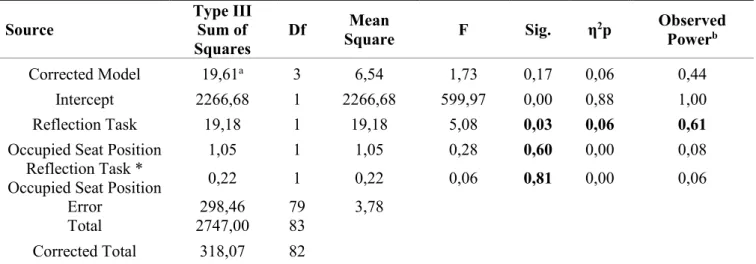
The analysis (Table 3) revealed that after taking into consideration the effect of factor occupied seat position, reflection task presented a significant effect of medium size (F(1, 79)= 5,08; p= 0,03; η2p= 0,06; Power= 0,61) over the average distance of chosen seat from the
occupied seat. Participants on the justice salience treatments (M= 4,86; SD= 2,18) presented a lower distance of chosen seat from the occupied seat when compared with the participants in the reflection task absent treatments (M= 5,81; SD= 1,71). On Figure 4 the results are represented graphically.
26 Table 3
Tests of between-subjects effects (dependent variable: distance of chosen seat from the occupied seat)
Source Type III Sum of
Squares Df
Mean
Square F Sig. η2p Observed Powerb
Corrected Model 19,61a 3 6,54 1,73 0,17 0,06 0,44
Intercept 2266,68 1 2266,68 599,97 0,00 0,88 1,00
Reflection Task 19,18 1 19,18 5,08 0,03 0,06 0,61
Occupied Seat Position 1,05 1 1,05 0,28 0,60 0,00 0,08
Reflection Task *
Occupied Seat Position 0,22 1 0,22 0,06 0,81 0,00 0,06
Error 298,46 79 3,78
Total 2747,00 83
Corrected Total 318,07 82
a. R Squared = 0,06 (Adjusted R Squared = 0,03) b. Computed using alpha = 0,05
Figure 4. Estimated marginal means for distance of chosen seat from the occupied seat per condition (Error bars: 95% C.I.)
The occupied seat position factor (far left side vs far right side) effect was not significant (p= 0,60) (Table 3). That is, after considering the effect of reflection task factor, the occupied seat position did not significantly influence the distance of chosen seat from the occupied seat (F(1, 79)= 0,28; p= 0,60; η2p= 0,00; Power= 0,08). Lastly, no significant interaction between