Késsia Hapuque Santos de Andrade
Licenciatura em Bioquímica na Faculdade de Ciências e
Tecnologia da Universidade Nova de Lisboa
Cyclopentenones: synthesis and
biological evaluation in human cancer
cells
Dissertação para obtenção do Grau de Mestre em
Química Bioorgânica
Orientador: Prof. Doutor Carlos Alberto Mateus Afonso,
Professor Catedrático, Faculdade de Farmácia da
Universidade de Lisboa
Co-orientador: Rafael Filipe Teixeira Arbuéz Gomes,
Investigador, Faculdade de Farmácia da Universidade de
Lisboa
Júri:
Presidente: Prof. DoutoraPaula Cristina de Sério Branco, FCT-UNL Arguente(s): Prof. Doutora Luísa Maria da Silva Pinto Ferreira, FCT-UNL
LOMBADA
Késsia Hapuque Santos de Andrade
Licenciatura em Bioquímica na Faculdade de Ciências e
Tecnologia da Universidade Nova de Lisboa
Cyclopentenones: synthesis and
biological evaluation in human cancer
cells
Dissertação para obtenção do Grau de Mestre em
Química Bioorgânica
Orientador: Prof. Doutor Carlos Alberto Mateus Afonso,
Professor Catedrático, Faculdade de Farmácia da
Universidade de Lisboa
Co-orientador: Rafael Filipe Teixeira Arbuéz Gomes,
Investigador, Faculdade de Farmácia da Universidade de
Lisboa
Júri:
Presidente: Prof. DoutoraPaula Cristina de Sério Branco, FCT-UNL Arguente(s): Prof. Doutora Luísa Maria da Silva Pinto Ferreira, FCT-UNL
Vogal(ais): Prof. Doutor Carlos Alberto Mateus Afonso, FF-UL
III
Outubro 2018
Cyclopentenones: synthesis and biological evaluation in human cancer cells
Késsia Hapuque Santos de Andrade, Copyright
A Faculdade de Ciências e Tecnologia e a Universidade Nova de Lisboa têm o direito, perpétuo e sem limites geográficos, de arquivar e publicar esta dissertação através de exemplares impressos reproduzidos em papel ou de forma digital, ou por outro qualquer meio conhecido ou
que venha a ser inventado e de divulgar através de repositórios científicos e de admitir a sua cópia e distribuição com objetivos educacionais ou de investigação, não comerciais, desde que
V
Agradecimentos
Primeiramente, deixo os meus mais sinceros agradecimentos a todos que contribuíram para o meu aprendizado e crescimento como química e para a realização desta dissertação.
Gostaria de expressar minha profunda gratidão:
Ao Professor Doutor Carlos Afonso pela oportunidade de trabalhar em seu laboratório, me recebendo e acolhendo de forma tão atenciosa, pelo apoio, supervisão científica, confiança e suporte durante esse ano.
À Professora Paula Branco, por me ter aceite no Mestrado em Química Bioorgânica, por me incentivar a tomar decisões importantes na minha vida académica e por me permitir alargar os meus conhecimentos.
Ao meu co-orientador Rafael Gomes por todo o suporte, ajuda, orientação e conhecimento em química orgânica que me transmitiu. Obrigada pela paciência, disponibilidade e encorajamento para comigo.
À Doutora Raquel Frade pela confiança em deixar em minhas mãos um trabalho que ela sempre realizou com excelência e por me ter me ter transmitido parte do seu conhecimento acerca de ensaios biológicos.
À todos os investigadores do laboratório de síntese orgânica e do grupo iMed pela amizade e o acolhimento, pela constante disponibilidade em me novas técnicas, ensinar-me a trabalhar com novos equipaensinar-mentos e partilharem comigo conheciensinar-mentos que muito ensinar-me fizeram crescer esse ano. Em especial ao Doutor Carlos Monteiro, Doutor Jaime Coelho, Doutora
Shrika Harjivan, Doutor Hélio Faustino, Doutora Filipa Siopa, Ricardo Lopes, João Ravasco, João António e Milene Fortunato.
À minha querida colega de mestrado Maria Beatriz Ferreira que esteve ao meu lado em todos os momentos durante esse ano, desde os mais divertidos aos mais tensos, me ajudando não só a crescer profissionalmente, mas também pessoalmente. Obrigada pela amizade e carinho comigo.
Ao meu colega de mestrado João Lopes pela partilha de conhecimentos, pela paciência e pelos momentos bem passados. À todos os meus colegas de mestrado que estiveram comigo esses dois anos nas aulas, nos congressos e nos tempos livres, e aos professores que deram o seu melhor para contribuírem com o meu crescimento académico.
À todos os meus amigos de vida académica, de vida escolar e pessoal, pela amizade, apoio, compreensão e encorajamento.
E um agradecimento muito especial à minha família, principalmente aos meus pais, meu irmão e minha avó, que sempre foram a minha base e motivação para seguir em frente. Serei grata por toda a minha vida pelo suporte, educação e o mais importante de todos: o amor que sempre me deram. Sem eles eu nunca chegaria até aqui.
VII
Resumo
Ciclopentenonas (CPs) são cetonas cíclicas cuja estrutura consiste num grupo carbonilo α,β-insaturado ligado a um anel. Muitos compostos que contêm o anel de ciclopentenona são biologicamente ativos, como por exemplo as prostaglandinas que apresentam propriedades antivirais, antiinflamatórias, antifúngicas, apoptóticas e antitumorais.
Foi demonstrado que a maioria dessas propriedades são devido ao caracter aceitador de Michael do grupo carbonilo α,β-insaturado que pode reagir com diversos nucleófilos. Um exemplo é a reação com Glutationa, que atua em mecanismos de desintoxicação, contribuindo positivamente para combater a resistência à medicamentos antitumorais. No entanto essa reatividade desses aceitadores de Michael os torna promíscuos à reações indesejadas com macromoléculas perigosas para as células.
Tendo por base essa promiscuidade, o nosso objetivo foi de sintetizar uma pequena biblioteca de compostos com pobre caracter aceitador de Michael e que apresentam citotoxicidade em células tumorais do colon retal, da mama e do pulmão. Sendo assim, preparamos diferentes CPs substituídas nas posições 2 e 4, baseando as nossas reações em métodos já descritos, inclusive pelo nosso grupo.
Dessas CPs, as 2-morfolino CPs e as 2-hidroxi CPs não formaram aductos com Glutationa por adição de Michael provando ser pobres aceitadoras de Michael e mostraram considerável atividade citotóxica contra as células tumorais testadas. Já a Trans-4,5-morfolino ciclopentenona formou aducto com Glutationa provando ser um ótimo aceitador de Michael ao mesmo tempo que não apresentou nenhuma actividade citotóxica.
Apesar do trabalho ainda estar em andamento podemos inferir que as CPs podem actuar por um mecanismo de ação diferente dos conhecidos por alquilação ao grupo carbonilo α,β -insaturado, e isso e um grande avanço no âmbito da química medicinal para a descoberta de novos fármacos com melhor desempenho contra o cancro e menores efeitos secundários.
IX
Abstract
Cyclopentenones (CPs) are cyclic ketones whose structure consists of an α, β -unsaturated carbonyl group attached to a membered ring. Many compounds which contain the cyclopentenone ring are biologically active, for example prostaglandins which have antiviral, anti-inflammatory, antifungal, apoptotic and antitumor properties
It has been shown that most of these properties are due to the Michael acceptor character of the α, β-unsaturated carbonyl, group which can react with various nucleophiles. An example is the reaction with Glutathione, which acts on detoxification mechanisms, contributing positively to combat resistance to antitumor drugs. However, this reactivity of these Michael acceptors makes them promiscuous to unwanted reactions with macromolecules critical to cells.
Based on this promiscuity, our goal was to synthesize a small library of compounds with poor Michael acceptor character and which have cytotoxicity in tumour cells of rectal colon, breast and lung. Thus, we prepared different substituted CPs in positions 2 and 4, basing our reactions on methods already described, including by our group.
From these synthesized CPs, 2-hydroxy-4-substituted CPs (with lower Michael acceptor character) showed considerable cytotoxic activity, while the others, showed no sufficiently cytotoxicity. The CP with a very good Michael acceptor character formed adducts with Glutathione in stability assays, while the 2-morpholine-4-substituted CPs (with lower Michael acceptor character) showed no formation of adducts with Glutathione.
Although the work is still in progress we can infer that CPs can act by a mechanism of action different from those known by alkylation to the α, β-unsaturated carbonyl group, and this is a great advance in the field of medicinal chemistry for the discovery of new drugs with better cancer performance and fewer side effects.
XI
Subject Index
Acknowledgements ... V
Resumo... VII
Abstract... IX
Subject Index... XI
Figure Index... IXX
Scheme Index ... XXIII
Table Index... XXVII
Graph Index... XXIX
List of Abbreviations ...XXXI
Chapter I – Introduction ... 1
1.1 - Medicinal Chemistry... 1
1.2 - Cancer, apoptosis and Multidrug resistance ... 3
1.3 - The Worldwide Problem of cancer... 5
1.4 - Cyclopentenones as antitumor agents ... 6
1.5 - Cyclopentenones Prostaglandins (CPPGs) ... 7
1.6 - The reaction with Reduced Glutathione (GSH) ... 9
1.7 -Promiscuity of Michael Acceptors ... 13
1.8 - Synthesis of diamino cyclopentenones ... 14
1.9 - Synthesis of 2,4-bifunctionalised cyclopentenones... 19
1.10 -Further functionalization of cyclopentenones... 21
Chapter II – Objectives... 23
Chapter III – Results and Discussion... 25
3.1 - Synthesis and Biological Assays... 25
3.1.1 - Trans-4,5-morpholine cyclopentenone... 25
3.1.2 - 2,4-bifunctionalised cyclopentenones... 28
3.2 - Stability Assays...45
Chapter IV – Conclusion and Future Work ...53
Chapter V – Experimental Part ... 55
5.1 - General methods ... 55
5.2 - General procedure for Trans-4,5-morpholine cyclopentenone synthesis ... 56
XIII
5.3.1 - 4-((4-fluorophenyl)thio)-2-morpholinocyclopent-2-en-1-one... 57
5.3.2 - 4-((4-chlorophenyl)thio)-2-morpholinocyclopent-2-en-1-one...58
5.3.3 - 4-((4-methoxyphenyl)thio)-2-morpholinocyclopent-2-en-1-one... 58
5.3.4 - 2-morpholino-4-(p-tolylthio)cyclopent-2-en-1-one... 59
5.3.5 - 4-methoxy-2-morpholinocyclopent-2-en-1-one... 59
5.4 - General procedure for hydroxy cyclopentenone’s synthesis... 60
5.4.1 - 4-((4-fluorophenyl)thio)-2-hydroxycyclopent-2-en-1-one...60
5.4.2 - 4-((4-chlorophenyl)thio)-2-hydroxycyclopent-2-en-1-one... 60
5.4.3 - 2-hydroxy-4-((4-methoxyphenyl)thio)cyclopent-2-en-1-one... 61
5.4.4 - 2-hydroxy-4-(p-tolylthio)cyclopent-2-en-1-one... 61
5.4.5 - General procedure for attempts of 4-((4-chlorophenyl)thio)-2-((4- methoxy-phenyl)diphenylmethoxy)cyclopent-2-en-1-one’s synthesis...61
5.5 - General procedure for amine cyclopentenone’s synthesis from hydroxy cyclopentenones...62
5.5.1 - 4-((4-chlorophenyl)thio)-2-(propylamino)cyclopent-2-en-1-one...62
5.5.2 - 4-((4-chlorophenyl)thio)-2-(pentylamino)cyclopent-2-en-1-one...62
5.5.3 - 2-(allylamino)-4-((4-chlorophenyl)thio)cyclopent-2-en-1-one...63
5.5.4 - 2-(benzylamino)-4-((4-chlorophenyl)thio)cyclopent-2-en-1-one...63
5.5.5 - methyl (3-((4-chlorophenyl)thio)-5-oxocyclopent-1-en-1-yl)glycinate...63
5.6 - General procedure for 4-((4-chlorophenyl)thio)-2-methoxycyclopent-2-en-1-one’ssynthesis... 64
5.7 - General procedure for (E)-4-((4-chlorophenyl)thio)-2-methoxycyclopent-2-en-1-one O benzyl oxime... 65
5.8 - General procedure for the attempts of 4-((4-chlorophenyl)thio)-2-((4-methoxyphenyl)diphenylmethoxy)cyclopent-2-en-1-one’s synthesis... 65
5.8.1 – First Attempt...65
5.8.2 – Second Attempt...66
5.8.3 – Third Attempt...67
5.9 - Cytotoxicity assays in human cell lines ...67
5.10 - Stability assays with Glutathione...69
Chapter VI –References ...71
Chapter VII – Attachment ………….………..………..………..………79
Appendix 7.1 - 1H NMR spectra at 300MHz in CDCl3 of trans -4,5-dimorpholinocyclopent-2-en-1-one... 79
Appendix 7.2 - 13C NMR spectra at 100MHz in CDCl3 of trans -4,5-dimorpholinocclopent-2-en-1-one…...80
XV
Appendix 7.4 - 13C NMR spectra at 100MHz in CDCl3 of
4-((4-fluorophenyl)thio)-2-morpholinocyclopent-2-en-1-one…...81
Appendix 7.5 - 1H NMR spectra at 300MHz in CDCl3 of
4-((4-chlorophenyl)thio)-2-morpholinocyclopent-2-en-1-one…...82
Appendix 7.6 - .13C NMR spectra at 100MHz in CDCl3 of
4-((4-chlorophenyl)thio)-2-morpholinocyclopent-2-en-1-one …...82
Appendix 7.7 - 1H NMR spectra at 300MHz in CDCl3 of
4-((4-methoxyphenyl)thio)-2-morpholinocyclopent-2-en-1-one …...83
Appendix 7.8 - 13C NMR spectra at 100MHz in CDCl3 of
4-((4-methoxyphenyl)thio)-2-morpholinocyclopent-2-en-1-one …...83
Appendix 7.9 - 1H NMR spectra at 300MHz in CDCl3 of
2-morpholino-4-(p-tolylthio)cyclopent-2-en-1-one...84
Appendix7.10 -13C NMR spectra at 100MHz in CDCl3 of
2-morpholino-4-(p-tolylthio)cyclopent-2-en-1-one…...84
Appendix7.11 - 1H NMR spectra at 300MHz in CDCl3 of
4-methoxy-2-morpholinocyclopent-2-en-1-one …...85
Appendix7.12 - 13C NMR spectra at 100MHz in CDCl3 of
4-methoxy-2-morpholinocyclopent-2-en-1-one…...85
Appendix7.13 -1H NMR spectra at 300MHz in CDCl3 of
4-((4-chlorophenyl)thio)-2-hydroxycyclopent-2-en-1-one …...86
Appendix 7.14 - 13C NMR spectra at 100MHz in CDCl3 of
4-((4-chlorophenyl)thio)-2-hydroxycyclopent-2-en-1-one…...86
Appendix 7.15 - 1H NMR spectra at 300MHz in CDCl3 of
4-((4-fluorophenyl)thio)-2-hydroxycyclopent-2-en-1-one…...87
Appendix 7.16 - 13C NMR spectra at 100MHz in CDCl3 of
4-((4-fluorophenyl)thio)-2-hydroxycyclopent-2-en-1-one…...87
Appendix7.17 - 1H NMR spectra at 300MHz in CDCl3 of
2-hydroxy-4-(p-tolylthio)cyclopent-2-en-1-one …...88
Appendix7.18 -13C NMR spectra at 100MHz in CDCl3 of
2-hydroxy-4-(p-tolylthio)cyclopent-2-en-1-one …...88
Appendix 7.19 - 1H NMR spectra at 300MHz in CDCl3 of
4-((4-chlorophenyl)thio)-2-(propylamino)cyclopent-2-en-1-one…...89
Appendix 7.20 - 13C NMR spectra at 100MHz in CDCl3 of
4-((4-chlorophenyl)thio)-2-(propylamino)cyclopent-2-en-1-one…...89
Appendix 7.21 - 1H NMR spectra at 300MHz in CDCl3 of
4-((4-chlorophenyl)thio)-2-(pentylamino)cyclopent-2-en-1-one …...90
Appendix 7.22 - 13C NMR spectra at 100MHz in CDCl3 of
4-((4-chlorophenyl)thio)-2-(pentylamino)cyclopent-2-en-1-one …...90
Appendix 7.23 - 1H NMR spectra at 300MHz in CDCl3 of
2-(allylamino)-4-((4-chlorophenyl)thio)cyclopent-2-en-1-one …...91
Appendix 7.24 - 13C NMR spectra at 100MHz in CDCl3 of
XVII
Appendix 7.25 - 1H NMR spectra at 300MHz in CDCl3 of
2-(benzylamino)-4-((4-chlorophenyl)thio)cyclopent-2-en-1-one…...92
Appendix 7.26 - 13C NMR spectra at 100MHz in CDCl3 of
2-(benzylamino)-4-((4-chlorophenyl)thio)cyclopent-2-en-1-one…...92
Appendix 7.27 - 1H NMR spectra at 300MHz in CDCl3 of methyl
(3-((4-chlorophenyl)thio)-5-oxocyclopent-1-en-1-yl)glycinate…...93
Appendix 7.28 - 13C NMR spectra at 100MHz in CDCl3 of methyl
(3-((4-chlorophenyl)thio)-5-oxocyclopent-1-en-1-yl)glycinate…...93
Appendix 7.29 - 1H NMR spectra at 300MHz in CDCl3 of
4-((4-chlorophenyl)thio)-2-methoxycyclopent-2-en-1-one’s …...94
Appendix 7.30 - 13C NMR spectra at 100MHz in CDCl3 of
4-((4-chlorophenyl)thio)-2-methoxycyclopent-2-en-1-one’s …...94
Appendix 7.31 - 1H NMR spectra at 300MHz in CDCl3 of
E)-4-((4-chlorophenyl)thio)-2-methoxycyclopent-2-en-1-one O-benzyl oxime…...95
Appendix 7.32 - 13C NMR spectra at 100MHz in CDCl3 of
XVIII
Index of figures
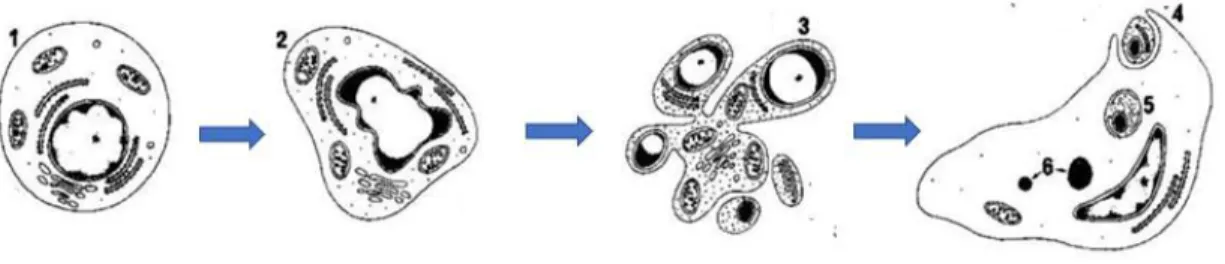
Figure 1.1- Examples of natural occurring bioactive molecules: (a) morphine from opium; b) quinine from the bark of the cinchon; c) cocaine from coca leaves……...… 2 Figure 1.2 - Diagram illustrating sequence of ultrastructural changes in apoptosis. (1) Normal cell.
(2) Early apoptosis characterized by compaction of chromatin, condensation of cytoplasm, and convolution of nuclear and cell outlines. (3) The nucleus fragments and protuberances formed, separate to produce apoptotic bodies. (4, 5, 6) These bodies are phagocytosed by nearby cells and degraded within lysosomes. Adapted from Kerr, J.F.R. et al, Cancer, 1994, 73 (8).7…….………..…. 3
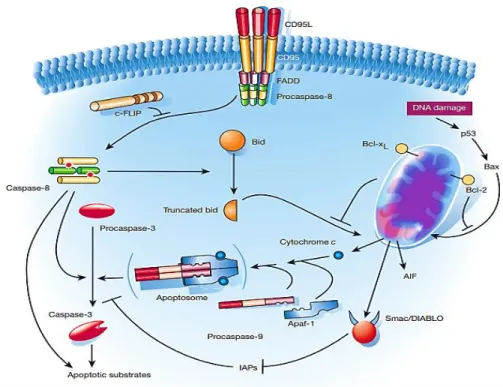
Figure 1.3- Example of two major apoptotic pathways in mammalian cells. Both culminate at the
cleavage of apoptotic substrates. The left is death-receptor pathway where the caspase-8 are activated by induced proximity and the right is the mitochondrial pathway used extensively in response to extracellular cues and internal insults such as DNA damage where cascase-3 are activated by different ways. Reproduced from Budihardjo, I. et al, Annu. Rev. Cell Dev. Biol., 1999, 15.9.…….………..….. 4
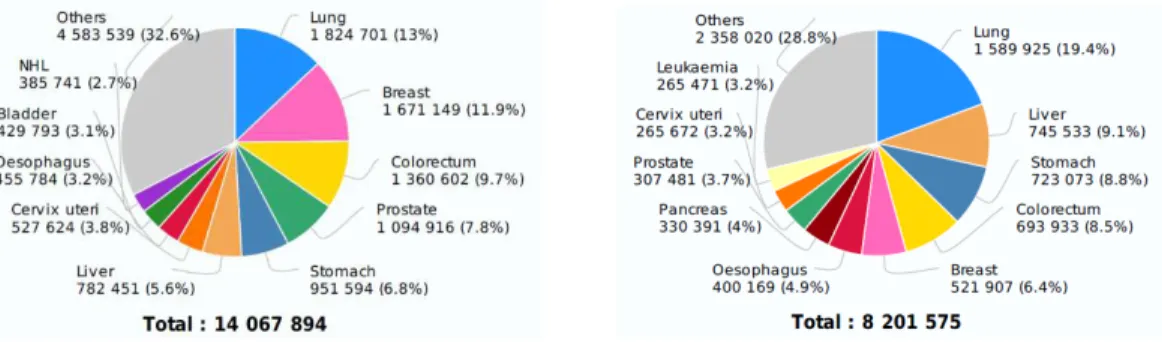
Figure 1.4- At left are represented the estimated number of incident cancer cases, both sexes,
all ages, worldwide (top 10 cancer sites) in 2012, and at right the estimated number of deaths by cancer, both sexes, all ages, worldwide (top 10 cancer sites) in 2012. Reproduced from: GLOBOCAN 2012, Global Cancer Observatory, International Agency for Research on Cancer 2018.17......…....5
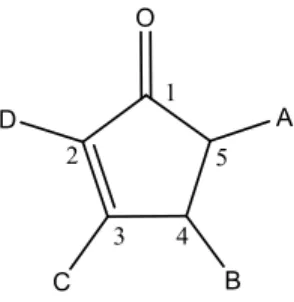
Figure 1.5- 5-membered ring structure of CP ………...……….…… 6
Figure 1.6- Generation of cyclopentenone prostaglandins in the metabolism context. Adapted
from Garzon, B. et al, J Proteomics, 2011, 74.95……….7
Figure 3.1 - NMR spectra of trans-4,5-dimorpholinocyclopent-2-en-1-one ………..….27 Figure 3.2- NMR spectra of 4-((4-chlorophenyl)thio)-2-morpholinocyclopent-2-en-1-one……..30
Figure 3.3 - NMR spectra of 2-hydroxy-4-(p-tolylthio)cyclopent-2-en-1-one ……….….. 36
Figure 3.4 - Comparison of chemical shifts in NMR spectra of same proton by two different
compounds……….….………. 36
Figure 3.5 - NMR spectrum of (4R,5S)-4,5-dimorpholinocyclopent-2-en-1-one in Plasma Solution
……….………...46
Figure 3.6- NMR spectrum of (4R,5S)-4,5-dimorpholinocyclopent-2-en-1-one in GSH Solution
after 5 minutes: formation of an intermediate ………....….46
Figure 3.7 - NMR spectrum of (4R,5S)-4,5-dimorpholinocyclopent-2-en-1-one in GSH Solution
after 5 minutes: formation of an adduct with GSH by Michael Addition …….….….. 47
Figure 3.8 - NMR spectrum of 4-((4-chlorophenyl)thio)-2-morpholinocyclopent-2-en-1-one in
Plasma Solution ………..…….….….. 48
Figure 3.9 - Figure 3.9. - NMR spectrum of
4-((4-chlorophenyl)thio)-2-morpholinocyclopent-2-en-1-one in GSH Solution after 5 minutes: 20% of formation of an adduct with
GSH…….….………. 49
Figure 3.10 - NMR spectrum of 4-((4-hlorophenyl)thio)-2-hydroxycyclopent-2-en-1-one in Plasma
Solution………..……... 50
Figure 3.7 - NMR spectrum of 4-((4-hlorophenyl)thio)-2-hydroxycyclopent-2-en-1-one in GSH
XX
Figure 5.1 - Procedure of incubation, count and seeded of the cells ……… 68
Figure 5.2 - Procedure of incubation of compounds with the cells…….……… 68
XXII
Scheme Index
Scheme 1.1 Alkylation of PGs by thiol molecules……….9
Scheme 1.2Reaction of methylglioxal detoxification………..…..….10
Scheme 1.3 - Reaction of COMC and GSH to form adduct GSMC ………11
Scheme 1.4 – Proposed mechanism of the hight reactive enone formation and possible adducts formations from the enone ……….………..…11
Scheme 1.5 - Retrosynthesis of Agelastatin A lead to trans-4,5-diamine cyclopentenones…...14
Scheme 1.6– First total synthesis reported for Agelastatin A………..15
Scheme 1.7– Synthesis of trans-4,5-diamino cyclopentenones from furfural and anilines. Lewis
et almethod……….………...….16
Scheme 1.8 - Trans-4,5-diamine cyclopentenones from furfural and secondary amines. Li and
Batey Method………....………...16
Scheme 1.9 - Proposed mechanism for trans-4,5-diamine cyclopentenones synthesis by Li and
Batey………...………..…17
Scheme 1.10 - Bickley’s methody for thiols addition to cyclopentenones ...…..……19
Scheme 1.11 - Synthesis of 2,4-bifunctionalised cyclopentenones by a one-step reaction ...…20
Scheme 1.12 - Proposed mechanism for the synthesis of 2,4-bifunctionalised cyclopentenones
………..……….20
Scheme 1.13 - Illustration of the reactions of 2,4-amino-thio cyclopentenones towards
electro-philes, nucleophiles and acids………..21
Scheme 1.14 - Reaction into hydroxyl-CP and primary amines ………. 21
Scheme 2.1 - Illustration of this work reactions……….……….23
Scheme 3.1 - Proposed mechanism for trans-4,5-morpholine cyclopentenone from furfural and
morpholine ………..26
Scheme 3.2 - Proposed mechanism for the synthesis of 2,4-bifunctionalised cyclopentenones
from trans-4,5-morpholine cyclopentenone ………..… 29 Scheme 3.3 - Above, the generic scheme for the synthesis of 2-morpholine-4-substituted CP in
MeOH at basic conditions. Below, the molecular structures of 2,4-bifunctionalised cyclopentenones synthetized………...….29
Scheme 3.4 - Unsuccessful attempts of 2,4-bifunctionalised cyclopentenones synthesis….….31
Scheme 3.5 - Proposed mechanism for the synthesis of 2-hydroxy-4-substituted-CPs
2-thio-4-morpholine CP……….………... 33
Scheme 3.6 - Keto-enolic tautomerism of 2-hydroxy-4-substituted-CPs …….……….….34
XXIV
Scheme 3.8 - Above, the generic scheme for the synthesis of 2-hydroxy-4-substituted CP in
MeOH: H2O under acidic conditions. Below, the molecular structures of 2-hydroxy-4-substituted-CPs synthetized. ………35
Scheme 3.9 - Compounds previously synthetized and their IC50. ……….…….…39
Scheme 3.10 - Proposed mechanism for
4-((4-chlorophenyl)thio)-2-((4-methoxyphenyl)diphe-nylmethoxy)cyclopent-2-en-1-one synthesis ..………...40
Scheme 3.11 - Above, the generic scheme for the synthesis of amine CPs from
2-hydroxy-4-substituted CPs in MeCN under acidic
conditions..………...42
Scheme 3.12 - Proposed mechanism for amines CPs synthesis CPs from
2-hydroxy-4-substituted CP..………...43
Scheme 3.13 - The scheme for the synthesis of
4-((4-chlorophenyl)thio)-2-morpholinocyclopent-2-en-1-one..………..………...43
Scheme 3.14 - Proposed mechanism for 2-methoxy-4-substituted CP’
synthesis..……….………...43
Scheme 3.15 - The generic scheme for the synthesis of
(Z)-4-((4-chlorophenyl)thio)-2-methoxycyclopent-2- en-1-one O-benzyl
oxime..………...…...44
Scheme 3.16 - Proposed mechanism for oxime formation..………...44
Scheme 3.17 - General Scheme of formation of an adduct with GSH by Michael
Addition..………...47
Scheme 3.18 - General scheme for the formation of
N5-((2R)-1-((carboxymethyl)amino)-3-((3-((4-chlorophenyl)thio)-5-oxocyclopent-1-en-1-yl)thio)-1-oxopropan-2-yl)-D-glutamine 99 from 47..………...………...49
Scheme 3.19 - General scheme for the formation of
N5-((2R)-1-((carboxymethyl)amino)-3-((3-((4-chlorophenyl)thio)-5-oxocyclopent-1-en-1-yl)thio)-1-oxopropan-2-yl)-D-glutamine 99 from 64..………...………...51
Scheme 5.1 - First attempt to the synthesis of
4-((4-chlorophenyl)thio)-2-((4-methoxyphe-nyl)diphenylmethoxy)cyclopent-2-en-1-one in DCM ,at basic conditions, catalyzed by
DMAP………...………….66
Scheme 5.2 - First attempt to the synthesis of
4-((4-chlorophenyl)thio)-2-((4-methoxyphe-nyl)diphenylmethoxy)cyclopent-2-en-1-one in THF ,at basic conditions. ………….66
Scheme 5.3 - First attempt to the synthesis of
4-((4-chlorophenyl)thio)-2-((4-methoxyphe-nyl)diphenylmethoxy)cyclopent-2-en-1-one in DCM ,at basic conditions, catalyzed by
XXVI
Table Index
Table 1 - Reported methods for the preparation of 4,5-diamino-CPs basing in Li and Batey
Method ……….……….……….……….………18
Table 2 - Unsuccessful attempts for
4-((4-chlorophenyl)thio)-2-((4-methoxyphenyl)diphenylme-thoxy)cyclopent-2-en-1-one synthesis……….………...…41
XXVIII
Graph Index
Graph 3.1 - Values of cellular viability obtained after exposure of the MCF-7, HT-29 and NCI-
H460 tumour cells to trans- 4,5-morpholine cyclopentenone at 20 µM, for a period of 48 hours. Viability was determined with the Neutral Red reagent and the experimental points represented are the mean of 3 replicates per experimental condition and the experimental error is the standard deviation………..………..28
Graph 3.2 - Values of cellular viability obtained after exposure of the HT-29 colon tumour cells to
2-thio-4-morpholine cyclopentenones at 20 µM, for a period of 48 hours. Viability was determined with the Neutral Red reagent and the experimental points represented are the mean of 3 replicates per experimental condition and the error experimental is the standard deviation………...………...….32
Graph 3.3 - Values of cellular viability obtained after exposure of the NCI-H460 lung tumour cells
to 2-thio-4-morpholine cyclopentenones at 20 µM, for a period of 48 hours. Viability was determined with the Neutral Red reagent and the experimental points represented are the mean of 3 replicates per experimental condition and the error experimental is the standard deviation ………..……… 32
Graph 3.4 - Values of cellular viability obtained after exposure of the MCF-7 breast tumour cells
to 2-thio-4-morpholine cyclopentenones at 20 µM, for a period of 48 hours. Viability was determined with the Neutral Red reagent and the experimental points represented are the mean of 3 replicates per experimental condition and the error experimental is the
standard deviation
………..….… 33
Graph 3.5 - Values of cellular viability obtained after exposure of the HT-29 colon tumour cells to
2-hydroxy-4-substituted-CPs at 20 µM, for a period of 48 hours. Viability was determined with the Neutral Red reagent and the experimental points represented are the mean of 3 replicates per experimental condition and the error experimental is the standard deviation
………...……37
Graph 3.6– Linear correlation into the cellular viability values of 2-hydroxy-4-substituted-CPs at 20 μM for HT-29 colon tumour cells and σ value of each substituent
………... 38
Graph 3.7 - Values of cellular viability obtained after exposure of the HT-29 colon tumour cells to
2-hydroxy-4-substituted-CPs at 20 µM, 40 µM, 60 µM , 80 µM and 100 µM for a period of 48 hours. Viability was determined with the Neutral Red
XXX
List of Abbreviations
ACN – Acetonitrile
BHK-2 – baby Hamster Kidney Cells
Boc – tert-butyloxycarbonyl protecting group CAN –Ceric ammonium nitrate
CP – Cyclopentenone
CPPGs – Cyclopentenone Prostaglandines COMC – 2-Crotonyloxymethyl-2-cyclohexenone
COTC – -(4R, 5R, 6R)-4,5,6-trihydroxy-2-cyclohexenone DBU – 1,8-Diazabicyclo[5.4.0]undec-7-ene
DMAP – 4-Dimetilaminopiridina DMF – Dimethylformamide DMSO – Dimethyl Sulfoxide DNA – Deoxyribonucleic acid
EtOAc – Ethyl Acetate
E1cB – Elimination Unimolecular conjugate Base Glo-I – glyoxalase I
GSH – Glutathione
GST – Glutathione S-transferase
HPLC – High Performance Liquid Chromatography IGF-1 – Insuline Like Grownt Factor 1
IKK-β– Nuclear Factor Kappa B
IUPAC – International Union of Pure and Applied Chemistry JNK – c-Jun N-terminal kinases
KOtBu – Potassium Tert-butoxide
LA – Lewis Acid
XXXII
NBS – N-Bromosuccinimide NF-κB – factor nuclear kappa B
NMR – Nuclear Magnetic Resonance PDC – Pyridinium Dichromate PGs – Prostaglandins
PTSA monohydrate – p-Toluenesulfonic Acid Monohydrate
RPMI medium – Roswel Park Memorial Institute medium TEA – Triethylamine
TFA – Trifluoroacetic acid
TLC – Thin Layer Chromatography
TMS – Tetramethylsilane
Traf-2 – Tumor Necrosis factor receptor associated factor SAR – Structure Activities Relationships
SES – 2-(Trimethylsilyl)ethanesulfonyl
1
Introduction
1.1.
Medicinal Chemistry
The medicinal chemistry is an interdisciplinary science concerned on “the discovery, the development, the identification and the interpretation of the mode of action of biologically active compounds at the molecular level” (IUPAC). In general, encompasses a combination of chemistry (synthetic organic chemistry and computational chemistry) and biological sciences (molecular biology, biochemistry, enzymology, pharmacology, veterinary and human medicine, and toxicology).1
The synthetic organic chemistry is focused on the design and synthesis of new therapeutic agents (using natural products or commercially available molecules as starting material) through novel chemical reactions and on the optimization of these reactions such as: 1) reaction selectivity; 2) energy required; 3) yield; 4) reaction times; 5) costs; 6) safer conditions; 7) minimize the environmental impact.
The computational chemistry uses theoretical chemistry and computer simulation methods to solve chemical problems and understand Structure Activities Relationships (SAR).
Biological Sciences study the biological response to the novel molecules and their mechanism, using a wide range of methodologies according to the purpose.2
From ancient times, human beings strive to discover the cure of diseases that affect them. Before the twentieth century, they used to treat diseases by rudimentary techniques such the use of medicinal herbs and potions, but the medicinal chemistry born in the mid-nineteenth century with the first serious efforts to isolate and purify the pure chemicals responsible for the medicinal properties (active principles) of remedies. Since then, it is possible to obtain many naturally occurring drugs and determine their structures (Figure 1.1.). 2,3 Nowadays, with the advances in chemical and biological
2
sciences it's possible to understand better body functions at cellular and molecular level, and discover, design and develop drugs that can combat many diseases.
One important group of diseases that have been extensively studied by the scientific community is Cancer.
3
1.2.
Cancer, apoptosis and Multidrug resistance
Cancer is a generic term for a group of diseases characterized by the uncontrolled division of abnormal cells, which cannot suffer apoptosis and may invade adjacent parts of the body and spread to other organs.
Environmental influences, dietary influences and genetic polymorphisms are the factors that most contribute to the development of cancer. The latter involves the alteration or deletion of genes such as oncogenes, tumour suppressor genes, DNA repair genes and genes encoding phase I and phase II enzymes.4,6
The apoptosis is an essential physiological process of regulated destruction of cells, being important for cell migration and cell division, for the maintenance of tissue homeostasis.7
Morphologically, the process involves rapid cell condensation followed by formation of membrane-enclosed apoptotic bodies containing well-preserved organelles, which are phagocytosed and digested by nearby cells (Figure 1.2.).8
Figure 1. 2. Diagram illustrating sequence of ultrastructural changes in apoptosis. (1) Normal cell. (2) Early apoptosis characterized by compaction of chromatin, condensation of cytoplasm, and convolution of nuclear and cell outlines. (3) The nucleus fragments and protuberances formed, separate to produce apoptotic bodies.
(4, 5, 6) These bodies are phagocytosed by nearby cells and degraded within lysosomes. Adapted from Kerr, J.F.R. et al, Cancer, 1994, 73 (8).7
4
Figure 1.3. Example of two major apoptotic pathways in mammalian cells. Both culminate at the cleavage of
apoptotic substrates. The left is death-receptor pathway where the caspase-8 are activated by induced proximity and the right is the mitochondrial pathway used extensively in response to extracellular cues and
internal insults such as DNA damage where cascase-3 are activated by different ways. Reproduced from Budihardjo, I. et al, Annu. Rev. Cell Dev. Biol., 1999, 15.9
Targeting the cell apoptosis and consequently the cancer treatment considerable number of pharmaceutical drugs have been developed. Unfortunately, a big problem involves the cancer chemotherapy: the multidrug resistance (MDR).11
MDR is the ability of cancer cells to acquire resistance to various drugs.11 Several
mechanisms have been encountered for the acquisition of resistance by tumor cells. One of these is the induction and activation of efflux transporter proteins.12 Others are: the mutations in
topoisomerase II,13 the enhanced repair of DNA,14 the changes in genes that are critical for
proliferation or apoptosis,15 and overexpressing enzymes that may increase detoxification and
5
1.3.
The Worldwide Problem of cancer
Every year, around the world, millions of people are diagnosed with cancer, and more than half of the patients die from it. According to the estimates for 2011 from World Health Organization (WHO), cancer is considered the second most common cause of death after cardiovascular disease being responsible for 8.8 million deaths in 2015.5 The incidence of cancer is increasing, with more
than 20 million new cases of cancer expected in 2025. This increase of cancer disease is related to the continuing global demographic and epidemiologic transitions. Thus, with the growth, the population aging (older people are more susceptible to cancer) and the economic development, mainly in developed countries, some habits are risk factors that contribute to increase the incidence of these disease cases. These habits can be a sedentary life-style, stress, bad eating habits and smoking. If these risk factors could be modified between 30% and 50% of cancer deaths could be avoided.17-21
GLOBOCAN is a database assembled using an enormous amount of data available from the Descriptive Epidemiology Group of the International Agency for Research on Cancer (IARC), an agency of the World Health Organization in Lyon, France. The fifth version of GLOBOCAN estimates, per sex, the incidence and mortality rates in 2012 for all cancers, in 184 countries and 30 regions worldwide (Figure 1.4.)17. The data point to lung cancer (1.82 million), breast cancer (1.67 million)
and colon cancer (1.36 million), as the most commonly diagnosed cancers (excluding the non-melanoma skin cancer), and also point to lung cancer (1.6 million deaths), liver cancer (745,000 deaths) and stomach cancer (723,000 deaths) as the most responsible cancers to deaths.22 The
developing countries have greater problems in diagnosing the number of cases and consequently the number of deaths by cancer, but developed countries show higher rates of cancer. This is due to the same risk factors mentioned above: aging of the population and growth. Should be mentioned that the type of cancer varies between geographic regions and the factors could be for the economic development, for the genetic differences and lifestyle differences. 17-21
Figure 1.4.– At left are represented the estimated number of incident cancer cases, both sexes, all ages,
worldwide (top 10 cancer sites) in 2012, and at right the estimated number of deaths by cancer, both sexes, all ages, worldwide (top 10 cancer sites) in 2012. Reproduced from: GLOBOCAN 2012, Global Cancer
6
1.4.
Cyclopentenones as antitumor agents
Cycloalkenones, such as cyclopentenones and cyclohexenones are an important class of molecules that have been thoroughly studied as a highly versatile building blocks for the synthesis of many natural and synthetic biologically active compounds.
Cyclopentenones (CP) are cyclic ketones whose structure consists of an α, β-unsaturated carbonyl group attached to a ring which may suffer many modifications. (Figure 1.5.). One example of these are the additions. The way that nucleophiles reacts on additions depends on the nature of the α-β-unsaturated carbonyl, the type of nucleophile and the reactions conditions.23
Figure 1.5.– 5-membered ring structure of CP
7
1.5.
Cyclopentenones Prostaglandins (CPPGs)
Prostaglandins PG(s) are chemical messengers synthetized from fatty acids, mainly having diverse hormone-like effects. They act on a variety of cells as autocrine and paracrine lipid mediators. These different biological activities depend on their structure and consequently on the type of receptor which it binds.26,29
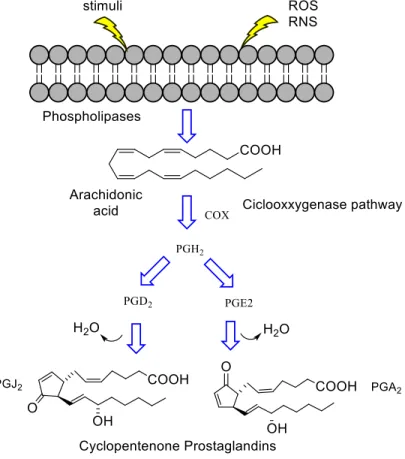
The cyclopentenones prostaglandins (CPPGs) are a PGs subgroup which are part the class A and J, coming from dehydration of class E and D respectively (Figure 1.6.).30,32 The CPPGs may
interact with multiple cellular targets including signalling molecules and transcription factors and they show antiviral,25,33 anti-inflammatory,24,34 antifungal,35 apoptotic36-38 and antitumor properties.39-41
Figure 1.6.– Generation of cyclopentenone prostaglandins in the metabolism context. Adapted from
Garzon, B. et al, J Proteomics, 2011, 74.95
Studies with CPPGs showed that the CP moiety act as a pharmacophore of anticancer molecules.
8
PGA2 and the same results was demonstrated into PGJ2 and its precursor PGD2 (with stronger inhibition of PGJ in relation of PGD).31 Studies with other related compounds with no cyclopentenone
ring showed no similar range of biological activities, for example observations by Bui and Strauss on the effect of CPPGs on stress-induced IGF-1 and Waf1 gene expression. Unlike the compounds without the cyclopentene moiety, these CPPGs repressed IGF-1 and induced Waf1 gene expression, demonstrating the requirement for the α-β unsaturated carbonyl group for the regulation of these two genes.43 This regulation of IGF-1 and p21CIP1 / WAF1 by CPPGs are associated with the cell cycle
arrest, inducing growth arrest of human and murine tumor cells in the G1 phase at sub-toxic doses. 44-46
These results demonstrate directly that CPPGs requires the reactive α-β unsaturated carbonyl group for biological activity and it’s possible to state that the majority of its activities are mimicked by 2-cyclopenten-1-one itself.24,41,48,49 This requirement suggests that the CPPGs might
alkylate exposed cysteine residues on key cellular target proteins and this alkylation may result in loss of function of the targets.49
This alkylation with specific cysteine residues in cellular proteins might be confirmed by the elucidation of the molecular mechanism for repression of the NF-κB activity. The NF-κB is a transcription factorinvolved in inflammation and immunity, activated in response to proinflammatory stimuli, stress or infection. This pathway activation has been associated with stimulation of cancer cell proliferation and prevention of apoptosis.50,51 CPPGs may inhibit this pathway at several levels.
One of these is the direct modification of a critical cysteine residue in IKK-β (this enzyme phosphorylates the NF-κB inhibitory molecule, releasing it from the complex and allowing it to be transported to the nucleus to promote DNA transcription)34 and the other is the direct interaction with
the p50 subunit of NF-κB inhibiting DNA binding.52,53
Corroborating these studies, naturally occurring CP marine prostanoids, such as clavulones and derivatives demonstrated a cytotoxicity comparable to the best performing chemotherapeutics.54
Furthermore, scientists showed that incorporating the CP chemical group in anticancer molecules such as chalcones55 and jasmonates56 increases the antiproliferative potential.
9
1.6.
The reaction with Proteins and Reduced Glutathione (GSH)
The CPPGs may also react with the sulfhydryl group of reduced glutathione (GSH) (Scheme.1.1.).
Scheme 1.1. - Alkylation of PGs by thiol molecules.
Glutathione (GSH) is a tripeptide produced naturally in the body found within almost all cells and being the most abundant non-protein thiol in the cell.59 This peptide is synthesized from just three
amino acids, glutamic acid, cysteine and glycine and has several different and vital physiological roles including antioxidation, maintenance of the redox state, modulation of the immune response and detoxification of xenobiotics. Under normal conditions, the majority of GSH exists in reduced form and a minority in the oxidized form (GSSG).60 This last is obtained from the oxidation of the reduced
by direct interaction with free radicals or acting as a cofactor for antioxidant enzymes. GSH may also
be found conjugated to protein and non-protein sulfhydryl, via disulphide bond formation.61,62
In cancer GSH has both protective and pathogenic roles. It is crucial in the removal and detoxification of carcinogens,63,64 but in cancer cells may also increase resistance to chemo- and
radiotherapy.61
Many detoxifications of carcinogens mechanisms include phase I reactions catalyzed by cytochrome P-450, hydrolysis or reduction, and phase II reactions. The GSH conjugation with electrophilic substances such as alkenes, halides and epoxides act as the major phase II reactions in mammalian species. This conjugation is usually catalyzed by phase II isoenzymes known like glutathione S-transferases (GSTs) that in human are divided into seven classes (Alpha, Mu, Pi, Omega, Theta, Zeta and microsomal),65,66 being that the most highly expressed GST isoenzyme in
various human cancerous and precancerous tissues is GSTP1-1.67
These enzymes are also associated to a detoxification process of anticancer drugs, such as chlorambucil,68 melphalan,69 carmustine,70 cisplatin,71 and busulfan,72 reducing drastically the
reactivity of these compounds and favoring their elimination by glutathione S-conjugate export pump (GS-X pump).61,73-77 The GSTs, specifically GSTP1 also act on the regulation of apoptosis through
10
Traf-2 and JNK, which upon oligomerization of GSTP1-1, are released in order to play their role in inducing apoptosis.79 Therefore, the overexpression of GSTs and the high levels of glutathione (GSH)
in tumors are associated to the development of MDR.61,73-77 Thus, in order to modulate cancer cell
resistance to anticancer drugs the search for molecules capable of inhibiting GS-X pump, GSTs and Glo-I has become one of the primaries aims of contemporary research.
Among other detoxification reactions that glutathione acts, we draw special attention for the detoxification of methylglyoxal (one toxin produced as a product of metabolism) performed by the glyoxalase system that involves the reduction of glutathione to S - D - lactil – glutathione (catalysed by glyoxalase-I) and its hydrolysis to glutathione and D-lactic acid (catalysed by glyoxalase-II).80,81
Studies have showed that methylglyoxal is toxic to proliferating cells and has been suggested that Glo-I are associated to drug resistance since has been detected in elevated levels in tumour colon tissue (Scheme 1.2.).82
Scheme 1.2. - Reaction of methylglyoxal detoxification
It was thought that the inhibition of a Glo-I was responsible for the anticancer properties.83,84
Thus, in 1975, a potential inhibitor of glyoxalase-I was isolated by Umezawa and co-workers from the culture broth of Streptomyces griseosporeus known as 2-crotonyloxymethyl-(4R, 5R, 6R )-4,5,6-trihydroxy-2-cyclohexenone (COTC),85,86 but Umezawa et al. noted that the inhibition of the enzyme
was observed only in the presence of GSH, in other words, the COTC had no significant effect by itself.85,87,88
The same results occur with a synthetic analogue of COTC known 2-Crotonyloxymethyl-2-cyclohexenone (COMC)87 This lead to the hypothesis that the biological activity is associated to the
reaction into COMC and GSH to form an adduct (GSMC) by nucleophilic addiction and loss of crotonate portion (Scheme 1.3.),88,89 however subsequent studies of IC50 in murine melanotic
11
Scheme 1.3. - Reaction ofCOMC and GSH to form the adduct GSMC
Then, kinetics studies indicated that these adducts formation implicates a multistep mechanism involving an electrophilic exocyclic enone intermediate into GSH and COMC/COTC by a Michael addition catalyzed by GST, and these electrophilic intermediate then reacts with a second equivalent of GSH to afford the GSMC
.
90,91Indeed, under physiological conditions, the incubation of COMC with model dinucleotides or single-stranded 16-mer oligo-nucleotides, showed the formation of adducts of the exocyclic amino group of the guanine residues,90,92 it means that the exocyclic enones can be likely to react with
nucleophilic groups on nucleic acids (DNA) and proteins inside cells and DNA alkylation, for example, provides a plausible mechanism of cytotoxic activity, which is shared by a large number of chemical carcinogens and cross-linking antitumor agents (Scheme 1.4.).92
Scheme 1.4. – Proposed mechanism of a reactive enone formation and possible adducts formations from the
enone
Moreover, GSTP1 are overexpressed in tumor cells when in presence of cytotoxic agents.92
MCF-12
7wt breast tumor cells (the MCF-7piGST overexpress the pi GST isozyme at levels 10-fold greater than in wild-type tumor cell line).92
13
1.7.
Promiscuity of Michael Acceptors
It is known that there is specificity for substrates that react with Michael acceptors (as cyPG). This specificity depends on the type of cell to act, the amount of GSH available, the side groups present on the CP ring, and, of course, the reactivity of the substrate that is influenced by the acquired conformation.94,95
Nevertheless, the cyclopentenones exhibit high reactivity, and due to the large number of targets available for alkylation, it may represent a problem for its application to the level of medicinal chemistry.
Thus, the presence of reactive enones in human cells (both in normal and cancer cells) may lead to severe side effects. In other words, Michael acceptors are considered Pan-assay interference compounds (PAINS) because they tend to react with numerous biological targets rather than the desired targets.23,96,97
14
1.8.
Synthesis of diamino cyclopentenones
As mentioned above, CPs have been attracted attention of medicinal chemists. CPs as trans -4,5-diamine cyclopentenones could be employed as very useful intermediates towards antitumor natural products.
One example is the cytotoxic tetracyclic alkaloid known as (-)-Agelastatin A 1, isolated from
the axinellid sponge Agelas dendromorpha by Ambrosio et al,98 which actuates as anticancer compound exhibiting potent cytotoxicity against L1210 leukemia in mice and human KB nasopharyngeal tumour cell lines.99 This interesting biological activity coupled with the heterocyclic
array contained in this type of alkaloids, makes them attractive targets for total synthesis, and their retrosynthetic analysis could lead to trans-4,5-diamine cyclopentenones 2 (Scheme 1.5.).
Scheme 1.5. –Retrosynthesis of Agelastatin A lead to trans-4,5-diamine cyclopentenones
The first total synthesis reported for 1 achieved a yield of 7% starting from Hetero Diels-Alder
15
Scheme 1.6. –First total synthesis reported for Agelastatin A
Since then, many research groups have reported different synthetic pathways for Agelastatin A, and consequently for amino cyclopentenones, because it’s one important precursor for Agelastatin, as explained above.
Among pathways we can highlight the methods by: Feldman et al., which reported the first enantioselective syntheses involving 14 steps from (R)-epichlorohydrin where the most important transformation was a sulfinate-promoted cyclization of an alkynyliodonium salt to get a functionalized cyclopentene intermediate;101,102 Hama et al, which involved 20 steps (yielding only 1%) starting with
a sequential sigmatropic rearrangement followed by a cyclisation via ring closing metathesis to give trans-4,5-diamino cyclopentenol and after thetrans-4,5-diamino cyclopentenone precursor;103 Davis et al., which involved 11 steps, 23% yield, and was based in addition of a lithium enolate of ethyl (dibenzylamino)acetate to an acrolein-derived N-sulfinyl imine to give a sulfinimine-derived by 2,3-diamino ester followed by ring-closing metathesis to get 4,5-2,3-diamino cyclopenten-2-enone;104,105 Hale
et al, which started with acylation, hydrolysis and oxidation of a quiral oxazolidinone to give a diamino cyclopentenone (afforded after 5 steps with an yield of 14%), followed by intramolecular Michael addition with the cyclopentane rings and a pyrrole and finally hydrogenation and monobromination.106,107 Other total synthesis should be highlighted such as from Dikson et al, Trost
16
Besides the enormous advances in this area, the reported total synthesis still has some limitations such as the high number of steps and overall low yields. For these reasons the development of one method for a small and efficient synthesis would be highly useful.
In 1850, was reported by J. Stenhouse the formation of salts named Stenhouse salts (SSs) resulting from the furan ring-opening reaction upon condensation of furfural 17 and amines 18.109-111
After that, other studies such as the one from Lewis et al. revealed that these SS under harsh conditions (refluxing methanol in the presence of hydrochloric acid) undergo a thermal 4π -electrocyclization reaction to give the colorless 4,5-diamino-2-CP, however this reaction was not recognized for many years because 2 could rearrange into the thermodynamically more stable
2,4-diamino-CP 19 (unselective reaction). Allso because the reaction times are long (80 days) and the
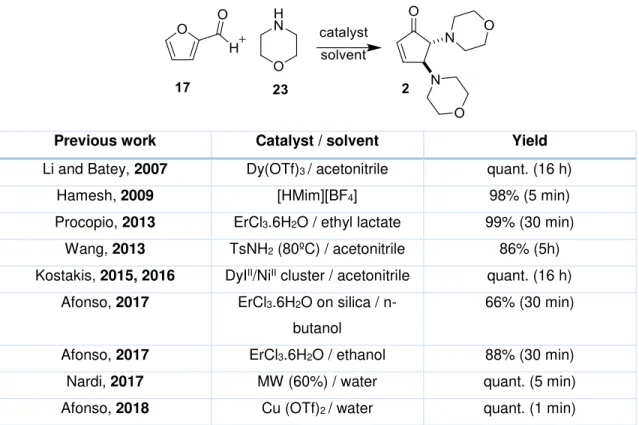
yields poor (Scheme 1.7.).112-116
Scheme 1.7– Synthesis of trans-4,5-diamino cyclopentenones from furfural and anilines. Lewis et al method.
Trying to get around this trouble, Li and Batey reported a protocol to the formation of trans -4,5-diamine cyclopentenones from furfural and secondary amines. Initially was used protic solvents such EtOH, in the presence of excess catalyst such BF3.OEt2 Ti(OiPr)4, Al(OiPr)3 and B(OMe)3. Were
obtained good yields, instead of the absence of Lewis acids or the presence of protic acids like HCl, but curiously for the lanthanide Lewis acids (prominently Dy(OTf)3) the reaction proved to be very
efficient (with excellent yield and excess diastereomeric > 95%) in MeCN (Scheme 1.8.). They have also analyzed the formation of these cyclopentenones reacting 17 with primary amines, but all the
reactions were unsuccessful, except for aniline.117
17
A mechanism has been proposed for this reaction. It starts with the formation of an iminium ion which would undergo addition in position 5. Subsequent furan ring-opening affords the deprotonated Stenhouse salt 22 that after Nazarov electrocyclization yields the CP 2. NMR studies
to the cyclisation of the Stenhouse salts indicated a fast ring closure (first order kinetics) and computational studies showed that the ring-closure is consistent with a thermal conrotatory 4π electrocyclization suggesting a Nazarov mechanism and the trans stereochemistry is consistent with the Woodward-Hoffmann rules (Scheme 1.9.).117
Scheme 1.9.– Proposed mechanism for trans-4,5-diamine cyclopentenones synthesis by Li and Batey.
After this pioneer work by Li and Batey, other protocols has been reported such as from Ramesh’s group which the reaction is catalysed by the acidic ionic liquid 1-methylimidazolium tetrafluoroborate [Hmim]+[BF4] and does not require anhydrous conditions neither solvent because
the IL plays the dual role of catalyst as well as recyclable reaction medium; 118 from Procopio’s group,
where the catalytic activity of Er(III) was tested using Er(OTf) 3, in acetonitrile and Ethyl Lactate at
different experimental conditions, and then using ErCl3 and ErCl3 × 6H2O which is moderately
expensive and has low toxicity;119 from Wang’s group which the method is catalysed by tosylamine at
high temperatures (80ºC) in acetonitrile during 5h;120 from Kostakis’s group where the reaction is
catalysed by DyIII/NiIII heteronuclear clusters in acetonitrile121,122 and the protocol from Nardi’s group
that is an environmentally friendly method in water under microwave irradiation at high temperatures (60 °C) (Table 1).123
Our group have been also involved in methods to prepare 2. One of these involves the use
of erbium(III) chloride immobilized on silica as a reusable catalyst, proving to be a very efficient catalyst in n-butanol at room temperature and mild reaction conditions.124 Another reported method
involves the use of erbium(III) chloride hydrated in ethanol, at 50ºC and mild conditions during 30 min. and is considered suitable for use in introductory organic chemistry laboratory classes.125 The
18
Table 1 - Reported methods for the preparation of 4,5-diamino-CPs basing in Li and Batey Method.
Previous work Catalyst / solvent Yield
Li and Batey, 2007 Dy(OTf)3 / acetonitrile quant. (16 h)
Hamesh, 2009 [HMim][BF4] 98% (5 min)
Procopio, 2013 ErCl3.6H2O / ethyl lactate 99% (30 min)
Wang, 2013 TsNH2 (80ºC) / acetonitrile 86% (5h)
Kostakis, 2015, 2016 DyIII/NiII cluster / acetonitrile quant. (16 h)
Afonso, 2017 ErCl3.6H2O on silica /
n-butanol
66% (30 min)
Afonso, 2017 ErCl3.6H2O / ethanol 88% (30 min)
Nardi, 2017 MW (60%) / water quant. (5 min)
19
1.9.
Synthesis of 2,4-bifunctionalised cyclopentenones
The diamino-cyclopentenones are Michael acceptors, and as we explained above, can react with nucleophiles. Two types of addictions may occur: conjugated (1,4 addition) or direct (1,2 addition). The thiols usually react with CPs by conjugated addition. This can be explained by the type of attraction between electrophiles and nucleophiles. Thiol is a soft nucleophile and β-carbon of CP is a soft electrophile (because they have larger atoms with diffuse orbitals), and soft molecules tend to be attracted to with each other by a dominant orbital control.23
Some protocols that highlight the reactivity principles of 1,4 additions to thiols have been reported.127-132
One of these, studied the reaction of cysteine derivates with prostaglandins (PGA1) in order to understand their mechanism. Suzuki’s group showed that the conjugation was selective to the endocyclic double bond, even were another exocyclic double bond in a position was also in conjugation with the carbonyl group, and this conjugation to the exocyclic bond only took place in presence of higher amounts of thiol, at longer times and when the other was already thiolated. It was also observed that the stability of the formed adduct was inversely proportional to pH.127
Bickley’s group using cyclopentenones with cysteines observed that thiols added exclusively anti regarding to OTBDMS on the third position to give trans product 26 and was observed reversibility
of the addition when exposed to physiological pH (scheme 1.10).128The anti diastereoselectivity was
also observed in the synthesis of an aristomycin analog by Das et al,129 and Dauvergne’s group also
used a trans thioadduct (formed in good yield) like intermediate to the replacement of C-4 tosylate in studies about the functionalization of cyclopentenones.130
Despite the soft character of the thiols, the thiolation can be a very sensitive procedure. This was proved in the synthesis of Mannostatin A and analogs by Cho et al. when aminodiol diastereoisomers afforded different products.131
20
Basing on the method from Li and Batey, our group in 2013 described a one pot method of synthesis of 2,4-bifunctionalised cyclopentenones via conversion of 2-furaldehyde 17 with morpholine 23 followed by concomitant 1,4 addition (Scheme 1.11). In the optimization of this synthesis was
observed that the use of protic solvents such as MeOH improved reaction rates and yields, and most hard oxophilic Lewis acids were effective. After some screening, the optimal Lewis acid chosen to catalyse the formation of 2 was AlCl3 (0.1 eq.)and the base forconjugated addition and formation of
27 was KOtBu (0.25eq.) The reaction of the diamine CP intermediate with alkoxides (nucleophiles),
showed that the excess of these affords undesirable side products by the competition of conjugate addition into alkoxide and morpholine. Then, this method was applied for amines and thiols.132
Scheme 1.11 - Synthesis of 2,4-bifunctionalised cyclopentenones by a one-step reaction.
Combining all evidences found at the optimization process, was possible to understand the mechanism of the reaction. It proceeds by 1,4 addition of thiol to the diamino cyclopentenone 2
followed by E1cB elimination (Scheme 1.12).132
The E1cB elimination (Elimination Unimolecular conjugate Base) is a reaction in which two groups are eliminated, a poor leaving group on the α-carbon and an acidic hydrogen on the relatively β-carbon under basic conditions. It starts with the abstraction of the most acidic proton by the base generating a stabilized enolate (the conjugate base or anion of enol) followed by the elimination of the leaving group and formation of double or triple bond (because the lone pair of electrons on the anion moves to the neighbouring atom).133
Scheme 1.12– Proposed mechanism for the synthesis of 2,4-bifunctionalised cyclopentenones
21
1.10. Further transformations of 2-morpholino-4-thioalkyl-cyclopentenones
Our group has speculated if these 2-morpholino-4-thioalkyl-cyclopentenones 30 could be
transformed into new products by reacting them toward electrophiles and nucleophiles.
First, was attempted react with CP 31 electrophiles such allyl bromide, p-fluorobenzyl
bromide and p-chlorobenzyl bromide in toluene and MeCN, at different temperatures for prolonged periods of time, and there was no reaction. Only in presence of base such DBU and Et3N at high
temperatures over a few hours or days was observed partial reaction but was afforded more than 3 products hard to isolate with very low yields (Scheme 1.13.).132 Then, was also attempted react 31
towards nucleophiles such α-toluenethiol and thiophenol in MeCN and toluene, at different temperatures over several days, under normal and basic conditions. And there was also no reaction but in acidic conditions using PTSA monohydrate was observed the formation of an hydrolysis product (Scheme 1.13.).132
Scheme 1.13. - Illustration of the reactions of 2,4-amino-thio cyclopentenones towards electrophiles,
nucleophiles and acids
After optimization was found that the mixture of MeOH:H2O (4:1) was sufficient (the absence
of water gave multiple products) and HCl was a suitable acid for the reaction and that its excess could afford undesirable products. Thus the optimal conditions for hydrolysis stablished are: HCl (1.1 equiv.) in of MeOH:H2O (4:1) at 60ºC for 2 hours. 132
Once primary amines could not be condensed with 2-furaldehyde, these could be easily introduced onto hydroxy cyclopentenenone compounds with moderate yields, however aniline and secondary amines were difficult to insert (Scheme 1.14.).132
23
Objectives
Due to the unsaturated α,β-carbonyl group of cyclopentenones, these compounds act as Michael acceptors and may react with various nucleophiles making them dangerous compounds (PAINS).23
Thus, the objective of this work is the development of a small family of CP with very poor Michael acceptor character that possess cytotoxic activity for HT-29, MCF-7 and NCI-H460, respectively colon, breast and lung cancer cells (which are currently the most frequent types of cancer in the world).17 It means that they could retain the cytotoxic activity through a mechanism of action
different to the non-specific macromolecule alkylation, and it could avoid severe side effects.
Our group has been working on the preparation of trans-4,5-diaminocyclopentenones from furfural (cheap furan derivative, easily available and obtained from non-edible carbohydrates such as xylose). From these compounds was observed the addition of a thiol to the enone under basic conditions, followed by consequent elimination of an amine to reestablish the CP and was also observed no second addition of the excess thiol to this newly formed enone, which makes it poor Michael acceptor. Therefore, is important to synthetize new CPs with cytotoxicity to cancer cells and to prove its poor Michael character by interaction for example with glutathione (Scheme 2.1.)
Scheme 2.1. –Illustration of this work reactions
25
Results and Discussion
3.1. Synthesis and Biological Assays
3.1.1.
Trans
-4,5-morpholine cyclopentenone
We have synthetized trans-4-5-morpholine cyclopentenone by two different methodologies. The first method is based on the one-step reaction before proposed and reported by our group, but the difference is that now we divide the reaction in two steps: (1) synthesis of trans -morpholine cyclopentenone 42 and 2) nucleophilic conjugated addition, because we needed large
amounts of 42 to react it with several nucleophiles.
Thus, we prepare 42 by reacting two equivalents of morpholine (a secondary amine) with
furfural in MeOH (a protic solvent), in the presence of AlCl3 at room temperature under inert
atmosphere. In order to achieve a successfully reaction the elimination of water was essential inside the reaction medium (for that we used MgSO4 that is a fast drying agent).
This reaction gave excellent yields (94%) after work up (filtration and extraction), and the product 42 did not need to be further purified. Usually a yellow solid is formed but when this does not
happen by itself it is necessary to employ the addition of a small amount of diethyl ether, slightly polar solvent, because it is good for crystallization. The work up that consists by filtration, addition of Brine and extraction to the organic phase with DCM, is important to eliminate the metal to the reaction.
The other method used to synthetize 42, is quite similar to the previous one but the catalyst
used was ErCl3.6H2O and the solvent was acetonitrile. This method also shown to be effective
affording excellent yield (92%) and it has some advantages when compared to the other: inert atmosphere is not necessary, and the reaction is complete in 12 times shorter time (30 min.). The
26
strictly anhydrous conditions for the first approach are essential because the AlCl3 is a Lewis acid
catalyst that immediately reacts with water rather than with substrates and stops the reaction. On the other hand, in case of ErCl3.6H2O the presence of water may be beneficial.134
The proposed mechanism for these reactions are shown below in scheme 3.1.
Scheme 3.1. – Proposed mechanism for trans-4,5-morpholine cyclopentenone from furfural and morpholine
The reaction starts with the condensation (catalyzed by the Lewis acid) of 2-furaldehyde and one molecule of morpholine to form the iminium ion intermediate 39 that is unstable. Previous
experimental observations and computational studies showed that its formation is the rate limiting of the mechanism. Then, occurs a second condensation of another molecule of morpholine with the iminium ion at the 5-position of furan ring by 1,6-addition that promotes the furan opening to yield the deprotonated Stenhouse salt 41 which can undergo conrotatory 4π electrocyclization to yield the final trans-4,5-diaminocyclopent-2-enone derivatives as a single diastereoisomer.