1
A Work Project, presented as part of the requirements for the Award of a Master’s Degree in Management from
the Nova School of Business and Economics
CONSULTING PROJECT FOR THE OPTIMIZATION OF THE AUTOMOTIVE PROVIDERS NETWORK OF EUROP
ASSISTANCE PORTUGAL
DEEP-DIVE INTO THE AUTO ASSISTANCE NETWORK MANAGEMENT
BEATRIZ FRAZÃO FERREIRA
Work Project carried out under the supervision of:
Professor Constança Monteiro Casquinho
Abstract
In order to optimize the Auto Providers Network, it was performed a diagnosis of the internal context of Europ Assistance Portugal. Through internal expert interviews, data analysis and research, it was found that EAP faces pressure from its providers network, specifically due to its low levels of digitalization, high refusal rate and overall complexity of internal processes and systems. In this regard, a deeper analysis was made into the overall provider selection and activation process, with the goal of fully understanding the best way to improve it, keeping in mind the providers’ pain points
Keywords: Diagnosis, Optimization, Roadside Assistance Network, Process Mapping
This work used infrastructure and resources funded by Fundação para a Ciência e a Tecnologia (UID/ECO/00124/2013, UID/ECO/00124/2019 and Social Sciences DataLab, Project 22209), POR Lisboa (LISBOA-01-0145-FEDER-007722 and Social Sciences DataLab, Project 22209) and POR Norte (Social Sciences DataLab, Project 22209).
1. Project Presentation
2. Executive Summary
3. Methodology
4. Diagnosis
1.
External Analysis
2.
Internal Analysis
5. Analysis | Our 4 Ps Framework
1.
Placement
2.
Performance
3.
Partnership
4.
Potential
6. Recommendations
1. Major Projects:
- Providers Selection To-Be
- Motorbike Repair Project
- Partnership Scheme
2. Quick Wins
7. Risk Analysis
8. Limitations and Further Research
9. References
10. Appendix
Agenda
Internal Analysis
Diagnosis:
Analysis of the network regarding missions, providers, digitalization,
ROS, refusal rate, average cost and average time to arrival. Additional
analysis of the provider selection process.
Europ Assistance Portugal aims to answer to all the assistance requests from emergency situations to cover the daily basis needs.
It offers a wide range of assistance services while collaborating with 3,000 partners in order to cover every requirement a client
might have.
Sources: Europ Assistance Portugal 5
Diagnosis | Internal Analysis | Company’s Description and Business Lines
4
Europ Assistance Portugal is an insurance and assistance company which has been present in Portugal since 1993. The company was firstly directed to the Travel and Automobile assistance but now it is diversifying by creating new business lines such as the Health and Home & Family assistance. Moreover, EAP employs around 300 employees including a call-centre which operates 24/7. It also collaborates with a 3,000 providers network distributed all over the country in order to assist the half million clients’ needs. Hence, Europ Assistance strives to be the most reliable care company in the world by being there anytime and anywhere.
Description
In 2017:
53% of EAP shares 47% of EAP sharesIn 2018:
100% of EAP sharesIn 2018, the Generali group, which already had 53% of Europ Assistance Portugal, acquired Seguradoras Unidas, resulting in 100% of EAP ownership.
Business Lines
• Maintenance • Accident Care • Guarantee of damages • Rent-a-car Assistance • Mechanical Insurance• Private & Corporate • Medical Assistance • Flight delays insurance
• Documents Insurance • Luggage Insurance • Psychological Support • Customized Medical Assistance • Phone Assistance 24/7 • Transport Service • Medication support • Home Care • Pet Care • Simplar
Auto
Travel
Health
Home &
Family
EAP faces pressures from both sides: firstly from the insurance companies that keep reducing the premiums in order to leverage
competitiveness, which impacts directly EAP’s auto assistance revenues and secondly, from the providers that demand higher
prices for their services.
Sources: Europ Assistance Portugal | Internal data 6
Diagnosis | Internal Analysis | The Auto Business Line: context
4
NON-EXHAUSTIVEInstitutional clients:
The Company:
Customer:
Main Stakeholders
Providers:
Business Model
In the Auto business line, Europ Assistance is integrated in two distinct business models, depending on its function to the institutional client.
In a B2B context, EAP is a service provider responsible for the automotive assistance of customers in need as well as a provider of fleet management. Thus, institutional clients in this context represent, for example, OEMs (Citroen, Ford) or rent-a-cars (Europcar).
In a B2B2C context, EAP is a re-insurance company, that handles risk management for its institutional clients that are insurance companies (example: Tranquilidade, Logo).
Towing providers represent 69% of total costs for EAP.
69% 7%
16% 8%
Graph 9: Cost Structure 2018
Towing Taxi Rental Other
EAP receives a premium for each insurance company’ client it handles, in exchange for managing the premiums it receives in order to pay to the providers. With the increasing competitive advantage and pressure from the competition, the insurance companies have been forced to reduce the premiums it pays, thus reducing the margin of EAP. This influences not only EAP, but also the end-suppliers, since the lower premiums lead to EAP’s lower budget to manage its auto providers. Consequently, this has forced EAP to postpone the increase in providers’ price tables for the past 10 years, which causes high levels of dissatisfaction among providers.
As a result of the data processing, it was gathered a total of 329 working towing providers in 2019. The mapping emphasizes the
relation between the number of requests assisted by EAP since the beginning of 2019 and the location of the providers’
headquarters.
Sources: Internal Data | Team Analysis 7
Diagnosis | Internal Analysis | Missions Concentration and Auto Providers Distribution
4
Map 1: Missions distribution and concentration Map 2: Auto Providers distribution
•
High number of missions in the main districts:
Porto, Lisbon and Algarve;
•
Auto assistance required all over the country;
•
Downward trend from the coast to the interior:
only 7% of total missions were provided in
Portugal’s interior.
•
Big concentration of tow truck companies in the
big cities: Porto and Lisbon;
•
Provider’s coverage all over the country;
•
Big dispersion in the interior.
Lisbon and Porto represent a large concentration of missions. However, the two counties have different realities, since the
missions in Lisbon county are concentrated in one single provider, while in Porto the missions are fragmented.
8
Diagnosis | Internal Analysis | Missions Concentration and Auto Providers Distribution: Lisbon and Porto
4
The Porto district represents 18% of total missions in Portugal, from which 21% are from missions requested to the Porto county.
The Porto county represents 4% of total missions in Portugal. The distribution of missions in this county is fragmented, with 95% of services being done by 8 different providers. This group of providers is responsible for a significant volume of missions in the Porto district, since they operate in multiple counties.
The Lisbon district represents 26% of total missions in Portugal, from which 37% are from missions requested to the Lisbon county.
The Lisbon county represents 10% of total missions in Portugal. The distribution of missions in this county is highly concentrated, with 84% of them being done only by Portilavauto. This provider loses some relevance, however, when looking at the Lisbon district, but still represents 33% of those missions.
84% 5%
3% 8%
Graph 10: Distribution of missions
in Lisbon county, by provider
Portilavauto Carteam Trucks Assisteoeste Outros 22% 18% 13% 12% 10% 10% 5% 5% 5%
Graph 11: Distribution of missions
in Porto county, by provider
Garagem Lapa Rui Brandão Lima & Lima Assislongo Art II Seprama Serviarregadas C. Santos Outros
26%
of total missions in Lisbon district18%
of total missions in Lisbon district County District4%
of total missions in Lisbon county10%
of total missions in Lisbon countyLisbon
Porto
Map 1: Missions distribution and concentration
EAP Auto Network, specifically in towing, is not meeting the 60% digitalization target, set for 2020. The increase of digitalization
adoption will allow EAP to be more aware of its towing network, in terms of costs, time to arrival and specially, geo-position,
which is key to have an efficient and effective provider selection, once a service is requested.
9
Diagnosis | Internal Analysis | Auto Network Overview: Digitalization per region
4
Digitalization
Missions that can be digitally tracked, through GPS or TASK
.
44 735
19 328
52 636
South Center North
Graph 12: Digi
talization
per Region
Nr. Of digital OTs Total Nr. of OTs
36% 33% 51%
125,892
57,999
102,976
Digitalization Rate (%)
Digitalization allows EAP to be more aware of its provider network, particularly its towing partners. Using these tools, it is possible to know where the towing trucks are and which one is closest to the reported incident, how many kilometers the truck travelled, how much time it took to arrive, etc.
This will improve the process of selecting the right provider for each mission, the billing and invoicing and the management of such a large network.
By improving the processes and having more control, it is expected that both the internal cost and the average costs per digital mission will be lower than in a non-digital dispatching.
Moreover, the current time to arrival metrics are based only on digitally-tracked missions. This means that, to be sure that the average time to arrival target of 45 minutes is in fact being met, it is essential to increase digitalization.
Full Digital
Missions that are resolved with no human interaction between EAP and the customer.
Why is digitalization so important for EAP?
Conclusions
The region with more digital Missions is the North with 51%, where most providers are equipped with both GPS and TASK systems (44%).
The South has 36% of digital missions, and the majority of providers uses only GPS (77%).
In the Center, only 33% of missions are digital. This region is known to have mostly more traditional providers, many unwilling to adopt digital tools. From those that welcomed the digital era, most use only GPS (49%).
Employing RoS brings significant benefits to EAP as well as its stakeholders. So far in 2019, only the South has achieved a RoS rate
that meets the 2020 target of 18%.
10
Diagnosis | Internal Analysis | Auto Network Overview: Repair on Spot per region
4
Repair On Spot
When the provider reaches the breakdown place and repairs the vehicle
immediately, without having the need to provide a towing service.
27 763
6 153 12 202
South Center North
Graph 13: RoS per Region
OTs RoS OTs totais
19% 9% 11%
145,831
67,092
115,622
Digitalization Rate (%)
The region with more RoS missions is the South with 19%. This region uses more motorbikes to provide RoS assistance, compared with the others. This is an effective method, especially in big cities such as Lisbon, where traffic is a big issue, since motorbikes are more able to get rapidly to the vehicle in need of assistance.
The North has 11% of RoS Missions. This region has the most RoS tools (200), and uses the diagnostic systems more than the others, which helps to identify the issue faster.
In the Center, only 9% of Missions are resolved through RoS, mainly using mobile patrols, and not yet including the use of EVs or other hybrid equipment.
134 114 139 20 7 11 7 1 29 38 49 South Center North
Graph 14: RoS Tools per Zone
Mobile Patrols Motorbike Evs/Hybrid equipment Diagnostics System
200
Total
159 190
Why is RoS Rate so important for EAP?
However, not all of the towing providers have the necessary equipment to perform RoS. The most common RoS tool used by providers are mobile patrols.
Furthermore, it is not always obvious if a towing request can be resolved through a RoS, as it entails the experience and intuition of the call-center operators and EAP partners.
Being able to resolve a towing mission through RoS is beneficial for everyone: EAP saves costs by not employing second services (such as the taxi or rent-a-car service) and having more towing providers available for other assistance requests, towing companies are able to perform more assistances, and customers can continue their journey with a repaired vehicle.
Conclusions
The refusal rate has increased throughout 2019, across regions and in comparison with the previous year. The refusal rate is
heavily linked with spikes in the number of missions, capacity constraints of towing partners, the digital tools used to accept the
missions, as well as lack of attractive price tables.
Sources: Internal Data 11
4
The RSA business suffers from seasonality, which is reflected in the first half of 2018: during the summer months it is common for the refusal rate to increase, due to more assistance requests by drivers on vacation, and also due to the increase in temperatures that causes some vehicles to malfunction.
In the second half of 2018 the refusal rate reached critical levels (almost 30%), which carried on to 2019. This could be a consequence of several factors, such as the increase in number of missions coupled with the lack of capacity faced by the towing companies. Additionally, based on interviews with partners, using digital tools makes it so that providers cannot accept services unless they are available, which limits their control over operations. Unattractive price tables were also listed as a hindrance to a lower refusal rate.
Diagnosis | Internal Analysis | Auto Network Overview: Refusal Rate per month and per region
0% 10% 20% 30%
Jan Feb Mar Apr May Jun Jul Aug Sep Oct Nov Dec
Graph 16: Refusal Rate per month
2018 2019 Linear (2018)
Following the general country trend, there was an increase on the refusal rate in every region in 2019, compared with 2018.
Although Lisbon is the region with lowest refusal rate in 2018, it recorded the highest YOY increase, from 9.5% to 23%.
Litoral Alentejano is by far the region where the refusal rate is the highest, with 52% in 2019. This could be explained by the fact that this region is known to be a crossing place, meaning that most of the missions are long-distance, and towing providers in general prefer shorter-distance missions.
0% 10% 20% 30% 40% 50%
Lisboa e Arredores Porto e Arredores Litoral Alentejano Algarve
Graph 15: Refusal Rate per region
2018 2019
EAP’s system currently calculates the refusal rate considering multiple refusals of the same provider for the same mission request. Thus, it is believed that the actual refusal rate is lower than the one presented.
The average cost per mission and the average time to arrival are highly correlated with the amount of kilometers. For that reason,
Southern regions, which have less providers and are in areas of passage, show the highest average cost per mission. Data on time
to arrival, which is a proxy for customer satisfaction, depends upon the digitalization of the providers network
.
Sources: Internal Data| 1% of each region in the total volume based on source 12
4
00:00:00 00:07:12 00:14:24 00:21:36 00:28:48 00:36:00 00:43:12 00:50:24January February March April May June July August
Graph 18: Average time to arrival by region
Lisboa e Arredores Porto e Arredores Algarve
Average cost per mission remains relatively unchanged throughout the year, despite the seasonality aspect of the business.
Litoral Alentejano is the region with the highest average cost per mission, reaching €68 in May. On the other hand, Lisbon is the region with lower average cost per Mission, with only €35 in February.
These huge differences are mainly correlated with the amount of Kms that the towing companies need to do to complete the mission. Because Litoral Alentejano is a crossing place, many of the missions in the region are long-distance ones, while in the Lisbon area, missions are mainly local.
Litoral Alentejano data sample is not representative due to the low digitalization in the region, which limits data collection.
Algarve is the region with highest average time to arrival throughout the year because of the few providers’ supply and the use of higher radius in this area. Also, average time to arrival increases in the summer due to the higher volume of cars and people towards the South.
Porto and Lisbon show similar behavior, with an increase in May due to the higher volume of services in that month. However, Lisbon’s time to arrival is affected by the fact that the company that captures more volume of services is not digitalized.
€ 30 € 40 € 50 € 60 € 70
January February March April May June July August
Graph 17: Average cost per Mission per region
Lisboa e Arredores Porto e Arredores Litoral Alentejano Algarve
Diagnosis | Internal Analysis | Auto Network Overview: Average cost per mission and Average time to arrival
1%
7% 18% 21%
The roadside assistance journey map helps to visualize a typical RSA service and identify the stages of the process that most
impact the efficiency of the network
Sources: Team Analysis 13
Diagnosis | Internal Analysis | Roadside Assistance Journey Map
4
The End Consumer is an insurance holder, who paid the premium to the Institutional Client (e.g. Insurance Company). Europ Assistance is the entity that establishes the connection between the service provider and the end consumer, in exchange for a fee. In order to meet the End Customers needs the provider dispatches the Tow truck. After the assistance is provided, Europ Assistance makes a pre-valuation of the service and the provider approves, so that the payment can be processed accordingly (IIM or manual).
Entities
End Consumer
Provider
Europ Assistance (EAP)
Institutional Client 1 2 3 4 5
1. The End Consumer
contacts its insurance, which is redirected to an EAP operator
2. EAP engages with the end consumer in order to identify
the issue and to decide what kind of RSA is appropriate
5. The end consumer receives RSA
4. If non-digital: the provider receives the mission and notifies its Tow truck driver. If digital, the tow truck driver directly receives the request and accepts the mission (GPS or TASK)
3. EAP selects and activates the provider to complete the RSA
mission via digital or non-digital means.
Current provider selection prioritizes digital channels; after three unsuccessful attempts, non-digital channels are selected to
complete the missions, through the PIE selection.
Sources: Providers Team, Business Excellence Team | 1 Radius defined between 6 KMs and 15 KMs | 2Automatic or manual activation | 3 Maximum of 50 KMs radius | 4Assumption: mission accepted 14
Diagnosis | Internal Analysis | Provider Selection As-is
4
Request for assistance GPS finds providers PIE finds providers 2True Digital PIE selection
Request sent to provider closer to the breakdown vehicle 1. TASK: • Send to driver • Sent to HQ, which re-directs to driver 2. Inosat: • Send to driver • Sent to HQ Mission Accepted Mission Refused Request sent to provider based on 3 criteria: distance3 to breakdown, quota and hierarchy 1. FAX/Mail4 2. TTS 3. Telephone4 Repeat until provider accepts Mission Accepted Mission Refused TD not successful
3
GPS tries to find providers, based on defined radius 1GPS does not find providers
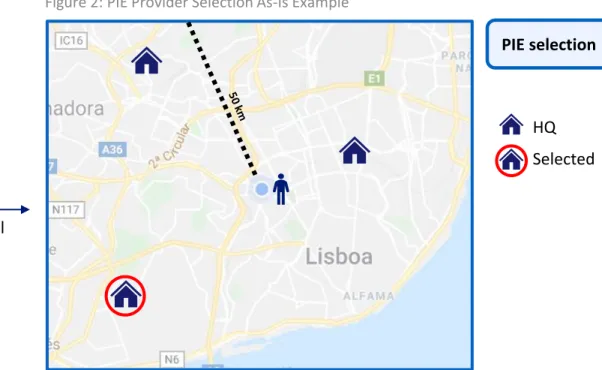
To better understand the current provider selection, it was exemplified in a real request from Avenida Columbano Bordalo
Pinheiro. Assuming the activation through digital channels fails, the PIE systems will select providers based on their headquarters’
proximity to the breakdown.
Sources: Internal, Providers Team and Business Excellence Team 15
4
TASK Inosat Out of Zone
True Digital PIE selection
After three unsuccessful attempts
HQ Selected
Diagnosis | Internal Analysis | Provider Selection As-is, practical example
Service requested in Avenida Columbano Bordalo Pinheiro; process starts with the GPS locating digitally available tow trucks in a radius defined of 6 KMs: finds 3 trucks: 1 using TASK and 2 using Inosat. Having in mind GPS criteria, it will select the truck using TASK. If the truck refuses, GPS will search again for available digital trucks only finding the other two trucks using Inosat, selecting the closer one to the incident.
If the second and third attempt the services are also refused, the service request will change from a digital channel (GPS) to a non-digital channel (PIE). In the same logic, as previously, PIE system locates the bases in a radius defined, and will select the base considering primarily distance, secondly quotas and thirdly hierarchy. After selecting the provider the service will be requested by this order: FAX/Mail, TTS and finally Telephone.
Analysing the current selection process highlighted some challenges of both the True Digital and the PIE selection stages, that
hinder the effective and efficiency allocation of the providers for each mission.
Sources: Internal, Providers Team and Business Excellence Team | 1Key Account Manager 16
4
True Digital PIE selection
Diagnosis | Internal Analysis | Provider Selection As-is, Challenges
The challenges faced under the current True Digital provider selection are: • Distance between the breakdown and the providers calculated as a straight
line (ignoring road access, traffic, bodies of water, etc.);
• TASK providers are prioritized over Inosat providers (TASK providers require pre-accepting the missions in the HQ);
• For the provider, being activated through the digital channels implies some loss of control over their own operations, since EAP is the one to allocate the specific trucks to the missions;
• Limited capacity of provider to accumulate missions, since trucks with GPS can only accept one service at a time;
• No distinction between exclusive RoS providers and other providers.
The challenges faced under the current PIE provider selection are:
• Providers’ quotas for particular counties are calculated as the number of missions accepted by the provider over the number of missions in the county; this method ignores the number of mission requests sent that the provider voluntarily rejected;
• Provider hierarchy of the system is outdated, and is not standardized (based on relationship between provider and KAM1, instead of a set of specific criteria);
• Customer isn’t able to follow the status of their request, thus they often call to the call-center, to get updates and information regarding TTA, which congests the phone lines.
Mapping the process of the as-is provider selection, together with the expert interviews conducted and the visit to the call-center operations, made it possible to better understand the challenges of this current selection process. Specifically, some features of the system were found to be conductive to higher refusal rates, as well as an inefficient provider selection.
TASK and Inosat are the two geo-location systems that EAP uses to track the providers who complete digital missions. The apps
function in a similar way from the P.O.V of the provider, however, TASK always gives control to the driver, who has the final
decision over whether the services gets accepted or refused.
Sources: EAP | 1It is also possible for the company’s HQ to send the mission to another available truck driver | 2Similar in terms of provider selection. 17
Diagnosis | Internal Analysis | TASK vs. Inosat flux
4
TASK and Inosat are the two systems that towing companies use, which enables them to complete services digitally due to the use of geo-location (GPS). For this purpose, Inosat is the system most commonly used in the market. However, there is a cost associated with getting the subscription for the service, as well as for every geo-location device put on every truck. For that reason, EA created TASK, a zero-cost app that allows providers to complete digital services and also contributes to EAP’s digitalization target. The way the two systems work is very similar2: EAP requires a provider, and locates through GPS the closest tow truck; then, a request is sent to the provider, who can accept (or refuse) this mission. The provider has two types of options regarding the acceptance of the service.
TASK
VS.
Inosat
The first option is the same for both TASK and Inosat: EAP locates an available tow truck, and sends a request, which is directly accepted (or refused) by the tow truck driver.
O
p
ti
on
1
For TASK, the second option adds a middle layer: EAP locates an available tow truck, and sends a request to the company’s HQ, which pre-accepts the mission; then, the HQ sends the request to the driver which was identified as available1, which then also needs to accept the mission.
O
p
ti
on
2
For Inosat, the second option is simple: EAP locates an available tow truck, and sends the request to the company’s HQ, which directly accepts the mission, and then passes it on to the driver, to complete the service (but unlike TASK, there is no need for the driver to accept the service again).
“…syndication is only accomplished when the consultant truly cares about the client, and I believe our team was successful
because we deeply understood the challenge that EAP faces”
18
Appendix | Individual Reflections | Beatriz Ferreira # 26308
10Beatriz
Belbin Analysis
Top: President, Teamworker
During the project, I was able to harness the most of the these roles by being organized and communicating effective ways of moving forward in the project, without being too overpowering, and always putting the team’s unity in first place. This challenge allowed me to develop my ability of communicating my ideas.
Bottom: Finisher, Intellectual
Key learnings
I joined the Consulting Labs to experience a consulting project, as close to real-life as possible, being it in an academic setting. I want to start my professional life as a consultant, thus I firmly believed that this project could give me tools to better prepare myself for that future. My expectations were more than met!
International Masters in Management, major in Strategy
“I love to get lost in a good book: explore the world, live different lives, learn about new cultures and go on adventures, all from the comfort of my home…
But my dream is to travel to all the places I’ve read about and create my own adventure!”
Syndication
Adaptability
During the project, I understood the importance of communicating and developing a trusting relationship with the client. Only by doing so, is it possible to show commitment, which ultimately leads to a successful project and to a happy client. In my opinion, syndication is only accomplished when the consultant truly cares about the client, and I believe our team was successful because we deeply understood the challenge that EAP faces, and we were always committed to do our best work.
Moreover, I constantly experienced the need to adapt to new situations and handle the pressure of deadlines. While in my academic experience there was always a framework or model to rely on, during this project, we often had to create and ideate our own solution, such as the framework we designed.