A Work Project, presented as part of the requirements for the Award of a Masters in Economics from the NOVA – School of Business and Economics
Quality of Life of Hypertensive and Diabetic Patients
Who suffers the most?
Maria das Dores Eiró Araújo Valente de Almeida
Number 637
A Project carried out under the supervision of Professor Pedro Pita Barros 07/01/2015
A Work Project, presented as part of the requirements for the Award of a Masters in Economics from the NOVA – School of Business and Economics
Quality of Life of Hypertensive and Diabetic Patients
Who suffers the most?
Abstract
Objective: Quality of life was measured using the EQ-5D index for Portugal and a Self-Assessed Ranking of Health (SARH) to understand which patients suffer the most decrease in quality of life: diabetics or hypertensive.
Method: Using the National Health Survey (NHS), two analyses were conducted on 5649 respondents. The EQ-5D index was calculated by matching questions in the NHS with its dimensions. The SARH was calculated based on a specific question in the NHS. Results: Differences between diseases do not occur using the EQ-5D index. Using the SARH, type 1 diabetics suffer the most while hypertensive suffers the least.
1. Introduction
Lifestyles have suffered a drastic change in the last years in what concerns eating habits and the practice of physical exercise. Nowadays, people live more sedentary and stressful lives, causing an increase in the appearance of certain diseases, for instance, diabetes and hypertension.
The persistence of aforementioned lifestyles, coupled with the ageing of the population and increase in obesity is reckoned to continue to escalate, hence, the prevalence of diabetes and hypertension will follow in the same direction. Thus, it is important to understand the impact these conditions have on a person’s health and how should treatment be directed in order to try and provide a lifestyle as similar as possible to normal.
Diabetes is a metabolic disease that is defined by an increase in glucose or sugar in the blood. One can distinguish two types of diabetes: type 1 and type 2. People who suffer from the former (also known as insulin-dependent) undergo a complete lack of insulin in their bodies, while the latter have only few insulin or their bodies cannot effectively use it. If not properly treated, diabetes may lead to several complications, such as heart attack, stroke, kidney failure, eye problems, and amputations, among others conditions. The number of people who suffer from this disease has been increasing, with the latest account being of 382 million (8,3% of adults). It is important to mention that the most affected age group is of people between 40 and 59 years old and also people who live in low-middle income countries. In 2012, this disease killed 4.8 million people, half of which were under 60 years old.1 In Portugal, the numbers are also quite high, in 2013, the prevalence of the population, aged between 20 and 79, who suffered from diabetes
was of 13,0% (2013), which corresponds to a number of about 1 million people, these numbers have increased by 11% when compared to the numbers of 2009. Furthermore, more than 25% of the elderly population (60-79 years) suffer from this disease.2
Hypertension (or high blood pressure) is a chronic medical condition that is described as an elevated blood pressure in the arteries.
The number of people who suffer from hypertension is also quite upsetting: in 2008, approximately 40% of adults had this disease and it is estimated that it is responsible for about 12,8% of the total of deaths. Analysing these numbers for Portugal, we see that they are relatively alike: 42,1% have high blood pressure (2010). Similarly to diabetes, hypertension is also more prevalent in low-middle income countries and the causes underlying it are also practically the same: unhealthy diets, lack of physical activities that lead to excessive weight, and others.
Moreover, if a person suffers from both diseases, the risks of stroke, heart attack and kidney failure are drastically increased.3
As one has just seen, there is a severe number of people who suffer from diabetes or/and hypertension; two diseases that have similar causes and can lead to similar complications. Given this, it is of major interest to study how these conditions affect every-day lifestyles and which one can cause more suffering.
In order to do so, it is necessary to have an instrument that will allow the measurement of quality of life. In this report, it was used the EQ-5D-3L and a self-assessed ranking of health.
The EQ-5D is an instrument used to measure the health-related quality of life, which has the advantage of providing a single index that allows for comparison among
diseases and can also be used in economic valuation (Sakamaki et.al, 2006) due to its easy interpretation and method of scoring (Dyer et.al, 2010). Five dimensions compose the EQ-5D: mobility, self-care, usual activities, pain/discomfort and anxiety/depression, and each of them is divided into three levels: 1-no problems, 2-moderate problems, 3-severe problems.
In order to attain the Self-Assesses Ranking of Health, one appealed to the Portuguese National Health Survey; by using a particular question that required respondents to rate their health state in a scale of 1 to 5, being 1 the least favourable health state and 5 the best possible health state.
This report will be organized in the following manner: one will start with a brief literature review that provides a theoretic framework and provides reasoning from some of the variables later on chosen to model quality of life; then a description of the data used. Furthermore, one will present some results regarding the data in use and model two alternatives to analyse quality of life, followed by a brief discussion and a conclusion on the study.
By the end of this report, one came to the conclusion that measuring quality of life using different variables provides different results. In this study, if one uses the EQ-5D index as dependent variable, diabetes and hypertension will have equal impacts on the decrease of quality of life. However, using a Self-Assessed Ranking of Health will create divergences in the impacts of both diseases: diabetes will be responsible for a greater decrease in quality of life, more specifically, type 1 diabetes.
2. Literature Review
Diabetes and hypertension are two quite common diseases, whose numbers have been aggravating along the years due to changes in societies as a whole. This means that,
nowadays people live more sedentary and have unhealthy diets, mostly due to lack of time, which also leads to immense stress.
Given this, it is important to see how these diseases will affect daily routines and how to provide an adequate treatment, or at least, allow a more tolerant life to patients.
According to Chin (2014), hypertensive patients are able to live quite normal lives, provided that they follow their medication regimen. However, this is not the case for diabetics, and since diabetes is not curable it is of a great importance to enable them to live a life as similar as possible to those of healthy people. It is possible to do so by reducing physical and psychological burdens and other limitations that are associated with this disease (Sakamaki et al., 2010). So, it is important to stress that treatment of diabetes cannot lay only in the control of levels of glycaemia but should also focus on the improvement of the quality of life (Choi et al., 2011)
In order to help diabetics and hypertensive people lead a regular life, it is substantial to analyse in which dimensions they face more difficulties, and it is in this aspect that the EQ-5D index comes in handy, it allows an evaluation of the physical, mental and emotional implications of such diseases, which will he helpful in the selection of treatment methods (Dyer et al., 2010) and prioritization of interventions.
Moreover, in this work project one is going to analyse the impact of certain socio-demographic and economic characteristics, as these factors also influence health-related quality of life (Jordhoy et al., 2001).
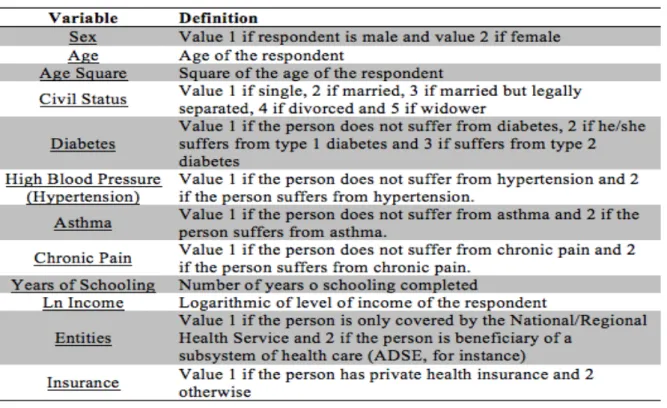
The variables chosen were the following: age, sex, civil status, suffering from diabetes, hypertension, asthma or chronic pain, number of years of schooling completed, income, which entity the person is beneficiary of in terms of health care (if the person is covered only by the National/Regional Health System or if it is beneficiary of some subsystem
of health: ADSE, for instance) and whether or not the person as private health insurance. The variable age square was also included in order to deal with the non-linear age effect. By this I mean that, as a person ages, it is likely that quality of life tends to decrease at an increasing rate.
According to Theodorou et al. (2011), there are, in fact, differences in quality of life due to variances of these socio-demographic characteristics, as the relation between these characteristics and quality of life is characterized by a higher quality of life amongst participants with higher education and in employment. These findings are supported by the findings of Gharipour et al. (2010), which also found a positive association between income, years of education and marital status with health related quality of life.
This positive correlation between this variables and quality of life may be due to the fact that, as Theodorou (2010) states, following the doctor’s instructions is linked to these economic and social factors.
3. Data
To achieve the values needed for each dimension of the EQ-5D per respondent of the National Health Survey (NHS), one looked for the appropriate questions and, with the given answers, matched them to one of the possible levels. Furthermore, in order to achieve a single index, the weights for each dimension used were the ones previously calculated by Ferreira et al. (2013).
Given missing answers in the National Health Survey, the number of individuals included in this study was 5649 with 3098 females and 2551 males. Moreover, the number of respondents who were aged below 18 was 709, between 18 and 50 was 2587 and above 50 years old 2353. Additionally, the number of diabetics was of 427 individuals, with 59 suffering from type 1 diabetes and the remaining 368 had type 2
diabetes, and the people who suffer from hypertension accrued to 1344. Separating males from females, we get the number of female diabetics to be 220 (30 suffering from type 1 diabetes and 190 from type 2 diabetes), while the hypertensive females ascended to 816; furthermore, the male diabetics were 207 (29 with type 1 diabetes and 178 with type 2 diabetes), whilst the ones who suffered from high blood pressure was 528. From these results, it is possible to see that there is quite a difference between diabetics (427) and hypertensive people (1344), with more respondents suffering from type 2 diabetes (368) than type 1 (59); nonetheless, the mean duration of each one is rather similar (11 years, approximately, for the ones who suffer from high blood pressure and 10 years for the diabetics).
3.1. Matching EQ-‐5D and NHS
So that one may present the values of each dimension of the EQ-5D index, as was already stated, it was necessary to match the suitable questions of the Portuguese NHS. The questions that matched the dimensions were the following:
Thus, for instance, if one looks at the first dimension (mobility) what was performed to achieve the levels for each respondent was that if the person answered “Yes” to the question “Are you confined to bed?” then, it means that it faces severe problems in dimension mobility, so level 3 is given. If the answer is “No”, the following questions are needed, hence, if the answer for “Do you spend all day on a chair?” is “Yes”, level 2 is assumed, if “No” is the answer, in order to give level 1 to the respondent, the answer to the question “How far can you walk without stopping or feeling any discomfort?” needs to be “More than 200 meters”, otherwise, level 2 is given as well, even if the person does not spend all day in a chair.
After this matching, it is possible to create the several health states provided by the EQ-5D index. So, given each person’s answer to how they feel in each dimension, it is achieved a unique health state combining the levels of each of the five dimensions. For instance: 11111 is a perfect health state in which the person faces no problems in any of the dimensions, 22122 is a health state in which the person faces no problems in usual activities and faces moderate problems in all other dimensions.
After these health states are attained, one can calculate a single value so that it is possible to compare and evaluate the quality of life across individuals.
3.2. Achieving the EQ-‐5D index
After the calculation of individual health states of the EQ-5D, it was necessary to calculate the single index based on the weights given to each dimension previously determined by Ferreira et al. (2013). It is important to stress that the EQ-5D index cannot be higher than 1, which corresponds to a “perfect” health state, however, it can be below 0, which will give situations in which the respondents are in a situation considered to be “worse than death”.
It was not possible to compose the EQ-5D index with all the respondents of the National Health Survey, due to the fact that there were several missing values in important questions that were necessary to calculate the values for each dimension. So, the results are not a full representation of the Portuguese population, more specifically 5084 answers were lost in the calculation process of the EQ-5D.
4. Results
After calculating the EQ-5D index, a computation of the summary statistics was made, in order to compare how do the values change when the respondents suffer from one of the diseases or even from both.
The graphs below show us the EQ-5D index and the Self-assessed Ranking of Health of the full sample of the NHS.
Graphs 1: Comparison of the EQ-5D Index with the Self-Assessed Ranking of Health (full sample)
Analysing the graph on the left that corresponds to health states measured in terms of the EQ-5D Index, one can observe that there is a majority part of the respondents who are in a health state smaller than 1 (4387 of the respondents have a value smaller than 1 and greater than 0) and there exists, also, a minority part of the population who are in a state considered to be worse than death (12 people have an EQ-5D<0 and 2 are in a
health state equal to zero). Moreover, 1247 of the respondents are in a perfect health state (EQ-5D=1).
Now, analysing the graph to the right, which corresponds to the Self-Assessed Ranking of Health, one observes some major differences: the number of people in the worst health state is quite larger (149), while the number of people in the best health state is rather smaller (603). Below, is a similar analysis for Hypertensive people and type 1 and type 2 diabetics.
Graphs 2: Comparison of the EQ-5D Index with the Self-Assessed Ranking of Health (hypertension)
If one looks at the graphs initially computed, it is possible to observe small difference. Observing only the graphs on the left, there is a decrease in the percentage of the population who were in a situation of full health state. Also there was an increase in the percentage of people in region between 0 and 0.5, which may begin to suggest that suffering from diabetes may lead to a decrease in the quality of life. In what concerns the graphs on the right, there was an evident decrease of the percentage of the population in the best health state (5), from 11% to merely 2%, moreover, one sees that the percentage of the population that considered themselves in the health state 4 suffered, also, a great decrease.
Graphs 3: Comparison of the EQ-5D Index with the Self-Assessed Ranking of Health (type 2 diabetics)
Graphs 3 correspond to the part of the population who suffers from type 2 diabetes. We perceive a similar pattern to the ones concerning people who suffer from hypertension. Regarding the graph on the right, one observes, again, a great decrease in the area corresponding to the two best health states (4 and 5). Regarding the graph on the left, there is also a decrease in the percentage of the population in the perfect health state and a greater increase in the percentage of people who are considered to be in a situation worse than death.
Graph 4: Comparison of the EQ-5D Index with the Self-Assessed Ranking of Health (type 1 diabetics)
From the graphs above, one immediately see a different pattern than the ones computed for hypertension and type 2 diabetes. From the graph on the right, the main change is the percentage of people in health state 1 and 2, and, looking at the graph on the left,
death. Moreover, the graph on the left shows a greater decrease in the percentage of people in the perfect health state or in health states close it.
From this initial analysis, one can suspect that these diseases have an impact in quality of life, regardless of how it is measured (even though the impact will differ).
Subsequently, one analysed how the EQ-5D index varies according to age, sex and existence or not of the two diseases.
Table 2: Mean EQ-5D Index by age, sex and disease
In the table it is quite easy to observe that with the increase in age there is a decrease in the EQ-5D index, and hence of the quality of life. Particularly, the EQ-5D index of people with less than 20 years old is much higher than those with more than 71 years old. Moreover, one can also see that females present a less EQ-5D index than males, and clearly there is a decrease in the quality of life of people who suffer from diabetes and hypertension in a similar length. This can begin to be an indicative that the effect of both diseases will be alike.
Below, one presents how these two diseases influence the dimensions of the EQ-5D Index. First and foremost, in order to see how these diseases will affect the dimensions in the EQ-5D, one will examine how are the distribution of the respondents per level of each dimension.
Table 3: Percentage of population, with no chronic disease, per level of the EQ-5D index
As one can observe, the respondents that do not suffer from any chronic disease are mainly in level 1 in the first dimensions. Nonetheless, even though these people do not suffer from any disease, there is still a significant number that suffer from moderate or even severe problems in the dimensions pain/discomfort and anxiety/depression.
Table 4: Percentage of population suffering from diabetes per level of the EQ-5D index
From this table, one can verify that people who suffer from type 1 diabetes have more severe problems in all of the dimensions than people who suffer from type 2 diabetes. Nonetheless, in both cases, the two most affected dimensions are Pain/Discomfort and
When looking only at the respondents who suffer from hypertension, one actually observes quite a analogous pattern to the one described above; which means that the most affected dimensions are pain/discomfort and anxiety/depression, with the latter having the larger number of level 3 answers, as we can clearly see in the table below.
Table 5: Percentage of population suffering from hypertension per level of the EQ-5D index
From these results, we see that these two diseases do not affect much day-to-day activities but do, in fact, have a huge impact in the psychological of the sufferers.
5. Method
In order to estimate how quality of life is affected by all the independent variables described above, one estimated two different models that differ based on the dependent variable.
Hence, the first regression will be done using a Tobit model, due to the fact that the dependent value -EQ-5D index- is subject to a ceiling effect. This ceiling effect corresponds to the fact that this index cannot present values larger than 1, as a person cannot be in a situation better than the one considered to be the “perfect” health state. This means that the EQ-5D is upper-limited to 1. Moreover, as was already said, the dependent variable is merely a sample of the population (due to the several missing values in the NHS) and so is not representative of the population as a whole.
This time, the model used was an Ordered Probit model. This model was chosen because the dependent variable will be defined as 5 possible outcomes, which present important meaning due to their order, in the sense that it is important to state that 5 is better than 4, which is better than 3, and so on. So the model to use needs to take these factors into account, and so, the model to do so is the Ordered Probit Model.
The different independent variables estimated in these two models were the ones already presented in the Literature Review. It is, however, relevant to mentions a few important notes.
The variable Civil Status will be separated into 5 dummy variables: 1 corresponds to whether or not the person is single, 2 if the person is married, 3 if the person is married but legally separated, 4 is when the person is divorced and, finally, 5 if the person is a widower. Additionally, 4 dummy variables were used to incorporate if a person suffers or not from diabetes, asthma, hypertension and/or chronic pain. The variable diabetes takes value 1 if the person does not suffer from this disease, 2 if the person has type 1 diabetes and 3 if the person has type 2 diabetes. All other diseases take value 1 if the person does not suffer from it and 2 otherwise. Moreover, the variable entities takes value 1 if the person is only covered by National or Regional Health System in terms if health care and 2 if the person is beneficiary of some subsystem of health care.
In what concerns the variable income, the NHS presents it as 10 different categories: respondents could choose from these categories of income that stated that income was from a given minimum value to a maximum one. In order to use this variable in our model, mean income from each category was used. However, for the final category, income was presented as being greater than 2000€ so, to obtain the mid-point of this open-ended interval, one used the Pareto Curve and the method used by Henson (2014).
5.1. Results
Just as a reminder, below is presented a table with a brief description of each variables.
Table 6: Description of the variables
The Estimation results for the both models were the following:
Table 7: Estimation Results
. legend: * p<.05; ** p<.01; *** p<.001 _cons .23954315*** sigma _cons 1.0742103*** age2 .00012394*** 2.insurance -.01808997 2.entities .02278148** ln_income .03121744*** schooling -.00511265*** age -.01588326*** 2.chronicl~n -.09233915*** 2.highbloo~e -.01851076* 2.asthma -.03775353* 3 -.03043947* 2 -.06807892* diabetes 5 -.0204581 4 -.00399638 3 -.03859962 2 -.00925975 civilstatus 2.sex -.05601271*** model Variable EQ5D legend: * p<.05; ** p<.01; *** p<.001 _cons 1.2904161*** cut4 _cons -.27090928 cut3 _cons -1.8819752*** cut2 _cons -2.914685*** cut1 age2 .0002169*** 2.insurance -.0514045 2.entities -.04896143 ln_income .18235719*** schooling .05157435*** age -.04415771*** 2.chronicl~n -.69556962*** 2.highbloo~e -.38659891*** 2.asthma -.42881167*** 3 -.42162389*** 2 -1.087966*** diabetes 5 .02456748 4 .05044156 3 .04261296 2 -.01959858 civilstatus 2.sex -.20734524*** selfhealth Variable SelfHealth
Analysing the Tobit Model (table on the left), one sees that some results were quite different from what may have been expected, for instance the fact that the civil status is not statistically significant, which may be not entirely intuitive as a person who is married or lives with someone may feel less anxious or depressed, which should matter on the quality of life measured by the EQ-5D. Another variable not statistically significant for our model is whether or not the person has private health insurance. As expected, suffering from either one of the diseases listed above decreases the quality of life, but the one that has the most impact is whether or not the person has suffered from chronic pain. Additionally, one sees that a patient with type 1 diabetes has a larger decline in quality of life than a person with type 2 diabetes, and that both types of diabetes create a greater decline than hypertension.
Now, regarding the estimations on the right (Ordered Probit Model), in what concerns statistical significance, the results are quite alike with only one more variable not being significance: entities. The major difference from this table to the previous one is that the disease with the greatest negative impact on the quality of life (self-assessed by respondents) is no longer chronic pain but type 1 diabetes. Nevertheless, when analysing health conditions in this matter, one observes a much larger effect of either one of the diseases than before. Comparing both types of diabetes, one sees that type 1 is much more impactful than type 2, nevertheless, one perceives that the effect of hypertension will be, again, smaller.
Subsequently, two tests must be done, so that one can confidently say that the impacts of type 1 and 2 diabetes and hypertension are different. Below, one presents the test for the equality of parameters for the diseases, taking as dependent variable the EQ-5D Index.
Output 1: Test for the Equality of the parameters of type 1 and 2 diabetes and hypertension (Tobit Model)
In the three cases, the null hypothesis is not rejected; hence, the effect of both diseases in the health related quality of life is equal.
Below are the same tests, but using the Self-Assessed Ranking of Health as dependent variable.
Output 2: Test for the Equality of the parameters of diabetes and hypertension (Ordered Probit Model).
In this situation, one can see that the outcome will be different. Now, the null hypothesis is rejected for the first two scenarios, thus the effect of type 1 diabetes and type 2 diabetes, and of type 1 diabetes and hypertension will not be the same. Nonetheless, type 2 diabetes and hypertension do have an equal impact in the self-assesses quality of life.
5.1.1. Compensating Diabetics and Hypertensive Patients
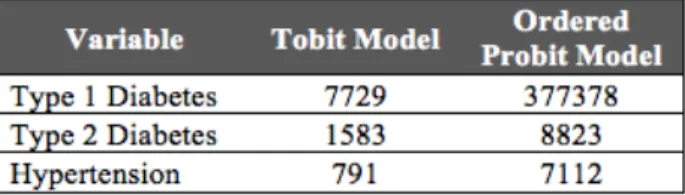
After this analysis, one may wonder how much should be given to a sick person in order for his/her well being to be equal to that of a healthy person. In order to do so, one calculated the Compensating Variation Income (CIV) based on a paper by O’Neill (2014). Prob > F = 0.3679 F( 1, 5632) = 0.81 ( 1) type2 - highbloodpressure = 0 . test type2=highbloodpressure Prob > F = 0.0784 F( 1, 5632) = 3.10 ( 1) type1 - highbloodpressure = 0 . test type1=highbloodpressure . test type1=highbloodpressure Prob > F = 0.2012 F( 1, 5632) = 1.63 ( 1) type1 - type2 = 0 . test type1=type2 Prob > F = 0.6387 F( 1, 5632) = 0.22 ( 1) type2 - highbloodpressure = 0 . test type2=highbloodpressure Prob > F = 0.0000 F( 1, 5632) = 26.24 ( 1) type1 - highbloodpressure = 0 . test type1=highbloodpressure Prob > F = 0.0000 F( 1, 5632) = 22.74 ( 1) type1 - type2 = 0 . test type1=type2
Table 8: Mean CIV for each disease
From the table above, one can see that respondents from the NHS with type 1 diabetes require a much larger amount than respondents with either type 2 diabetes or hypertension. Furthermore, one also observes a rather difference between the CIV depending on the model used; using the estimations of the Ordered Probit Model, the amount of money needed to compensate a sick person, in order to achieve the same well-being of a not ill person, is much higher than when one uses the estimation of the Tobit Model.
5.1.2. Removing non-‐significant variables
In this section, one will analyse what happens to the two models when the non-statistically significant variables are removed.
Table 8: Estimation Results without non-significant variables legend: * p<.05; ** p<.01; *** p<.001 _cons .23965266*** sigma _cons 1.0544782*** age2 .00012594*** 2.entities .02285067** ln_income .0319615*** schooling -.00475504*** age -.01623464*** 2.chronicl~n -.09201462*** 2.highbloo~e -.01903627* 2.asthma -.03740656* 3 -.03061854* 2 -.06827805* diabetes 2.sex -.05741955*** model Variable active legend: * p<.05; ** p<.01; *** p<.001 _cons 1.3019374*** cut4 _cons -.25839492 cut3 _cons -1.8688942*** cut2 _cons -2.9015011*** cut1 age2 .00022081*** ln_income .17566684*** schooling .0515475*** age -.04456268*** 2.chronicl~n -.69695078*** 2.highbloo~e -.38799734*** 2.asthma -.42677711*** 3 -.42351527*** 2 -1.083441*** diabetes 2.sex -.20667388*** selfhealth Variable active
From the table on the left (Tobit Model) one sees that, by removing the variables civil status and private health insurance, our estimation remains quite similar in the sense that the coefficients barely change. However, now one has a model with all variables being statistically significant.
Similar to what happened in the Tobit Model, one sees that in the Ordered Probit Model (table on the right), again, by removing non-significant variables from the estimation, the results are barely altered and, once more, one finds itself with a model with all variables being statistically significant.
Discussion
As was discussed above, type 1 diabetics suffer a greater decrease in quality of life (using the Self-Assessed Ranking of Health) than hypertensive patients. This can be easily explained by the fact that, on the contrary of diabetics, hypertensive people are able to live quite a normal life (given that they take the medicines needed). Additionally, even though type 1 diabetics are the ones who suffer the most decrease in quality of life, we also observe a significant decrease in well being in hypertensive people and type 2 diabetics.
However, if one uses the EQ-5D index the result is that suffering from either one of the diseases leads to similar impact on quality of life. Hence, the main difference to be explained here is the fact that when people assess their health states, the impact is quite different and much larger.
When one uses the EQ-5D index, there are only 5 dimensions that are taken into account, and only 3 levels that rank the amount of difficulties one has in each dimensions. So, both diseases may not affect those 5 dimensions that much (as seen in the beginning, the most affected were Pain/Discomfort and Anxiety/Depression), but if
one assesses his own well-being, he may find other dimensions which are more affected and may even attach more weight to these other dimensions.
Furthermore, it is important to state that using the Self-Assessed Ranking of Health requires a greater amount of compensation for ill people to be as well off as those without these conditions.
Conclusion
After the conclusion of this work project, one intended to answer the question: Who suffers the most?
However, the answer depends on how one measured quality of life. If the instrument to do so were the EQ-5D index, the answer would be that diabetics and hypertensive people suffer equally (regardless of being type 1 or type 2 diabetics). Although if one used a self-assessed ranking of health the answer would be that type 1 diabetics suffer more than people who suffer from type 2 diabetics hypertension; and the impact of type 2 diabetics and hypertension is quite similar.
Moreover, it is important to state that these results may not be representative of the whole Portuguese population, in the sense that, in this study, it is not possible to work with every respondent in the NHS due to the amount of missing answers in the survey. Nonetheless, this study can begin to give us some intuition that perhaps one should focus more on how to improve quality of life for type 1 diabetics, fundamentally on the dimensions related to psychological health (as dimensions anxiety/depression and pain/discomfort are the most affected ones). Given that type 1 diabetics require quite a large amount to be as well off as non-diabetics, if one targets attention to these dimensions, it will allow an increase in quality of life and also a decline in the compensation needed to achieve a better well-being.
These findings are consistent with similar studies that show that, in what regards hypertension, the main impaired functions are the ones related to social and psychological functioning; moreover the least damaged functions are the ones consistent with mobility and usual activities, which is also true in this work project. However, one found that pain/discomfort is also a particularly damaged dimension in hypertensive people, which should not be the case, as other studies found, since hypertension is a disease usually not associated with pain.
Now, analysing the results for diabetics, they were also quite similar to those of previous studies. Diabetes is a disease that, also, mostly affects psychological functioning, in the sense that sufferers from this disease are more likely to experience depressions, which is corresponds with the findings in this work project.
References
Badia, Xavier et al., 2001. “A Comparison of United Kingdom and Spanish General Population Time Trade-off Values for EQ-5D Health States”, Med Decis Making, 21, 7-16
Cameron, A. Colin, Trivardi, Provin K, 2005, “Multinomial Models: Ordered Sequential and Ranked Outcomes”, in Microeoconoemtrics: Methods and Applications, 519-521, Cambridge University Press
Cameron, A. Colin, Trivardi, Provin K, 2005, “Tobit and Selection Methods: Censored and Truncated Models”, in Microeoconoemtrics: Methods and Applications, 530-531, Cambridge University Press
Carvalho, Michelle Adler Normando et al., 2012. “Quality of Life of Hypertensive Patientes and Comparison of two Instruments of HRQOL Measure” (http://www.scielo.br/pdf/abc/2012nahead/en_aop03112.pdf)
Choi, Yong Jun et al., 2011. “ The Relationship between Diabetes Mellitus and Health-Related Quality of Life in Korean Adults: The Fourth Korea National Health and Nutrition Examination Survey”, Diabetes Metab J., Volume 35, 587-594 (http://www.ncbi.nlm.nih.gov/pmc/articles/PMC3253969/)
Dyer, Matthew TD et al., 2010. “A Review of health utilities using the EQ-5D in studies of cardiovascular disease”. (http://www.hqlo.com/content/8/1/13)
Ferreira, Lara N. et al., 2013. “The valuation of the EQ-5D in Portugal”, Quality of Life Research, Volume 23, Issue 2, pp 413-423
Gharipour, Mojgan et al., 2010. “Socioeconomic characteristics and controlled
hypertension: Evidence from Isfahan Healthy Heart Program”, Acta Cardiol., Volume 65, 425-30 (http://www.ncbi.nlm.nih.gov/pubmed/20821935)
Jordhoy, MS. et al., 2001. “Quality of life in advanced cancer patients: the impact of sociodemographic and medical characteristics”, British Journal of Cancer, Volume 85,
1478-1485(http://www.ncbi.nlm.nih.gov/pmc/articles/PMC2363932/pdf/85-6692116a.pdf)
O’Neill, Stephen, 2014. “Monetising the impact of various health conditions on the well being of elderly across Europe”, mimeo, presented at the EuHEA PhD conference (Manchester)
Parker, Robert Nash and Fenwick, Rudy, 2014 “The Pareto Curve and Its Utility for Open-Ended Income Distributions in Survey Research”
Sakamaki, Hiroyuki et al., 2006. “Measurement of HRQL Using EQ-5D in Patients with Type 2 Diabetes Mellitus in Japan”, International Society for Pharmacoeconomics and Outcomes Research, Volume 9, Number 1
(https://www.ispor.org/consortiums/asia/ViH/21-Sakamaki%20et%20al.pdf)
Theodorou, Mamas et al., 2011. “Quality of Life Measurement in Patients with Hypertension in Cyprus”, Hellenic Journal of Cardiology, Volume 52, 407-415 (http://www.hellenicjcardiol.org/archive/full_text/2011/5/2011_5_407.pdf)
Torrance, Nicola et al., 2014. “Estimating the burden of disease in chronic pain with and without neuropathic characteristics: Does the choice between the EQ-5D and SF-6D matter?” (http://www.ncbi.nlm.nih.gov/pmc/articles/PMC4220009/)
Wandell, Per E., 2005. “Quality of life of patients with diabetes mellitus”, Scandinavian Journal of Primary Health Care,Volume 23, 68-74
International Diabetes Federation: Diabetes Atlas, 6th edition 2013
Diabetes: Factos e Números Portugal 2014; Relatório Anual do Observatório Nacional da Diabetes
World Health Organization: A global brief on Hypertension, 2013