Rita Ilhão Moreira1 &Pedro Silva Cunha1&Pedro Rio1&Manuel Nogueira da Silva1&Luísa Moura Branco1& Ana Galrinho1&Joana Feliciano1&Rui Soares1&Rui Cruz Ferreira1&Mário Martins Oliveira1
Received: 19 October 2017 / Accepted: 6 February 2018 / Published online: 19 February 2018 # Springer Science+Business Media, LLC, part of Springer Nature 2018
Abstract
Purpose Renal dysfunction is often associated with chronic heart failure, leading to increased morbi-mortality. However, data regarding these patients after cardiac resynchronization therapy (CRT) is sparse. We sought to evaluate response and long-term mortality in patients with heart failure and renal dysfunction and assess renal improvement after CRT.
Methods We analyzed 178 consecutive patients who underwent successful CRT device implantation (age 64 ± 11 years; 69% male; 92% in New York Heart Association (NYHA) functional class ≥ III; 34% with ischemic cardiomyopathy). Echocardiographic response was defined as≥ 15% reduction in left ventricular end-systolic diameter and clinical response as a sustained improvement of at least one NYHA functional class. Renal dysfunction was defined as an estimated glomerular filtration rate (eGFR) below 60 mL/min/1.73 m2.
Results Renal dysfunction was present in 34.7%. Renal dysfunction was not an independent predictor of echocardiographic response (OR 1.109, 95% CI 0.713–1.725, p 0.646) nor clinical response (OR 1.003; 95% CI 0.997–1.010; p 0.324). During follow-up (mean 55.2 ± 32 months), patients with eGFR < 60mL/min/1.73 m2had higher overall mortality (HR 4.902, 95% CI 1.118–21.482, p 0.035). However, clinical response in patients with renal dysfunction was independently associated with better long-term survival (HR 0.236, 95% CI 0.073–0.767, p 0.016). Renal function was significantly improved in patients who respond to CRT (ΔeGFR + 5.5 mL/min/1.73 m2
at baseline vs. follow-up,p 0.049), while this was not evident in nonresponders. Improvements in eGFR of at least 10 mL/min/1.73 m2were associated with improved survival in renal dysfunction patients (log-rankp 0.036).
Conclusion Renal dysfunction was associated with higher long-term mortality in CRT patients, though, it did not influence echocardiographic nor functional response. Despite worse overall prognosis, renal dysfunction patients who are responders showed long-term survival benefit and improvement in renal function following CRT.
Keywords Renal dysfunction . Cardiac resynchronization therapy . Chronic heart failure . Long-term outcome
1 Introduction
Cardiac resynchronization therapy (CRT) is a well-established treatment for patients with symptomatic heart failure (HF), depressed left ventricular (LV) ejection fraction (LVEF), and a prolonged QRS duration [1]. Several studies have
demonstrated improvement in exercise capacity, quality of life, and LVEF, in addition to reverse remodeling, mitral re-gurgitation reduction, and improved survival [2–7].
Renal dysfunction, defined as an estimated glomerular fil-tration rate (eGFR) reduced below 60 mL/min/1.73 m2, is often associated with chronic HF, with about one third of HF patients suffering from at least mild to moderate renal dysfunction [8–10].
Many of these heart failure patients are considered candi-dates for CRT. However, data regarding functional response and its effect on subsequent survival in this population is sparse. Moreover, CRT may have also a role in improving renal function, given the high degree of interaction seen in cardiorenal physiology [11,12]. The aim of this study was to
* Rita Ilhão Moreira [email protected]
1 Department of Cardiology, Hospital de Santa Marta, Centro
Hospitalar Lisboa Central, Rua de Santa Marta, n° 50, 1169-024 Lisbon, Portugal
Response and outcomes of cardiac resynchronization therapy in patients
with renal dysfunction
evaluate the response and subsequent long-term mortality in patients with HF and chronic renal dysfunction (CKD) and to understand the incidence and predictors of renal improvement after CRT.
2 Methods
2.1 Study design
This study is a single-center analysis of patients who underwent successful CRT device implantation. A total of 178 consecutive CRT recipients were included, and patient data was collected in our Cardiology Department Information System and analyzed. Extensive demographic and clinical data, including death, New York Heart Association (NYHA) class, and hospitalization for HF wors-ening were collected from medical records. Follow-up data were obtained by medical record reviews, outpatient clinical visits, and telephone contact.
The study protocol was approved by the local Research Ethics Board.
2.2 Patients
Patients were selected for CRT if they met the currently rec-ommended criteria: (1) LVEF < 35%, (2) symptoms of HF, defined as NYHA classes II–IV despite optimal medical ther-apy, and (3) QRS duration > 120 ms.
Patients were classified as ischemic in the presence of sig-nificant coronary artery disease (> 50% stenosis of two or more epicardial vessels or left main or proximal left anterior descending coronary artery stenosis > 50% on coronary angi-ography and/or a history of previous myocardial infarction or revascularization). The other patients were classified as nonischemic. Clinical response to CRT was defined as a sustained improvement≥ 1 in NYHA functional class at 6-month follow-up.
2.3 Evaluation of renal function
Estimated eGFR was calculated using the standard formula by Cockcroft and Gault and expressed in mL/min/1.73 m2[13]. Patients were divided into two pre-specified subgroups: eGFR < 60 mL/min/1.73 m2 and eGFR ≥ 60 mL/min/1.73 m2. Change in the continuous eGFR measurement was assessed, and the threshold of 10 mL/min/1.73m2was chosen to define renal response as in prior studies that demonstrated the rela-tionship between changes in GFR of 10 mL/min/1.73 m2and cardiovascular outcomes [14,15].
2.4 Implantation
All leads were placed transvenously via the subclavian and cephalic route using fluoroscopy. The right ventric-ular lead was positioned in the apex or mid septum. The LV lead was placed in the posterolateral or lateral tributary vein of the coronary sinus with an over-the-wire system depending on the ability to cannulate the veins, the pacing threshold, or the diaphragmatic stimu-lation. The standard settings included an atrioventricular (AV) delay of 100 ms (sensed) and 130 ms (paced), with DDD or DDDR mode and standard lower (50 beats/min) and upper (120–130 beats/min) pacing rates.
2.5 Echocardiography
Transthoracic two-dimensional echocardiography infor-mation was assessed at baseline and at 6 months of CRT device implantation. In this study, LV reverse remodeling (LVRR) was defined as an increase ≥ 15% reduction in left ventricular end-systolic dimension (LVESD). Echocardiographic cardiac dimensions and function were assessed using a commercially available ultrasound system (Vivid-7 and Vivid-E9; GE Vingmed Ultrasound, Horten, Norway) equipped with a 3.5-MHz transducer. LVESD, left ventricular end-diastolic di-mension (LVEDD), and LVEF were determined accord-ing to standard techniques and digitally stored for offline analysis in cine-loop format.
2.6 Statistical analysis
Data are expressed as mean ± standard deviation (SD) for continuous variables and as frequencies and percent-ages for categorical variables. Data distribution was test-ed for normality using the Kolmogorov–Smirnov test or Shapiro–Wilk as appropriate. Missing patient-level covariates were assumed to be missing and no imputation was performed. Comparisons of baseline characteristics and outcomes were performed using the chi-square test or Fisher’s exact test, when appropriate, for categorical variables and the Student’s t test or the Mann–Whitney test for continuous variables. The cumu-lative event rates after CRT implantation were calculated using the Kaplan–Meier method and dichotomizing the population according to the renal function. The log-rank tests for time-to-event data with respect to all-cause mortality were used for statistical comparison between two patient groups. All the statistical tests were two-sided, and a p value < 0.05 was considered significant. The SPSS version 21 software (SPSS Inc., Chicago, IL) was used for computation.
3 Results
3.1 Baseline characteristics
The study included 178 consecutive patients with an average age of 63.9 ± 10.7 years; the majority of whom were men (69.3%). Most had nonischemic cardiomyopathy (65.7%), suffered from severe HF (92.1% with NYHA class≥ III), and had poor LV function (mean LVEF 25.1 ± 6.5%).
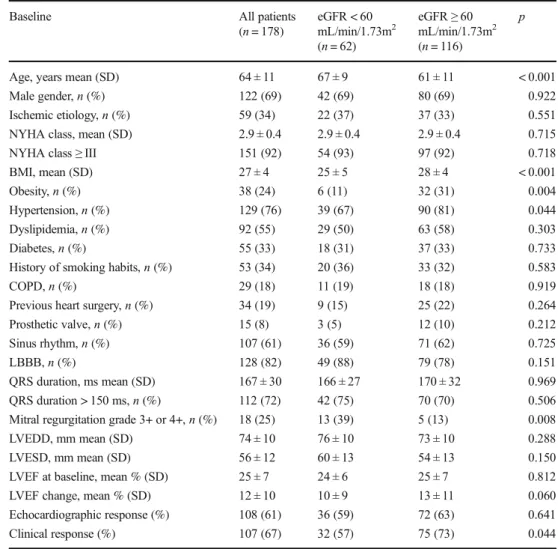
Mean plasma creatinine level was 1.16 ± 0.47 mg/dL, and mean estimated creatinine clearance was 72.8 ± 30.1 mL/min/ 1.73 m2. Renal dysfunction (eGFR < 60 mL/min/1.73 m2) was present in 34.7% of the patients. The baseline character-istics of the two groups are shown in Table1. Patients with renal dysfunction were older and presented a higher rate of moderate to severe mitral regurgitation. There were no signif-icant differences in pre-implant LVEF or QRS duration.
3.2 Renal function, left ventricular reverse
remodeling, and clinical response
Overall, 108 patients (60.6%) showed ≥ 15% reduction in LVESD (LVRR or echocardiographic response to CRT) at 6 months of follow-up. Echocardiographic response to CRT occurred without significant differences among patients with and without renal dysfunction (59.0 and 62.6%, respectively; p = 0.64). In a multivariable Cox-regression analysis, adjusting for age, sex, left bundle branch block, QRS duration > 150 ms, and etiology, renal dysfunction was not a predictor of LVRR (OR 1.109, 95% CI 0.713–1.725, p 0.646).
Although renal dysfunction was associated with less clini-cal response (57.1 vs. 72.8%,p = 0.04), in a multivariate lo-gistic regression analysis, baseline renal dysfunction was not an independent predictor for 6-month functional response (OR 1.003; 95% CI 0.997–1.010; p 0.324), after adjusting
Table 1 Baseline clinical and
echocardiographic characteristics Baseline All patients
(n = 178) eGFR < 60mL/min/1.73m2 (n = 62) eGFR≥ 60 mL/min/1.73m2 (n = 116) p
Age, years mean (SD) 64 ± 11 67 ± 9 61 ± 11 < 0.001 Male gender,n (%) 122 (69) 42 (69) 80 (69) 0.922 Ischemic etiology,n (%) 59 (34) 22 (37) 37 (33) 0.551 NYHA class, mean (SD) 2.9 ± 0.4 2.9 ± 0.4 2.9 ± 0.4 0.715 NYHA class≥ III 151 (92) 54 (93) 97 (92) 0.718 BMI, mean (SD) 27 ± 4 25 ± 5 28 ± 4 < 0.001 Obesity,n (%) 38 (24) 6 (11) 32 (31) 0.004 Hypertension,n (%) 129 (76) 39 (67) 90 (81) 0.044 Dyslipidemia,n (%) 92 (55) 29 (50) 63 (58) 0.303 Diabetes,n (%) 55 (33) 18 (31) 37 (33) 0.733 History of smoking habits,n (%) 53 (34) 20 (36) 33 (32) 0.583 COPD,n (%) 29 (18) 11 (19) 18 (18) 0.919 Previous heart surgery,n (%) 34 (19) 9 (15) 25 (22) 0.264 Prosthetic valve,n (%) 15 (8) 3 (5) 12 (10) 0.212 Sinus rhythm,n (%) 107 (61) 36 (59) 71 (62) 0.725 LBBB,n (%) 128 (82) 49 (88) 79 (78) 0.151 QRS duration, ms mean (SD) 167 ± 30 166 ± 27 170 ± 32 0.969 QRS duration > 150 ms,n (%) 112 (72) 42 (75) 70 (70) 0.506 Mitral regurgitation grade 3+ or 4+,n (%) 18 (25) 13 (39) 5 (13) 0.008 LVEDD, mm mean (SD) 74 ± 10 76 ± 10 73 ± 10 0.288 LVESD, mm mean (SD) 56 ± 12 60 ± 13 54 ± 13 0.150 LVEF at baseline, mean % (SD) 25 ± 7 24 ± 6 25 ± 7 0.812 LVEF change, mean % (SD) 12 ± 10 10 ± 9 13 ± 11 0.060 Echocardiographic response (%) 108 (61) 36 (59) 72 (63) 0.641 Clinical response (%) 107 (67) 32 (57) 75 (73) 0.044 Obesity was defined as BMI≥ 30 kg/m2. Heart surgery includes previous valvular and/or revascularization surgery
NYHA New York Heart Association, BMI body mass index, COPD chronic obstructive pulmonary disease, LBBB left bundle branch block,LVEDD left ventricle end-diastolic diameter, LVESD left ventricle end-systolic diameter, LVEF left ventricular ejection fraction
for age, sex, left bundle branch block, QRS duration > 150 ms, and etiology.
3.3 Renal function and long-term mortality
Renal function was investigated in relation to mortality after CRT. At the end of the follow-up period (mean follow-up 55.2 ± 32 months), 51 patients (29.0%) had died. Compared to patients without renal dysfunction, patients with eGFR < 60 mL/min/1.73 m2had a higher mortality (45.9 vs. 20.0%, p < 0.001), with a 10-mL/min/1.73 m2
lower eGFR being as-sociated with a 20% higher risk for mortality. In patients with renal dysfunction, a cumulative 9, 18, and 26% of the patients died by 12-, 24-, and 36-month follow-ups, respectively. In contrast, a respective 2, 5, and 8% of the patients without renal dysfunction died during the same time period (log-rankp val-ue 0.001).
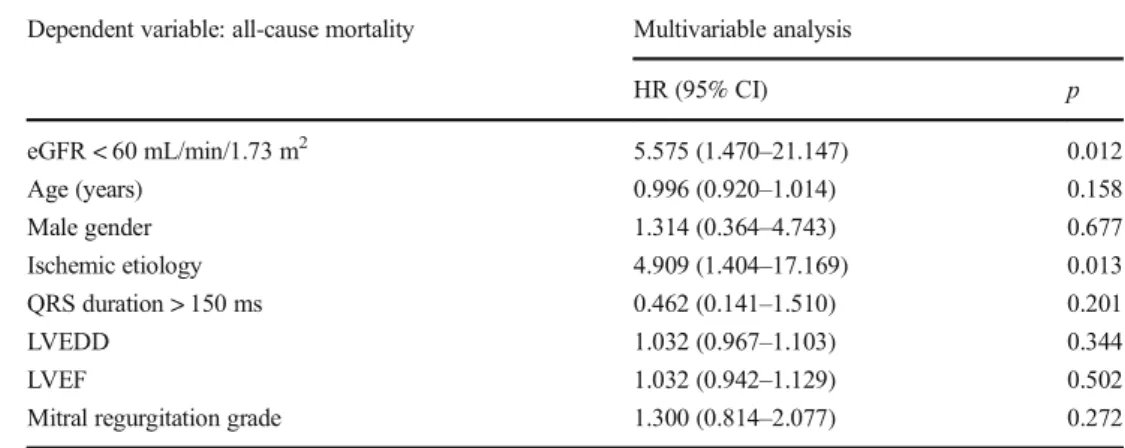
Renal dysfunction was tested as an independent predictor for mortality using a Cox proportional hazards model, adjusting for age, sex, etiology of heart failure, QRS duration > 150 ms, LV dimensions, LVEF, and mitral regurgitation grade. Renal dysfunction remained a strong predictor of mor-tality after CRT, with a corrected hazard ratio (HR) of 5.575 (95% CI 1.470–21.147, p 0.012, Table2).
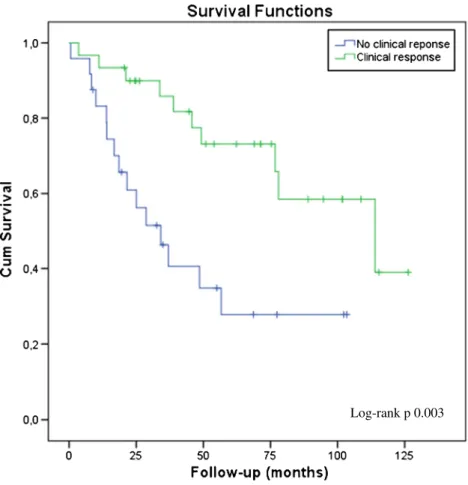
In patients with clinical response, a lower eGFR was asso-ciated with increased mortality after follow-up (31.1 vs. 13.3%,p = 0.03). However, in renal dysfunction patients, those who had functional response had a better survival com-pared to clinical nonresponders, as can be seen in Kaplan– Meier curve (log-rankp value 0.003, Fig.1). Furthermore, there was no significant difference regarding the amplitude of the benefit following CRT in responders with renal dys-function by comparison to responders with normal renal func-tion (Fig.2). In patients with renal dysfunction, clinical re-sponses (HR 0.236, 95% CI 0.073–0.767, p = 0.016) as well as female gender (HR 0.013, 95% CI 0.033–0.668, p = 0.013)
and LVEDD (HR 0.915, 0.816–0.972, p = 0.004) were inde-pendent survival predictors after multivariate Cox analysis.
3.4 Renal response after CRT
In 155 patients, blood samples were available after 6-month follow-up and the effect of CRT on renal function was assessed. Overall, there was an improvement in renal function (eGFR 75.1 mL/min/1.73 m2 at baseline vs. 80.2 mL/min/ 1.73 m2at follow-up,p = 0.022), including in renal dysfunc-tion patients (43.2 mL/min/1.73 m2at baseline vs. 50.8 mL/ min/1.73 m2at follow-up,p = 0.005). This improvement was only significant in patients who showed response to CRT (ΔeGFR + 5.5 mL/min/1.73 m2
at baseline vs. follow-up, p = 0.049, for echocardiographic responders; ΔeGFR + 6.0 mL/min/1.73 m2,p = 0.028, for clinical responders). In nonresponders, no significant improvement in renal function was observed (ΔeGFR + 4.2 mL/min/1.73 m2
,p = 0.227, for echocardiographic nonresponders; ΔeGFR + 0.6 mL/min/ 1.73 m2,p = 0.871, for clinical nonresponders).
Renal response (improvement in eGFR of at least 10 mL/ min/1.73 m2) was observed in 35.2% of all population. In a multivariable model, age (OR 0.900, 95% CI 0.841–0.964, p = 0.003), male gender (OR 0.207, 95% CI 0.064–0.660, p = 0.008), NYHA class ≥ III at baseline (OR 29.307, 95% CI 2.413–356.028, p = 0.008), and change in LVEF (OR 1.06, 95% CI 1.007–1.117, p 0.027) were predictors of renal response. Each 1% improvement in LVEF between baseline and follow-up was associated with a 6% increased likelihood of renal response.
To assess the impact of renal response on survival of pa-tients with renal dysfunction, Kaplan–Meier analysis was per-formed in patients stratified by presence or absence of renal response (Fig.3). Renal response was associated with signif-icantly improved survival in renal dysfunction patients (log-rank p value 0.036). In a multivariable Cox-regression
Table 2 Multivariable analysis of eGFR and clinical and
echocardiographic factors on mortality
Dependent variable: all-cause mortality Multivariable analysis
HR (95% CI) p eGFR < 60 mL/min/1.73 m2 5.575 (1.470–21.147) 0.012 Age (years) 0.996 (0.920–1.014) 0.158 Male gender 1.314 (0.364–4.743) 0.677 Ischemic etiology 4.909 (1.404–17.169) 0.013 QRS duration > 150 ms 0.462 (0.141–1.510) 0.201 LVEDD 1.032 (0.967–1.103) 0.344 LVEF 1.032 (0.942–1.129) 0.502
Mitral regurgitation grade 1.300 (0.814–2.077) 0.272 HR hazards ratio, CI confidence intervals, LBBB left bundle branch block, LVEDD left ventricle end-diastolic diameter,LVEF left ventricular ejection fraction
analysis, improvement in eGFR of at least 10 mL/min/1.73 m2 remained an important predictor of outcomes in patients with renal dysfunction (HR 0.004, 95% CI 0.000–0.667, p 0.035).
4 Discussion
The findings of the current study can be summarized as follows: (1) baseline renal dysfunction (eGFR < 60 mL/min/1.73 m2) is
a strong predictor for long-term mortality in patients undergo-ing CRT implantation; (2) there was no significant difference in echocardiographic nor clinical response rate to CRT between patients with and without renal dysfunction; (3) renal dysfunc-tion patients who are responders to CRT therapy show better long-term outcome; (4) CRT responders have a significant im-provement in renal function; and (5) renal response (improve-ment in eGFR of at least 10 mL/min/1.73 m2) is associated with improved survival in renal dysfunction patients.
Log-rank p 0.003
Fig. 1 Kaplan–Meier survival curves of CRT patients with renal dysfunction according to clinical response
Fig. 2 Long-term all-cause mor-tality in each eGFR group by functional response to CRT
HF is a systemic condition affecting and being affected by several organs as a result of the bidirectional relationship be-tween the cardiovascular symptoms and other systems, in-cluding renal, hepatic, pulmonary, central nervous, and hema-topoietic systems [16–19]. HF is a risk factor for the develop-ment of CKD and vice versa, while the two conditions quite often coexist. The potential pathogenic pathways linking HF with CKD involve neuro-hormonal activation, inflammation, and coincident risk factors [20].
Renal failure is greatly prevalent among HF patients. It has been estimated that as many as 25 to 50% of patients with HF have impaired renal function (creatinine clearance < 60 mL/ min/1.73 m2) [4, 10,21,22]. In large trials, including the SOLVD (Studies of LV Dysfunction) [21] and CHARM (Candesartan in Heart Failure: Assessment of reduction in Mortality and Morbidity) [23], eGFR < 60 mL/min/1.73 m2 was associated with increased mortality during long-term fol-low-up.
Renal dysfunction patients with CRT therapy started to be evaluated more recently. In a subanalysis of the MIRACLE (Multicenter InSync Randomized Clinical Evaluation) study [24], 452 patients were randomized to either CRT or control group. In the CRT group, patients with decreased eGFR had less mean reduction of LV dimensions. Although, authors did
not test for significance of these results, this observation sug-gested that impaired renal function results in less LVRR after CRT. This topic was further evaluated by Van Bommel and colleagues [25] in a group of CRT recipients (NYHA class III or IV; LVEF 24 ± 8%) with a high prevalence (39%) of eGFR < 60 mL/min/m2. In this study, renal dysfunction was a pre-dictor for echocardiographic nonresponse, which may be an explanation for no response and higher mortality in the renal dysfunction group.
We, however, showed that echocardiographic response to CRT occurred without significant differences among patients with and without renal dysfunction and that baseline eGFR was not a predictor for 6-month echocardiographic nonre-sponse. Furthermore, although patients with renal dysfunction presented less clinical response, after adjusting for other clin-ical variables, baseline eGFR was not a predictor of functional nonresponse. These results have also been demonstrated pre-viously by Bogdan and colleagues [26] in 179 patients with CRT (90% NYHA class III or IV, LVEF = 24.2 ± 6.2%), in which functional response rates (defined by a composite score using New York Heart Association functional class, 6-min walk test, and quality of life) did not differ significantly be-tween patients with and without renal dysfunction. These find-ings suggest that the functional and echocardiographic benefit
Fig. 3 Kaplan–Meier survival curves of CRT patients with renal dysfunction according to renal reponse
of CRT is not diminished among patients with renal dysfunc-tion. Additionally, we found that renal dysfunction patients who responded to CRT had a better outcome than nonre-sponders. In a subanalysis of MADIT-CRT trial [27], it was also demonstrated that long-term benefit from CRT was not influenced by baseline renal function. In this study, patients with left bundle brunch block derived long-term benefit form CRT, with greater absolute risk reduction in death among those with moderate renal dysfunction (absolute risk reduction of 14% for all-cause mortality in patients with eGFR < 60 mL/ min/1.73m2vs. 6% in patients without renal dysfunction).
Finally, we also observed that patients who respond to CRT have a significantly improvement of renal function, while this is not evident in nonresponders. This renal response after CRT was also observed in patients with renal dysfunction at base-line, and it was associated with better long-term survival in these patients. CRT might improve renal function by several mechanisms, including improvement in LVEF, with conse-quently improvement in forward perfusion and decrease in venous congestion [11]. The fact that LVEF changes were an independent predictor of renal response in our study sup-ports this explanation. These results were also demonstrated by Singal and colleagues [14] in a retrospective analysis where improvement in renal function occurred in patients across all CKD stages with LVEF improvement being a pre-dictor of renal response. In this study, it was also demonstrated that renal response conferred a significant (73%) hazard re-duction for 5-year death, transplant, or LV assistance device.
Taking these results into consideration, the excess mortality in the renal dysfunction group may be due to other potential causes than CRT nonresponse per se. Even milder degrees of renal impairment have been associated with increasing mor-tality and cardiovascular complications [15]. Renal dysfunc-tion may also lead to other complicadysfunc-tions, such as azotemia, anemia, derangements in calcium–phosphate homeostasis, in-flammation, infection, and conditions promoting coagulation [28–30], each of which may contribute to the risk for mortal-ity, either cardiac or noncardiac.
In fact, in this population, annual mortality rate in patients with renal dysfunction was more than triple comparing with patients without renal dysfunction. This fact should be taken into consideration when deciding for CRT. However, since patients with renal dysfunction in our study derived a CRT benefit, as clinical responders had better long-term survival by comparison to nonresponders, in our opinion, patients with renal dysfunction should not be excluded from CRT.
5 Limitations
This is a retrospective, nonrandomized, and noncontrolled study, which should be considered when interpreting the re-sults. Nonetheless, this represents a real-life group of patients.
Clinical response was based only in NYHA class improve-ment and did not include functional capacity evaluation and quality of life scores, and the definition of LV improvement used was limited to change in dimensions, as pre- and postimplant LV volumes were not always available. Clinical and echocardiographic response was evaluated at 6 months of follow-up, and some patients may have late LVRR [31,32]. Only a few patients had eGFR < 45 mL/min/1.73 m2(15.7%), and therefore one needs to be cautious when extrapolating the results to the extremes. Parameters such as position of LV lead, device programming, presence of rhythm abnormalities, extent of myocardial scar, biomarker brain natriuretic peptide, and diuretic dosage data were not addressed in this study.
6 Conclusion
Renal dysfunction (eGFR < 60 mL/min/1.73 m2) was associ-ated with higher long-term mortality in CRT patients. However, mild to moderate renal dysfunction did not influ-ence echocardiographic nor functional response. Despite worse overall prognosis, responder patients with renal dys-function still have a long-term survival benefit following CRT. Furthermore, CRT responders show an improvement in renal function which was associated with better survival. The excess mortality in mild to moderate renal dysfunction patients may be due to other potential causes than CRT non-response per se, and therefore, we suggest that these patients should not be excluded for CRT.
Compliance with ethical standards
The study protocol was approved by the local Research Ethics Board.
Conflict of interest The authors declare that they have no conflicts of interest.
References
1. Ponikowski P, Voors AA, Anker SD, Bueno H, Cleland JGF, Coats AJS, et al. 2016 ESC Guidelines for the diagnosis and treatment of acute and chronic heart failure. Eur J Heart Fail. 2016:933–89. 2. McAlister FA, Ezekowitz J, Hooton N, Vandermeer B, Spooner C,
Dryden DM, et al. Cardiac resynchronization therapy for patients with left ventricular systolic dysfunction: a systematic review. JAMA. 2007;297(22):2502–14.
3. Chung ES, Leon AR, Tavazzi L, Sun JP, Nihoyannopoulos P, Merlino J, et al. Results of the predictors of response to CRT (PROSPECT) trial. Circulation. 2008;117(20):2608–16.
4. Moss AJ, Hall WJ, Cannom DS, Klein H, Brown MW, Daubert JP, et al. Cardiac-resynchronization therapy for the prevention of heart-failure events. N Engl J Med. 2009;361(14):1329–38.
5. Yu C-M, Sanderson JE, Gorcsan J. Echocardiography, dyssynchrony, and the response to cardiac resynchronization ther-apy. Eur Heart J. 2010;31:2326–37.
6. Miyazaki C, Redfield MM, Powell BD, Lin GM, Herges RM, Hodge DO, et al. Dyssynchrony indices to predict response to car-diac resynchronization therapy: a comprehensive prospective single-center study. Circ Heart Fail. 2010;3(5):565–73.
7. Delgado V, Van Bommel RJ, Bertini M, Borleffs CJW, Marsan NA, Ng ACT, et al. Relative merits of left ventricular dyssynchrony, left ventricular lead position, and myocardial scar to predict long-term survival of ischemic heart failure patients undergoing cardiac resynchronization therapy. Circulation. 2011;123(1):70–8. 8. Smith GL, Lichtman JH, Bracken MB, Shlipak MG, Phillips CO,
DiCapua P, et al. Renal impairment and outcomes in heart failure. Systematic review and meta-analysis. J Am Coll Cardiol. 2006;47(10):1987–96.
9. Heywood JT, Fonarow GC, Costanzo MR, Mathur VS, Wigneswaran JR, Wynne J, et al. High prevalence of renal dys-function and its impact on outcome in 118, 465 patients hospital-ized with acute decompensated heart failure: a report from the ADHERE database. J Card Fail. 2007;13(6):422–30.
10. Giamouzis G, Kalogeropoulos AP, Butler J, Karayannis G, Georgiopoulou VV, Skoularigis J, et al. Epidemiology and impor-tance of renal dysfunction in heart failure patients. Curr Heart Fail Rep. 2013;10(4):411–20.
11. Bock JS, Gottlieb SS. Cardiorenal syndrome: new perspectives. Circulation. 2010;121(23):2592–600.
12. Ronco C, Haapio M, House AA, Anavekar N, Bellomo R. Cardiorenal syndrome. J Am Coll Cardiol. 2008;52(19):1527–39. 13. Cockcroft DW, Gault MH. Prediction of creatinine clearance from
serum creatinine. Nephron. 1976;16(1):31–41.
14. Singal G, Upadhyay GA, Borgquist R, Friedman DJ, Chatterjee NA, Kandala J, et al. Renal response in patients with chronic kidney disease predicts outcome following cardiac resynchronization ther-apy. Pacing Clin Electrophysiol. 2015;38(10):1192–200. 15. Anavekar NS, McMurray JJV, Velazquez EJ, Solomon SD, Kober
L, Rouleau J-L, et al. Relation between renal dysfunction and car-diovascular outcomes after myocardial infarction. N Engl J Med. 2004;351(13):1285–95.
16. Triposkiadis F, Starling RC, Boudoulas H, Giamouzis G, Butler JJ. The cardiorenal syndrome in heart failure: cardiac renal syndrome. Heart Fail Rev. 2012;17:355–66.
17. Møller S, Bernardi M. Interactions of the heart and the liver. Eur Heart J. 2013;34(36):2804–11.
18. Bang C, Antoniades C, Antonopoulos AS, Eriksson U, Franssen C, Hamdani N, et al. Intercellular communication lessons in heart fail-ure. Eur J Heart Fail. 2015;17:1091–103.
19. Vaduganathan M, Greene SJ, Butler J, Sabbah HN, Shantsila E, Lip GYH, et al. The immunological axis in heart failure: importance of the leukocyte differential. Heart Fail Rev. 2013;18(6):835–45.
20. Filippatos G, Farmakis D, Parissis J. Renal dysfunction and heart failure: things are seldom what they seem. Eur Heart J. 2014;35(7): 416–8.
21. Al-ahmad A, Rand WM, Manjunath G, Konstam MA, Salem DN, Levey AS, et al. Reduced kidney function and anemia as risk factors for mortality in patients with left ventricular dysfunction. J Am Coll Cardiol. 2001;38(4):955–62.
22. Dries DL, Exner DV, Domanski MJ, Greenberg B, Stevenson LW. The prognostic implications of renal insufficiency in asymptomatic and symptomatic patients with left ventricular systolic dysfunction. J Am Coll Cardiol. 2000;35(3):681–9.
23. Hillege HL, Nitsch D, Pfeffer MA, Swedberg K, McMurray JJ, Yusuf S, et al. Renal function as a predictor of outcome in a broad spectrum of patients with heart failure. Circulation. 2006;113:671– 8.
24. Boerrigter G, Costello-Boerrigter LC, Abraham WT, St. John Sutton MG, Heublein DM, Kruger KM, et al. Cardiac resynchronization therapy improves renal function in human heart failure with reduced glomerular filtration rate. J Card Fail. 2008;14(7):539–46.
25. Van Bommel RJ, Mollema SA, Borleffs CJW, Bertini M, Ypenburg C, Marsan NA, et al. Impaired renal function is associated with echocardiographic nonresponse and poor prognosis after cardiac resynchronization therapy. J Am Coll Cardiol. 2011;57(5):549–55. 26. Bogdan S, Klempfner R, Sabbag A, Luria D, Gurevitz O, Bar-Lev D, et al. Functional response to cardiac resynchronization therapy in patients with renal dysfunction and subsequent long-term mortality. J Cardiovasc Electrophysiol. 2014;25(11):1188–95.
27. Daimee UA, Moss AJ, Biton Y, Solomon SD, Klein HU, McNitt S, et al. Long-term outcomes with cardiac resynchronization therapy in mild heart failure patients with moderate renal dysfunction. Circ Heart Fail. 2015;8(4):725–32.
28. McCullough PA. Cardiorenal risk: an important clinical intersec-tion. Rev Cardiovasc Med. 2002;3(2):71–6.
29. Luft FC. Renal disease as a risk factor for cardiovascular disease. Basic Res Cardiol. 2000;95:I72–6.
30. Foley RN, Parfrey PS, Sarnak MJ. Epidemiology of cardiovascular disease in chronic renal disease. J Am Soc Nephrol. 1998;9:S16– 23.
31. Burns KV, Gage RM, Curtin AE, Bank AJ. Long-term echocardio-graphic response to cardiac resynchronization therapy in initial non-responders. JACC Hear Fail. 2015;3(12):990–7.
32. Viveiros Monteiro A, Martins Oliveira M, Silva Cunha P, Nogueira Da Silva M, Feliciano J, Branco L, et al. Time to left ventricular reverse remodeling after cardiac resynchronization therapy: better late than never. Rev Port Cardiol. 2016;35(3):161–7.