Development of a LEED
®certified resin
Nádia T. Paiva*1, João Ferra2, Paulo Cruz3, Jorge Martins4, Fernão Magalhães5 and Luísa Carvalho6
1PhD Student, LEPAE, Dept. of Chemical Engineering, University of Porto- Faculty of Engineering, Rua Drº Roberto Frias, 4200-465, Porto, PORTUGAL
2Research & Development, EuroResinas – Industrias Químicas, 7520-195 Sines, Portugal.
3Product & Business Development, EuroResinas – Industrias Químicas, 7520-195 Sines, Portugal.
4Coordinator Professor, DEMad-Dept of Wood Engineering, Polytechnic Institute of Viseu, Campus Politécnico de Repeses, 3504-510 Viseu, PORTUGAL
5Assistant Professor, LEPAE, Dept. of Chemical Engineering, University of Porto- Faculty of Engineering, Rua Drº Roberto Frias, 4200-465, Porto, PORTUGAL
6Coordinator Professor, DEMad-Dept of Wood Engineering, Polytechnic Institute of Viseu, Campus Politécnico de Repeses, 3504-510 Viseu, PORTUGAL
Summary
The aim of this work is to develop a PF resin for wood-based panels production that satisfies formaldehyde emission restrictions and LEED criteria. The effect of small changes in condensation pH was tested in order to optimize the mechanical performance and formaldehyde emissions. In this work particleboard production was also optimized, by changing blending conditions and pressing times.
The results showed that a higher amount of base added in the condensation step results in better mechanical performance. On the other hand, higher amounts of catalyst will result in better performances for different pressing times.
The best performing resin obtained in this study showed very good values for internal bond strength and formaldehyde content, making appropriate for use in the so-called “Green Building” construction.
Introduction
A challenge to wood-based panels (WBP) industry has been the production of panels with very low formaldehyde emission keeping a good overall physic-mechanical performance. This restriction is associated to the recent formaldehyde classification by IARC (International Agency for Research on Cancer) as “carcinogenic to humans (Group 1)” (IARC, 2006). However, a new important challenge has been recently imposed by LEED (Leadership in Energy and Environmental Design®) certification, implying the absence of adhesives with urea-formaldehyde chemical bonds in “Green Building” construction. LEED certification promotes sustainable buildings that meet a set of environment preservation and human health quality goals
(LEED, 2011). Minimizing indoor air contamination associated to substances that are odorous, irritating and/or harmful to the comfort and well-being of installers and occupants is one of the objectives. In this context, possible alternatives to urea-formaldehyde (UF) resins are melamine-formaldehyde (MF), melamine-phenol-melamine-formaldehyde (MPF) and phenol-melamine-formaldehyde (PF) resins. The last group of resins was the one used in this study.
Phenolic resins are the polycondensation products of the reaction of phenol with formaldehyde and they were the first true synthetic polymers to be developed commercially (Baekeland, 1909). The PF synthesis process begins with the initial reaction between formaldehyde and phenol in the presence of either acid or alkali in order to form a methylolphenol or phenolic alcohol, and then dimethylolphenol. The initial attack may be at the 2-, 4- e 6- position of the phenolic ring. The second reaction stage involves the reaction between the methylol groups with other available phenol or methylolphenol, leading first to the formation of linear polymers and then to the formation of hard-cured, highly branched structures (Pizzi, 2003).
Depending on the F/P molar ratio and the pH used during the condensation step, the final phenol condensation products can be Resols or Novolac. Resols are obtained as a result of alkaline catalysis and an excess of formaldehyde (F/P greater than 1). A resol molecule contains reactive methylol groups and heating causes the reactive resol molecules to condense to form large molecules, without the addition of a hardener. On the other hand, Novolac resins are produced with an acidic catalyst and with a deficiency in formaldehyde (F/P lower than 1). This type of resins has no reactive methylol groups and therefore without hardening agents (formaldehyde donors) is incapable of condensing with other novolac molecules on heating (Pizzi, 2003).
The biggest differences between acid and alkaline catalysis present in the PF synthesis process are: rate of reaction between formaldehyde and phenol, methylolphenol condensation and the nature of the condensation products. Hydrochloric acid is the most interesting case of acid catalyst. For alkaline catalysis, sodium hydroxide (Caesar and Sachanen, 1948), ammonia and hexamine (Kamoun and Pizzi, 2000a; Kamoun and Pizzi, 2000b) can be used. The catalyst concentration is important in the case of acidic catalysis, mostly affecting the reaction rate. PF resins are usually used for plywood and particleboard for exterior applications. Thus, it is necessary that these products have a high resistance to moisture and the only type of PF resins used in the particleboard production is the Resol resin. The particleboards are prepared in a specific mold, which is subsequently fed to a hot platen press with a pressing factor, usually between 5 and 12 s·mm-2. The pressing speed depends on the thickness pressing time and desired moisture panel. The pressing process is usually carried out at temperatures between 190 and 230 ºC and pressures between 25 and 35 kg·cm-2 (Pizzi, 2003).
The main purpose of this study is to develop a PF resin for wood-based panels production that satisfies formaldehyde emission restrictions and LEED criteria.
Materials and Methods
Resin Preparation
All resins were synthesized in round bottom flasks with volumes 5 L, equipped with mechanical stirring and a thermometer. Temperature control was accomplished by means of a heating blanket. pH and viscosity measurements are performed off-line, on samples taken from the
reaction mixture. The resins were synthesized according to the conventional process in which the methylolation and condensation step both occurs at alkaline conditions (Pizzi, 2003).
The process begins with the methylolation/condensation reaction between a 40 % formaldehyde solution and a 90 % phenol solution, at an alkaline pH – between 9 and 10 – by adding an appropriate amount of sodium hydroxide. In the methylolation step the initial attack may be at the 2-, 4- and 6- position of the phenolic ring. The condensation step of the reaction involves the reaction of the methylol groups with other available phenol or methylolphenol, leading first to the formation of linear polymers and then to the formation of hard-cured, highly branched structures. The formaldehyde solution is added gradually, allowing the heat of reaction to raise temperature from the initial 60 °C to values between 95 and 100 ºC. The amount of formaldehyde solution added to the phenol solution is sufficient to provide a formaldehyde/phenol molar ratio (F/P) of 1.8.
The condensation reaction proceeds until a desired viscosity is attained, between 400 and 600 cP, and is terminated by cooling of the resin to a temperature of 50 ºC. At this temperature a determined amount of sodium hydroxide is added to guaranty that the final resin pH is between 11 and 12. The reaction is finally terminated by cooling the reaction mixture to a temperature of 25 ºC.
Resin Properties Determination
Viscosity, pH, alkalinity (defined as the amount of base added during resin synthesis), free phenol and solid content were determined at the end of each synthesis. Viscosity was measured with a Brookfield viscometer at 25 ºC. The resin pH was measured using a combined glass electrode. The solid content was determined by evaporation of volatiles in 2 g of resin for 3 h at 120 ºC. The alkalinity was determined by potentiometric neutralization of a solution to a pH of 7, using a strong acid. The free phenol was determined with gas chromatography.
Particleboard Preparation
The production of particleboards is essentially divided into four stages: preparation of raw materials, blending, mat formation and pressing. Wood particles were provided by Sonae Indústria, Oliveira do Hospital. Standard particle mixtures were used for the core and face layers, which are composed of different proportions of pine, eucalypt, pine sawdust and recycled wood. The moisture content of the standard mixtures was checked before blending. The average moisture content of the face and core layers particles was 2.5 % and 3.5% respectively. Wood particles were then blended with resin, catalyst and paraffin in a laboratory glue blender. The gluing factor was 7 % resin solids in the face and between 4 and 6 % in the core, based on the oven-dry weight of wood particles. The catalyst content in the core layer was higher (between 5 and 10 % solids based on oven-dry weight of resin) than in the face layer (1 % solids based on oven-dry weight of resin). The paraffin level was 0.1 % solids (based on oven-dry weight of wood).
Three-layer particleboard was hand formed in an aluminium container with 220x220x80 mm. The total percentages of board mass were: 20 % for the upper face layer, 62 % for the core layer and for 18 % bottom face layer. Boards were pressed in a laboratory scale hot-press, controlled
transducers. The glued particles were pressed at 190 ºC to produce panels with a target density of 650 kg/m3 and thickness of 17 mm. The pressing times are between 150 and 300 s.
Determination of Internal Bond Strength and Formaldehyde Content
After pressing, boards were stored in a conditioned room (20 ºC, 65 % relative humidity) and then tested according to European standards. The internal bond strength (IB) was determined according to EN 319 (tensile strength perpendicular to the plane of the board) and formaldehyde content was determined according to EN 120 (perforator method). Panels for formaldehyde content analysis were stored in sealed plastic bags.
Results and Discussion
In this study, two different PF resins were synthesized, according to the same process, only with a small change in one relevant process variable: the total amount of sodium hydroxide added to the resin. The remaining process variables were the same for both resins, and their final F/P molar ratio was 1.8. Table 1 shows the physico-chemical properties of the two resins.
Table 1: Properties of the PF resins
The biggest difference between the resins produced is the free phenol content. This can be explained in terms of the alkalinity of the two resins. In Resin A, 4 % sodium hydroxide was added, based on the total amount of resin, while in Resin B the added amount was 9 %.
An important occurrence happens when the final amount of sodium hydroxide is added: the viscosity of the reaction mixture decreases. The greater the quantity of base added to the reaction mixture, the lower is the resin’s final viscosity. So, in order to add a higher quantity of base, the total final amounts have to be added in two or three times. The higher level and time of condensation will probably provide a higher consumption of phenol, which results in lower values of this compound in the final resin. In a commercial way, a good resin needs to have a free phenol as low as possible.
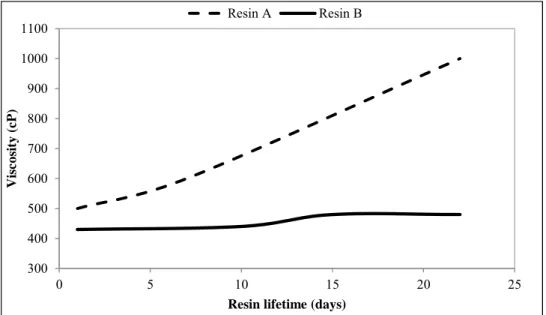
One of the biggest problems of PF resins is their low stability with time. In this study was also important to find a way to produce a resin with good storage stability. In order to evaluate the stability, these resins were stored at 25 ºC during 21 days. The viscosity evolution during this amount of time is present in Figure 1.
It is possible to see that Resin B, with the higher final alkalinity, presents more stability than Resin A, which viscosity increase from around 500 to 1000 cP in just 21 days. On the other hand, Resin B, only increase 60 cP during the same amount of time. This fact can be explained by the low quantity of free phenol in the final resin. Lower values of free phenol present in final Resin Solids content (%) Alkalinity (%) pH Final viscosity (mPa·s) Free Phenol (%)
A 50.02 3.6 10.52 500 1.02
resin will result in lower stability reactions, and as consequence the viscosity increase is very low too.
Figure 1: Resin stability during 21 days
A series of particleboard panels were produced with both resins using different pressing times varying between 150 and 300 s. The results are very clear and show that the presence of a higher value of alkalinity is better for the physic-mechanical properties. All boards made with Resin A presents values of internal bond strength close to zero. However, the Resin B boards show values between 0 and 0.50 N/mm2 for different pressing conditions, as discussed next.
In order to identify the best conditions for blending and pressing of the wood particles, different amounts of resin and catalyst were used in the core layer particles. Table 2 shows the four different conditions used. The amount of resin is based on the oven-dry weight of wood particles and the amount of catalyst is based on the oven-dry weight of resin.
Table 2: Blending conditions
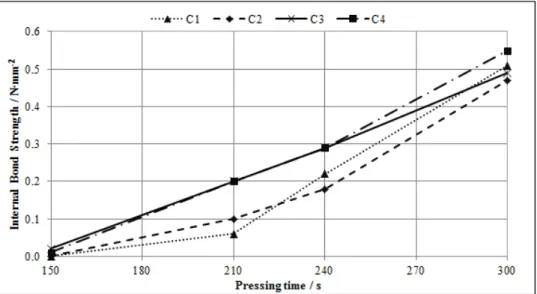
Figure 2 shows the results for the internal bond strength for different pressing times. As shown in this figure, for all conditions, lower pressing time values result in lower internal bond strength
300 400 500 600 700 800 900 1000 1100 0 5 10 15 20 25 Vi sc os it y (cP)
Resin lifetime (days)
Resin A Resin B
Condition Amount of resin (%) Amount of catalyst (%)
C1 4.5 5 C2 5.0 5 C3 4.5 10 C4 5.0 10
value. Better results are found for the two series of boards that were produced with a higher amount of catalyst, but the best value is the one with simultaneously the highest amount of resin and catalyst. Since the main objective is to produce boards with the minimum acceptable value of 0.35 N/mm2 (the requirement for type P2 boards according to EN 312 standard), it is possible to claim that, under these conditions, a pressing time between 240 and 270 s is needed to obtain boards with good quality.
Figure 2: Internal Bond Strength variation with pressing time
In order to prove the reproducibility of the Resin B synthesis process, three new resins were synthesized. For particleboard production, the conditions C4 and pressing time of 300 s were chosen. The physico-mechanical properties of these three resins are present in Table 3.
Table 3: Physico-mechanical properties of the Resin B with three replicates (pressing time of 300 s)
As we can see the three resins are very similar for both properties and it can be said that the synthesis process is reproducible. Both values of internal bond strength are higher than the acceptable minimum of 0.35 N/mm2, and the values of formaldehyde content are also below the maximum acceptable of 2.7 mg/100 g oven dry board specified by the Japanese F**** legislation (Marutzk, 2008).
Properties / Resin Resin B1 Resin B2 Resin B3 Internal Bond Strength (N/mm2) 0.43 0.46 0.50
Conclusions
With this study it was possible to conclude that the presence of a higher amount of base in the final resin results in more stable resin, with much better physico-mechanical properties. On the other hand, base addition during the condensation step results in a resin with very low content of phenol because of the higher degree of condensation.
The best performing resin obtained in this study, Resin B, showed very good values for internal bond strength and formaldehyde content, allowing its use of in the so-called “Green Building” construction.
Acknowledgements
This work is co-founded by FEDER/QREN (E0_formaldehyde project with reference FCOMP010202FEDER005347) in the framework of “Programa Operacional Factor de Competitividade”.
The authors wish to thank: Euroresinas (Sonae Indústria) and Sonae Indústria PCDM for providing the equipment and raw materials needed for this work.
Nádia Paiva wishes to thank FCT – Foundation for Science and Technology and EuroResinas (Sonae Indústria) for the PhD grant with reference SFRH/BDE/51294/2010.
Bibliography
Baekeland L. H., Method of making insoluble products of phenol and formaldehyde, Patent Number 942699 (1909)
Caesar C., and Sachanen A. N., Triophene-Formaldehyde Condensation, Industrial and Chemical Engineering 40(5) (1948) 922-928
IARC, World Health Organization - International Agency for Research on Cancer (2006) LEED, LEED 2009 - For Commercial Interiors Rating System (2011)
Kamoun C., and Pizzi A., Mechanism of hexamine as a non-aldehyde polycondensation resins hardener – part 1, Holzforschung Holzverwertung 52(1) (2000) 16-18
Kamoun C., and Pizzi A., Mechanism of hexamine as a non-aldehyde polycondensation resins hardener – part 2, Holzforschung Holzverwertung 52(1) (2000) 66-67
Marutzk, R., In Proceedings of 6th European Wood-Based Panel Symposium, Hannover, Germany (2008)