0
The impact of Cause Related Marketing
on purchasing behaviour for high and low involvement
purchase context -
The case for diapers in Portugal
Mirali Jitendra Jamnadas
152117248
Dissertation written under the supervision of Professor Sérgio
Moreira.
Dissertation submitted in partial fulfilment of requirements for the
International MSc in Management at Católica-Lisbon School of Business and
Economics.
12
thMarch 2019
1
Abstract
Title \ The impact of Cause Related Marketing on purchasing behaviour for high and low
involvement purchase context - The case for diapers in Portugal
Author \ Mirali Jitendra Jamnadas
Consumers are progressively looking for the best quality-price relation in their purchase. Hence, promotions have become essential.
On the other hand, shoppers aim to buy with a purpose that is aligned with their values and also fulfils their needs. Actually, consumers are more alert to company’s responsible behaviour and to their Corporate Social Responsibility (CSR) practices.
This study investigates if Cause Related Marketing (CRM) campaigns, executed as part of enterprises CSR strategy, drive consumers purchase intention. To understand this, diapers category was chosen since it is heavily promoted. The investigation also discusses if CRM is an efficient strategy when opposed to promotions. Lastly, it intends to discover if brand choice differs when the purchase context is manipulated between high and low involvement. To address the objectives, qualitative research was employed and eleven interviews conducted.
Key findings suggest CRM is not determinant when buying diapers. Several features are evaluated by subjects, and price is one of the most relevant - consumers are only open to pay a restricted price premium to adopt a prosocial behaviour. Moreover, CRM generates dissimilar reaction in consumers, and campaigns may be more effective in private label brands. Finally, in regards to context, CRM impacts consumers differently according to their personal beliefs.
Keywords: cause related marketing; CRM; Corporate Social Responsibility; CSR; high
2
Resumo
Título \ O impacto do Marketing Social na escolha da marca comprada em contexto de alto e de baixo envolvimento: O caso das fraldas em Portugal.
Autor \ Mirali Jitendra Jamnadas
Atualmente, os consumidores procuram a melhor relação qualidade-preço aquando da compra. Assim, as promoções tornaram-se essenciais.
Esperam também comprar produtos alinhados com os seus valores e que satisfaçam as suas necessidades, estando cada vez mais atentos ao comportamento responsável da empresa e às suas práticas de Responsabilidade Social Corporativa (RSC).
Este estudo investiga se as campanhas de Marketing Social (MS), executadas como parte da estratégia de RSC das empresas, influenciam a escolha das fraldas que detêm alto nível promocional. Assim, questiona também se o MS é uma estratégia eficiente comparativamente às promoções. Pretende ainda descobrir se a escolha da marca difere quando o contexto de compra varia entre alto e baixo envolvimento.
Os resultados de pesquisa qualitativa e onze entrevistas sugerem que o MS não é determinante na compra de fraldas. Várias características são avaliadas, sendo o preço uma das mais relevantes - os consumidores estão abertos a pagar um diferencial de preço restrito para adotar um comportamento pró-social. Adicionalmente, o MS gera reações díspares, e os resultados sugerem que as campanhas podem ser mais eficazes em marcas próprias. A perceção de MS do consumidor difere consoante o contexto. Os resultados indicam que os consumidores reagem de maneira diferente, i.e., conforme as suas crenças.
Palavras-chave: responsabilidade social corporativa; marketing social; contexto de
3
Acknowledgements
First and foremost, I want to thank my parents for their support throughout my entire academic and personal journey. You have inspired me to be the best version of myself in every challenge I came across. You have showed me the incredible power of learning by listening to others and by staying humble. Thank you for teaching me the most important values, the ones of affection, hard work and humbleness that I will take with me in my future life.
Second, I want to thank my sister Riddhi and my brother Dharmine for always being present. You have taught me to be resilient, to never give up on my dreams and to believe merit makes the difference, not the grade. You have shaped me to be a better person, you have encouraged me to challenge myself and you have forgiven me for every mistake. You are both an inspiration to me and I couldn’t be prouder of being your little sister and being raised by you.
Third, I want to thank my friends, who have supported me during these two years of master and have contributed to the final delivery of my dissertation. A special note to Mariana, Ana, Bárbara and Vicky – you guys are my second family and I appreciate all the time and effort you have dedicated in listening to me when I was lost, in introducing me to new people who could help me achieve my dissertation goals and in giving me confidence even when I was far outside my element. I am grateful for having you in my life and I hope you know how incredibly important you are to me.
I also want to express an enormous thank you to Professor Sérgio Ramos, who has kindly accepted to guide me through the learning process of writing my dissertation. I express my gratitude for your invaluable feedback, for always supporting me and believing in me. Last but not the least, I want to thank my friends and colleagues from CLSBE for providing me a great master experience. I cannot also forget all the friends outside my university who have been present and also the ones that showed themselves available to answer my questions regarding this dissertation.
4
Contents List
Abstract ... 1 Resumo ... 2 Acknowledgements ... 3 1. INTRODUCTION ... 5 1.1. Topic presentation ... 51.2. Problem Statement and Research Questions ... 6
2. LITERATURE REVIEW ... 7
2.1. CSR Definition and Importance ... 7
2.2 Relevance of Marketing for CSR Strategy: Cause-Related Marketing ... 8
2.2.1 Cause-related marketing: Advantages and disadvantages ... 11
2.3. Purchasing Intention for High and Low involvement context products ... 13
2.3.1. Relevance of High and Low involvement contexts to CRM ... 14
3. METHODOLOGY ... 15
3.1. Sample ... 15
3.2. Data Collection ... 16
3.3. Data Analysis ... 19
4. RESULTS ... 20
4.1. Section 1 – Key determinants of purchasing choice ... 20
4.2. Section 2 – Perceptions about CRM ... 23
4.3. Section 3 – Purchase intention assessment towards CRM on High Involvement Purchase ... 25
4.4. Section 4 – Purchase intention assessment towards CRM on Low Involvement Purchase ... 29
4.5. Section 5 – High & Low involvement comparison ... 34
5. CONCLUSIONS ... 35
5.1. Major Findings ... 35
5.2. Limitations and Future Research ... 39
6. BIBLIOGRAPHY ... 41
5
1. INTRODUCTION
1.1. Topic presentation
According to the Kantar World Panel, one in every five dollars globally is spent on promoted goods. Promotions play a crucial role in increasing sales for most fast-moving consumer goods (FMCG). Consumers are progressively looking for the best quality-price relation and promotions have become essential to fulfil this requirement. From a company’s perspective a question regarding this strategy arises - Is financial value being destroyed? Are categories losing money not to lose customers? Are there any viable alternatives to this escalating trend?
In Portugal, according to Nielsen, in 2018 a new promotion peak was reached. 47% of all FMCG’s sales were sold on deal, the highest percentage on the last 6 years, with the percentage increasing year by year. To categories in which consumers stay only for a limited amount of time, such as the baby category, how impactful is this? At the end, when looking for a specific product as diapers, shoppers only buy them for 4 years maximum in the majority of cases. Brands and retailers should be able to extract as much value in this period as possible and promotions are a bottleneck to that. In fact, they increase volume sold on the short term but at a lower value (Kantar World Panel, November 2018). On top of this, since 2011 the goal of 100.000 newborns per year in Portugal has not been reached. In 2017 the gross birth rate situated in 8.4 births per 1000 residents and, even though, Portugal might be recovering and increasing the rate, it will not be neither easy nor a fast path (Pordata, 2019). Not many babies are born, which implies sales for the baby category cannot escalate growth.
Can firms extract the maximum value, in the limited amount of time parents stay in the diapers category, not relying solely on the promotions? At the moment, every week, at least, one brand (retailers’ brand included) is in promotion, reaching levels that vary between 15% up to 50%.
An alternative could be the alignment of the firm’s Corporate Social Responsibility (CSR) towards a long-term sales growth goal. Past research has shown consumers perceive companies that engage in socially responsible activities as warmer and more trustworthy (Aaker et al., 2011; Chernev & Blair, 2015; Hansmann, 1981) among other characteristics. Therefore, Cause Related Marketing (CRM) could be an approach to
6 consider. When engaging in CRM campaigns firms “promise a donation to a cause every time a consumer makes a purchase”(Müller, Fries, & Gedenk, 2014). This strategy allies both the commercial and social responsibility strategies of a firm. It might also be a solution which drives consumer purchase intention or differentiates a certain brand within the baby category whilst being a viable alternative to the high promotional intensity.
1.2. Problem Statement and Research Questions
The aim of the dissertation is to understand the impact of CRM on purchase intention of products where consumers stay only for a limited amount of time, more specifically, on diapers. The impact of CRM on purchase intention will be studied both in high and low involvement context:
High involvement context purchase: Households buy diapers for their own children
Low involvement context purchase: Households buy diapers to offer a Social Cause (Ajuda de Berço)
The choice for diapers is based on several reasons. According to past research by Ross, Patterson and Stutts (1992), CRM campaigns are more effective and lead to more favourable responses when the targeted audience has children. The investigation done in the field has used FMCG to verify and analyse the impact of CRM campaigns. These products are suitable since they vary in price, are usually in promotion and allow to understand if CRM is indeed a differentiating factor in the purchasing moment. However, the goods chosen for these researches have never impacted the referred audiences’ children.
Despite being a FMCG, diapers are special in their relation with the shoppers. Indeed, new parents tend to be particularly more sensitive to social causes and one can assume they do not want to jeopardize their own baby’s well-being when making their purchase decision. To our knowledge, there is no research regarding the effectiveness of CRM campaigns in the diapers category nor if they lead to a purchase intention different from the buyer’s initial will.
7 Having the above queries into consideration this dissertation aims to answer the following research questions:
Research Question 1: Does CRM influence diapers brand choice?
Research Question 2: Is the influence of CRM on diapers brand choice different in high and low involvement contexts?
Research Question 3: Is CRM more efficient influencing diapers brand choice than regular promotions?
2. LITERATURE REVIEW
2.1. CSR Definition and Importance
The need for businesses to address social issues urged after the second world war, mostly after the 60’s with companies being pressed to assume more than their commercial interests (Carroll & Shabana, 2010; Mohr, Webb, & Harris, 2001). Thus, social responsibility started to be seen as an investment towards better long term performance of companies (P. Rajan Varadarajan & Anil Menon, 1988).
Over time several Corporate Social Responsibility definitions were constructed, and for the purpose of this dissertation Aguinis (2011) definition will be taken into consideration - “CSR are context-specific organizational actions and policies that take into account stakeholders’ expectations and the triple bottom line of economic, social and environmental performance.” However, for this concept to be complete, it is important to account for past definitions such as the one given by Carroll (2011) which highlights that CSR actions are framed in a specific period of time and can either be required, expected or desired by stakeholders and Kottler and Lees’ (2005) which highlights the importance of using corporate resources to meet the mentioned expectations.
Arguments against and in favor of CSR are discussed over time. On one hand, against CSR practices, Friedman (1962) argues that “the only responsibility of business is to maximize profits of owners and shareholders” and Davis (2018) contends that businesses don't have the expertise to make socially oriented decisions and those actions might be distractors. Additionally, by providing businesses with the ability to undertake
8 social responsibility, companies are even more empowered in other domains of the society.
Contrariwise, literature shows that CSR practices above and beyond contributing to society, also have a positive effect on consumers attitudes towards the brands (Sen & Bhattacharya, 2001), purchasing intent and sales (Green & Peloza, 2011). Thus, rewarding firms’ for their engagement in prosocial activities (Mohr et al., 2001).
It has further been shown CSR can provide value for consumers in three different forms that are distinctive between them and may enhance or reduce the overall product (brand or company) value proposition for the consumer (Green & Peloza, 2011).
The 3 forms are:
- Emotional value: Donations to Not for Profit Organizations (NPO) generate this kind of value. It is more associated to the more conventional way of aiding, i.e. in the giving form. It can create positive and negative value for the consumer; - Social value: this value is generated having into consideration society’s norms
and expectations. Is the consumers’ behavior approved by the society and by the individual as well? Is it aligned with personal and group values?
- Functional value: it is created when consumers face a win-win situation. A good example is to increase fuel efficiency since it helps to protect the environment and leads to money savings.
To highlight that more than one value form can be attained simultaneously.
2.2 Relevance of Marketing for CSR Strategy: Cause-Related Marketing
According to literature CSR strategies can be accomplished by leveraging on multiple disciplines, such as operations, human resources management, organizational behavior or marketing. CRM is an example of the later one and it is defined as a strategy which satisfies the organizational objectives by acknowledging and communicating product benefit and linking the brand to a charitable cause through a specific social contribution, (Varadarajan & Menon, 1988). In other words, companies that choose to apply CRM “promise a donation to a cause every time a consumer makes a purchase” (Müller et al.,
9 2014). In line with Varadarajan and Menon (1988) research, several corporate and marketing objectives can be accomplished, some examples include:
a) increasing customer database and gathering retailers support for merchandising activities at a store level, potentially leading to the goal of higher sales (through multiple units sell-out at once or repeated sales throughout time);
b) enhancing brand image and promoting brand recognition; c) reaching new market segments.
At the same time, cause related objectives can also be pursued, for instance, generating funds and awareness for the supported causes and promoting direct contributions, ( financial, in-kind or in volunteering format) from retailers and/or consumers.
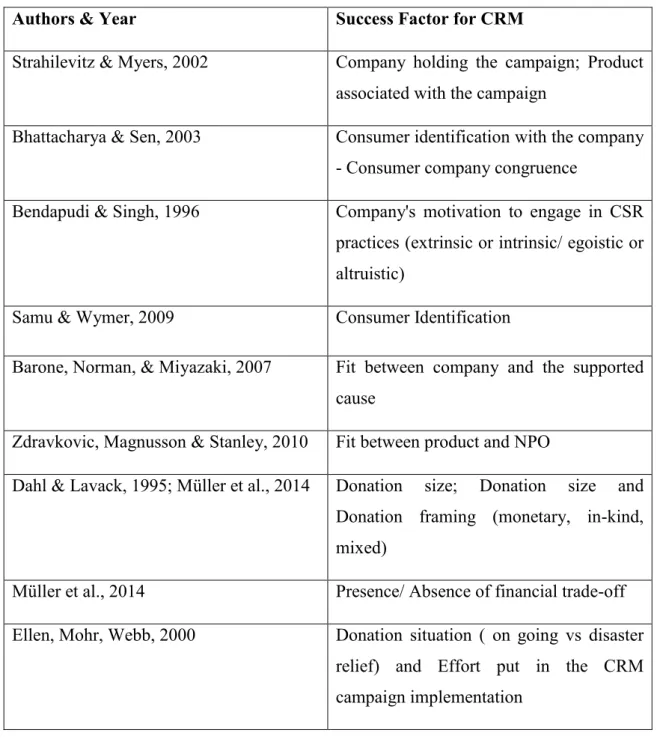
Hence, according to literature CRM is part of a company’s CSR strategy. Nevertheless, alone it cannot fully represent a successful CSR strategy. In addition, several factors influence the effectiveness of a CRM campaign (i.e., the effectiveness of using guaranteed contributions to Not for Profit Organizations as purchase incentives). The bellow table summarizes the most relevant and depicting aspects:
10
Authors & Year Success Factor for CRM
Strahilevitz & Myers, 2002 Company holding the campaign; Product associated with the campaign
Bhattacharya & Sen, 2003 Consumer identification with the company - Consumer company congruence
Bendapudi & Singh, 1996 Company's motivation to engage in CSR practices (extrinsic or intrinsic/ egoistic or altruistic)
Samu & Wymer, 2009 Consumer Identification
Barone, Norman, & Miyazaki, 2007 Fit between company and the supported cause
Zdravkovic, Magnusson & Stanley, 2010 Fit between product and NPO
Dahl & Lavack, 1995; Müller et al., 2014 Donation size; Donation size and Donation framing (monetary, in-kind, mixed)
Müller et al., 2014 Presence/ Absence of financial trade-off Ellen, Mohr, Webb, 2000 Donation situation ( on going vs disaster
relief) and Effort put in the CRM campaign implementation
Literature also states CRM can be used by firms as a tactical tool to boost sales and a strategic activity to enhance brand image (Müller et al., 2014). Past research conveys that CRM is more effective for frivolous or hedonic products (which are motivated by pleasure, fantasy or fun) than for utilitarian products which are practical and answer a specific consumer need. The fact described derives from consumers’ sense of guilty when buying hedonic items. The higher the sense of guilt, the higher the likelihood to contribute to a charitable cause. Indeed, Strahilevitz & Myers (2002) described this
11 phenomenon as affect-based complementarity. The stimulus of giving and contributing to charity offsets the purchase guilty feeling. However, and as noticed by Chang (2008), such hypothetical argument has still not been empirically proven recurring to emotion-related measures.
Moreover, CRM has proven to be successful since consumers derive utility from the fact of giving and get a moral satisfaction from the act of purchasing while associating it to a good cause (Kahneman & Knetsch, 1992) – the effect is named warm glow. Consumers, at least partially, recognize the company as a gift-giver. For that purpose consumers must perceive firm’s motivations to engage in CRM as genuine, intrinsic and altruistic (Ellen, Mohr & Webb, 2000). In order to evaluate whether or not warm glow is present, shoppers evaluate the benefits and costs of the CRM campaign for themselves.
Furthermore, Pracejus & Olsen, (2004) demonstrate that cause-brand fit is an important measure to quantify the CRM campaign effectiveness. According to their study, a high fit campaign had between 5 and 10 times the impact of a low fit campaign, when considering monetary donation framing. Additionally, the right donation size, the donation framing (monetary, nonmonetary or mixed) and the existence of financial trade-off are key to influence the effectiveness of CRM campaigns (Müller et al., 2014).
2.2.1 Cause-related marketing: Advantages and disadvantages
From the company’s perspective CRM presents some key advantages when compared to other CSR strategies. First, it is easier to communicate to shoppers (focused marketing campaign). Second, it is cheaper in the sense that it can be restricted to a limited donation in a percentage of price/profit/number of items donated. For instance, in Procter & Gamble’s Dodot premature campaign, for each pack of diapers bought by the consumer 1 diaper for premature babies was donated to hospitals, up to the limit of 200.000 diapers. Third, it is potentially more adjusted to firms’ consumer and customer segments as well as to the firms’ corporate ability (e.g., firms ability to offer products or services in which they are experts); (Chernev & Blair, 2015; Sheikh & Beise-Zee, 2011).
12 Likewise, practicing CRM allows to create purchasing incentives and to enhance company image (Smith & Alcron, 1991). Moreover, selecting one specific cause to support may lead to positive spillover effects for the company, such as:
a) increased customer awareness b) increased support to the company
c) improved brand recall and recognition (Sheikh & Beise-Zee, 2011).
Moreover, Bhattacharya & Sen (2001) highlight that the focal company is not the only beneficiary of a CSR initiatives. Building on this consideration, consumers derive utility from helping and the aided charity, in addition to the funds or in-kind donation, increases their visibility and subsequently populations’ awareness towards the supported cause.
However, CRM if not well executed also presents some disadvantages: campaigns may be perceived as company’s self-interest/egoism rather than genuine concern. According to attribution theory “consumers evaluate and respond to CRM campaigns by making inferences about a company’s underlying motives for engaging in such a campaign” (Ellen, Mohr & Webb, 2000). Indeed, donation is contingent on sales and sales are perceived as a benefit for the company more than a pro-social behavior. These considerations can negatively impact brand image and consequently future sales. (Barone et al., 2007).
From consumers’ perspective the more cause-affinity there is with the CRM campaign, more likely they are to purchase the product (Sheikh & Beise-Zee, 2011). Even when a cause has strong support from many consumers, the market segment that has low cause affinity is not impacted, being therefore a disadvantage for CRM since it might not impact every shopper the same way. Also, if the supported cause is controversial or has members that oppose it, the negative spillovers will damage the company image.
On top of these, Bhattacharya and Sen (2001) state that the impact of any CSR initiative (such as CRM) is significantly higher from consumers’ internal perspective (awareness about the campaign, attitudes and perceptions of the company and/or brand) than from external and tangible outcomes (purchasing behavior, word of mouth).
13
2.3. Purchasing Intention for High and Low involvement context products
Purchase intention is defined as a persons’ conscious plan to make an effort to buy a certain product (Spears & Singh, 2004). It is personal, related to a brand and divergent from attitudes (Bagozzi, Tybout, Craig, & Sternthal, 2006; Ostrom, 1969). Extensive research on consumer behavior indicates there are differences in decision making processes and, subsequently, on purchasing intentions for products according to the degree and type of involvement associated to the product in analysis. Theory suggests that when subjects are involved they make informed choices and proactively search for information (e.g., Bettman 1979; Engel, Kollat & Blackwell 1978). However, Olshavsky and Granbois (1979) highlight consumer’s behavior is not based on extensive research or in a comprehensive evaluation of the choice alternatives. Situation, emotions and several areas of involvement also may play a critical role at this moment (Bloch & Richins, 2006; Kapferer & Laurent, 1983).
Zaichkowsky, Lynne, & Zaichkowsky, (1985) have clarified that involvement means “ a person's perceived relevance of the object based on inherent needs, values, and interests.” This definition recognized past descriptions of involvement (e.g. Engel and Blackwell 1982; Krugman 1967; Mitchell 1979). Looking more in detail to the involvement areas, it is possible to list them in 3 categories:
• Personal Involvement - defined as “inherent interest, values or needs that motivate the subject towards the product”;
• Physical Involvement - related to product characteristics based on differentiation and that intensify subjects’ interest
• Situational Involvement – subject interest for the product is timed and due to the specific situation dependent relevance
In that sense, the same product/object might be linked to different involvement categories according to the person and context in study.
The level of involvement influences both consumers’ purchase decision extensiveness and their communication processing. The number of attributes shoppers compare between existent brands and the time they take to choose are indicative of the decision extensiveness. Communication processing is analysed through buyers’ degree of
14 information quest, openness to advertisements and the responses generated by this stimulus at a cognitive level (Krugman, 1967).
2.3.1. Relevance of High and Low involvement contexts to CRM
Intuitively one may assume from observed behavior that consumers’ purchase choice are different when buying for personal use or when doing it for donation. For instance, many times when observing donation baskets to food banks it is possible to note shoppers’ preference for private label products. One reason could be the appreciation of distinct attributes when buying for donation. Interestingly, to the best of my knowledge, no research has been done to investigate the differences in purchasing choices considering high involvement purchase as products for personal use and low involvement purchase as products to donate through a CRM campaign.
Nonetheless, on one hand, research by Heeler, Francis, Okechuku, & Reid (1979) has investigated gift purchase in two contexts – for close friends and to offer as a wedding gift. To some extent a parallelism can be considered in this study: close friends represent the high involvement context, the wedding gift purchase represents the low involvement context. The major limitation in this comparison would be the absence of an intermediary entity that would allow the donation to happen. In the parallelism the donation would be the act of purchasing to offer, not expecting anything in return. The referred study outlined shoppers examine less information regarding their purchase options when obtaining a wedding gift, hence putting less effort in the choice. Evidence also demonstrated that the number of brands and attributes considered by shoppers while purchasing presented no significant differences between purchasing contexts. On the other hand, investigation conducted by Clarke and Belk (1979) described shoppers predicted they would spend more time (i.e., visit more stores) and even spend higher values when purchasing as gift rather than for personal use. Shapiro (1970) also stated price would be less of a barrier when buying as gift. Further research by Belk, (1982) attempted to discover the reason behind such discrepancies. In this study high involvement purchases included buying a gift for a wedding and buying an anniversary gift for a close friend, whereas low involvement meant buying a thank-you gift to repay a favour and buying an anniversary gift for a casual friend. Findings corroborate that there are differences in purchasing for self-purpose or as a gift. However these results cannot be generalizable for high and low involvement contexts, since other variables
15 also determine the purchasing behaviour. One of the most depicting factors seems to be the occasion of purchase – in high involvement, when the gift was bought for a wedding occasion, respondents thought the gift should be more expensive and purchased thoughtfully whereas when the gift was bought to an anniversary it could be less expensive and almost bought instantly, without much reflection. For low involvement, considering the scenarios of buying a thank you gift and a anniversary gift. Results were consistent once more. The price range considered for purchase was similar to the one in high involvement and the level of dedication in finding the right purchase varied according to the occasion of purchase. For all these, Belk (1982) outlines generalization would only constitute an oversimplification of reality when considering the comparison between gift giving and purchase for self-use.
In summary, previous research shows that most of the times, involvement does not seem the differentiating factor in the purchase moment when comparing gift giving and purchase for self-use. It is thought-provoking to understand if these same inferences hold true when the purchased gift is in fact a donation through a CRM campaign.
3. METHODOLOGY
To conduct the present study interviews with household diaper’s purchasers were run. Each face-to-face interview followed a semi-structured script prepared with the essential questions as well as some follow-up interrogations. Afterwards, the data was systematically analysed, and the results were described leading to the major findings and managerial implications.
3.1. Sample
The data was collected through interviews. Eleven in person interviews were done. The household buyers were mainly women (ten out of eleven). The participant’s age ranges between 30 and 37 years old, with a mean age of 33 years. 55% of participants have two children and 45% only one. The group was heterogeneous in terms of level of education: 30% had high school education, 40% had a bachelor’s degree and the other 30% vary between postgraduate studies and PhD. At the end of the interviews, participants were surveyed and shared they enjoyed participating in the study, found the questions easy to understand and found the subject of the study interesting.
16
3.2. Data Collection
A pre-test was run to validate the appropriateness of the method as well to validate the script. The pre-test consisted in one focus group in which the feedback regarding the script was collected and small changes incorporated. Individual interviews were then taken as the primary data source. The final script was composed of four sections designed as it follows:
Section 1 – Key determinants of purchasing choice: this section aimed to discover which factors are considered by participants’ and influence their purchasing choices. Additionally, it explored why those factors are important drivers;
Section 2 – Perceptions about CRM campaigns: this category intended to learn about buyer’s perception on past CRM campaigns in the Baby Care category. Covered topics included brands’ perceived motivation to engage in CRM, company-cause fit, consumer-cause fit and CRM campaigns’ expected impact on purchasing behaviour; Section 3 – Purchase intention assessment towards CRM on High Involvement Purchase Context: the goal of this section was to discover in which situations subjects are more influenced to purchase diapers with a CRM campaign on going, knowing they are buying for their own children. To accomplish this, respondents were exposed to fictional diapers purchasing scenarios, as presented in Diagram 1.
17
Purchase intention assessment -CRM & High Involvement
Scenario 1: Shoppers are faced with a Price Premium of 10%
when choosing their preferred brand. Buyers choose between having 10% discount for themselves or contribute to donate
vaccines to UNICEF with those 10%.
Scenario 2: Shoppers are faced with a Price Premium of 35%
when choosing their preferred brand. Buyers choose between having 10% discount for themselves or contribute to donate
vaccines to UNICEF with those 35%.
Scenario 3: Respondents need to choose which diapers to buy.
The options are their preferred brand without any discount (i.e. paying a price premium) or their second preferred choice
considering a 35% discount.
Section 4 – Purchase intention assessment towards CRM on Low Involvement Purchase Context: the objective of this section was to discover in which situations respondents are more influenced to purchase diapers with a CRM campaign on going, knowing they are buying to donate for a social cause. To achieve this, respondents were exposed to imaginary purchasing scenarios, as presented in Diagram 2.
18
Purchase intention assessment -CRM & Low Involvement
Scenario 1: When buying diapers to donate for a local NPO
shoppers are faced with a Price Premium of 10% when choosing their preferred brand. Buyers choose between having 10% discount for themselves or contribute to donate vaccines to
UNICEF with it.
Scenario 2: When buying diapers to donate for a local NPO
shoppers are faced with a price premium of 35% when choosing their preferred brand. Buyers choose between having 35% discount for themselves or contribute to donate vaccines to
UNICEF with it.
Scenario 3: Respondents need to choose which diapers to buy to
donate to a local NPO. The options are their preferred brand without any discount (i.e. paying a price premium) or their second
preferred choice considering a 35% discount.
The full script is available on Appendix A.
Participants were selected based on personal contacts and invited to participate in the study via text message or a phone call.
Interviews allow to take advantage of social clues, e.g. voice and body language whilst analysing and perceiving respondents spontaneous reactions towards the questions and presented information (Opdenakker 2006). Furthermore, interviews allow to infer causal relations (Saunders, Lewis, & Thornhill, 2007) such as the one investigated here for CRM and purchase decision.
A total of eleven in depth face-to-face semi-structured interviews were conducted. Follow up questions were used to incentivize participants to explain their perspectives and further develop their purchase behaviour and decision-making process. According to Miller and Crabtree (1992) this method allows participants to elaborate on their initial answer and build their opinion with fundament.
19 The interviews lasted up to 30 minutes and took place in a comfortable and convenient local for participants. The conversations were recorded with the permission of the participants and afterwards transcribed.
At the end of the interview participants were requested to fill-in a survey with their demographic information, including age, number of children, level of education and nationality. Additional information regarding their participation in the interview was requested. This information included how easy respondents found answering and understanding the questions, the perceived level of interest of the studied issue, and participants’ satisfaction level with their participation.
The full survey is available on Appendix B.
3.3. Data Analysis
Interviews transcripts were analysed individually and then grouped according to the common themes which appeared. The data was analysed through a thematic analysis. A thematic analysis consists of a rigorous qualitative research method which identifies, analyses, organizes, describes and reports themes found within a data set (Braun & Clarke, 2006; Maguire and Delahunt,2017).
According to Braun and Clarke (2006) thematic analyses provide a useful way to examine different perspectives highlighting similarities and differences from responses plus generate unexpected insights, making it a very flexible research tool.
There are two different levels of themes, namely the semantic and latent. The prior one which states exactly what participants have said, organising it, and the latter one which starts to identify and examine the underlying ideas beyond what has been said. (Braun & Clarke, 2006). For the purpose of this dissertation, both levels were sequentially applied.
The procedure of data analysis followed three phases. First, the recorded interviews were transcribed into paper. Afterwards, patterns were recognized, and the data organized into themes and codes. Lastly the themes and codes were validated by an independent experienced researcher and the consolidated information organized.
20
4. RESULTS
In the following part, I will present the results from the conducted interviews. The outputs are organized according to the studied topics and participants are referred as Partipant 1 (P1), Participant 2 (P2) so forth.
The main results regarding each section follow below and the full thematic analysis is available on Appendix C.
4.1. Section 1 – Key determinants of purchasing choice
Respondents refer to eight different diapers purchase determinants. For each of them they provide an explanation of why it is important from their perspective. Further down you may find each factor detailed.
1. Baby wellbeing - In this category parents refer factors important to guarantee the baby’s well-being. The variables include baby’s comfort and dryness throughout the night. The diapers specifically should be affordable, adjustable and prevent rashes, bad odours and allergies.
“The diapers must be very comfortable for the baby and should not cause allergies or rashes” - P1
“The diapers should be adjustable, avoid leaks and rashes” – P5
2. Brand - Most interviewee’s highlight they are loyal to one or two brands, with few factors possible to influence them to switch to another brand.
Sections Key determinants of purchasing choice Perceptions about CRM Purchase intention assessment - CRM & High Involvement Purchase intention assessment - CRM & Low Involvement
High & Low involvement comparison
Diagram 3 – Results structure overview
Key Purchase Determinants
1.Baby
Wellbeing 2.Brand 3.Age Promotion4.Price & ental Impact5.Environm 6.Accessi-bility 7.Habit 8.Reviews Diagram 4 – Key purchase determinants referred by participants
21 Participants that are in the experimental phase refer they are trying different brands according to the price and testing their baby’s adaptation.
“I only buy the blue Dodot. (…) I am so happy that I consider myself very loyal to the brand. The only thing that might make me rethink it is the environmental impact. I would consider ecological brands.” – P3
“I am very loyal to Dodot and Pingo Doce’s private label. My choice is always between these 2, depending on the price” – P4
3. Age - Several subjects show concern regarding the fit between the baby’s age and the diapers they are using. Parents show preference towards manufacturers’ brand when babies are smaller, usually around 6 months. After this age parents say they lean more towards private label diapers. Some parents, who have their second child, show themselves more prone to use private label even before the 6 months.
“I think there are 2 different moments, when they are newborns, we want to buy the best for the baby’s skin so we go for the safer and most well communicated brands. When the baby is older (more than 1 year), price became more important and I switched from Dodot brand to Private Label (Pingo Doce) “– P2
4. Price & Promotions - Parents highlight price and promotion as a key
purchase determinant. It is considered one of the most important factors. Some parents are very sensitive to price, opting for private labels the most of times. Other respondents are somewhat sensitive to price, saying they would choose private label only when their preferred brand is not in promotions. Lastly, some shoppers are not price sensitive at all and always buy the same diapers brand.
“Price and quality are 2 main factors I consider important (…). Depending on the price, meaning promotion level, I either choose Dodot or Pingo Doce” – P5
“Private label is always cheaper than actual brands, that’s why even if Dodot is in promotion for example, we would still choose private label.” – P11 5. Environmental Impact - Many parents proactively referred their
environmental concern when choosing disposable diapers. It is important to notice that in most cases this worry didn’t translate to real behaviour change and the use of alternative diapers. Indeed the majority of respondents say
22 they are concerned with their ecological footprint, but not open to change for environmentally friendly diapers in the near future. The reasons presented are economic and unpractical diaper changing. Parents who are open to change await friend’s reviews to switch or hope to find more competitive prices.
“If I change, it would only be to ecological diapers if I knew, as a fact, that those provide the same baby well-being as the disposable ones, but with a lower environmental footprint. In my second baby, if my friend that is pregnant now has a good experience with ecological diapers, I will also try.” – P3
“I know the impact of all these diapers is huge, but logistically it seems impossible to use the re-usable one” – P5
6. Accessibility - One person refers diapers choice depends on the place of
purchase and which are the accessible brands.
“For my first child I used to always buy Dodot. Now, with the little one, I have started trying and using private label according to the supermarket where I am. I use Pingo Doce, Jumbo or Continente.” - P8
7. Habit - The respondent refer to her purchase choice as a habit, with few
external stimuli impacting in the decision moment.
“I feel like too many times I go to buy things in auto-pilot mode and I don’t notice if other things are happening in the store, but if there is a stimulus with prosocial campaigns with a big highlight maybe I can be impacted and re-think my choices…” – P10
8. Reviews - Some interviewees refer the importance of reviews to consider
distinctive diapers brand. They refer reviews are especially relevant when trying new brands.
“We take into consideration the reviews of mum’s on Facebook and, according to that and the price, we are trying different diapers.” – P11
23
4.2. Section 2 – Perceptions about CRM
Respondents share their perceptions about CRM considering six different perspectives. Each of them is detailed in the following.
1. Awareness - Respondents share their awareness regarding past CRM
campaigns in the baby category. Some respondents say they either knew the two campaigns presented or at least 1 of them. Others refer they didn’t know any of the campaigns.
“I knew the campaign of Dodot Prematures and become aware through social media” – P4
2. Brand-Cause Fit - Shoppers say they believe the supported cause is aligned
with the brands’ core business.
“There is a match between the brand and the supported cause. It is not a “forced match”. It makes all the sense and I can understand the campaigns were well thought and presented.” – P2
Literature states brand-cause fit is driver for purchase as consumers do not perceive the association as a way to be fooled into buying more a certain product.
3. Consumer- Cause Fit - Shoppers explain how much they identify and
connect with the supported causes. The vast majority states they relate more with emotional campaigns.
“I emotionally connect and identify with Dodot’s campaign because my daughter was premature. It is amazing they have developed these diapers. It is not that common to see brands associating and dedicating to causes in this way. It is an interesting product and answers a real need” – P2
Perceptions about CRM
1.Awareness Cause Fit2.Brand- 3.Consumer-Cause Fit Motivation4.Brands' 5. Attitudes 6. Impact on purchase
24 According to literature this factor is an enabler for purchase. Indeed in the interviews participants who connected more emotionally with the CRM campaign showed themselves more prone to buy.
4. Brands Underlying Motivation -Shoppers explain which they believe are the reasons behind brands prosocial activities such as CRM campaigns. Some shoppers believe firms’ actions are altruistic, others that they are merely conceived to increase profit and few others see it as a double goal strategy, to do good and sell more. These results corroborate previous literature stating the importance of attribution theory for the effectiveness of CRM campaigns. Consumers that relate the campaign with brands’ intrinsic motivation present a more positive attitude towards CRM campaigns.
“If Dodot wanted to donate, they shouldn’t need me to buy diapers for them to make it. This only reinforces that brands do this only to earn more money.” - P3
“Chicco and Dodot are big brands, so they are powerful in their messages to the consumers…So I think they developed such campaigns to raise awareness and because they can have a positive impact. If it was for example a small brand that sells biodegradable diapers, the impact would not be as strong as with these 2 brands.” – P7
5. Attitude towards CRM - Some consumers claim they distrust the results of
CRM campaigns and if they are aligned with society’s real needs. Additionally, other shoppers refer they are sceptic about the truth of the campaigns and question the amounts donated. Other customers highlight they prefer not to associate with brands to support causes. The main reason is they can donate by themselves and see the results.
“I think it is impactful the way brands communicate the causes. One of the thing I’ve asked myself is if the campaigns answer real needs of the community? Are the items really being donated? Are brands aware that consumers may be more quantities due to their communication and so they must really be accountable for their acts? But I haven’t put more in depth thought in to the subject.” - P8
6. Impact on purchasing moment - Shoppers elaborate on their beliefs about the impact of CRM campaigns at the purchasing moment. Many elucidate CRM by itself, in this category would not be a differentiating factor nor a
25 buying driver. Determinants such as price and baby wellbeing play a more important role. Others elaborate on the requirements a brand must follow for CRM to be effective: a) reasonable amount donated; b) good instore communication of the campaign; c) information regarding the expected end result of the campaign; d) no price premium to pay and see the purchase as a trial moment.
“None of the campaigns would make me buy the brands. The most important factors would be the ones I referred previously.” – P7
“I would think about buying Dodot diapers if I was indicisive in which brand to choose or if I had never tried the brand before. (…)” – P4
4.3. Section 3 – Purchase intention assessment towards CRM on High Involvement Purchase
Shoppers are faced with the three different purchase scenarios explained in the methodology section and share their most likely behaviour. For each scenario respondents’ answers are specified next.
Scenario 1 – In this scenario participants respond with three different possibilities which are
summarized in Diagram 6 and detailed afterwards.
A1. Partipants choose the self discount
Distrust towards CRM campaigns
Distrust in brands' motivation to engage
in CRM Supported Not for Profit Organization is
International
A2. Participants choose to donate the 10%
The percentage is a small donation
The supported cause is important
The campaign is well promoted in store
A3. Participants create an hybrid alternative
Consumers believe they do good and
save money simultaneously
Scenario 1 – CRM vs 10% Discount
Diagram 6 – Participants purchase choices in High Involvement considering a 10% price premium
26 Some shoppers choose the 10% discount for themselves. The reasons mentioned are:
a) Customers don’t trust in campaigns’ real impact towards the cause nor in brands’ purpose to create a CRM campaign;
“I would choose option a, i.e. the discount for me. I really don’t know if what the campaign claims is actually going to happen and the item’s will be donated. (…) I prefer to go myself and donate to UNICEF, even though I assume that behaviour from my side would not be very likely” – P5
b) The supported NPO is International hence less accessible
“(…) After the campaign we have seen the actual in kind donation happening to the association because it was geographically and mentally closer to me as consumer. With UNICEF and other organizations alike it seems and feels like the output is hidden or unrevealed and nobody exactly knows how the campaign finished.” – P9 However, 7 out of 11 respondents choose to donate 10% towards UNICEF. This result is an evidence of the warm glow effect when purchasing diapers with a small contribution towards a social cause. Indeed, respondents were not asked for a too high monetary effort and were rewarded with moral satisfaction. Participants who choose to donate refer that:
a) The donation size is a small percentage of the pack value;
“Option b without any doubt, to see if I can also help someone in need through UNICEF. Of course the 10% would make the difference for me because diapers are expensive but I would easily help someone that needs.” – P6
b) They understand the importance of the cause;
“Vaccines is a very specific issue… I understand how expensive they can be, because I felt it when I had to buy them for my baby girl, so, if with only 10% I can help on that, I would go for option b and buy the diapers with the campaign.” –P8
c) Their attention was caught while they were instore buying diapers.
“If the campaign was well promoted and highlighted in store I would probably go for option b. Otherwise I buy in auto pilot and would miss the campaign” – P2
Alternatively, few shoppers create a hybrid answer scenario where both purchases are possible due to economic reasons.
“I’m not sure if I would be able to always choose the pack that donates. Most likely sometimes I would choose to donate other to have the discount for myself. “– P4
27
Scenario 2 – In this scenario participants respond with three different possibilities which are
summarized in Diagram 7 and detailed afterwards.
When considering a higher price premium, respondents opt to get the self-discount more often than in the previous scenario, with half of the participants choosing the discount stating:
a) the price premium for diapers is too high for them to be indifferent:
“Very honestly, I would go for option a. 35% weights on the budget and also, I do understand vaccines are important, but I cannot afford to spend this much…” – P8 a) they can find alternative ways to support social causes which do not depend on the act
of purchasing something:
“I would choose option a, the discount for me, because my solidarity action do not need to have a brand or a purchase as an intermediary.” – P2
b) they distrust donation campaign such as the one presented:
“The discount, for the same reason, I mistrust a lot these campaigns and the after effects.” – P5
A1. Partipants choose the self discount
Price Premium too high
Shoppers find alternative ways to
support the cause
Distrust towards CRM campaigns
A2. Participants choose to donate the
35%
The act of donating is more relevant
than the price premium asked
A3. Participants create an hybrid
alternative
Consumers believe they do good and
save money simultaneously
Scenario 2 – CRM vs 35% Discount
28 The other half of shoppers is dispersed between:
a) hybrid option due to economic reasons:
“Well I don’t know, but maybe I would find an intermediate solution and buy one pack with the donation campaign and one with the discount for me. And then I could do both things.” – P6
b) donating the value asked, keeping the consistency with previous answer and claiming this would be the right thing to do:
“Option b – for the same reason as before, if I can help, I choose to do it.”- P1 c) no answer, stating they cannot predict which option they would choose in real life:
“Here’s something (referring to the price premium) that makes me think twice in the scenario. The fact is there are many brands that associate themselves with good causes and as a consumer I need to choose which ones to support. I cannot help every cause, even if I want to. I will need to understand which causes I relate to more and where I really think I will make the difference, you know? “– P11
Scenario 3 – In this scenario participants respond with three different possibilities which are
summarized in Diagram 8 and detailed afterwards
Some shoppers choose the self-discount, i.e. their second preferred brand [Private label] since it’s cheaper than suppliers’ brand and on top is on promotion. Price is the main purchase driver:
“Option a since I know the brand and could have the discount” – P10
A1. Partipants choose the 35% discount (2nd preferred brand) Price Premium too high Shoppers trust the brand A2. Participants choose to donate the 35% (preferred brand)
Brand is the most important factor A3. Participants create an hybrid alternative Consumers believe they do
good and save money simultaneously
Scenario 3 – Preferred Brand with CRM vs 35% Discount in the 2nd brand
Diagram 8 – Participants purchase choices in High Involvement considering their brand preferences
29 Half of the participants choose their preferred brand, considering either suppliers brand or private label. When suppliers’ brand is the preferred one, consumers refer they feel good by choosing the best brand whilst donating.
“Option b, brand and how much I trust in the diapers I usually use are the most important factors. Even though I don’t get the discount, I am buying my preferred brand and helping at the same time” – P1
When private label is the preferred brand shoppers refer they feel good since they are able to save money, choose their preferred brand and also support a good cause.
“Option b. If my usual brand, in this case, Pingo Doce, is with the campaign I would choose it at the moment even though Dodot was with promotion. I think would not even compare prices. Pingo Doce is the brand I prefer and on top is helping. I would keep loyal to the brand and it would be a win-win situation. I would not change my purchasing habit.” - P2
Lastly, some shoppers say they would choose a hybrid option as it would allow them to save money whilst still helping.
“In this case, once more, I would buy 2 packs, 1 of each. I would be helping and also saving some money.” – P6
4.4. Section 4 – Purchase intention assessment towards CRM on Low Involvement Purchase
Shoppers are faced with the three different purchase scenarios explained in the methodology section and share their most likely behaviour. For each scenario, respondents answers are specified next.
30
Scenario 1 – In this scenario participants respond with two different possibilities which are
summarized in Diagram 9 and detailed afterwards.
The respondents are divided in their choices. There is no majority in any choice but there are no hybrid answers either, contrary to choices in high involvement context.
Shoppers who choose the self-discount are consistent across their previous answers and also reveal less guilt by choosing this option claiming they would already be aiding a cause by donating.
“I would keep choosing the discount every time, it doesn’t really matter if it is for me or to offer.” - P5
“Here I would go for the discount because I would feel less guilty about taking the discount for me as I am already helping by donating to “Ajuda de Berço”. – P11
On the contrary, buyers who choose to purchase diapers with the CRM campaign share their will to help 2 causes in a single purchase and in some other cases just share they still would be consistent with their previous answers.
“I would choose the diapers with the campaign since I can help, and it doesn’t make the difference if it is for my children or to offer. The only difference would be in the quantity I
A1. Partipants choose the self discount
Distrust towards CRM campaigns
Sense of guilt diminished
Remain consistent with previous answers
A2. Participants choose to donate the 10%
Shoppers contribute to 2 causes at once
Remain consistent with previous answers
Scenario 1 – CRM vs 10% Discount
31 would buy. Let’s imagine my preferred brand is in promotion and on top has this campaign. Then instead of buying just one pack to offer I would consider buying more.” – P1
“I would choose the option that has the campaign since Iwould be helping in 2 different ways,
UNICEF and Ajuda de Berço”- P7
Scenario 2 – In this scenario participants respond with three different possibilities which are
summarized in Diagram 10 and detailed afterwards.
In this scenario, the majority of respondents choses the self-discount. The reasons pointed out are:
a) shoppers refer they feel less guilty to take the discount since it is a purchase for donation.
“Option a, for the same reason, I’m already donating and helping “Ajuda de Berço”, so I wouldn’t feel as guilty as in the first scenarios you showed me when I was buying to my baby girl.” – P11
A1. Partipants choose the self discount
Sense of guilt diminished Remain consistent
with previous answers The discount is the
most relevant determinant
A2. Participants choose to donate the
35%
The act of donating is more relevant
than the price premium asked
A3. Participants create an hybrid
alternative
Consumers believe they do good and
save money simultaneously
Scenario 2 – CRM vs 35% Discount
32 b) shoppers are consistent with their previous choice and continue to be distrustful of
CRM campaigns
“When donating I choose the same products as for my kids, so the brand I choose would not vary. Once more and being consistent I would choose the discount for me since I am very sceptical about the campaign.” – P5
c) consumers value more the discount than the CRM campaign
“Option a, since the discount is considerable. In this case, to donate, if I would see another brand with 50% discount I would consider buying it. I only buy some specific diapers for my daughter because I know it suits her, but that doesn’t mean other babies won’t adapt to a different brand. What is the best for my baby girl is not necessarily the best for other babies.” – P8
Consumers who choose to buy the diapers with the CRM campaigns were consistent on their choices and also referred they perceived a double benefit when purchasing the brand in cause. “I would still go for option b for the same reasons as before. I think helping through these campaigns is amazing and if I can help I will choose to do it… but the campaigns by themselves would not be the decisive factor to buy. Since the campaign is in the brand I usually use, I buy it anyway and it doesn’t really matter if it is to offer as in the donation case we were talking about.” – P1
“Option b, as long as it is still affordable I would like to help the causes, UNICEF and Ajuda de berço. “ – P7
Lastly, few shoppers opt for a hybrid solution stating it would allow saving money and also supporting two different causes.
33
Scenario 3 – In this scenario participants respond with two different possibilities which are
summarized in Diagram 11 and detailed afterwards.
The majority of respondents acknowledges discount would be the decisive factor on which option to choose. In fact, if there were other diaper brand’s with more than 35% of discount, the top two preferred brands could even be disregarded for this scenario. Shoppers declare they find the price premium high and put in perspective that they are already donating, hence making an effort.
“It’s more complicated here to have to choose between my preferred brand (Dodot) and Pingo Doce, however the price would be the most important factor and I wouldn’t feel as guilty to buy Pingo Doce as I am helping… for these reasons, the discount,i.e. Pingo Doce diapers.” – P11
Some shoppers give up the discount and choose their preferred brand. However, the existence of the CRM campaign is usually not an incentive and the brand they trust in is the most important factor, as seen in the below testimonies.
“Dodot with the ongoing campaign. I am choosing the brand I find suitable and by chance it has the campaign on going. It’s not the campaign that makes me choose Dodot as I am very
A1. Partipants choose the 35% discount (2nd preferred brand)
Price Premium too high
Shoppers trust the brand
A2. Participants choose to donate the 35% (preferred brand)
Brand is the most important factor
Scenario 3 – Preferred Brand with CRM vs 35% Discount in the 2nd brand
Diagram 11 – Participants purchase choices in High Involvement considering their brand preferences
34 loyal to the brand plus my options for donation are the same as if I was buying for my baby.” – P1
4.5. Section 5 – High & Low involvement comparison
This section disclosures the key similarities and differences on shopper intended behaviour regarding brand choice and the importance of discount for the two different purchase contexts explored above.
A) Brand Choice
Shoppers acknowledge, at the beginning of the interviews, they are somewhat loyal to just two brands when purchasing diapers for their kids while mentioning price as the decisive factor many times. The majority of respondents keeps choosing their usual two brands referring there are no differences when buying for themselves or for donation. Nonetheless, some participants would consider other brand options to donate according to the price since they believe their preferences are not necessarily the same as the receiver’s ones’.
This phenomenon somehow supports the underlying assumption of the study which aims to discover if there are differences when purchasing to personal use or to donate. Brand is a decisive factor in diapers, but circumstances of purchase play an important role in the choice, making it less of a decisive factor when the attachment with the end user reduces.
“To donate, I think I would look more for the discount than for the brand. So if there was another brand with a cheaper price, I would probably go for the latter one” – P6
B) Importance of Discount
As previously referred, when purchasing diapers in high involvement context consumers would only consider a maximum of 2 brands, even when in store other brands offered a higher discount. From the moment the context of purchase changed to low involvement, some shoppers show themselves more open to analyse different promotions occurring in store. In fact, I highlight the change of behaviour in some participants who became more price sensitive in the donation framework, hence considering brands which did not make part of the set of options at the beginning of the study. This change was observable for both small monetary donations (10%), making participants opt for the discount instead of the CRM campaign brand, and bigger donations (35%) in which they would not choose the offered discount in the known brand but rather a 50% discount in a new brand. Actually, even if one
35 of the top 2 brands had a CRM campaign, still different brands would be considered and chosen in order to allow savings.
Once more, context influences buying choices and price is proven to be a fundamental purchase driver in the diaper’s category.
5. CONCLUSIONS
The aim of this research was to investigate if diapers brand choice is influenced by the presence of CRM campaigns and if this choice differs when the purchase context is manipulated, varying between high and low involvement context. In addition, the study aimed to understand if CRM is an efficient alternative strategy to persuade brand choice when compared to regular promotions. Eleven in person interviews were conducted to address the objectives.
5.1. Major Findings
The findings from this study have managerial implications for brands that wish to introduce CRM campaigns as part of their marketing and CSR strategies.
1. CRM success is contingent on campaigns design and execution
According to the present study CRM does not seem to be a key determinant factor considered when purchasing diapers. Nevertheless, participants often mention they are not aware of such campaigns and that would be highly relevant during the actual act of purchase. One must highlight that awareness is decisive in allowing CRM to be a successful purchase determinant. Henceforth the importance of designing and executing flawless CRM campaigns. First, the campaign design should enable emotional connection towards the supported cause and explain why it is a relevant issue to solve. Additionally, it should state when will donations take place and where can the results of the campaign be accessed. In fact, to avoid the sense of distrust regarding CRM causes, consumers need to understand the positive impact generated. Second, the campaign execution should privilege two main channels– instore execution and campaign presence in social networks. The former channel allows to impact the consumer in the exact moment of their purchase. Drawing shopper’s attention towards a CRM campaign may be effective in increasing the likelihood of purchase. To accomplish it one possible recommendation is to have specific point of sales materials communicating the campaign during the valid period. The latter channel allows to reach consumers even before