Dissertation submitted in partial fulfillment of requirements for the degree of MSc in Business Administration, at the Universidade Católica Portuguesa, March 2014.
THE ROLE OF EXPERIENCE AND TALENT
IN THE QUALITY OF AN INVENTION
Master Thesis
Rita Maria Paredes
1
Abstract
Title: The role of Experience and Talent in the Quality of an Invention. Author: Rita Maria Paredes.
The purpose of this dissertation is to understand the role of innate talent and acquired expertise in the quality of an invention. The main argument is that ability and expertise positively interact in affecting the inventions’ quality. In other words, an individual who possesses innate ability is better positioned to take advantage from acquired expertise. This study was conducted on a random sample of 5144 European inventors from 1978 to 1999, for which I have information regarding all their previous patented inventions. To assess an invention’s quality, I referred to the number of forward citations of an invention, and to measure innate ability I followed a two-steps empirical strategy: first of all, I performed an OLS and estimated the fixed effect as a proxy for individual ability. Secondly, I used a Poisson model in which I included the estimated fixed effect, interacted with three measures of experience: stock of past inventions, breadth of social experience and breadth of technological experience. Empirical findings suggest that innate ability combined with acquired expertise (measured as the stock of past inventions) and breadth of social experience have a positive impact on the quality of an invention.
2
Table of Contents
Abstract ... 1
Acknowledgements ... 3
Introduction ... 4
Literature review and theory development ... 6
Methods ... 13
Sample and Data ... 13
Measures ... 13 Dependent variable ... 14 Independent variables ... 15 Control variables ... 16 Empirical strategy ... 17 Results ... 18 Robustness check ... 21 Conclusion ... 25 References ... 27
3
Acknowledgements
First of all, I would like to express my sincere gratitude to my adviser, Professor Raffaele Conti, for his help, time and endless support during the development of this dissertation. His guidance and feedback were crucial for improving my work and develop this master thesis.
Secondly, to all my friends: thank you so much. Thank you for your infinite patience, countless hours listening about my thesis and limitless support during this period of my life. A special thanks to my Católica-Lisbon friends, who were there for me at all times. I could never have done this without you.
To my parents and sister: I’m extremely grateful. You, of all people, were the ones that lived closer to me during this past months, always supported me and gave me strength to keep pursuing my goals. I cannot thank you enough.
Lastly, I would like to dedicate my thesis to my grandmother Vóni, who I miss every day and is no longer with us. I just wish you could be here right now.
4
Introduction
“A man may die, nations may rise and fall, but an idea lives on.” — John F. Kennedy
“Where once we optimized our organizations for efficiency and quality, now we must optimize our entire society for innovation. Innovation has always been America’s soul. From the nation’s inception, we have most fundamentally been about discovery, about new beginnings, about setting out for the frontier.”
Council on Competitiveness Report, 2008
Innovation is the fundamental driving force of firm’s competitiveness and economic development. Due to the constant changes in the customer tastes, organizations’ competitive advantage may easily disappear. Hence, innovation becomes the key instrument to keep and enhance firm’s competitive advantages, since only through innovation a company is able to adapt and thrive (Morris, 2013. Abdel-Razek and Alsanad, 2013).
Innovation can be described as the successful implementation of creative ideas, and thus, individual creativity is the fundamental source for innovation (Amabile, 1996). Henceforth, it is crucial to understand which individual characteristics are associated with the most valuable inventions. Specifically, two factors might be particularly important: innate talent and acquired experience. Some authors defend that talent is the key for a creative inventor (Feist and Barron, 2002), while others state that experience acquired with practice throughout life is the key to an invention’s quality (Simonton, 1999). A more nuanced view suggests that there is actually an interaction between experience and talent for augmenting the quality of the creative outcome (Eesley and Roberts, 2012).
Based on this last perspective, the goal of this study is to investigate the interaction between acquired expertise and innate ability, in order to evaluate their impact in inventions’ creativity. Specifically, I analyze three dimensions of experience: an inventor’s stock of past inventions, to what extent an inventor worked with different colleagues in the past and to what extent an inventor worked in different fields.
5
I will argue that these three dimensions increase, in fact, the potential of recombination of already existing ideas and creations. However, as the knowledge an inventor possesses increases, the complexity also increases, creating a higher difficulty to manage it. In order to manage this complexity, superior abilities are required, and thus, only a talented individual may be capable of it (Hoisl, Gruber and Harhoff, 2010). Hence, an individual who possesses this innate ability becomes better positioned to take advantage from acquired expertise.
To test this theory, I considered a random sample of 5144 European inventors from 1978 to 1999. In this sample, I have information regarding the previous inventions developed by inventors and their complete patent history.
I used the number of a patent forward citations as a measure of invention quality. To measure innate talent, I followed a two-steps empirical strategy: in the first step, I performed an OLS and estimated the fixed effect as a proxy for individual ability. In the second step, by using a Poisson model, I included the estimated fixed effect interacted with the three measures of experience: stock of past inventions, breadth of social experience and breadth of technological experience.
Results show that people born with innate talent become even more creative when they acquire and gather experience throughout their lives. In particular, the empirical analysis suggests that the number of people an inventor has collaborated with and the number of past inventions he or she has produced positively interact with inventors’ innate ability in enhancing the quality of the creative outcome.
The structure of this thesis is the following: Firstly, I make a brief literature review covering all relevant search for my analysis. Then, I explain the empirical methodology and the data used for the analysis. Thirdly, I present the results of the empirical analysis. And last, I conclude the work and enumerate a few limitations.
6
Literature review and theory development
The importance of innovation
Innovation is a crucial source to sustain a competitive advantage. In fact, due to the constant changes in the business’ environment, increasing levels of rivalry and the constant appearance of substitute products, successful firms are those which are able to develop innovative and creative solutions and keep ahead of the competition (Conti, Gambardella and Mariani, 2014).
Any valuable innovation starts from a good creative idea, in which quality is usually assessed according to its, (a) novelty, in the sense that creative ideas must represent something different from extant ideas and (b) appropriateness, meaning that creative ideas must also be useful and appropriate to the task at hand (Kaufman and Sternberg, 2007).
Throughout the years, many authors discussed whether the capacity to produce high quality ideas can be enhanced by talent or is rather developed over time. Differential psychologists have shown that certain intellectual and personality variables tend to predict creative achievement (Simonton, 2008), while others believe that talent is not born but instead develops through hard work and deliberate practice (Protzko and Kaufman, 2010).
In the next section, we will discuss these different perspectives on the role that talent and acquired expertise have for individual creativity.
The role of talent in individual creativity
According to Feist and Barron (2002), talent is the best predictor of creative achievements. That is, the most important creative contributions are usually developed by people who are talented early in life and show the greatest potential. Additionally, individuals who show higher levels of productivity early in life tend to continue achieving greatness for longest periods of time.
7
According to the American Heritage Electronic Dictionary (1992), the primary definition of talent is “a marked innate ability”, where innate means “possessed at birth; inborn” (Simonton, 1999, p. 436). The domains in which talent might affect performance include activities as diverse as entrepreneurial leadership and artistic creativity.
Talent may be important for creativity as it encompasses all characteristics that directly or indirectly enable extraordinary performance in these domains, like psychological traits and cognitive processes (Simonton, 1999), and one can say that these two treats are its main components.
As for psychological traits, two-thirds of the reliable variance in measured personality traits refers to genetic influences (Bouchard, 1994). The issue of which psychological traits early in life best predict talent and influence creative achievement later in life is indeed very important (Feist and Barron, 2002). For instance, According to Simonton (1990), a creative person must be persuasive to be creative, and autonomous, due to the fact that a creative inventor is exposed to an enormous amount of extraneous influences, thus needs autonomy in order to avoid the constraints of conventional views and assess which ideas can be transformed into creative achievements (Simonton, 2003). These personal inborn qualities are usually linked with higher levels of performance. In other words, an individual born with psychological traits that can be translated into talent in specific areas, usually over perform those with less inborn talent. Also, people with these innate traits are usually more rewarded for their personal qualities since they accomplish higher levels of achievement (Vinkhuyzen et. al, 2009).
Superior cognitive processes may also be the explanation for talent, due to the fact that one highly gifted individual may be more able to develop a thought or an idea that can be extremely original and creative in a specific domain. According to Simonton (1999), these cognitive processes, which define an individual’s level of physical and mental achievement (Ericsson, Nandagopal and Roring, 2009) must exist, in order to convert mere inborn talent into true creativity. Furthermore, it is argued that highly creative individuals have a higher cognitive capacity to make remote associations between separate ideas. Thus, if a stimulus exists, a creative individual has many associations available, all with equal probabilities of retrieval (Simonton, 2003).
8 The role of experience in individual creativity
An alternate stream of research has instead focused on the role of acquired expertise for creativity. For instance, Robert Weisberg (2006) discusses the thinking processes of average people and geniuses, concluding that these processes are the same for both types of people. That is, Weisberg found that average people and geniuses have the same thinking processes when being creative (the mental processes and thoughts that lead to a creative behavior are alike), and everyone is capable of creative thought.
According to many scholars besides Weisberg, creative achievement in science has no foundation in natural endowment (Simonton, 2008), nor one can rely on genetics for the explanation of creativity. Hence, for them innate talent and the existence of genius is largely a myth. They use experience, training and deliberate practice (number of hours devoted to the direct acquisition of the necessary knowledge and skill) to explain one’s creativity levels and variances in performance (Simonton, 1999).
The role of acquired expertise on creativity is not straightforward, though. Some works have shown that experience is important, and that higher levels of creativity only emerge by acquiring knowledge in a specific domain over a decade or more of intensive practice. For instance, Hayes (1989) found that 10 years of musical study were necessary, for 73 of 76 composers, in order to write a masterpiece. Similarly, without an enormous amount of background knowledge, one cannot create a brilliant symphony or theory of physics (Kozbelt, Beghetto and Runco, 2012).
Howe (1999) claims that deliberate, thoughtful, reflective practice and hard work lead to extraordinary levels of accomplishment (Sternberg, 2000), thus this may lead to higher levels of creativity and success. Gruber (1998), highlights that “each creative
person is and must be unique in exactly the way that explains his or her accomplishments”
(Ainley, 2000). Hence, an individual’s experience may explain the higher creativity levels in his past successful inventions and thus his accomplishments.
Yet, experience might also negatively affect the quality of the creative outcomes. For instance, according to Audia and Goncalo (2007), experience of past success may lead individuals to generate new ideas that become incremental over time. The reason is
9
that when an individual generates a creative idea, future ideas can derive from already existing knowledge, and be framed from the standpoint of the initial idea.
Consequently, inventions by established inventors with a past record of inventions are less likely of being a breakthrough – i.e. an invention that the technological community recognizes as highly valuable – even if established inventors are in a better position for achieving a breakthrough, since they are more productive in terms of quantity of ideas generated (Conti, Gambardella and Mariani, 2014).
Overall, as the previous review shows, many scholars believe that acquired expertise plays the most important role in individual creativity, even if previous research disagrees on whether past experience is always beneficial to creative achievement.
The interaction between experience and talent
A third perspective is more nuanced, and suggests that talent and acquired expertise actually interact in enhancing creativity, since learning from experience can be more important in certain situations, and highly talented individuals can extract more from experience (Eesley and Roberts, 2012). In this respect, some authors believe that scientific achievement is a matter of talent operating in a context of training: talent enhances training and talent enhances performance (Simonton, 2008), which will lead to higher levels of creativity, and thus, accomplishment.
However, no empirical research has been made yet explaining how creativity and experience interrelate. Hence, the research question is: How does experience interact with innate ability in affecting creative outcome?
In order to address this research question, I will assume that any invention is the outcome of a knowledge recombination process. Many studies have indeed argued that an innovative invention depends on the recombination of already existing ideas and creations (Hoisl, Gruber and Harhoff, 2010). In fact, Nelson and Winter (1982), claim that “the creation of any sort of novelty in art, science, or practical life – consists to a substantial extent of a recombination of conceptual and physical materials that were previously in existence.” (p. 130). For instance, one can see smartphones as the result of a knowledge recombination between other extant technologies, such as audio, video,
10
batteries, chips, antennas, display and internet; or car technology can be considered as a recombination of other existing technologies, such as engine, bicycle and carriage (Castaldi, Frenken and Los, 2013).
Hence, the bigger the set of knowledge pieces an inventor is provided with, the greater the potential to generate high-quality inventions (Chua and Iyengar, 2008). Yet, the larger the set of initial elements a potential invention may derive, the more complex the process of recombination becomes. When creators have multiple possibilities to make recombination, an information and knowledge overload may occur, due to increased difficulty in the decision on which particular knowledge piece to use. As a result, having an increased set of knowledge may influence positively or negatively the outcome of a creative process, according to the individual’s ability to cope with complexity. In this respect, talented individuals, thanks to their superior cognitive processes, should be more able to manage complexity. This also implies that they are better positioned to take advantage from experience, which in fact might provide individuals with the raw material to recombine. In particular, I will use three different dimensions of experience to address this issue: (1) the number of prior creative output (the stock of past inventions); (2) to what extent an inventor worked with different colleagues in the past and (3) to what extent an inventor worked in different fields.
Consider the first dimension of experience: stock of past inventions. Successful inventors, which have already produced many inventions in the past due to the stock of knowledge already accumulated, are more likely to generate new ideas, since by relying on their past ideas, easily available knowledge to recombine is possessed (Audia and Goncalo, 2007).
Yet, the ability to recombine knowledge is constrained by an individual’s cognitive ability. The higher the complexity due to the increased stock of knowledge accumulated, the higher it becomes the requirement of superior cognitive abilities, in order to deal with such complexity. In other words, with this increased complexity due to the greater knowledge possessed by an inventor when recombining information, superior innate abilities in executing such recombination are needed (Hoisl, Gruber and Harhoff, 2010). Hence, I hypothesize that:
11 Hypothesis 1: The impact of stock of past inventions on innovation quality becomes more
positive when individual innate ability increases.
Considering now the second dimension of experience, that is, the breadth of social experience. Previous studies suggest that group size is a crucial driver of innovation, since the knowledge recombination from different domains may be enabled in larger groups due to (1) the bigger amount of knowledge they can draw from, and (2) the network links that can augment the existing knowledge base. The higher the number of group members, the higher will be the likelihood that different knowledge pieces can be combined (Hoisl, Gruber and Harhoff, 2010).
Similarly, when an inventor can access the knowledge of a large number of past collaborators, the probability of creating an innovative solution becomes higher, since there is a higher diversity of thoughts and knowledge (Taylor and Greve, 2006).
However, the possibility of accessing knowledge of a larger group of people also implies more complexity. When an individual possesses a higher innate ability, he should become more able to take advantage of the increasing complexity of knowledge set and leverage it in order to develop something innovative, and thus, with a higher quality (Hoisl, Gruber and Harhoff, 2010).
Hence, I formulate the following hypothesis:
Hypothesis 2: The impact of breadth of social experience on innovation quality becomes
more positive when individual ability increases.
A similar argument should apply to the third dimension of experience, the breadth of technological experience. In order to develop new knowledge across technological borders, inventors need to combine different types of expertise (Hoisl, Gruber and Harhoff, 2010). Empirical research suggests that recombining different knowledge pieces will enable more significant advances in inventions (Hoisl, Gruber and Harhoff, 2010). In other words, better inventions are created when knowledge pieces from different technological domains are recombined.
12
However, as knowledge in diverse domains provides more mechanisms for developing innovative arrangements and significant advances, managing it may become complex, and this higher complexity of possessing such knowledge pieces might become overwhelming for inventors during the creative process. As previously mentioned, only people with superior cognitive abilities are able to manage such complexity.
Hence, I hypothesize that:
Hypothesis 3: The impact of breadth of technological experience on innovation
13
Methods
Sample and Data
In order to investigate the role of the experience dimensions and innate ability in inventor’s creativity, I used a random sample of 5144 European inventors. This database provides information regarding the previous inventions produced by inventors and the complete patent history for all inventors from 1978, the year the European Patent Office started to receive applications, until 1999, in order to be able to assess the inventions’ value, according to the number of forward citations received (which is an indispensable measure for this analysis).
Measures
This section presents the variable measures used to study the relationship between natural ability and the measures of experience (stock of past inventions, breadth of technological experience and breadth of social experience), and assess their impact in the quality of an invention. For simplicity purposes, Table 1 shows a summary of all variable measures.
14 Table 1 – Description of Variables
VARIABLES DEFINITION
Quality of Inventions Number of forward citations an inventor received by an invention 5 years after its application.
Stock of past inventions Number of patents accumulated by an inventor.
Breadth of Social Experience
Number of different co-inventors an inventor has worked with, divided by the total number of collaborations. It takes the value of zero when the number of patents is zero.
Breadth of Technological Experience
1- Herfindal index of patent concentration, within the 129 IPC3 classes. It takes the value of 0 when the number of accumulated patents is zero.
Ability*StockPastInv Interaction variable of Stock of Past Inventions and Ability (i.e., estimated fixed effect from equation (1)). Ability*BSocExp Interaction variable of Breadth of Social Experience and
Ability (i.e., estimated fixed effect from equation (1)).
Ability*BTechExp
Interaction variable of Breadth of Technological Experience and Ability (i.e., estimated fixed effect from equation (1)).
Year Dummy Dummy variable coded as 1 for each year of the sample period (1978-1999).
Inventors Dummy Dummy variable coded as 1 for each inventor. Technological Category
Dummy
Dummy variable coded as 1 for each category. Defined according to the ISI-INPI-OST classes.
Dependent variable
Quality of inventions
In order to test my theory, the dependent variable I use is the number of forward citations received by a patent in a five year period after it has been applied for, which is a proxy for the quality of an invention (Hall, Jaffe and Trajtenberg, 2005). In other words, inventions with a higher number of citations present a higher quality level (OECD
15
Science, Technology and Industry Scoreboard, 2011)1. The number of citations is extremely correlated with different measures of economic or technological value, such as the contribution to an organizations’ value (Hall, Jaffe and Trajtenberg, 2005), inventors’ assessment of economic value (Gambardella et al., 2008), expert evaluations of patent value (Albert et al., 1991), patent renewal rates (Harhoff et al., 1999) and consumer surplus generated (Trajtenberg, 1990).
Independent variables
Stock of past inventions
This variable is measured by the stock of past inventions (patents) an inventor has applied for in the past, and is used to test my hypothesis 1 that the impact of stock of past inventions on innovation quality becomes more positive when individual ability increases.
Breadth of technological experience
This variable is measured as 1 - Herfindal index of patent concentration, within the 129 IPC3 classes, and is used to test my hypothesis 3 that the impact of breadth of technological experience on innovation quality becomes more positive when individual ability increases, since the more technological domains an individual is familiarized with, higher will be the set of knowledge from which he can draw an invention from. This variable measures the dispersion of the stock of past inventions across different technological fields, according to the formula below:
Where n is the total number of patents, and nk is the number of patents in each of
the 129 IPC3 technological classes k.2
1 Available at:
http://www.oecd-ilibrary.org/sites/sti_scoreboard-2011-en/06/13/index.html?contentType=/ns/Book,/ns/StatisticalPublication&itemId=/content/book/sti_scorebo ard-2011-en&containerItemId=/content/serial/20725345&accessItemIds=&mimeType=text/html
16 Breadth of Social Experience
I use this variable not only to control for the benefits an inventor can have by working with others (increased knowledge and ideas sources), but also to test my hypothesis 2 that the impact of the breadth of social experience on innovation quality becomes more positive when individual ability increases. Also, it can be defined as the ratio between the number of co-inventors an inventor has worked with, divided by the total number of collaborations. For instance, if an inventor worked with 10 co-inventors, and 5 of them are diverse people, the value of the breadth of social experience will be 0.5. The number of co-inventors is used since the exposure to this dimension of experience can influence the inventions’ value.
Interactions
To study the relationship between ability and breadth of technological experience, breadth of social experience and stock of past inventions, I created three interaction variables: Ability*BTechExp, Ability*BSocExp and Ability*StockPastInv (log). These variables were vital to answer the research question of this study, and address the issue of which measures of experience, combined with individual ability, influence the quality of an invention.
Control variables
In order to reduce the risk of over or underestimation in my analysis, I will introduce control variables, such as the fixed effects for year, technological category and inventors. Since these variables are probably correlated both with the dependent and independent variables, this should prevent endogeneity problems that can appear.
I introduced a control variable for years (dummy) mainly due to the fact that time fluctuating factors may have an impact on the quality of an invention. I also included a technological category (dummy) control variable, since many inventions may be concentrated in the same categories and therefore receive more citations, which could potentially affect the quality of inventions. To control for the individual time invariant characteristics (including the innate talent, which is precisely the variable I am interested to estimate), I added a dummy variable for inventors.
17
Empirical strategy
In order to study the role of the dimensions of experience and innate ability in the quality of inventions, I followed two steps. In the first step performed an OLS and estimated the fixed effect as a proxy for individual ability (equation 1), Highlighted:
(1) log Cit = β1StockPastInv + β2BSocExp + β3BTechExp + Z + δy + δcat + δinv + ε The estimate of δinv is the proxy I used for individual innate ability, which represents to what extent the inventor is able to produce high quality inventions, regardless the skills he has accumulated over time.
In the second step I used a Poisson model, since the dependent variable is a count. I included the estimated fixed effect interacted with three measures of experience: stock of past inventions, breadth of social experience and breadth of technological experience (equations 2, 3 and 4).
(2) Cit= f( βStockPastInv + γ(𝐴𝑏𝑖𝑙𝑖𝑡𝑦̂ * LogStockPastInv)+ Z + δy + δcat + δinv + ε)
(3) Cit= f( βBSocExp + γ(𝐴𝑏𝑖𝑙𝑖𝑡𝑦̂ * BSocExp)+ Z + δy + δcat + δinv + ε) (4) Cit= f( βBTechExp + γ(𝐴𝑏𝑖𝑙𝑖𝑡𝑦̂ * BTechExp) + Z + δy + δcat + δinv + ε)
In the equations, “Cit” represents the number of forward citations received by an invention, Ability represents the estimated fixed effect of equation (1), Z is the vector of the control variables, such as the breadth of technological experience and the breadth of social experience. Ability*LogStockPastInv, Ability*BSocExp and Ability*BTechExp represent the interaction variables. Finally, factor δ represents the year, category and inventors dummies, and ε represents the error, which is cluster per inventor.
Concerning the coefficients, I expect γ in all three equations (2, 3 and 4) to be positive and significant. These expectations are aligned with my three hypothesis. In other words, I believe the stock of past inventions (which represents the acquired expertise), the breadth of social experience and breadth of technological experience, combined with innate ability, to have a positive and significant impact in the quality of inventions.
18
Results
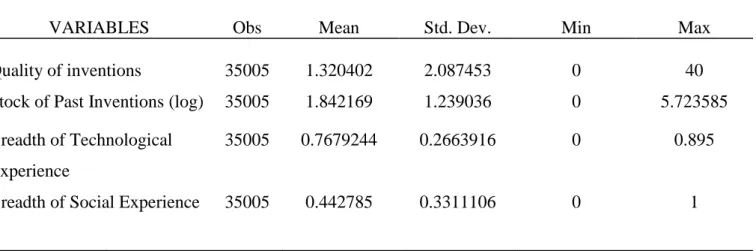
Before presenting the regressions, I provide some descriptive statistics and the correlation matrix of the variables used.
Table 2 - Descriptive Statistics
VARIABLES Obs Mean Std. Dev. Min Max
Quality of inventions 35005 1.320402 2.087453 0 40 Stock of Past Inventions (log) 35005 1.842169 1.239036 0 5.723585 Breadth of Technological
Experience
35005 0.7679244 0.2663916 0 0.895
Breadth of Social Experience 35005 0.442785 0.3311106 0 1
In the table above one can note that, on average, the quality of inventions (measured in the number of forward citations) is approximately 1.3 when its maximum is 40. One should also notice that the average of breadth of technological experience is approximately 0.77, a considerably high number having in consideration that its maximum is 0.895.
Table 3- Correlations
By looking at the correlation matrix, one can notice that the correlation between both the stock of past inventions and breadth of technological experience with invention’s
1 0.0597 0.0026 -0.0048 -0.4203 0.3121 1 0.3255 0.6449 1 Quality of inventions Breadh of Technological Experience 0.4770 1
Stock of Past Inventions (log) 1
Ability*BTechExp -0.2126 0.0338 -0.0235 1
Breadth of Social Experience 0.1447 -0.2374 1
Ability*StockPastInv(log) 0.3138 0.0192 -0.1034 0.6209 Ability*BSocExp 0.0826 0.0093 -0.0949 0.6246 Ability* BSocExp Ability* StockPastInv(log) VARIABLES Quality of Inventions Stock of Past Inventions (log) Breadh of Technological Experience Breadth of Social Experience Ability* BTechExp
19
quality is positive. On the other hand, the breadth of social experience is negatively correlated with the quality of inventions. However, more reliable results can be obtained only in a multivariate regression, which allows to assess the impact of any variable net of other effects.
One can see the results obtained with the Poisson regression in the Table 4, presented below. Table 4 – Findings (1) (2) (3) (4) VARIABLES Quality of Inventions Quality of Inventions Quality of Inventions Quality of Inventions LogStockPastInv -0.194*** -0.195*** -0.194*** -0.219*** (0.027) (0.027) (0.027) (0.027) Breadth of Technological experience 0.157** 0.137** 0.162** 0.173** (0.070) (0.067) (0.070) (0.070) Breadth of Social Experience 0.033 0.034 0.003 0.036
(0.033) (0.034) (0.034) (0.033) Ability*BTechExp 0.135 (0.201) Ability*BSocExp 0.149* (0.078) Ability*LogStockPastInv 0.096** (0.047) Year Dummy Y Y Y Y Category Dummy Y Y Y Y Inventors Dummy Y Y Y Y Observations 32,719 32,719 32,719 32,719 Number of inv 3,439 3,439 3,439 3,439
Standard errors in parentheses *** p<0.01, ** p<0.05, * p<0.1
By analyzing the table above, one can clearly see some important findings:
(1) Considering first the impact of the breadth of social experience, that is, the extent to which focal inventor has worked with different collaborators. One can see in model (3) that having worked with different people does not have a positive impact on the quality of inventions – as this variable’s coefficient is positive, but
20
is not statistically significant. However, it is important for more talented people, as the interaction is positive and statistically significant (at the 10 per cent level). Specifically, a one standard deviation increase in the breadth of social experience (equal to 0.33) increases the impact of individual ability by 5 per cent.
(2) Regarding the impact of breadth of technological experience, by looking at model (2) one can see that it presents a positive impact in the quality of an invention, since its coefficient is significant at a 5 per cent level. Specifically, when there is a one standard deviation (equal to 0.27) increase in the breadth of technological experience, the quality of inventions increases by 3.7 per cent. However, the interaction with ability is statistically not significant.
(3) Another finding is observable in model (4), as one can notice that the interaction between the stock of past inventions and ability has a statistically significant coefficient (at a 5 per cent level). More precisely, a one per cent increase in the stock of past inventions increases the impact of ability by approximately 9.6 per cent. In other words, people born with high abilities are better inventors, even more so when they accumulate a higher number of inventions. However, the number of the stock of past inventions itself has a negative impact on inventions’ value. Specifically, where there is a one per cent increase in the stock of past inventions, the quality of an invention decreases by 0.219 per cent.
21
Robustness check
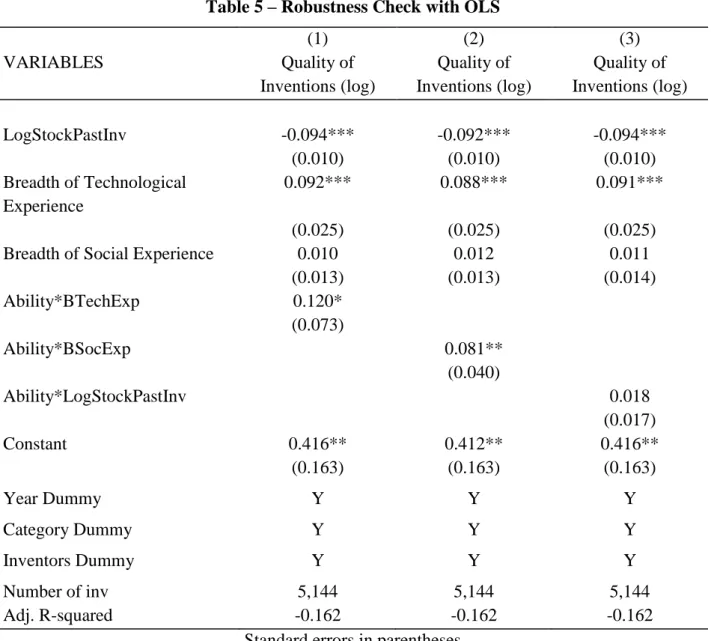
As a robustness check, I estimated equation (2), (3) and (4) with an OLS, rather than a Poisson. Table 5 presents the results.
Table 5 – Robustness Check with OLS
(1) (2) (3) VARIABLES Quality of Inventions (log) Quality of Inventions (log) Quality of Inventions (log) LogStockPastInv -0.094*** -0.092*** -0.094*** (0.010) (0.010) (0.010) Breadth of Technological Experience 0.092*** 0.088*** 0.091*** (0.025) (0.025) (0.025)
Breadth of Social Experience 0.010 0.012 0.011
(0.013) (0.013) (0.014) Ability*BTechExp 0.120* (0.073) Ability*BSocExp 0.081** (0.040) Ability*LogStockPastInv 0.018 (0.017) Constant 0.416** 0.412** 0.416** (0.163) (0.163) (0.163) Year Dummy Y Y Y Category Dummy Y Y Y Inventors Dummy Y Y Y Number of inv 5,144 5,144 5,144 Adj. R-squared -0.162 -0.162 -0.162
Standard errors in parentheses *** p<0.01, ** p<0.05, * p<0.1
In model (2), one can easily see that the results are similar to the Poisson regression, where the breadth of social experience itself does not have an impact on the quality of inventions, since its coefficient is not statistically significant. However, when interacted with ability it becomes significant at a 5 per cent level. Specifically, a one
22
standard deviation increase (equal to 0.33) in the breadth of social experience increases the impact of innate ability by 2.7 per cent.
Considering now the impact of the stock of past inventions in inventions’ value, one can see in model (3) that when interacted with ability becomes non-significant. However, this measure of experience has a negative impact on the quality of inventions. More precisely, when the stock of past inventions increases by one per cent, the inventions’ quality decreases by 0.094 per cent.
Furthermore, when looking at model (1), one can see that the breadth of technological experience has a positive impact on the quality of an invention, since its coefficient is positive and significant at a 1 per cent level. Specifically, when there is a one standard deviation increase (equal to 0.27) in the breadth of technological experience, the quality of inventions will increase by 2.5 per cent. Also, one can notice that this measure of experience has a positive impact on inventions’ quality, since the coefficient of the interaction between this variable and ability is positive and significant at a 10 per cent level. More precisely, a one standard deviation increase in the breadth of technological experience (equal to 0.27) increases the impact of individual ability by 3.24 per cent.
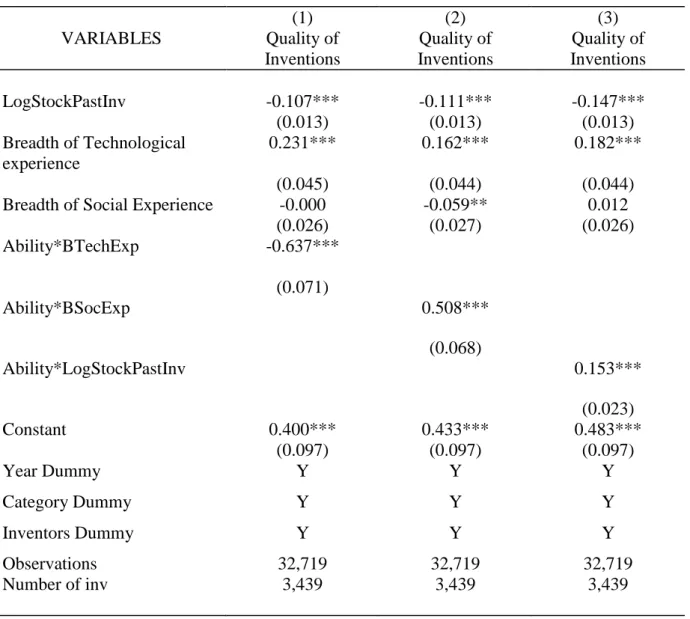
A further robustness test was performed in order to assess the impact of the interaction variables in the quality of an invention, by using a Negative binomial regression. The advantage of this model is “the model is convenient and practical; it handles overdispersion, it allows the likelihood ratio and other standard maximum likelihood tests to be implemented and it has good properties (…)” (Ismail and Jamal, 2007, p. 103). Furthermore, using both a Poisson and a Negative Binomial model preserves the validity and power of the empirical analysis (Piza, 2012)3. The results are shown in Table 6.
Most of the findings were consistent with the ones in Tables 4 and 5, with the Poisson and OLS regressions. However, in this model the interaction between ability and the breadth of technological experience, and its impact on inventions’ quality becomes significant at a 1 per cent level. Meaning that, the breadth of technological experience (broader set of knowledge) combined with individual ability has a negative impact on the quality of an invention. Specifically, a one standard deviation increase in the breadth of
23
technological experience (equal to 0.27) decreases the impact of individual ability by 17.2 per cent.
Table 6 – Robustness Check with Negative Binomial
(1) (2) (3) VARIABLES Quality of Inventions Quality of Inventions Quality of Inventions LogStockPastInv -0.107*** -0.111*** -0.147*** (0.013) (0.013) (0.013) Breadth of Technological experience 0.231*** 0.162*** 0.182*** (0.045) (0.044) (0.044)
Breadth of Social Experience -0.000 -0.059** 0.012
(0.026) (0.027) (0.026) Ability*BTechExp -0.637*** (0.071) Ability*BSocExp 0.508*** (0.068) Ability*LogStockPastInv 0.153*** (0.023) Constant 0.400*** 0.433*** 0.483*** (0.097) (0.097) (0.097) Year Dummy Y Y Y Category Dummy Y Y Y Inventors Dummy Y Y Y Observations 32,719 32,719 32,719 Number of inv 3,439 3,439 3,439
Standard errors in parentheses *** p<0.01, ** p<0.05, * p<0.1
Furthermore, the coefficients of the two remaining interactions suffer a slight increase in models (2) and (3) and both become statistically significant at a 1 per cent level. In model (2), a one standard deviation increase in the breadth of social experience (equal to 0.33) increases the impact of individual ability on inventions’ quality by 16.8 per cent.
Additionally, in model (3), one can also see that the impact of the stock of past inventions associated with innate ability increases in comparison to the Poisson model.
24
In this case, a one per cent increase in stock of past inventions increases the impact of individual ability by approximately 15.3 per cent.
However, the Negative Binomial model might raise some issues, such as it may not control for all stable individual characteristics. Thus, the Poisson and OLS are more reliable, since the fixed effect is working properly in these two models.
25
Conclusion
This study shows that not only innate ability and experience per se play an important role in the quality of an invention, measured as the number of forward citations, but also ability combined with experience significantly affect inventions’ quality.
Hence, this study presents some relevant contribution to previous analysis. First, even though research has been made to study the impact of experience and/or talent in the creativity of an invention (Eesley and Robert, 2012. Simonton, 1999, 2008), no empirical study has focused on evaluating the interaction between innate ability and experience together.
Second, this work enriches our understanding regarding the impact of experience on creative outcome. In this respect, related to Audia and Goncalo (2007) - who found that previous experience has a negative impact on creative solutions due to the fact that past success may lead inventors to stay narrowly focused on previous ideas - my results indicate that experience (measured as the stock of past inventions) when combined with innate ability, allows inventors to develop higher quality inventions. Furthermore, I also found that the breadth of social experience, combined with high ability, enhances the quality of a solution as well. In other words, a talented individual with already acquired expertise and who knows a lot of people is more able to develop creative and impactful inventions.
However, this study has some important limitations. First, I measured the quality of inventions by the number of forward citations, in which I cannot exclude self-citations, or citations from scholars that prove that other individuals were wrong.
Second, I cannot claim any causal relationship between experience, ability and the quality of invention outcome. The reason is that, due to data limitation, I could not take into account other variables potentially correlated with my experience measures, on one hand, and invention quality, on the other. Therefore, there might be an omitted variable bias. For instance, the academic education, since individuals with further education (undergraduate, masters, etc) might be inclined to develop a higher quality solution; or the number of firms an inventor has worked in.
26
Third, the sample of European inventors may not be representative of the overall inventor population, since these inventors may differ from others that have different nationalities.
Fourth, and most importantly, my measure of individual ability might capture also other individual time invariant factors which do not properly relate to innate talent. For instance, the nationality of inventors, the cultural background he or she was exposed during his childhood and parent education.
In spite of these limitations, this study provides important managerial implications. Firstly, since talented people with acquired expertise are able to generate better inventions, they should be assigned to a significant number of R&D projects, as the accumulation of experience will raise their future inventions’ value. Also, according to my findings, the more people a talented individual works with, higher the quality of his or her inventions is. Hence, inventors should be allocated in the “center” of an organization, so they can know and meet more people, and be able to develop higher quality inventions.
Overall, this study sheds some light on the combined impact of innate ability and experience on the quality of an invention. Assessing which other measures of experience, both alone and combined with ability, may influence the quality of an invention is an important topic for future research.
27
References
Abdel-Razek, R.H., Alsanad, D.S. (2013). Mapping Technological Innovation: Methodology and Implementation. Global Conference on Business and Finance
Proceedings, 8, 175-183.
Ainley, M. (2000). Talent in Context, by Friedman, R.C. and Rogers, K.B. Book reviews,
High Ability Studies, 11, 87-90.
Albert, M.B., Avery, D., Narin, F., McAllister, P. (1991). Direct validation of citation counts as indicators of industrially important patents. Research Policy, 20, 251-259.
Audia, P.G., Goncalo, J.A. (2007). Past Success and Creativity over Time: A Study of Inventors in the Hard Disk Drive Industry. Management Science, 53, 1-15.
Balogh, L., Munnich, A. (2000). Intellectual Talent: Psychometric and Social Issues, by Benbow, C.P. and Lubinski, D. Book reviews, High Ability Studies, 11, 93-95.
Bouchard, T.J., Jr. (1994). Genes, Environment and Personality. Science, 264, 1700-1701.
Bruns, H.C. (2013). Working Alone Together: Coordination in Collaboration Across Domains of Expertise. Academy of Management Journal, 56, 62-83.
Castaldi, C., Frenken, K., Los, B. (2013). Related Variety, Unrelated Variety and Technological Breakthroughs: an analysis of U.S. state-level patenting. Eindhoven Center
for Innovation Studies (ECIS) working paper series 13-03.
Chen, G., Farh, J., Campbell-Bush, E.M., Wu, Z., Wu, X. (2013). Teams as Innovative Systems: Multilevel Motivational Antecedents of Innovation in R&D Teams. Journal of
28
Chua, R.Y., Iyengar, S.S. (2008). Creativity as a Matter of Choice: Prior Experience and Task Instruction as Boundary Conditions for the Positive Effect of Choice on Creativity.
Journal of Creative Behavior, 42, 164-180.
Conti, R., Gambardella, A., Mariani, M. (2014). Learning to Be Edison: Inventors, Organizations, and Breakthrough Inventions. Organization Science, in press.
Eesley, C.E., Roberts, E.B. (2012). Are you experienced or are you talented? When does innate talent versus experience explain entrepreneurial performance? Strat.
Entrepreneurship J., 6, 207-219.
Ericsson, K.A., Nandagopal, K., Roring, R.W. (2009). Toward a Science of Exceptional Achievement. Attaining Superior Performance through Deliberate Practice. Ann. N.Y.
Acad. Sci., 1172, 199-217.
Feist, G.J., Barron, F.X. (2002). Predicting creativity from early to late adulthood: Intellect, potential, and personality. Journal of Research in Personality, 37, 62-88.
Freeman, J. (2000). Genius Explained, by Howe, M.J.A. Book reviews, High Ability
Studies, 11, 83-85.
Gambardella, A., Harhoff, D., Verspagen, B. (2008). The value of European patents. Eur.
Manag. Rev. 5 (2) 69-84.
Hall, B.H., Jaffe, A.B., Trajtenberg, M. (2005). Market Value and Patent Citations. Rand
Journal of Economics, 36, 16-38.
Harhoff, D., Narin, F., Scherer, F.M., Vopel, K. (1999). Citation frequency and the value of patented inventions. Review of Economics and Statistics, 81 (3) 511-515.
Harrington, J., Voehl, F. (2012). Innovation Management: Part 1 A Breakthrough Approach to Organizational Excellence. International Journal of Innovation Science, 4, 231-243.
29
Hoisl, K., Gruber, M., Harhoff, D. (2010). Invention Processes and Knowledge Recombination Across Technological Boundaries. Paper to be presented at the Summer conference 2010 on “Opening Up Innovation: Strategy, Organization and Technology” at Imperial College London Business School, June 16 - 18, 2010.
Kaufman, J.C., Sternberg, R.J. (2007). Creativity. Change – Heldref Publications, 55-58.
Kendall, T.D. (2008). Ability and Specialization among Economic Researchers.
Managerial and Decision Economics, 29, 609-618.
Kozbelt, A., Beghetto, R.A., Runco, M.A. (2012). Theories of Creativity. Pp. 20-47.
Leiponen, A., Helfat, C.E. (2010). Innovation Objectives, Knowledge Sources, and the Benefits of Breadth. Strategic Management Journal, 31, 224-236.
Morris, L. (2013). Three Dimensions of Innovation. International Management Review,
9, 5-10.
Protzko, J., Kaufman, S.B. (2010). The Genius in All of Us: Why Everything You’ve Been Told about Genetics, Talent, and IQ is Wrong, by David Shenk.
Simonton, D.K. (1999). Talent and Its Development: An Emergenic and Epigenetic Model. Psychological Review, 106, 435-457.
Simonton, D.K. (2003). Scientific Creativity as Constrained Stochastic Behavior: The integration of Product, Person and Process Perspectives. Psychological Bulletin, 129, 475-494.
Simonton, D.K. (2008). Scientific Talent, Training, and Performance: Intellect, Personality, and Genetic Endowment. Review of General Psychology, 12, 28-46.
Sternberg, R.J. (2000). The Psychology of High Abilities, by Howe, M.J.A. Book reviews,
30
Taylor, A., Greve, H.R. (2006). Superman or the Fantastic Four? Knowledge Combination and Experience in Innovative Teams. Academy of Management Journal, 49, 723-740.
Trajtenberg, M. (1990). A penny for your quotes: Patent citations and the value of innovations. RAND Journal of Economics, 21, 172-187.
Vinkhuyzen, A., Sluis, S., Posthuma, D., Boomsma, D.I. (2009). The Heritability of Aptitute and Exceptional Talent Across Different Domains in Adolescents and Young Adults. Behav Genet, 39, 380-392.