D
D
i
i
r
r
e
e
c
c
t
t
i
i
o
o
n
n
a
a
n
n
d
d
l
l
e
e
g
g
i
i
t
t
i
i
m
m
a
a
t
t
i
i
o
o
n
n
i
i
n
n
s
s
y
y
s
s
t
t
e
e
m
m
u
u
p
p
s
s
c
c
a
a
l
l
i
i
n
n
g
g
–
–
p
p
l
l
a
a
n
n
i
i
f
f
i
i
c
c
a
a
t
t
i
i
o
o
n
n
o
o
f
f
f
f
l
l
o
o
a
a
t
t
i
i
n
n
g
g
o
o
f
f
f
f
s
s
h
h
o
o
r
r
e
e
w
w
i
i
n
n
d
d
Nuno Bento
Margarida Fontes
M
Ma
a
rç
r
ço
o
2
20
01
17
7
W
WP
P
n
n.
.
º
º
2
20
0
17
1
7/
/0
01
1
DOCUMENTO DE TRABALHO WORKING PAPER*
ISCTE - Instituto Universitário de Lisboa, DINÂMIA’CET – IUL, Lisboa, Portugal. Corresponding author: [email protected]**
LNEG – Laboratório Nacional de Energia e Geologia, Estrada do Paço do Lumiar, 22, 1649-038 Lisboa Portugal, [email protected]Direction and legitimation in system upscaling –
planification of floating offshore wind
Nuno Bento*
Margarida Fontes**
WP n. º 2017/01
DOI: 10.15847/dinamiacet-iul.wp.2017.011. INTRODUCTION ... 4
2. Conceptualizing the upscaling of technological innovation systems ... 6
2.1 Core concepts in technological innovation systems ... 6
2.2 TIS lifecycle ... 9
2.3 Legitimation and guidance in system dynamics ... 11
2.4 Roadmaps as instruments to accelerate growth ... 14
3. Methodological issues ... 15
3.1 Research question and hypothesis ... 15
3.2 Empirical setting and method ... 16
4. Roadmap analysis: Shared strategies for scaling up floating offshore wind energy ... 19
4.1 Technology ... 19
4.1.1 The evolution of floating offshore wind energy ... 19
4.1.2 Commercialization plans ... 23
4.2 Structural components ... 28
4.2.1 Actors ... 28
4.2.2 Networks ... 29
_____________________________________________________________________________
DINÂMIA’CET – IUL, Centro de Estudos sobre a Mudança Socioeconómica e o Território ISCTE-IUL – Av. das Forças Armadas, 1649-026 Lisboa, PORTUGAL
Tel. 210464031 - Extensão 293100 E-mail: [email protected] http://dinamiacet.iscte-iul.pt/
2
4.3 Functions ... 31
4.3.1 Influence in the direction of search ... 31
4.3.2 Legitimation ... 32
4.3.3 Impact on the other functions ... 34
4.3.4 Methodology to map legitimacy and guidance ... 37
5. Confronting the opinion of actors with roadmaps ... 40
6. Summary of the findings ... 43
7. Conclusion ... 44
8. References ... 47
_____________________________________________________________________________
DINÂMIA’CET – IUL, Centro de Estudos sobre a Mudança Socioeconómica e o Território ISCTE-IUL – Av. das Forças Armadas, 1649-026 Lisboa, PORTUGAL
Tel. 210464031 - Extensão 293100 E-mail: [email protected] http://dinamiacet.iscte-iul.pt/
3
Direction and legitimation in system upscaling –
planification of floating offshore wind
ABSTRACTThis research investigates the process of construction of visions and plans to accelerate emerging low-carbon innovations. We adopt the technological innovation systems perspective to focus on system building processes, including the establishment of constituent elements and performance of key innovative activities. We analyze national roadmaps that have been developed for a technology that approaches upscaling and market take-off: offshore wind energy in deepwaters, i.e., more than 50 meters deep where there is high potential of resources but whose technology is still immature. The roadmaps analysis informs on how actors prepare the growth of the system and perform critical innovation activities. The analysis shows the importance of influence in the direction of search (guidance) and legitimation in the transition to growth. It points to different types of guidance depending on the technological and institutional context, in particular the tendency for a higher external openness with the approximation of technology deployment and with government involvement. A survey of actors’ opinion reveals that roadmaps tend to overinflate expectations and have a positive but limited impact on the technology development. Policy implications include recommendations for managing the process of formation of visions and legitimacy of emerging innovations. The analysis has implications for the operationalization of the functions guidance and legitimacy, as well as indicates limits to the current functional analysis and discusses future research directions.
KEYWORDS: Functions of innovation systems; industrial lifecycle; up-scaling; roadmaps; offshore wind energy.
HIGHLIGHTS:
- We operationalize the study of collective strategy building (guidance) and social acceptance (legitimation) through roadmaps analysis;
- We apply the framework to floating offshore wind technology which enters the up-scaling phase; - Guidance and legitimation are important conditions for technology upscaling and take-off; - Types of guidance towards external openness change with technological progress and
government involvement;
_____________________________________________________________________________
DINÂMIA’CET – IUL, Centro de Estudos sobre a Mudança Socioeconómica e o Território ISCTE-IUL – Av. das Forças Armadas, 1649-026 Lisboa, PORTUGAL
Tel. 210464031 - Extensão 293100 E-mail: [email protected] http://dinamiacet.iscte-iul.pt/
4
1. INTRODUCTION
The moment of transition to growth is crucial in the development of emerging innovation systems. They must attaint a certain degree of social acceptance and organization to make that happen. This question is particularly relevant in the context of climate change mitigation, as efforts to avoid catastrophic consequences call for the implementation of low-carbon innovations (IPCC, 2014). Technologies evolve in the early years of the life-cycle and eventually standardize, which typically shifts the focus from product innovation to process innovation (Abernathy and Utterback, 1978; Taylor and Taylor, 2012; Huenteler et al., 2016). At the same time, the adoption environment adjust to permit the transition to growth (Van de Ven and Garud, 1993; Dosi and Nelson, 2010; Markard, 2016). Research shows that scaling is a common heuristic in the process of technological development (Winter, 2008). Technology up-scaling precedes market take-off and mass commercialization of energy technologies (Wilson, 2012). Furthermore, up-scaling requires some degree of agreement among the actors on the anticipation of the future of both the technology (including standards) and markets.
The take-off of new technologies involves the formulation of collective expectations and visions. This process is addressed by the literature on technological innovation systems (TIS). This literature shows how several contextual structures affect the take-off of technological innovation systems, including sectorial, geographical and political contexts (Bergek et al., 2015). TIS studies also highlight the importance of key innovation processes (the so-called system functions) in the process of transition to growth, particularly the influence in the direction of search and legitimation (Bergek et al., 2008a,b; Hekkert et al., 2007). Influence in the direction of search (or guidance) refers to the existence and sharing of collective expectations that aim to improve the attractiveness of the focal TIS to actors from other activities (Hekkert and Negro, 2009). This expectations management can be based on roadmaps and policy action plans (Borup et al., 2013). Legitimation designates the degree of acceptance of the technology and the conformity with the existent institutions (Bergek et al, 2008b; Markard et al., 2016). The two functions are namely essential for the mobilization of resources, the formation of demand, and the acquisition of political strength that are necessary for technology up-scaling and growth (Aldrich and Fiol, 1994; Negro et al., 2012).
Roadmaps are instruments that support technology management and planning and thus can be seen as an important element in the governance of the system transition (McDowall, 2012; Phaal et al., 2004, 2011). Roadmaps convey a collective vision and strategy that may influence the direction of search. They can also contribute to form collective expectations and thus establish technology legitimacy. Roadmaps are particularly helpful in early years of
_____________________________________________________________________________
DINÂMIA’CET – IUL, Centro de Estudos sobre a Mudança Socioeconómica e o Território ISCTE-IUL – Av. das Forças Armadas, 1649-026 Lisboa, PORTUGAL
Tel. 210464031 - Extensão 293100 E-mail: [email protected] http://dinamiacet.iscte-iul.pt/
5 random patterns by enabling to run “in packs with others to create new relationships and institutions for collective survival” (Van de Ven, 2017: 40).
Roadmaps are the result of a negotiation process that leads to a compromise between different anticipations of the future. They have the character of anticipatory coordination (Rip, 2012) by reducing the risk and uncertainty in technology growth. However, the compromise may reflect not only the differences in visions among the participant actors, but also their discursive power (capacity to frame an innovation), ideology and political cultures (Geels, 2014). In spite of this limitation, roadmaps provide a valuable setting to examine the perspectives and proposals for preparing the system development.
The literature recognizes the importance of the formulation (legitimation) and sharing (guidance) of expectations (Bergek et al., 2008b; Hekkert et al., 2007), but there is still little understanding on how these two crucial processes are formed along the transition to growth. This paper addresses this gap by analyzing the specific ways in which the construction of shared visions, in the context of roadmapping processes, contributes to the emergence of collective expectations and strategies. In particular, it assesses how roadmaps inform the unfolding process of TIS up-scaling through the performance of critical functions such as guidance and legitimacy.
Therefore, the main research questions are: What are the specific forms available to prepare the growth of new low-carbon innovations?; How these processes uphold the formation of a collective expectation and strategy that prepare for industry take-off?
We analyze the visions and guidelines that are materialized in roadmaps and documents alike. To validate the expectations that are formulated in the roadmaps, we perform in parallel a survey of actors’ opinion. The empirical setting is the development of the offshore wind energy in floating platforms, a new technology which promises to unlock a huge resource potential in deepwaters (water depths of 50 meters or higher) (Firestone et al., 2015; European Commission, 2014). This technology presents a high potential to reduce emissions in the electricity sector, provided that it overcomes a number of technological and institutional challenges that prevent take-off (Wieczorek et al, 2013, 2015; Firestone et al., 2015).
Floating offshore wind energy is more than a simple extension of the offshore wind technological innovation system and thus can arguably constitute a TIS on its own right. In fact, it develops under a different environment that is marked by a specific sectoral, technological, geographical and political context. The supply chain is different from the offshore wind in shallow waters in the near-shore (Rodrigues et al., 2015) – and even more distinct from the onshore wind (Wüstemeyer et al., 2015). The technologies are different (e.g. floating foundations, size of turbines) and have a disparate structure of costs (Green and Vasilakos,
_____________________________________________________________________________
DINÂMIA’CET – IUL, Centro de Estudos sobre a Mudança Socioeconómica e o Território ISCTE-IUL – Av. das Forças Armadas, 1649-026 Lisboa, PORTUGAL
Tel. 210464031 - Extensão 293100 E-mail: [email protected] http://dinamiacet.iscte-iul.pt/
6 2011). The countries active in the development of floating offshore wind have in common large potential sites located in deep waters relatively close to shore (e.g. Norway, Japan and Portugal); and, thus, unsurprisingly, there is little overlapping with the countries that invest in the offshore wind in shallow waters (Kern et al., 2015). Finally, floating offshore wind has lower environmental impacts and lower interference with other activities than installations onshore and in the near-shore.
The contribution of this study for the literature is twofold. First, it improves the conceptualization of technology up-scaling and life-cycles in TIS, adding to the recent efforts in this area (see Markard, 2016). Second, it improves the analytical treatment and operationalization of the process of building both visions/expectations/strategies and public acceptance around a new TIS. This study particularly allows a better grasp of the main drivers of direction of search and legitimation.
The paper is organized as follows. Section 2 reviews the literature on the acceleration of growth of new technological innovations systems. Section 3 explains the methodological approach followed in the study. Section 4 presents the results of the roadmaps analysis and the survey. The conclusion section summarizes the findings and discuss their implications for the policy and the literature.
2. CONCEPTUALIZING THE UPSCALING OF TECHNOLOGICAL
INNOVATION SYSTEMS
The research investigates strategies aiming to “change gears” and accelerate the development of low-carbon innovations, a crucial topic for decarbonizing the actual energy system. To understand the underlying processes, we take the theoretical perspective of technological innovation systems (TIS) (Bergek et al., 2008a; Markard et al., 2012) which is adequate to analyze the complexity around the innovation in energy technologies (Gallagher et al., 2012). This approach is complemented with insights from industrial and technology life-cycles (e.g. Taylor and Taylor, 2012) and roadmaps (e.g. Phaal et al, 2011).
2.1 Core concepts in technological innovation systems
Technological innovation systems (TIS) regards innovation as an interactive process involving actors (e.g., firms, users) and networks acting under a particular context of institutions and policies (Jacobsson and Bergek, 2011). In these terms, the emergence of a new TIS encompasses the establishment of structural components – i.e. technology, actors, networks and institutions - dedicated to the focal TIS or shared with other existing TISs (Markerd and Truffer,
_____________________________________________________________________________
DINÂMIA’CET – IUL, Centro de Estudos sobre a Mudança Socioeconómica e o Território ISCTE-IUL – Av. das Forças Armadas, 1649-026 Lisboa, PORTUGAL
Tel. 210464031 - Extensão 293100 E-mail: [email protected] http://dinamiacet.iscte-iul.pt/
7 2008). Technology is a key element of the TIS structure, including both artefacts and knowledge (Bergek et al., 2008b). Actors comprise individuals and organizations (e.g. firms) along the value chain. Networks are links established between actors to perform a given task (e.g. knowledge development and diffusion, political lobby). Institutions encompasses formal rules (e.g. laws and property rights, codes and standards) and informal norms (e.g. tradition and culture) that structure social, economic and technological interactions (North, 1990; Borrás and Edquist, 2014).
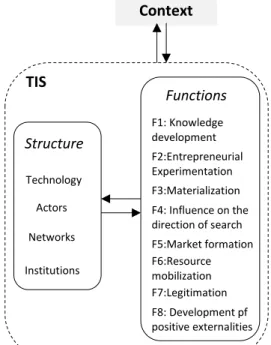
In addition to the establishment of the structural components, TIS scholars have been increasingly looking at the performance of key innovative processes (the so-called “functions”) that are needed for the development and growth of innovation systems (Figure 1). A number of functions were identified in two seminal papers (Hekkert et al., 2007; Bergek et al., 2008a).1 Two functions are particularly important to accelerate the take-off of emerging innovation systems by their impact on the fulfillment of the other functions (Hekkert and Negro, 2009; Suurs et al., 2009; Bergek et al., 2008b): influence on the direction of search (or guidance) and legitimation.
Influence on the direction of search reflects the mechanisms that persuade new actors in
the TIS to allocate innovation activities and investments between competing technologies and designs. This includes the combined effect of two factors (Bergek et al., 2008a): visions, beliefs and expectations in growth potential; and the actor’s perceptions of the relative advantage of the technology from indicators that include incentives and regulation (Borup et al., 2013).
Legitimation involves social acceptance and compliance with the concerned institutions (Bergek
et al., 2008b). The creation of legitimacy is a socio-political process by which expectations are formed and shaped in favor of the technology (Borup et al., 2006). Technology legitimacy is also a matter of conformity with the institutional structures of the context (Markard et al., 2016). This includes the alignment of the regulation with the needs of the innovation. New technologies particularly have to overcome “the liability of newness” in a process that is often surrounded by the competition from established technologies (Zimmerman and Zeits, 2002). By affecting actor’s perceptions, legitimation also indirectly influences their strategies and thus the direction of search (Bergek et al., 2008a). Both functions (guidance and legitimation) are therefore crucial for emerging and existing technologies to attract new actors and mobilize resources necessary for expansion and functioning (Markard et al., 2016; Bergek et al., 2008a).
1 The rest of the presentation adopts the list of functions as described in Bergek et al. (2008a,b). A group
of researchers from Utrecht University has developed an alternative list of functions with slight changes to the previous one (Hekkert et al., 2007): entrepreneurial activities; knowledge development; knowledge diffusion through networks; guidance of search; market formation; resource mobilization, and creation of legitimacy.
_____________________________________________________________________________
DINÂMIA’CET – IUL, Centro de Estudos sobre a Mudança Socioeconómica e o Território ISCTE-IUL – Av. das Forças Armadas, 1649-026 Lisboa, PORTUGAL
Tel. 210464031 - Extensão 293100 E-mail: [email protected] http://dinamiacet.iscte-iul.pt/
8 Other functions are also important to build up new innovation systems. Development of formal
knowledge refers to the way that knowledge is created, combined, codified and shared, to form
the scientific and technological base that allows the innovation to progress (Bergek et al, 2008a; Jacobsson and Bergek, 2011). Entrepreneurial experimentation refers to the development of more applied, tacit and explorative knowledge through risk-taking “entrepreneurial” actions, namely with the experimentation of a diversity of designs under a dynamic environment (Van de Ven, 2017). Materialization designates the early investment in capital stock or artefacts, including factories and infrastructures. Market formation refers to the creation of a demand around increasingly organized markets, from pilot projects to niches and bridging markets. Early demand opens crucial opportunities for learning, while reducing perceived risks with the adoption by consumers (von Hippel, 2010). Resource mobilization points out the need to attract human capital, financial capital and complementary assets from other sectors to gear up innovation systems. Finally, development of positive externalities refers to the strength of the system and the dynamics of growth, comprising the capacity to take advantage of spillovers from the fulfillment of system functions, as well as from the structures and resources extant in other TISs, in order to accelerate growth (Bergek et al, 2008b).
The functional analysis permit to identify the processes that challenge the development of the TIS (Bergek et al., 2008a; Hekkert et al., 2007). These challenges may require an intervention at the level of the supporting structure of the innovation system to address the failures in the system functions (Wieczorek et al., 2015). The type of intervention includes standardization (institution) to reduce technological risks or attraction of new actors from other sectors to bring resources that are needed for technology up-scaling.
Finally, the context influences the dynamics of the focal TIS through the interaction with the contextual structures (Bergek et al., 2015). These comprise institutions, actors and networks that surround the innovation system beyond the technology-specific structures, such as other technological innovation systems, national or regional innovation systems, and political systems (Bergek et al., 2015; Markard et al., 2016). Examples of TIS-context interactions include, in the sphere of legitimation, the deliberated action of actors to promote political goals (context structures) on the focal technology. In addition, complementarities can raise from the interaction between the TIS and the wider context. Complementarity refers to a positive interaction with two or more elements of the context (Markard and Hoffman, 2016). Complementarities are essential for the emergence and growth of new technologies as missing complementary components can negatively affect or even hamper the development of the system (Dahmén, 1988). Examples of complementarities include technological, organizational, institutional and infrastructural complementarities (Van de Ven, 1993; Markard and Hoffman,
_____________________________________________________________________________
DINÂMIA’CET – IUL, Centro de Estudos sobre a Mudança Socioeconómica e o Território ISCTE-IUL – Av. das Forças Armadas, 1649-026 Lisboa, PORTUGAL
Tel. 210464031 - Extensão 293100 E-mail: [email protected] http://dinamiacet.iscte-iul.pt/
9 2016). Technological innovation systems are therefore complex entities that interact with the context and evolve over time.
Figure 1 - Basic components of the technological innovation systems approach (Source: authors from Bergek et al., 2008a,b; Hekkert et al, 2007; Bergek et al, 2015)
2.2 TIS lifecycle
The TIS literature conceptualizes the dynamics of innovation systems typically in terms of the comparison of the state of the system at different stages of development. Bergek et al. (2008a) distinguish between a formative phase when “…constituent elements of the new TIS begin to be put into place, involving entry of some firms and other organizations, the beginning of an institutional alignment and formation of networks” (idem: 419) and a growth phase when “… the focus shifts to system expansion and large-scale technology diffusion through the formation of bridging markets and subsequently mass markets...” (idem: 420).
The formative phase involves four “key” features according to Jacobsson and Lauber (2006): “institutional changes, market formation, the formation of technology-specific advocacy coalitions, and the entry of firms and other organizations” (idem: 258). As regards “ ‘take-off’ into a rapid growth phase”, Jacobsson and Lauber (2006: 260) consider that a “necessary
Context Technology Networks Institutions Structure Functions F1: Knowledge development F2:Entrepreneurial Experimentation F3:Materialization F4: Influence on the direction of search F5:Market formation F6:Resource mobilization F7:Legitimation F8: Development pf positive externalities TIS Actors
_____________________________________________________________________________
DINÂMIA’CET – IUL, Centro de Estudos sobre a Mudança Socioeconómica e o Território ISCTE-IUL – Av. das Forças Armadas, 1649-026 Lisboa, PORTUGAL
Tel. 210464031 - Extensão 293100 E-mail: [email protected] http://dinamiacet.iscte-iul.pt/
10 condition is … that larger markets are formed” in order to “setting in motion a process of cumulative causation”.
Along the same lines, Markard and Hekkert (2013) suggest three stages in the TIS evolution: nascent, emerging, and mature.2 These stages would present different characteristics in terms of technology maturity, key innovative activities (functions) and structural components (actors, institutions, networks) (Markard and Hekkert, 2013; Markard, 2016). A “nascent” (or formative) TIS is a period marked by a large diversity of ideas and concepts, as well as a structure formed by a relative small number of actors mainly organized around networks of knowledge creation and R&D. An “emerging” TIS (including up-scaling) features a lower cost and improved quality technology, which is supported by a gradually more structured system that includes a higher number, more diversified, networks of actors enjoying a stronger political strength, with a growing focus (guidance) on scaling-up the manufacturing base and the technology to reduce costs and open larger markets. Finally, a “mature” TIS comprises a high degree of structuration around a standardized mass-commercialized product, stable formal and informal technology-specific institutions and established networks.
A number of changes occur across the stages of development that can help us to understand the system dynamics, including at the level of the technology, system functions and institutions.
Technology follows temporal patterns that have been identified in the lifecycle literature, comprising the eventual emergence of a dominant design and the shift in the focus of innovation from product innovation in the era of ferment to incremental change in the more advanced stages (e.g. Abernathy and Utterback, 1978; Taylor and Taylor, 2012). However, empirical studies have also shown evidence of alternative patterns of innovation with little or no decline of product innovation across the technology lifecycle in the case of complex products and systems (Davies and Hobday, 2005; Huenteler et al., 2016).
Functions may change in the transition from the formative into the growth phase as it has been suggested by several authors (e.g. Bergek et al., 2008a). Key functions tend to evolve during this process from knowledge creation, legitimation and formation of expectations, in the nascent stage, to resource mobilization and market formation, in the later stages.
Institutional structures evolve from initial visions and collective expectations (cognitive structures), to more informal and formal types of technology-specific institutions such as
2 Wilson (2012) proposes a similar terminology based on the analysis of the historical scaling dynamics of
wind energy: formative phase, up-scaling phase and growth phase. In a more recent version of the paper, Markard (2016) adds a stage of declining TIS. This new stage is not considered in the rest of our presentation also because we are more concerned with the conditions required during the early stages of technology development.
_____________________________________________________________________________
DINÂMIA’CET – IUL, Centro de Estudos sobre a Mudança Socioeconómica e o Território ISCTE-IUL – Av. das Forças Armadas, 1649-026 Lisboa, PORTUGAL
Tel. 210464031 - Extensão 293100 E-mail: [email protected] http://dinamiacet.iscte-iul.pt/
11 technology designs (normative structures), to established standards (regulatory structures) (Markard et al., 2016). The consolidation of institutions enhances the degree of structuration of the system in terms of the emergence of an industry around the technology that comprises “the build-up of value chains, formation of markets, development of educational programs, alignment of regulatory structures, etc.” (Markard and Hekkert, 2013: 7).
For example, in the case of offshore wind energy, further progresses arguably depend on the mobilization of specialized human resources and financial capital, formation of markets and investment in infrastructure and grid connection (Wieczorek et al., 2013, 2015; Jacobsson and Karltorp, 2013). These processes often involve complementaries between several system components including technology, institutions and infrastructures, which can take long to materialize and need proper planning horizons to accompany the development of the focal TIS and avoid creating bottlenecks (Markard and Hoffmann, 2016). This example shows how important it is to coordinate strategies between private and public actors in system upscaling.
2.3 Legitimation and guidance in system dynamics
The transition to growth is a crucial moment in the development of emerging innovation systems. It requires the creation of expectations and collective strategies capable of mobilizing resources and other key innovative activities (functions) to accelerate growth (Wilson, 2012). The process of transition of TISs from emergence to growth remains relatively little understood (Markard, 2016). We posit that it is possible to improve our understanding about system upscaling and take-off by looking at the performance of two particular system functions: legitimation and influence in the direction of search (guidance).
Legitimation refers to the motivation and formation of expectations around a technology, whereas influence in the direction of search deals with the impact of expectations on collective strategies. Bergek et al. (2008a: 417) notes that: “Legitimacy also influences expectations among managers and, by implication, their strategy (and thus the function ‘influence on the direction of search’)”. The two functions are therefore interrelated through expectations.
The sociology of expectations (e.g. Borup et al, 2006) is a stream in the literature that studies the processes that influence the development of new technological system. Expectations refers to real time representations of future technological situations and capabilities, combining views on the progress of the technology, its potential markets and its social context (Borup et al 2006; Van Lente, 1993). Thus, expectations constraint the agenda setting for the field and help creating a “mandate” for the actors involved in its development (Bakker et al, 2011). When widely shared, they can have an important role in aligning different actors around common
_____________________________________________________________________________
DINÂMIA’CET – IUL, Centro de Estudos sobre a Mudança Socioeconómica e o Território ISCTE-IUL – Av. das Forças Armadas, 1649-026 Lisboa, PORTUGAL
Tel. 210464031 - Extensão 293100 E-mail: [email protected] http://dinamiacet.iscte-iul.pt/
12 objectives, effectively contributing to steer development. For this reason, expectations have been described as “performative”, i.e. actively shaping the way new technologies evolve (Borup et al, 2006; Pollock and Williams, 2010, Konrad, 2006). This highlights the importance of processes, such as roadmaps, which lead to the articulation, voicing and sharing of expectations (McDowall et al, 2012).
Technology roadmaps materialize visions and guidelines for the future development, being increasingly used by advocacy coalitions and governments in emerging technologies or industries, particularly in the case of sustainable energies (Amer and Daim, 2010). Roadmapping has become “a powerful technique for supporting technology management and planning, especially for exploring and communicating the dynamic linkages between technological resources, organizational objectives and the changing environment” (Phaal et al, 2004: 5). This instrument started at organization level, but has also become frequent at technology and sectorial levels (Daim and Oliver, 2008; IEA, 2014).
In spite of its widespread use, roadmaps have been largely ignored by the literature on socio-technical transitions (McDowall, 2012) which can be explained by its frequent practitioner focus. The first attempts to conceptualize the role played by system level roadmaps in the governance of transitions start to appear (McDowall, 2012; Rip, 2012; Phaal et al, 2011). Following this emerging stream of research, we propose that the process of formulation and implementation of technology roadmaps can be indicator of both the content and effectiveness of the performance of system functions, especially influence in the direction of search and legitimation.
First, roadmaps are instruments for the articulation of shared visions and expectations regarding the future development of the technology, thus contributing to align key actors and to guide their future behavior (McDowall, 2012). They influence the direction of search as the collective strategy becomes more widely accepted. Roadmaps also contribute to improve the general perception about the technology as a result of their action upon several factors including public policy (Bergek et al., 2008a). However, roadmaps’ effectiveness depends on how broad is the involvement of actors in their formulation and how inclusive is the consensus reached on the chosen path(s) (McDowall, 2012).
Second, roadmaps can provide additional legitimacy to the collective strategies, thus being an instrument of legitimation (Borup et al., 2013). Their implementation might contribute to the alignment of the technology with the institutional structures in force. This occurs namely by acting upon one of the three legitimation processes identified in Markard and Hoffmann (2016): i) the adaptation to existing structures and the gradual increase of technology-specific institutions in the TIS (e.g. standards); ii) the increase of technology legitimacy following a
_____________________________________________________________________________
DINÂMIA’CET – IUL, Centro de Estudos sobre a Mudança Socioeconómica e o Território ISCTE-IUL – Av. das Forças Armadas, 1649-026 Lisboa, PORTUGAL
Tel. 210464031 - Extensão 293100 E-mail: [email protected] http://dinamiacet.iscte-iul.pt/
13 change in the context (e.g. low carbon technologies increase legitimacy with higher public attention to climate change); iii) the framing or re-positioning a focal technology in response to the new institutional structures (e.g. nuclear re-legitimation as a climate-friendly technology).3
As regards legitimation, the effectiveness of roadmaps depends on whether the proposals are acknowledged as being grounded in credible, good quality, analysis and if they result from a participatory process involving key actors (McDowall et al, 2012). Targets set by the government are naturally more credible; When Roadmaps result from the initiative of specific industry or technology advocacy coalitions, they can have an additional role of policy lobbying for changes in the regulation (Amer and Daim, 2010).45
Therefore, technology roadmaps that are produced by broad coalitions of actors or government-led partnerships are more likely regarded as the expression of shared visions and expectations (guidance) about the development of the system, as well as the reflection of chosen technology pathways more aligned (legitimacy) with current institutions. Both guidance and legitimation may result from a consensus reached along the roadmapping process, however with the limitations inherent to such consensus. On the one hand, the consensus may reflect the interests of more influential actors (e.g. powerful regime actors) who can use their position to steer the development in the direction that suits better their specific interests – by narrowing the range of possible paths or excluding some minority perspectives (McDowall, 2012; Bergek et al., 2013). On the other hand, expectations can be inflated especially when the roadmap departs from the initiative of an advocacy coalition to persuade public authorities (McDowall, 2012). Both limitations call for a careful interpretation of such documents, whose analysis should be complemented with other sources (e.g. surveys of actors’ opinion) whenever possible.
3 As noted by Smith et al. (2005: 1506): “The transition management literature places significant emphasis
on the role of ‘guiding visions’ (Rotmans and Kemp, 2001; Berkhout et al., 2004), and it is clear that codified representations of technological expectations play a vital role in framing socio-technical problems, as well as motivating actors to seek to solve them (Brown et al., 2000).”
4 As Jacobsson and Lauber (2006) concludes in their study of the diffusion of renewable energy
technologies in Germany: “Legitimacy and visions are shaped in a process of cumulative causation where institutional change, market formation, entry of firms (and other organisations) and the formation and strengthening of advocacycoalitions are the constituent parts. At the heart of that process lies the battle over the regulatory framework.” (Jacobsson and Lauber, 2006: 272).
5 This is consistent with Suchman (1995), who reviews the strategic and institutional approaches of
organizational legitimacy to identify three primary forms of legitimation: pragmatic, moral (normative) and cognitive (collective comprehensibility).
_____________________________________________________________________________
DINÂMIA’CET – IUL, Centro de Estudos sobre a Mudança Socioeconómica e o Território ISCTE-IUL – Av. das Forças Armadas, 1649-026 Lisboa, PORTUGAL
Tel. 210464031 - Extensão 293100 E-mail: [email protected] http://dinamiacet.iscte-iul.pt/
14 2.4 Roadmaps as instruments to accelerate growth
Technology roadmaps are instruments for mapping industry emergence that have been particularly used in new technology-intensive sectors to support strategy and decision making in innovation processes (Phaal et al, 2011; Smith et al., 2005). Such mapping is regarded as a basis for understanding the dynamics of the system and for acting upon those dynamics. Particularly, roadmaps might be able to identify focal points for action and make decisions concerning the most adequate strategies according to the stage of development of the technological system.
In these terms, Phaal et al. (2011) suggests a framework for mapping industry emergence that is inspired in technology lifecycle and evolutionary theories. The framework identifies common patterns in the transitions between phases based on the analysis of the emergence of 25 innovations (Figure 2). The authors define four phases (precursor, embryonic, nurture, growth) and periods of transition between them that are marked by key events, identified as “demonstrators”. The demonstrators are milestones in the innovation process and thus should be focal points for strategy development and goal setting. These include:
- “technology demonstrators” showing the feasibility of the underlying science (i.e. science to technology (S-T) transition) from precursor to embryonic phase;
- “commercial application demonstrators” demonstrating the potential for revenue generation (i.e. technology to application (T-A) transition) from embryonic to nurture phase; and
- “mass market demonstrators” displaying the economic advantages and market growth potential of the technology (i.e. application to market (A-M) transition) from nurture to growth phase.
These phases coincide to a large extent with the ones suggested in the TIS literature (Section 2.2). Precursor and Embryonic phases would enter into the Nascent TIS; Nurture phase presents similar challenges as of Emerging TIS; and Growth phase corresponds roughly to the Mature TIS. However, this framework focus mainly on technology development which is but a component of the entire system; It namely overlooks important challenges in the transition like the organization of the value-chain for scaling or the improvement of the public opinion about the innovation to stimulate demand and lower the risk of investments in production. Still this representation is helpful to highlight the technology-specific challenges that must be overcome to accelerate development. Therefore the roadmapping approach complements systemic theories (e.g. TIS) by outlining a number of key events that require attention in the transition to growth.
_____________________________________________________________________________
DINÂMIA’CET – IUL, Centro de Estudos sobre a Mudança Socioeconómica e o Território ISCTE-IUL – Av. das Forças Armadas, 1649-026 Lisboa, PORTUGAL
Tel. 210464031 - Extensão 293100 E-mail: [email protected] http://dinamiacet.iscte-iul.pt/
15 Figure 2 - An applied framework for roadmapping (Source: Phaal et al., 2011)
3. METHODOLOGICAL ISSUES
3.1 Research question and hypothesis
The research seeks to improve the understanding about the process of planning the up-scaling of new sustainable energy technologies.
Drawing on the insights from the revision of the literature, we advance the following hypotheses concerning the acceleration of technological development:
(i) guidance and legitimation are key processes to accelerate the growth of emerging systems (because of their role in the performance of the other crucial processes such as resource mobilization and market formation, as already shown in the literature) and their performance can assume specific forms in the transition process;
(ii) roadmaps are an element in the process of formation (legitimation) and share (guidance) of collective expectations;
(iii) the context influences roadmaps, namely in terms of the stage of technology maturity or the process of creation of a consensus.
_____________________________________________________________________________
DINÂMIA’CET – IUL, Centro de Estudos sobre a Mudança Socioeconómica e o Território ISCTE-IUL – Av. das Forças Armadas, 1649-026 Lisboa, PORTUGAL
Tel. 210464031 - Extensão 293100 E-mail: [email protected] http://dinamiacet.iscte-iul.pt/
16 3.2 Empirical setting and method
We take the case of offshore wind energy in deepwaters – more than 50 meters deep, where most of the potential is located but whose technology is more immature – in a number of countries, to give the empirical background for the discussion.
The definition of the boundaries of the TIS is very important to understand what is newly emerging in the wind energy industry. Studies have shown that offshore wind energy and onshore wind energy are two clearly separated TISs, namely having a different supply chain (Wüstemeyer et al., 2015). Floating offshore wind energy is more than a simple part of the offshore wind technological innovation system and can eventually constitute a TIS on its own right. First, the supply chain (including competencies) required to develop wind energy farms in deepwaters is different from the one in shallow waters in the near-shore (Rodrigues et al., 2015). Second, the technologies are also different, especially in what concerns the foundations (fixed versus floating structures) and the structure of costs (Green and Vasilakos, 2011). Thirdly, the countries that have been involved in the development of this technology are not the same as for the offshore wind energy in shallow waters (Kern et al., 2015); they have in common large wind resources potential that are located in deep waters relatively close to shore (e.g. Norway, Japan and Portugal). Finally, floating offshore wind tend to have lower environmental impacts and lower interference with other activities than installations onshore or in the near-shore and, in consequence, may face less external resistance.
The paper applies system theories namely TIS (Bergek et al., 2008a; Hekkert et al; 2007; Markard et al., 2012) to track the processes of structuration (e.g. creation of value-chains) of technological innovation systems that enter into the up-scaling stage. The analysis comprises the requirements of up-scaling in terms of changes in technology, actors, networks and institutions, at more structural level, as well as in core innovative activities or functions (including guidance and legitimacy), at more functional level.
To understand how these critical structural and functional elements unfold, we analyze roadmaps and equivalent national programs for floating offshore wind energy. As pointed earlier, roadmaps are the result of a process (presumably inclusive) that attempts to reach a certain consensus among the key actors about the future development of the technology, what they expect to happen and the paths that should be followed to achieve it. For this purpose, roadmaps often provide a diagnosis of the state of the art of the technology, as well as an identification of the main system players and emerging networks. Because roadmaps are an element in the process of formation and sharing of expectations, they can be an important
instrument for the performance of system functions like influence in the direction of search and
_____________________________________________________________________________
DINÂMIA’CET – IUL, Centro de Estudos sobre a Mudança Socioeconómica e o Território ISCTE-IUL – Av. das Forças Armadas, 1649-026 Lisboa, PORTUGAL
Tel. 210464031 - Extensão 293100 E-mail: [email protected] http://dinamiacet.iscte-iul.pt/
17 In addition to the diagnosis, roadmaps set out a vision of the future and identify needs and actions to be performed, at different levels, in order to fulfill it (McDowall, 2012). In other words, roadmaps reflect the actors’ view on how to “change gears” and accelerate the development of the technology. So, they are good indicators (although partial) of the way that actors perceive and prepare the TIS growth.
Thus roadmaps analysis enables us to investigate the performance of the system functions like guidance and legitimation in the transition to growth. Although roadmaps are not the only instrument for collective construction of visions and strategies, they provide important insights about the creation and dissemination of expectations around the new technology (Borup et al., 2013). In addition, the comparison of roadmaps from different contexts may enable us to understand the influence of the context in their performance of the system functions.
Since roadmaps are only one element in collective strategy definition, we need to complement the analysis with additional information of the process. For that reason, we carry out separately an opinion survey among actors involved in the international development of floating offshore wind energy to assess the effectiveness of the roadmaps in the performance of the functions.
We compiled data from technological plans and roadmaps and organized them with the help of the typology of phases, transitions and key events (e.g. “demonstrators”) proposed by Phaal et al. (2011). In the absence of a national development strategy, technology-based plans of key actors are analyzed instead. This procedure allows us to situate the technology in the innovation process - though acknowledging the non-linearity of this process – as well as to perform a comparative analysis of the strategies followed in different countries. Roadmaps also offer indications of the changes foreseen in the other structural elements of the system (actors, networks and institutions) and on the strategies to perform the system functions, as argued above. The relevant information is extracted from the documents following a specifically created framework that is presented in Appendix 1 to analyze roadmaps for floating offshore wind energy.
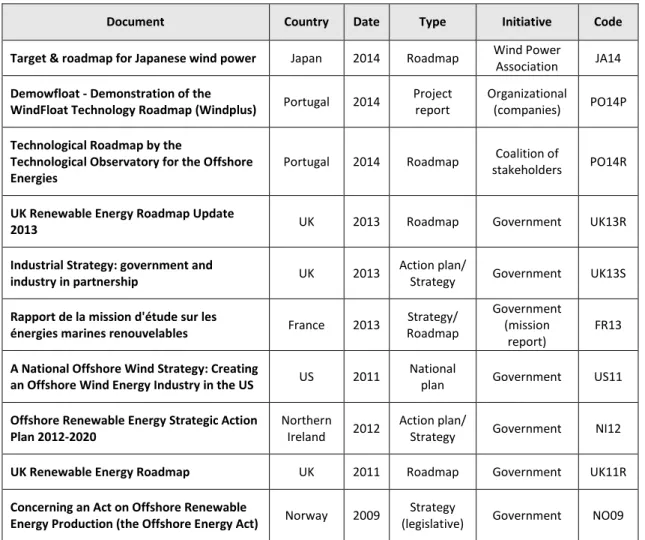
The work is therefore based on the examination of the extant literature in desk research, as well as on empirical research supported by documentary data. Table 1 lists the roadmaps (or equivalent documents) used in the analysis, encompassing 10 documents from 6 countries, from 2009 to 2014. The data extracted from the individual roadmaps, following the analytical framework devised, is presented in Appendix 2. The analysis is complemented with data from a variety of secondary sources. A non-exhaustive list includes official statistics, companies’ press releases and other documentary sources such as websites or presentations at events. In addition, the roadmaps analysis are compared with the results of an opinion survey among the actors
_____________________________________________________________________________
DINÂMIA’CET – IUL, Centro de Estudos sobre a Mudança Socioeconómica e o Território ISCTE-IUL – Av. das Forças Armadas, 1649-026 Lisboa, PORTUGAL
Tel. 210464031 - Extensão 293100 E-mail: [email protected] http://dinamiacet.iscte-iul.pt/
18 (companies, organizations, ..) involved in the growth of the technology innovation system in late 2015 and 2016.
Table 1 – Roadmaps and equivalent documents analyzed
Document Country Date Type Initiative Code
Target & roadmap for Japanese wind power Japan 2014 Roadmap Wind Power
Association JA14
Demowfloat - Demonstration of the
WindFloat Technology Roadmap (Windplus) Portugal 2014
Project report
Organizational
(companies) PO14P
Technological Roadmap by the
Technological Observatory for the Offshore Energies
Portugal 2014 Roadmap Coalition of
stakeholders PO14R
UK Renewable Energy Roadmap Update
2013 UK 2013 Roadmap Government UK13R
Industrial Strategy: government and
industry in partnership UK 2013
Action plan/
Strategy Government UK13S
Rapport de la mission d'étude sur les
énergies marines renouvelables France 2013
Strategy/ Roadmap Government (mission report) FR13
A National Offshore Wind Strategy: Creating
an Offshore Wind Energy Industry in the US US 2011
National
plan Government US11
Offshore Renewable Energy Strategic Action Plan 2012-2020
Northern Ireland 2012
Action plan/
Strategy Government NI12
UK Renewable Energy Roadmap UK 2011 Roadmap Government UK11R
Concerning an Act on Offshore Renewable
Energy Production (the Offshore Energy Act) Norway 2009
Strategy
_____________________________________________________________________________
DINÂMIA’CET – IUL, Centro de Estudos sobre a Mudança Socioeconómica e o Território ISCTE-IUL – Av. das Forças Armadas, 1649-026 Lisboa, PORTUGAL
Tel. 210464031 - Extensão 293100 E-mail: [email protected] http://dinamiacet.iscte-iul.pt/
19
4. ROADMAP ANALYSIS: SHARED STRATEGIES FOR SCALING UP
FLOATING OFFSHORE WIND ENERGY
In this section we apply the framework described above to analyze technology roadmaps in order to uncover the projected changes to the technology, the components of the structure and the functions of the innovation system. But first we provide a brief account of the evolution of floating offshore wind energy technologies in recent years.
4.1 Technology
4.1.1 The evolution of floating offshore wind energy
The emergence of offshore wind in deepwaters occurs in a dynamic context for wind energy in the more shallow waters. Offshore wind energy is rapidly growing in Europe with more than 8 GW installed and 41 GW projected by 2020 (Table 2). More than half of the new capacity is expected to be installed in the United Kingdom and Germany, consolidating the leadership of these countries. The European Wind Energy Association (EWEA, 2013) suggests that the capacity could reach 150 GW by 2030, meeting 14% of EU’s final electricity consumption. Asian countries have also been active in offshore wind energy, with China currently having over 1.5 GW and planning 10 GW more by 2020 (FOWIND, 2014; IEA, 2011). Japan has already installed 50 MW, including 4 MW of floating turbines. The Japan Wind Power Association (JWPA, 2014) anticipates 700 MW by 2020, of which 100 MW in deepwaters. Korea and Taiwan have capacity targets for the coming years as well. The US has no offshore wind farms so far, but has announced plans to build 498 GW by the end of 2017, including 30 MW of floating turbines, and 54 GW by 2030.
The evolution of offshore wind energy has been summarized by Rodrigues et al. (2015, p.1132) as follows: “…the initial OWPs [offshore wind projects] mostly served as proof of concept. Hence, they were located in shallow waters close to shore and were composed of few wind turbines leading to low investment costs which were highly dependent on the number of turbines. Nowadays, commercial projects have higher installed capacities, are highly capital intensive and more complex to design, due to the larger seabed areas, higher number of turbines and longer distances to shore.”
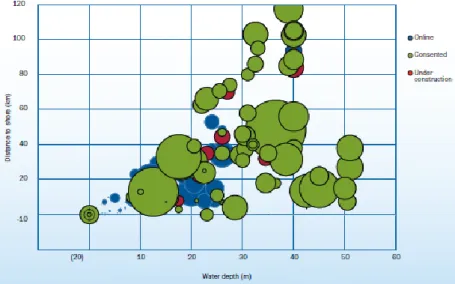
The average water depth and distance to shore have been increasing over time (Figures 3 & 4). Higher distances to shore are correlated with higher mean wind speeds that yield greater capacity factors (Rodrigues et al., 2015). However, the water depths tend to increase with the distance to shore, driving up installation and foundation costs, as well as operational and
_____________________________________________________________________________
DINÂMIA’CET – IUL, Centro de Estudos sobre a Mudança Socioeconómica e o Território ISCTE-IUL – Av. das Forças Armadas, 1649-026 Lisboa, PORTUGAL
Tel. 210464031 - Extensão 293100 E-mail: [email protected] http://dinamiacet.iscte-iul.pt/
20 maintenance costs (Green and Vasilakos, 2011). Most future wind farms are likely to remain at a maximum depth of 50 meters, but there are still a significant number of projects expected for higher depths. This especially concerns countries that have deepwaters relatively close to the shore, such as Portugal, Norway or Italy. To exploit the huge potential in the deepwaters, a number of technologies are necessary, such as floating support structures, which are still in the pre-commercial stage.
Table 2 - Offshore wind energy installed capacity and generation potential by Member State up to 2020 as described in the National Renewable Energy Action Plans (NREAPs)
Source: European Commission, 2014.
Figure 3 - Mean depth of extant and planned European offshore wind farms
_____________________________________________________________________________
DINÂMIA’CET – IUL, Centro de Estudos sobre a Mudança Socioeconómica e o Território ISCTE-IUL – Av. das Forças Armadas, 1649-026 Lisboa, PORTUGAL
Tel. 210464031 - Extensão 293100 E-mail: [email protected] http://dinamiacet.iscte-iul.pt/
21 Figure 4 - Average water depths and distance to shore of consented, under construction and online
wind farms
Source: EWEA, 2015.
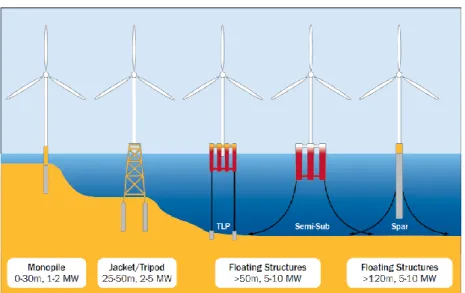
Figure 5 presents the main technical options for turbine foundations across various water depths, with a particular emphasis on the floating concepts that were adapted from the oil and gas industry (showing the complementarities or “couplings” with existing sectors, cf. Markard and Hoffmann, 2016). The designs of the structure and foundations of offshore wind turbines are different from those of land-based wind energy generators. Shallow waters and depths below 30 meters often employ monopile designs, while tripod and jackets are more used in transitional depths (between 30 and 50 meters). These designs can already enable projects from shallow waters until relatively far from shore. Semi-submersible and floating designs could have a greater potential for energy cost savings by unlocking wind potential in deepwaters. Three designs are particularly disseminated: tension-leg platform (TLP); semi-submersible tri-floater; and spar buoy. Although inspired from the oil & gas offshore know-how, floating designs need further adaptation to turbines and testing. They promise to reduce project costs through full assembly onshore and less complex installation, as well as environment impacts on the seabed. However, costs are still significantly high and should be reduced to become competitive against the other options (EWEA, 2013; Rodrigues et al., 2015).
_____________________________________________________________________________
DINÂMIA’CET – IUL, Centro de Estudos sobre a Mudança Socioeconómica e o Território ISCTE-IUL – Av. das Forças Armadas, 1649-026 Lisboa, PORTUGAL
Tel. 210464031 - Extensão 293100 E-mail: [email protected] http://dinamiacet.iscte-iul.pt/
22 Figure 5 - Options for offshore wind foundations
Source: EWEA, 2013.
Figure 6 – The most cited barriers to the development of floating offshore wind technologies according to the documents under analysis
The analysis of the national roadmaps reveals a number of perceived obstacles to the development of floating offshore wind energy (Figure 6). The most frequently mentioned barriers are: high costs (explicitly referred in 7 out of 10 roadmaps); immature technology (7); and the need of codes and standards (5).
7 7 5 4 0 5 10 High costs Immature technology
Codes and standards
Grid connection
_____________________________________________________________________________
DINÂMIA’CET – IUL, Centro de Estudos sobre a Mudança Socioeconómica e o Território ISCTE-IUL – Av. das Forças Armadas, 1649-026 Lisboa, PORTUGAL
Tel. 210464031 - Extensão 293100 E-mail: [email protected] http://dinamiacet.iscte-iul.pt/
23 Upfront costs are still high, what raises the output costs and constrains the market outlook for floating offshore wind (Battaglia et al, 2015). Pilot projects received slightly over 300 €/MWh in the United Kingdom through renewable obligation certificates or ROCs. More recently, the Japanese government also approved a feed-in tariff of 36,000 JPY (approx. 264 €/MWh) to support the deployment of floating offshore wind energy. This compares with an average levelized costs of energy (LCOE) of 180 €/MWh for offshore wind energy from fixed foundations (European Wind Energy Technology Platform, 2014; The Crown Estate, 2012). However, costs start to reduce and technology is improving as a consequence of the learning from the deployment of the first floating turbines. Therefore further cost reduction remains crucial to ensure commercial viability of the technology.
Standardization is another challenge that needs to be addressed before market takes off. This will require further investment in both R&D and demonstration (Phaal et al., 2011).
4.1.2 Commercialization plans
Roadmaps are frequently followed by more concrete announcements of experimental projects and demonstrations of small, pre-commercial, series. The decision to invest in demonstrators is often associated to a longer term perspective of the actors to commercialize the new technology. The current and planned experimentation projects with floating wind turbines can thus be analyzed as the intermediary steps that are taken to bring the technology to the market as in the Phaal’s industrial emergence framework (Phaal et al., 2011). Thus these projects enable a first assessment of how roadmaps are impacting decisions on the short term.
Table 3 shows the currently active projects on deepwaters offshore wind energy worldwide. The type of projects is further discriminated into pilot, prototype and pre-production, coinciding with different demonstrators that mark the transition from science to technology (S-T), technology to application (T-A) and application to market (A-M), respectively, following the terminology proposed in Phaal et al. (2011). The table shows that the technology is clearly passing the prototype stage to enter into the pre-production stage which will be eventually followed by the serial production stage. The first floating offshore wind farms are expected to be installed and connected in 2017 in several countries in Europe and in the US.
At the same time, the maximum unit capacity of turbines is increasing with plans to install 7, 8 and even 10 MW in the next years. The installation of larger size turbines allows increasing the capacity of the wind farms (or alternatively reduces the number of turbines needed to install in order to reach the same nameplate capacity). Note that upscaling unit capacity was sign of the end of the formative phase and transition to large markets in the case of the onshore wind energy (Wilson, 2012).
_____________________________________________________________________________
DINÂMIA’CET – IUL, Centro de Estudos sobre a Mudança Socioeconómica e o Território ISCTE-IUL – Av. das Forças Armadas, 1649-026 Lisboa, PORTUGAL
Tel. 210464031 - Extensão 293100 E-mail: [email protected] http://dinamiacet.iscte-iul.pt/
24 The rhythm of annual installations, according to the projects surveyed, should accelerate from 10-17 MW per year in 2015 and 2016, to 143 MW and 127 MW respectively in 2017 and 2018 – assuming that all the projects remain within the timelines. The cumulative installed capacity would then raise from 35 MW in 2016 to 305 MW in 2018. These numbers compare with the DNV GL’s forecast which expects a slower start for floating wind energy - 66 MW by 2017 and 120 MW in 2018 - but a higher capacity of 870 MW by the end of the decade.6
_______________________________________________________________________________________________________________________________
DINÂMIA’CET – IUL, Centro de Estudos sobre a Mudança Socioeconómica e o Território ISCTE-IUL – Av. das Forças Armadas, 1649-026 Lisboa, PORTUGAL
Tel. 210464031 - Extensão 293100 E-mail: [email protected] http://dinamiacet.iscte-iul.pt/
25 Table 3 Selected active projects in deepwater offshore wind worldwide
(S-T) Demo/Pilot (T-A) Prototype (A-M) Pre-production/Serial
No. Project name Country Company Type of
foundation
Minimum water depth (meter)
Scale Year Turbine
size (MW) Date of deployment Capacity/Turbine size (MW) Expected date of deployment Status *
1 Hywind Norway Statoil Spar buoy 200 2.3 MW 2009 IV
2 Hywind Scotland Pilot Park
Scotland Statoil Spar buoy 95 30 MW (5x 6MW) 2017 I
3 Kinkardine Scotland Pilot Offshore Renewable,Ltd partnership with Atkins,plc Semi-submersible 60 50 MW (8x 6-8MW) 2018 I 4 PelastarWave-Hub
Scotland The Glosten Associates
Tension-leg turbine platform
55 0.1 MW 2011 V
5 Windfloat Portugal EDP,Principle, Power,Repsol Semi-submersible 50 2 MW 2011 25 MW (4x 6-8MW) 2017 IV 6 Windfloat US Principle Power Semi-submersible 120 30 MW 2017 I 7 Maine Aqua Ventus (DeepCWind) US Consortium (Maine Univ, NREL, AEWC, etc.) Semi-submersible n.a. 0.02 MW 2013 12 MW (2x 6MW) 2017 I 8 Goto Fowt (Kabashima Island, Kyushu) Japan Ministry (MOE), Toda, (leaders) Spar 100 0.1 MW 2012 2 MW 2013 IV 9 Wind Lens (Hakata Bay, Kyushu) Japan Kyushu University Floater (Semi-submersible) n.a. 0.006 MW 2011 1MW n.a. IV 10 FORWARD Fukushima - phase 1 Japan Consortium (Marubeni, Mitsubishi, Hitachi, Tokyo Semi-submersible 100 2 MW 2013 IV
_______________________________________________________________________________________________________________________________
DINÂMIA’CET – IUL, Centro de Estudos sobre a Mudança Socioeconómica e o Território ISCTE-IUL – Av. das Forças Armadas, 1649-026 Lisboa, PORTUGAL
Tel. 210464031 - Extensão 293100 E-mail: [email protected] http://dinamiacet.iscte-iul.pt/
26 Fukushima - Phase 2 University, Japan Marine United, etc.) supported by the METI submersible
Spar buoy 100 5 MW 2015 III
11 Poseidon Denmark Floating Power Floater (Semi-submersible)
45 0.03 MW 2009 5 MW n.a. I
12 Floatgen France Gamesa, Acciona, Ideol, etc. Floater 35 2 MW 2015 II 13 Vertimed (Inflow, Vertiwind (1&2) )
France Nenuphar, EDF EN, (Technip) Semi-submersible 50 0.035 MW 2009 2.6 MW 2015 26 MW (13x 2MW) 2018 II 14 Sea Reed - Groix
France DCNS, Alstom Tension-leg buoy
n.a. 6 MW 2017 I
15 Nautilus Spain Nautilus Floating Solutions SL
Semi-submersible
n.a. 10 MW 2016 I
16 Balea Spain EVE Tension leg platform or Semi-submersible 20 26 MW (2x 5MW + 2x 8MW) 2018 I
17 FloCan5 Spain Cobra, Gobierno de Canarias Semi-submersible 50 25 MW (5x 5MW) 2018 I 18 Blyth Blyth Offshore Demonstrator
England EDF Energies Nouvelles
n.a. 37 40 MW
(5x 8MW)
2017 II
Status: I - Early planning; II - (Consent) Authorised; III - Under construction; IV - (Fully) Commissioned; V - Decomissioned. Source: 4COffshore, 2015; EWEA, 2013; Main(e), 2013.
_____________________________________________________________________________
DINÂMIA’CET – IUL, Centro de Estudos sobre a Mudança Socioeconómica e o Território ISCTE-IUL – Av. das Forças Armadas, 1649-026 Lisboa, PORTUGAL
Tel. 210464031 - Extensão 293100 E-mail: [email protected] http://dinamiacet.iscte-iul.pt/
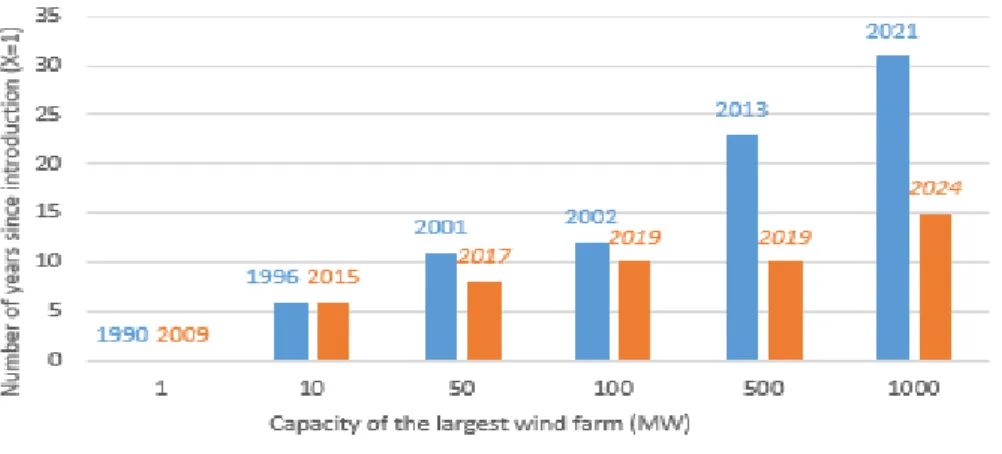
27 To assess the rate and extent of the planed deployment of floating wind energy, we compare with the growth of offshore wind in shallow waters and in the near-shore using fixed structures. Fixed-bottom wind turbines are the closest technology that is comparable to floating wind turbines. We use data on both historical and forecasted growth, i.e., the time taken to pass from several MW to dozens MW, hundreds MW, and thousands MW (gigawatt) wind farms. Figure 7 shows the results.
Figure 7 - Comparison of the growth of offshore wind farms with fixed-bottom (historically) and floating foundations (projected, as described in the demonstration plans)
Author’s calculations using data from 4COffshore, 2015; EWEA, 2013; Main(e), 2013; Rodrigues et al., 2015.
The two technologies (fixed and floating) take identical number of years (ca. 6 year) to pass from the construction of the first full-scale prototype (1990 and 2009 for bottom-fixed and floating offshore wind, respectively), to the first dozen MW farm (1996 and 2015 for fixed and floating structures, respectively). However, the transition to half hundred MW farms should be faster according to the plans for floating wind, i.e. 8 years instead of 11 taken in the case of fixed-ground farms. The rhythm accelerates for higher sizes of the wind parks up to the first gigawatt project, for which floating is expected to take 15 years or half the time expected for bottom-fixed farms (ca. 30 years).
This result seems optimistic and suggests that actors anticipate that floating offshore wind energy may benefit from spillovers (e.g. knowledge, supply chain) gained in the previous deployment in the near-shore. In any case, as pointed by Fowind (2014), coordination is important between actors and public authorities to avoid unrealistic timelines that can deter developers from applying for the available capacities.