CUIDADO É FUNDAMENTAL
UNIVERSIDADE FEDERALDO ESTADODO RIODE JANEIRO. ESCOLADE ENFERMAGEM ALFREDO PINTO
R E V I S T A O N L I N E D E P E S Q U I S A
INTEGRATIVE REVIEW OF THE LITERATURE
CUIDADO É FUNDAMENTAL
UNIVERSIDADE FEDERALDO ESTADODO RIODE JANEIRO. ESCOLADE ENFERMAGEM ALFREDO PINTO
DOI: 10.9789/2175-5361.2017.v9i1.297-301
DOI: 10.9789/2175-5361.2017.v9i1.299-303 | Souza MAR; Wall ML; Moraes AC; et al. | The vital power and the legacy…
Poder vital e o legado de florence nightingale no processo
saúde-doença: revisão integrativa
The vital power and the legacy of florence nightingale in the health-disease
process: integrative review
Potencia vital y el legado de florence nightingale en el proceso
salud-enfermedad: revisión integradora
Marli Aparecida Rocha de Souza1; Marilene Loewen Wall2; Andrea Cristina de Moraes3; Benedita de Almeida4; Daniele Moreira de Lima5
How to quote this article:
Souza MAR; Wall ML; Moraes AC; et al. The vital power and the legacy of florence nightingale in the health-disease process: integrative review. Rev Fund Care Online. 2017 jan/mar; 9(1):297-301. DOI: http://dx.doi. org/10.9789/2175-5361.2017.v9i1.297-301
ABSTRACT
Objective: This study aimed to characterize the national scientific evidence of the last ten years about Florence Nightingale and the vital power and its applicability in nursing, and identify the concepts of vital power.
Methods: It is an integrative review of the full national literature articles, through four databases. Seven articles were selected after applying the inclusion and exclusion criteria. Analysis of the issues on the legacy of Florence and the action of the internal and external environment on the vital power emerged. Results: Most studies focused on the environment of inclusion of the individual as the vital power and strengthen this classified as inner strength. Conclusion: Nursing professionals play an essential role in observing about keeping the environment where the patient is inserted, favoring the strengthening of the vital power, highlighting the presence of the companion as strengthening this vital power in the hospitalization process.
Descriptors: Postpartum period, Parturition, Nursing.
1 Nurse. Masters in Universidade Federal do Paraná. Member of Núcleo de Estudos, Pesquisa e Extensão em Cuidado Humano em
Enfermagem (NEPECHE). E-mail: [email protected].
2 PhD in Nursing. Universidade Federal do Paraná. Member of Núcleo de Estudos, Pesquisa e Extensão em Cuidado Humano em
Enfermagem (NEPECHE). E-mail: [email protected].
3 Nurse. PhD student in Universidade Federal do Paraná. Hospital e Maternidade Municipal de São José dos Pinhais. Member of
Núcleo de Estudos, Pesquisa e Extensão em Cuidado Humano em Enfermagem (NEPECHE). E-mail: [email protected].
4 Master in the Graduate Program in Professional Master of Nursing Universidade Federal do Paraná (UFPR). Enfermeira da
Prefeitura de Curitiba (PR). Member of Núcleo de Estudos, Pesquisa e Extensão em Cuidado Humano em Enfermagem (NEPECHE). E-mail: [email protected].
RESUMO
Objetivo: Caracterizar as evidências científicas nacionais dos últimos dez
anos sobre Florence Nightingale e o poder vital e sua aplicabilidade na enfermagem, além de identificar os conceitos sobre poder vital. Método: Revisão integrativa da literatura de artigos nacionais completos, por meio de quatro bases de dados. Foram selecionados sete artigos após a aplicação dos critérios de inclusão e exclusão. Da análise surgiram os temas sobre o legado de Florence e a ação do meio ambiente interno e externo sobre o poder vital. Resultados: A maioria dos estudos focou o ambiente de inserção do indivíduo como fortalecer do poder vital e esta classificada como força interior. Conclusão: Os profissionais de enfermagem ocupam um papel imprescindível na observação em manter o ambiente onde o paciente está inserido, favorecendo o fortalecimento do poder vital, destacando a presença do acompanhante como fortalecedor desse poder vital no processo de hospitalização.
Descritores: Puerpério, Parto, Enfermagem.
RESUMEN
Objetivo: Este estudio tuvo como objetivo caracterizar la evidencia
científica nacional en los últimos diez años acerca de Florence Nightingale y la potencia vital y su aplicabilidad en la enfermería e identificar los
conceptos de poder vital. Método: És una revisión integradora en la
totalidad los artículos nacionales de literatura, a través de cuatro bases de datos. Seleccionados siete artículos después de aplicar los criterios de inclusión y exclusión. El análisis los temas la herencia de Florence la acción
del entorno interno y externo la potencia vital surgió. Resultados: La
mayoría de los estudios se centraron como la energía vital y fortalecer esta
clasificado como fuerza interior. Conclusión: Enfermería desempeñan un
papel esencial en la observación acerca de mantener el medio ambiente en que se inserta el paciente lo que favorece el fortalecimiento la potencia vital, destacando la presencia la pareja como el fortalecimiento en la hospitalización.
Descriptores: Período de postparto, Parto, Enfermería.
INTRODUCTION
Nursing is a health profession recognized since the mid-nineteenth century, and in front of this recognition presents a historical walk of intense search, going from empirical to scientific and increasingly seeking out studies on various themes related to the profession and in many of these studies stands out with innovative techniques to combat situations that affect health in order to strengthen discipline as scientifical and to support daily practice.
The search on health promotion began with Florence Nightingale, where all her contributions to the professionalization of nursing are referenced in several studies, and therefore has an essential role in the history and the search for the qualification of care, being able to support theory and practice with skill, using both simple and feasible measures in their professional performance.
Among the many legacies left by Florence Nightingale and that guide nursing, we will emphasize the vital power, characterized as an innate force that exists in humans,1 and
is used by them to experience the health-disease process, which is strengthened or not, as the situations that arise in
the environment where they are inserted. Nursing can not be limited to only a practice of technicalities, but must advance on significant issues such as creating means for strengthening the vital force.2 “The proper use of fresh air, light, heat,
cleanliness, calm, proper selection and diet administration should be such that the patient does not dispense their vital energy” and therefore nursing should use properly and with good sense, all that is present in the environment of this individual, both physical as well as social and psychological, treating them as being individual and unique, promoting the lowest expenditure of vital energy.2
Thus, it is defined as a matter of research, which are the scientific evidence of the last ten years about Florence Nightingale and the vital power, and its applicability in nursing. As the object of study there is national scientific evidence about Florence Nightingale and the vital power and its applicability in nursing. And the objective is to characterize the national scientific evidence of the last ten years about Florence Nightingale and the vital power and its applicability in nursing, and identify the concepts of vital power.
METHODS
This is an integrative review study of literature, based on the steps of Ganong, which enabled the pursuit of national studies that worked with the theme of vital power and its applicability in nursing, seeking greater guidance about the research related to the theme, as well as reflection for future studies.
The research was conducted based on the following steps of the integrative review: issue identification and selection of the hypothesis or research question, establishing criteria for including and excluding studies/sampling or searching the literature, definition of information to be extracted from studies selected/categorization of studies, evaluation of the studies included in the integrative review, interpretation of results, presentation of review/knowledge synthesis.3
In this article, the inclusion criteria to guide the search and selections of publications were:
a) Articles in national scientific journals, published in Portuguese, which addressed the subject of vital power in the interpretation of Florence Nightingale and applicability in nursing;
b) Published from 2004 to 2014, ie the last ten years, Considering the necessity of a current review on the subject;
c) Indexed by at least one of the Latin American databases and Caribbean Health Sciences (LILACS), Nursing Database (BDENF), or in the Scientific Electronic Library Online (SciELO) and Virtual Library in Health (BVS);
d) Locatable by the keywords “vital power”, “Florence Nightingale” and the following registered descriptors in the Descriptors Portal of Health Sciences (DeCS): “puerperal”, “birth”, “companion”, “nurses”. Initially
with the research in Descriptors of Health Sciences (DeCS), it was not found as a descriptor vital power, but vitalism, this however is not related to the topic discussed. Also we found as a descriptor vital cycle, and this relates to studies on the stage of life of children, adolescents and the elderly, but not to the purpose of the research.
Given this reality we chose to make direct searches in online databases with the keyword vital power and found articles related to escorts, birth, the perception of the mother, and the professionalization of the health team. There was a new search, which found the vital power related to hospitalization focusing on religion and individual beliefs, including childbirth related situations, but not to the legacy of Florence Nightingale, which did not allow us to include in this research. Even after this new search the selected articles were mostly focused on the area of women’s health and they experiencing situations related to childbirth.
Exclusion criteria were:
a) Publications not available in full text;
b) Publications presenting full-text availability, but whose link presented errors when attempting to access it;
Data collection was conducted from March to July 2014 and after classification and theme delimitation a full reading of seven articles found was held, which showed relation to the focus of this research approach to the writings of Florence Nightingale, the vital power and its applicability in nursing.
RESULTS AND DISCUSSION
It was observed after the reading of the articles that the subject vital power was used in these studies in order to relate it to issues where the internal and external environment influences the individual, leading them to a situation of restoration of the health-disease process.
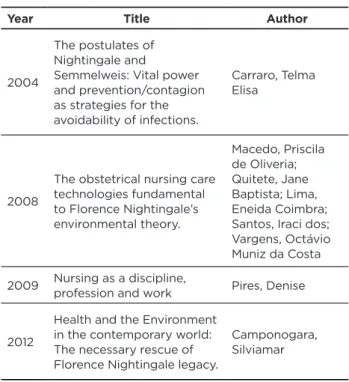
After analysis, an articles division was made as to the themes that were related and divided into 2 categories. Table 1 reveals the items found in the category, the legacy of Florence Nightingale and its relation with the vital power in the health-disease process; and Table 2, the vital power related to care during labor, delivery and postpartum, nursing actions and presence of the companion.
Legacy of Florence Nightingale and its relationship with the vital power in the health-disease process.
The vital power is characterized as an inner strength and innate to human beings and that can be leveraged by internal and external factors acting on the restoration of health.4,7
Table 1 - Distribution of articles found in the “Legacy
Florence Nightingale and the relationship of the vital power in the health disease process”. Curitiba/PR, 2014
Author Title Year Carraro, Telma Elisa The postulates of Nightingale and
Semmelweis: Vital power and prevention/contagion as strategies for the avoidability of infections. 2004 Macedo, Priscila de Oliveria; Quitete, Jane Baptista; Lima, Eneida Coimbra; Santos, Iraci dos; Vargens, Octávio Muniz da Costa The obstetrical nursing care
technologies fundamental to Florence Nightingale’s environmental theory. 2008 Pires, Denise Nursing as a discipline,
profession and work 2009
Camponogara, Silviamar Health and the Environment
in the contemporary world: The necessary rescue of Florence Nightingale legacy. 2012
Fonte: Elaborado pelo autor.
The legacy of Florence Nightingale is based on the mobilization of the environment, both physical, social and psychological of the individual, to assist in the healing process. The role of nursing staff for this purpose should be focused on strengthening this force, leading them to recover from the disease.4,7
While “care”, nursing should be used in unique and humanized forms of strategies, working “together for humans, aiming at intensifying its vital power and awakening or strengthening the need to face the opponent, or hospital infection.”4 Its applicability was analyzed through
observations in interpersonal relationships, comfort, welfare and conditions offered by the environment and by the nursing staff in hospitals, particularly maternity clinics, which showed in their care, postpartum women who developed puerperal infection and subsequent maternal death.
Besides the need for the nursing staff to conduct a more humanized care, the presence of the companion was regarded as one of the vital power favoring the puerperal woman, not with the obligation to do so, but for his presence beside her. 4 The participation of nursing as a positive
factor in the vital power was developed with the need for care professionalization, that following the approach and recognition given by Florence Nightingale, should be performed by qualified professionals with training and knowledge required, and this nursing care should “promote life, the life potential, the welfare of human beings in their individuality, complexity and comprehensiveness.”2,6
Therefore, there is a reflexive articulation about work, discipline and profession, with the conclusion that nursing
should be represented by professionals with differential to develop in their practice technically competent actions in any situation of service and run them protectively, while its applicability can then be made in any hospital situation. The presence of the nursing staff was also assessed as necessary, to establish a balance by means of insertion of the patient and essential in maintaining your vital energy in the disease recovery process, and this means both physical, psychological and social.5,7
The vital power was evaluated as a source necessary in the evolution of labor, making this the most natural driven and less intervention. Its applicability was developed through observation as to the health team, to promote the environment with respect to the delivery process through privacy, the partner’s presence, a welcoming environment free of noise and unnecessary sounds, maintaining natural brightness, and the presence of the nurse providing security, attention, food, hygiene and comfort through individualized care with the individual knowledge of women there present.5
Associating the writings of Florence Nightingale as to the vital power, non-invasive actions in care in obstetric nursing, favors the development of the physiology of labor and birth. This is present in the promotion of a suitable environment and strengthening the autonomy of the mother, raising her inner strength and decreasing the cost of the energy needed for healing.5
The vital power related to care during labor, delivery and postpartum, nursing actions and presence of the companion.
The presence of the companion during the process of labor and health team performance in care through the humanization of care in both direct assistance as in the promotion of a suitable environment was evaluated in hospitals in rooming with puerperal women.1,8
Table 2 - Distribution of articles found in the “The vital power
related to care during labor, delivery and postpartum, nursing actions and presence of the companion”. Curitiba/PR, 2014
Author Title
Year
Carraro, Telma Elisa; Knobel, Roxana; Frello, Ariane Thaise; Gregório, Vitoria Regina Petters; Grüdtner, Dalva Irani; Radünz, Vera; Meincke, Sonia Maria Könzgen
The role of the health team in care and comfort in labor and delivery: Opinions of puerperal women
2008
Frello, Ariane Thaise; Carraro, Telma Elisa Components of nursing
care in the birthing process
2010
Bernardi, Mariely Carmlina; Carro, Telma Elisa Vital power of puerperal
women during nursing care at home
2014
Fonte: Elaborado pelo autor.
The comfort provided by the nursing team for the woman in labor and delivery promotes advantages such as recovery of strength, personal power, spirit, welfare, growth, ability to mobilize coping mechanisms, the performance of usual roles, improving the quality of life and adaptation to the situation experienced, which will directly influence on the vital power of women, leading to the advantage of their immune system.1
This professional practice should be focused throughout the process of pregnancy, for better preparation of these women, not only in scientific and technical part, but also ethically and morally.1,8 To restore the vital power provides
comfort and safety by making these women protagonists of this point in their lives.
Regarding the presence of factors that enhance or weaken the vital power of puerperal, these do not relate only in hospitals, but where they are inserted, that is, in their natural environment.9 The applicability through monitoring of puerperal at home as the subjective variables are reported as the presence of a family, respect for the culture and beliefs by nursing stimulus as to the care of the baby for that puerperal, and the objective variables such as nursing consultation, feeding guidelines, hygiene, observation of situations related to breastfeeding and engorged breasts.9
The care considered as a way to provide a moment of “interaction between those who care and who are cared, or awakens and strengthens the vital energy responsible for the restorative process,”9 when these variables are identified in
the environment, it can prevent unnecessary waste of vital energy.2 The role of nursing is demonstrated as essential
in facilitating an appropriate environment by promoting the presence of the companion, which as reported plays an important role in strengthening the vital power of the woman in labor and postpartum women.
But nursing should be attentive to give necessary support so that it can develop effective participation at that time, through better communication, information and mainly monitoring the team in adverse situations that lead to the weakening of the vital power.
CONCLUSION
Nursing productions of the last ten years have demonstrated the importance of the legacy of Florence Nightingale, the role of the nursing team and everything that is inserted in the internal or external environment, not only related to the structure, but also the emotional and social. For that, nursing plays an important role in fostering that environment, and should be seen by these professionals as part of a service not only technicalist, but mainly humanized.
The means to mobilize the internal or external environment offered for favoring the vital power and used in the delivery process, delivery and postpartum is shown as potentiating agents or disempowering in respect of hospitalization process, strengthening the idea
of greater awareness of the nursing staff as to their role in the interconnection of the hospitalized individual and the environment in which it is inserted, and especially the need to implement a humanized care.
Humanized care is related to the care in labor legislation and one of them implemented in 2005 which addresses the right of pregnant women to have the presence of a companion of her choice during labor, delivery and postpartum.10 For
pregnant women, this participation has generated comfort and safety factors, then being imperative the need of nursing to work in their profession with an overview evaluating the insertion environment of the mother and what is needed to improve it in order to support their autonomy on delivery.
As for the view of nursing as a discipline, profession and work, it is clear that as a discipline it deals of care in the sense previously developed and quoted by Florence Nightingale, when she relates to nursing a profession that must go beyond the completion of technical procedures and look at not only one part of the disease, but with the whole vision for the provision of care.
We therefore suggest that due to the relevance of the subject addressed here and their direct influence on nursing, there should be further research focusing on the vital power and its relationship in the health-disease process to a greater favoring of the promotion of knowledge, to contribute to the preservation of life in its fullness.
REFERENCES
1. Carraro, TE, Knobel R, Frello AT, Gregório VRP, Grudtner DI, Raduns V, Meincke SMK. O papel da equipe de saúde no cuidado e conforto no trabalho de parto e parto:opinião de puérperas. Texto Contexto Enfermagem. 2008; 17 (3):502-9.
2. Nightingale F. Notes on Nursing: what it is, and what it is not. New York (US): Dover publications; 1860.
3. Mendes DKS, Silveira RCC, Galvão CM. Revisão integrativa: método de pesquisa para a incorporação de evidências na saúde e na enfermagem. Texto e Contexto Enfermagem. 2008; 17(4):758-64. 4. Carraro, TE. Os postulados de Nightingale e Semmelweis: poder
vital e prevenção/contágio com estratégias para a evitabilidade das infecções. Revista Latino Americana em Enfermagem. 2004; 12(4):650-7.
5. Macedo PO. As tecnologias de cuidado de enfermagem obstétrica fundamentadas pela teoria ambientalista de Florence Nighgtingale. Escola Anna Nery Revista de Enfermagem. 2008;12(20):341-7. 6. Pires D.A. Enfermagem enquanto disciplina, profissão e trabalho.
Revista Brasileira de Enfermagem. 2009;62(5):739-44.
7. Camponogara S. Saúde e meio ambiente na contemporaneidade: o necessário resgaste do legado de Florence Nigtingale. Escola Anna Nery. 2012;16.(1): 178-184.
8. Frello AT, Carraro TE. Componentes do cuidado de enfermagem no processo de parto. Revista Eletronica de Enfermagem. 2010;12(4):660-8.
9. Bernardi MC, Carraro TE. Poder vital de puérperas durante o cuidado de enfermagem no domicílio. Texto Contexto Enfermagem. 2014; 23(1): 142-50.
10. Brasil. Lei nº. 11.108, de 07 de abril de 2005. Altera a Lei nº 8.080, de 19 de setembro de 1990, para garantir as parturientes o direito à presença de acompanhante durante o trabalho de parto, parto e pós-parto imediato, no âmbito do Sistema Único de Saúde – SUS, 2005.
Received on: 18/12/2014 Reviews required: 17/09/2015 Approved on: 15/06/2016 Published on: 08/01/2017 _________
Author responsible for correspondence:
Marli Aparecida Rocha de Souza. Av. Pref. Lothário Meissenr, 632 3º andar Jardim Botânico, Curitiba/PR. Brazil ZIP-code: 80210-170