DOI: 10.9789/2175-5361.2018.v10i1.137-144 | Silva ASS, Costa FJLS, Câmara JT, et al. | Disease prevalence in infectious...
Disease prevalence in infectious Care Center of Users of
Psychosocial Caxias-MA
Prevalência de doenças infecciosas em usuários de Centro de Atenção
Psicossocial de Caxias-MA
Prevalencia de enfermedades en infeccioso Centro de Atención de Usuarios
de Caxias Psicosocial-MA
Aglaupy Sabrina Santos da Silva1; Francisca Jessica Lima Santos Costa2; Joseneide Teixeira Câmara3; Fabrício
Máximo das Neves4; Jefferson Teodoro de Assis5
How to quote this article:
Silva ASS, Costa FJLS, Câmara JT, et al. Disease prevalence in infectious Care Center of Users of Psychosocial Caxias-MA. Rev Fund Care Online. 2018 jan./mar.; 10(1):137-144. DOI: http://dx.doi.org/10.9789/2175-5361.2018.v10i1.137-144
ABSTRACT
Objective: This study aimed to determine the prevalence of HIV, syphilis, hepatitis B and hepatitis C in users of CAPS III of Caxias-MA. Methods: This is a retrospective study conducted at the Center for Psychosocial Care City Caxias-MA. For data collection was used a roadmap to chart analysis for sociodemographic data and on serology tests for HIV, syphilis, hepatitis B and C 300 records. Results: The results showed that 50% of respondents resided in the city of Caxias, 30 and 39 (26.3%), incomplete primary education (37.7%), most had psychiatric diagnosis of schizophrenia (22%). The overall prevalence was 4.5% for syphilis, 13.4% for hepatitis B and have not found prevalence rates for HIV and hepatitis C. Conclusion: Mechanisms to encourage these services to implement education programs on sexual health aimed at the prevention and care of these diseases and prevention mechanisms.
Descriptors: Prevalence, Infectious Diseases, Mental Disorder, CAPS.
1 Graduated in nursing, baccalaureate. Email: [email protected].
2 Specialist in Interdisciplinary Management of Environment and Environmental Education, Bachelor of Biological Sciences, Bachelor of
Nursing, Nursing Assistant at the University Hospital of the Federal University of Grande Dourados. Email: [email protected].
3 PhD in Tropical Medicine and Public Health (UFG). Lecturer at the Nursing Department, CESC / UEMA.
Email: [email protected].
4 Postgraduate in Hospital Nutrition and Ambulatory (AVM FACULTY INTEGRATED - WPÓS). Email: [email protected]. 5 Nurse Specialist in cardiac emergency. Nursing assistant at the Federal University of Grande Dourados.
RESUMO
Objetivo: Este estudo teve como objetivo determinar a prevalência de HIV, sífilis, hepatite B e hepatite C, em usuários de CAPS III de Caxias-MA.
Métodos: Trata-se de um estudo retrospectivo realizado no Centro de Atenção Psicossocial da cidade de Caxias - MA. Para a coleta de dados foi utilizado um roteiro para análise de prontuário para dados sociodemográficos e sobre as sorologias de HIV, sífilis, hepatites B e C em 300 prontuários.
Resultados: Os resultados demonstraram que 50% dos pesquisados residiam na cidade de Caxias, 30 e 39 anos (26,3%), ensino fundamental incompleto (37,7%), a maioria tinham diagnóstico psiquiátrico de esquizofrenia (22%). As prevalências gerais foram 4,5% para sífilis, 13,4% para hepatite B e não foram encontradas prevalências para HIV e hepatite C. Conclusão: Mecanismos para estimular estes serviços a implementarem programas de educação em saúde sexual voltados para a prevenção e cuidado dessas doenças, bem como mecanismos de prevenção.
Descritores: Prevalência, Doenças Infecciosas, Transtorno Mental, CAPS.
RESUMEN
Objetivo: Este estudio tuvo como objetivo determinar la prevalencia de VIH, sífilis, la hepatitis By la hepatitis C en usuarios de CAPS III de Caxias-MA. Métodos: Se trata de un estudio retrospectivo realizado en el Centro de Atención Psicosocial Ciudad Caxias- MA. Para la recolección de datos se utilizó una hoja de ruta para trazar el análisis de los datos sociodemográficos y en las pruebas de serología para el VIH, sífilis, hepatitis B y C 300 registros.
Resultados: Los resultados mostraron que el 50% de los encuestados residía en la ciudad de Caxias, 30 y 39 (26,3%), la educación primaria incompleta (37,7%), el diagnóstico psiquiátrico tenido la mayor parte de la esquizofrenia (22%). La prevalencia global fue del 4,5% para la sífilis, el 13,4% para la hepatitis B y no han encontrado tasas de prevalencia de VIH y hepatitis C. Conclusión: Mecanismos para estimular estos servicios para poner en práctica programas de educación sobre salud sexual para la prevención y el cuidado de estas enfermedades y los mecanismos de prevención.
Descriptores: Prevalencia, Enfermedades Infecciosas, Trastorno Mental, CAPS.
INTRODUCTION
Brazilian psychiatric reform was recognized internationally because of the innovative nature of its Mental Health Policy, due to the complexity and heterogeneity in which it was marked by discrimination, poverty and social exclusion of these patients.1
The change in mental health policy in the context of this reform has brought important care changes, mainly the provision of more community ambulatory care services, the Psychosocial Care Centers (CAPS), concomitantly with a progressive reduction of beds in psychiatric hospitals.2
According to, 3 the creation of new mental health
devices, as well as the insertion of mental health actions in public health, has enabled new approaches, new principles, values and looks to people suffering from psychic suffering, promoting more appropriate forms of care for madness in the Family, social and cultural spheres.
In addition,4 emphasizes that the paradigm shift that
guides mental health practices includes dimensions other than care, such as social reintegration, leisure, hospitality, and the opportunity to work for those with mental distress.
All these changes point towards an integral care of these individuals, but the challenges are continuous and there are still many gaps to be filled, such as knowing about the health of mentally ill patients outside the psychic approach to disorders. According to the Ministry of Health in its book Prevention and Attention to STI / AIDS in Mental Health in Brazil, individuals with mental disorders are potentially subject to a greater risk of diverse health conditions, including sexually transmitted infections (STI) and among Infections, human immunodeficiency virus (HIV), syphilis, and hepatitis B and C.5
In view of the exposed problem, this research had as general objective: to determine the prevalence of HIV, syphilis, hepatitis B and hepatitis C in users of the CAPS III of Caxias – MA.
METHODS
It is a retrospective study of quantitative, descriptive and documentary approach. This research was carried out at the Center for Psychosocial Care III (CAPS III), located in the city of Caxias-MA. It deals with a public institution that is intended for the care of adults with mild mental disorders to severe and persistent disorders.
It was founded in the city on October 1, 2005. It currently consists of a team of 62 professionals, including: 3 psychiatrists, 2 psychologists, 2 social workers, 1 occupational therapist, 7 nurses (5 day caregivers and 2 day care workers) (10 day caregivers and 6 day caregivers), 2 social workers, 1 nutritionist, 1 physical educator, 1 pedagogue, 1 pharmacist, 1 pharmacist assistant, 1 speech therapist, 1 artisan, 3 receptionists, 3 waiters, 3 janitors, 10 security guards, 1 1 administrative assistant and 1 general director.
It operates 24 hours, weekends and holidays, serving besides the city of Caxias, the cities: Afonso Cunha, Aldeias Altas, Coelho Neto, Duque Bacelar, São João do Sóter and Buriti. CAPS III provides intensive, semi-intensive and non-intensive care. Data collection was performed from November 2014 to March 2015. The population of users of CAPS III services comprises patients who have monthly or biweekly consultations with psychiatrists and psychologists (non-intensive) patients who use daily therapy Occupational, spend the day in the institution and the night returns home (semi-intensive regime) and patients who stay in the institution making use of the nocturnal host (intensive regime).
For the purposes of this research, and according to the inclusion criteria, only the patients’ records of patients who underwent care in a semi-intensive and intensive regimen were included in the study because they are long-stay patients at CAPS, which allows a better follow-up by the institution. The medical records that presented insufficient information considering the variables used in the data collection instrument were excluded from the survey. According to the CAPS III registration books, in 2014 there were 740 users in these two types of assistance.
The sample size was calculated considering the prevalences of HIV (0.8%), syphilis (1.1%), hepatitis B (16.3%) and C
(2.63%) of a study conducted by 6. Thus, the calculation was
based on the expected HIV positive prevalence in CAPS users of 0.8% (because it is the lowest prevalence among the other diseases) in the finite population of 740 users (intensive and semi-intensive regimen). Parameter with a tolerable margin of error of 5% and a confidence level of 95% 7 thus finding
the value of 227 medical records. However during this study 300 medical records were searched.
Where: N = Number of individuals in the sample. = Critical value corresponding to
the desired degree of confidence
= Population proportion of individuals belonging to the category we are interested in studying (prevalence). = Population proportion of individuals who do not belong to the category we are interested in studying (q = 1 - p). E = Error margin or maximum error of estimation. Identify the maximum difference between the sample proportion and the true population proportion (p).
Sample Calculation:
Table 1 - Distribution of sociodemographic data of users of CAPS III of Caxias - MA, in the year 2015
Characteristics of the participants N %
City of residence Caxias 150 50 Aldeias Altas 12 4,0 Codó 10 3,3 Outros 61 20,3 No information 67 22,4 Total 300 100 Sex Feminine 140 46,7 Masculine 160 53,3 Total 300 100 Age group 19 a 29 55 18,3 30 a 39 79 26,3 40 a 49 62 20,7 50 a 59 52 17,3 60 a 69 21 7,0 70 a 79 06 2,0 80 a 89 09 3,0 90 a 99 04 1,4 No information 12 4,0 Total 300 100 Race Black 03 1,0 Brown 01 0,3 No information 296 98,6 Total 300 100 Education Illiterate 36 12,0
Elementary School Incomplete 113 37,7
Complete primary education 18 6,0
Incomplete high school 07 2,3
Complete High School 43 14,3
Incomplete Higher Education 05 1,7
Complete Higher Education 05 1,7
Others 03 1,0
No information 70 23,3
Total 300 100
Income
Less than 1 minimum wage 113 37,7
From 1 to 3 minimum wages 80 26,7
From 4 to 5 minimum wages 03 1,0
From 6 to 7 minimum wages 01 0,3
No Income 19 6,3
No information 84 28,0
For the collection of data, a script was used for analyzing the chart containing 17 questions proposed by the Research Group on Epidemiology and Health Assessment5 and specifically adapted for this work,
aimed at identifying the sociodemographic profile and the psychiatric diagnosis of the users served in CAPS III, As well as for the data collection on the serology of HIV, syphilis, hepatitis B and C. The variables in analysis were: municipality of residence, sex, age group, race, education, income, psychiatric diagnosis, HIV serology, serology Of syphilis, hepatitis B serology and hepatitis C serology. Data analysis was performed using EPI INFO software (for WINDOWS version 3.5.2 / 2005). The results of the research were organized into tables and their data presented in percentages. The confidence interval considered was 95.5% and the margin of error was 5%. The chi-square test (X²) was also used. Values of p <0.05 were considered statistically significant. In compliance with Resolution No. 466/12, of the National Health Council, which has ethical and legal principles of research involving human beings, the research project was submitted to the Brazil Platform, and then directed to the Research Ethics Committee (CEP) of the Center
of Higher Studies of Caxias (CESC), State University of Maranhão, approved with the number of opinion 974.949 and CAAE 4571214.8.0000.5554.
RESULTS AND DISCUSSION
We analyzed 300 medical records for the identification of the sociodemographic profile and the psychiatric diagnosis of CAPS III users.
Sociodemographic Profile of CAPS III
Users
Table 1 represents the quantification of the answers about the sociodemographic profile of the studied population.
According to the survey, 50% of the respondents had a residence in Caxias. The research also showed that there was a prevalence of males (53.3% of those surveyed) and that the predominant age group was between 30 and 39 years (26.3%). The most frequent schooling was incomplete primary education (37.7%) and income less than 1 minimum wage (26.7%).
The most common diagnosis was of Schizophrenia with 22% (n = 66), followed by Other Anxiety Disorders 10.4% (n = 31), Depressive Episodes and Recurrent Depressive Disorder, both with 7.4% (n = 22) Prevalence. The results are shown in table 2.
Prevalence of HIV, Syphilis, Hepatitis B
and Hepatitis C in CAPS III users
In order to perform the research, 300 medical records were analyzed, but only in 89 medical records (29.6%) was the description of the serological tests for HIV, syphilis, hepatitis B and hepatitis C.
Prevalence of syphilis was considered for those who presented positive VDRL on the serological examination. Table 2 - Distribution of the psychiatric diagnoses of users of the CAPS III of Caxias - MA, 2015
Psychiatric Diagnostics Nº %
Organic Mental Disorders 10 3,3
Mental and behavioral disorders due to alcohol use 10 3,3
Mental and behavioral disorders due to the use of psychoactive substance 14 4,7
Schizophrenia 66 22,0
Schizotypal disorder 01 0,3
Acute and transient psychotic disorder 12 4,0
Other non-organic psychotic disorder 07 2,3
Unspecified non-organic psychosis 08 2,7
Maniac episode 01 0,3
Bipolar affective disorders 12 4,0
Depressive episodes 22 7,4
Recurrent depressive disorder 22 7,4
Persistent mood (affective) disorder 01 0,3
Other anxiety disorders 31 10,4
Somatoform disorders 01 0,3
Mental retardation 11 3,7
Other mental retardation 01 0,3
Epilepsy 09 3,0
No information 61 20,3
Considering the sample of 89 (100%) tests found, there were 4 positive exams for the VDRL, thus 4.5% (n = 04) prevalence of infection by syphilis. These results are shown in table 3.
According to the description of the general serology results, 12 (13.4%) of the 89 patients who had undergone the test had a positive marker for HBV infection. HBsAg was detected in 1 patient (1.1%), Anti-HBc was detected in 11 patients (12.3%), and in 7 (7.9%) alone, in 2 (2, 2%) associated with Anti-HBc IgM and in the other 2 (2.2%) to Anti-HBs. Table 4 shows the amount of reagent results and percentages for each marker.
No HIV prevalence was found, as indicated by the serological results. No tests with anti-HIV positive. There was also no prevalence of hepatitis C (Anti-HCV negative in all samples).
Table 3 - Results of serology for syphilis described in the medical records of users of CAPS III of Caxias - MA in the year 2015
VDRL Nº %
Negative 85 95,5
Positive 04 4,5
Total 89 100
Table 4 - Result of serology for hepatitis B described in the medical records of users of CAPS III of Caxias - MA in the year 2015
Reagents
Markers Nº %
HbsAg 01 1,1
Anti-HBc total 07 7,9
Anti-HBc total /Anti-HBcIgM 02 2,2
Anti-HBc total /Anti-HBs 02 2,2
Total 12 13,4
Table 5 - Association between syphilis prevalence data and the psychiatric diagnoses of CAPS III users. Caxias, 2015 Psychiatric diagnoses
PREVALENCE OF SYPHILIS
Positive Negative
Nº % Nº %
Unspecified organic or symptomatic mental disorder 0 0 1 0,01
Mental and behavioral disorders due to alcohol use 0 0 6 0,08
Mental and behavioral disorders due to drug use 1 0,25 5 0,07
Schizophrenia 0 0 28 0,36
Acute and transient psychotic disorders 0 0 11 0,14
Bipolar affective disorders 1 0,25 7 0,09
Depressive episodes 2 0,5 11 0,14
Mental retardation 0 0 6 0,08
Epilepsy 0 0 2 0,03
Total 4 1 77 1
*p-value 0,3807, and qui-squared .
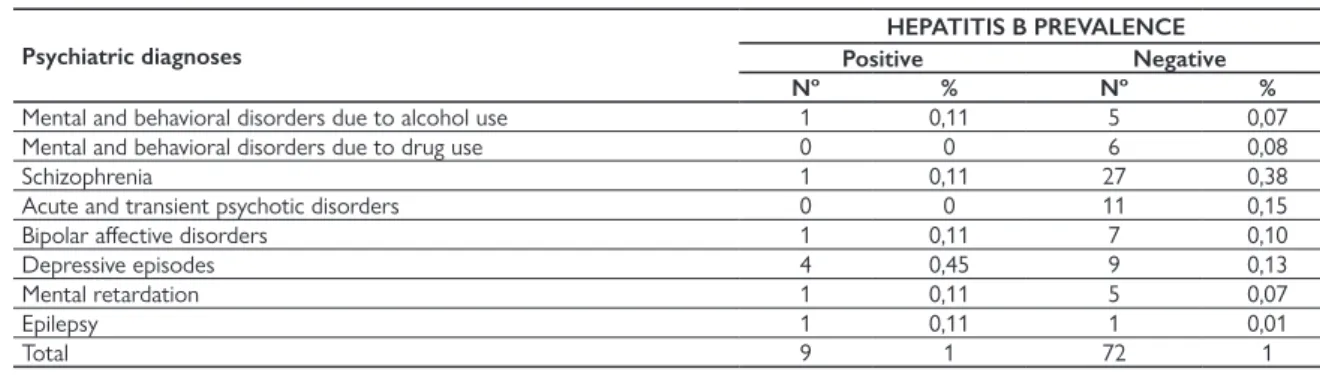
Table 6 - Association between hepatitis B prevalence data and the psychiatric diagnoses of CAPS III users. Caxias, 2015
Psychiatric diagnoses PositiveHEPATITIS B PREVALENCENegative
Nº % Nº %
Mental and behavioral disorders due to alcohol use 1 0,11 5 0,07
Mental and behavioral disorders due to drug use 0 0 6 0,08
Schizophrenia 1 0,11 27 0,38
Acute and transient psychotic disorders 0 0 11 0,15
Bipolar affective disorders 1 0,11 7 0,10
Depressive episodes 4 0,45 9 0,13
Mental retardation 1 0,11 5 0,07
Epilepsy 1 0,11 1 0,01
Total 9 1 72 1
*p-value 0,1341 and qui-squared .
It is also considered that the majority of the patients most susceptible to contracting hepatitis C virus infection, namely drug users, are treated in CAPS AD (alcohol and drugs) in the municipality.
Association between the Prevalence
of Syphilis and Hepatitis B and the
Psychiatric Diagnosis
As shown in table 5, there was no statistically significant association (p-value> 0.05) between syphilis prevalence and psychiatric diagnoses.
However,7 in his work, found that belonging to the
diagnostic group of organic mental disorders (F00-09) was statistically associated with syphilis infection.
No other studies evaluating this association were found in the literature.
It could be observed, according to table 8, that there was no statistically significant association (p-value> 0.05) between the psychiatric diagnoses and the prevalence of hepatitis B. We did not find in the literature studies that directly associate the presence of Hepatitis B with the psychiatric diagnosis.
DISCUSSION
Sociodemographic profile of CAPS III
users
The aim of this study,8 was to identify the
sociodemographic and clinical profile of users of a CAPS in the city of Campinas, SP, Brazil, showing that 53.75% of the users were also males, the mean age was 41, 28 years old and most had a level of education corresponding to incomplete elementary education.
Still corroborating with these data, the work of 9 which
aimed to delineate the profile of the patients attended at the Center for Psychosocial Care of Barbacena, MG, revealed that the mean age of the participants was 38.7 years; The majority of the patients were male (56.6%) and had low educational level (60%).
These results differ from other studies in relation to gender, where the authors found higher prevalence rates for females.(10-13)14 states that mental disorders are more
prevalent among women, black or brown, low-educated, and low-income individuals.
According to 12 this gender discrepancy is justified by the
fact that women present higher prevalences of anxiety and mood disorders than men. Men present higher prevalence rates of psychoactive substance use disorders, including alcohol.
About the income of users, few studies have shown percentages for this variable, what is known is that low income is common in this population.
In the survey of 14 it was verified that 61.1% live with
the importance of up to a minimum wage. The low level of education of CAPS users, together with the limitations of psychological problems, justifies the poor income of the respondents, which is a determinant of poor quality of life and dignity of these individuals.
Psychiatric Diagnostics of CAPS III users
The diagnostic profile of the respondents resembles that of many studies, in which the most prevalent diagnosis was also that of schizophrenia.11;15-17
Corroborating with these data, the study by 6 with a
national sample also found schizophrenia and other psychotic disorders as the primary registered diagnosis (47.3%), followed by depression (13.3%), bipolar disorder (9.0%), substance use (7.0 %) and anxiety (3.6%).
However, it differs from the work,9 in the Psychosocial
Care Center of Barbacena, MG, where psychotic disorders
(28.8%) were the most prevalent diagnoses; Followed by drug use (20.7%); Mood disorders (22.3%); And mental retardation (3.9%).
The lack of information regarding the psychiatric diagnosis in the medical records is highlighted. Despite the importance of these as a form of registration of information about the assistance provided to users of services in Brazil, the precariousness and inadequacy of records are still evident.11
Prevalence of HIV, Syphilis, Hepatitis B
and Hepatitis C in CAPS III users
The prevalence of syphilis found in this study was lower than the prevalence of the study carried out in a hospital psychiatric service in Belo Horizonte, which indicated a prevalence of 7.6%.18
However, it is superior when compared to the prevalence found in the national multicenter study conducted in public psychiatric hospitals and outpatient clinics (CAPS), showing that syphilis was present in about 1.1% of those with mental disorders.18 Syphilis is an important Public health problem in the general population, mainly due to the high mortality of congenital syphilis.19
For the psychiatric population, the neurotropic potential of syphilis is of great importance because neurosyphilis may be a reversible cause of dementia and has often been underdiagnosed in psychiatric patients.18
Studies that address the prevalence of syphilis in this population are extremely scarce. In this sense, new research should be encouraged.
When considering the surveys conducted with a population similar to that of this study, it is observed that the majority had higher prevalences. This is evidenced in the research of, 6 that found seroprevalence for hepatitis B
of 16.3% by the HBsAg and Anti-HBc reagents in a national sample.
Corroborating this information,15 conducted a study
of 931 patients from psychiatric hospitals and outpatient services in 5 cities in the United States and obtained HBV prevalence rates of 23.4%.
Some studies also estimated prevalences of hepatitis B in individuals with mental disorder, but with patients in hospitalization units. 20 in a study carried out in the
cities of Goiânia-GO and Anápolis-GO, investigated a population consisting of patients that presented a mental problem associated or not with chemical dependence and individuals with Down Syndrome, obtaining the prevalence of hepatitis B of 24.3% For mental problems without chemical dependence and 16.9% associated to chemical dependence.
Another very relevant research carried out by 21 in the
city of Trindade-GO, obtained a global HBV infection index of 12.9%. This was the only study found in the researched literature with prevalence lower than that found in this study.
No HIV prevalence was found, as indicated by the serological results. No tests with anti-HIV positive. There was also no prevalence of hepatitis C (Anti-HCV negative in all samples).
Data on the prevalence of HIV and hepatitis C in this study differ from national and international prevalences 22-23; 6,15 and it is suggested that the limited number of our sample
may have interfered with the findings.
It is also considered that most of the patients most susceptible to contracting hepatitis C virus infection, namely drug users, are treated in CAPS AD (alcohol and drugs) in the municipality.
Association between the prevalence
of Syphilis and Hepatitis B and the
Psychiatric Diagnosis
It could be observed, according to table 8, that there was no statistically significant association (p-value> 0.05) between the psychiatric diagnoses and the prevalence of hepatitis B. Studies that directly associate the presence of Hepatitis B with the psychiatric diagnosis were not found in the literature. It is known that psychiatric symptoms and not psychiatric disorder alone can directly contribute to greater inability to protect against sexually transmitted diseases. Cognitive impairment and psychopathological changes are indicated as an influence on risk behaviors.22,24
CONCLUSION
The present study aimed to determine the prevalence of HIV, syphilis, hepatitis B and C in patients using CAPS III of Caxias-MA. The analyzes revealed a prevalence of 13.4% for hepatitis B and 4.5% for syphilis. No prevalence of HIV and hepatitis C was found.
Regarding the profile of this population, 50% of the respondents resided in the city of Caxias. There was a prevalence of males (53.3%). The predominant age group was 30 to 39 years (26.3%). The most frequent schooling was incomplete primary education (37.7%) and income less than 1 minimum wage (26.7%).
Analyzing the most prevalent psychiatric diagnoses, 22% of those surveyed had schizophrenia, followed by other anxious disorders with 10.4%. These percentages may be underestimated due to the number of medical records that did not contain information regarding the psychiatric diagnosis.
The adequate completion of the information of the records belonging to the medical record should be encouraged, given that such data enable epidemiological analyzes when necessary.
There was no statistically significant association between the prevalence of syphilis, hepatitis B, and sociodemographic variables. Likewise, there was no statistically significant association between syphilis prevalence, hepatitis B and psychiatric diagnoses.
This study became of fundamental importance to subsidize later studies in this area. There is a lack of studies that estimate the prevalence of infectious diseases in this population so vulnerable and excluded by society.
Faced with this situation, mechanisms to stimulate these services to implement sexual health education programs aimed at the prevention and care of these diseases, as well as prevention based on vaccination against hepatitis should be developed.
Actions such as encouraging STD/AIDS testing and counseling, making condoms more accessible to patients, and promoting the training of the mental health team for these diseases are some effective preventive actions for this population.
REFERENCES
1. Possas CA. et al. Políticas públicas de prevenção e atenção às IST/ HIV/AIDS nos serviços de saúde mental no Brasil. In: BRASIL. Ministério da Saúde. Secretaria de Vigilância em Saúde. Programa Nacional de DST e AIDS. Prevenção e atenção as IST/AIDS na saúde mental no Brasil: análises, desafios e perspectivas. Brasília, DF: Ministério da Saúde, 2008. Disponível em: <http://bvsms. saude.gov.br/bvs/publicacoes/prevencao_atencao_aids_saude_ mental.pdf>. Acesso em: 20 nov. 2013
2. Brasil. Ministério da Saúde. Secretaria de vigilância em saúde. Departamento de DST, Aids e Hepatites Virais. Coordenação de doenças sexualmente transmissíveis e Aids. Série Telelab. Sífilis: estratégias para diagnósticos no Brasil. Brasília, DF. Ministério da Saúde: 2009/2010. 100p.
3. Hirdes AA. reforma psiquiátrica no Brasil: uma revisão. Ciênc. saúde coletiva. 2009 vol.14, n.1, p. 297-305.
4. Alves DS. Integralidade nas Políticas de Saúde Mental. IN: Pinheiro, RM. RA. Os Sentidos da Integralidade na Atenção e no Cuidado à Saúde. 6 ed. Rio de Janeiro: 2006 ABRASCO. 180p 5. Brasil Ministério da Saúde. Secretaria de Vigilância em Saúde.
Departamento de Vigilância Epidemiológica. Hepatites virais: o Brasil está atento. 3. ed. Brasília, DF: Ministério da Saúde, 2008b. 6. Guimarães MDC. et al. Prevalence of HIV, Syphilis, Hepatitis B
and C Among Adults with Mental illness: A Multicenter Study in Brazil. RevBrasPsiquiatr. 2009vol. 31, nº 1, p. 43-47. Belo Horizonte – MG.
7. Fonseca JS, Martins GA. Curso de Estatística. 1996.6. ed. São Paulo, SP: [s.n.],
8. Miranda IMS, Ballarin M, LGS. Perfil sócio-demográfico e clínico dos usuários de um centro de atenção psicossocial do município de Campinas. In: XV Encontro de Iniciação Científica da PUC-Campinas, 2010, Campinas. Anais do XV Encontro de Iniciação Científica da PUC-Campinas.
9. Mangualde AAS. et al. Perfil epidemiológico dos pacientes atendidos em um Centro de Atenção Psicossocial. Revista de Saúde Mental e Subjetividade da UNIPAC. Barbacena jul./dez 2013 n. 19, p. 235-248.
10. Kantorski LP. Relatório de pesquisa/Conselho Nacional de Desenvolvimento Científico e Tecnológico – CNPq. CAPSUL – Avaliação dos CAPS da Região Sul do Brasil. Pelotas, 2008 RS. 437p.
11. Nascimento AF, Galvanese, ATC. Avaliação da estrutura dos centros de atenção psicossocial do município de São Paulo, SP. Revista de Saúde Pública, v. 43, Suppl 1, 2009. p. 8-15.
12. Tomasi E, Facchini LA, Piccini RX, Thumé E, Silva RA, Gonçalves H, Silva SM. Efetividade dos Centros de Atenção Psicossocial no cuidado a portadores de sofrimento psíquico em cidade de porte médio do Sul do Brasil: uma análise estratificada. Cadernos de Saúde Pública. 2010 v. 26, n. 4, p. 807-815.
13. Dutra L, Stathopoulou G, Basden S, Leyro T, Powers M, & Otto M. (A meta-analytic review of psychosocial interventions for substance
use disorders. The American Journal of Psychiatry. 2008, 2(3), 165-176.
14. Rocha SV, Almeida MMG, Araújo TM, Júnior JSV. Atividade física no lazer e transtornos mentais comuns entre idosos residentes em um município do nordeste do Brasil. J Bras Psiquiatr. 2011 v. 60, n. 2: p. 80-85.
15. Rosenberg SD. et al. Prevalence of HIV, hepatitis B, and hepatitis C in people with severe mental illness. Am. J. Public Health, [S.l.], 2001 v. 91, p. 31-37.
16. Montanari AJ. Avaliação da implantação do Centro de Atenção Psicossocial em Cataguases - MG. Mental, 2005 v. 3, n. 4, p. 83-114. 17. Pelisoli CL, Moreira AK. Caracterização epidemiológica dos
usuários do Centro de Atenção Psicossocial Casa Aberta. Revista de Psiquiatria do Rio Grande do Sul. 2005 v. 27 n. 3.
18. Almeida RC, Pedroso ERP. Vulnerabilidade e exposição a marcadores sorológicos dos vírus da imunodeficiência humana, hepatites B e C, vírus linfotrópico de células T humanas e sífilis em pacientes psiquiátricos internados em hospital público. Rev. Assoc. Méd Minas Gerais. 2004 v. 14, p. 244-50.
19. Tabisz L. et al. Sífilis, uma doença reemergente. Rev. Med. Res. jul./ set. 2012 v.14, n. 3, p. 165–172. Curitiba, PR, 2012.
20. Souza MM. et al. Soroprevalência da infecção pelo vírus da hepatite B em portadores de doença mental. Revista Brasileira de Psiquiatria. São Paulo, v. 26, nº 1, p. 35-38.
21. Moraes TC. Prevalência da infecção pelo vírus da hepatite B em uma população institucionalizada portadora da doença mental. 2013. 85f. Dissertação (Mestrado em Medicina Tropical e Saúde Pública) – Instituto de Patologia Tropical e Saúde Pública, Universidade Federal de Goiás, GO, 2013.
22. Campos L N. et al. HIV, Syphilis, and Hepatitis B and C Prevalence Among Patients with Mental Illness: a review of the literature. Cad. SaúdePública. 2008 vol. 24, supl. 4, p. 607-620.
23. Tabibian JH. et al. Hepatitis B and C among veterans on a psychiatric ward. Dig Dis Sci. 2008 v.53 p.1693-1698. 24. Oliveira HN. Usuários de Serviços de Saúde Mental e
Vulnerabilidade para DST/HIV: estudo piloto. 2006. 189f. Dissertação (mestrado) – Universidade Federal de Minas Gerais. Faculdade de Medicina. Belo Horizonte, MG, 2006.
Received on: 09/14/2016 Reviews required: 03/29/2017 Approved on: 01/04/2017 Published on: 01/08/2018
Author responsible for correspondence:
Francisca Jessica Lima Santos Costa Rua Manoel Gonçalves, 641A, Piquizeiro Caxias/MA, Brazil ZIP-code: 65600-110