Pinto et al. Int J Diabetes Clin Res 2017, 4:079
Volume 4 | Issue 2 DOI: 10.23937/2377-3634/1410079
International Journal of
Diabetes and Clinical Research
Open AccessCitation: Pinto E, Braz N, Nascimento T, Gomes E (2017) Do Patients Value Nutritional Therapy? A Quantitative Study in Type-2 Diabetes Patients. Int J Diabetes Clin Res 4:079. doi.org/10.23937/2377-3634/1410079
Received: October 01, 2017: Accepted: December 26, 2017: Published: December 28, 2017
Copyright: © 2017 Pinto E, et al. This is an open-access article distributed under the terms of the Creative Commons Attribution License, which permits unrestricted use, distribution, and reproduction in any medium, provided the original author and source are credited.
Do Patients Value Nutritional Therapy? A Quantitative Study in
Type-2 Diabetes Patients
Ezequiel Pinto
1*, Nídia Braz
1, Tânia Nascimento
1and Eurico Gomes
21Centre for Research and Development in Health, School of Health, University of Algarve, Faro, Portugal 2AEDMADA, Portugal
*Corresponding author: Ezequiel Pinto, Centre for Research and Development in Health, School of Health, University of Algarve, Dr. Adelino da Palma Carlos, 8000-510 Faro, Portugal, Tel: +351-289-800-100, E-mail: [email protected]
Abstract
Introduction: Type 2 diabetes patients’ adherence to
phar-macotherapy is higher than adherence to nutritional therapy or lifestyle change behaviours, and patients do not value nutritional therapy in the same level as they value other types of interventions. This study aimed to analyse the va-lue that T2DM patients place on nutritional therapy and to identify perceived barriers to nutritional therapy adherence. Methods: A non-random sample of 62 patients receiving he-alth care in a Diabetes Clinic in the municipality of Faro, in the Portuguese region of the Algarve, was interviewed with a semi-structured protocol regarding sociodemographic characteristics, lifestyle, physical activity, and dietary habi-ts. Additional data were collected from the patient’s clinical files and by conducting anthropometric assessment using standard methods.
Results: Patients show a poor dietary intake and we found
a prevalence of 36% (n = 22) of overweight patients and 53% (n = 33) of obese patients. Mean BMI was 30.1 kg/m2
(SD = 4.21). Physical activity is considered less important than dietary intake and that pharmacologic treatment for the management and control of T2DM (F = 19.6; p < 0.001). Va-lue placed in dietary intake as a treatment for the disease is high, but patients seem to have a trouble in complying with the recommendations and to sustain the compliance they achieved. Patients should be empowered to improve their self-care and to consider nutrition therapy as valuable as other treatments.
Keywords
Type 2 diabetes, Nutrition, Adherence to treatment
OriGiNal rEsEarch arTiclE
Check for updates
control, and general management of diabetes consists of patient education, medical nutrition therapy, physi-cal activity, and pharmacologiphysi-cal therapy combined with oral hypoglycaemic agents or insulin [1]. The chronic nature of diabetes and its associated complica-tions, as well as their potential for impact on the over-all quality of life, confirm the need for adequate treat-ment and managetreat-ment of the disease, preferably from a team that may include physicians, nurses, dietitians, and pharmacists with expertise and a special interest in diabetes. In order for the therapeutic plan to succeed, individuals with diabetes should also assume an active role in their self-care [2].
Several literature reviews suggest that a significant proportion of T2DM patients exhibit poor adherence to treatment and poor management of the disease. Some of the factors that compromise adherence include com-plex pharmacological treatment, clinical inertia, safety concerns, socioeconomic issues, ethnicity, poor patient education, beliefs, and social support [3-5].
Adherence to treatment is defined as the active, vol-untary involvement of the patient in the management of the disease, by following a mutually agreed course of treatment and sharing responsibility with health care providers [6]. In health studies, non-adherence to treatment regimens has been described and measured as complying in less than 80% of the prescribed treat-ment [3], and it is believed that, as a group, diabetes patients are especially prone to substantial adherence problems [7-9]. A 2003 report from the WHO states that
Introduction
Treatment and prevention approaches for type 2 diabetes mellitus (T2DM) focus on achieving glycaemic
non-adherence rates for chronic illness treatment regi-mens and for lifestyle changes are approximately 50% [10] and, in the case of diabetes, literature reviews re-port general adherence to treatment ranging from 23% to 77% [3,11,12]. Adherence to one component of the treatment also seems independent of the adherence to other components [11], as research suggests that ad-herence to pharmacotherapy is higher than adad-herence to nutritional therapy or lifestyle change behaviours, and that patients do not value nutritional therapy in the same level as they value other types of interventions [5,10,12].
Based on the available evidence, the study aims to analyse the value that T2DM patients place on nutri-tional therapy and to identify perceived barriers to nu-tritional therapy adherence.
Methods
We conducted a quantitative assessment of a non-random sample of T2DM patients receiving health care in a Diabetes Clinic in the municipality of Faro, in the Portuguese region of the Algarve. Patients were invited to be a part of this study during their medical consulta-tions and a date was set up according to their availabil-ity to proceed with data collection. The inclusion criteria were age below 85 years, medical diagnosis of T2DM for at least 12 complete weeks, and having been at least in one individual consultation with a registered dietitian in the past year. Patients were excluded if they a) Were undergoing a pharmacotherapy regimen with insulin, as this could imply a significantly different nutritional ther-apy when compared with patients on oral antidiabetic agents only; b) Had a diagnosis of degenerative disorder of the central nervous system; and c) Were following a lactose-free or gluten-free diet. During a two-month period, all patients matching the inclusion criteria were invited to be a part of this study. Out of the 66 patients who were invited, 4 declined, citing having a limited time to spare and being unavailable to book a specific date to attend the data collection interview. Thus, the final study sample was composed of 62 patients.
Patients were individually assessed by a trained di-etitian, using a semi-structured, face-to-face interview protocol, regarding sociodemographic characteristics, lifestyle, physical activity, and dietary habits. The inter-view included a 24 h dietary recall, three questions were the patients were asked to rate, in a five-point Likert scale, the importance (1-not important at all, 5-abso-lutely essential) that food, physical activity, and drug therapy have in disease control, and also two questions in a five-point Likert scale were patients were asked to rate the quality (1-very poor, 5-very good) of both their overall eating habits and the overall eating habits of other T2DM patients. The last section of the interview was conducted in a flexible and unstructured way, and patients were asked to talk about the importance of fol-lowing an adequate diet and complying with nutritional
recommendations.
Upon completing the interview, we collected data on waist circumference, height, and weight, using stand-ardized methods. We computed body mass index (BMI) for each patient and collected additional clinical data (HbA1c and lipid profile at the time of the recruitment medical consultation, age at diagnosis) from the pa-tients’ clinical files. Each data collection interview lasted between 75 and 120 minutes.
All stages of this study obeyed the ethical rules for health sciences research as stated in the sixth revision of the Declaration of Helsinki, including an informed consent form which was signed by every patient during the briefing recruitment.
Dietary data was computed into nutrients using na-tional food composition tables.
Data were analysed with IBM-SPSS software version 20.0 (SPSS Inc., Chicago, IL, USA). Patient description and characterization were presented as mean values accompanied by standard deviations, and prevalence calculated as the percent of the total number of valid observations in each calculation.
The Kolmogorov-Smirnov test was used to assess adherence to the Normal distribution and Student’s t-test or Mann-Whitney’s U were computed for compari-sons between two groups. One-way analysis of variance (ANOVA) was used for multiple group comparisons and correlations were analysed with Pearson’s correlation coefficients. The chi-square test (X2) was used for group comparisons of qualitative variables.
Statistical significance in all procedures was deter-mined by two-tailed analysis and set at 0.05.
Results
The final sample was composed of 62 patients, 53% males (n = 33) and 47% females (n = 29), with ages rang-ing between 47 and 74-years-old (M = 60.2; SD = 7.68). Women had a higher mean age (M = 61.1; SD = 7.90) than men (M = 59.5; SD = 7.53) but differences were not statistically significant (t = -0.79; p = 0.431). Regarding educational level, 45% (n = 28) of patients completed only up to 4 years of schooling and 10% (n = 6) have a higher education degree. We did not find gender differ-ences in educational levels (X2 = 5.29; p = 0.259).
The anthropometric, dietary and clinical characteris-tics of the sample are presented in Table 1.
Of the anthropometric, dietary and clinical charac-teristics of the sample, only two variables showed gen-der differences: Male patients showed a significantly higher (t = 2.8; p = 0.006) mean energy intake (M = 2499 kcal; SD = 793.19) than women (M = 2018.1; SD = 469.56), and also a significantly higher intake (t = 2.0; p = 0.04) of total carbohydrates (M = 293.8 g; SD = 123.88) than women (M = 241.3; SD = 73.22).
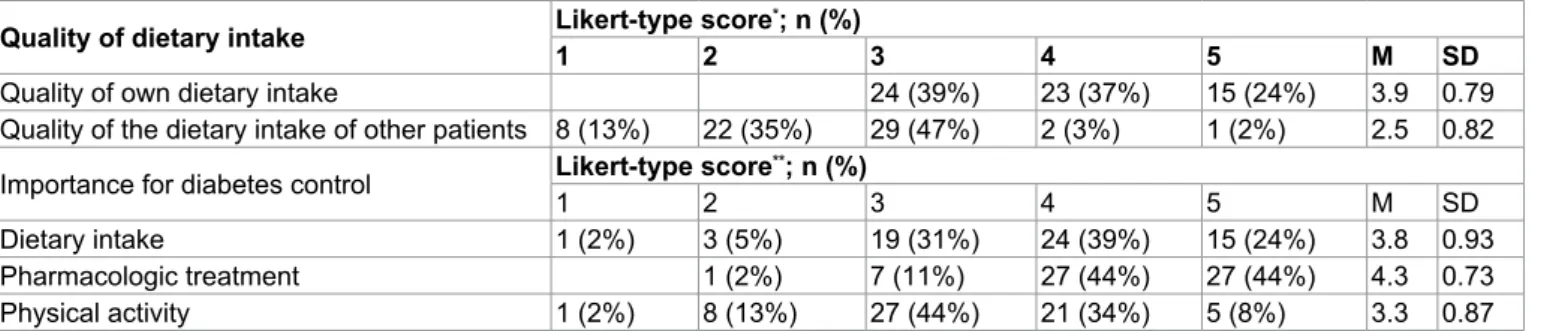
patients is poorer (M = 2.5; SD = 0.82) than their own. According to Mann-Whitney’s test, differences in scores for diet intake quality are statistically significant (U = 473.5; p < 0.001). We did not find statistically significant correlations in the perceptions for the quality of own dietary intake or for the dietary intakes for other pa-tients, according to gender, age, or time (years) since the diagnosis (p > 0.05).
According to ANOVA analyses (F = 19.6; p < 0.001), physical activity is considered less important than di-etary intake and that pharmacologic treatment for the management and control of T2DM (Table 2).
Additional analyses with Student’s t-test, comput-ed with Bonferroni’s correction, show that there are statistically significant differences in all paired group comparisons between treatments (p < 0.05), and that dietary intake (M = 3.9; SD = 0.93) is considered less im-portant than the pharmacological treatment (M = 4.3; SD = 0.73).
We did not find any gender differences in the per-ceptions of the importance of dietary intake, pharmaco-When considering BMI according to the categories
proposed by the WHO [13], we found that 22 patients (36%) were overweight and that 33 patients (53%) were obese. The remaining 7 patients (11%) were classified as having normal weight.
BMI was positively correlated with total carbohy-drate intake (r = 0.283; p = 0.029) and total energy in-take (r = 0.274; p = 0.031), but not correlated with any other nutrient intake that was computed using the 24 h recall (p > 0.05). According to ANOVA analyses, we also did not find any statistically significant differences (p > 0.05) in any of the dietary intake variables according to BMI classification, which suggests that normal weight, excess weight, and obese patients have similar dietary intakes.
When asked to rate the quality of their overall diet intake in a Likert scale (Table 2), patients scored a mean value of 3.9 points (SD = 0.79). Patients rated their over-all diet as “acceptable” (n = 24; 39%), “good” (n = 23; 37%) or “very good” (n = 15; 24%). On the overall, par-ticipants consider that the dietary intake of other T2DM
Table 1: Anthropometric, dietary and clinical characteristics of the sample (n = 66).
Md M SD Min Max
HbA1c (%) 7 7.4 1.64 5 12
Age at diagnosis 55 54.0 7.49 37 69
Years with the disease 5 6.2 4.46 0 19
Weight (kg) 79 78.8 14.79 52 111
Height (cm) 159 161.4 8.95 149 181
BMI (kg/m2) 30 30.1 4.21 21 41
Dietary intake assessed by 24 h recall
Energy (kcal)* 2028 2274.2 699.90 1516 4519
Protein (g) 82 88.9 28.14 40 156
Protein (% of energy intake) 15.9 16.0 3.9 6.5 24.8
Total carbohydrates (g)* 254 269.3 105.87 107 565
Total carbohydrates (% of energy intake) 47.7 47.3 10.9 25.6 64.0
Sugars (g) 91 109.4 69.25 7 343
Sugars (% of energy intake) 18.7 19.0 9.6 1.8 46.3
Dietary fibre (g) 16 18.0 8.58 6 53
Lipids (g) 86 89.8 34.97 28 193
Lipids (% of energy intake) 37.2 35.6 9.7 15.7 59.8
Cholesterol (mg) 292 377.6 243.53 19 1045
Md: Median; M: Mean; SD: Standard Deviation; Min: Minimum; Max: Maximum; *Statistically significant gender differences (p <
0.05), with higher mean intakes in male patients.
Table 2: Perceptions on the quality of dietary intake and importance for diabetes control and management, assessed in 5-point
Likert scales.
Quality of dietary intake Likert-type score1 2 *; n (%)3 4 5 M SD
Quality of own dietary intake 24 (39%) 23 (37%) 15 (24%) 3.9 0.79
Quality of the dietary intake of other patients 8 (13%) 22 (35%) 29 (47%) 2 (3%) 1 (2%) 2.5 0.82 Importance for diabetes control Likert-type score1 2 **; n (%)3 4 5 M SD
Dietary intake 1 (2%) 3 (5%) 19 (31%) 24 (39%) 15 (24%) 3.8 0.93
Pharmacologic treatment 1 (2%) 7 (11%) 27 (44%) 27 (44%) 4.3 0.73
Physical activity 1 (2%) 8 (13%) 27 (44%) 21 (34%) 5 (8%) 3.3 0.87
M: Mean; SD: Standard Deviation; *Likert scale anchors defined as: 1-very poor, 2-poor, 3-acceptable, 4-good, 5-very good; **
Lik-ert scale anchors defined as: 1-not important at all, 2-of little importance, 3-of average importance, 4-very important, 5-absolutely essential.
trends in T2DM patients. A systematic review of obser-vational studies [14] reports that obesity rates exceed-ed 30% in 38 of the 44 studies analysexceed-ed for this variable and 50% in 14 of the 44 studies. Additional data from 3637 UK patients in secondary care [15] showed that 86% of patients with T2DM were overweight or obese and, in Spain, a nationwide population-based cross-sec-tional survey with 12,077 individuals, reports that only 11.4% had BMI below 25 kg/m2 [16].
The results from the dietary assessment show high intake of sugars, when assessed according to the dietary references for adults [17] and also when considering the nutritional guidelines for T2DM patients [2,18]. Total carbohydrate intake is within acceptable macronutrient range (carbohydrate should account for 45-65% of daily energy intake) proposed for T2DM patients [18,19], but patients’ intake of sugars, with a mean of 109.4 g (SD = 69.3 g) and accounting for 19% (SD = 9.6%) of daily en-ergy intake, is significantly higher than recommended, as guidelines state that adults should aim for a maxim of 50 g of sugars or less than 10% of total energy intake, per day [2,20]. The same guidelines suggest that a fur-ther reduction of the intake of free sugars to below 5% of total energy intake should be considered.
Our data suggest that patients should adjust their intake to benefit from the advantages that proper nu-trition provides to T2DM control and weight reduction, and it is recommended that sucrose-containing foods should be substituted for other carbohydrates, in order to avoid excess intake in energy, and excess intake of simple, fast-absorbing carbohydrates [2].
Patients showed an optimistic bias in their percep-tion of the quality of dietary intake. This is in accordance with the literature, which states that when asked to logic treatment, or physical activity in diabetes control
(p > 0.05), but we found a positive correlation between importance placed on pharmacologic treatment and time since the diagnosis (r = 0.273; p = 0.032), suggest-ing that patients that have a longer progression of the disease place higher importance in the pharmacologic treatment.
Table 3 shows the results of patients recalling advice given by health professionals in the last year, and their perception of compliance.
When analysing patient perceptions and opinions about the importance of food and nutritional recom-mendations, recorded in the non-structured part of the interview, we found that all of the patients stated that “food is important” or that it plays “an important role” in patients’ life. Most (53%; n = 32) patients expressed the importance that food has in social gatherings and 67% (n = 40) of them stated that food is “something that gives me pleasure”, with a smaller subset of these (n = 8) expressing that “sometimes it’s the only pleasure” they have. All patients, at some point in the interview, considered dietary intake as an “important part of the treatment for diabetes” and also declared that, on the overall, they try to comply to all nutrition recommenda-tions that they are given. Nevertheless, at some point during the interview, 38 participants (63%) stated that “sometimes, my diabetes doesn’t seem to be affected by my diet, whatever I eat”.
Table 4 describes the difficulties that were most fre-quently mentioned by patients when talking about nu-trition recommendations.
Discussion
Our data reflect the general overweight and obesity
Table 3: Advice given by health professionals. During the past year, did a health
professional told you to… Remembers being told by a health professional Tried his/her best to comply, after being told Complies at the moment
N % N % N %
Engage in physical activity 55 83% 22 40% 16 29%
Try to lose weight 41 62% 21 51% 18 44%
Follow a scheduled time for meals 62 94% 42 68% 42 68%
Weigh or measure foods 45 68% 30 67% 12 27%
Record/write a food diary 18 27% 10 56% 0 0%
Use food substitution list to plan meals 35 53% 5 14% 1 3%
Switch to foods with lower calories 18 27% 13 72% 7 39%
Eat less carbohydrates 29 44% 14 48% 14 48%
Eat less sugar, candy or sweets 19 29% 19 100% 12 63%
Share or engage in meal planning/preparing 33 50% 12 36% 12 36%
Table 4: Statements about barriers to comply with nutrition recommendations.
Statement N %
“A proper diet takes too much effort”. 32 52%
“Following dietary advice implies different meals from the rest of the family”. 26 42% “My diabetes doesn’t seem to be affected by my diet, whatever I eat”. 38 61% “When I go to [social gatherings] there are no adequate meal options”. 24 39%
“A proper diet is more expensive”. 30 48%
their daily life. Patients’ perception that their disease does not seems to be affected, no matter what they eat, should be addressed by proper nutrition education. Re-garding the limitations of our study, we propose that the small sample size does not allow us to extrapolate to a wider group of patients. Although we invited patients to this study during the course of a two-month period and recruited a significant number of T2DM patients who attend consultations at the clinic, the final sample size can limit our ability for some statistical analyses and for stratifying the data. Additionally, we did not conduct a thorough dietary assessment, which must include other data collection tools apart from a 24 h recall. This meth-od provides an estimate of intake, but can misrepresent usual dietary intake.
Our sample was also composed by patients with low educational level, which can be associated with a low adherence to treatment and is also identified in the lit-erature as an important determinant of dietary habits [31,32].
Conclusions
Our study allows us to conclude that T2DM patients perceive dietary intake as an important part of their treatment, but not as valuable as pharmacologic ther-apy.
The purpose of this study was not to assess the qual-ity of the nutritional or medical therapy, or the type of patient education messages that were previously de-livered to these patients, but our data suggest that pa-tients believe that engaging in nutritional recommenda-tions is hard or that patients are not provided with the necessary tools to follow recommendations.
Patients should be empowered to improve their self-care and to consider nutrition therapy as valuable as other treatments, such as pharmacologic therapy.
There is sufficient evidence in the literature to sup-port the effectiveness of nutritional therapy in T2DM and there are clear guidelines for the construction of meals plans for T2DM patients. Nevertheless, future re-search must address the ways that educational, psycho-social, cultural or economic characteristics may hinder compliance of nutritional recommendations. Although a stricter adherence to existing guidelines and a much stronger attention to the desired therapeutic goals may allow a decrease in diabetes costs, morbidity, and mor-tality, there is still a significant problem in adherence to therapy. Future research must also focus on developing tailored strategies for patient education and for improv-ing risk communication.
Acknowledgements
All authors contributed to the drafting and revising of this manuscript. The authors wish to express their gratitude to the AEDMADA Diabetes Clinic and its pro-fessionals, without whom this work would not have classify their agreement with the likelihood of an event,
individuals are more unjustifiably optimistic when they perceive having some form of control over that event [21]. This can explain the difference in the perception of diet quality, as individuals, having more control over their own diet, perceive its outcomes in a favourable way. According to the literature, the tendency to be-lieve that one's own outcomes of an event are more favourable than that of others, can partly explain why health education messages can be ineffective [22].
Patients consider a proper diet a valuable treatment, but pharmacotherapy is a more highly regarded ther-apeutic tool. This is in accordance with the literature, which suggests that adherence to pharmacotherapy seems to be the behaviour with the highest prevalence in T2DM patients, with reports of adherence to thera-peutic regimens of oral antidiabetic agents ranging from 70% to 80% [5,12,23]. Regular physical activity also pre-sents a low prevalence in diabetes patients, with a lit-erature review reporting an adherence to a physical ac-tivity plan of 26%, and stating that individuals with dia-betes are considered among the least likely to engage in regular physical activity [24]. This review also suggests that only 25% of older adults with diabetes meet the recommendations for physical activity proposed by the ADA [2].
Our data suggest that patients consider nutrition as an important part of their daily life, but do not en-gage or maintain dietary recommendations for long. The literature shows that nutrition counselling requires a contextual understanding of the patient’s individual situation, in order to support and promote health be-haviour change [25], and that the difficulties and com-plexities of the nutritional care process in T2DM suggest that a single, uniform approach is not desirable, due to the intricacies of diabetes aetiology, complications, and glycaemia determinants [26-28]. Patient educa-tion, which enables people with diabetes to improve their knowledge, skills and confidence, allowing them to self-manage their condition, must include interven-tions that empower patients to incorporate nutritional management and physical activity into his/her lifestyle and to develop personal strategies to promote health and behaviour change [29]. Changing food behaviour is not an easy task because it requires alterations in habits that have been built up over the course of an extended period of time, but targeted interventions that include behaviour and nutrition counselling have proven to be successful in primary care and community settings, in-cluding in T2DM patients [30]. Nevertheless, nutrition counselling requires a contextual understanding of the patient’s individual situation, in order to support and promote health behaviour change [25].
Our study shows that even if patients place value in nutritional therapy, they still experience significant problems in translating dietary recommendations to
17. Institute of Medicine (2005) Dietary Reference Intakes for Energy, Carbohydrate, Fiber, Fat, Fatty Acids, Cholesterol, Protein, and Amino Acids (Macronutrients). National Aca-demies Press 1313.
18. Franz MJ, Bantle JP (2012) American Diabetes Association guide to medical nutrition therapy for diabetes. (2nd edn),
American Diabetes Association, 562.
19. Franz MJ, Boucher JL, Green-Pastors J, Powers MA (2008) Evidence-based nutrition practice guidelines for diabetes and scope and standards of practice. J Am Diet Assoc 108: S52-S58.
20. World Health Organization (2015) Guideline: Sugars intake for adults and children.
21. Weinstein ND (1980) Unrealistic optimism about future life events. Journal of Personality and Social Psychology 39: 806-820.
22. Weinstein ND, Klein WM (1995) Resistance of personal risk perceptions to debiasing interventions. Health Psychol 14: 132-140.
23. Ahmad NS, Ramli A, Islahudin F, Paraidathathu T (2013) Medication adherence in patients with type 2 diabetes mel-litus treated at primary health clinics in Malaysia. Patient Prefer Adherence 7: 525-530.
24. Qiu SH, Sun ZL, Cai X, Liu L, Yang B (2012) Improving patients' adherence to physical activity in diabetes mellitus: A review. Diabetes Metab J 36: 1-5.
25. Morris SF, Wylie-Rosett J (2010) Medical nutrition therapy: A key to diabetes management and prevention. Clinical Diabetes 28: 12-18.
26. Franz MJ, Powers MA, Leontos C, Holzmeister LA, Kulkar-ni K, et al. (2010) The evidence for medical nutrition therapy for type 1 and type 2 diabetes in adults. J Am Diet Assoc 110: 1852-1889.
27. American Diabetes Association (2013) Standards of medi-cal care in diabetes-2013. Diabetes Care 36: S11-S66. 28. American Diabetes Association, Bantle JP, Wylie-Rosett J,
Albright AL, Apovian CM, et al. (2008) Nutrition recommen-dations and interventions for diabetes: A position statement of the American Diabetes Association. Diabetes Care 31: S61-S78.
29. Funnell MM, Brown TL, Childs BP, Haas LB, Hosey GM, et al. (2011) National standards for diabetes self-manage-ment education. Diabetes Care 34: S89-S96.
30. Spahn JM, Reeves RS, Keim KS, Laquatra I, Kellogg M, et al. (2010) State of the evidence regarding behavior change theories and strategies in nutrition counseling to facilitate health and food behavior change. J Am Diet Assoc 110: 879-891.
31. Nestle M, Wing R, Birch L, DiSogra L, Drewnowski A, et al. (1998) Behavioral and social influences on food choice. Nutrition Reviews 56: 50-64.
32. Sobal J, Bisogni C (2009) Constructing food choice deci-sions. Ann Behav Med 38: S37-S46.
been possible.
Ethical Statement
We declare that this study followed all necessary ethical procedures and regulations.
Conflict of Interest Disclosure Statement
The authors did not receive any funding for this re-search and confirm that the content of this article has no conflict of interest.
References
1. Nyenwe EA, Jerkins TW, Umpierrez GE, Kitabchi AE (2011) Management of type 2 diabetes: Evolving strategies for the treatment of patients with type 2 diabetes. Metabo-lism 60: 1-23.
2. American Diabetes Association (2017) Standards of medi-cal care in diabetes-2017. Diabetes Care 40: S4-S5. 3. Delamater AM (2006) Improving patient adherence. Clinical
Diabetes 24: 71-77.
4. Diabetes and Nutrition Study Group of the Spanish Dia-betes Association (GSEDNu) (2006) DiaDia-betes nutrition and complications trial: Adherence to the ADA nutritional recommendations, targets of metabolic control, and onset of diabetes complications. A 7-year, prospective, popula-tion-based, observational multicenter study. J Diabetes Complications 20: 361-366.
5. Asche C, LaFleur J, Conner C (2011) A review of diabetes treatment adherence and the association with clinical and economic outcomes. Clin Ther 33: 74-109.
6. Barofsky I (1978) Compliance, adherence and the thera-peutic alliance: Steps in the development of self-care. Soc Sci Med 12: 369-376.
7. Kurtz SM (1990) Adherence to diabetes regimens: Empiri-cal status and cliniEmpiri-cal applications. Diabetes Educ 16: 50-59.
8. Day JL (2000) Diabetic patient education: Determinants of success. Diabetes Metab Res Rev 16: S70-S74.
9. Shrivastava S, Shrivastava P, Ramasamy J (2013) Role of self-care in management of diabetes mellitus. J Diabetes Metab Disord 12: 14.
10. Sabatâe E (2003) Adherence to long-term therapies: Evi-dence for action. World Health Organization.
11. Walker E, Usher J (2003) Understanding and enhancing adherence in adults with diabetes. Curr Diab Rep 3: 141-148. 12. Cramer JA (2004) A systematic review of adherence with
medications for diabetes. Diabetes Care 27: 1218-1224. 13. WHO/FAO (2003) Diet, nutrition and the prevention of chronic
diseases. WHO/FAO Expert Consultation. Geneva: WHO. 14. Colosia AD, Palencia R, Khan S (2013) Prevalence of
hypertension and obesity in patients with type 2 diabetes mellitus in observational studies: A systematic literature re-view. Diabetes Metab Syndr Obes 6: 327-338.
15. Daousi C, Casson IF, Gill GV, MacFarlane IA, Wilding JP, et al. (2006) Prevalence of obesity in type 2 diabetes in se-condary care: Association with cardiovascular risk factors. Postgrad Med J 82: 280-284.
16. Navarro-Vidal B, Banegas JR, Leon-Munoz LM, Rodri-guez-Artalejo F, Graciani A (2013) Achievement of car-diometabolic goals among diabetic patients in Spain. A nationwide population-based study. PLoS One 8: e61549.