R E S E A R C H
Open Access
Pharmacological characterization of
cnidarian extracts from the Caribbean Sea:
evaluation of anti-snake venom and
antitumor properties
Cláudia S. Oliveira
1,2,3, Cleópatra A. S. Caldeira
1,2,3, Rafaela Diniz-Sousa
1,2,3, Dolores L. Romero
4, Silvana Marcussi
5,
Laura A. Moura
6, André L. Fuly
6, Cicília de Carvalho
7, Walter L. G. Cavalcante
7,8, Márcia Gallacci
7, Maeli Dal Pai
9,
Juliana P. Zuliani
1,2,3, Leonardo A. Calderon
1,2,3and Andreimar M. Soares
1,2,3,10*Abstract
Background:
Cnidarians produce toxins, which are composed of different polypeptides that induce pharmacological
effects of biotechnological interest, such as antitumor, antiophidic and anti-clotting activities. This study aimed to
evaluate toxicological activities and potential as antitumor and antiophidic agents contained in total extracts from five
cnidarians:
Millepora alcicornis
,
Stichodactyla helianthus, Plexaura homomalla, Bartholomea annulata
and
Condylactis
gigantea
(total and body wall).
Methods:
The cnidarian extracts were evaluated by electrophoresis and for their phospholipase, proteolytic, hemorrhagic,
coagulant, fibrinogenolytic, neuromuscular blocking, muscle-damaging, edema-inducing and cytotoxic activities.
Results:
All cnidarian extracts showed indirect hemolytic activity, but only
S. helianthus
induced direct hemolysis and
neurotoxic effect. However, the hydrolysis of NBD-PC, a PLA
2substrate, was presented only by the
C. gigantea
(body wall)
and
S. helianthus
. The extracts from
P. homomalla
and
S. helianthus
induced edema, while only
C. gigantea
and
S. helianthus
showed intensified myotoxic activity. The proteolytic activity upon casein and fibrinogen was presented
mainly by
B. annulata
extract and all were unable to induce hemorrhage or fibrinogen coagulation. Cnidarian
extracts were able to neutralize clotting induced by
Bothrops jararacussu
snake venom, except
M. alcicornis
. All
cnidarian extracts were able to inhibit hemorrhagic activity induced by
Bothrops moojeni
venom. Only the
C. gigantea
(body wall) inhibited thrombin-induced coagulation. All cnidarian extracts showed antitumor effect against Jurkat cells,
of which
C. gigantea
(body wall) and
S. helianthus
were the most active; however, only
C. gigantea
(body wall) and
M.
alcicornis
were active against B16F10 cells.
Conclusion:
The cnidarian extracts analyzed showed relevant in vitro inhibitory potential over the activities induced by
Bothrops venoms; these results may contribute to elucidate the possible mechanisms of interaction between cnidarian
extracts and snake venoms.
Keywords:
Caribbean sea cnidarians, Bioprospection, Antiophidic, Antitumor, Natural products
* Correspondence:[email protected];[email protected]
1Centro de Estudos de Biomoléculas Aplicadas a Saúde (CEBio), Fundação Oswaldo Cruz de Rondônia (Fiocruz Rondônia), Porto Velho, RO, Brazil 2Brazilian Marine Biotechnology Network (BioTecMar Network), Porto Velho, Brazil
Full list of author information is available at the end of the article
Background
Marine organisms, which comprise half of the total global
biodiversity, have been recognized as the largest remaining
reservoir of novel compounds to be evaluated for drug
ac-tivity [1
–
6]. Animals belonging the phylum Cnidaria are
of great importance for studies of pharmacological and
toxicological assessments. The composition of cnidarian
venoms
remains
incompletely
elucidated.
However,
several of their compounds have been described, including
peptides, proteins, purines, quaternary ammonium
com-pounds, biogenic amines and betaines [1,
7
–
11].
Venoms from such animals as snakes [12
–
14], scorpions
[15
–
18], anurans [19,
20], cone snails [21,
22] and
cnidar-ians [23
–
25] have been used as a source of bioactive
com-pounds for the prospection of lead comcom-pounds potentially
useful for the development of new anticancer therapies
[26,
27]. This fact has provoked a growing worldwide
interest in the screening of proteins, peptides, marine
nat-ural products (MNPs) from cnidarians in order to discover
new anticancer bioactive compounds [28,
29].
The use of genomic and proteomic approaches had
per-mitted a rapid increase in the number of sequences from
cnidarians deposited in protein and gene databases [30
–
32].
Some of these toxins have been used for the development
of anticancer molecules. One interesting example is the
hemolytic toxin (HT) from
Stichodactyla helianthus
sea
anemone which was conjugated with an antibody towards
an antigen expressed on immature T lymphocytes (IOR-T6)
producing an o-hemolytic hybrid IOR-T6-HT that showed
toxicity against CEM cells expressing the IOR-T6 antigen
and non-toxic effects for K562 cells without the antigen [33].
Additionally, several marine natural products are able
to inhibit the toxic effects of snake venoms, such as
ex-tracts from
Plocamium braziliense
[34],
Canistrocarpus
cervicornis
[35] and seaweed
Prasiola crispa
[36]. The
marine extracts that also inhibit PLA2
activity include
manoalide [37], vidalols, and a group of terpenoids that
contain masked 1,4-dicarbonyl moieties. Furthermore,
the biotechnological potential of PLA2
inhibitors may
provide therapeutic molecular models that exert
antio-phidian activity to supplement the conventional serum
therapy against these multifunctional enzymes [38,
39].
This study aimed to evaluate toxicological activities
and their efficacy against tumor and snake-venom toxic
activities from five Caribbean Sea cnidarian species of
the hydrozoa class:
Millepora alcicornis, Plexaura
homo-malla
and Cnidarians of the anthozoa class:
Condylactis
gigantea
(total and body wall),
Stichodactyla helianthus,
and
Bartholomea annulata
.
Methods
Materials and reagents
The synthetic fluorescent substrates Acyl 6:0 NBD
phospholipids, phosphatidylcholine (PC) and
NBD-phosphatidic acid (PA) were purchased from Avanti Polar
Lipids Inc. (USA). The reagents used in the
electrophor-esis, salts and other reagents were obtained from Sigma
Chemical Company (USA).
Cnidarian extracts
The cnidarians specimens were collected in the coast of
Havana City during a one-year period. The extracts of
corals were obtained as previously described by [40],
whereas anemone extracts were obtained according to
[41]. Protein quantitation was based on the Bradford
method (BioRad) using bovine serum albumin (BSA) as
a standard.
Animals
Adult male mice weighing 25 to 30 g were maintained
under a 12 h light-dark cycle (lights on at 07:00 h) in a
temperature-controlled environment (22 ± 2 °C) for at
least ten days prior to the experiments. Food and water
were freely available. Animal procedures were in
accord-ance with the guidelines prepared by the Committee on
Care and Use of Laboratory Animal Resources, National
Research Council, USA. The ethical aspects related to
the project were approved by the Ethics Committee on
Animal Use (No. 2012/1) and the Ethics Committee
(102/2009) for Research on Human Beings from Brazil
(CAAE: 14204413.5.0000.0011).
Electrophoresis
SDS-PAGE 12.5% (m/v) was carried out as previously
described [42]. 500
μ
g samples
C. gigantea
(body-wall),
C. gigantea
(total),
M. alcicornes
,
S. helianthus
,
P.
homo-malla
and
B. annulata
were pretreated in reducing
con-ditions (SDS plus
β
-mercaptoethanol) at 100 °C for
5 min. Gels were stained with 0.1% Coomassie brilliant
blue R-350 in ethanol: acetic acid (5:1,
v
/v) for 15 min
and discolored in 10% acetic acid. The molecular mass
was estimated by interpolation from a linear logarithmic
plot of relative molecular mass versus distance of
migra-tion
using
standard
molar
mass
markers
(SDS7
Sigma-Aldrich).
Phospholipase activity
The Phospholipase A2
(PLA2) activity was measured
using the indirect hemolytic assay on agarose gels
con-taining red blood cells and egg yolk phospholipids [43].
The hemolytic activity was evaluated
spectrophotomet-rically using suspensions of fresh human RBC (red blood
cells) as previously described [44,
45].
software RFPC) with excitation and emission wavelengths
of 460 and 534 nm, respectively. The enzymatic activity of
each cnidarian extract was evaluated for 250 s after the
addition of substrate (3.3
μ
g/mL, final concentration) in a
reaction medium containing 50 mM Tris-HCl, and 8 mM
CaCl2, pH 7.5, at room temperature.
Proteolytic activity assay
Proteolytic activity upon fibrinogen was measured as
de-scribed by [46] with some modifications. Fibrinogen
(70
μ
g) diluted in PBS was incubated with different
amounts of cnidarian extracts diluted in 20
μ
L buffer
(pH 7.5) at 37 °C for 2 h. The reaction was stopped with
20
μ
L of a solution containing 10% (v/v) glycerol, 10%
(v/v)
β
-mercaptoethanol, 2% (v/v) SDS, and 0.05% (w/v)
bromophenol blue. Fibrinogen hydrolysis was
demon-strated by SDS-PAGE using 12% polyacrylamide gels.
Proteolytic activity upon casein was measured as
de-scribed by [47]. Cnidarian extracts (100 and 500
μ
g)
were incubated for 30 min at 37 °C in a solution of
0.1 M Tris-HCl pH 9.0 containing 1% casein. After the
incubation period, 1.5 mL of 30% TCA was added to
each sample to stop the enzymatic reaction and
centri-fuged at 340
x g
for 25 min. Then, the samples were read
on a spectrophotometer at a wavelength of 280 nm. One
unit of protease activity was defined as the amount of
enzyme that produces an increase in absorbance of
0.001 units/minute at 280 nm.
Hemorrhagic activity assay
Hemorrhagic activity was quantitatively estimated by the
method of [48] with some modifications. Groups of six
Swiss mice (18-22 g) were shaved on the back and then
intradermally (i.d.) injected with different doses of
cni-darians extracts or snake venoms, in 50
μ
L of phosphate
buffered saline (PBS). After 2 h, animals were
anesthe-tized and euthanized. The shaved back skin was
re-moved
and
the
hemorrhagic
halo
diameter
was
measured. The minimum hemorrhagic dose (MHD) was
obtained from the mean of these diameters (mm). The
MHD is defined as the dose of snake venom or extract
that produces a hemorrhagic lesion of 10 mm diameter
after 2 h.
Coagulant activity assay
The clotting time was determined by mixing 20
μ
L of the
samples (in 0.15 M NaCl, pH 7.4) with 200
μ
L of citrated
bovine plasma at 37 °C. The
B. jararacussu
snake venom
(20
μ
g) was assayed in order to determine the minimum
coagulant dose (corresponding to the time between 1 and
1.2 s
–
100% activity). For the neutralization trials, the
snake venom was previously incubated with different
cni-darian extracts for 30 min at 37 °C, at different
propor-tions (1:5, 1:10 and 1:30, w/w).
Neuromuscular blocking
Mice were euthanized by exsanguination after previous
cervical dislocation. Phrenic-diaphragm (PD) preparation
was removed and mounted vertically in a conventional
isolated organ-bath chamber containing 15 mL of
physio-logical solution of the following composition (mmol/L):
NaCl, 135; KCl, 5; MgCl2, 1; CaCl2, 2; NaHCO3, 15;
Na2HPO4, 1; glucose, 11. This solution was bubbled with
carbogen (95% O2
and 5% CO2). The preparation was
at-tached to an isometric force transducer (Grass, FT03) for
recording the twitch tension. The transducer signal output
was amplified and recorded on a computer via a
trans-ducer signal conditioner (Gould, 13
–
6615-50) with an
Ac-quire Lab Data Acquisition System (Gould). The resting
tension was 5 g; indirect contractions were stimulated by
supramaximal pulses (0.2 Hz, 0.5 ms) delivered from an
electronic stimulator (Grass-S88 K) and applied to the
phrenic nerve by means of a suction electrode. The
prep-aration was allowed to stabilize for 45 min before the
addition of a single concentration of toxin [49].
Muscle-damaging activity
Morphological analysis
At the end of the myographic study, the diaphragm
muscle was removed from the bath and frozen in liquid
nitrogen. Transverse sections (8 mm thick) were cut out
at
−
20 °C in a cryostat and stained with hematoxylin and
eosin (HE) prior to examination by light microscopy [50].
Muscle damage was quantified in HE stained
prepara-tions, using an Analysis Imaging System (Leica, Qwin).
The number of fibers with lesions was expressed as a
per-centage of the total number of cells (muscle damage
index), in three non-overlapping non-adjacent areas of
each muscle, observed at the same magnification.
Creatine kinase release
The creatine kinase (CK) assay was carried out using the
CK-UV kinetic kit from
Sigma Chem. Co.
Different
cnidarian extracts were injected (i.m., 50
μ
L) into Swiss
male mice weighing 18
–
22 g (
n
= 6). The control
animals received 0.15 M PBS. After 3 h, the blood from
the tail was collected in heparin-coated tubes and
centri-fuged for plasma separation. The amount of CK was
then determined using 4
μ
L of plasma, which was
incu-bated for 3 min at 37 °C with 1.0 mL of the reagent.
En-zyme activity was expressed in international units per
liter (IU/L), with one unit of activity corresponding to
phosphorylation of 1
μ
mol of creatine/min at 25 °C.
Edema inducing activity
Groups of six Swiss male mice (18
–
22 g) were injected
caliper (Mytutoyo-japan) [51,
52]. The zero time values
were then subtracted and the differences reported as
median % ± S.D.
Cytotoxic activity
Tumor cell cytotoxic activity of cnidarian extracts on
human acute T-cell leukemia (Jurkat) and B16F10 cell
lines were assayed using the MTT method according to
[53]. Cells were dispersed in 96-well plates at a density
of 1 × 10
5cells per well. After 24 h of culture, the media
were removed and fresh media, with or without different
concentrations of samples, were added into the wells
and incubated for 24 h. The extracts were evaluated at
1000, 100 and 10
μ
g/mL concentrations using
Vincris-tine as positive control (100
μ
g/mL). Results were
expressed as a percentage (%).
Statistical analysis
Results were expressed as mean ± S.D. Data was
ana-lyzed by ANOVA complemented by the Tukey-Kramer
test, using the statistical program GraphPad 5.0. Values
of
p
< 0.05 were considered significant.
Results and discussion
The SDS-PAGE analysis in denaturing conditions of the
cnidarian extracts showed the difference between
ex-tracts of
C. gigantea
(body-wall),
C. gigantea
(total),
S.
helianthus, B. annulata
,
M. alcicornes
and
P.
homo-malla
. Considering that the extracts were obtained from
the entire organism, it should be noted that the anatomy
of
M. alcicornes
and
P. homomalla
is different from that
of anemones. For this reason, the method of protein
ex-traction must be differentiated for these organisms.
Thus, it is possible that in the 500
μ
g extract applied to
the electrophoresis, a low protein yield made it
impos-sible to visualize bands on the polyacrylamide gel
(Fig.
1a).
The extracts of
S. helianthus
and
C. gigantea
(body-wall) hydrolyzed the NBD-PC substrate that is specific
for the PLA2
enzymes, which was not observed for the
other extracts tested (Fig.
2b). Martins and coworkers
[54] isolated a PLA2
(CgPLA2) composed of 14 kDa
di-mers and 29 kDa monomer from the
C. gigantea
extract.
Another study reported showed that Sticholysin I and II,
two 19 kDa pore-forming cytokines, present in the
S.
he-lianthus
extract, low activity against specific substrates
for phospholipase activity when tested alone [55].
However, fractions enriched with these two molecules
together demonstrated a significant increase in
phospho-lipase activity [56]. Although CgPLA2
and Sticholysin I
and II are known to exert phospholipase activity, it
should be emphasized that the experiments were carried
out with total extract. It is possible that these molecules
are responsible for the hydrolysis promoted against the
NBD-PC substrate, but we do not rule out the existence
of other molecules that are components of the extract,
which alone or in clusters may be acting in the
hydroly-sis of the NBD-PC substrate.
As shown in Fig.
2a, all extracts displayed indirect
hemolytic activity. However, only extracts of
S.
helian-thus
and
C. gigantea
showed direct hemolytic activity by
lysis of red blood cells, in a concentration-dependent
manner (Fig.
3a, b). Hemolysis was provoked not only
by anemone extract as observed in
B. annulate
[57] and
S. helianthus
[58] but also by
M. alcicornes
aqueous
ex-tract [8]. In addition, Sticholysin II toxin isolated from
S.
helianthus
has also been described for its hemolytic
cap-acity [45,
59
–
63].
The extracts of
C. gigantea
(body wall) and
B.
annu-lata
were able to partially hydrolyze the
α
and
β
chains
of fibrinogen; however,
S. helianthus, M. alcicornis
and
P. homomalla
were incapable of hydrolyze fibrinogen
ef-ficiently (Fig.
1b). The fibrinogenolytic assay was carried
out using 50
μ
g of the cnidarian extracts, whose
proteo-lytic activity upon casein was evaluated; furthermore, the
extract of
B. annulata
(100
μ
g) hydrolyzed casein at
80 U/min. The extracts of
C. gigantea
(body wall) and
B.
annulata
at 500
μ
g hydrolyzed casein at 118 and 170 U/
min, respectively (Fig.
2c).
As to the hemorrhagic effect, extracts of
M. alcicornis
and
P. homomalla
induced bleeding at a concentration
of 150
μ
g (Fig.4a) and inhibited bleeding induced by
Bothrops
snake venom. All cnidarians extracts tested
inhibited the hemorrhagic activity induced by
B. moojeni
venom at a ratio of 1:30 w/w, showing approximately
40% inhibition in the presence of extracts of
C. gigantea
(body wall),
P. homomalla
and
M. alcicornis
(Fig.4c).
Interestingly, the
B. neuwiedi
venom extracts did not
in-hibit hemorrhage (Fig.
4b).
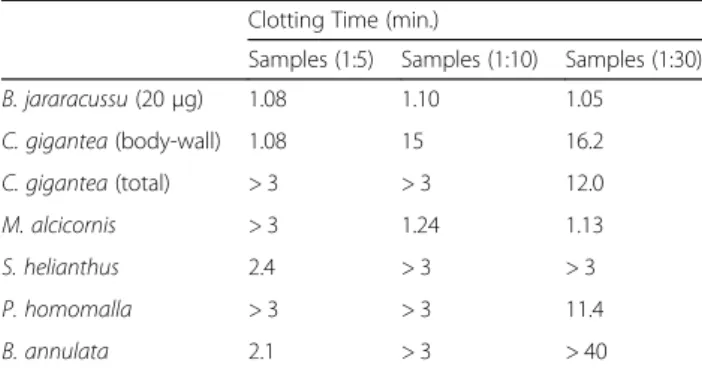
Coagulant activity was not induced by cnidarian
ex-tracts. However, all cnidarian extracts except
M.
alcicor-nis
inhibited the coagulant activity induced by
B.
jararacussu
venom at the ratios of 1:5 and 1:10 w/w. In
this assay, the
B. annulata
extract at a 1:30 w/w ratio
showed the greatest ability to delay the clotting time of
citrated plasma after the addition of
B. jararacussu
venom for more than 40 min (Table
1). The other
ex-tracts tested at the 1:30 w/w ratio presented lower
in-hibitory
effect
(Fig.
5).
Additionally,
C.
gigantea
body-wall extract at a concentration of 200
μ
g/mL were
Fig. 4Induction and Inhibition of hemorrhagic activity. (a) Hemorrhage induced by snake venoms: (Bj)B. jararacussu, (Bp)B. pirajai, (Ba)B. alternatus, (Bn)B. neuwiedi, (Bm)B. moojeni- all venoms at 30μg and, cnidarian extracts: (1)C. gigantea(body-wall), (2)C. gigantea(total), (3)M. alcicornis,(4)S. helianthus(5)P. homomalla, (6)B. annulata -all extracts at 150μg. (b) Inhibition of hemorrhagic activity induced byB. neuwiedi
(Bn) at 20μg and; (c) Inhibition of haemorrhagic activity induced byB. moojeni(Bm) at 10μg. Results are reported as mean % ± S. D (n = 3)
Fig. 3Hemolytic activity of cnidarian extracts. (1)C. gigantea(body-wall), (2)C. gigantea(total), (3)M. alcicornis,(4)S. helianthus,(5)P. homomalla
able to inhibit thrombin-induced coagulation. This
activ-ity can be produced by the presence of protease
inhibi-tors, as reported by [64], who showed the presence of
protease inhibitory activity in the extract from the
mar-ine sponge
Xetospongia muta
(Poriphera) and in the sea
anemones
B. granulifera
and
B. annulata
. According to
these authors, this activity was dose-dependent and the
molecule responsible for the inhibition had a low
mo-lecular weight. Di Bari and coworkers [65] also described
the presence of protease inhibitors in aqueous extracts
of marine sponges; all extracts were able to inhibit the
activity and expression of matrix metalloproteinases
(MMP-2 and MMP-9) in mice astrocyte culture.
At 3 h after the injection of 50
μ
g of cnidarian extracts
into the gastrocnemius mouse muscle, a slight myotoxic
effect from the extracts of
M. alcicornis
and
P.
homo-malla
was observed, approximately 22% above those
ob-served for the controls injected with PBS alone. The
C.
gigantea
(body-wall),
C. gigantea
(total) and
S.
helian-thus
presented increased activity, while extract of
B.
annulata
did not show myotoxic effect.
Some studies have demonstrated the toxic effects of
marine animals such as coral
Millepora alcicornis
, which
causes systemic reactions in the kidney, lung and liver
[8],
and
Millepora
complanata
,
which
presents
non-peptide toxins highly lethal to mice with LD50
of
4.62
μ
g/g body weight [66]. The other cnidarian extracts
tested,
C. gigantea
(body-wall),
C. gigantea
(total) and
S.
helianthus
, showed a more pronounced myotoxic effect,
smaller only compared with to those induced by
B.
jar-aracussu
venom and the myotoxin BthTX-I, which are
highly myotoxic (Fig.
6a). The edema induction was
observed only in the presence of extracts from
P.
homo-malla
and
S. helianthus
(Fig.
6b).
Fig. 5Effect of cnidarian extracts on coagulation.(1)C. gigantea
(body-wall), (2)C. gigantea(total), (3)M. alcicornis,(4)S. helianthus,
(5)P. homomalla, (6)B. annulata,200μg/mL of the extract were pre-incubated with fibrinogen; clotting was then started by the addition of thrombin and monitored at A405nm. Results are reported as mean % ± S. D (n = 3)
Fig. 6Myotoxic activity and edema-induction by cnidarian extracts.
(Bj)B. jararacussusnake venom and (BthTX-I) Bothropstoxin-I fromB. jararacussu(1)C. gigantea(body-wall), (2)C. gigantea(total), (3)M. alcicornis,(4)S. helianthus(5)P. homomalla, (6)B. annulata.(a) CK activity was measured 3 h after the i.m injection of 50μL with 50μg of each cnidarian extracts (1–6) and 20μg of the Bj and BthTX-I. Results are presented as means ± S.D. (n= 4). (b) Paw edema in Swiss mice was induced by injection of 100μg of cnidarian extracts and 10μg of Bj at 30, 60 and 180 min. Results are reported as mean % ± S. D (n= 6)
Table 1
Clotting activity inhibition from
B. jararacussu
snake
venom by cnidarian extracts
Clotting Time (min.)
Samples (1:5) Samples (1:10) Samples (1:30)
B. jararacussu(20μg) 1.08 1.10 1.05
C. gigantea(body-wall) 1.08 15 16.2
C. gigantea(total) > 3 > 3 12.0
M. alcicornis > 3 1.24 1.13
S. helianthus 2.4 > 3 > 3
P. homomalla > 3 > 3 11.4
In isolated neuromuscular preparation, extract from
S.
helianthus
(100
μ
g/mL) induced a time-dependent
block-age of indirect twitches (Fig.
7). After 300 min, the twitch
amplitude was reduced by about 84%. In contrast, at the
same concentration, extracts from
C. gigantea
(body wall)
and
C. gigantea
(total) did not affect the indirectly evoked
twitches. Morphological and morphometric analyses
re-vealed an absence of significant damage in diaphragm
muscles exposed to
S. helianthus
and
C. gigantea
total
ex-tracts (Fig.
8). On the other hand, a slight, but significant
level of damage was observed in muscles exposed to
C.
gigantea
body wall extract (Fig.
8).
Fig. 7Effects ofS. helianthusextract (100μg/mL) upon indirect evoked twitches on mouse phrenic-diaphragm preparation.The ordinate represents the % amplitude of twitches relative to the initial amplitude. The abscissa indicates the time (min) after the addition of the extract to the organ bath. Vertical bars represent the SEM; *indicates the point from which there are significant differences relative to control (p< 0.05)
The cytotoxic activity of cnidarian extracts upon the
human tumor cell lines JURKAT (leukemia T) and
B16F10 (melanoma) (Fig.
9a
and
b) showed that all
ex-tracts presented anti-tumor activity against JURKAT
cells, except the extract
B. annulata
. Additionally,
ex-tracts of
C. gigantea
(body-wall) and
S. helianthus
showed significant anti-tumor activity at concentrations
of 1000
μ
g/mL, of which the latter still showed cytotoxic
activity of 50% even at the lowest concentration
evalu-ated (10
μ
g/mL). As to their activity on B16F10 cells,
only the extract of
C. gigantea
(body wall) and
M.
alci-cornis
showed anti-tumor activity at concentrations of
1000 and 100
μ
g/mL. Some authors proposed that this
cytotoxic activity on tumor cell lines is associated with
the induction of apoptosis considering the fact that some
enzymes isolated from animals exhibit hydrolytic activity
by altering the cell membrane [67]. Another study
re-ported the cytotoxic effect of extracts from the marine
sponge
Polymastia janeirensis
on a human glioma line
(U138MG); in the experiment, both aqueous and organic
extracts induced cell death by apoptosis and necrosis
[68]. Similar results with extracts from the sponge
Hyat-tella cribriformis
in ethyl acetate, which exhibited potent
growth inhibition of tumor cells as sarcoma, ovarian
cancer, colon and breast cell lines [69].
Conclusions
The neutralization of the clotting induced by
B.
jarara-cussu
snake
venom
and
the
inhibition
of
the
hemorrhagic activity induced by
B. moojeni
venom were
demonstrated by the majority of the cnidarian extracts
tested, whereas the ability to inhibit thrombin-induced
coagulation was shown by the
C. gigantea
(body wall).
Together with the anti-tumor effect against JURKAT
cells demonstrated by all cnidarian extracts tested and
the specificity shown against B16F10 cells, these findings
constitute important evidence that cnidarians extracts
are a rich source of bioactive molecules that should be
studied in order to produce data for the development of
new alternatives for snakebite envenomation and cancer
therapies.
Acknowledgments
This work was supported by Ministry of Science and Technology (MCTI), National Council for Scientific and Technological Development (CNPq), Funding Authority for Studies and Projects (FINEP), Coordination for the Improvement of Higher Education Personnel (CAPES), National Research Network in Marine Biotechnology (process no. 408522/2013-5, MCTI/CNPq/ FNDCT) and Rondônia Research Foundation (FAPERO). The authors express their gratitude to Genetic Heritage Management Board (CGEN/MMA) for financial support under the authorization number 010627/2011-1. The authors thank the Program for Technological Development in Tools for Health-PDTIS-FIOCRUZ for use of its facilities. Amy Grabner provided the English editing of the manuscript. The authors thank the Andrea A. Moura, Nestor A. D. Mendes, Anderson M. Kayano, and Auro Nomizo for their collaboration of the work and manuscript.
Funding
This work was funded by the FIOCRUZ, FAPERO, Conselho Nacional de Desenvolvimento Cientifico e Tecnológico (CNPq), Coordenação de Aperfeiçoamento de Pessoal de Nível Superior, Ministério da Ciência e Tecnologia (MCTI) from Brazil.
Availability of data and materials
The data sets used and/or analyzed during the current study are available from the authors (CSO, CASC, RDS, DLR, SM), upon reasonable request.
Authors’contributions
CSO, CASC, RDS, DLR and SM provided the biochemical and functional characterization. CSO, CASC, RDS, DLR, SM, LAM, ALF, CC, WLGC, MG, MDP and AMS conducted all the experiments, and analyzed and discussed the results obtained. JPZ, LAC, AMS, SM, DLR, MG and ALF participated in the analysis and discussion of the results, carried out a critical review of the work, and assisted in the writing and structuring of the article. AMS, DLR, MG and ALF were responsible for the conception of the work, supervised all the experiments and drafted the manuscript. All the authors read and approved the final manuscript.
Ethical approval and consent to participate
The procedures with animals are in accordance with the guidelines for the care and uses of laboratory animals from National Research Council, USA. The ethical aspects related to the project were approved by the Ethics Committee for Animal Use (No. 2012/1), (No. 102/2009) and Ethics Committee for Human Research–CEP from Brazil (CAAE: 14204413.5.0000.0011).
Consent for publication Not applicable.
Competing interests
The authors declare that they have no competing interests.
Fig. 9Anti-tumor activity of cnidarian extracts. (V) Vincristine 100μg/mL, (Vc) Vincristine 10μg/mL, (1)C. gigantea(body-wall), (2)
Publisher
’
s Note
Springer Nature remains neutral with regard to jurisdictional claims in published maps and institutional affiliations.
Author details
1Centro de Estudos de Biomoléculas Aplicadas a Saúde (CEBio), Fundação Oswaldo Cruz de Rondônia (Fiocruz Rondônia), Porto Velho, RO, Brazil. 2Brazilian Marine Biotechnology Network (BioTecMar Network), Porto Velho, Brazil.3Departamento de Medicina, Universidade Federal de Rondônia (UNIR), Porto Velho, RO, Brazil.4Centro de Estudios de Proteínas, Facultad de Biología, Universidad de La Habana, Havana, Cuba.5Departamento de Química, Universidade Federal de Lavras (UFLA), Lavras, MG, Brazil. 6Departamento de Biologia Celular e Molecular (GCM), Instituto de Biologia, Universidade Federal Fluminense (UFF), Niterói, RJ, Brazil.7Departamento de Farmacologia, Instituto de Biociências, Universidade Estadual Paulista (UNESP), Botucatu, SP, Brazil.8Instituto de Ciências Biológicas, Departamento de Farmacologia, Universidade Federal de Minas Gerais (UFMG), Belo Horizonte, MG, Brazil.9Departamento de Morfologia, Instituto de Biociências, Universidade Estadual Paulista (UNESP), Botucatu, SP, Brazil.10Centro Universitário São Lucas (UniSL), Porto Velho, RO, Brazil.
Received: 19 December 2017 Accepted: 7 August 2018
References
1. Frazão B, Vasconcelos V, Antunes A. Sea anemone (cnidaria, anthozoa, actiniaria) toxins: an overview. Mar. Drugs. 2012;10:1812–51. 2. Aneiros A, Garateix A. Bioactive peptides from marine sources:
pharmacological properties and isolation procedures. J Chromatogr B Anal Technol Biomed Life Sci. 2004;803:41–53.
3. Cooper EL, Hirabayashi K, Strychar KB, Sammarco PW. Corals and their potential applications to integrative medicine. Evid Based Complement Alternat Med. 2014;2014:184959.
4. Kim S-K, Venkatesan J. Introduction to Marine Biotechnology. Springer Handb. Mar. Biotechnol. 2015:1–10.
5. Choudhary A, Naughton L, Montánchez I, Dobson A, Rai D. Current Status and Future Prospects of Marine Natural Products (MNPs) as Antimicrobials. Mar. Drugs. Multidisciplinary Digital Publishing Institute. 2017;15:272. 6. Mayer A, Rodríguez A, Taglialatela-Scafati O, Fusetani N. Marine Pharmacology in
2012–2013: Marine Compounds with Antibacterial, Antidiabetic, Antifungal, Anti-Inflammatory, Antiprotozoal, Antituberculosis, and Antiviral Activities; Affecting the Immune and Nervous Systems, and Other Miscellaneous Mechanisms of. Mar. Drugs. Multidisciplinary Digital Publishing Institute. 2017;15:273. 7. Honma T, Shiomi K. Peptide toxins in sea anemones: structural and
functional aspects. Mar Biotechnol. 2006;8:1–10.
8. Hernández-Matehuala R, Rojas-Molina A, Vuelvas-Solórzano AA, Garcia-Arredondo A, Alvarado CI, Olguín-López N, et al. Cytolytic and systemic toxic effects induced by the aqueous extract of the fire coralMillepora alcicorniscollected in the Mexican Caribbean and detection of two types of cytolisins. J. Venom. Anim. Toxins Incl. Trop. Dis. 2015;21:36.
9. Jouiaei M, Casewell NR, Yanagihara AA, Nouwens A, Cribb BW, Whitehead D, et al. Firing the sting: chemically induced discharge of cnidae reveals novel proteins and peptides from box jellyfish (Chironex fleckeri) venom. Toxins (Basel). 2015;7:936–50.
10. Liew YJM, Soh WT, Jiemy WF, Hwang JS. Mutagenesis and functional analysis of the pore-forming toxin HALT-1 from Hydra magnipapillata. Toxins (Basel). 2015;7:407–22.
11. Takahashi T, Takeda N. Insight into the molecular and functional diversity of cnidarian neuropeptides. Int J Mol Sci. 2015;16:2610–25.
12. Ghazaryan NA, Ghulikyan LA, Kishmiryan AV, Kirakosyan GR, Nazaryan OH, Ghevondyan TH, et al. Anti-tumor effect investigation of obtustatin and crudeMacrovipera lebetina obtusavenom in S-180 sarcoma bearing mice. Eur J Pharmacol. 2015;764:340–5.
13. Mukherjee AK, Saviola AJ, Burns PD, Mackessy SP. Apoptosis induction in human breast cancer (MCF-7) cells by a novel venom L-amino acid oxidase (Rusvinoxidase) is independent of its enzymatic activity and is accompanied by caspase-7 activation and reactive oxygen species production. Apoptosis. 2015;20:1358–72.
14. Almeida JR, Resende LM, Watanabe RK, Corassola VC, Huancahuire-Vega S, da S Caldeira CA, et al. Snake venom peptides and low mass proteins: molecular tools and therapeutic agents. Curr Med Chem. 2016;23:1–29.
15. Tong-ngam P, Roytrakul S, Sritanaudomchai H. BmKn-2 scorpion venom peptide for killing oral cancer cells by apoptosis. Asian Pac J Cancer Prev. 2015;16:2807–11.
16. Ketelhut DFJ, Homem De Mello M, ELG V, Esmeraldino LE, Murakami MT, Arni RK, et al. Isolation, characterization and biological activity of acidic phospholipase A2 isoforms from Bothrops jararacussu snake venom. Biochimie. 2003;85:983–91.
17. Estrada-Gómez S, Gomez-Rave L, Vargas-Muñoz LJ, van der Meijden A. Characterizing the biological and biochemical profile of six different scorpion venoms from the Buthidae and Scorpionidae family. Toxicon. 2017;130:104–15. 18. Shahbazzadeh D, Yardehnavi N, Kazemi-Lomedasht F, Bagheri KP, Behdani
M. Anticancer activity of H. lepturus venom and its hemolytic fraction (heminecrolysin). HBB. Heal. Biotechnol. Biopharma. 2017;1:46–53. 19. Schmeda-Hirschmann G, Quispe C, Theoduloz C, de Sousa PT, Parizotto C.
Antiproliferative activity and new argininyl bufadienolide esters from the “cururú”toadRhinella (Bufo) schneideri. J Ethnopharmacol. 2014;155:1076–85. 20. Sousa LQ, Machado KD, Oliveira SF, Araújo LD, Monção-Filho ED,
Melo-Cavalcante AA, et al. Bufadienolides from amphibians: a promising source of anticancer prototypes for radical innovation, apoptosis triggering and Na +/K+-ATPase inhibition. Toxicon. 2017;127:63–76.
21. Abdel-Rahman MA, Abdel-Nabi IM, El-Naggar MS, Abbas OA, Strong PN.
Conus vexillumvenom induces oxidative stress in Ehrlich’s ascites carcinoma cells: an insight into the mechanism of induction. J. Venom. Anim. Toxins Incl. Trop. Dis. 2013;19:10.
22. Lebbe EKM, Tytgat J. In the picture: disulfide-poor conopeptides, a class of pharmacologically interesting compounds. J. Venom. Anim. Toxins Incl. Trop. Dis. BioMed Central; 2016;22:30.
23. Leone A, Lecci RM, Durante M, Piraino S. Extract from the zooxanthellate jellyfishCotylorhiza tuberculatamodulates gap junction intercellular communication in human cell cultures. Mar Drugs. 2013;11:1728–62. 24. Mariottini GL. The role of Cnidaria in drug discovery. Cnidaria, Past: Present
Futur. Springer International Publishing; 2016. p. 653–68.
25. Sanderson BJS, Da Silva KB, Ramezanpour M. How venom from the Magnificent Sea Anemone,Heteractis magnifica, kills breast and lung Cancer cells. Cnidaria, Past: Present Futur. Springer International Publishing; 2016. p. 669–81. 26. Gomes A, Bhattacharjee P, Mishra R, Biswas AK, Dasgupta SC, Giri B, et al. Anticancer
potential of animal venoms and toxins. Indian J Exp Biol. 2010;48:93–103. 27. Linghong W, Chao D, Xian L, Wenyan H, Xiulan S. Anticancer potential of
bioactive peptides from animal sources. Oncol. Rep. [National Hellenic Research Foundation]. 2017;38:637–51.
28. Fan M, Nath A, Tang Y, Choi Y-J, Debnath T, Choi E-J, et al. Investigation of the Anti-Prostate Cancer Properties of Marine-Derived Compounds. Mar. Drugs. Multidisciplinary Digital Publishing Institute. 2018;16:160. 29. Song X, Xiong Y, Qi X, Tang W, Dai J, Gu Q, et al. Molecular Targets of
Active Anticancer Compounds Derived from Marine Sources. Mar. Drugs. 2018;16:175. Multidisciplinary Digital Publishing Institute
30. Oliveira JS, Fuentes-Silva D, King GF. Development of a rational nomenclature for naming peptide and protein toxins from sea anemones. Toxicon Elsevier Ltd. 2012;60:539–50.
31. Technau U, Schwaiger M. Recent advances in genomics and transcriptomics of cnidarians. Mar Genomics. 2015;24:131–8.
32. Xie B, Huang Y, Baumann K, Fry B, Shi Q. From Marine Venoms to Drugs: Efficiently Supported by a Combination of Transcriptomics and Proteomics. Mar. Drugs. Multidisciplinary Digital Publishing Institute; 2017;15:103. 33. Avila AD, Mateo de Acosta C, Lage A. A new immunotoxin built by linking a
hemolytic toxin to a monoclonal antibody specific for immature T lymphocytes. Int. J. Cancer. 1988;42:568–71.
34. da Silva GA, Domingos TFS, Fonseca RR, Sanchez EF, Teixeira VL, Fuly AL. The red seaweedPlocamium brasilienseshows anti-snake venom toxic effects. J Venom Anim Toxins Incl Trop Dis. 2015;21:2.
35. Domingos TFS, Vallim MA, Cavalcanti DN, Sanchez EF, Teixeira VL, Fuly AL. Effect of Diterpenes isolated of the marine algaCanistrocarpus cervicornis
against some toxic effects of the venom of theBothrops jararacasnake. Molecules. 2015;20:3515–26.
36. da Silva ACR, Pires AMG, Ramos CJB, Sanchez EF, Cavalcanti DN, Teixeira VL, et al. The seaweedPrasiola crispa(Chlorophyta) neutralizes toxic effects of
Bothrops jararacussusnake venom. J Appl Phycol Springer Netherlands. 2017;29:781–8.
38. Marcussi S, Sant’Ana CD, Oliveira CZ, Rueda AQ, Menaldo DL, Beleboni RO, et al. Snake venom phospholipase A2inhibitors: medicinal chemistry and therapeutic potential. Curr Top Med Chem. 2007;7:743–56.
39. Santos-Filho NA, Silveira LB, Boldrini-França J. Myotoxin Inhibitors. Springer Netherlands; 2017. p. 321–349.
40. Salas-Sarduy E, Cabrera-Muñoz A, Cauerhff A, González-González Y, Trejo SA, Chidichimo A, et al. Antiparasitic effect of a fraction enriched in tight-binding protease inhibitors isolated from the Caribbean coralPlexaura homomalla. Exp Parasitol. 2013;135:611–22.
41. Romero Del Sol DL, Luberta A, Dávila L, Barral AM, Garateix A, Mas R, MDLÁ CP. Aislamiento y Purificación parcial de cuatro polipéptidos a partir de la anémona marinaCondylactis gigantea. Rev. Biol. 1987;1:3–13.
42. Laemmli UK. Cleavage of structural proteins during the assembly of the head of bacteriophage T4. Nature. 1970;227:680–5.
43. Gutiérrez JM, Chaves F, Rojas E, Elizondo J, Avila C, Cerdas L. Production of monovalent antiBothrops asperantivenom: development of immune response in horses and neutralizing abilit. Rev Biol Trop. 1988;36:511–7. 44. Harshman S, Sugg N. Effect of calcium ions on staphylococcal alpha
toxin-induced hemolysis of rabbit erythrocytes. Infect Immun. 1985;47:37–40. 45. Martinez D, Campos AM, Pazos F, Alvarez C, Lanio ME, Casallanovo F, et al.
Properties of St I and St II, two isotoxins isolated from Stichodactyla helianthus: A comparison. Toxicon. 2001;39:1547–60.
46. Rodrigues VM, Soares AM, Guerra-Sá R, Rodrigues V, Fontes MR, Giglio JR. Structural and functional characterization of neuwiedase, a nonhemorrhagic fibrinogenolytic metalloprotease from Bothrops neuwiedi snake venom. Arch. Biochem. Biophys. 2000;381:213–24.
47. Van Der Walt SJ, Joubert FJ. Studies on puff adder (Bitis arietans) venom I. Purification and properties of protease a. Toxicon. 1971;9:153–61. 48. Kondo H, Kondo S, Ikezawa H, Murate R, Ohsaka A. Studies on the
quantitative method for determination of hemorrhagic activity of Habu snake venom. Jap J M Sc Biol. 1960;13:43–51.
49. Cavalcante WLG, Campos TO, Dal Pai-Silva M, Pereira PS, Oliveira CZ, Soares AM, et al. Neutralization of snake venom phospholipase A2toxins by aqueous extract ofCasearia sylvestris(Flacourtiaceae) in mouse neuromuscular preparation. J Ethnopharmacol. 2007;112:490–7.
50. McManus JFA, Mowry RW. Staining Methods. Histologic and histochemical. Science.80). 1960;133:1009–1009.
51. Soares AM, Guerra-Sá R, Borja-Oliveira CR, Rodrigues VM, Rodrigues-Simioni L, Rodrigues VM, et al. Structural and functional characterization of BnSP-7, a Lys49 myotoxic phospholipase A2homologue fromBothrops neuwiedi pauloensis venom. Arch Biochem Biophys. 2000;378:201–9.
52. Soares AM, Mancin AC, Cecchini AL, Arantes EC, França SC, Gutiérrez JM, et al. Effects of chemical modifications of crotoxin B, the phospholipase A2subunit of crotoxin fromCrotalus durissus terrificussnake venom, on its enzymatic and pharmacological activities. Int J Biochem Cell Biol. 2001;33:877–88. 53. Mosmann T. Rapid colorimetric assay for cellular growth and survival:
application to proliferation and cytotoxicity assays. J Immunol Methods. 1983;65:55–63.
54. Martins RD, Alves RS, Martins AMC, Barbosa PSF, Evangelista JSAM, JJF E, et al. Purification and characterization of the biological effects of phospholipase A2 from sea anemone Bunodosoma caissarum. Toxicon. 2009;54:413–20.
55. Lanio ME, Morera V, Alvarez C, Tejuca M, Gómez T, Pazos F, et al. Purification and characterization of two hemolysins fromStichodactyla helianthus. Toxicon. 2001;39:187–94.
56. del Monte-Martínez A, González-Bacerio J, Romero L, Aragón C, Martínez D, de los Á Chávez M, et al. Improved purification and enzymatic properties of a mixture of Sticholysin I and II: isotoxins with hemolytic and phospholipase A2activities from the sea anemoneStichodactyla helianthus. Protein Expr Purif. 2014;95:57–66.
57. Santamaría A, Sánchez-Rodríguez J, Zugasti A, Martínez A, Galván-Arzate S, Segura-Puertas L. A venom extract from the sea anemoneBartholomea annulataproduces haemolysis and lipid peroxidation in mouse erythrocytes. Toxicology. 2002;173:221–8.
58. Monroy-Estrada HI, Segura-Puertas L, Galván-Arzate S, Santamaría A, Sánchez-Rodríguez J. The crude venom from the sea anemone
Stichodactyla helianthusinduces haemolysis and slight peroxidative damage in rat and human erythrocytes. Toxicol Vitr. 2007;21:398–402.
59. Cilli EM, Pigossi FT, Crusca E, Ros U, Martinez D, Lanio ME, et al. Correlations between differences in amino-terminal sequences and different hemolytic activity of sticholysins. Toxicon. 2007;50:1201–4.
60. Celedón G, González G, Barrientos D, Pino J, Venegas F, Lissi EA, et al. Stycholysin II, a cytolysin from the sea anemoneStichodactyla helianthus
promotes higher hemolysis in aged red blood cells. Toxicon. 2008;51:1383–90. 61. Alvarez C, Pazos IF, Lanio ME, Martinez D, Schreier S, Casallanovo F, et al.
Effect of pH on the conformation, interaction with membranes and hemolytic activity of sticholysin II, a pore forming cytolysin from the sea anemoneStichodactyla helianthus. Toxicon. 2001;39:539–53.
62. Huerta V, Morera V, Guanche Y, Chinea G, González LJ, Betancourt L, et al. Primary structure of two cytolysin isoforms fromStichodactyla helianthus
differing in their hemolytic activity. Toxicon. 2001;39:1253–6.
63. Lanio ME, Alvarez C, Ochoa C, Ros U, Pazos F, Martínez D, et al. Sticholysins I and II interaction with cationic micelles promotes toxins’conformational changes and enhanced hemolytic activity. Toxicon. 2007;50:731–9. 64. Pascual I, Lopéz A, Gómez H, Chappé M, Saroyán A, González Y, et al.
Screening of inhibitors of porcine dipeptidyl peptidase IV activity in aqueous extracts from marine organisms. Enzym Microb Technol. 2007;40:414–9. 65. Di Bari G, Gentile E, Latronico T, Corriero G, Fasano A, Nonnis Marzano C,
et al. Inhibitory effect of aqueous extracts from marine sponges on the activity and expression of Gelatinases a (MMP-2) and B (MMP-9) in rat astrocyte cultures. PLoS One. 2015;10
66. García-Arredondo A, Rojas-Molina A, Bah M, Ibarra-Alvarado C, Gallegos-Corona MA, García-Servín M. Systemic toxic effects induced by the aqueous extract of the fire coralMillepora complanataand partial purification of thermostable neurotoxins with lethal effects in mice. Comp Biochem Physiol C Toxicol Pharmacol. 2015;169:55–64.
67. Samy RP, Gopalakrishnakone P, Chow VT. Therapeutic application of natural inhibitors against snake venom phospholipase A2. Bioinformation. 2012;8:48–57. 68. da Frota MLC, Braganhol E, Canedo AD, Klamt F, Apel MA, Mothes B, et al. Brazilian marine spongePolymastia janeirensisinduces apoptotic cell death in human U138MG glioma cell line, but not in a normal cell culture. Investig New Drugs. 2009;27:13–20.