CIES e-Working Paper No. 111/2011
Youth, Precarity and the Future:
Housing transitions in Portugal during the economic crisis
DAVID CAIRNS
CIES e-Working Papers (ISSN 1647-0893)
2
David Cairns is a Senior Researcher at the Centre for Research and Studies in Sociology (CIES-IUL), funded by the Ciência 2008 programme of the Portuguese Foundation for Science and Technology (FCT). Previously, he was a Senior Research Associate at the Institute of Social Sciences, University of Lisbon (ICS-UL). He has also worked and studied at the National University of Ireland, Galway, Queen’s University Belfast and the University of Ulster. Research projects undertaken include a three-year study of youth and geographical mobility, working as part of the co-ordination team of the European Commission funded study Families and Transitions in Europe (2001-2005) and a doctoral thesis exploring sectarianism in Northern Ireland. His main research interests are in the areas of youth and migration, in particular from comparative European perspectives, with over twenty publications to date, including articles in International Migration, Journal of the Royal Anthropological Institute and Young. Email: [email protected]
Abstract
This working paper examines the housing transitions of young people presently studying at universities in Lisbon, Portugal (n=200). While prior research has established that Portuguese youth tend to stay within the parental home for prolonged periods, this discussion asks if the on-going economic crisis is likely to make a significant impact upon these housing transitions. Other related issues explored include the extent of respondents’ involvement in domestic tasks and the extent of support received from parents, in addition to subjective assessments of the impact of the economic crisis upon their future lives. The results not only confirm that these young people intend to prolong their stays in the parental home due to the crisis, but also that they envisage difficulties in entering an increasingly unstable labour market, which leads to a perception of the future characterised by precarity.
Keywords: Youth, Economic Crisis, Undergraduates, Housing Transitions, Housing, Portugal
3
Introduction
The fact that Portugal, like much of Europe, is presently living through a period of economic crisis is evident from available indicators such as a high government debt ratio, the unsustainable level of private sector borrowing and weak export performance (INE, 2010; Ernst and Young, 2010). Official government statistics also show that the national unemployment rate is rising sharply, particularly for young people: 23.4% at the time of writing, compared to 10.9% for the total population (INE, 2010). The solution to this crisis proposed by economists is essentially one of further modernisation of the Portuguese economy through a widening and deepening of the tax burden, balancing consumption with exports and heightening job flexibility (OECD, 2010). In response, an austerity programme has been initiated by the Portuguese government, bringing with it for many people a potential erosion of living standards and a deterioration in working conditions, not to mention a heightened risk of unemployment. Meanwhile, for youth, there are the additional challenges of not only finding but also keeping a job, as well as establishing an independent household, a situation that points towards precarity and inequality for those entering the labour market for the first time.
With respect to housing transitions, with prior research already suggesting that Portuguese youth spend lengthy periods residing with their families, can we expect the period of inter-generational co-residence to lengthen even further as a result of the economic crisis? This paper explores this hypothesis, along with related considerations such as youth involvement in the domestic life of their households and the different forms and levels of support received from the family. Added to this is an assessment of youth perceptions of the crisis itself: who do they think is to blame and who should have the responsibility for improving this situation?
This task has been achieved through original empirical investigation with a sample of undergraduates in the Lisbon area, sourced at four universities during 2010. Following contextualisation of some of the main themes within the literature on youth transitions and an outline of the methodological approach, a number/range of key results derived from this research are presented. They not only confirm the continuing popularity of inter-generational
4
co-residence among these young people but also bring to light their often interlinked social, economic and cultural justifications for prolonging this housing situation.
Theorising and Studying Youth Transitions
The study of youth transitions to adulthood includes theoretical and empirical investigation into areas such as movement between different educational stages and that from full-time education to the labour market. Other important transition areas include ‘domestic transitions’ (Coles, 1995) such as forming a family and moving out of the parental home into independent accommodation. Success in transitions is typically related to the mobilisation of individual agency, albeit within the structure of social and economic constraints, and factors such as social class, gender, ethnicity and location (Furlong and Cartmel, 1997: 2-6, 23; see also Schoon et al., 2001). Furthermore, in post-industrial societies, transitions are presumed to be longer and more complex, plans for the future increasingly uncertain (Leccardi, 2005: 125; Roberts et al., 1994: 44; see also Roberts, 2008), and transition trajectories ‘de-synchronized’ and ‘discontinuous’ (Walther, 2006: 120). Young people therefore need to be reflexive in their educational and occupational planning if they are to make their way successfully through the ‘labyrinthine structures of life’ (Pais, 2003: 122; see also Pais, 2001).
With respect to housing transitions, the main focus of attention in recent decades has been on the growing popularity of prolonged home-staying, with the period of cohabitation with parents often stretching into the mid-twenties age range and beyond, particularly but not exclusively in southern European contexts (see, for example, Cherlin et al., 1997; Bendit et al., 1999; Billari et al., 2001; Aassve et al., 2002; Christie et al., 2002; Ford et al., 2002; Holdsworth, 2006; Billari and Liefbroer, 2007; Ule and Kuhar, 2008). Much of this work focuses upon the impact made by economic factors and welfare systems in mediating transitions (see, for example, Sgritta, 2001). And, frequently, relationships between young people and their parents are conceptualised in terms of a growing dependency on the family, or the ‘privatisation’ of welfare (Jones, 1995: 12). Other studies, however, have pointed towards other reasons for the growth in youth home-staying, the most notable being that generally harmonious inter-generational relationships, often coupled with the literal comfort
5
zone of the family home, have led to a disinclination to leave even where material shortages are not present (Santoro, 2006; Holdsworth, 2006; Lahelma and Gordon, 2008).
In evaluating much of the prior work on youth transitions, we do need to be careful when drawing parallels between past and present realities and the different objective social and economic circumstance of those residing in the European ‘core’ nations and the periphery. This is not to say that this work is ‘wrong’ but, rather, that general theory and national/transnational typologies not only become outmoded but also need to reflect local social, economic and cultural considerations. For these reasons, the capacity of existing concepts of youth transitions to cope with the economic crisis needs to be questioned, particularly in contexts where there has been a dramatic decline in the life chances available.
Transitions in Portugal: more education, less work?
To address, now, the specific geographical context of this paper, a number of studies have examined Portuguese youth transitions within the broader context of Europe (Guerreiro and Abrantes, 2004; Pappámikail, 2004; Pais et al., 2005). These studies note that there has been a relatively rapid expansion in tertiary education and a fragmentation of the labour market, as well as the fact that the vast majority of young people, particularly those still in education, continue to live within the parental home: as many as 98% of respondents in one study (see Biggart, 2005).
Explanations of prolonged stays in southern Europe usually link leaving home to marriage in these ‘Catholic’ countries and to the lack of state support for those living outside the family (Billari et al, 2001; see also Cavalli and Galland, 1995; Jones, 1995; Aassve et al., 2002; Naldini, 2003). Parents may also help define ideas on the ‘right’ time to move and the ‘right’ reasons for doing so (see Stettersen, 1998). Portuguese research has also emphasised the continuing importance of family support during the transition to adulthood (see, for example, Figueiredo et al., 1999; Pais, 2001; Wall et al., 2001; Abrantes, 2003), and the relative unimportance of other social ties, most notably those involving peers, which have the potential to enable housing transitions (see Cairns, 2009).
6
Youth transitions and the economic crisis
Recent research by the author has begun to examine the impact of the economic crisis upon various aspects of youth transitions, starting with research conducted with undergraduates in the UK and Ireland in 2010 on labour market exclusion and geographical mobility. This led to a number of tentative conclusions: for example, that young people are often fearful about their labour market chances due to the recession and, as first discussed in an earlier study on a similar theme prior to the recession, that prolonged home-staying has become a well-established feature of the transition to adulthood (see Cairns, forthcoming; see also Cairns, 2008; Cairns, 2010).
With respect to the present research, it should also be noted that this work is not an enquiry into the social, political and economic origins of the economic crisis in Portugal. Rather, the study looks at transitions during the crisis as opposed to reasons for this situation. As Portugal is one of the countries of Europe most visibly affected by the economic crisis, albeit not to the same extent or in the same manner as Greece, Iceland, Ireland or the UK, we nevertheless have a valuable opportunity to observe how young people react to the crisis in terms of housing transitions and their attempts to enter the labour market.
Methodology
The present discussion focuses on one specific national context, Portugal, and those presently studying at university institutions in the capital, Lisbon. While, in part, a pragmatic choice, the selection of this location was also influenced by the results of a prior research project in which the author participated as a member of the coordination team. The research found that, out of nine diverse European regions surveyed, Portugal had the highest proportion of home-staying youth (see Biggart, 2005). More recently, another study conducted by the author with university educated youth in Lisbon found that 76% were living at home, with those living away from home more likely to be residing with another family member than a partner or friends (Cairns and Growiec, 2011: 12-13).
7
With respect to the educational focus of this research, the decision not to survey a more representative sample of the youth population was in part a realistic choice, considering time and other resource limitations, though it was also due to the fact that access to higher education in Portugal has been substantially broadened in the last 30 years. This allowed a relatively broad spectrum of youth to be surveyed, although the majority of Portuguese students still come from families with the most ‘social, cultural and economic capital at their disposal – the entrepreneurs and executives and the professionals and managers’ (Mauritti and Martins, 2009: 83-85).
Sample breakdown and research questions
Fieldwork was conducted between October and December, 2010. Following an initial pilot study conducted with a group of 30 sociology students at ISCTE, 200 undergraduates (ISCED level 5) were surveyed in four tertiary education institutions: the University of Lisbon (Faculty of Arts), the Technical University of Lisbon (Engineering), the Catholic University of Lisbon (Law and Social Communication) and ISCTE, Lisbon University Institute (Business). Balanced quotas of respondents were included, 50 students from each institution, with an almost equal gender division: 49.5% male and 50.5% female. With respect to the ‘youth’ profile of the research, the original intention was to limit the sample to those aged between 18 and 22; however, a small number of students aged between 23 and 25 were ultimately included. The decision to raise the age profile was due to the need to include more students from minority backgrounds in terms of country of origin (to 6.5% of the sample); when it became apparent during the fieldwork that such students tended to be slightly older than their ‘Portuguese’ counterparts, this change was necessary in order to avoid their exclusion.
Respondents were also asked about their parents’ occupations to enable socio-economic family background to be deduced. ‘Highest’ occupations of father, mother or guardian were coded initially into ISCO-88 categories, which were then canalised into broader categories to enable meaningful analysis (60% were from ‘skilled non-manual backgrounds; 17% from ‘skilled manual’; 11.5% from ‘semi/unskilled non-manual’ and 11.5% from ‘semi/unskilled manual’). Other information collected included housing
8
arrangements (85% lived with their families), as well as marital status (all were single though 24.5% had non-cohabiting partners) and number with children (only three cases). Hence, as only very small numbers of those within the sample had children or were in stable relationships, it was not possible to explore differences along these axes.
Besides biographical details, a number of key measures were included in a questionnaire, along with further qualitative questions. Considering that all of the respondents were presently in education and most still living at home (85%), questions about housing transitions were necessarily prospective, i.e. regarding their future plans rather than past actions. Assessing the impact of the economic crisis was also prominent. With respect to the latter area, the pilot provided not only the opportunity to fine-tune questions but also obtain a better idea of what actually mattered to undergraduates regarding their housing, and other, transitions. It was obvious from feedback that more attention needed to be paid to the role of the economic crisis, which led to the inclusion of questions on responsibility for the crisis.
Analysis of Results
Housing transitions during the economic crisis
What impact is the economic crisis having upon housing plans, as well as on other aspects of the transition to adulthood? A total of 66% of all respondents felt that the crisis would have a negative impact on their future housing situation, with 54% specifically stating that they were planning to stay in their present place of residence because of the crisis. A total of 92% also anticipated that the crisis would have a negative impact on their labour market situation. Using binary logistic regression, Table 1 provides breakdowns by gender, social class (or having parents in skilled or semi/unskilled professions) and living arrangements as dependent variables.
9
Table 1 Housing and labour market prospects by gender, social class and living arrangement ?Crisis Affects Future
Housing Situation
Will Remain in Present Housing Situation
Crisis Affects Labour Market Situation
ß Exp (ß) ß Exp (ß) ß Exp (ß)
Gender (male) -.790** .454 -.138 .871 -1.209* .299
Class (skilled) -.325 .722 -.481 .618 -.793 .452
Living (with family) .521 1.684 .797 2.219 .371 1.449
*Pearson chi square = less than .05, **Pearson chi square = less than .005
As we can see in Table 1, there are significant differences with respect to gender and anticipated impact upon housing prospects (Nagelkerke R²=0.47) and gender and labour market situation, with the female respondents appearing to be more fearful (Nagelkerke R²=0.55). In contrast, ‘social class’ and living arrangements have no significant impact, although there is an almost significant relationship between where young people live and their remaining in the present housing arrangements (Pearson chi square = 0.058). But what is interesting about the latter result is that it is those presently living at home who are over twice as likely to anticipate prolonging their present situation. Incidentally, other factors such as age, educational institution and year of study were tested but made no significant difference.
What are legitimate reasons for leaving home?
Bearing in mind what prior studies have indicated regarding the ‘right’ reasons for leaving home, and that the family plays an important part in this process (Stettersen, 1998), we investigated this issue in greater depth.
10
Table 2 Reasons for leaving home
Reason % important (very important)
?Having enough money 95.0 (74.4)
?Having a secure job 83.5 (61.3)
?Needing personal space 83.4 (45.7)
?Finding the right place 77.6 (38.3)
?Feeling it is time to go 73.5 (35.7)
?Having a relationship 60.1 (25.3)
?To have/Having children 59.6 (36.4)
?Finishing studies 55.3 (26.9)
?Moving to a different place 38.2 (15.1)
?Beginning studies 35.9 (20.0)
Sick of family 27.2 (13.3)
Friends leaving home 12.2 (3.6)
Siblings leaving home 10.3 (3.1)
Ranked in order of importance, we can see that ‘Having/to ‘Have enough money’ is overwhelmingly the most frequently cited justification for leaving home (95%). It is also notable that educational reasons (beginning or ending studies) as well as factors relating to friends and family were not prominent. A further surprise is the relative lack of prominence of having a relationship and children, particularly the low numbers who thought these reasons were ‘very important’: 36.4% and 25.3%, respectively.
These results seem to confirm the longstanding idea of youth transitions, that plans tend to be grounded in economic determinism as opposed to social relationships (see especially Furlong and Cartmel, 1997: 40). The dominance of financial concerns, along with the more predictable fact of having a secure job, is quite overwhelming, suggesting that these young people may think that starting an independent housing career is a matter of having enough money and/or finding the right job. With life chances likely to decrease along with salaries during the economic crisis, this implies that leaving home is less likely to happen.
11
Family support and domestic life
Prior studies have not only shown that a comfortable family home can dissuade young people from considering leaving but also that a substantial depth and range of support is also provided during the inter-generational cohabitation period (see especially Lahelma and Gordon, 2008). With so many of these young people residing in the parental home for so long, it is obviously necessary to ask questions about the domestic environment, and what it is that these young people actually do while living at home (see also Sweeting et al., 1998).
Table 3 Family support and domestic life
Item %
Living with Family Living Independently All
Family Support
Financial support 80 87 82
Emotional support 91 90 91
Help with studies 65 67 66
Help with career 74 79 75
Access to car** 73 47 69
Access to holiday home 66 57 64
Domestic Life
Own room 89 83 88
Own decision on social hours 83 90 84
?Own decision on social places 96 100 96
Place to study 96 100 96
Internet without limits** 99 90 98
Ability to invite friends** 98 83 96
12
Both family support and domestic life help inform us about the quality of life these young people enjoy, including differences between those who live with their families and those with other living arrangements, such as living alone or with a partner. It is immediately apparent that they not only receive a high level and a broad range of support but also a substantial degree of personal autonomy even when living with their parents. This extends to areas such as having access to a car and, presumably during the summer, a holiday home. We can also see that there are minimal differences between responses for those living with and without their families except regarding car access, unlimited internet access and being able to invite friends to visit; on these two last measures, those living at home actually score significantly higher.
In another key area of domestic life, that of household chores, Guerreiro and Abrantes (2004) found that many of the young males interviewed as part of their study had little involvement in such activities. Table 5 therefore explores this issue with respect not only to living arrangements, but also gender. The range of items includes areas such as washing clothes, cleaning and tidying the house and doing the shopping, as well as cooking for themselves and for others.
13
Table 4 Living arrangements, gender and domestic chores %
Living with Family Living Independently All
Washing** 24 52 28
Tidying-up 71 83 73
Cleaning 54 69 56
Shopping 66 69 66
Cooking, for self 82 86 82
Cooking, for others* 54 34 51
Male Female
Washing*** 16 39 28
Tidying-up 68 78 73
Cleaning 50 61 56
Shopping 65 68 66
Cooking, for self* 76 88 82
Cooking, for others 45 57 51
*Pearson chi square = less than .05, **Pearson chi square = less than .005 ***Pearson chi square = 0
The present research only partly supports the claim that young males, in this case those from higher education backgrounds, do not engage in housework to the same extent as their female counterparts. This is most apparent with respect to the issue of doing the washing; however, we can also see for the female respondents that, while their involvement in washing the clothes is significantly higher compared to their male counterparts, it is still a minority interest. More obviously, we can see that those who live independently of their families are much more likely to do their own washing, but less likely to cook for people other than themselves.
14
What these results tell us is that these young people appear to live fairly comfortable lives at home. That those living away from home have similar levels of support also suggests that their families continue to help even when their children are not living at home. This finding is consistent with the results of a recent study from Catalonia, which found that parents maintain strong support links with their children even after they have left home (Merino and Garcia, 2006: 36-37). Other prior studies also suggest that leaving home does not necessary represent a definitive event; it can often involve multiple ‘boomerang’ departures and returns (Molgat, 2002: 135; Holdsworth and Morgan, 2005: 6) or the maintenance of two residences (see Billari et al., 2008).
The economic crisis in Portugal
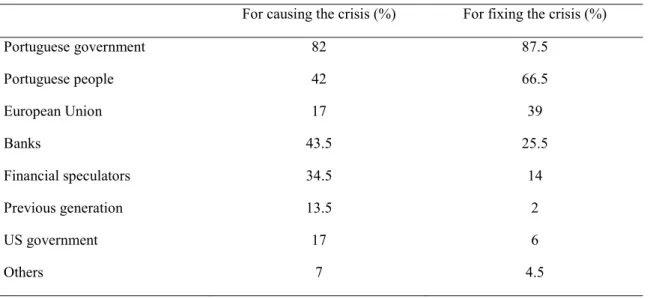
The remaining questions focused on various aspects of the economic crisis itself, particularly with respect to its anticipated impact on transition. But first of all, the opportunity was taken to ask these young people who they felt was responsible for causing the crisis and improving the situation, respectively.
Table 5 Responsibility for the economic crisis in Portugal
For causing the crisis (%) For fixing the crisis (%)
Portuguese government 82 87.5 Portuguese people 42 66.5 European Union 17 39 Banks 43.5 25.5 Financial speculators 34.5 14 Previous generation 13.5 2 US government 17 6 Others 7 4.5
Even bearing in mind that the respondents had the freedom to nominate as many ‘guilty parties’ as they saw fit, we can see that the Portuguese government are the clear ‘winners’ in both categories, although slightly more respondents (87.5%) thought that the
15
government had the responsibility for fixing the crisis than for causing it (82%); likewise, in the case of the Portuguese people, the same pattern of results emerges, to an even greater extent. The reverse trend is noticeable elsewhere, with regard not only to banks and financial speculators, but also the previous generation, meaning the parental generation of these respondents: 13.5% thought they were a cause but only 2% felt that the responsibility of contributing to improving the situation belonged to them. It should also be added that with respect to the responses to another question, 78% of all respondents felt that they were going to be worse off in comparison to this previous generation. Meanwhile, with regard to how long they expected the crisis to last, the average duration was 7.5 years. Responses ranged from one year to 100, with five years as the median response.
Conclusion: Family, Precarity and the Future
The recession of the late 1970s and early 1980s has been noted as a turning point in the shift from Fordist to post-Fordist economic regime, and from manufacturing to services, with the consequent transformations in the direction and duration of youth transitions (Furlong and Cartmel, 1997: 110). It remains to be seen what impact the present economic crisis will have upon young people’s attempts to reach adulthood. Certainly, we can see that the austerity cuts that we are witnessing across Europe are aimed, often explicitly and deliberately, at heightening precarity among the youth population. Are we then witnessing a shift of equal or greater magnitude, or merely a blip from which economies will soon recover? Should the former position represent the actuality of what is happen, then in respect to understanding education to work transitions, existing Youth Studies’ theories have a problem: with such transitions already typified as being precarious, how are they to be conceptualised after undergoing a more fundamental period of dissolution?
Returning to the housing transition theme, we can see that, in the Portuguese context, it is the family that is the main mediator, with outward movement tightly regulated. It would be somewhat crude to typify the domestic environments of these young people as a gilded cage, but the lack of a real compulsion to leave is evident, as is their somewhat simplistic imagining of the housing market.
16
Acknowledgements
The author would like to thank his colleague Dr Joana Azevedo for her invaluable assistance during the fieldwork and also Dr Graça Cordeiro and Dr Rita Cachado for their help with the pilot and questionnaire design stages, respectively.
References
Aassve, A., Billari, F. C., Mazzuco, S. and Ongaro, F. (2002) ‘Leaving Home: A Comparative Analysis of ECHP data’, Journal of European Social Policy, 12, 259-275.
Abrantes, P. (2003) ‘Identidades juvenis e dinâmicas de escolaridade’, Sociologia: Problemas e Práticas 41: 93-115.
Bendit, R., Gaiser, W. and Marbach, J. (1999) Youth and Housing in Germany and the European Union. Data Trends on Housing: Biographical, Social and Political Aspects. Opladen: Leske & Budrich.
Biggart, A. (2005) Families and Transitions in Europe: Final Report. University of Ulster: Coleraine.
Billari, F. C. and Liefbroer, A. C. (2007) ‘Should I Stay or Should I Go? The Impact of Age Norms on Leaving Home’, Demography 44: 181-198.
Billari, F. C., Philipov, D. and Baizán, P. (2001) ‘Leaving Home in Europe: The Experience of Cohorts born around 1960’, International Journal of Population Geography 7: 339-356. Billari, F. C., Rosina, A., Ranaldi, R., and Romano, M.C. (2008) ‘Young Adults Living Apart and Together (LAT) with Parents: A Three-Level Analysis of the Italian Case’, Regional Studies 42(5): 625-639.
Cairns, D. (2008) ‘Moving in Transition: An Exploration of Northern Ireland Youth and Geographical Mobility’, Young 16(3): 227-249.
Cairns, D. (2009) ‘“The Wrong Portuguese?” Youth and Geographical Mobility Intentions in Portugal’, in H. Fassman, M. Haller and D. Lane (eds) Migration and Mobility in Europe: Trends, Patterns and Control. Aldershot: Edward Elgar.
Cairns, D. (2010) ‘Pulled-in or Pushed Out? The Economic Crisis and Youth Migration in Belfast’, conference paper presented at European Sociological Association Youth and Generation Network Midterm Conference, Youth Economy and Society, September 2010, Disley, England.
17
Cairns, D. and Smyth, J. (2010) ‘Youth on the Move? Student Mobility and Immobility in Portugal and Northern Ireland’ in D. Cairns (ed.) Youth on the Move? European Youth and Geographical Mobility, Wiesbaden: VS-Verlag.
Cairns, D. and Growiec, K. (2011) ‘Learning Insularity: Social Learning, Social Capital and Staying at Home among European Youth’, in Z. Beckerman and T. Geisen (eds) Migration, Minorities, and Learning – Understanding Cultural and Social Differences in Education. New York: Springer.
Cairns, D. (forthcoming) ‘I wouldn’t want to stay here: Economic Crisis and Youth Mobility in Ireland’, International Migration.
Cavalli, A. and Galland, O. (eds) (1995) Youth in Europe. Social Change in Western Europe. London: Pinter.
Cherlin, A. J., Scabini, E. and Rossi, G. (1997) ‘Still in the Nest: Delayed Home Leaving in Europe and the United States’, Journal of Family Issues 18: 572-575.
Christie, H., Munro, M. and Rettig, H. (2002) ‘Accommodating Students’, Journal of Youth Studies 5: 209-235.
Coles, B. (1995) Youth and Social Policy, London: University College London.
Ernst and Young (2010) Ernst and Young Eurozone Forecast. Autumn Edition,
http://www.ey.com/Publication/vwLUAssets/Eurozone_-_Autumn-2010/$FILE/1008EDA229_eurozone_forecast_autumn2010_global_v04.pdf
Figueiredo, A., Silva, C. and Ferreira, V. (1999) Jovens em Portugal: Análise Longitudinal de Fontes Estatísticas. Oeiras: Celta Editora.
Ford, J., Rugg, J. and Burrows, R. (2002) ‘Conceptualising the Contemporary Role of Housing in the Transition to Adult Life in England’, Urban Studies, 39: 2455-2467.
Furlong, A. and Cartmel, F. (1997) Young People and Social Change: Individualisation and Risk in Late Modernity. Buckingham: Open University Press.
Gallie, D. and Paugam, S. (eds) (2000) Welfare Regimes and the Experience of Unemployment in Europe. Oxford: Oxford University Press.
Holdsworth, C. and Morgan, D. H. J. (2005) Transitions in Context: Leaving Home, Independence and Adulthood. Maidenhead: Open University Press.
Holdsworth, C. (2006) ‘Don’t you think you’re missing out, living at home? Student Experiences and Residential Transitions’, The Sociological Review 54: 495-519.
Instituto Nacional de Estatística (2010) Unemployment rate November 2010. http://www.ine.pt/xportal/xmain?xpid=INE&xpgid=ine_destaques&DESTAQUESdest_boui= 104784378&DESTAQUESmodo=2
18
Lahelma, E. and Gordon, T. (2008) ‘Resources and (In(ter))dependence: Young People’s Reflections on Parents’, Young 16(2): 209-226.
Leccardi, C. (2005) ‘Facing Uncertainty. Temporality and Biographies in the New Century’, Young 13(2): 123-146.
Mauritti, R. and Martins, S. da Cruz (2009) ‘Higher Education Students: Contexts and Social Origins’, in A. Firmino da Costa, F. L. Machado and P. Ávila, Knowledge and Society: Portugal in the European Context, Vol. III, pp. 81-97. Oeiras: Celta.
Merino, R. and Garcia, M. (2006) “Emancipation Enlargement and the Acquisition of Autonomy by Young People in Catalonia”, Young 14(1): 33-47.
Molgat, M. (2002) ‘Leaving Home in Quebec: Theoretical and Social Implications of (Im)mobility among Youth’, Journal of Youth Studies 5(2): 135-152.
Naldini, M. (2003) The Family in the Mediterranean Welfare States. London: Frank Cass. OECD (2010) OECD Economic Surveys: Portugal.
http://www.oecd.org/dataoecd/34/20/46062172.pdf
Pappámikail, L. (2004) ‘Relações Intergeracionais, Apoio Familiar e Transições Juvenis para a Vida Adulta em Portugal’, Sociologia: Problemas e Práticas 46: 91-116.
Pais, J. M. (2001) Ganchos, Tachos e Biscates. Lisbon: Editora Âmbar.
Pais, J. M. (2003) ‘The Multiple Faces of the Future in the Labyrinth of Life’, Journal of Youth Studies 6(2): 115-126.
Pais, J. M., Cairns, D. and Pappámikail, L. (2005) ‘Jovens Europeus: Retrato da Diversidade’, Tempo Social 17(2): 109-140.
Roberts, K., Clark, S. C. and Wallace, C. (1994) ‘Flexibility and Individualisation. A Comparison of Transitions into Employment in England and Germany’, Sociology 28: 31-54. Roberts, K. (2009) Youth in Transitions: Eastern Europe and the West. Houndmills: Palgrave Macmillan.
Santoro, M. (2006) ‘Living with Parents. A Research Study on Italian Young People and their Mothers’, in C. Leccardi and E. Ruspini (eds) A New Youth? Young People, Generations and Family Life, pp. 146-163. Ashgate: Aldershot.
Schoon, I., McCulloch, A., Joshi, H., Wiggings, R. D. and Bynner, J. (2001) ‘Transitions from School to Work in a Changing Social Context’, Young 9(1): 4–22.
Sgritta, G. (2001) Family and Welfare Systems in the Transition to Adulthood: An Emblematic Case Study. Working Papers of the Institute for Social and Economic Research, paper 2001-18. Colchester: University of Essex.
19
Sweeting, H., West, P. and Richards, M. (1998) ‘Teenage Family Life, Lifestyles and Life Chances: Associations with Family Structure, Conflict with Parents and Joint Family Activity’, International Journal of Law, Policy and the Family, 12: 15-46.
Ule, M. and Kuhar, M. (2008) ‘Orientations of Young Adults in Slovenia toward the Family Formation’, Young 16(2): 153-183.
Wall, K., Vasconcelos, P., Aboim, S. and Cunha, V. (2001) ‘Families and Informal Support Networks in Portugal: the Reproduction of Inequality’, Journal of European Social Policy 11(2): 213-233.