Universidade de Lisboa
Faculdade de Medicina de Lisboa
Authenticity Recognition in Laughter and
Crying: An ERP Study
Mónica Gonçalves Barbeito Costa
Orientador: Prof. Doutora Diana Maria Pinto Prata
Co-orientador: Prof. Doutora Ana Patrícia Teixeira Pinheiro
Dissertação especialmente elaborada para obtenção do grau de
Mestre em Neurociências
2
2018
Universidade de Lisboa
Faculdade de Medicina de Lisboa
Authenticity Recognition in Laughter and
Crying: An ERP Study
Mónica Gonçalves Barbeito Costa
Orientador: Prof. Doutora Diana Maria Pinto Prata
Co-orientador: Prof. Doutora Ana Patrícia Teixeira Pinheiro
Dissertação especialmente elaborada para obtenção do grau de
Mestre em Neurociências
3
A impressão desta dissertação foi aprovada pelo Conselho Científico da
Faculdade de Medicina de Lisboa em reunião de 18 de setembro de 2018.
4
INDEX
ABSTRACT ... 6
RESUMO ... 8
INTRODUCTION ... 11
1. Non-linguistic affective vocalizations ... 12
2. ERP Technique ... 14
3. Multi-stage approach to auditory affective processing ... 15
4. Authenticity ... 19
AIMS OF THE STUDY ... 26
METHODS ... 27
1. Participants ... 27
2. Auditory Stimuli ... 29
3. Task ... 32
4. EEG Data Acquisition and Processing ... 33
5. Procedure ... 35
6. Statistical Analyses ... 35
6.1 Behavioural Statistical Analyses ... 35
6.2 EEG Statistical Analyses ... 36
6.3 Correlations ... 37
RESULTS ... 38
1. Behavioural Results ... 38
1.1 Mean Reaction Time ... 38
1.2 Authenticity Ratings ... 39
1.3 Arousal Ratings ... 40
5
2. EEG Results ... 44
2.1 Spontaneous emotional vs. neutral vocalizations ... 46
2.2 Voluntary emotional vs. neutral vocalizations ... 52
2.3 Spontaneous vs. voluntary emotional vocalizations... 57
3. Correlations ... 60
DISCUSSION ... 64
1. The effects of emotion in voice processing... 64
2. The effects of authenticity in voice processing ... 66
3. Relationship between ERPs and behavioural data ... 69
4. Limitations ... 71
CONCLUSIONS ... 72
ACKNOWLEDGMENTS ... 73
6
ABSTRACT
Our ability to detect authenticity in the human affective voice, whether an emotion was evoked spontaneously (reactive, genuine) or voluntarily (deliberate, controlled), is crucial in our everyday social interactions as emotions may carry different meanings and elicit different social responses. Taking laughter as an example, while a spontaneous laughter is stimulus-driven and signals positive affect, voluntary laughter deliberately signals polite agreement or affiliation without necessarily being associated with an emotional experience. Recent functional magnetic resonance (fMRI) studies have shown brain differences between these voluntary and spontaneous laughter vocalizations. While both spontaneous and voluntary laughs engage the auditory cortex, voluntary laughter requires additional involvement of brain areas typically involved in mentalizing, possibly involved in the decoding of the intentional state behind these vocal expressions. However, how authenticity affects the temporal course of voice processing is still unclear. Previous imaging studies have shed light on the areas putatively involved in the processing of authenticity in vocal emotions. Nevertheless, fMRI lacks temporal resolution and is unable to provide information about the exact time-window on which differences in the processing between spontaneous and voluntary vocalizations in the brain may occur.
In the current study we used the event-related brain potentials (ERPs) methodology to shed light on how authenticity modulates the temporal course of vocal information processing in the brain. In particular, we investigated differences between spontaneous and voluntary non-linguistic affective vocalizations (crying and laughter) in both amplitude and latency of ERP components associated with early (N100, P200) and late stages (late positivity potential – LPP) of voice processing. We also aimed to replicate previous findings suggesting amplitude and latency differences as a function of emotionality in these three ERP components. In addition, we explored the extent to which sex differences may exist in both authenticity and emotionality modulation of these potentials. Twenty-three right-handed healthy participants (13 female) listened to spontaneous and voluntary non-linguistic affective vocalizations (happy, sad and neutral) while they rated the authenticity conveyed by the speaker, as the electroencephalogram (EEG) was recorded.
No differences in terms of amplitude or latency were found between spontaneous and voluntary vocalizations in the N100, P200 and LPP components. Emotionality effects
7 were found at an early processing stage (N100) with happy and sad vocalizations eliciting more negative amplitude than neutral vocalizations. Happy vocalizations elicited an enhanced P200 when compared with neutral vocalizations. At later processing stages (500 – 700 ms), happy and sad vocalizations elicited a stronger late positivity (LPP) than neutral vocalizations. No differences between emotional and neutral vocalizations were detected in the latency of these components. Lastly, no sex differences were found in the amplitude or latency of N100, P200 and LPP for emotionality or authenticity effects.
Although exploratory with a small sample size and deserving further replication, all together, our results possibly suggest authenticity as unlikely to be decoded during the first 700 ms after vocalization onset. The emotional salience of the voice, on the other hand, seems to be extracted as early as 100 ms after onset. While emotional content seems to be rapidly decoded from vocal cues, authenticity may involve further elaborated processing occurring at very late stages of processing.
Key-words: Voice processing; Authenticity; Emotion; Non-linguistic vocalizations; Event-related potentials (ERP).
8
RESUMO
A voz humana comunica não só informação verbal, como também informação acerca da identidade e estado emocional do locutor (e.g., medo, raiva, nojo, tristeza, felicidade, surpresa) através de modulações nas propriedades acústicas (frequência, intensidade, ritmo). A autenticidade de uma expressão emocional é uma propriedade também extraída quando escutamos uma voz. Através do perfil acústico da vocalização e do seu contexto somos capazes de detetar se uma emoção foi evocada espontaneamente (ato reativo, genuíno) ou voluntariamente (ato deliberado, controlado). A capacidade de detetar a autenticidade de expressões emocionais na voz humana é crucial nas nossas interações sociais no dia-a-dia, já que estes dois tipos de expressões transmitem diferentes significados e provocam diferentes respostas sociais. Usando como exemplo a gargalhada, enquanto a gargalhada evocada espontaneamente é o resultado de um evento externo assinalando afeto positivo, a gargalhada evocada voluntariamente é deliberada indicando cortesia ou afiliação, sem necessariamente estar associada a uma experiência emocional. Estudos recentes com ressonância magnética funcional mostraram diferenças no cérebro entre gargalhadas evocadas espontaneamente e voluntariamente. Enquanto tanto a gargalhada espontânea como a gargalhada voluntária ativam áreas do córtex auditivo, a gargalhada voluntária ativa adicionalmente áreas típicas da mentalização, possivelmente envolvendo a interpretação da intenção da expressão vocal. Contudo, permanece por explorar como a autenticidade afeta o curso temporal do processamento de voz. Um modelo de múltiplos estágios de processamento da informação vocal foi proposto por Schirmer & Kotz (2006) com base em estudos com potenciais evocados e de ressonância magnética funcional. Este modelo sugere um processamento da informação vocal em três diferentes estágios: análise das propriedades acústicas (indexado pelo componente N100, ocorrendo cerca de 100 ms após o inicio da vocalização), extração da saliência emocional (indexado pelo componente P200, ocorrendo cerca de 200 ms após o inicio da vocalização) e por último, avaliação cognitiva da expressão vocal (indexado pelo late positivity potential – LPP, ocorre entre 500 e 700 ms após o inicio da vocalização). Diferenças no processamento da informação vocal entre estímulos emocionais e neutros, têm sido amplamente reportadas nestes três estágios de processamento. No entanto, os estudos previamente mencionados utilizaram estímulos que foram desenvolvidos instruindo atores a imitar emoções (expressões de emoção voluntária) e não expressões de emoção espontâneas. Permanece por esclarecer até que
9 ponto estes resultados reportados poderão ser explicados por diferenças na autenticidade da emoção. Estudos de neuroimagem prévios mostraram com elevada resolução espacial quais as áreas no cérebro putativamente envolvidas no processamento de autenticidade no processamento vocal afetivo. Não obstante, a técnica de imagem ressonância magnética funcional carece de resolução temporal, não permitindo extrair informação relativamente à janela temporal exata durante a qual estas diferenças no processamento cognitivo entre vocalizações espontâneas e voluntárias poderão ocorrer no cérebro.
No presente estudo utilizámos uma abordagem com potenciais evocados para esclarecer como a autenticidade modula o curso temporal do processamento de informação vocal afetiva no cérebro. Em particular, tivemos por objetivo investigar as diferenças entre vocalizações não-verbais espontâneas e voluntárias (gargalhada e choro) em termos da amplitude e latência dos componentes eletrofisiológicos associados a estágios iniciais (N100, P200) e a estágios mais tardios (LPP). Procurámos também replicar resultados prévios que sugerem diferenças em termos da amplitude e latência em função da emocionalidade da vocalização (emocional vs. neutro) no componente N100, P200 e LPP. Adicionalmente, como hipótese exploratória investigámos até que ponto diferenças de sexo podem existir tanto na autenticidade como na emocionalidade na modulação destes potenciais evocados. Vinte e três participantes destros saudáveis (13 mulheres) ouviram vocalizações não-verbais espontâneas e voluntárias (expressando alegria, tristeza ou tom neutro), enquanto classificavam a autenticidade expressada pelo locutor, enquanto era registado um eletroencefalograma (EEG) em simultâneo.
Em termos dos efeitos da autenticidade no processamento de informação vocal, não foram encontradas diferenças relativamente à amplitude e latência entre vocalizações espontâneas e voluntárias nos componentes N100, P200 e LPP. Efeitos de emocionalidade foram encontrados em estágios iniciais do processamento vocal (N100), com vocalizações de alegria e tristeza mostrando deflexões menos negativas quando comparadas com vocalizações neutras. Vocalizações de alegria evocaram um P200 de maior magnitude do que vocalizações neutras, não existindo diferenças significativas entre vocalizações de alegria e tristeza ou entre vocalizações de tristeza e neutras. Em estágios mais tardios do processamento (500 – 700 ms), vocalizações de alegria e tristeza evocaram uma positividade tardia (LPP) mais pronunciada do que vocalizações neutras. Os efeitos de emocionalidade reportados nos potenciais N100, P200 e LPP verificaram-se de igual modo em vocalizações espontâneas e vocalizações voluntárias. Não foram encontradas diferenças de latência entre vocalizações emocionais e neutras em nenhum
10 estágio de processamento vocal (N100, P200 e LPP). Por último, relativamente a diferenças de sexo no processamento da autenticidade e emocionalidade na informação vocal, não foram encontradas diferenças nestes três componentes entre homens e mulheres.
Ainda que exploratório e com necessidade de futuras replicações, os nossos resultados sugerem que a autenticidade possivelmente não será descodificada durante os primeiros 700 ms após o início da vocalização. A emocionalidade por outro lado, parece ser extraída cedo no processamento vocal, nos primeiros 100 ms (N100) após o início da vocalização irrespectivamente da valência (positiva e negativa), sendo que tanto vocalizações de alegria como de tristeza evocaram uma menor amplitude no componente N100 do que vocalizações neutras. A emocionalidade da vocalização parece deste modo ser detetada em estágios iniciais (N100), irrespectivamente da valência do estímulo. Porém no estágio seguinte, verificou-se que apenas vocalizações de alegria evocaram um P200 de maior amplitude, relativamente a vocalizações neutras. Este resultado poderá dever-se à elevada sensibilidade do componente P200 à ativação fisiológica inerente ao estímulo vocal, isto é, estímulos caracterizados por uma maior ativação fisiológica (e.g., gargalhada) são percebidos como emocionalmente mais salientes. Em estágios mais tardios do processamento verificou-se uma maior positividade do componente LPP em vocalizações emocionais (alegria e tristeza) comparativamente a vocalizações neutras. As vocalizações emocionais, independentemente da sua valência (positiva ou negativa), parecem assim promover uma elaboração cognitiva mais profunda.
Em suma, de acordo com os resultados obtidos neste estudo preliminar enquanto o conteúdo emocional parece ser rapidamente processado em pistas vocais, a autenticidade possivelmente envolve um processamento mais elaborativo que ocorre em estádios mais tardios do processamento.
Palavras-chave: Processamento de voz; Autenticidade; Emoção; Vocalizações não-verbais; Potenciais evocados.
11
INTRODUCTION
The human voice communicates not only verbal information, but also information about a speaker’s identity and emotional state (e.g., fear, anger, disgust, sadness, happiness, surprise) through the modulation of acoustic features such as pitch, loudness and tempo (Belin, Zatorre, Lafaille, Ahad & Pike, 2000; Karpf, 2006). Voice-selective regions can be found in the human auditory cortex, which are located bilaterally in the superior temporal sulcus (STS), when listening to human vocal sounds (speech or non-speech) compared to other sound categories (Belin et al, 2000). Three functionally distinct neural pathways of voice processing have been described: speech, identity and affect (Belin, Bestelmeyer, Latinus & Watson, 2011). Different brain areas are recruited by these voice processing pathways: speech – temporal areas (anterior and posterior STS) and inferior prefrontal regions (left hemisphere); emotion – temporo-medial regions (anterior insula and amygdala) and inferior prefrontal regions (mainly right hemisphere); and lastly, vocal identity – regions of the right temporal sulcus (Belin, Fecteau & Bédard, 2004, Belin et al, 2011).
In particular, emotional cues may be conveyed through emotional speech prosody as well as through non-linguistic affective vocalizations (Hawk, van Kleef, Fischer, van der Schalk, 2009). Emotional prosody refers to suprasegmental modulations of speech to convey emotion (speech melody). On the other hand, non-linguistic affective vocalizations represent more primitive forms of vocal expressions unconstrained by linguistic structure (e.g., laughter, sobs, screams) (Pell, Rothermich, Liu, Paulmann, Sethi & Rigoulot, 2015; Sauter, Eisner, Calder & Scott, 2010a).
12
1.
Non-linguistic affective vocalizations
Emotion is expressed via multiple sensory channels, including the visual and auditory channels. The visual and auditory channels have been shown to convey emotional meaning on their own, transmitting enough information to allow emotion recognition without a need for complementary action from other channels (Hawk et al, 2009). A vast research has been conducted in the visual modality, showing for example that our ability to recognize ‘basic’ emotions (fear, anger, disgust, sadness, happiness and surprise) from facial expressions alone is generally accurate (Ekman, 1982; Ekman, Friesen & Hager, 2002; Calvo & Nummenmaa, 2016). Compared to research in visual emotional processing, research probing emotional processing in the auditory modality has been scarce (Hawk et al, 2009). Communication through vocal cues portrays several advantages over visual cues, as emotions may be communicated over long distance, directing our attention to relevant cues in our environment (Hawk et al, 2009).
Non-linguistic affective vocalizations (i.e., more primitive forms of vocal expressions unconstrained by linguistic structure) can be categorized according to different criteria: category (emotion valence – happiness, sadness, anger, fear, surprise, disgust) (Schröder, 2003), valence and arousal (Sauter et al, 2010a), authenticity (i.e. whether an expression is evoked spontaneously or voluntarily) (McGettigan et al, 2015) or affiliative value (emotional contagion, i.e., how much we resonate with others’ emotions) (Neves et al, 2018).
Scherer (1994) was the first author to introduce the concept of ‘affect bursts’, describing them as ‘‘very brief, discrete, nonverbal expressions of affect in both face and
voice as triggered by clearly identifiable events’’ (p. 170). The concept was later updated
by Schröder (2003) who described ‘affect bursts’ as emotional non-speech expressions that range in a continuum, ranging from clear non-speech vocalizations (raw affect bursts) (e.g., laughter) to interjections with a phonemic structure (e.g., ‘‘Wow!’’) (Scherer, 2003; Schröder, 2003). ‘Affect bursts’ may include expressions of happiness (laughter), anger (growling), fear (screams), sadness (sobbing), disgust and surprise (Hawk et al, 2009; Sauter et al, 2010a). Whereas speech production relies on fast, precise, coordinated actions of supra-laryngeal articulators, movement of the larynx and sub-glottal pressure (Murray & Arnot, 1993), non-linguistic vocalizations do not require these precise supra-laryngeal movements or articulations, being produced by roughly positioning pharyngeal/oral/labial constrictions (Sauter et al, 2010a). In this line, laughter has been
13 defined as modified breathing (Provine, 2004), while crying comprises erratic inhalation accompanied sometimes by tears in adults (Vingerhoets & Bylsma, 2015).
In this work, we will focus on non-linguistic affective vocalizations, as they convey emotional meaning without the confound of concurrent semantic content or the need of a situational context (Schröder, 2003). Thus, non-linguistic vocalizations are advantageous when studying the impact of vocal cues characteristics on voice processing, such as authenticity (i.e., whether an emotion is produced spontaneously or voluntarily), as they lack potential semantic confounds which are encountered with speech prosody avoiding possible interactions between affective and semantic content (Schröder, 2003; Pell et al, 2015).
Behavioural evidence indicates that accuracy in the recognition of vocal emotions varies according to the type of vocal stimulus presented (emotional prosody – words/sentences, pseudo-words/sentences; non-linguistic affect vocalizations) (Castro & Lima, 2010; Hawk et al, 2009; Vasconcelos, Dias, Soares & Pinheiro, 2017). Concerning emotional prosody, sentences and pseudo-sentences (speech with intelligible semantic content) have similar accuracy rates (75% for sentences and 71% for pseudo-sentences) (Castro & Lima, 2010). The accuracy rates for non-linguistic affective vocalizations are higher, with a mean recognition rate of 81%, without a need of situational context (Schröder, 2003; Schreder, 2003). Hawk and colleagues (2003) further confirmed this result by comparing accuracy rates between facial, speech and non-linguistic affective expressions. Higher scores were obtained both for facial and non-linguistic affective expressions than for speech. Furthermore, non-linguistic affect vocalizations recognition is efficient even when the cognitive system is loaded with another task (Lima, Anikin, Monteiro, Scott & Castro, accepted). Similar to facial expressions, non-linguistic affective vocalizations are recognized across different cultures (Sauter, Eisner, Ekman & Scott, 2010b) due to the nonverbal evolutionary nature of the sounds (Lima, Castro & Scott, 2013). Nonetheless, an in-group effect is found with accuracy rates being higher for vocalizations produced by members of one’s own culture than for other cultures (Sauter et al, 2010b). In a recent study, Vasconcelos et al (2017) have found happy non-linguistic vocalizations (laughter) are easier to recognize (higher accuracy) when compared with other vocal emotions categories (anger, disgust, fear, sadness, pain, surprise and pleasure). Higher accuracy in the recognition happy vocalizations may be explained by the critical role laughter plays in our daily social interactions and communication, signalling affiliation or appeasement (Scott et al, 2015). Neuroimaging
14 evidence shows voice-selective cortical regions in the human brain which respond exclusively to the human voice when compared with other sounds, such as the bilateral superior temporal sulcus (STS), not only for speech sounds but also for non-speech sounds (non-linguistic affective vocalizations) (Belin, Zatorre & Ahad, 2002; Charest et al, 2009). Moreover, evidence with near infra-red spectroscopy shows activation of voice-selective regions upon hearing emotional prosody in 7-month old infants who are still at an early stage of speech development but can already discriminate voices (Grossman, Oberecker, Koch, & Friederici, 2010). This finding further suggests these voice-selective areas are not exclusively related to speech, but also to non-verbal human displays of communication (Belin et al, 2011). Blasi and colleagues (2011) found evidence for an early specialization on processing non-verbal vocalizations and emotion in developing infants, reflected in greater activation in the anterior temporal cortex for non-linguistic vocalizations of happiness and sadness, than for non-voice environmental sounds.
Neurophysiological evidence suggests that the decoding of emotional meaning from human vocalizations in real time is species-specific and of great importance for social interactions (Pell et al, 2015; Schirmer & Kotz, 2006). Non-linguistic vocalizations have been reported to be processed faster than emotional prosody, possibly due to its primitive origins (e.g., detecting threats in the environment) (Pell et al, 2015). The event-related potentials (ERP) technique has a high temporal resolution in the order of milliseconds (ms), as opposed to fMRI which presents a temporal resolution in the order of seconds (s). Hence, it allows investigating the specific time-window in which a given cognitive process takes place and how it changes throughout time (Luck, 2005).
2.
ERP Technique
The ERP (event-related potential) technique offers a non-invasive method for studying information processing in the human brain in real time due to its high temporal resolution, aiding in determining which stage or stages of processing are influenced by a specific experimental manipulation. The advantage of ERP technique compared to behavioural measures is that it allows a continuous measure of processing between a stimulus and a response (Luck, 2005). ERPs are a series of voltage deflections in the electrical brain activity evoked by a specific event (sensory, cognitive or motor), these deflections can be recorded through an electroencephalogram (EEG) (Crowley & Colrain,
15 2004; Luck, 2005). An ERP waveform consists of neurophysiological data averaged through multiple trials and time-locked to the presentation of a specific cognitive or sensory event, giving rise to positive or negative peaks that reflect a discrete stage of the neural processing of this event (Crowley & Colrain, 2004; Luck, 2005; Picton, Lins, & Scherg, 1995). These components can be characterized by their amplitude (magnitude measured from the maximal peak of a given component), latency (time interval between stimulus onset and maximal peak of a given component), polarity (positive or negative), scalp distribution (anatomical site of generation) or function reflected by them (Luck, 2005). Depending on whether the stimulus is visual, auditory or motor, a series of early components reflective of initial information processing will be elicited, followed by later components associated with integrative and higher-order cognitive processing (Crowley & Colrain, 2004). ERPs allow to study the temporal dynamics of neural responses elicited by dynamic stimuli (e.g., vocalizations), being fitting to probe the multi-stage model of vocal information processing. As for the neural underpinnings of emotional vocal cues processing, a multistage model has been proposed by Schirmer and Kotz (2006), integrating fMRI and electroencephalography (EEG) evidence, establishing three stages of information processing.
3.
Multi-stage approach to auditory affective processing
A multi-stage model of vocal emotional processing has been proposed by Schirmer & Kotz (2006) establishing three different stages: 1) Sensory processing – the analysis of the acoustic properties of a vocal stimulus (extraction of pitch, loudness and tempo) that takes place bilaterally in the STS (superior temporal sulcus); 2) Integration – general detection of salience from acoustic cues that takes place in the bilateral superior temporal gyrus (STG) and STS; 3) Cognition – cognitive evaluation of the emotional significance of the voice that occurs in the inferior frontal gyrus (IFG) and orbitofrontal cortex (Schirmer & Kotz, 2006). Importantly, these stages have been also indexed by distinct event-related potential (ERP) signatures reflected: N100, P200 and Late Positivity Potential (LPP). The multi-stage model of vocal emotional processing was later updated by Frühholz, Trost and Kotz (2016) based on fMRI evidence, advocating for a unifying neural network that underlies the processing of all types of affective sounds, which included areas that were not previously considered integrative for emotion
16 decoding (cerebellum, basal ganglia and insula). Moreover, a bilateral engagement of the inferior frontal cortex when listening to emotional cues in the human voice has been described when higher-order cognitive processes are taking place (evaluating an emotional vocalization) (Frühholz & Grandjean, 2013). According to the multi-stage model of vocal emotional processing proposed by Schirmer and Kotz (2006), the amplitude of the N100, P200 and LPP components is modulated by the acoustical properties, salience and cognitive appraisal of the vocal stimulus, respectively.
N100
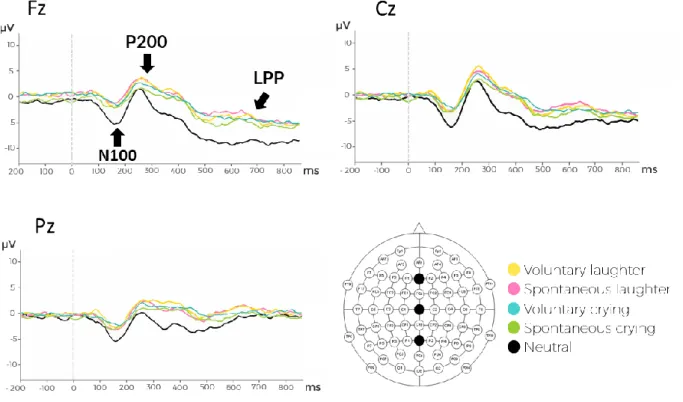
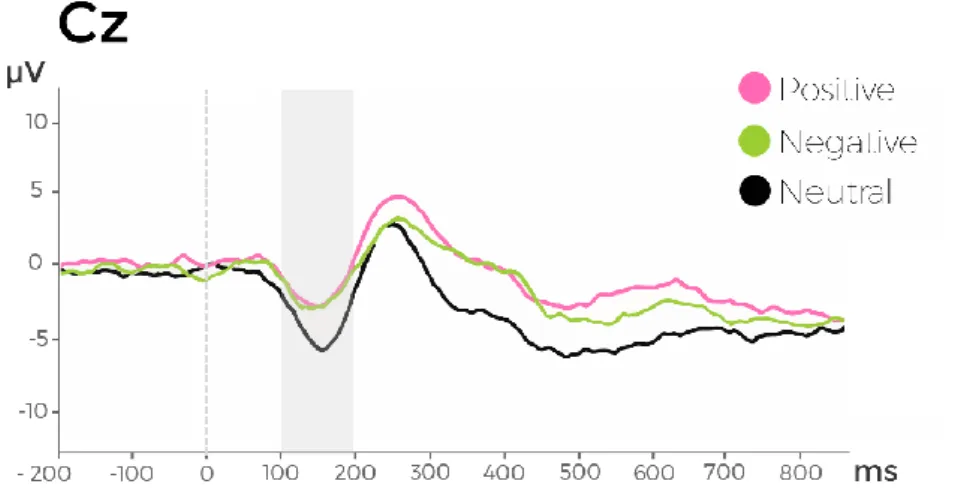
The N100 is a negative ERP elicited during the sensory processing stage, generated in the bilateral secondary auditory cortex (peaking approximately at 100 ms after stimulus onset) (Rosburg, Boutros & Ford, 2008). A differentiation between human sounds (i.e., human produced vocalizations) and non-human sounds (i.e., environmental sounds) is already established at this early stage (Murray, Camen, Gonzalez-Andino, Bovet & Clark, 2006; Charest et al, 2009). Most neurophysiological studies suggest no response to the emotional quality of stimuli at this early stage (Garrido-Vázquez et al, 2013; Paulmann & Kotz, 2008; Paulmann et al., 2010; Schirmer et al., 2013). However, some exceptions indicate an early differentiation between emotional and neutral stimuli reflected in the N100, both in non-linguistic vocalizations (Liu et al, 2012; Pell et al, 2015; Wang, Pan, Liu & Chen, 2015) and emotional prosody (Iredale et al, 2013; Pinheiro et al, 2012). Liu and colleagues (2012) reported a more negative amplitude for neutral vocalizations (“mmhm”) compared to happy (laughter) and angry (“humph”) vocalizations. An early ERP component, the P50 (occurring around 50 ms after stimulus onset), was also elicited by angry vocalizations in this study, indicating increased automatic attention to acoustic cues signalling threat and danger (Liu et al, 2012). Pre-attentive processing (i.e., processing without conscious awareness) differences between emotional and neutral vocalizations were not only shown in terms of amplitude, but also latency, as emotional vocalizations were associated with reduced latency compared to neutral vocalizations, which may indicate they are processed faster (Liu et al, 2012; Pinheiro et al, 2012). Likewise, in emotional prosody studies reduced latency of the N100 was also reported for emotional compared to neutral words and sentences (Iredale et al, 2013; Pinheiro et al, 2012). The processing differences due to the emotional quality of the stimuli in the N100 mentioned above might be accounted for by variations in acoustic
17 parameters (e.g., mean fundamental frequency/ pitch) of the experiment stimuli, as a majority of these studies did not control for this parameter.
A valence-tagging process (pleasant – positive or unpleasant – negative) has been established to take place only at a secondary stage of auditory information processing (P200) (Paulmann, Bleichner & Kotz, 2013). Nevertheless, two studies have reported amplitude differences with non-linguistic affective vocalizations, with happy and angry vocalizations presenting a decreased N100 amplitude when compared to sad and fearful vocalizations, respectively (Pell et al, 2015; Jessen & Kotz, 2011). An initial tagging of emotional relevant cues may be already occurring at this early stage, directing our attention to motivationally salient cues in our environment for the next processing stage of information integration, the P200 (Liu et al, 2012).
P200
The P200 is a positive ERP elicited during the integration stage and it is generated in the auditory cortex in the temporal region (peaking approximately at 200 ms after stimulus onset) (Paulmann, Pell & Kotz, 2008; Schirmer & Kotz, 2006). The P200 is a primary emotional salience detector, aiding in the classificatory process of distinguishing between emotional and neutral vocalizations (Crowley & Colrain, 2004; Schirmer & Kotz, 2006). An enhanced frontocentral positivity distribution is reported for the P200 in affective non-linguistic vocalizations (fear, achievement and disgust) (Sauter & Eimer, 2010) and emotional prosody (Paulmann et al, 2013) when compared to neutral vocalizations and prosody. While some studies report an increased P200 for emotional vocalizations when compared to neutral (Iredale et al, 2013; Liu et al, 2012; Paulmann, Seifert & Kotz, 2010; Pinheiro et al, 2012; 2014; Schirmer et al, 2013), others present a decreased amplitude for emotional vocalizations (Garrido-Vázquez et al, 2013; Paulmann & Kotz, 2008). Nonetheless, emotional and neutral vocalizations are evidenced to be distinguished at this stage regardless of emotion valence (anger, fear, disgust, happiness, surprise and sadness), type of vocal expression (non-linguistic vocalization or speech) (Pell et al., 2015), task-relevance (Kotz & Paulmann, 2007; Paulmann et al, 2013) or acoustic properties of the stimulus (Schirmer et al, 2013).
Valence seems to have a modulatory role in the P200, but whether a valence-tagging process may be initiated at this stage is not consensual across the literature. Some studies argue that the P200 is not sensitive to stimulus valence, with no distinction between a wide range of vocal emotions in emotional prosody (Paulmann & Kotz, 2008;
18 Paulman et al, 2010; Pinheiro et al, 2014; Iredale et al, 2013) or in non-linguistic affective vocalizations (Sauter & Eimer, 2010). Conversely, increased amplitude has been found for happy in comparison to angry prosody (Pinheiro et al, 2012) and between the six basic emotions (anger, fear, disgust, happiness, pleasant surprise and sadness) (Paulmann et al, 2013), pointing to a valence-tagging process that is indexed by the P200. Increased (i.e., more positive) P200 amplitudes were reported for anger, happiness and pleasant surprise, followed by disgust, sadness and fear, more specifically in frontal and central regions (Paulmann et al, 2013). Peak latencies have also been found to differ depending on emotion valence, with earlier peaks for happiness (laughter), followed by anger (growls) and sadness (sobs) only in non-linguistic vocalizations (Pell et al, 2015). In what concerns arousal, the P200 component seems to be partially responsive to arousal features of vocal expressions, with more arousing stimuli eliciting a more positive amplitude, irrespective of their valence (Sauter & Eimer, 2010; trends in Paulmann et al, 2013). Emotions such as anger and happiness are considered more arousing than sadness based on behavioural results, as such an enhanced sensitivity to arousal features can be observed. This subtle categorization in valence and arousal possibly predicts differences in stimulus appraisal in the following component, the Late Positivity Potential (LPP).
LPP
The LPP is a positive ERP component elicited during the higher-order cognitive evaluation stage (450–700 ms after stimulus onset), and its maximal over centroparietal electrodes (Pell et al, 2015). This late component indexes a more elaborate stage of emotional processing of affective input (i.e., evaluation of the emotional significance of a stimulus) (Kotz & Paulmann, 2012). The LPP has been widely described in visual neurophysiological studies, with greater amplitude when individuals attend to emotional compared to neutral pictures (Dennis & Hajcak, 2009; Brown et al, 2012). Similar findings have been found with auditory stimuli, with LPP being strongly modulated by the emotional category of a vocal stimulus with significant differences being described between the six basic emotions (happiness > pleasant > surprise > anger > fear > sadness > disgust) (Paulmann et al., 2013).
The LPP amplitude is increased for emotional expressions high in arousal compared to expressions low in arousal (Paulmann et al., 2013). A modulatory effect of valence is observed in this component, with a more positive sustained wave for non-linguistic vocalizations which signal cues of threat (anger) than for non-threat cues
19 (happiness and sadness) (Paulmann et al, 2013; Pell et al, 2015). As growls (angry vocalizations) are representative of aggression and threat, the increased positivity may be the result of deeper processing for the promotion of an immediate adaptive response (Pell et al, 2015). Importantly, no interaction between valence and arousal has been reported (Paulmann et al, 2013). Cues signalling social pressure and control have also been found to lead to a preferential and more comprehensive processing, illustrated by a significantly more positive-going LPP waveform for controlling speech (i.e., order to act) than for autonomy-supportive speech (i.e., presents the choice to act) and neutral speech (Zougkou et al, 2015).
A recent study probing the processing of insults and how this processing can be modulated by the presence of a laughing crowd, found that the LPP was more positive when the insults and compliments were accompanied by a laughing crowd, compared to when they were presented without it. Even without laughter, verbal insults presented an increased LPP compared to compliments showing that insults elicit deeper emotional processing (Otten et al, 2017). This finding highlights the importance of the social context in which the communication is taking place. Not only insults elicited increase elaborative processing in the presence of a laughing crowd, but also compliments which were possibly perceived as a sarcastic comment (Otten et al, 2017).
The ERP studies aforementioned used sets of stimuli produced by actors posing emotions (voluntary expressions of emotion) instead of spontaneous expressions of the same emotions which may be more representative of real-life social interactions. It remains unclear to which extent may the previous results be explained by differences in emotion’s authenticity. Additionally, considering authenticity is present in our daily social interactions and that our ability to encode and decode voluntary expressions accurately presents an evolutionary advantage, it would be an important dimension of voice processing to explore in more detail.
4.
Authenticity
Discriminating whether an emotion was spontaneously or voluntarily expressed in everyday social interactions is an important and advantageous social skill in order to avoid deception (Gervais & Wilson, 2005; Lavan, Rankin, Lorking, Scott & McGettigan, 2017). Equally important is our ability to produce these same voluntary expressions in
20 our social interactions, for example for group affiliation (Lavan, Short, Wilding & McGettigan, 2018). The ability of humans to imitate the emotional expressions of others, even if their current emotional state is different, may constitute a social skill prompting affiliation and cooperation (e.g., politely agreeing with someone even though you do not share a similar view on a given subject) (Scott, Lavan, Chen & McGettigan, 2014).
In research, three approaches to the development of sets of emotional expressions can be described (Scherer & Bänziger, 2010). The most common approach is to request professional actors or amateurs to portray an emotion with a set of guidelines (voluntary portrayal of emotion). The second approach is to induce a genuine emotional state in participants through presentation of external triggers (e.g., presenting a funny video to induce laughter) or by requesting them to recall a personal memory (e.g. feelings of loss over a close person passing away to induce crying) (spontaneous portrayal of emotion). Lastly, a more ecologically valid approach includes recording spontaneous expressions of emotion through field observation (spontaneous portrayal of emotion) (Anikin & Lima, 2017; Scherer & Bänziger, 2010). This last approach is methodologically challenging as confounding factors can influence the recording, as well as time-consuming. However, the current state of social media (facebook, youtube, twitter) allows researchers to access audio and video of individuals thoroughly engaged in highly emotional activities, serving as a tool for future studies (Anikin & Lima, 2017). Authenticity as a modulating aspect of emotion recognition has garnered more attention recently, mainly with studies concerning laughter and discrimination of smiles authenticity (Lavan & McGettigan, 2016). Laughter is a non-verbal positive expression of emotion recognized across distinct cultures that has a critical role in promoting and maintaining social bonding (Scott et al, 2015). There are two main types of laughter: spontaneous laughter (stimulus-driven and genuine) and voluntary laughter (deliberate and associated with an intentional communicative act by signalling affiliation or polite agreement) (Bryant & Atkipis, 2014; Scott et al, 2015). Smiling is a positive non-verbal signal (facial expression) denoting enjoyment, also widely recognized across cultures and signalling affiliation (Ekman, 1982). Smiling can also be categorized regarding its authenticity: spontaneous (Duchenne smile) and voluntary (non-Duchenne smile) smiles (Gunnery & Ruben, 2013). While the spontaneous smile engages the corner of the eyes (contraction of the orbicularis oculi muscle) and lifts the corners of the mouth (zygomatic major muscle), signalling genuine enjoyment, the voluntary smile lacks engagement of eye muscle contractions, signalling politeness or masking negative emotions (Ekman, Friesen & Hager, 2002; Gunnery &
21 Ruben, 2013). Individuals can distinguish between spontaneous and voluntary smiles due to morphological differences in facial expressions (Krumhuber & Manstead, 2009) and in laughter based on acoustic differences (Bryant & Aktipis, 2014; Lavan, Scott, & McGettigan, 2016).
Studies with laughter indicate that listeners perceive spontaneous and voluntary laughter distinctively in terms of authenticity, arousal and valence (Lavan et al, 2016). This differentiation has been encountered more robustly with non-linguistic affective vocalizations, as in most studies with emotional prosody stimuli listeners do not accurately detect authenticity (Jürgens, Drolet, Pirow, Scheiner, & Fischer, 2013; Jürgens, Grass, Drolet, & Fischer, 2015; Scherer, 2013). Nonetheless, a study by Drolet, Schubotz, and Fischer (2012) reported accurate detection of authenticity in speech above chance levels (Anikin & Lima, 2017). As for authenticity detection in non-linguistic affect vocalizations, behavioural evidence indicates an accuracy of 61% (Bryan & Atkipis, 2014) and 72% (Lavan et al, 2015). The higher accuracy in Lavan and colleagues (2015) study may be related to the pre-selection of the stimuli in which the selection criteria optimized authenticity detection (Anikin & Lima, 2017). Regarding valence and arousal perception, spontaneous laughter is rated by listeners as higher in arousal and more positively valenced than voluntary laughter (Lavan et al, 2016).
Neuroimaging studies have suggested spontaneous and voluntary laughter may engage different neural systems (McGettigan et al, 2015; Lavan et al, 2017). Whereas spontaneous laughs (designated as “evoked”) elicit greater activation in bilateral primary auditory cortex (Heschl’s gyrus) and superior temporal gyrus (STG), voluntary laughs (designated as “emitted”) elicit increased activation in mentalizing areas (anterior medial prefrontal cortex (amPFC) and anterior cingulate gyrus) (McGettigan et al, 2015). “Mentalizing” refers to the action of inferring emotions, beliefs and intentions of others and using them as cues in social interactions (Baron-Cohen, 2004). Mentalizing plays a role in discriminating the authenticity of a non-linguistic affective expression by attending to its acoustic properties and interpreting its meaning (McGettigan et al, 2015). In laughter, results reflect a differential level of engagement of the auditory cortex: spontaneous laughter presents is more rapidly and automatically processed than voluntary laughter, which requires the interpretation of the expression and motivation behind the laugh (mentalizing) (McGettigan et al, 2015). Hence, while spontaneous and voluntary laughter are both processed in the auditory cortex, voluntary laughter requires further processing in mentalizing areas for its understanding (McGettigan et al, 2015). Further
22 support for these results comes from a study that found similar activations in the anterior medial pre-frontal cortex (amPFC) when participants listened to more socially complex laughter (joy, taunting laughter), while tickling laughter elicited a response in the right STG, similarly to McGettigan and colleagues (2015) (Szameitat et al, 2010). A recent study suggested that the increased response in the amPFC to voluntary laughter corresponds not only to the engagement of mentalizing processes by attributing a mental state/ motivation to the voluntary laughter, but also to a reflection of the social ambiguity of the vocalizations (Lavan et al, 2017). A linear decrease was observed in amPFC activation when authenticity detection increased, further corroborating that when the listener hears a clearly voluntary laughter, the amPFC is engaged to resolve the cause of the ambiguity. According to this evidence, the amPFC may have a role in higher order resolution of the meaning of emotional cues and their underlying cause and not specifically in categorical properties such as authenticity discrimination (Lavan et al, 2017).
In everyday life, emotional signals reach us in multiple modalities, with several studies showing that congruent information from multiple modalities improves emotion decoding accuracy (Lavan & McGettigan, 2016). Laughter authenticity discrimination is increased in multimodal (audio-visual) compared to unimodal contexts (visual or auditory channel), with a major influence of the auditory channel (Lavan & McGettigan, 2016). This auditory dominance may be explained by the auditory nature of laughter, prioritizing our extraction of affective information from this channel despite visual displays. Conversely, with sadness the main influence for decoding may be the visual channel, with the presence of tears in adulthood (Provine, Krosnowski, & Brocato, 2009), as spontaneous auditory crying has been found to be ambiguously categorized and confused with spontaneous laughter (Lavan, Lima, Harvey, Scott, & McGettigan, 2014).
A relationship between authenticity and emotional contagion (“propensity to resonate with others’ emotions” (Neves et al, 2018, p. 3) has been recently described. Higher trait levels of empathy (experiencing a similar emotion displayed by another person) and emotional contagion (self-report questionnaires) and perceived emotional contagion (subjective ratings) seem to enhance laughter authenticity discrimination (computed an index of authenticity to determine individual ability to discriminate spontaneous and voluntary laughter), without any sex differences being reported (Neves et al, 2018). Both high mentalizing abilities (Dawel, Palermo, O’Kearney & McKone, 2015) and high trait empathy (Neves et al, 2018; Dawel et al, 2015) have been positively
23 associated with authenticity discrimination in vocal cues. Mentalizing processes may promote cognitive strategies to infer authenticity in order to understand the meaning of the vocalization. On the other hand, high trait empathy may facilitate authenticity discrimination between spontaneous and voluntary expressions by simulation (emotional contagion), as individuals with a high trait empathy may respond with a stronger emotional response to spontaneous expressions (Dawel et al, 2015).
The portrayal of emotions by simulation (e.g., professional actor/ researcher is asked to pose a given emotion) has been thoroughly used in most studies for stimulus development, not only in the case non-linguistic affective vocalizations but also of facial expressions for behavioural, neuroimaging and ERP studies. The accumulating neuroimaging and behavioural evidence signal emotion decoding differences in the processing of spontaneous and voluntary laughter, in terms of its social and affective properties. It remains to be determined whether the authenticity of emotional vocal expressions may have influenced the results of the findings previously described. Previous imaging findings have shown which brain areas are involved in the processing of affective vocal authenticity (McGettigan et al, 2015). Nonetheless, while fMRI studies have elucidated the areas putatively involved in the processing of affective vocal authenticity, they fail to provide insight into the time course underlying authenticity recognition in vocal cues. On the other hand, the ERP technique is characterized by a high temporal resolution in the order of the milliseconds (ms), which is critical to determine the exact time-window on which differences in the processing between spontaneous and voluntary vocalizations in the brain may occur. When we study auditory stimuli such as non-linguistic vocalizations which are not static but dynamic stimuli, the ERP technique presents advantages in understanding how an auditory cue is processed in real time from stimulus onset to offset. An EEG study of the effects of authenticity in the temporal course of voice processing is thus of great importance to better understand emotional voice processing in the brain.
5.
Sex differences
Evidence for sex differences in emotion recognition has been mixed. On the one hand, some studies found that women perform more accurately than men in recognizing nonverbal signs in different sensory modalities (visual, auditory, audio-visual)
24 (Collignon, Girard, Gosselin, Saint-Amour, Lepore & Lassonde, 2010), while other studies highlight that sex differences may be due to uncontrolled factors (sensory modality, sex of the actor and emotion) in the experimental design (Thompson & Voyer, 2014). Sensory modality functions as a moderator possibly driving sex differences as marginally larger effect sizes are found for non-verbal emotion recognition in the audio-visual modality than for the audio-visual modality. The sex of the actor also seems to moderate these effects, as larger effect sizes for a female advantage in emotion recognition are reported when listening to male actors, compared to female or mixed actors. Lastly, larger effect sizes are obtained for negative emotions than for positive emotions which may be due to a general increased variability in negative emotions recognition (Thompson & Voyer, 2014).
In vocal emotional processing, sex differences indicating a female advantage were only found in emotional prosody studies revealing increased mismatch negativity (MMN) (elicited by the detection of auditory changes) and N400 (elicited by memory retrieval and integration of a word in a context) amplitudes, when compared to male listeners (Schirmer & Kotz, 2003; Schirmer, Kotz & Friederici, 2005; Schirmer, Striano & Friederici, 2005). However, no studies to date have indicated sex differences in the N100, P200 and LPP components during emotional vocal processing. Female listeners were reported to show a larger MMN to emotional (angry and happy) than to neutral vocalizations outside their attentional focus, in a German and Asian sample (Hung & Cheng, 2014; Schirmer, Striano & Friederici, 2005). An interaction between the semantic and the emotional meaning of a word (positive and negative words) was also found in women when asked to judge emotional congruence between the word presented and the emotion portrayed. This interaction was reflected in an increased N400 amplitude for emotional prosody than for neutral speech (Schirmer & Kotz, 2003; Schirmer, Lui, Maess & Escoffier, 2006). Later, a study by the same authors reported no sex differences between men and women in N400 amplitude, as both sexes showed a decreased N400 amplitude to emotional congruent words compared to incongruent words (Schirmer, Kotz & Friederici, 2005). The result is justified by the authors as a consequence of task design differences, as the latter study had a shorter interval between prime and target. Additionally, in a sample comparing men and women performance in a semantic task, N400 differences were found to be related to inter-individual variability (empathy) and not to sex differences (Van der Brink et al, 2012).According to the studies afore mentioned, women seem to be better at remembering the emotional tone, using emotional prosody more automatically for affective language processing than men. These findings suggest that both men and women are sensitive to the emotions conveyed in the
25
vocalizations, but encode the information differently (Schirmer & Kotz, 2003; Schirmer, Striano & Friederici, 2005).
26
AIMS OF THE STUDY
The present study aimed to explore how authenticity (i.e., whether an emotion is evoked spontaneously or voluntarily) modulates the temporal course of vocal information. We investigated potential differences in the latency and the amplitude of the N100, P200 and LPP ERP components between spontaneous and voluntary vocalizations for happiness (laughter) and sadness (crying), considering that these ERPs may capture relevant stages of the temporal processing of different aspects of the vocalization.
Based on previous neurophysiological findings stating emotional and neutral vocalizations are processed differently, we hypothesized differences between neutral and emotional non-linguistic vocalizations at early processing stages (N100, P200 and LPP components) (Hypothesis 1). We expected to replicate previous accounts of a differential effect of neutral and emotional vocal processing, given that previous research showed that emotional stimuli elicit increased amplitude in N100, P200 and LPP components in non-linguistic vocalizations (Liu et al, 2012; Jessen & Kotz, 2011; Pell et al, 2015; Wang et al, 2015) and emotional prosody (Iredale et al, 2013; Paulmann et al, 2010; 2013; Pinheiro et al 2012; 2014; Schirmer et al, 2013; Otten et al, 2017).
In light of functional neuroimaging (McGettigan et al, 2015; Lavan et al, 2017) and behavioural evidence (Lavan et al, 2014; 2015; 2016) establishing a differential processing of spontaneous and voluntary laughs, we hypothesized that spontaneous and voluntary vocalizations would be distinguished from one another at different time points during vocal processing and reflect distinct ERP effects following a multi-stage approach.
Building on previous neurophysiological evidence suggesting the P200 and LPP amplitude and latency is affected by how motivationally salient the event is in non-linguistic affective vocalizations (Pell et al, 2015), we hypothesized that authenticity would modulate the P200 and LPP components (Hypothesis 2). We speculated that voluntary vocalizations would present increased amplitude and earlier latency in the P200 and LPP components compared to spontaneous vocalizations, due to its increased saliency.
In addition, as an exploratory hypothesis due to the mixed evidence in the literature (Schirmer & Kotz, 2003; Schirmer, Kotz & Friederici, 2005; Schirmer, Striano & Friederici, 2005), we explored sex differences in authenticity discrimination. Authenticity possibly modulates the P200 and LPP components differently in women and men, with women presenting increased amplitude in the P200 and LPP components, comparably (Hypothesis 3).
27
METHODS
1.
Participants
A total of 38 individuals (21 men and 17 women) participated in this experiment. Fifteen participants had to be excluded due to problems in data acquisition (n = 8) or low signal-to-noise ratio (n = 7).
The final sample included 23 healthy college students (13 females) with an average age of 23.43 (SD = 1.67, range = 22 – 28 years). They were recruited through neurocolab.wordpress.com, a recruitment platform that was developed by the research team. The inclusion criteria for this study were: right handedness (Edinburgh Handedness Inventory) (Oldfield, 1971); European Portuguese as a first language. For female participants, an additional inclusion criterion was to be on the active weeks of contraceptive pills (Radke & Derntl, 2016). Participants provided written informed consent and were paid for their participation in the 2-hour and 30 min study.
The Positive and Negative Affect Schedule (PANAS) (Watson, Clark, & Tellegen, 1988, Portuguese version, Galinha & Ribeiro, 2005) was administered to evaluate the participants’ current emotional state to ensure a low variability of mood states in the sample (Positive Affect Score – M = 21.65, SD = 5; Negative Affect Score – M = 15.39, SD = 5.50). A cognitive assessment included the Working Memory Index of the Weschler Adult Intelligence Scale – Third Edition (WAIS – III) (Weschler, 2008) to measure working memory (WM Index = 19.87, SD = 3.79), as deficits in working memory result in difficulties performing simple cognitive tasks and decision-making. As a control measure the Brief Symptom Inventory (Derogatis & Melisaratus, 1983; Portuguese version - Canavarro, 2007) was administered (Global Severity Index (GSI) = 1.68, SD = 0.46) as a control measure for participant’s psychopathology (Table 1). No participant was excluded based on these scores.
Table 1. Socio-demographic characteristics of the sample.
Age (years)
Sex Mean ± SD Range
Male (N = 10) 23.70 ± 1.95 22 – 28
28
Mean ± SD Range Positive Affect Score (PANAS) 21.65 ± 5 14 – 31
Negative Affect Score (PANAS) 15.39 ± 5.5 10 – 33
WM Index 19.87 ± 3.79 13 – 27
BSI (GSI) 1.68 ± 0.46 1.09 – 2.50
Male 1.79 ± 0.49 1.13 – 2.50
Female 1.6 ± 0.44 1.09 – 2.45
PANAS = Positive and Negative Affect Schedule, WM = Working Memory, BSI = Brief Symptom Inventory, GSI = Global Symptom Index.
Authenticity discrimination has been positively correlated with empathy (ability to share the emotional experiences of another) and mentalizing abilities (action of inferring emotions, beliefs and intentions of others) (Dawel et al, 2015; Neves et al, 2018). Empathy was assessed by administering The Empathy Quotient (EQ) (Baron-Cohen & Wheelwright, 2004; Portuguese version, Rodrigues et al, 2011): cognitive empathy (M = 10.83, SD = 2.34); emotional reactivity (M = 9, SD = 2.04); social skills (M = 9.65, SD = 2.20) and empathic difficulties (M = 13.30, SD = 2.72). Individual differences in mentalizing were assessed by applying the Reading the Mind in the Eyes Test (RMET) (Baron-Cohen, Wheelwright, Hill, Raste & Plumb, 2001; Portuguese version - Mouga & Tavares) (M = 26.30, SD = 3.15) (Table 2). Men and women did not differ significantly in empathy or mentalizing scores (p > 0.5).
Table 2. Empathy and mentalizing scores of the sample.
Mean ± SD Range EQ 21.48 ± 7.01 8 – 36 Male 19.6 ± 8.15 8 – 36 Female 22.92 ± 5.93 15 – 34 RMET 26.3 ± 3.15 21 – 32 Male 25.5 ± 3.13 22 – 30 Female 26.92 ± 3.14 21 – 32
29 2.
Auditory Stimuli
The auditory stimuli consisted of nonverbal spontaneous and voluntary vocalizations of laughter and crying (happiness and sadness) and two types of neutral vocalizations (spectral rotations, i.e. obtained by inversing the spectral characteristics of neutral or emotional vocalizations resulting in unintelligible non-emotional sounds; neutral vocalizations, i.e. vowels uttered with neutral intonation). Two types of neutral vocalizations (spectral rotations and neutral vocalizations) were included in the current study given that ERPs studies have invariably selected one or the other, but no study to date has explored which one would be methodologically advantageous. Although spectral rotations are a good match in spectro-temporal complexity to the emotional stimulus presented in those studies, they have been criticized for being anti-natural sounds not present in our environment and as such introducing noise in how we process them. As such, a secondary goal of the current study is to define which type of neutral vocalization is more adequate for a neurophysiological approach.
Spontaneous vocalizations consist of spontaneously produced vocalizations either in response to a humorous video (spontaneous laughter) or recalling of upsetting events (spontaneous crying). Voluntary vocalizations consist of acted expressions under full voluntary control. The set of stimuli used was developed at the University College of London and has been validated at both behavioural and neuroimaging levels (Lavan et al, 2014; McGettigan et al, 2015), except the neutral spectral rotations which were pre-tested in a Portuguese sample through an online questionnaire (Qualtrics), as further detailed. The vocalizations were produced by six speakers (3 women) in a soundproof anechoic chamber. For the recording of authentic laughter (spontaneous), YouTube videoclips which each speaker identified beforehand as amusing were shown, inducing them to laugh out loud. Regarding the recording of spontaneous crying, speakers were encouraged to recall personal upsetting events and/or start by pose crying in order to transition to genuine crying. Lastly, for the recording of voluntary laughter and crying, speakers were instructed to simulate laughter without experiencing any genuine feelings of amusement and to simulate crying without any genuine feelings of sadness, respectively. In order to avoid carry-over effects of genuine amusement/ sadness, the recording of the voluntary laughter/ crying always preceded the recording of spontaneous laughter/ crying. From the raw recordings separate files of laughter and crying vocalizations were sampled at a rate of 44 100 Hz to mono.wav files with 16-bit resolution. To control for the high acoustical
30 properties variability of the raw recordings, the audio was normalised for root-mean-square (RMS) amplitude using Praat software (www.praat.org) (Lavan et al, 2014).
Regarding the spectrally rotated neutral vocalizations, an online questionnaire was created through Qualtrics platform (www.qualtrics.com) and distributed through a link. A total of 83 sounds were presented in a randomized sequence: 69 spectrally rotated sounds (34 from emotional vocalizations and 35 from baseline vocalizations) and 14 emotional sounds (3 spontaneous laughter, 4 voluntary laughter, 3 spontaneous crying, and 4 voluntary crying). The instructions were to attend to the auditory stimuli and evaluate them according to their valence in a Likert scale (1 – Negative, 4 – Neutral, 7 – Positive). A total of 27 participants (11 male) who did not take part in the main study responded to the questionnaire (mean age = 36.36, SD = 13.56 years). Mean, mode and standard deviation and duration was calculated for each sound. The selection criteria were the following: Mode = 4 (neutral) and Mean > 3. Two sets of thirty spectral rotations were developed in order to choose a combination similar duration to the other experimental conditions: one set with 15 baseline vocalizations which were spectrally rotated and 15 emotion vocalizations spectrally rotated and a second set, with 20 baseline spectral rotations and 10 emotion spectral rotations. The set with 20 baseline spectral rotations (which tend to have longer duration) and 10 emotions spectral rotations (tend to have shorter duration) was selected, as its average duration was more similar to the other experimental conditions. The selected spectral rotations were perceived as neutral (M = 3.228, SD = 0.194) and had a mean duration of 2.282s (SD = 0.689s).
A total of 132 nonverbal vocalizations were included in the experiment (18 spontaneous laughter, 18 voluntary laughter, 18 spontaneous crying, 18 voluntary crying, 30 spectrally rotated neutral, and 30 neutral vocalizations). Each of the emotional vocalizations was presented twice. The number of vocalizations produced by women and men was similar across conditions: nine produced by women and nine by men for spontaneous laughter/ crying and voluntary laughter/ crying; and fifteen by women and fifteen by men for neutral vocalizations. The acoustical properties of the stimuli (duration (ms), mean fundamental frequency – F (0), mean intensity (dB)) were obtained using Praat software (www.praat.org) (Table 3).
31 Table 3. Acoustic properties of the experimental stimuli.
Stimulus Type Duration (ms) (Mean ± SD) Mean F0 (Hz) (Mean ± SD) Mean Intensity (dB) (Mean ± SD)
Positive Spontaneous Laughter 2399.94 ± 460.73 397.13 ± 90.62 66.10 ± .10 Voluntary Laughter 2248.89 ± 400.15 257.84 ± 60.26 66.04 ± .11
Negative Spontaneous Crying 2685.44 ± 289.36 421.38 ± 57.04 63.40 ± 3.10 Voluntary Crying 2182.61 ± 351.48 368.62 ± 87.75 64.64 ± 6.93
Neutral Vocalizations 2498.73 ± 292.08 182.13 ± 54.01 64.81 ± 0.04 Spectral Rotations 2282.70 ± 689.28 235.32 ± 112.2 64.31± 4.48
Ms = milliseconds, F0 = fundamental frequency, Hz = hertz, dB = decibel.
Due to the normality assumption not being fulfilled for mean duration, mean intensity and mean fundamental frequency, non-parametric Kruskal-Wallis H Tests were performed, followed by pairwise comparisons with Bonferroni correction for multiple comparisons. Significant differences in the acoustic parameters were found for mean duration (χ2(4) = 18.094, p = .001), mean fundamental frequency (χ2(4) = 64.499, p = .001) and mean intensity (χ2(5) = 59.459, p = .001).
Follow-up comparisons for mean duration revealed the distributions differed significantly with spontaneous vocalizations showing increased duration of the stimuli compared to voluntary vocalizations only for crying vocalizations (p = .001). Concerning differences in emotionality, negative vocalizations presented a higher duration than positive vocalizations (spontaneous: p < .001; voluntary: p < .001) irrespective of authenticity. Acoustic mean duration differences were also found between neutral vocalizations and voluntary vocalizations, with increased duration for neutral than for both laughter (p = .023) and crying vocalizations (p = .024).
Pairwise comparisons showed the distributions of mean fundamental frequency differed significantly in terms of authenticity with spontaneous laughter presenting a higher fundamental mean frequency than voluntary laughter. No significant differences were found for mean fundamental frequency between spontaneous crying and voluntary crying (p = .062). Concerning the emotionality of the vocal expression, negative vocalizations presented an increased mean fundamental frequency compared to positive vocalizations, only for voluntary vocalizations (p = .046), with no differences being found for spontaneous vocalizations (p = .448). Neutral vocalizations presented a decreased
32 fundamental frequency compared to all the emotional conditions, spontaneous laughter (p < .001), voluntary laughter (p < .001), spontaneous crying (p < .001) and voluntary crying vocalizations (p < .001).
Pairwise comparisons revealed the distributions of mean intensity did not differ significantly according to the authenticity of the emotional expressions (positive: p = .078, negative: p = .784). Regarding emotionality, positive vocalizations presented a higher mean intensity than negative vocalizations (spontaneous: p < .001; voluntary: p < .001), irrespective of authenticity. Neutral vocalizations presented a lower mean intensity than spontaneous laughter (p < .001), voluntary laughter (p < .001), spontaneous crying (p = .004) and voluntary crying vocalizations (p = .001).
3.
Task
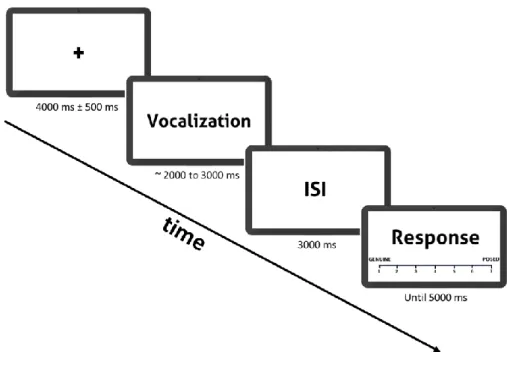
Before starting the task, the experimenter explained to participants that they would hear a set of sounds and would rate the emotional sounds in terms of their perceived authenticity (i.e., whether a sound is genuine or posed). Concerning neutral sounds, they were instructed only to attend to the stimulus. A trial started with a 4000 ms fixation cross with a jitter of 500 ms, followed by the presentation of the vocal expression. Before the authenticity rating, where the participant had up to 5000 ms to respond, a 3000 ms inter-stimulus interval consisting of a fixation cross was presented. Participants responded in a 7-point Likert scale their perceived authenticity of the stimuli presented, ranging from 1 (“Genuine” – spontaneous) to 7 (“Posed” – voluntary). The task had a total of 204 trials (duration = 36 min) with a fixed sequence presentation of the stimuli. The rationale for presenting a fixed sequence, instead of a pseudorandomized sequence, relates to the future applicability of this task with oxytocin intranasal intake since a variable order of the stimuli and oxytocin may interact not allowing a fair comparison between subjects. Transitions from trial to trial were taken into account in the sequence design by distributing the several types of transition from one condition to another equally. The experimental design is outlined in Figure 1.
33
ISI = Interstimulus interval.
Fig. 1 Illustration of an experiment trial.
After EEG data acquisition, participants were instructed to evaluate the perceived arousal and emotional contagion of the previously presented vocal stimuli in a 7-point Likert scale (Arousal: 1 – Low arousal, 7 – High arousal; Emotional Contagion: 1 – Not contagious at all, 7 – Highly contagious). Stimuli were divided across two blocks: the first block assessed the perceived arousal of each stimulus, whereas the second block assessed the perceived emotional contagion of each stimulus. Each block had a total of 72 trials (18 spontaneous laughter, 18 voluntary laughter, 18 spontaneous crying, 18 voluntary crying). A trial had the following sequence: a fixation cross presented during 1500 ms with a jitter of 500 ms, presentation of the vocalization, fixation cross during 1s and lastly, perceived arousal or emotional contagion rating depending on the block. The task was presented in a fixed sequence which accounted for transitions and had a total of 124 trials (15 min). Each vocalization was only presented once in each block.
4.
EEG Data Acquisition and Processing
The electroencephalogram (EEG) was recorded at a continuous rate using a 64-channel BrainVision actiCHamp system (Brain Products, München, Germany) at a 512 Hz sampling rate. For offline reference, two flat-type electrodes were placed on the left and right mastoids. Bipolar horizontal and vertical electro-oculograms were acquired through 4 flat-type facial electrodes: two electrodes were placed at the outer corner of each eye