RAUSP Management Journal
http://rausp.usp.br/ RAUSP Management Journal 53 (2018) 164–177
Original Article
Technological coevolution in the electric energy sector
Coevolu¸cão tecnológica no setor de energia elétrica
Coevolución tecnológica en el sector de la energía eléctrica
Camila Franco
a,∗, Samuel Fac¸anha Câmara
b, Ronaldo Couto Parente
caUniversidade Federal do Rio de Janeiro, Instituto COPPEAD de Administra¸cão, Rio de Janeiro, RJ, Brazil bUniversidade Estadual do Ceará, Fortaleza, CE, Brazil
cFlorida International University, Miami, FL, United States
Received 14 September 2016; accepted 24 February 2017 Available online 27 April 2017
Scientific Editor: Filipe Quevedo-Silva
Abstract
This article analyzes the co-evolution of technological capabilities of electric companies’ subsidiaries and Small and Medium Enterprises connected through common Research and Development projects. The analysis is based on the following variables: learning, network and autonomy, which together form the construct of Embeddedness, i.e. the level of involvement these companies develop. In order to achieve the objectives, the authors conducted interviews aiming to identify the characteristics of each variable. As a result, an evolution in the technological capabilities was found, in both the subsidiaries and the partner companies, after the development of the projects. This accumulation is achieved through the relationship with the levels of Embeddedness (learning and network); and such relationship is directly proportional in the beginning of the projects and inversely proportional in the end. The change in the relationship between variables highlights the companies’ capacity to absorb and accumulate the acquired knowledge even when the partnership has already ended.
© 2017 Departamento de Administrac¸˜ao, Faculdade de Economia, Administrac¸˜ao e Contabilidade da Universidade de S˜ao Paulo – FEA/USP. Published by Elsevier Editora Ltda. This is an open access article under the CC BY license (http://creativecommons.org/licenses/by/4.0/).
Keywords: Coevolution; Technologic capabilities; Electric energy
Resumo
O artigo objetiva analisar como ocorre a coevoluc¸ão das Capacidades Tecnológicas de subsidiárias de energia elétrica e Pequenas e Médias Empresas que se relacionam a partir da execuc¸ão de projetos de Pesquisa e Desenvolvimento. A análise é baseada nas seguintes variáveis: aprendizado,
networke autonomia, as quais, juntas, formam o constructoEmbeddednessreferente ao envolvimento que estas empresas estabelecem entre si. Para alcanc¸ar o objetivo proposto, os autores realizaram entrevistas visando diagnosticar as características presentes dentro de cada variável. Como resultado encontrou-se uma evoluc¸ão nas capacidades tecnológicas tanto das subsidiárias como das empresas parceiras após o desenvolvimento dos projetos. Este acúmulo é conseguido através da relac¸ão com os níveis de Envolvimento (aprendizado enetwork); relac¸ão esta que se apresenta diretamente proporcional no início dos projetos e inversamente proporcional ao final deles. Esta mudanc¸a na relac¸ão entre as variáveis destaca a capacidade que as empresas desenvolvem em absorver e acumular o conhecimento adquirido mesmo quando já finalizada a parceria.
© 2017 Departamento de Administrac¸˜ao, Faculdade de Economia, Administrac¸˜ao e Contabilidade da Universidade de S˜ao Paulo – FEA/USP. Publicado por Elsevier Editora Ltda. Este ´e um artigo Open Access sob uma licenc¸a CC BY (http://creativecommons.org/licenses/by/4.0/).
Palavras-chave: Coevoluc¸ão; Capacidades tecnológicas, Energia elétrica
∗Corresponding author.
E-mail:[email protected](C. Franco).
Peer Review under the responsibility of Departamento de Administrac¸ão, Faculdade de Economia, Administrac¸ão e Contabilidade da Universidade de São Paulo – FEA/USP.
https://doi.org/10.1016/j.rausp.2017.02.001
Resumen
El objetivo en este artículo es analizar cómo se produce la coevolución de las capacidades tecnológicas de filiales de energía eléctrica y peque˜nas y medianas empresas (PyMEs) que se relacionan a partir de proyectos de Investigación y Desarrollo (I&D). El análisis tiene como base las siguientes variables: aprendizaje, redes y autonomía, que forman el constructo deEmbeddednessreferente a la relación que estas empresas establecen entre sí. Para lograr el objetivo propuesto, los autores han llevado a cabo entrevistas con el fin de examinar las características presentes en cada variable. Como resultado, se encuentra una evolución en las capacidades tecnológicas tanto de las filiales como de las empresas asociadas después del desarrollo de los proyectos. Esta acumulación se logra por medio de la relación con los niveles deEmbeddedness(aprendizaje y redes); una relación que se muestra directamente proporcional al comienzo de los proyectos e inversamente proporcional a su término. Este cambio en la relación entre las variables destaca la capacidad que las empresas desarrollan para absorber y acumular el conocimiento adquirido, incluso cuando la asociación o colaboración ya ha terminado.
© 2017 Departamento de Administrac¸˜ao, Faculdade de Economia, Administrac¸˜ao e Contabilidade da Universidade de S˜ao Paulo – FEA/USP. Publicado por Elsevier Editora Ltda. Este es un art´ıculo Open Access bajo la licencia CC BY (http://creativecommons.org/licenses/by/4.0/).
Palabras clave: Coevolución; Capacidades tecnológicas; Energía eléctrica
Introduction
Researchers are increasingly addressing studies of multina-tional subsidiaries (Achcaoucaou & Miravitlles, 2012; Bartlett & Goshal, 1986; Birkinshaw, Hood, & Young, 2005; Cantwell & Mudambi, 2005; Lee, 2010), in the area of strategy and inter-national negotiations. This growth is based on the fact that subsidiaries are organizations that could have a strong impact on their host economy, due largely to the fact that these compa-nies have easy access to resources from their parent-compacompa-nies, sometimes sharing valuable assets such as knowhow among the different units, incorporating the relations of the countries in which they are based and thus facilitating intra-knowledge and inter-firm flow (Almeida & Phene, 2004).
Since they are immersed in a new environment, often at a certain cultural distance, the subsidiaries endeavor to partner with local companies to set up networks. This includes those aiming for technological development in order to reach a higher level of organizational performance since, according toLiu and Chaminade (2010), network links are positively related to the performance of technological innovation.
Moreover, to achieve this performance of technological innovation, companies still aim to develop what we know as technological capabilities, which are nothing but the resources required to generate and manage technical change (Bell & Pavitt, 1993), in other words, the innovation process.
According toPolanyi (1944)these partnerships built up by companies can be understood as embeddedness, which is char-acterized as an immersion of these players (companies) in social relationships in their own sphere.Uzzi (1996)adds to this idea saying that these social links created with various players in their environment could contribute to achieving performance.
When subsidiaries build these partnerships with local small and medium-size enterprises (SMEs), the study of such inter-play also becomes more relevant to the extent that: (i) there is sparse literature on the success of innovations in this context and the study of capabilities required to further such a process and (ii) the incentive given to innovation of this type of enter-prise is a significant part of the effort of technological innovator policies developed in emerging countries, since they believe in
the key role of these policies in national economic development (Forsman, 2009; Lee, 2010; OECD, 2005).
Numerous papers in literature are concerned with the role of subsidiaries of multinational corporations (MNC) in their host countries, mainly in the relationship formed with local economies (Cantwell & Mudambi, 2005; Chang, Mellahi & Wilkinson, 2009). Several subjects are addressed constantly adopting this viewpoint, such as creating knowledge (Almeida & Phene, 2004); performance (Andersson, Forsgren, & Holm, 2002; Birkinshaw et al., 2005); innovation (Kokko & Kravtsova, 2008); networking (Achcaoucaou & Miravitlles, 2012) and so on.
It is noticeable in the past few years that studies have intensi-fied regarding the development of innovative and technological corporate capabilities, including papers addressing the question in the international sphere from the viewpoint of technologi-cal evolution of these companies and investigating the role of subsidiaries in the creation and accumulation of such technolog-ical capabilities (Almeida & Phene, 2004; Ariffin & Bell, 1999; Birkinshaw & Hood, 1998; Chang et al., 2009; Lee, 2010).
However, many studies that address the behavior of sub-sidiaries portray the reality of businesses mostly located in Asian countries, namely China, Malaysia and Taiwan (Chang et al., 2009; Lee, 2010), thereby revealing the specificities of these places, creating a gap in geographical coverage in literature. There are many differences between countries in the Far East and the West and this is reflected in the economy, technology and innovation in those countries. So it is important that the role of MNC subsidiaries is also studied more in the emerging countries in the West, so that a comparison can therefore be made of these two contexts.
This gap in literature, as already mentioned, widens even fur-ther when referring to SMEs, bearing in mind that the studies in this area often refer to large enterprises (Birkinshaw & Hood, 2000; Chang, 2011; Danneels, 2002). Thus, a certain gap is visible in the study of the dual effects of partnerships among sub-sidiaries and SMEs in their technological developments, dealing with their technological evolution mostly in a scenario of emerg-ing countries outside the Asian axis. Furthermore, these studies do not sufficiently address the factors affecting embeddedness and the technological coevolution between companies, and this demonstrates a need for understanding how the technological capabilities of these different companies evolve when they are embedded.
Since few studies address the matter of this technological evolution (accumulation of technological capabilities) of sub-sidiaries in an embeddedness context in the environments where they are located, this defines the starting point of this research, namely: How do the technological capabilities of SMEs and sub-sidiaries evolve, working together in developing projects related to research and development (R&D), considering the factors of embeddedness?
The purpose of this study is to understand how coevolution of the technological capabilities of two subsidiaries of a multi-national in the electricity sector occurs, and of SMEs related to them in R&D projects, in the Brazilian cities of Fortaleza and Rio de Janeiro in Northeast and Southeast Brazil, respectively. Hence, the study proposes to examine the embeddedness and consequent coevolution of the technological capabilities among subsidiaries of a multinational and the SMEs associated with them when implementing R&D projects. To do so a qualitative methodology case of studies will be used.
With that in mind, this paper will contribute to the literature three ways: (i) To identify and operationalize the factors affect-ing the embeddedness process in which subsidiaries and SMEs are to be found; (ii) to identify how the technological capabilities of both types of enterprise have evolved in the process based on their embeddedness; and (iii) to assess coevolution of the tech-nological capabilities of the subsidiary and SMEs before, during and after the project adopted among them.
Theoretical framework
The strategy of installing subsidiaries, mainly in emerging countries, has been a source of accumulation of capabilities and, consequently, an increase in performance for parent companies. Subsidiaries, finding themselves embedded in a new operating environment, relate in different ways with the companies in these countries, mediated by a number of variables present in the process.
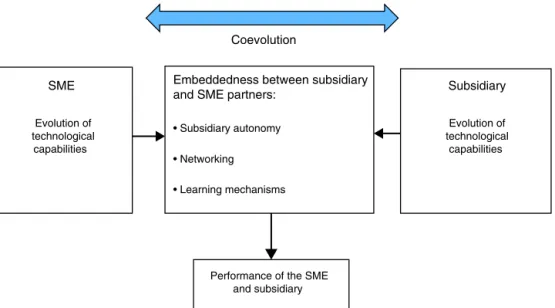
These variables and the consequent coevolution between the players are addressed herein from a framework based on per-tinent literature (Fig. 1), which shows the embeddedness and coevolution of technological capabilities of the subsidiaries with the SMEs in the host country that interact with them. In the following subsections each element in this framework and the relationship between them will be discussed.
Coevolution
Keiser (1989) points out that the coevolutional forms of organization originate in a certain set of political and social circumstances. These circumstances are formed from inter-play among exogenous and endogenous influences (North, 1990). The organization considered an open system is a sub-ject addressed by authors Baum and Singh (1994)and which is raised again in the discussion on organizational ecosystems. Drust and Poutanen (2013)discuss collaborative arrangements, or forms of collaborations between companies, assuming this to be a dominant topic in organizational theories.
Several of these theories have emphasized the existing rela-tionship between the organization and its external environment. The links made between the external and internal players enable development of the company’s capabilities and, also, this rela-tionship consists of a cycle of interplay considered to be the essence of the feedback process, in which the behavior of vari-ables within such a cycle is closely linked, influencing one another (Ahuja, Soda & Zaheer, 2012; Carney & Gedajlovic, 2002; Vonortas & Zirulia, 2015).
According to McCarthy, Lawrence, Wixted and Gordon (2010), in addition to the pace of environmental change, orga-nizational changes are becoming increasingly complex and interconnected. Accordingly, a coevolutional approach is a good way to study and understand such changes (Breslin, 2016).
From a coevolution view, authors Carney and Gedajlovic (2002) suggest that the notion of interdependence is funda-mental, in the sense that the companies are influenced by and also influence their environment (Baum & Singh, 1994).Poroc (1994) comments that the coevolution processes should be understood through the notion that he calls organizational com-munity, to which institutions, regulatory agencies and a business population belong. The core of this community is the inter-play series by which members exchange ideas, resources and commitments. Thus, the author states that evolution of an orga-nizational community could be defined as the coevolution of its components.
Several works are developed to study empirically how the corporate coevolution process occurs, proposing frameworks and analyzing the influences that the factors exert both on busi-nesses and the included environment (Rodrigues & Child, 2003; Suhomlinova, 2006; Volverba & Lewin, 2003). These frame-works help envisage which factors are more relevant for the study of the topic of corporate coevolution.
Rodrigues and Child (2003)propose a framework analyzing four dimensions: performance, process, objectives and policies, and form. These dimensions apparently complement the idea suggested byVolverba and Lewin (2003) that the coevolution prospect is an integrating force and that, therefore, is based on a variety of relevant theoretical outlooks.
Embeddedness between subsidiary and SME partners:
• Subsidiary autonomy
• Networking
• Learning mechanisms
SME
Evolution of technological
capabilities
Subsidiary
Evolution of technological
capabilities
Performance of the SME and subsidiary
Coevolution
Fig. 1. Embeddedness and coevolution of technological capabilities between subsidiaries and multinationals and local SMEs.
Source: Developed by the authors.
Another author contributing to the discussion isSuhomlinova (2006), who considers that analyzing the mutual influ-ences between organizations and environments in transition economies is a gap in literature. This is why he develops a coevo-lutional model of organizational change in transition where it focuses on the survival of the organization.
Based on these authors it may be said that companies that adopt coevolutional models need to interact with the factors within and outside the organization, in order to adapt to the embedded medium and, principally, survive in an environment full of selective factors. In this respect, it is noted that the models incorporate the premise of the adaptation and selection factors, considering them not as orthogonal forces but rather fundamen-tally interrelated.
Embeddedness
Polanyi (1944)gave a valuable addition to the academic field when introducing the termembeddedness, which considers that the economic agents are immersed in social relations. Based on this, some authors began to pay closer attention to this ongoing process in the practice of managerial life, namely:Granovetter (1985),Uzzi (1996),Zukin and DiMaggio (1990),Steiner (2006) and more recently,Meyer, Mudambi, and Narula (2011) and Halaszovich and Lundan (2016).
Uzzi (1996)contributed to literature by explaining a benefit of this social immersion. He stated that the performance of compet-itive companies could be facilitated by the social links that they create with several actors in their social environment.Zukin and DiMaggio (1990)broaden this concept when they propose four immersion mechanisms that consider interconnecting the con-cerns of economics and social organization: cognitive, cultural, political institution and social structural mechanisms.
Meyer et al. (2011)state that the embeddedness process cre-ates both business opportunities and operational challenges. This
process brings the company into closer interplay with the other companies at lower costs (Halaszovich & Lundan, 2016).
Based on the mechanisms proposed byZukin and DiMaggio (1990)this paper suggests a study of social immersion based on a three-pillar approach: learning, which is coupled to the cognitive and cultural mechanisms; networking, related to social struc-tures, since they refer to the need to understand how network structures and qualities of their relationships affect the economic activity of a given organization; and lastly, autonomy, which is coupled with the mechanism of political institutions, bearing in mind that this factor concerns the competent attributes of a cer-tain institution in order to adopt their processes and practices independently.
Learning
In the environments of technological development the vari-able most commonly described as a determining factor is organizational learning. However, to achieve this it is necessary to acknowledge that the individual learning process has a strong impact on the concept and practices of organizational learning, since the latter starts from individuals.
Individual learning, interplay and sharing knowledge and experiences with each other facilitate organizational learning, but organization knowledge cannot be generated on its own but rather from the individual’s initiative and interplay with his or her work peers organized in groups. From this viewpoint, organi-zational learning is to some extent the socialization of individual learning within the organization (Nonaka & Takeuchi, 2008).
the term learning applies to the second meaning. It is understood hereinafter that learning is the process that allows the company to accumulate technological capability as time goes by.
Figueiredo (2002, 2003), based on Latecomer Company Lit-erature (LCL) and Technological Frontier Company LitLit-erature (TFLC), develops a learning process model in which he iden-tifies the different processes by which the company acquires technical knowledge – from external and internal sources – to build its technological capability. The model consists of four learning processes: (1) external knowledge-acquisition; (2) internal knowledge-acquisition; (3) knowledge-socialization and (4) knowledge-codification. These, in turn, are subdivided in knowledge-acquisition mechanisms and processes (1 and 2) and knowledge-conversion mechanisms and processes (3 and 4). The processes are examined on the basis of four features: variety (in terms of presence/absence of a process); intensity (repetition over time in creating, updating and reinforcing the learning pro-cess); functioning (regarding the functionality of the process over time) and interaction (way in which the learning processes influence each other).
Thus, learning and its mechanisms must be an important vari-able in building the concept of embeddedness. In the proposed framework this variable is a determinant for the embeddedness of subsidiaries with SMEs: Embeddedness is established between these players by sharing knowledge in the learning process.
Networking
In the specific case addressed herein, the embeddedness environment comprises the technological development and innovation networks. The external network with the different actors involved in the process of organizational or technological innovation could play a key role as a strategic source for skills development (Andersson et al., 2002). When cooperating with external actors, businesses increase their ability to reorganize their knowledge base, since the learning provided by network-ing also keeps a relationship with the actors’ ability to restructure the functions and contents of their interplay.Powell, Koput and Smith-Doerr (1996)find evidence that relates growth of compa-nies to their networking. According to the authors, the skill to absorb knowledge from the environment depends, among other things, on the network of inter-organizational relations formed by the companies.
According to the study byLiu and Chaminade (2010), the network link is positively related to technological innovator performance. The authors explain that the more connected and compacted the network the more frequent the learning interplay, since a large number of people can cross a shorter social distance to learn from each other. This result confirms whatBaletsrin, Verschoore, and Reyes (2010)say about the results that can be provided by a network. The authors claim that that networking benefits for companies are learning, success and innovation.
The literature offers a range of network typologies that fulfill the various criteria to be explored; the degree of formaliza-tion (Grandori & Soda, 1995); degree of centralization (Corrêa, 1999); degree of similarity (Santos, Pereira, & Franc¸a, 1994); perpetuity of cooperation (Belussi & Arcangel, 1998); geo-graphical concentration (Sheremetieff, 2003); presence of ICT
(OECD, 2005); and purpose (Castilla, Hwang, Granovetter, & Granovetter, 2000; Porter, 1992).
In relation to the networks classified by their purpose, that is, the objective for setting up a network, the authors list:
• Networks of access and opportunity, related to the labor mar-ket (manpower) (Castilla et al., 2000);
• Networks of power and influence – reflecting the flow of influ-ence of financial institutions on corporations (Castilla et al., 2000);
• Networks of production and innovation – relating to innova-tion development (Castilla et al., 2000);
• Networks with tangible interrelations – presenting relation-ships differentiated by various types of sharing, such as production, market, procurement, technology and infrastruc-ture (Porter, 1992);
• Networks with intangible interrelations – involving transfer of knowhow (Porter, 1992).
Another classification in the literature, which helps extend knowledge about networking is presented byDantas and Bell (2011)that use levels to measure the variation in the network for-mation process. These levels vary depending on that inTable 1.
Autonomy
Birkinshaw (1997),Birkinshaw, Hood, and Jonsson (1998) and others refer to the subsidiaries winning “mandates”; that is, they assumed the responsibility and have autonomy to learn, develop and manufacture goods on a global basis. These man-dates could also be lost and won. In other words, if on one hand subsidiaries are used abroad to leverage specific benefits, on the other, they could contribute to increase these or create new benefits for the multinational companies (MNCs).
Cantwell and Mudambi (2005)in their paper address two dif-ferent mandate typologies that a company could receive from its parent company: competence-creating mandate, referring to the competence given for the role of creating, generating new tech-nologies and R&D development, and competence-exploiting mandate, which is the type of competence designed only for operation and exploitation.
So, the subsidiary role is no longer restricted to adapting the parent company’s technology to local market requirements (Li, Ferreira & Serra, 2009), but also now includes major sources of technological development (Ghoshal & Bartlett, 1988; Li et al., 2009).
Birkinshaw et al. (1998)discussed how subsidiaries might contribute to some specific benefits for the MNCs and the importance of the relationship between the head office and subsidiaries, and also for the subsidiaries to develop initiative. According to the authors, it is the subsidiaries’ initiative that ensures their contribution to the development and creation of specific benefits for the MNC.
Table 1 Network levels.
Levels Concept
Passive Focused only on production and operation. Equipment use and troubleshooting.
Active Participation in knowhow production. Undertaking more complex technological activities. New technology production, R& D project development and participation in partners’ R&D efforts.
Strategic Technology exchange and transfer.
Source: Adapted fromDantas and Bell (2011).
initiative could also be identified: internal and global. The author developed a model describing the three types of initiative of a controlled company depending on the market place: local mar-ket, consisting of competitors, suppliers, clients and regulatory agencies; internal market, characterized by the internal opera-tions of the company and global market, which includes clients and suppliers that are outside the internal and local market.
Cantwell and Mudambi (2005)consider that the ability to achieve an effective voice within the parent company depends on three factors: (i) the characteristics and potential of development of the place where a company is situated; (ii) the organization’s internal status, that is, level of capabilities and possibilities of achieving independent initiatives, and (iii) strategic practices and origins of the parent company’s group with regard to its potential to encourage networking at a local level with external partners.
Technological capabilities
The term has been used to reference the resources required to generate and manage technical change (Bell & Pavitt, 1993) and it is through such capabilities that businesses undertake their pro-ductive and innovative activities (Miranda & Figueiredo, 2010). These capabilities, in order to continue in an accumulation process, are influenced by all variables present in the environ-ment in which the organization is inserted. The variables of embeddedness, especially, have a fundamental influence on this process. The method and frequency of the company’s embed-dedness can provide benefits in terms of knowhow accumulation and innovative performance. These benefits could even spread to other partners involved in these relationships (Uzzi & Gillespie, 2002).
From the literature it is found that a number of empirical studies provide grounds for relating the study of technologi-cal capabilities with the variables addressed herein.Lin (2015), Figueiredo and Piana (2016), Figueiredo (2009), Dantas and Bell (2011),Kim (1997),Dosi (1988),Lall (1992), andBell and Pavitt (1993, 1995)are some of those who offer the idea of a relationship between capabilities and the learning process within the organization.
On the other hand, Vandaier and Zaheer (2016),Vonortas (2013),Lasagni (2012),Yokakul and Zadiew (2010),Forsman (2009),Amato Neto (2000), Liu and Chaminade (2010) and Baletsrin et al. (2010) show the relationship existing in the network factor, connections and partnerships that companies establish in order to help in the process of capabilities accu-mulation.
Lastly,Cantwell and Mudambi (2005),Birkinshaw (1997), Bartlett and Goshal (1986), andBirkinshaw and Hood (1998) also collaborate when presenting in their studies the relationship existing between technological capabilities and the autonomy factor.
Concerning the form of technological capability classifica-tion/accumulation, Dantas and Bell (2011)identified a series of capability dimensions whose variations could be observed to check the degrees of these capabilities in developing companies, arising from four different levels, as follows:
• Assimilative capability– activities focused on training and learning about operationalization and the use of technolo-gies (also arising from the concept of Absorptive Capability adopted byCohen and Levinthal (1990), that describe it as a skill for recognizing the value of the new, external knowledge, assimilating and applying it for commercial purposes). • Adaptive capability– construction of an initial knowledge
design base, introduction to more formal and deliberative methods of learning.
• Generative capability – independent activities of R&D, more comprehensive knowledge bases, scientific knowledge in relevant disciplines and technologies.
• Strategic capability– generation and implementation of new technologies than are capable of taking the company to the international technological frontier.
Methodology
This study is characterized as explanatory, to the extent that “it aims to clarify the factors contributing to the occurrence of a certain phenomenon” (Vergara, 2009, p. 45).
A case study field survey was carried out with two multina-tional subsidiaries, one installed in the city of Fortaleza (Ceará state) and the other in Niterói (Rio de Janeiro state) and with small and/or medium-size enterprises that work with them in developing R&D-related projects. The company size was clas-sified based on the number of employees, in accordance with a Sebrae guideline. The choice of these two subsidiaries is because of the researchers’ accessibility to both institutions.
(2007), is characterized by a researcher observing the facts spon-taneously. The question guide used in the interview is presented inAppendix Ahereof.
The following was adopted for data treatment: interviews were recorded and later transcribed in order to use the con-tent analysis technique. To work the variables represented in the framework, the qualitative data obtained from the interviews were operationalized to transform them in quantitative data and then analyze them.
For this analysis two simple regression analyses were carried out (Hair Jr., Black, Babin, Anderson, & Tatham, 2009) using the ordinary least squares algorithm and considering as variables: Regression 1 – Embeddedness of the subsidiary (dependent) and embeddedness of the SME (independent); Regression 2 – Technological capability of the SME (dependent) and techno-logical capability of the subsidiary (independent). The estimated equations of the straight lines are presented as follows:
Regression 1–Es=a+b.Epme
Regression 2–Ctpme=a+b.CTs
where Es = subsidiary embeddedness (1–27); Ep = SME embed-dedness (1–27); CTpme = SME technological capability (1–5); CTs = subsidiary technological capability (1–5); a= vertical intercept;b= angular coefficient.
The dimensions of the three variables belonging to the embeddedness construct will vary in level, so that it is noticeable how certain variables evolve over time, bearing in mind that the levels adopted in this study are cumulative.
To operationalize the learning variable, the model by Figueiredo (2002) was used, which characterizes the processes of knowledge acquisition, socialization and codification. The characteristics present in each dimen-sion were found by searching literature on the relevant topic (Figueiredo, 2009; Kogut & Zander, 1992; Non-aka & Takeuchi, 1997; NonNon-aka, 1994; Simon, 1991). To analyze the level of learning in each characteristic, the proposal of Figueiredo (2003) was adopted when basing this analysis on the variety (or frequency) of such characteristics. In this way, to observe the learning variable in this study, a set of characteristics was observed belonging to each project analyzed (characteristics studied listed inAppendix B).
The authors based the application of the network variable on the dimensions proposed byCastilla et al. (2000)– access, power and innovation networks – and on the levels of networking as proposed by Dantas and Bell (2011) – active, passive and strategic. Each network dimension assessed at the three levels was the network variable on a one-to-nine scale. This level was obtained using the average of the interviewed companies.
The autonomy variable was applied based on initiatives taken in three different markets: local, home and global (Birkinshaw, 1997). They were leveled based on three stages: stage 1, corre-sponding to an exploitation skill only; stage 2, developing into a creative skill; and stage 3, with regard to creating not only daily goods and services but also technology (Cantwell & Mudambi, 2005).
Table 2
Quantity of interviews/visits carried out.
Actors/quantity Number of interviews/visits
Face-to-face interviews
Skype interview Visits Total
Company 2 4 0 3 7
Company 1 6 0 3 9
Partner Companies (11) 11 2 8 21 Research Institute (4) 4 2 2 8
University (3) 4 1 3 8
Research Center (2) 2 1 1 4
Association (2) 5 1 3 9
NGO (1) 1 1 0 2
Research Core (1) 1 1 0 2
Foundation (1) 1 1 0 2
Total 39 10 23 72
Table 3
Quantity of projects analyzed.
Actors Company 2 Company 1 Total
Partner Companies 5 14 19
Research Institute 4 3 7
University 3 5 8
Research Center 0 6 6
Association 0 5 5
NGO 0 1 1
Research Core 0 1 1
Foundation 0 1 1
Total 12 36 48
Lastly, technological capabilities were considered based on four levels used in the study byDantas and Bell (2011)– assim-ilative, adaptive, generative and strategic capability. In order to measure each variable, the phases of the projects were consid-ered as a time proxy and divided into before, during and after the projects. Unlike the embeddedness variables, the measurement of technological capabilities variable will not be based on levels, since their categories are considered to be specific, representing different realities that the company might or might not have at any given time.
Data source
The case study was carried out between October and December 2013 in Ceará and Rio de Janeiro states. Forty-nine interviews were conducted with the R&D project managers of the two subsidiaries (referred herein only as “COMPANY 1” from Fortaleza and “COMPANY 2” from Niterói) and of the partner institutions (totaling 25) in addition to 23 visits, totaling 48 analyzed projects as shown inTables 2 and 3.
Table 4
Formation of embeddedness.
Variables Partner companies Subsidiaries
Before During After Before During After
Learning 2.40 5.27 2.52 1.70 7.23 4.07
Accumulation 3.1 3.8 3.2 2.1 3.7 3.2 Socialization 4.2 7.2 3.75 3.0 9.0 9.0 Codification 0 4.8 0.6 0.0 9.0 0.0
Network 3.6 6.2 6.8 3 6 8
Autonomy 9 9 9 9.0 9.0 9.0
Embeddedness 15 20.47 18.32 13.7 22.23 21.07
Source: Own author.
The partner companies interviewed were small and this enabled learning all about their structure, as well as the employ-ees and modus operandi. In the subsidiaries the managers provided knowhow mainly in the R&D sector, where some project experiments are discussed and sometimes implemented. Due to this accessibility, the authors succeeded in confirming some information provided during the interviews by direct observation of the workplace, materials, equipment, products, and also by chatting with other people involved in the process.
Analysis and results
The case of the two subsidiaries presented a total volume of 72 R&D projects completed since 2010 and implemented by different types of partner institutions (companies, foundations, universities, research centers and nongovernmental organiza-tions). R&D projects developed by those electricity companies were regulated by Aneel (national electricity regulatory agency), which establishes that they “must be ruled by finding innova-tions to confront the market and technological challenges of the electricity companies” (Aneel, 2008, p. 7). Each project was framed in a certain phase (directed basic research, advanced research, experimental development, first in series, precursor batch and market insertion) and should be completed within a maximum 60-month term. Although subsidiaries have partnered with numerous types of organization the case specifically studied the R&D projects in conjunction with SMEs.
Embeddedness
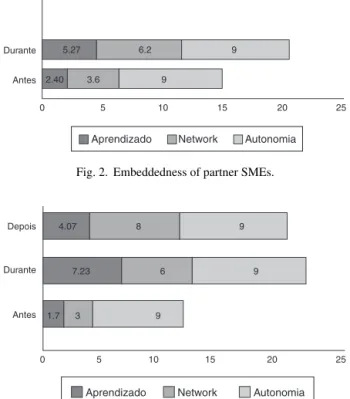
When gaging the evolution of embeddedness adopted by sub-sidiaries and partner companies (Table 4,Figs. 2 and 3) it is found that R&D projects emphasize these levels of embeddedness, which is apparent by the rise in values attributed to learning and networking when they are implemented. When subsidiaries first implement the projects they raise the learning level by around 119% (from 1.7 to 7.23, according to the average characteristics present in these periods), which can be confirmed by listening to a manager of a partner company: “The projects used to have more or less nine employees but today have more than 20”. After completion this rate drops to 52% (from 7.23 to 4.07). It should be stressed that here it is not accumulated learning but its mea-sure of flow; that is, the subsidiaries learn a further 119% when
0 5 10 15 20 25
2.52
5.27
2.40 3.6 9
6.2 9
6.8 9
Depois
Durante
Antes
Aprendizado Network Autonomia
Fig. 2. Embeddedness of partner SMEs.
0 5 10 15 20 25
Depois
Durante
Antes
Aprendizado Network Autonomia
4.07
7.23
1.7 3 9
6 9
8 9
Fig. 3. Embeddedness of MNC subsidiaries.
they adopt R&D projects with their SME partners and learn 52% less after the projects close, considering their research and development objective. In the case of the network, the increase in networking rises from 3 to 6 when the projects are implemented and even more so from 6 to 8 when they terminate. Therefore, it is clear that subsidiaries increase their embeddedness by learning and networking with the R&D projects. Looking at the embed-dedness construct as the sum of the others, it is perceived that embeddedness rises 36% and drops only 10% when they are finalized. Accordingly, it can be said that subsidiaries generally achieved higher levels of embeddedness when undertaking their R&D projects in conjunction with the SMEs, and that this was due to learning and networking, while autonomy levels, accord-ing to interviewees and collected evidence, were already high and terminated high, “All autonomy comes from us, the group only organizes the format”, says the manager of one subsidiary.
Technological capabilities
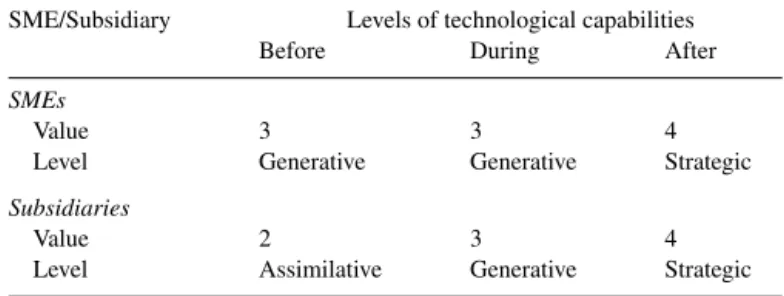
In relation to technological capabilities, it was seen that subsidiaries and SMEs alike evolved to post-project strategic capabilities and that, in the case of subsidiaries, evolution was greater since they started at a lower level (assimilative), while the SMEs began, before the projects, with generative capabili-ties, which is perhaps why they have been chosen as partners in these R&D projects (Table 5).
Table 5
Performance of SME and subsidiary technological capabilities.
SME/Subsidiary Levels of technological capabilities Before During After
SMEs
Value 3 3 4
Level Generative Generative Strategic
Subsidiaries
Value 2 3 4
Level Assimilative Generative Strategic
showing the evolution of the R&D sector, which emerged from the development of such projects. Other evidence that could be shown here regarding the evolution of technological capabili-ties is based on what the managers said: “Today the company is moving from that formalizing level of painstaking work to the brainstorming level” (manager of a subsidiary); “Now the com-pany has credibility for development and innovation” (manager of a partner company).
The managers of a subsidiary acknowledged that when first undertaking projects the work had to be done, “as a stop-gap”. In time, however, they perceived their importance for the orga-nization at a level of advanced technologies, work-facilitating innovations and ideas that guaranteed the company a top posi-tion. Since then the company has been specializing in developing such projects and as a result leveraged its capabilities from just an assimilative to a generative level. The importance of the projects is so vital for the company that the managers believe that, in the near future, this level of capability will tend to increase to the strategic level, since they recognize that the results of the projects are now reaching international competitors, with a view to patents.
Concerning the SMEs, although the majority are now at a generative technological capability level due to the fact of being companies focusing on project development, with a significant innovative and technological load, they have shown that, by partnering with the subsidiaries, their capability may rise to the strategic level in the short term, confirmed by some statements: “The company now has knowhow to operate in the energy effi-ciency area”. So, already technologically developed in some certain segments, the partnership has helped develop a new niche, with major impacts on the competition. Another state-ment shows that the results of the project have produced a global patent and the international market sees it as a possible market-ing item: “The product created a global patent shared with the subsidiary”. This inferred that the level of technological capa-bility of the interviewed SMEs has real possibilities of evolving in the short term to the maximum (strategic) level.Appendix C provides some evidence from the interviews, which give sup-port to the quantitative findings demonstrated herein. Based on this evidence, it can be understood more clearly how the embed-dedeness process, including learning, network and autonomy variables, influenced the evolution of the technological capabil-ities in not only the two subsidiaries in question, but also the partner companies embedded in projects with them.
Es = 1.6157Epme - 9.9698 R2 = 0.9262
0 9 18 27
0 9 18 27
Embeddedness subsidiárias (Es)
Embeddedness PMEs (Epme)
Fig. 4. Coevolution of embeddeness (SMEs and subsidiaries).
CTpme = 0.5CTs + 1.8333 R2 = 0.75
1 2 3 4 5
1 2 3 4 5
Cap. Tec. das PMEs (CTpme)
Cap. Tec. das subsidiárias (CTs)
Fig. 5. Coevolution of technological capabilities (SMEs and subsidiaries).
Coevolution
The evaluations by the different sources of empirical evidence (interviews, observations and documents) of the variables and embeddedness construct have revealed that subsidiaries must present a coevolutional movement of their technological capa-bilities by carrying out the analyzed R&D projects. This finding is based on evidence, such as scientific articles published in aca-demic journals on project development, which aggregates the learning level of both companies; and on the fact that some of those responsible for the projects have begun and others even completed the master’s level for further specialization and con-tribution to the work. Moreover, we even heard the following phrase from one of the managers of a partner company: “The partnership with “COMPANY 1” and the university helped kick-start innovation in the company and we are now, after the project, mature enough to propose, even on our own, innovator solutions for the market”. This shows that the networking factor has been extremely important for the life of these SMEs, since similar recurring phrases have been heard, while there is more evi-dence in subsidiaries procuring these companies to propose new projects, continuity and new solutions. The numerous meetings of managers of subsidiaries clearly demonstrate that coevolution of subsidiaries and partners, in fact, did exist with the devel-opment of R&D projects, reinforced by the SME-subsidiary association when analyzing the constructs embeddedness and technological capabilities (Figs. 4 and 5).
learning, networking and autonomy), and the technological capabilities among subsidiaries and partner companies in the three time periods. The variables were obtained from the opera-tionalization shown inTable 4.
It is apparent, after analyzing these figures, that there is a positive coevolution direction between the subsidiaries and SMEs; in other words, both embeddedness and technological capabilities move in the same direction. The trends of a linear relationship, demonstrated by the calculated regressions, may indicate that there is a closer relationship between the fluctu-ations of the related variables. Thus, the estimated equfluctu-ations show that embeddedness between the SMEs and subsidiaries is more closely related than the technological capabilities (greater positive incline). It can probably be said that there is a loss of coevolutional “energy”. The idea is that the different types of embeddednesss created by SMEs and subsidiaries probably influence each other, indicated by the linear regression, pre-senting the important adjustment coefficient above 0.9. This relationship jointly affects the technological capabilities of the organizations involved. However, what is noticeable is that, despite a very close embeddedness, the coevolution of the tech-nological capabilities, although having existed, did not follow the same pattern of proximity, perhaps because of the recurring differences in managerial and technological maturities among the projects and companies analyzed.
Conclusions and final considerations
The purpose of this study was to understand how the coevolu-tion of technological capabilities occurs of the two subsidiaries of a multinational in the electricity sector and of SMEs asso-ciating with them in R&D projects. To do so a case study was developed involving interviews with the two subsidiaries and partner companies.
The main results from this survey show that, from the projects developed in partnership, the level of embeddedness rose for both the subsidiaries and the SMEs. This level of embedded-ness can be translated by the learning levels absorbed by these companies and by the networking level, which characterizes the networks formed while developing such projects. This result is positive for every institution involved, since, even with the com-pleted project, its results are perpetuated within the organization. Moreover, it was apparent that the levels of technological capability also evolved from the development of projects in part-nership. This result is also more significant for the subsidiaries, which were regarded at minimum capability levels, that is, only with operating skills. After the study was completed, this index evolved to enable them to reach a capability level with more innovative and strategic activities.
It was also possible to fill a gap in literature that was limited, in studies of this kind, to scenarios in Asian countries, as in the work byChang et al. (2009), which focused on Taiwan sub-sidiaries located in the UK. Diverging from this research herein, Chang’s study presented a result that the Taiwan multination-als exert strong control over their UK subsidiaries, while in this study it was apparent that a high level of autonomy is given to the subsidiaries, and these can act independently and even
appropriate the results from projects run in their host country. This discrepancy occurs probably as a result of the existing cul-tural difference between the two countries, which causes the corporate management to diverge.
In the case of the study by Ariffin and Bell (1999) on Malaysian subsidiaries, one of the results concerns the techno-logical learning mechanisms now adopted by these companies and that offer a prerequisite for entry of an R&D-based innova-tion. To confirm the findings of the aforementioned authors, this study corroborates this result when addressing the learning fac-tor as a variable that contributes to the evolution of technological capabilities and, consequently, to innovation.
Still referring to the gaps suggested in the introduction to this paper, this study looked to work in the scenario of SMEs, revealing the potential that these Brazilian organizations have to develop their capabilities and also provide the growth of institutions partnering with them.
Concerning this study’s contributions, it is possible to high-light the following: (i) the factors of embeddedness (learning, networking and autonomy) influencing the relationship between subsidiaries and SMEs were operationalized to work better; (ii) understanding how the coevolution of both companies occurred in relation to their technological capabilities, observing how these factors contribute to developing the theory on coevolution and embeddedness; (iii) the study was conducted by observing three different periods in relation to the projects developed by these partnering companies, which provides an interpretation of the data with regard to time; and (iv) it was noted how the existing regional differences in the sphere of the relationships of the two subsidiaries in question influenced the evolution of their capabilities.
In addition to these contributions that help develop the theory, a practical contribution of this study is also apparent: electric-ity companies are able to understand how embeddedness and the partnerships formed in developing R&D projects are funda-mental for accumulating technological capabilities and levels of learning and networking. This could encourage them to more interplay and to find partnerships that help in this development, assisting the sector’s innovation process as a whole.
Furthermore, studying the SMEs, observing how their embeddedness occurs, technological development contributes to their endeavors to form even more partnerships with large enterprises in order to absorb new knowhow. Relationships and interplay provide a visibility in the market and, consequently, access to new opportunities. The learning acquired while con-ducting R&D-related projects leverages for these companies an area that very often is intended only for universities. The result of this research was to discover that the SMEs played a key role in the capability evolution process on a mutual basis; in other words, not only their own capabilities were more devel-oped but they were also able to help in the evolution process of the subsidiaries.
the finding herein or not, and therefore reach a generalization on the matter.
The second limitation is caused by the assessment method for the variables and constructs, which considers quantifying the empirical evidence collected in the field, in an attempt to shine light on the relations of the studied variables and on which the researchers may have made an error of judgment.
Lastly, another suggestion for future studies is that the scope of the study could extend to the relationships of the constructs studied with the performance of these organizations working in partnership.
Conflicts of interest
The authors declare no conflicts of interest.
Appendix A. Interview script
Name Institution E-mail Age Education
Time in the institution People in the project Time of project Phase of project Contracting expertise External/internal training Suppliers’ technical support Feedback
Contact with competitors Interplay with sector Congress participation Experimenting Codification Networking Autonomy Monitoring Social performance Financial performance Environmental performance
Appendix B. Learning characteristics
Seq. Learning characteristics
1 Experience contracting
2 Extramural education and training programs 3 Technical assistance, consulting services and licensing
agreements
4 Technical support to suppliers
5 Feedback and technical support for users or clients 6 Finding specialized knowhow sources
7 Monitoring competition
8 Implementing R&D facilities in knowhow rich places abroad 9 R&D-based interplay with universities and research institutes 10 R&D-based interplay with suppliers
11 R&D-based interplay with users 12 R&D-based interplay with competitors 13 Knowhow exchange with competitors
14 Active participation in scientific and technical conferences, workshops and meetings
15 In-house training 16 Operational trials
17 Design and engineering trials 18 Research and development trials 19 Sharing/socialization knowledge
20 Drafting handbooks with operating procedures and regulations 21 Interplay with own members of organization
22 Expertise
23 Corporate acquisition 24 Joint venture
25 Extramural training report
26 Preparing extramural training modules
Appendix C.
Interview evidence
Learning Networking Autonomy Capabilities
Subsidiaries The executive sector of a certain project was
shown–the interplay between members apparent
The university partnership enables a higher technical and theoretical degree for developing corporate solutions
“All autonomy is our own, the group only sets the format”
Evidence of a timeline posted in one of the company rooms showing evolution of the R&D sector
Favorable working environment for all interplay between all members of the R&D sector
The vast majority of projects consists of only one person from the subsidiary, which only manages it.
“The company today is leaving the formaliza-tion level – that painstaking work–now reaching a level of creating ideas” Some articles
The projects are chosen by Aneel and the main selection factor is financial
“It once used to be only a question of obligation, just for the sake of doing it” Evidence of
publicity material of the project for society “There’s a system that throws the subsidiary’s requirement and the interested institutions do the project and send it” Some managers specialized and achieved master’s degree through R&D Partner companies “Before projects had more or less nine employees but today they have more than 20” After the partnership, it had the opportunity to participate in some congresses and disseminate not only the project on which it is working but also the actual company. A report was shown sent to the subsidiary at conference and project follow-up level “Now the company has credibility for develop-ment and innovation” Favorable working environment for full interplay between all R&D sector members “The partnership helped to kick start the company” It adopts what was proposed in the initial project and at periodic meetings with the subsidiary’s manager, but actually only to fulfill the expected; implementa-tion is quite autonomous “The product created a global patent shared with the subsidiary”–it was shown
Until then the company was focused only on the commercial side, now it has also expanded to the academic field Embeddedness with research centers, institutes and universities to work on projects together “The company now has know how to operate in the energy efficiency area”
Some photos were seen of the trial phase when developing the project–partner company from Rio and subsidiary from Ceará References
Achcaoucaou, F., & Miravitlles, P. (2012). A double-network perspective on the evolution of subsidiary R&D role: A matter of dual embed-dedness.Soft Computing in Management and Business Economics,287, 97–108.
Ahuja, G., Soda, G., & Zaheer, A. (2012). The genesis and dynamics of organi-zational networks.Organization Science, 434–448.
Almeida, P., & Phene, A. (2004). Subsidiaries and knowledge creation: The influence of the MNC and host country on innovation.Strategic Management Journal,25, 847–864.
Amato Neto, J. (2000).Redes de coopera¸cão produtiva e clusters regionais. São Paulo: Atlas.
Andersson, U., Forsgren, M., & Holm, U. (2002). The strategic impact of exter-nal networks: Subsidiary performance and competence development in the multinational corporation.Strategic Management Journal,23, 979–996. ANEEL. (2008).Manual do Programa de Pesquisa e Desenvolvimento
Tec-nológico do Setor de Energia Elétrica. Brasília.
Ariffin, N., & Bell, M. (1999). Patterns of subsidiary-parent linkages and tech-nological capability building in Eletronics TNC subsidiaries in Malaysia. In K. Jomo, & G. Felker (Eds.),Indsutrial technology development in Malásia
(pp. 150–190). Routledge.
Baletsrin, A., Verschoore, J. R., & Reyes, E. (2010). O Campo de Estudo sobre Redes de Cooperac¸ão Interorganizacional no Brasil.Revista de Adminis-tra¸cão Contemporânea,14, 458–477.
Bartlett, C. A., & Goshal, S. (1986). Tap your subsidiaries for global reach.
Harvard Business Review,64, 87–94.
Baum, J., & Singh, J. (1994).Evolutionary dynamics of organizations. Oxford University Press.
Bell, M., & Pavitt, K. (1993). Technological accumulation and industrial growth: Contrast between developed and developing countries.Industrial and Cor-porate Change,2, 157–210.
Bell, M., & Pavitt, K. (1995). The development of technological capabilities. In I. U. Haque (Ed.),Trade, technology, and international competitiveness. Washington: The World Bank.
Belussi, F., & Arcangel, F. (1998). A typology of networks.Research Policy,
Birkinshaw, J. (1997). Entrepreneurship in multinational corporations: The characteristics of subsidiary initiatives.Strategic Management Journal,18, 207–229.
Birkinshaw, J., & Hood, N. (1998). Introduction and overview. In J. Birkin-shaw, & N. Hood (Eds.),Multinational corporate evolution and subsidiary development. Basingstoke: MacMillan.
Birkinshaw, J., & Hood, N. (2000). Characteristics of foreign subsidiaries in industry clusters.Journal of International Business Studies,31, 141–154. Birkinshaw, J., Hood, N., & Jonsson, S. (1998). Building firm-specific
advan-tages in multinational corporations: The role of subsidiary initiative.
Strategic Management Journal,19, 221–242.
Birkinshaw, J., Hood, N., & Young, S. (2005). Subsidiary entrepreneurship, internal and external competitive forces, and subsidiary performance. Inter-national Business Review,14, 227–248.
Breslin, D. (2016). What evolves in organizational co-evolution?Journal of Management & Governance,20, 45–67.
Cantwell, J., & Mudambi, R. (2005). MNE competence-creating subsidiary mandates.Strategic Management Research,26, 1109–1128.
Carney, M., & Gedajlovic, E. (2002). The co-evolution of institutional environ-ments and organizational strategies: The rise of family business groups in the ASEAN region.Organization Studies,23, 1–29.
Castilla, E. J., Hwang, H., Granovetter, E., & Granovetter, M. (2000). Social network in silicon valley. In W. F. Chong-Meon Lee (Ed.),The Silicon Valley Edge: A habitat for innovation and entrepreneurship. California: Stanford University Press.
Chang. (2011). The early and rapid internationalization of Asian emerging MNEs.International Business Journal,21, 171–187.
Chang, Y. Y., Mellahi, K., & Wilkinson, A. (2009). Control of subsidiaries of MNCs from emerging economies in developed countries: The case of Taiwanese MNCs in the UK.International Journal of Human Resource Management,20, 75–95.
Cohen, W. M., & Levinthal, D. (1990). Absorptive capacity: A new perspective on learning and innovation.Administrative Science Quarterly,35(1 – Special Issue: Technology, Organizations, and Innovation), 128–152.
Corrêa, G. N. (1999).Proposta de integra¸cão de parceiros na forma¸cão e gerên-cia de empresas virtuais. São Carlos, São Paulo: (Tese de Doutorado) Escola de Engenharia de São Carlos – USP.
Danneels, E. (2002). The dynamics of product innovation and firm competences.
Strategic Management Journal,23, 1095–1121.
Dantas, E., & Bell, M. (2011). The co-evolution of firm-centered knowledge network and capabilities in late industrializing countries: The case of petro-bras in the offshore oil innovation system in Brazil.World Development,39, 1570–1591.
Dosi, G. (1988). Sources, procedures and microeconomic effects of innovation.
Journal of Economic Literature,26, 1120–1171.
Drust, S., & Poutanen, P. (2013). Success factors of innovation ecosystems – Initial insights from a literature review. In R. Smeds, & O. Irrmann (Eds.),
CO-CREATE 2013: The boundary-crossing conference on co-design in inno-vation(pp. 27–38). Aalto University Publication Series.
Figueiredo, P. N. (2002). Learning processes features and technological capa-bility accumulation: Explaining inter-firm differences.Technovation,12, 685–698.
Figueiredo, P. N. (2003). Learning, capability accumulation and firms differ-ences: Evidence from latecomer steel.Industrial and Corporate Change,
12, 607–643.
Figueiredo, P. N. (2009).Gestão da inova¸cão: Conceitos, métricas e experiên-cias de empresas no Brasil. Rio de Janeiro: LTC.
Figueiredo, P. N., & Piana, J. (2016). When “one thing (almost) leads to another”: A micro-level exploration of learning linkages in Brazil’s mining industry.
Resources Policy,49, 405–414.
Forsman, H. (2009). Improving innovation capabilities of small enterprises: Cluster strategy as a tool.International Journal of Innovation Management,
13, 221–243.
Ghoshal, S., & Bartlett, C. A. (1988). Creation, adoption, and diffusion of inno-vations by subsidiaries of multintional corporations.Journal of International Business Studies,19, 365–388.
Gil, A. C. (2007).Como elaborar projetos de pesquisa(4 ed.). São Paulo: Atlas.
Grandori, A., & Soda, G. (1995). Inter firm networks: Antecedents, mechanism and forms.Organization Studies,16(2).
Granovetter, M. S. (1985). Economic action and social structure: The problem of embeddedness.The American Journal of Sociology,91, 481–510. Hair, J. F., Jr., Black, W. C., Babin, B. J., Anderson, R. E., & Tatham, R. L.
(2009).Análise multivariada de dados. Porto Alegre: Bookman.
Halaszovich, T. F., & Lundan, S. M. (2016). The moderating role of local embed-dedness on the performance of foreign and domestic.International Business Review,25, 1136–1148.
Keiser, A. (1989). Organizational, institutional, and societal evolution: Medieval craft guilds and the genesis of formal organizations.Administrative Science Quarterly,34, 540–565.
Kim, L. (1997). The dynamics of Samsung’s technological learning in semi-conductors.California Management Review,39, 142–155.
Kogut, B., & Zander, U. (1992). Knowledge of the firm, combinative capabilities, and the replication of technology.Organization Science,3(3).
Kokko, A., & Kravtsova, V. (2008). Innovative capability in MNC subsidiaries: Evidence from four European transition economies. Post-Communist Economies,20, 57–75.
Lall, S. (1992). Technological capabilities and industrialization.World Devel-opment,20, 165–186.
Lasagni, A. (2012). How can external relationships enhance innovation in SMEs? New evidence for Europe.Journal of Small Business Management,
50, 310–339.
Lee, R. P. (2010). Extending the environment–strategy–performance framework: The roles of multinational corporation network strength, market respon-siveness, and product innovation.Journal of International Marketing,18, 58–73.
Li, D., Ferreira, M. P., & Serra, F. (2009). Technology transfer within MNEs: Inter-subsidiary competition and cooperation.Revista de Administra¸cão e Inova¸cão,6, 139–158.
Lin, L. H. (2015). Innovation performance of Taiwanese information firms: An acquisition–learning–innovation framework.Total Quality Management,26, 29–45.
Liu, J., & Chaminade, C. (2010). Dynamics of a technological innovator network and its impact on technological performance.Innovation Management Policy and Practice,12, 53–74.
McCarthy, I. P., Lawrence, T. B., Wixted, B., & Gordon, B. R. (2010). A multidimensional conceptualization of environmental velocity.Academy of Management Review,35, 604–626.
Meyer, K., Mudambi, R., & Narula, J. (2011). Multinational enterprises and local contexts: The opportunities and challenges of multiple embeddedness.
Journal of Management Studies,48, 235–252.
Miranda, E. C., & Figueiredo, P. (2010). Dinâmica da acumulac¸ão de Capaci-dades Inovadoras: Evidências de Empresas de Software no Rio de Janeiro e em São Paulo.Revista de Administra¸cão de Empresas,50, 75–93. Nonaka, I. (1994). A dynamic theory of organizational knowledge creation.
Organization Science,5(1), 14–37.
Nonaka, I., & Takeuchi, H. (1997).Cria¸cão de conhecimento na empresa. (Vol. 13◦Reimpressão). Rio de Janeiro: Elsevier.
Nonaka, I., & Takeuchi, H. (2008). Teoria da criac¸ão do conhecimento organi-zacional. In H. Takeuchi, & I. Nonaka (Eds.),Gestão do Conheciment(pp. 54–90). Porto Alegre: Bookman.
North, D. (1990).Institutions, institutional change and economic performance. Cambridge: Harvard University Press.
OECD. (2005).Manual de Oslo: Diretrizes para coleta e interpreta¸cão de dados sobre inova¸cão.
Polanyi, K. (1944).The great transformation: The political and economic origins of our time. New York, Toronto: Farrar & Rinehart, Inc.
Poroc, J. (1994). On the concept of organizational community. In J. Baum, & J. Singh (Eds.),Evolutionary dynamics of organizations(pp. 451–456). New York: Oxford University Press.
Porter, M. (1992).Vantagem Competitiva. Criando e sustentando um desem-penho superior. Rio de Janeiro: Campus.
Powell, W., Koput, K., & Smith-Doerr, L. (1996). Interorganizational collabo-ration and the locus of innovation: Networks of learning in biotechnology.
Rodrigues, S., & Child, J. (2003). Co-evolution in an Institutionalized Environ-ment.Journal of Management Studies,40, 2137–2162.
Santos, S., Pereira, H. J., & Franc¸a, A. (1994).Coopera¸cão entre as micro e pequenas empresas. São Paulo: SEBRAE.
Sheremetieff, A. (2003). Redes Organizacionais Virtuais: Caracterizac¸ão, formac¸ão e gerenciamento. Rio de Janeiro. In(Disserta¸cão de Mestrado) Departamento de Engenharia Industrial da Pontifícia Universidade Católica do Rio de Janeiro. Rio de Janeiro. Rio de Janeiro: PUC-RJ. Simon, H. A. (1991). Bounded rationality and organizational learning.
Organi-zation Science,2(1).
Steiner, P. (2006).A sociologia econômica. Atlas.
Suhomlinova, O. (2006). Toward a model of organizational co-evolution in transition economies.Journal of Management Studies,43, 1537–1558. Trivi˜nos, A. N. (1987).Introdu¸cão à pesquisa em ciências sociais: A pesquisa
qualitativa em educa¸cão. São Paulo: Atlas.
Uzzi, B. (1996). The sources and consequences of embeddedness for economic performance of organizations: The network effect.American Sociological Review,61, 674–698.
Uzzi, B., & Gillespie, J. J. (2002). Knowledge spillover in corporate finan-cing networks: Embeddedness and the firm’s debt performance.Strategic Management Journal,23, 595–618.
Vandaier, R., & Zaheer, A. (2016). Alliance partners and firm capability: Evidence from the motion picture industry. Organization Science, 26, 22–36.
Vergara, S. (2009).Projetos e Relatórios de Pesquisa em Administra¸cão. São Paulo: Atlas.
Volverba, H. W., & Lewin, A. Y. (2003). Co-evolutionary dynamics within and between firms: From evolution to co-evolution.Journal of Management Studies,40, 2111–2136.
Vonortas, N. S. (2013). Social networks in R&D program evaluation.Journal of Technology Transfer,38, 577–606.
Vonortas, N., & Zirulia, L. (2015). Strategic technology alliances and networks.
Economics of Innovation and New Technology,24, 490–509.
Yokakul, N., & Zadiew, G. (2010). Innovation network and technological capa-bility development in the Thai SME sector: The case of the Thai dessert industry.International Journal of Technology Management & Sustainable Development,9, 19–36.