Nº 9 ‘Porto ‘UFP ‘2005
MIGRANTS IN CITIES: MODELLING URBAN IDENTITIES
1Sandra Wallman Professor Emeritus in Anthropology – Urban Change Dep. of Antrhopology | University College London [email protected]
Resumo
Este artigo lida com as ansiedades contemporâneas relacionadas com a imigração nas cidades europeias. Partindo de trabalhos anteriores na área da antropologia urbana, este artigo utiliza as perspectivas clássicas da disciplina para explicar variações locais nos padrões de exclusão ou absorção. Focaliza-se nos efeitos que cada sistema urbano tem sobre os resultados dos processos de imigração e identidade que neles têm lugar. Propõe um modelo de sistemas urbanos. Oferece um modo de reflectir sobre três questões: Porque é que áreas urbanas com populações igualmente mistas têm diferentes capacida-des para absorver populações recém-chegadas? O que orienta os processos identitários nas cidades? E finalmente: Que imigrantes serão mais bem sucedidos onde?
Abstract
This paper engages with contemporary anxieties about migration into European cities. It builds on earlier works in urban anthropology, and uses the discipline’s classical perspectives to explain local variation in patterns of exclusion and absorption. The focus is on effects of each urban setting on the outcome of migration and identity processes played out in it. A model of urban systems is proposed. It offers a way of thinking about three questions: Why do urban areas with similarly mixed populations have different capacity to absorb incomers? What drives group identity processes in cities? And finally: Which migrants will do best where?
1
An earlier version of this paper was read as the annual Bill Epstein Memorial Lecture in Sussex, June 2003. Another can be read as FEEM Nota di Lavoro 76.2003
[www.feem.it/web/activ/_wp.html].
“The migrant is not on the margin of modern experience; he (or she) is absolutely central to it.”
(Berger 1975 [backcover])
“…increasingly, exile, immigration and the crossing of boundaries are what the world is about.”
(Said 1989:225)
Introduction
Politicians, the media and ordinary people may have different migration agendas, but all the interest groups are affected by the same global events: the pressure of people moving or seeking to move into Western Europe from countries east and south of it; the fragmentation of national groups in Africa and the former Soviet Union; the shifting boundaries of the EU; changes in the organisation and the meaning of work… Western Europe tries to maintain a “Fortress” to keep migrants out, even as it widens EU boundaries to let more of them in.2 On the face of it this is a demographic issue: Europe needs the energy and the taxes that young migrants bring and is daunted by the problems of housing/ education/ employment/ integration that they might bring. But underlying these practical concerns there are anxieties about identity which have little to do with numbers.
The impetus for this project began with the observation that different parts of any large city have different capacity to incorporate incomers and to deal with diversity. In identity perspective, some areas are made more anxious by incursion than other. Trying to account for this I have developed a model3 which makes it easier to think about the variation between ‘good’ and ‘bad’ migration outcomes. Briefly, it indicates that people[s] and place, migrants and hosts combine, in each local arena, in a characteristic and consistent local style.
2
Without immigration, it appears that the ratio of pensioners to workers will have increased from 2 to 7 pensioners per worker by the year 2050 (The Independent , 25 April 2002). 3 Based on research in [parts of] London (Wallman 1982, 1984, 1985), Kampala, (Wallman
This paper reasons through the London and Turin field studies, which I shall sketch in a moment. The most striking point of comparison among them is the relative open-closed-ness of the local area as a system; the more open and heterogeneous, the more adaptable it will be in the face of economic change or in-migration.
This unsurprising correlation has the advantage of simplicity. But ideal type contrasts have limited application – both for the general fact of mismatch between a model and the real life in represents, and for specific reasons of practicality: it takes multi-layered study over many months to place a given area on the open: closed continuum and to make sense of its emergent properties. This paper reports efforts to get over both obstacles. Two questions drive it: Can a multivariate / polythetic classification of urban systems be achieved without long and detailed fieldwork? Could it be made the basis of reliable guide to the integration of migrants in cities?
1. Urban anthropology
The key words here are “migrants” and “cities”; the issue is relations between them. Insofar as the studies reported have been in and of cities, this paper belongs in the urban sub-division of social anthropology. It follows a trail blazed by Bill Epstein, Clyde Mitchell and others in Africa fifty years ago.4 Their influence shows in the development of recognisably anthropological methods for urban research (Epstein 1967; Mitchell 1969) and, implicitly, in the way the parameters of legitimate enquiry in social anthropology have shifted since.
In their time (and, in my experience, for some time after), anthro-pology’s role in cities was marginalised, inside as well as outside the discipline, by too narrow a focus on things that could distinguish it from other social sciences: – an emphasis on qualitative over quantitative
4 These are of course only two among many. Nor do I suggest that early contributions to
the sub-field are limited to the work of “the Manchester School “ in Africa; I cite only the references I need to support my argument. Later anglophone ethnographies focused in US and English cities have been influential. In USA: Whyte (1943), Gans (1962), Liebow (1967), Hannerz (1969). Among works on London, see Wallman (1984), Back (1996), Baumann (1996). All these are about multi-culturalism – which says as much about public concerns as about the cities themselves. For full bibliography see Hannerz (1980).
data; an emphasis on micro over macro levels of analysis; and an emphasis on the particular over the general case. In an uncritical view, the package combining these emphases was thought to work fine in the analysis of remote other cultures, but to be inappropriate as a basis for serious generalisations about urban life. This conclusion is an effect of too much attention being paid to the literal and too little to the conceptual canons of anthropological research. It is countered when we stop worrying about where anthropologists ‘normally’ go and what they ‘normally’ do when they get there, and focus instead on why they were doing what they did in the first place.
It is our conceptual canons which offer unique perspectives on social life across the board. First among them is comparison: What difference makes the difference between this and that, A and B? Second is the attention paid to context which shows in the habit of asking ‘what- -else-is-happening?’ when seeking to understand events. And third is connectedness: culture, structure and organisation function as domains or sub-systems of the whole. Always we seek to know in which way and by what agency they are related.
This perspective, assisted as it is by new notions of global-local, centre-periphery and the like, eclipses the rural-urban divide. Urban anthropology – by which we now mean only anthropology in or about cities – has grown up to be globally aware and locally multi-layered. Standing on the shoulders of the founding fathers, current practitioners give it a home at both levels. (Hannerz 1980; Paine 1992; Cohen and Fukui 1993; Rapport and Dawson 1998). This work is situated in their camp.
2. The migrant’s experience
No one suggests that migration is a new feature of the human condition, only that we are newly concerned about it. We have our reasons. The facts now 5 are that over a million people migrate into ‘fortress Europe’ every year – illegally if necessary; that the great majority of migrants are bound for cities; and that urban areas with
5
similarly mixed populations do not exclude or absorb incomers in the same way..
My point is that the city frames the migrant: host encounter; local versions of urban-ness decide the outcome of migration and identity processes. Every time, everywhere, migration involves those who move to a new place with those who already live in it. The process is never one-sided. Furthermore, the encounter between hosts and guests, us and them is both practical and symbolic. Its outcome is a product of What-is- -happening, and What-people-feel-about-what-is-happening – practical conditions and emotional reactions; economy and identity – never only one or the other (Wallman 1979).
Alongside these constants, anthropologists have lately observed a new element. We are struck by the fact that it is no longer only diaspora peoples who seek and defend ‘home’ across the world (Rapport & Dawson 1998). Home, in this usage, is a proxy for ‘‘belonging somewhere’. On the one hand it is about relations between peoples and places – between the identity of people [as groups or individuals] and the identity of the urban space in which they meet. On the other it implies the existential ‘who-am-I?’ question, a searching for the self. Both kinds of anxiety are aggravated by current events. How is anthropology to cope?
At one stage, its studies of the ethnic encounter concentrated on typing the contents of distinct cultural groups. As the arenas of our enquiry became progressively more urban and more ‘multi-cultural’, focus shifted to the ‘edges’ of groups as we tried to see how ‘encapsulated’ cultures change and what happens when they ‘clash’. The clash metaphor gave way to recognition of the interactive effects that cultures have on each other, and models of boundary process appeared in the repertoire. Lately however – again, not least because the world we try to understand has changed – we worry less about cultural groups and more about the urban settings in which they search for or defend ‘home’ – both as a material place and an existential goal.
In all the range of tools for understanding the new migrations, Hannerz’s concepts of creolisation, and of centre-periphery reversal (Hannerz 1992: 39, 219) provide important new frames; and Paine (1992) uses ‘cultural compression’ to signal the fact that the new migrants are rarely moving to vacant homes. Whether ‘pulled’ by economic prospects, ‘pushed’ by persecution, or seeking a self, the likelihood is
126
that they fetch up in cities with an already dense population, and press up against locals who have homes to defend. Crude laws of competition are only part of the story. More crucial is the challenge to my identity assumptions, created in the encounter with their beliefs and behaviour.
The really modern piece of this compression story is the role of mass media, of virtual encounters between different kinds of people. Cultural assumptions can be challenged even if no actual people interact: even homogeneous populations who do not move can now come up against ‘otherness’ on their TV screens and will be altered by it at one remove. Identity can migrate even while the person stays put (Rapport & Dawson 1998:26-28).
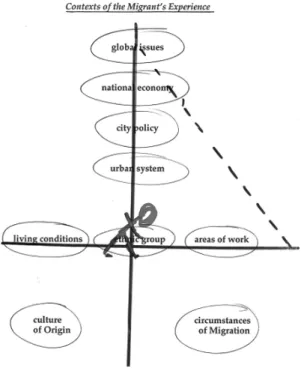
What does the real migrant make of all this? The elements of her experience are layered in Figure 1. It shows a single all-purpose migrant standing at the cross point of a vertical-horizontal axis. The vertical represents relations between that person (or ethnic group) and macro structures – laws, policies, class relations – over which they have no control. The horizontal represents lateral relations at the micro level – with neighbours, at work, out of work, in the shops, on the bus… This is the arena of negotiation, offering scope for individual agency or adaptation.
The difference between the axes is plain at the analytic level, but not so clear in real life. The diagonal line indicates possible connections between them: bureaucratic rules [on the vertical] may affect popular attitudes [on the horizontal]; social structure [on the vertical] limits the options available, and/but the individual [on the horizontal] has choice among them (as Firth 1956).
Figure 1: contexts of a migration
The host: migrant encounter has a different meaning in each context. Each context demands a response from both parties. If we could freeze-frame one context at a time, it might be possible to define a single best adaptive strategy – confrontation, negotiation, deception, assimilation – on both sides of the boundary. But the real life actor (migrant or host) may continue to be affected by other-things-happening, other obligations and identities – even when not focused on them (Wallman 1998). City life is a complex business.
3. Urban systems
Two aspects of city-ness imply a way through the complexity. One is that each city setting provides a framework of options which put at
least an outer limit on how people can make a livelihood in it. They may ‘choose’, in some sense, among the options offered, but they cannot take up options which are not there. The possibilities are enhanced and limited by the ‘capability’ of the place itself (Wallman 1997).
This applies most obviously to the economic aspects of livelihood, but getting by in the city – especially in the city – depends also on the skilful management of non-material resources like identity. And just as you cannot use job skills in a local system that has no market for them, so ethnicity (or any other identity focus) is not useful in every city setting, or for every purpose in it.
The second general point is that city settings are also social systems, made up of arenas of interaction and opportunity which operate as sub- -systems of the whole. In a systems’ perspective, everything is connected. This explains why actions rarely achieve exactly the results the actor intended. In anthropology, system: sub-system transformations are described in terms of context shift. The meaning of an action, a relationship or a resource is dependent on context and will change when that changes – just as the migrant’s experience of migration is different in each of the context-circles of Figure 1.
The systems’ perspective implicit in the holistic models of social anthropology is spelt out in other disciplines. The common general element is a distinction between more and less complex systems. Peter Senge, the management guru, distinguishes the detail complexity of so many variables that “all rational explanations are inherently incomplete”; and dynamic complexity’, recognisable “when cause and effect are not close in time and space …[when] obvious interventions do not produce expected outcomes”. We need, he says, to look for “the dynamics of the system that are obscured in the mass of detail” (Senge 1990).
Jane Jacobs essay “The kind of problem a city is” (in Jacobs 1961) explores the same complexity point but as an urban planner with cities in central focus. She makes her point by reference to the kind of problem it is not. Urban problems are commonly defined as problems of simplicity, involving a two variable, dependent: independent duo; or as problems of disorganised complexity “to which [only] statistical methods [and computers!] hold the key”. Correctly, however, they are neither. Urban problems are problems of organised complexity. Key to them is not that the number of variables is ‘moderate’ – more than two, less than two million – but that they are interrelated – as are the facts and factors of city life.
The reality is that cities present “situations in which a half dozen or several dozen quantities are all varying simultaneously and in subtly interconnected ways “. Worse: cities “do not exhibit [just] one such problem which, if solved, explains all. Because of systematic connections between them, change in or of any one level of the system changes the (local) conditions of possibility (Bourdieu 1977) and the capability of the whole (Wallman 1997). Moreover there are feedback loops throughout: change of one option creates a new outcome and in turn different options (as Barth 1972). The problems of the system, like the system itself, are decided by the nature of relationships holding it together. So are its emergent properties.
4. Modelling
This perspective sustains the assumption that, at each local level, the options for identity and livelihood, interaction and integration are framed by the boundaries of the local system. But this is ‘only’ a model. Empirical research is not so neat: the various options are in process, and the key elements of identity, interaction and boundary itself are not readily fixed to be counted or even mapped. This is the inescapable problem of model systems. Leach describes their limitations:
When the anthropologist attempts to describe a social system he necessarily describes only a model of the social reality. The model represents in effect the anthropologist’s hypothesis about ‘how the social system works’.
The different parts of the model system therefore…form a coherent whole – [the model represents] a system in equilibrium. But this does not imply that the social reality forms a coherent whole; on the contrary the reality situation is in most cases full of inconsistencies; and it is precisely these inconsistencies which can provide us with an understanding of the processes of social change.
(Leach 1954:6)6
A second problem is that so many elements of ‘the reality situation’ are invisible. Invisibility gets most attention in studies of those parts of the economic system that cannot be enumerated – i.e. of the ‘informal’ economy.7 Notably, the formal: informal difference echoes the distinction between categorical and relational data. We need to be clear that the informal is invisible not because it is not there, nor even because the economic establishment believes it is not there, but because it is not susceptible to regular quantitative measurement.
In effect, relationships are invisible to formal planning and policy only because they will not fit into hard-edged, either: or, binary categories – A or not-A (Kosko 1994:14). Anthropology, by contrast, is happy with a fuzzy perspective – A and not-A – which combines categorical and relational data. In this perspective the invisible bits become intelligible when the workings of the parent system are exposed. It is relationships which make the crucial difference between one local system and another (Wallman 1985, 2000, 2001).
Hence the variable effects of population mixture – sometimes socially good, sometimes not. Diversity is the outcome of relationships among groups in multi-cultural settings, not of multi-cultural numbers as such. The difference between them is more than semantic. I use ‘diversity’ to refer to the good’ outcome of cultural / economic/ demographic etc mixture; multiplicity is necessary to it, but not sufficient to explaining why it happens or predicting which way it will evolve. Jane Jacobs is even
6 Purists may be discomfitted by my use of Leach 1954 throughout this paper: Highland
Burma is a long way from urban Europe. But there is no better guide to the logic of abstract model systems; and anyway, at this level empirical facts are beside the point. 7
less compromising. For her, diversity of every sort is vital; without it, the urban system declines as a living place and a place to live. Homogeneity is monotony, the death of the system (Jacobs 1961:229), not just another ‘style’ of viability (pace Wallman 1985 cited).
More about this after reality checks in London and Turin.
5. The London project
The ideal type model is abstracted, as ideals are, from a mass of detail. It is a second level abstraction; the first involved identifying dimensions of one local system [here Battersea in south London] and comparing them with the same dimensions in another [Bow in east London]. See at length (Wallman 1982; 1984).
The procedure, from successive field studies to abstract model, is complicated but logical, involving a series of classifications. Even before the first level work began, observation of inner London showed that similarly mixed, low income areas can have different styles of livelihood. This was perceived [even] by ordinary people – a “folk classification”. Popular distinctions made between Battersea and Bow at that time were likely, if specified, to include reference to race relations or to the effects of economic recession, both ‘better’ in the first than in the second case.
The areas nevertheless are similar in superficial ways:8 both are dominantly working-class, low income areas with a growing sprinkling of ‘gentry’ and a visible ethnic mix. But on the basis of historic and economic review of the two boroughs, and the ethnographic study of one neighbourhood in each, we found them to have very different economic patterns and different ways of defining ‘outsiders’. Overall the Bow system comes across as homogeneous and rather closed; the Battersea system by comparison, is heterogeneous/open.
The project found ten points on which the contrast is unmistakable, and found the style of each area consistent throughout the ten dimensions. The following notes on each of them are
8
The ethnographic present here is late 1970s – early 1980s. It is likely that details of number and proportion have changed since then, but our expectation is that the characteristic styles of each area and the systematic differences between them have not.
an attempt to make [the similarities and differences] clear at the level of very superficial ethnography; the degree to which [they] can be distinguished at the level of social structure will only become apparent later on.
(Leach 1954:29)
Industrial structure is the most objective point of contrast. Battersea is made up of small firms and industries; Bow grew up round the three big industries of the London heartland – the docks, and the rag furniture trades – all now reduced in importance if not defunct, but the patterns of livelihood set by them continue.
Industrial type differs as much. In Battersea there are more service industries than manufacturing; in Bow the proportions are reversed.9
Employment opportunities follow. Three dominant industries provide a narrow range of jobs in Bow, and the redundancy of any one of them is catastrophic. Many employers/workshops/factories mean more numerous and varied opportunities; when a garage or laundry closes in Battersea, at least some of those thrown out of work will find it in similar firms that have not folded – in Battersea or further away.
Travel to work patterns are exactly opposite in the two areas: 65% of the male workforce travels out to work from Battersea; in Bow 65% work in the home borough – some close enough to walk to work,
Travel facilities match this. Public transport in and out of the East End is [still] limited; Battersea has [always] had access to all London and beyond through Clapham Junction.10
Labour movement of another kind upholds the contrast: the areas have opposite day/night population ratios. Battersea is a dormitory area; in the daytime residents move out and few outsiders commute in. Because the East End is/was an employment centre, Bow’s population is bigger in the daytime than at night.
Housing options are heterogeneous in Battersea, with varied housing stock and a mix of owner-occupation, private and public rental properties. In the Bow study area the houses are structurally identical, and in the wider borough 94% of housing is publicly owned: Bow residents have no
9
i.e., were different in the past, and despite economic etc change, are different in the present.
10 Clapham Junction, built in Victoria’s reign, was then ‘the biggest railway junction in the
chance to up/downgrade without leaving the local area; less choice in whether to buy or sell, whether and when to move.
Gatekeepers. In Battersea there are so many routes to local job and housing resources that no one person or group can control access overall. In Bow there are fewer and the likelihood of exclusive access is much greater. Ethnic niche-ing is common in Bow and rare, perhaps impossible, in Battersea.
Criteria for membership. One becomes ‘local’ to Battersea just by moving in, behaving appropriately and staying around. Belonging in Bow, in the East End tradition, is ascribed by birth, maybe by marriage, difficult even for the white English to achieve.
Finally, political traditions of the two areas are quite unlike. Battersea has a reputation for openness and heterogeneity. Its ethos is ‘internationalist’ and little interested in peoples’ origins. In 1913 it elected the first black mayor in the Anglophone world; in the 1920s it sent an Indian communist to parliament. These elections do not signify Battersea is pro-black or pro-foreign; both men were supported as local people concerned with local issues.
Bow/East End political patterns are ethnic by contrast. This is the part of London where the famous British fascist, Sir Oswald Mosley, began an effective racist campaign; it is also the part of London which stopped him. Even today it is an area where some street conflicts are unambiguously racial conflicts. In Brick Lane, once entirely Jewish and now virtually all Bengali, the National Front and the non-white population have been seen to clash as distinct groups.
6. Boundary Systems
These contrasts together imply that the more closed and homo-geneous the local structure, the less flexible will be the local economy and social style. It is not that one kind of area has no shortages and the other has many, or that one area is viable and the other is not. Whatever the level of resources, material and non-material, the crucial difference shows in the way they are managed and distributed.
The point is demonstrated when the two areas are visualised as different kinds of boundary system. In Figure 2, suppose that one ring
represents housing, another work, and the third something like social life – people I choose to spend time with.
The Battersea [Type A] structure is open because there is no neat overlap of the rings or the domains they represent, and incomers need only cross one boundary to enter the local system. In practical terms, access to [say] housing confers the right to local status – and largely without reference to the ethnic etc status of the incomer.
By contrast, in the relatively closed/homogeneous Bow structure [Type B], the domains overlap more tightly and entry is much more difficult. Local residents are11 likely to work locally in closely bounded groups, and the control of information about jobs will tend also to control access to other resources. The incomer arrow here shows that outsiders only earn local status by breaching all the boundaries together.
A B
Figure 2: Boundary systems
7. The Network Effect
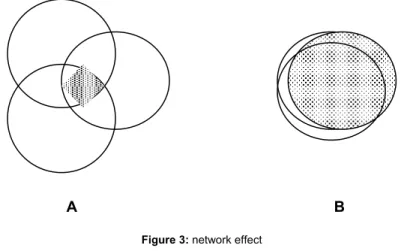
The network effect of these boundary patterns brings the contrast down to the level of interaction and [so] communication [Figure 3]. Two further essentials of the more open Battersea case [Type A] now show up. One is the core of relationships at the heart of the local system;
11
open-ness notwithstanding, the system has a strong localist identity. The other is the fact that most people have connections outside that core. And because their ties spread wider, the friends of their friends reach further and they are more able to pull in resources from other areas when the need arises. Hence the relative resilience of Type A systems in times of drastic change.
The Bow version [Type B] shows a tightly bounded local community and/but also the constraints of cosiness. When local resource domains overlap, the likelihood of interaction/communication with the wider outside, and of adapting to change, are more limited. By the same token, social relationships tend to be more multiplex and focused in discrete groups; the person you work with is also your neighbour and very likely a kinsman of some degree. Type B local systems have a [relatively] more ethnic flavour.
A B
Figure 3: network effect
Each type of model system engenders a characteristic local style. Ideal Type A is open, heterogeneous, adaptable; ideal Type B is closed, homogeneous, inflexible. The conditions giving rise to each version may be based in history, industrial structure and/or policy, but whatever their origins, the logic of social boundaries is such that one system is easier for incomers to make a home in than the other.
But here comes the caveat:
At the level of abstraction it is not difficult to distinguish one formal pattern from another. The structures which the anthropologist describes are models which exist only as logical constructions in his own mind. What is much more difficult is to relate such abstractions to the data of empirical fieldwork.
(Leach 1954:5)
The next step confirms how hard it is to apply model systems to real places:
8. Porta Palazzo
The pilot study for the Turin project was conducted in Porta Palazzo area in the historic centre. A full gamut of research methods, from broadbrush survey based on simple observation, to personal life history interview enabled quantifiable [categorical] elements and non-quantifiable [relational] elements of the local system to be mapped and layered. In the systems’ perspective they are connected and interdependent; our objective remains to see which varies with what.
For Porta Palazzo we have combinations of categorical and relational data along six dimensions – each implicated in the options offered by the place and the outcome of choices made by the people[s] in it. These dimensions can be itemised as: basic architectural forms/ housing options;12 the economy of the area/ options for work and livelihood; history of the area; livelihood and expectations of (local)13 hosts; livelihood and expectations of migrants; demography; and the networks/ niches/boundaries created by connections within the system. These dimensions echo those used to compare Battersea and Bow; the two
12
The architect responsible for the Periferia regeneration-by-participation project across Turin takes into account the form and construction of the buildings to be renovated when planning for the kind of people most appropriate to a particular part of town – whether rich/ poor, size of family or no family etc. Architecture limits the ‘capability’ of each area (Wall-man 1997).
13
sets will be integrated in a next phase of work. For present purposes, however, the style of Porta Palazzo is more effectively read off an holistic portrait of the local system, even if, as in the following paragraphs, much of it is based on ‘superficial ethnography’.
* * *
Porta Palazzo is described as one of the largest open market spaces in Europe. It is the locus of Turin’s vibrant informal economy and has ‘always’ been the reception area for in-migrants to Turin – in the 1950s as main entry point for southerners, lately for extra-communitari.14 Also, in fact or by association, Porta Palazzo is the place where stolen goods are transacted.
Italians remain in substantial majority; a good proportion of them are native to the south or are the children of southerners. They too are migrants in origin. The various groups tolerate each other in the style said to be characteristic of Turin: ‘Vicini, ma non insiemi [lit: ‘neighbours, but not together’].
Few children are seen in the area – whether through invisibility or absence will be confirmed when we amalgamate age profiles with the sex ratios of each group. The Chinese appear to live as whole families and the Italians are largely remnant elderly. Sex ratios are consistently different: data for two small census units show increases in total numbers, but little change in the male: female balance in each group.15 These differences begin to account for ethnic variation in patterns of work and residence, and so to explain why the hosts do not react the same way to all in-migrant groups (cf. Wallman 2000).
14 Migrants from outside the European Community – notably here from Africa and Eastern
Europe. 15
Amongst Albanians, there are ‘always’ between two and ten times more men than women; among Moroccans between three and 25 times as many men; and among Nigerians ‘always’ the opposite – this time between three and 25 times more women than men. Among the Chinese there are slightly more men but, consistent with high familism, they have near equal sex ratios. Successive censes show the consistency: Zone 1 in 1991 counted 20 male/2 female Albanians; 154/100 Chinese; 473/18 Moroccans; 1/4 Nigerians. In 1999 there were 71/6 Albanians; 120/105 Chinese; 230/89 Moroccans; 5/15 Nigerians. Similarly for Zone 12 not far away: in 1991 Chinese 62/48; Moroccans 292/27; Nigerians 1/25. And in 1999 Albanians 43/26; Chinese 101/91; Moroccans 498/184; Nigerians 41/87 (Osservatorio Interistituzionale sugli Stranieri in Provincia di Torino, 1999).
The restructuring of the city’s economy which followed the downsizing of FIAT’s Turin operation has deprived local workers, migrants and hosts alike, of the chance of a secure job; in a shrunken labour market there are fewer formal employment options of any kind. For some the principle constraint is lack of a residence permit, but even migrants with a full set of official documenti – indeed, even Italians themselves – are likely to be involved in unenumerated work in some way: where there are peddlers, for example, someone provisions them; and there is scope for those with legal contracts to ‘employ’ non-legal migrants. Certainly the informal economy thrives, and some make a secure livelihood within it. And just as certainly, change of the economic options disrupts patterns of competition and communication among the various groups.
A more current source of dramatic change, this time specific to Porta Palazzo, is a massive regeneration scheme. After decades in which the material fabric of the market and the surrounding streets was allowed to deteriorate, city and EU money has been made available for restoring, upgrading or rebuilding commercial and residential structures.
On the material side, the plan has included the demolition of cumbersome buildings [to be replaced by others of more suitable design], and the digging of a large underpass to carry city traffic under rather than through the square. The amenity value of these changes is obvious: the market area is more open, its magnificent architecture has come back into focus, and property values have risen accordingly.
Social aims and consequences of the regeneration are more complex. Clean-up and regeneration, like economic restructuring, changes the balance between groups. Demolishing buildings gets rid of ‘secret’ spaces and drives out the activities once hidden in them. Turin, even more than other ‘cultural capitals’, values its cultural diversity. This has been its cherished characteristic, relative to other Italian cities, since the 16th century, and is part of its appeal as host of the winter Olympics in 2006. Porta Palazzo is the city’s diversity flagship. At least for these reasons there is a general and often explicit commitment to ‘maintaining the immigrant presence’ in the area. At the same time however, and for substantially the same reasons, undesirable elements must be removed: the area is to be made cleaner, safer, healthier; in all respects ‘sanitised’.
authorities’ presence is more marked, market space is more heavily regulated. Among plainly unintended consequences are those which eat away at the desirable diversity of the area. The rental market begins to price out legitimate business of ethnic shopkeepers; the new arty boutiques, some specialising in ‘ethnic’ items, are largely owned and run by Italians. Eventually also, as local cheap-because-poor housing is improved and gentrified, rents will rise and low income migrant families will move somewhere cheaper with their children.
We do not know whether these movements will leave the local system more homogeneous, or even which measure of homogeneity/ heterogeneity to use: the emergent properties of the system are still to be understood. Importantly, their dynamic is ‘not necessarily in the realm of empirical fact; it is a question, in part at any rate, of the attitudes and ideas of particular individuals at a particular time’ (Leach 1954:286). Reviews of the livelihood and expectations of hosts and migrants are suggestive in this respect.
The local hosts represent numerous interest groups, each with its own take on past and future. Italian residents are mostly of long-standing and in remnant households. For them the area is now better because of renovation, and worse because of the migrants/drugs/danger package associated with it. The present reality is not what they remember, and the mismatch disrupts confidence and identity. Some of their hostility is directed towards the government which ‘allows’ migration and ‘panders to’ extra-communitari. The rightwing Lega Nord fuels the general anxiety.
Notionally on the other side of the boundary, important migrant groups, by categorical measures of race and number are Albanian, Chinese, Moroccan and Nigerian. The population is very diverse, but their different visibility in local and media discourse are better explained by relational effects of livelihood, migration history and culture: each ethnic group ‘gets by’ and helps/antagonises the locals in different ways. Connections are crucial to group visibility or irritant value: the local Nigerian economy is encapsulated; Moroccan livelihood involves more encounter of every sort with the host population. Expectations effect the experience of work as significantly as rates of pay. The role of sex work in the economic project of migrants, for example, is not the same for all the ethnic groups involved in it.…
140
* * *
So what kind of an urban system is this? The integrated picture of Porta Palazzo suggests open-ness and heterogeneity – an A type [Battersea] system. The fact that the elements mapped to produce it, intuitively the most crucial, are different from the ten of the original model need not impede the classification process. ‘
The same element of social structure may appear in one cultural dress in locality [X] and another…in locality [Y]… [The difference] does not necessarily imply that [the localities belong to …different social systems.
(Leach 1954:16)
For some purposes ethnographic facts are less important than the logic of the theory (Firth, in Leach 1954:vii.). For our purposes the point is that there are varieties as well as degrees of open- and closed-ness.
9. Classification
With the possibility of implicit comparison, one place with another, it is not difficult to classify a local system intuitively: – this place feels more closed, more homogeneous than that; Bow feels more closed/ homo-geneous than Battersea. Often, as in this London case, the intuitive judgement is echoed by objective measures. Similarly, the feeling that Porta Palazzo is unusually open/heterogeneous is confirmed by initial comparison with the neighbouring area of Piazza Cerignola.16 Census data reveal more children and old people; more long term residents; and a smaller proportion born outside Italy than is true for Porta Palazzo.17
It is right that the initial separation of like from unlike should be intuitive; formalising it, spelling it out, comes after. First, hunches about which differences make a difference [between one urban system and another] must be made explicit. Second, we need a key which allows the classification to be used by other people in other settings. Third,
16
This area is the doctoral research site of Patrick Hazard, Dept of Anthropology, UCL. 17
although we already know the general implications of open/closed-ness for adaptation, integration etc, the practical value of typology is limited unless we are able to specify them.
None of this can be attempted until we know the baseline position of each system on the open: closed continuum and are able to do more than guess how each is/will be affected by economic and population change. The exercise is not straightforward:
A ... model version of each …type is fairly precise, but the application of these categories to actual communities is decidedly flexible. Although the ideal types are distinct, the practical types overlap.
(Leach 1954:286)
This is amply demonstrated by the effort to classify Porta Palazzo.
* * *
The superficial description of Porta Palazzo implies open-ness and heterogeneity – at first sight an A type [Battersea] system [Figure 2]. But it is both A and not-A. The ambiguity can be visualised as a cluster of B-type circles off the open end of the scale [Figure 4]. Note that not all the miniature B-type systems are free standing. Some just touch, colliding but not relating. The likelihood of conflict, competition or integration happening across the boundaries, therefore, is very variable. One element in the currency of communication between hosts and Nigerians is prostitution; between hosts and Moroccans, drugs. The Chinese supply goods for Nigerian and Moroccan street merchants or shop-keepers to sell. Of course not all the Torinesi Chinese are in small scale commerce, not all the Nigerians – nor indeed all the hosts – are involved in prostitution, and not all the Moroccans (or the Italians!) deal in drugs. But these high-profile transactions colour each group’s image of the other and profoundly affect relations between them.
Figure 4: Porta Palazzo
These connections are not random. There ‘must’ be a logic to the processes driving them. Four possibilities suggest themselves:
Possibility [a.] It is a system evolving. In flux. Not yet integrated in a stable form. Torn apart by the disruptions of the regeneration project. The connections between the various dimensions remain malleable and the logic of the system is swinging about.18
Possibility [b.] Each of the sub-systems (imagined as separate circles) is closed, ethnic, homogeneous – a miniature version of Type B.; while the system as a whole is, or aims to be, Type A – open, heterogeneous, localist. Visualise a circle enclosing the sub-systems.
Possibility [c.] Perhaps different dimensions of the system are in different places on the open-to-closed scale. Previous research in Kampala found men’s relation to the local is open, women’s relatively closed (Wallman 1996 a,b). Perhaps here the subsystem /system levels have opposite styles – i.e. small homogeneous circles inside a hetero-geneous whole.
Possibility [d.] It is a prior or nascent form of Type A, made chaotic by the disruptions of regeneration, but moving systematically away from entropy towards organisation. This development towards A-ness is
18 All systems are ‘moving’, not static but in process. Their logic however is consistent. The
endogenous, but equally may be subject to ‘assistance’ from outside: Type A, after all, is politically desirable. In the real life Porta Palazzo scenario, it will be in the interest of the city government, the Gate Project, the Olympic committee, and of shopkeepers and residents in the area to avoid the extremes of pre-A chaos [version a.] and the perpetuation of multiple separate and unintegrated B types [version b].
Different operational decisions follow from each scenario. What kinds of intervention does it take to move the system in the direction desired? How much force can government planners, politicians and the like exert on it without offending important constituents, creating a backlash, or simply feeling bad about what they do?19 And, for the anthropologist, how can the dynamic behind a mass of detail be made plain?
10. Pruning
The bi-polar model allows each system to have a ‘diversity score’ read off its position on the continuum between open and closed extremes. But the anomaly of Porta Palazzo confirms the need to account also for urban process. The position score is an as-if fixed ranking of one system against others; connections between its separate dimensions make it a system in process and decide its emergent properties.
A visual image is a data set made manageable by pruning. The eye selects from it what the brain is looking for. The same goes for mental images of a local system.
Which types of information among the many available must I retain so the system has the sense I need? Which characteristics/ dimensions/ vectors make the significant difference between one system and another? This is not a two-variable problem amenable to typological classification. But how many variables are enough? And which of them is ‘best’ for the polythetic nuances we need? (Needham 1975).
The computer of course can handle any number of variables, but this classification is not in the binary form it can deal with. Systems of relationships are known by inference, not by counting. In the Porta
19
Harding (2000) writes of the no win situation of a democratic government need, when dealing with large influx of desperate people to be liberal enough for some voters and hard line enough for others.
Palazzo study a couple of dozen dimensions were mapped, then boiled down to six on the grounds that any more would be hard to manage and harder to grasp. Yet even these six are not right for a general typology; they represent Porta Palazzo well enough, but some of them apply uniquely to that local system – just as some of the ten dimensions of the Battersea: Bow contrast are peculiar to it. The set of features defining openness in Battersea is not the same as the set defining openness in Porta Palazzo. Nevertheless, in polythetic mode, they can be compared; there are “family resemblances” (Needham 1975:350-1) which justify putting them together in a fuzzy-edged, open[ish] class.
Progress in the typology project now demands a leap to questions provoked less by observation of local areas than by the hypothesis which underpins our models of them. Images can be compressed and details pruned down in the light of it. A good starting point still is the pruned image of the Battersea: Bow, open: closed contrast. It is this image which makes the difference between the two areas intelligible as systems. Key to it is the extent to which identity and economic contexts of livelihood overlap. In polythetic mode, the classification project suddenly becomes more interesting: “[in groups classified polythetically] the points of resemblance are not cultural particulars, but analytic abstractions” (Needham 1975:361) – for my purposes, relationships and the contexts which frame them.
Figure 5: scales of open/closed
Ultimately the three scores need to be brought back together and their connections within that particular system indicated. The cumulated score ranks the system [as though] in stasis; the interrelationship of the separate dimensions makes it a system in process. These relationships decide what will happen next – i.e. the system’s emergent properties – and they are keys to its classification.
11: Revision?
This procedure is one way to type Porta Palazzo as a system. Its peculiar dynamic can be charted as movement[s] between open and closed ends of the basic Battersea:Bow, A:B continuum. But even layered scoring will not account for the sense of it being off-scale, beyond A and yet not B. Would it help to postulate a third type? To revise the model? In Figure 4 the ‘chaos’ of Porta Palazzo becomes intelligible as the open, left hand extreme of the continuum. Bow remains the prototype closed, right hand extreme, but Battersea now represents an equilibrium mid-point. In this position the significance of heterogeneity with a localist central core is appreciated.
[closed]
[open]
A B
Where on the scale? Moving wich way? Figure 6: the model revised
This new version affirms that it is the ‘invisible’ interrelations among component parts, not simply the nature of the parts themselves, which make a local system and can serve to distinguish one type from another. It also brings the discussion back to the issue of diversity itself. Where is it in the model? What is it in the city?
Either the open: closed continuum is a styles of diversity index, driven by differences in the ways that similarly mixed populations manage their mixture. Or diversity is at one end of the scale, and the continuum measures more or less of it, not different kinds. A third option emerges from systems’ logic; diversity is a delicate equilibrium moment which happens only when all the necessary elements coincide.20
This point reprises Jane Jacobs’ credo [ibid.p.229]. Diversity as she recommends it is indeed Type A – open, mixed, but including the crucial solid core of interrelatedness. Open-ness without these connections is unstable chaos. In her view, interventions in Porta Palazzo should be designed to nudge the evolving system towards the diversity-as-equilibrium mid-point – now Type A in Figure VI.
20
Conclusion
So much for the model. Reality, of course, is not that neat; not really a coherent whole. On the contrary [here’s Leach again], the reality situation is in most cases full of inconsistencies… What’s more, he says, they are grounds for analytic optimism: it is precisely these inconsistencies which can provide […] understanding of the processes of social change. (Leach 1954:6) I continue to trust that he is right.
My contention is that the outcome of migration into any cityscape is decided as much by the urban system which drives it as by the cultures and motivations of the people living or trying to live in it. But the point can be turned around: each package of culture and motivation fits one kind of urban system better than another; different kinds of migrant thrive in and are drawn to different kinds of place. The opposite attractions of open and closed-ness imply opposite strategies of social capital management. In Putnam’s typology, bonding social capital is inward looking, invested to reinforce exclusive identities and homogeneous groups; bridging social capital is spent in inclusive ways, aiming to encompass people ‘outside’ (Putnam 2000:184). In his view, as in mine, there is no all purpose ‘best case’.
The London/Turin material sustains the point. London’s East End history is built on successions of incomers who use ethnicity for group identity, and to organise work and social life – first Huguenots, then Jews, lately Bengalis – always tightly identified, exclusionist groups, well-suited to closed, Bow-type B systems. The dominant public culture of Battersea-type A systems, on the contrary, is localist. They tend to be home to people, like West Indians and the Irish, who use their minority status in individualistic ways and are comfortable in a-ethnic settings. It is not that ethnicity never shows in such places, only that its locus will be households, families, persons – always private ethnic cultures which can be absorbed by ‘compression’ into the localist whole.
And by the same logic, the ‘chaos’ of Porta Palazzo offers optimal scope for dipping and diving in the informal economy, legitimate and/or criminal. In entropic form [Fig. 5] it is the ideal home for street vendors, brokers, traffikers – anyone with a livelihood that flourishes ‘invisible’ in the cracks of place and structure.
148
According to the dynamic of systems, chaos evolves into orga-nisation, and Porta Palazzo will have its equilibrium moment. But the people thriving in it now may like it less when the planners make it ‘better’, even if their children find the order amenable. Similarly, at the closed extreme of the continuum, first and second generation migrants often have painfully different ideals of city-ness. Incomers who miss the home they left will seek and foster boundaries which keep ‘us’ in and ‘them’ out – despite the extra risk of discrimination brought by ethnic exclusivity. (Freedman 1962). But their children are more likely to want wider-than-ethnic opportunities and identities, and to feel at home where ‘others’ and other-ness can be absorbed.
The group’s choice of one kind of system over another has implications for personal identity and ethnic survival. The spoken concern, inside and outside the migrant group, is numbers: migrants hope for a demographic pool big enough to keep the young marrying in; the host society worries about being swamped. More likely the key is social networks. Looking inward, ethnicity needs others of its kind; “Jews need other Jews in order to be Jews” (Ritterband 2000:227); looking out, the content and reach of links with anyone ‘not-Us’ decide whether the boundaries of the group persist or fade, exclude or absorb; whether the individual stays or goes.
There is only one firm conclusion: identity patterns which determine the exclusion/inclusion of migrants in cities is never just about population mix. Local styles of diversity are not simple functions of cultural emblems, multi-cultural presence or rates of familism, The city is not a two variable problem: the effects of change in numbers or proportions of demographic/ ethnic/economic categories in the population is decided by their relation to other categories and by other things happening in the system. Paraphrasing Jacobs: The key to urban problems is not the variables as such; it is their interrelationship.
So much we know. But answers to the questions I began with remain tentative:
will need to be more than usually deductive; with models based on explicit comparison and some brave hypotheses about context and connections, it is possible – I think in a matter of weeks – to map the essential patterning of relationships in a given area.
Could [this classification] be made the basis of a user-friendly yet reliable guide to the integration of migrants in cities? Again, we need to try; and again, the answer is “Maybe”. Practitioners want each system type to have a limited and clearly defined set of characteristics, and every actual system to have, or not to have, the full set. But similarities between real urban systems are more like resemblances among family members: two of the four have Dad’s ears, but only one of them has his colouring; the other throws back to Grandma’s red hair. One of the two has the same knees as number four…etc. In families, the specifics are of no interest as long as Junior looks ‘sort of’ like us. But classification of urban systems needs prior decisions about which relationships, in which combinations, are definitive. This will depend on comparative work before the event.
On this point the last word belongs with Evans-Pritchard, said (by Needham 1975:365) to have quipped: “There is only one method in social anthropology, the comparative method – and that’s impossible.” For present purposes I take this to mean that we learn nothing if we compare only the categorical dimensions of cities and leave systems of relationship out of account. Anthropology can – must – do better than that.
References
ARCHAMBAULT, Edith, & GREFFE, Xavier. (eds.). (1984). Les economies non officielles. Paris: Editions La Decouverte
BACK, Les. (1996). New Ethnicities &Urban Culture: racisms & multiculture in young lives. London: UCL Press
BARTH, Fredrik. (1972). Analytical Discussions in the Comparison of Social Organisations. In: American Anthropologist74: pp207-20
BAUMANN, G. (1996). Contesting Culture: discourses of identity in multi-ethnic London. Cambridge: Cambridge U.P.
BERGER, John . & Mohr, J. (1975). The Seventh Man. Harmondsworth: Penguin
BOURDIEU, Pierre. (1977). Outline of a Theory of Practice. Cambridge: Studies in Social Anthropology
COHEN, Anthony P., & FUKUI, Katsuyoshi. (1993). Humanising the City: social contexts of urban life at the turn of the millenium. Edinburgh: Edinburgh University Press
EPSTEIN, A.L. [1967]. The Craft of Social Anthropology. London: Tavistock.
FIRTH, Raymond. (1956). Elements of Social Organisation . London: Watts.
(1985) ‘Intelligibility’. In Overing, J. (ed.). Reason and Morality A.S.A. Monograph.
FREEDMAN, Maurice. [1962]. The Jewish Population of Great Britain.In: Jewish J. of Sociology Vol 4. June.
GANS, Herbert. (1962). The Urban Villagers. New York: Free Press
GERSHUNY, J.I. (1983). Social Innovation and the Division of Labour. Oxford: O.U.P.
GREGORY, C.A. & ALTMAN, J.C. (1989). Observing the Economy. A.S.A. Research Methods. London: Routledge
HANNERZ, Ulf. (1969). Soulside. New York: Columbia University Press
(1980). Exploring the City: inquiries toward an urban anthropology. NY, Columbia UP
(1992). Cultural Complexity studies in the social organisation of meaning. NY, Columbia UP
HARDING, Jeremy. (2000). The Uninvited: refugees at the rich man’s gate. London: Profile Books.
HARDING, P. & JENKINS, R. (eds.). (1989). The Myth of the Hidden Economy: towards a new understanding of informal economic activity. Milton Keynes, UK: Open University Press
HART, Keith (1973). Informal Income Opportunities and Urban Employment in Ghana.In:
Journal of Modern African Studies 11: pp61-89
JACOBS, Jane. (1961). The Death and Life of Great American Cities. NY, Vintage Books
JOHNSON, Steven, (2001), Emergence: the connected lives of ants, brains, cities and software. N.Y: Touchstone.
KOSKO, Bart, (1994), Fuzzy Thinking: the new science of fuzzy logic. London: Flamingo
LIEBOW, Elliot, (1967). Tally’s Corner. London: Routledge & Kegan Paul
LEACH, Edmund, (1954). Political Systems of Highland Burma. London: Bell.
NEEDHAM, R. (1975).Polythetic Classification: convergence & consequences. In: MAN [NS]10. pp349-369.
PAINE , Robert. (1992). The Marabar Caves, 1920-2020. In: Wallman [ed.] Contemporary
Futures. A.S.A. monograph no. 30: pp190-207
PUTNAM, Robert. (2000). Bowling Alone: the collapse and revival of American Community. N.Y.: Simon and Schuster.
RAPPORT, Nigel & DAWSON, Andrew (eds.). (1998). Migrants of Identity: perceptions of Home
in a world of movement. Oxford: Berg
RITTERBAND, Paul P. (2000). In Jack Wertheimer, (ed.). Jews in the Center: Conservative Synagogues & their Members. New Brunswick: Rutgers U.P.
SENGE, Peter. (1990). The Fifth Discipline. London: Century Business
SAID, Edward. (1989). Representing the Colonised: anthropology’s interlocutors. In: Critical Inquiry. 15winter. pp 205-225.
TAYLOR, Mark. (2002). The Moment of Complexity: emerging network culture. Chicago: Chicago U.P.
WALLMAN, Sandra. (1979). The Boundaries of ‘Race: processes of ethnicity in England.In: MAN [N.S.] 13: pp200-17
(1982). Living in South London: perspectives on Battersea 1871-1981 Gower Press/L.S.E
(1984). Eight London Households. London: Tavistock
(1985) Success and Failure in the Inner City.In: Town & Country Planning. Vol. 54, No 12 pp360-361
(1996a). Kampala Women Getting By: wellbeing in the time of AIDS. London: James Currey; Kampala: Fountain Press; Athens, USA: Ohio University Press
(1996b). Ethnicity, Work and Localism: narratives of difference in London and Kampala. In: Ethnic and Racial Studies 19: 1 pp 1-28
(1997) Appropriate Anthropology and the Risky Inspiration of Capability Brown’. In: James, Allison, Hockey, Jenny & Dawson, Andrew. (eds.). After Writing Culture. ASA monograph no. 34. pp 244-263.
(1998). Ordinary Women and Shapes of Knowledge: perspectives on the context of STD and AIDS.In: J.Public Understanding of Science 7:pp169-185
(2000). New Elements in the Migration Experience [Anthropological Perspectives]. In: Etnoantropologia 8/9 Special Issue: Migrazioni e dinamiche dei contatti interculturali. pp19-30
(2001). Global Threats, Local Options, Personal Risk. In: J. Health, Risk & Society Vol. 3, No:1. pp75-87
WHYTE, William. (1943). Street Corner Society. Chicago: University of Chicago Press