Article
0103 - 5053 $6.00+0.00
*e-mail: [email protected]
Transition Metal Oxide Nanopowder and Ionic Liquid: an Eficient System for the
Synthesis of Diorganyl Selenides, Selenocysteine and Derivatives
Senthil Narayanaperumal,a Kashif Gul,a Cristiane Y. Kawasoko,a Devender Singh,a,b
Luciano Dornelles,a Oscar E. D. Rodrigues*,a and Antonio L. Bragab
aLabSelen-NanoBio, Departamento de Química, Universidade Federal de Santa Maria,
97105-900 Santa Maria-RS, Brazil
bLabSelen, Departamento de Química, Universidade Federal de Santa Catarina,
88040-900 Florianópolis-SC, Brazil
Neste trabalho foi desenvolvido um método eiciente para a síntese de selenetos de diorganoíla e β-seleno aminas empregando Zn, quantidades catalíticas de ZnO nanoestruturado e líquidos iônicos (LI) como solventes recicláveis. Este sistema ZnO/LI apresentou alta eiciência nesta transformação, levando à formação dos produtos desejados em bons rendimentos.
We have developed an eficient method for the synthesis of diorganyl selenides and β-seleno amines using Zn, catalytic amounts of ZnO nanopowder, as a catalyst and ionic liquid as a recyclable solvent. This ZnO/ionic liquid system shows high eficiency in catalyzing these transformations with the formation of the desired products in high yields.
Keywords: synthesis, nanocatalysis, ionic liquids, selenium, selenocysteine, selenides
Introduction
The attention gained by organoselenides has been driven by the potential applications of selenium compounds in modern organic syntheses and asymmetric catalysis.1,2 Their importance stems from the prevalence of C−Se bonds in compounds with biological and pharmaceutical impact, e.g., selenocarbo-hydrates,3 selenoamino acids4 and selenopeptides.5 This class of molecules performs multiple therapeutic functions of great importance, for example, in antiviral to anticancer agents and in a variety of situations where free radicals are involved.6
Organoselenium compounds are important synthetic intermediates, and the formation of symmetrical and unsymmetrical diorganyl selenides is an area of intense research. In general, diselenide bond cleavage is carried out employing common reducing agents and expensive metal sources, as depicted in Scheme 1.7,8 Furthermore, reductive cleavage achieved by CsOH,7 ArB(OH)
2/CuI 8 and photochemical reactions7 has been reported in a substantial number of previous studies.
Reactions catalyzed by transition metal complexes have made a great contribution to the recent advances in relation to the cross-coupling reactions of diaryl diselenides with aryl halides.9-12 However, most of the methods available to synthesize diorganyl selenides have serious disadvantages including: i) the use of expensive metal sources and Scheme 1. General methodology for the synthesis of diorganyl selenides.
[Cu], bpy DMF, 110 oC
In, CH2Cl2
reflux La, I2, 5 h
THF, 67 oC,
Na, NH
3
Yb, THF, r.t.
InI, CH 2Cl
2
cat.RhCl(PPh 3)3
H2,THF-Et 3N,
50 oC
Se R
SmI
2, THF
R= Alkyl, Aryl ref 8
ref 7
ref 7 ref 7
ref 8
ref 8
ref 8
ref 8 Se Se
NaBH
4
, r.t.
ref 7
ref 7
LiAlH
4
reagents such as La, Yb, In, InI, and SmI2, etc.; ii) handling dificulties; iii) functional group incompatibility; iv) dificult work-up procedures; v) harsh reaction conditions, such as the use of strong acids or bases and vi) high temperatures or long reaction times. Thus, there is still considerable interest in the development of highly eficient methods for this transformation.13 Designing new speciic catalysts and exploring their catalytic activity can have signiicant effects on optimizing the eficiency of a wide range of organic synthesis techniques, and has resulted in more economical and environmentally-friendly chemical processes through the replacement of nonselective, unstable or expensive catalysts.
Nanotechnology is an emerging approach towards synthetic organic chemistry, particularly the area of nano-catalyzed organic transformations. Nano-catalysis can be considered as a bridge between homogeneous and heterogeneous catalysis. Because of the nano-size, i.e.,high surface area, the contact between reactants and catalysts increases dramatically and the latter can operate in the same manner as homogeneous catalysts (close to homogeneous catalysis). Also, due to their insolubility in the reaction solvent, they can be easily removed from the reaction mixture. Thus, nano-materials can combine the advantages of both systems and can offer unique activity with high selectivity. The recent availability of various high-purity metal oxides in nanoscale has allowed the improvement of cross-coupling reactions catalyzed by transition metal nanoparticles in the presence of a base. For this reason, signiicant progress has been made in this area14-19 and, as a result of their high catalytic activity, transition metal nanoparticles have been widely used as catalysts for organic synthesis. In spite of the effectiveness of these methods, the requirements of high temperatures,20 high catalyst loadings and specially designed ligands has prompted a search for new methods.
Ionic liquids (ILs) are organic salts with a low melting point, composed solely of cations and anions, which makes them highly tunable for speciic applications.21,22 These ILs properties have a large number of applications. Moreover, ILs have received considerable attention due to their ability to serve as effective reaction media for a wide range of organic reactions and other applications in chemistry.23 By modifying the structure of the cations or anions of ionic liquids, their properties can be tuning in order to perform certain reactions.
On account of these aspectsand in connection with our ongoing interest in the synthesis and evaluation of organochalcogen derivatives,24 our group has focused on the use of ionic liquids as mild and recyclable media, and on the use of metal oxide nanoparticles for the effective synthesis of unsymmetrical diorganyl selenides.
Results and Discussion
We recently reported an eco-friendly cross-coupling of diaryl diselenides with aryl and alkyl bromides catalyzed by CuO nanopowder in an ionic liquid (Scheme 2).25
Some previous protocol reported in the literature for the synthesis of diaryl selenides using CuO nanoparticles15 has some shortcomings,such as long reaction times and high temperatures, limiting the scope of the reaction to substrates that can withstand these harsh reaction conditions. Moreover, the use of solvents such as DMSO is undesirable from an environmental point of view.
With the use of an ionic liquid instead of DMSO as the solvent, the conversion rates were accelerated and higher yields were obtained.The developed methodologyoffers a clean, eco-friendly, inexpensive and eficient approach to obtaining diaryl or alkyl aryl selenides from alkyl or aryl halides with diaryl diselenides using CuO nanopowder in an ionic liquid. In the search for a ‘greener’ protocol, the recyclability of ILs was studied. After the work-up, the catalyst CuO nanopowder was removed from the BMIM-BF4 by iltration and the recovered ionic liquid was used again for the next coupling reactions.This operation was repeated at least three times without signiicant loss of eficiency, as shown in Figure 1.
The features of this method include the following: (i) use of easily accessible alkylating agents; (ii) use of low catalyst loads; and (iii) use of a recyclable solvent. Scheme 2.CuO nanopowder catalyzed cross-coupling of organic halides with diaryl diselenides.
R = aryl
R1 = alkyl or aryl
RSe Se R R1Se R
R1 Br
0.5
0.5 mol% CuO nano
BMIM-BF4, 2 equiv. KOH r.t., 60 min
Moreover, CuO nanoparticles (NPs) have been employed as a mediator, as an eficient and recyclable catalyst for cross-coupling reactions of organic diselenides with aryl boronic acids (Scheme 3).26 Generally, this kind of reaction involves particularly speciic ligands which limiting the scope of potential applications.
These ligand-free cross-coupling reactions of organic diselenides with aryl boronic acids using a catalytic amount of CuO nanoparticles in DMSO at 100 0C under air atmosphere afford the corresponding products in good to excellent yields. The catalyst can be easily recovered and utilized for further catalytic reactions, as depicted in Figure 2.
A more complex challenge in organoselenium chemistry is the development of new methods for the introduction of selenium-containing groups into organic molecules, particularly in a stereo-controlled manner. Due to the potentially synthetic importance of chiral β-seleno amines, particularly given the biological activity of selenocysteine and their derivatives, some approaches aiming at their synthesis have been documented in recent years.4
In general, the synthesis of chiral β-seleno amines and selenocysteine derivatives has been carried out through
aziridine ring opening, though the procedures often require basic or acid reaction conditions and the use of organic solvents which are undesirable from an environmental point of view (Scheme 4).27
In the search for an effective, mild and reusable reaction medium and in connection with our ongoing research, we combined here the introduction of a selenium-moiety in a stereoselective way with the use of a new and innovative ZnO28 nanopowder in ionic liquid. A series of β-seleno amines were synthesized from N-protected β-amino mesylates mediated by Zn in ionic liquid catalyzed by ZnO nanoparticles, as shown in Scheme 5.
In an attempt to optimize the protocol and increase its eficiency, several components were studied in order to understand the inluence of the different variables on this reaction. In a irst set of experiments, we studied the inluence of different ionic liquids (Figure 3).
For this, a standard condition was employed: β-amino mesylate 1a (2.0 equiv.) was treated with diphenyl diselenide (1.0 equiv.) in the presence of 10 mol% of ZnO nanopowder and commercially available Zn dust (1.6 equiv.) in ionic liquid (0.5 mL) for 2 h, under room temperature. The results are summarized in Table 1. Scheme 3.CuO nanopowder catalyzedcross-coupling of diphenyl
diselenide with aryl boronic acids.
RSe Se CuO NPs (3%) Ar Se R
DMSO 100 oC, 24 h
air
75-98%
R = Aryl and Alkyl Ar = Aryl
R + Ar B(OH)2
Figure 2. Reuse of CuO. a Reaction performed in the presence of diselenide
(0.5 mmol), aryl boronic acid (1.5 equiv.), 3 mol% of CuO NPs and DMSO (1 mL). b Recovered catalyst used. Yields are given for isolated products.
Scheme 4. Synthesis of chiral β-seleno amines from aziridine ring opening.
N
R1
R2
R1
SeR R1
SeR
SeR
NHR2
NH2
NHR2
Yields: 65-90% Yields: 35-83%
Yields: 60-98%
RSe
2 / Zn o
HCl / Et 2O RSe
2 / NaBH
4 THF / EtOH
RSe2
InI CH2Cl2
R1
Scheme 5. Synthesis of chiral β-seleno amines catalyzed by ZnO nanopowder using Zn in ionic liquid.
X = OMs, OTs PG= Boc, Ts
R =Bn, i-Pr, i-Bu R1= Ph,
p-Cl-C6H4, p-Me-C6H4 R
NH
X R
SeR1
BMIM-BF4 r.t. R1SeSeR1
Zn Nano ZnO
GP NH
It can be observed in Table 1 that the desired product was obtained in all ILs, and that BMIM-BF4 is the best solvent for this reaction affording the respective compound 2a in 87% yield (entry 1).
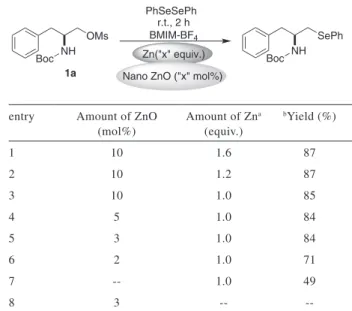
The amount of Zn and catalyst ZnO(nano) required to promote the reaction was also studied. Reactions with 1.6, 1.2 and 1.0 equiv. of zinc showed similar results, leading to the product in excellent yields (Table 2, entries 1-3).
We found that the amount of ZnO nanopowder inluenced the product formation. No signiicant difference was observed using 10.0 or 3 mol% of ZnO nanopowder, affording the product in similar yields (87 and 84% respectively, entries 1-5). However, when the amount of ZnO nanopowder was decreased to 2 mol%, the desired product was obtained in lower eficiency, yielding 71% (Table 2, entry 6). In the absence of ZnO nanopowder the yield was only 49% (Table 2, entry 7) and no product was observed in the absence of Zn (Table 2, entry 8). Thus, a combination of Zn dust and ZnO nanopowder is an effective system for this reaction, increasing signiicantly the yields.
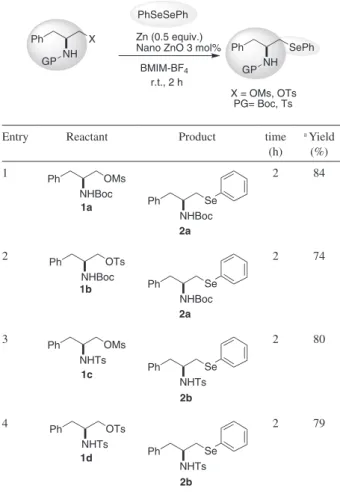
The effects of the leaving and the N-protecting groups on the starting materials were then investigated, as shown
in Table 3. L-phenylalaninol derivatives (mesylate and tosylate) were employed as standard amino alcohol derivatives and different protecting groups (Boc and Ts) were used in order to check their inluence on the course of the reaction.
It was veriied that the reaction was not strongly affected by these variables, as can be seen in Table 3. For instance, when tosylate was used as the leaving group, the respective β-seleno amines were obtained in good yields, regardless of the N-protecting group (Table 3, entries 3 and 4). Although the effect of the leaving group was not so pronounced, it was observed that mesylates afforded slightly better yields than tosylates (Table 3, entries 1 and 3). These results show the versatility of this methodology, allowing the eficient conversion of the respective compound 1 with different leaving groups (mesylates and tosylates) to chiral β-seleno amines applying a mild and effective protocol.
The optimization process revealed that the best combination for the synthesis of chiral β-seleno amines is 0.5 equiv. of diaryl diselenide, 1 equiv. of the mesylate 1, 3 mol% of ZnO nanopowder, 0.5 equiv. of Zn dust and 0.5 mL of BMIM-BF4 at room temperature.
The next step was to extend the methodology to a variety of chiral β-seleno amines from β-amino mesylates derived from L-valine, L-leucine and L-isoleucine, as summarized in Table 4.
Analyzing the Table 4, it was possible to verify that the “R” group derived from the corresponding amino acids had no signiicant effect on the course of the reaction, affording the desired chiral β-seleno amines in similar yields (Table 4, entries 1-6).
Figure 3 Room temperature ionic liquids.
Table 1. Effect of ionic liquid for the synthesis of β-seleno amine
NH
OMs SePh
NH r.t., 2 h
PhSeSePh Zn(1.6 equiv.)
dNano ZnO (10 mol%)
Boc Boc
Ionic Liquid
entry aIonic Liquid bYield (%)
1 BMIM-BF4 87
2 BMMIM-BF4 59
3 BMIM-PF6 67
4 BMIM-NTf2 26
5 BPy-BF4 64
aIonic liquids were prepared using a procedure available in the literature23
and subjected to vacuum conditions before use. b Yields refer to pure
isolated products characterized by 1H and 13C NMR.
Table 2. Optimization of Zn dust and nano ZnO catalyst
NH
OMs SePh
NH r.t., 2 h
PhSeSePh
Zn("x" equiv.)
Boc Boc
BMIM-BF4
Nano ZnO ("x" mol%) 1a
entry Amount of ZnO (mol%)
Amount of Zna
(equiv.)
bYield (%)
1 10 1.6 87
2 10 1.2 87
3 10 1.0 85
4 5 1.0 84
5 3 1.0 84
6 2 1.0 71
7 -- 1.0 49
8 3 --
--aRelated to the diselenide. bYields refer to pure isolated products
In the case of the R1 group from diselenide, the presence of an electron donating or withdrawing group (methyl and chloro, respectively) attached to the aromatic
ring inluences the course of the reaction. For instance, the presence of the electron withdrawing chloro atom allowed the desired product 2i to be obtained in high yield (91%). On the other hand, the electron donating methyl group afforded the product 2j in more moderate yield (85%) (Table 4, entries 7 and 8). These results could be rationalized due to the Se-Se cleavage in the p-chloro diselenide occurring more easily in the formation of the selenolate in the former case.
To check the scope of our methodology, we subjected the developed protocol to a more complex system. A biologically active selenocysteine4 derivative was synthesized from the corresponding β-amino mesylate. The reaction afforded the product in 78% yield, showing the versatility of the methodology in the presence of more complex functionalities (Scheme 6).
As reported in a previous publication, Zn dust is able to reduce PhSeSePh, allowing the formation of the reactive zinc selenolate, PhSeZnSePh.21 This active specie would enable the formation of the desired product. Although an improved yield was observed on using the ZnO catalyst, the precise reason for this behavior is still an intriguing subject of study. The Lewis acid ability of ZnO is well established in the literature29 and this may lead to an increased leaving group ability of the respective mesylates, enhancing the reaction process and affording the desired products in more effective yields.
An important feature of ionic liquids is that they can be reused and this aspect was thus veriied in this study. The data shown in Figure 4 illustrate that the medium could be reused at least three times without appreciable loss of eficiency in the synthesis of chiral β-seleno amines. Another attractive feature of this protocol would be the recovery of the ZnO. However, unfortunately, all attempts in this respect failed due the contamination of the catalyst with the Zn dust.
In summary, herein we have described an eficient, mild, and high yielding methodology for the preparation of chiral β-amino selenides from the corresponding β-amino mesylates and tosylates. The products were obtained by employing different amino acid moieties and protecting Table 3. Effects of protecting and leaving groups
X = OMs, OTs PG= Boc, Ts NH
X
SePh
BMIM-BF4
r.t., 2 h PhSeSePh
Zn (0.5 equiv.) Nano ZnO 3 mol%
GP NH
GP Ph
Ph
Entry Reactant Product time
(h)
a Yield
(%) 1
1a
Ph
NHBoc OMs
2a
Ph
NHBoc
Se
2 84
2 Ph
NHBoc
OTs
1b
2a Ph
NHBoc
Se
2 74
3 Ph
NHTs OMs
1c
2b
Ph
NHTs Se
2 80
4 Ph
NHTs OTs
1d
2b
Ph
NHTs Se
2 79
a Yields refer to pure isolated products characterized by 1H and 13C NMR.
Table 4. Synthesis of chiral β-seleno amines catalyzed by ZnO nanopowder using Zn in ionic liquid
R
NH OMs
R
SeR1
NH
BMIM-BF4
r.t., 2 h
R1SeSeR1
Zn (0.5 equiv.) Nano ZnO 3 mol%
GP GP
1a-j 2a-j
entry R Reactant PG R1 Product aYield
(%)
1 1e Boc Ph 2c 72
2 1f Ts Ph 2d 85
3 1g Boc Ph 2e 79
4 1h Ts Ph 2f 82
5 1i Boc Ph 2g 68
6 1j Ts Ph 2h 77
7 1a Boc p-Cl-C6H4 2i 91
8 1a Boc p-Me-C6H4 2j 85
a Yields refer to pure isolated products characterized by 1H and 13C NMR.
Scheme 6. Synthesis of selenocysteine derivatives.
NH
OMs Se
NH
BMIM-BF4
r.t., 2 h Zn (0.5 equiv.) Nano ZnO 3 mol%
Boc O
O
O O
Boc Se
Se
groups. The use of BMIM-BF4 led to a higher performance, with the advantage that it can be reused in up to three successive runs.
The combined use of ionic liquids and metal oxide nanoparticles for the synthesis of organoselenium compounds offers great potential for rapid and easily accessible developments in this area, due to the eficient, economical and easily performed operations. Intensive studies in this area are in progress in our laboratory.
Experimental
General procedures
1H and 13C NMR spectra were recorded at 200 and 400 MHz, respectively, with tetramethylsilane as the internal standard; chemical shifts given as ppm. Column chromatography was performed using Merck Silica Gel (230-400 mesh). Thin layer chromatography (TLC) was performed using Merck Silica Gel GF254, 0.25 mm thickness. For visualization, TLC plates were either placed under ultraviolet light, or stained with iodine vapor, or vanillin acid. All other solvents were used as purchased unless otherwise noted. 1H and 13C NMR spectral data of the compounds are identical to those previously reported.4,5,27
General procedure for the preparation of N-protected amino mesylate (1a-k)30
A stirred solution of the appropriate N-protected amino alcohol (5 mmol) was dissolved in DCM (15 mL), followed
by the addition of Et3N (1.2 equiv.), and the reaction mixture was kept at 0 °C. Mesyl chloride (1.2 equiv.) dissolved in 15 mL of DCM was then added dropwise over 30 min at 0 ºC and stirred for 2 h. After completion of the reaction, the solvent was evaporated and extracted with 5% NaHCO3 (40 mL), ethyl acetate, and sat. NaCl and dried over MgSO4, which afforded the crude product. All products were recrystallized from EtOAc/hexanes and obtained as white luffy crystals.
General procedure for the synthesis of 2a-k
In a Schlenk lask, under argon atmosphere, diselenide (0.5 mmol) and Zn (0.5 mmol) were stirred in BMIM-BF4 (0.5 mL) at room temperature for 1-2 min. The mesylate 1 (1 mmol) and 3 mol% of ZnO nanoparticles were then added and stirred for 2 h at room temperature. After completion of the reaction (monitored by TLC) the β-seleno amines were extracted from BMIM-BF4 using Et2O (3 × 10 mL) and dried over MgSO4. The solvent was then removed, yielding the crude products 2a-k, which were puriied by column chromatography.
Representative experimental procedure for BMIM-BF
4
reuse
After the work-up of the irst run, BMIM-BF4 was diluted in ethanol and iltered through a Celite pad to remove the inorganic materials followed by concentration to remove the organic solvents, and subjected to vacuum conditions for one hour to eliminate the moisture and traces of organic solvents. For the following runs the recovered ionic liquid was used after addition of 0.5 equiv. of Zn, 0.5 equiv. of diphenyl diselenide, 1.0 equiv. of mesylate 1 and nano-ZnO (3 mol%).
(S)-tert-Butyl-1-phenyl-3-(phenylselanyl)propan-2-yl carbamate (2a)5
1H NMR (400 MHz, CDCl
3) d 7.50-7.40 (m, 2H), 7.39-7.12 (m, 8H), 4.68 (br s, 1H), 4.09-4.07 (m, 1H), 3.02-2.98 (m, 2H), 2.87-2.82 (m, 2H), 1.38 (s, 9H). 13C NMR (100 MHz, CDCl3) d 154.80, 137.40, 132.43, 129.89, 129.10, 128.90, 128.16, 126.71, 126.20, 78.90, 51.42, 40.10, 32.50, 28.07.
(S)-4-Methyl-N-(1-phenyl-3-(phenylselanyl)propan-2-yl) benzenesulfonamide (2b)27
1H NMR (400 MHz, CDCl
3): d 7.43-7.39 (m, 4H), 7.27-7.09 (m, 9H), 6.93-6.91 (m, 2H), 4,69 (d, J 7.2 Hz, 1H), 3.55-3.48 (m, 1H), 3.12 (dd, J112.6 Hz, J24.4 Hz, 1H), Figure 4. Reuse of BMIM-BF4. a Ionic liquids were subjected to vacuum
conditions before use; b Yields refer to pure isolated products characterized
2.94 (dd, J113.8 Hz, J26.4 Hz, 1H), 2.83 (dd, J112.6 Hz,
J26.8 Hz, 1H), 2.76 (dd, J114.0 Hz, J26.8 Hz, 1H), 2.37 (s, 3H). 13C NMR (100 MHz, CDCl
3): d 143.13, 136.79, 136.45, 132.92, 129.51, 129.24, 128.61, 127.29, 126.96, 126.72, 54.49, 40.29, 32.87, 21.47.
(S)-tert-Butyl-3-methyl-1-(phenylselanyl)butan-2-ylcarbamate (2c)5
1H NMR (200 MHz, CDCl
3): d 7.55-7.50 (m, 2H), 7.26-7.23 (m, 3H), 4.60-4.55 (m, 1H), 3.69-3.59 (m, 1H), 3.07 (d, J 5.6 Hz, 2H), 1.94-1.77 (m, 1H), 1.42 (s, 9H), 0.91-0.87 (m, 6H). 13C NMR (100 MHz, CDCl
3): d 155.54, 132.93, 129.05, 126.99, 79.10, 55.64, 32.41, 31.69, 28.33, 19.43, 17.97.
(S)-4-Methyl-N-(3-methyl-1-(phenylselanyl)butan-2-yl) benzenesulfonamide (2d)27
1H NMR (400 MHz, CDCl
3): d 7.62 (d, J 8.4 Hz, 2H), 7.37-7.35 (m, 2H), 7.26-7.17 (m, 5H), 4.82 (d, J 6.4 Hz, 1H), 3.23-3.17 (m, 1H), 3.06 (dd, J112.8 Hz, J24.8 Hz, 1H), 2.74 (dd, J1 12.6 Hz, J2 6.6 Hz, 1H), 2.38 (s, 3H), 2.01-1.93 (m, 1H), 0.81 (d, J 6.8 Hz, 3H), 0.76 (d, J 6.8 Hz, 3H). 13C NMR (100 MHz, CDCl
3): d 143.19, 137.65, 133.07, 129.54, 129.15, 127.29, 127.05, 58.57, 31.64, 30.68, 21.49, 19.01, 17.44.
(S)-4-Methyl-N-(4-methyl-1-(phenylselanyl)pentan-2-yl) benzenesulfonamide (2f)27
1H NMR (400 MHz, CDCl
3): d 7.60 (d, J 8.4 Hz, 2H), 7.42-7.40 (m, 2H), 7.29-7.21 (m, 3H), 7.18 (d, J 8.4 Hz, 2H), 4.86 (d, J 8.4 Hz, 1H), 3.46-3.38 (m, 1H), 3.10 (dd, J1 12.4 Hz, J23.6 Hz, 1H), 2.73 (dd, J112.8 Hz, J26.8 Hz, 1H), 2.38 (s, 3H), 1.48-1.36 (m, 2H), 1.29-1.23 (m, 1H), 0.77 (d,
J 6.4 Hz, 3H), 0.59 (d, J 6.0 Hz, 3H). 13C NMR (100 MHz, CDCl3): d 142.19, 137.65, 133.19, 129.52, 129.08, 127.23, 126.98, 51.54, 43.82, 34.65, 24.30, 22.76, 21.52, 21.43.
(S)-tert-Butyl 1-(4-chlorophenylselanyl)-3-phenylpropan-2-ylcarbamate (2i)4
1H NMR (400 MHz, CDCl
3): d 7.41 (d, J 8.4 Hz, 2H), 7.30-7.11 (m, 7H), 4.61 (br s, 1H), 4.13-3.39 (m, 1H), 3.10-2.95 (m, 2H), 2.94-2.79 (m, 2H), 1.38 (s, 9H). 13C NMR (100 MHz, CDCl3): d 154.98, 137.38, 134.19, 133.34, 129.31, 129.30, 128.53, 128.22, 126.61, 79.49, 51.63, 40.39, 33.18, 28.29.
(S)-tert-Butyl 1-phenyl-3-(p-tolylselanyl)propan-2-ylcarbamate (2j)4
1H NMR (400 MHz, CDCl
3): d 7.40 (d, J 7.9 Hz, 2H), 7.28-7.19 (m, 3H), 7.13 (d, J 7.2 Hz, 2H), 7.05 (d, J 7.8 Hz, 2H), 4.67 (br s, 1H), 4.11-3.96 (m, 1H), 3.05-2.92
(m, 2H), 2.91-2.80 (m, 2H), 2.31 (s, 3H), 1.38 (s, 9H). 13C NMR (100 MHz, CDCl
3): d 155.03, 137.64, 137.18, 133.40, 129.98, 129.38, 128.44, 126.47, 126.17, 79.33, 51.67, 40.48, 33.24, 28.31, 21.03.
(S)-Methyl-2-(tertbutoxycarbonylamino)-3-(phenylselanyl) propanoate (2k)4
1H NMR (400 MHz, CDCl
3): d 7.56-7.51 (m, 2H), 7.28-7.23 (m, 3H), 5.42 (br s, 1H), 4.67-4.61 (m, 1H), 3.48 (s, 3H), 3.33-3.31 (m, 2H), 1.41 (s, 9H); 13C NMR (100 MHz, CDCl3) d 170.90, 154.78, 133.52, 128.94, 127.35, 79.81, 53.07, 52.06, 30.48, 28.07.
Acknowledgments
The authors gratefully acknowledge CNPq (INCT-Catalise, INCT-NANOBIOSIMES, Jovem Pesquisador em Nanotecnologia) for inancial support. Senthil and Kashif, recipients of TWAS-CNPq doctoral fellowships and Cristiane Yuriko Kawasoko, recipient of a CAPES doctoral fellowship, cordially acknowledge inancial support. The authors would like to thank Graciela R. Hedges for English language revision.
References
1. Back, T. G.; Organoselenium Chemistry: A Practical Approach,
Oxford University Press: USA, 1999; Devillanova, F. A.;
Handbook of Chalcogen Chemistry: New Perspectives in S,
Se and Te, Royal Society of Chemistry: Cambridge, 2006; McGarrigle, E. M.; Myers, E. L.; Illa, O.; Shaw, M. A.; Riches, S. L.; Aggarwal, V. K.; Chem. Rev. 2007, 107, 5841; Perin, G.; Lenardão, E. J.; Jacob, R. G.; Panatieri. R. B.; Chem. Rev. 2009,
109, 3, 1277; Freudendahl, D. M.; Santoro, S.; Shahzad, S. A.; Santi, C.; Wirth, T.; Angew. Chem. Int. Ed.2009, 48, 8409. 2. For a comprehensive review on the use of chiral organoselenium
in asymmetric catalysis see: Wirth, T.; Tetrahedron 1999, 55, 1; Wirth, T.; Angew. Chem. Int. Ed. 2000, 39, 3740; Braga, A. L.; Lüdtke, D. S.; Vargas, F.; Braga, R. C.; Synlett2006, 1453; Braga, A. L.; Lüdtke, D. S.; Vargas, F.; Curr. Org. Chem.2006,
10, 1921; Freudendahl, D. M.; Shahzad, S. A.; Wirth, T.; Eur. J. Org. Chem.2009, 1649.
3. Mukherjee, C.; Tiwari, P.; Misra, A. K.; Tetrahedron Lett.2006,
47, 441; Tiwari, P.; Misra, A. K.; Tetrahedron Lett.2006, 47, 2345.
4. Stadman, T. C.; Annu.Rev. Biochem.1996, 65, 83; Jacob, C.; Giles, G. I.; Giles, N. M.; Sies, H.; Angew. Chem. Int. Ed.2003,
42, 4742; Phadnis, P. P.; Mugesh, G.; Org. Biomol. Chem.2005,
Lett. 2006, 47, 1019; Braga, A. L.; Schneider, P. H.; Paixão, M. W.; Deobald, A. M.; Peppe, C.; Bottega, D. P.; J. Org. Chem. 2006, 71, 4305; Wessjohann, L. A.; Schneider, A.; Chem. Biodiversity2008, 5, 375 and cited references.
5. Braga, A. L.; Lüdtke, D. S.; Paixão, M. W.; Alberto, E. E.; Stefani, H. A.; Juliano, L.; Eur. J. Org. Chem.2005, 4260; Muttenthaler, M.; Alewood, P. F.; J. Peptide Chem. 2008, 14, 1223.
6. Mugesh, G.; Singh, H.; Chem. Soc. Rev.2000, 29, 347; Mugesh, G.; Du Mont, W. W.; Sies, H.; Chem. Rev.2001, 101, 2125; Nogueira, C. W.; Zeni, G.; Rocha, J. B. T.; Chem. Rev.2004,
104, 6255; Sarma, B. K.; Mugesh, G.; Org. Biomol. Chem.2008,
6, 965; Hassan, W.; Ibrahim, M.; Deobald, A. M.; Braga, A. L.; Nogueira, C. W.; Rocha,J. B. T.; FEBS Letters2009, 583, 1011; Alberto, E. E.; Nascimento, V.; Braga, A. L.; J. Braz. Chem. Soc. 2010, 11, 2032.
7. Yoshimatsu, M.; Sato, T.; Shimizu, H.; Hori, M.; Kataoka, T.;
J. Org. Chem. 1994, 59, 1011; Andreadou, I.; Menge, W. M. P. B.; Commandeur, J. N. M.; Worthington, E. A.; Vermeulen, N. P. E.; J. Med. Chem. 1996, 39, 2040; Nishino, T.; Okada, M.; Kuroki, T.; Watanabe, T.; Nishiyama, Y.; Sonoda, N.;
J. Org. Chem.2002, 67, 8696; Ranu, B. C.; Mandal, T.; Samanta, S.; Org. Lett. 2003, 5, 1439; Ranu, B. C.; Mandal, T.; J. Org. Chem. 2004, 69, 5793; Cohen, R. J.; Fox, D. L.; Salvatore, R. N.; J. Org. Chem. 2004, 69, 4265; Bonaterra, M.; Martín, S. E.; Rossi, R. A.; Tetrahedron Lett. 2006, 47, 3511; Ouchi, A.; Liu, S.; Li, Z,; Kumar, S. A.; Suzuki, T.; Hyugano, T.; Kitahara, H.;
J. Org. Chem.2007, 72, 8700.
8. Dowsland, J.; McKerlie, F.; Procter, D. J.; Tetrahedron Lett.
2000, 41, 4923; Su, W.; Gao, N.; Zhang, Y.; J. Chem. Res., Synopses2002, 4, 168; Taniguchi, N.; Onami, T.; J. Org. Chem. 2004, 69, 915; Goodman, M. A.; Detty, M. R.; Organometallics 2004, 23, 3016; Braga, A. L.; Vargas, F.; Zeni, G.; Silveira, C. C.; Andrade, L. H.; Tetrahedron Lett. 2002, 43, 4399; de Andrade, F. M.; Massa, W.; Peppe, C.; Uhl, W.; J. Organomet. Chem. 2005, 690, 1294; Wang, L.; Wang, M.; Huang, F.; Synlett 2005, 2007; Ajiki, K.; Hirano, M.; Tanaka, K.; Org. Lett. 2005,
7, 4193; Kumar, S.; Engman, L.; J. Org. Chem.2006, 71, 5400; Munbunjong, W.; Lee, E. H.; Ngernmaneerat, P.; Kim, S. J.; Singh, G.; Chavasiri, W. ; Jang, D. O.; Tetrahedron2009, 65, 2467.
9. Cristau, H. J.; Chabaud, B.; Labaudiniere, R.; Christol, H.;
Organometallics 1985, 4, 657; Nishiyama, Y.; Tokunaga, K.; Sonoda, N.; Org. Lett.1999, 1, 1725; Beletskaya, I. P.; Sigeev, A. S.; Peregudov A. S.; Petrovskii, P. V.; J. Organomet. Chem. 2000, 605, 96; Millois, C.; Diaz, P.; Org. Lett.2000, 2, 1705; Nishino, T.; Okada, M.; Kuroki, T.; Watanabe, T.; Nishiyama, Y.; Sonoda, N.; J. Org. Chem.2002, 67, 8696; Taniguchi, N.; Onami, T.; J. Org. Chem.2004, 69, 915; Ajiki, K.; Hirano, M.; Tanaka, K.; Org. Lett.2005, 7, 4193; Kumar, S.; Engman, L.;
J. Org. Chem.2006, 71, 5400; Taniguchi, N.; J. Org. Chem. 2007, 72, 1241.
10. For a review on aryl-chalcogen bond formation, see: Trost, B. M.; Fleming, I., eds.; Comprehensive Organic Synthesis, Pergamon Press, Ltd.: New York, 1991, Vol. 6.
11. For selected examples of aryl-heteroatom bond formation see: Palucki, M.; Wolfe, J. P.; Buchwald, S. L.; J. Am. Chem. Soc. 1997, 119, 3395; Marcoux, J.-F.; Doye, S.; Buchwald, S. L.;
J. Am. Chem. Soc.1997, 119, 10539; Hartwig, F.; Mann, G.;
J. Org. Chem.1997, 62, 5413; Yang, B. H.; Buchwald, S. L.;
J. Organomet. Chem.1999, 576, 125.
12. Paulmier, C.; Selenium Reagents and Intermediates in Organic Synthesis, Pergamon Press Ltd.: Oxford, 1986; Baldwin, J. E., ed.; Organic Chemistry Series 4, Pergamon Press Ltd.: Oxford, 1986; Krief, A. In Comprehensive Organometallic Chemistry II, Abel, E. W.; Stone, F. G. A.; Wilkinson, G., eds., Pergamon Press Ltd.: New York, 1995, vol. 11, ch. 13; Wirth, T., ed.;
Organoselenium Chemistry: Topics in Current Chemistry 208, Springer-Verlag: Heidelberg, 2000.
13. Recently, Santi et al. (cited bellow in this reference) described an elegant synthesis of stable PhSeZnX (X = Cl or Br) species prepared from PhSeX and Zn, which act as nucleophiles toward a series of electrophiles. However, we reasoned that for our purposes the use of diselenides and elemental zinc would be more attractive since we would be able to prepare in situ a wide range of selenium species that act in exactly the same way than those mentioned above: Movassagh, B.; Shamsipoor, M.;Synlett2005, 1, 121; Movassagh, B.; Shamsipoor, M.; Synlett2005, 8, 1316; Krief, A.; Derock, M.; Lacroixa, D.; Synlett2005, 18, 2832; Movassagh, B.; Tatar, A.; Synlett 2007, 12, 1954; Santi, C.; Santoro, S.; Testaferri, L.; Tiecco, M.; Synlett2008, 1471; Santi, C.; Santoro, S.; Battistelli, B.; Testaferri, L.; Tiecco. M.; Eur. J. Org. Chem. 2008, 32, 5387; Santoro, S.; Battistelli, B.; Testaferri, L.; Tiecco, M.; Santi, C.; Eur. J. Org. Chem. 2009, 4921.
14. Rout, L.; Jammi, S.; Punniyamurthy, T.; Org. Lett. 2007, 9, 3397; Rout, L.; Sen, T. K.; Punniyamurthy, T.; Angew. Chem., Int. Ed. 2007, 46, 5583.
15. Reddy, V. P.; Kumar, A. V.; Swapna, K.; Rao, K. R.; Org. Lett. 2009, 11, 951; Reddy, V. P.; Kumar, A. V.; Swapna, K.; Rao, K. R.; Org. Lett. 2009, 11, 1697; Reddy, V. P.; Swapna, K.; Kumar, A. V.; Rao, K. R.; J. Org. Chem. 2009, 74, 3189.
16. Jammi, S.; Sakthivel, S.; Rout, L.; Mukherjee, T.; Mandal, S.; Mitra, R.; Saha, P.; Punniyamurthy. T.; J. Org. Chem. 2009, 74, 1971.
17. Polshettiwar, V.; Baruwati, B.; Varma, R. S.; Chem. Commun. 2009, 1837; Polshettiwar, V.; Varma, R. S.; Org. Biomol. Chem. 2009, 7, 37; Polshettiwar, V.; Baruwati, B.; Varma, R. S.; Green Chem.2009, 11, 127; Polshettiwar, V.; Varma, R. S.; Chem. Eur. J.2009, 15, 1582.
18. Saha, A.; Saha, D.; Ranu, B. C.; Org. Biomol. Chem.2009, 7, 1652.
20. Suzuki, H.; Abe, H.; Osuka, A.; Chem. Lett.1980, 1363; Suzuki, H.; Abe, H.; Osuka, A.; Chem.Lett.1981, 151; Osuka, A.; Ohmasa, N.; Suzuki, H.; Synth. Commun. 1982, 857; Bowman, W. R.; Heaney, H.; Smith, P. H. G.; Tetrahedron Lett.1984, 25, 5821; Andersson, C. M.; Hallberg, A.; Linden, M.; Brattsand, R.; Moldeus, P.; Cotgreave, I.; Free Radical Biol. Med. 1994,
16, 17; Andersson, C. M.; Hallberg, A.; Hugberg, T.; Adv. Drug Res. 1996, 28, 65; Kwong, F. Y.; Buchwald, S. L.; Org. Lett. 2002, 4, 3517; Gujadhur, R. K.; Venkataruman, D.; Tetrahedron Lett.2003, 44, 81.
21. Welton, T.; Chem. Rev. 1999, 99, 2071; Narayanaperumal, S.; Alberto, E. E.; de Andrade, F. M.; Lenardão, E. J.; Taube, P. S.; Braga, A. L.; Org. Biomol. Chem. 2009, 7, 4647; Narayanaperumal, S.; Alberto, E. E.; Gul, K.; Rodrigues, O. E. D.; Braga, A. L.; J. Org. Chem.2010, DOI: 10.1021/ jo100454m; Singh, D.; Narayanaperumal, S.; Gul, K.; Godoi, M.; Rodrigues, O. E. D.; Braga A. L.; Green Chem.2010, DOI: 10.1039/c002648d
22. Mallick, B.; Balke, B.; Felser, C.; Mudring, A. V.; Angew. Chem., Int. Ed. 2008, 47, 7635; Schrekker, H. S.; Silva, D. O.; Gelesky, M. A.; J. Braz. Chem. Soc.2008, 19, 426; Singh, R.; Sharma, M.; Mamgain, R.; J. Braz. Chem. Soc.2008, 19, 357; Pernak, J.; Swierczynska, A.; Walkiewicz, F.; Kristtkowiak, E.; Maciejewski, A.; J. Braz. Chem. Soc. 2009, 20 839; Zhu, D. J.; Chen, J. X.; Liu, M. C.; Ding, J. C.; Wu, H. Y.; J. Braz. Chem. Soc.2009, 20, 482; Sequeira, C. A. C.; Santos, D. M. F.; J. Braz. Chem. Soc. 2009, 20, 387; Alves, D.; Pena, J. M.; Vieira, A. S.; Botteselle, G. V.; Guadagnin, R. C.; Stefani, H. A.; J. Braz. Chem. Soc. 2009, 20, 988.
23. For a comprehensive review on ionic liquids see: Wasserscheid, P.; Keim, W.; Angew.Chem. Int. 2000, 39, 3772; Hagiwara, R.; Ito, Y.; J. Fluorine Chem. 2000, 105, 221; Earle, M. J.; Seddon, K. R.; Pure Appl. Chem. 2000, 72, 1391; Rogers, R. D.; Seddon, K. R.; Ionic Liquids Industrial Applications to Green Chemistry,
2001, ACS, Symposium Series 818; Sheldon, R. A.; Chem. Commun. 2001, 2399; Dupont, J. ; de Souza,V .; Suarez, P. A. Z. ;
Chem. Rev. 2002, 102, 3667; Wilkes, J. S.; Green Chem. 2002,
4, 73; Song, C. E.; Chem. Commun. 2004, 9, 1033; Cassol, C. C.; Ebeling, G.; Ferrera, B.; Dupont, J.; Adv. Synth. Catal.2006, 243; Ranke, J.; Stolte, S.; Störmann, R.; Arning, J.; Jatropha, B.;
Chem. Rev. 2007, 107, 2183; Hapiot, P.; Lagrost, C.; Chem. Rev.
2008, 108, 2238; Wasserscheid, P.; Welton, T.; Ionic Liquids in Synthesis, 2nd ed., Wiley-VCH: Weinheim, 2008;Martins, M. A. P.; Frizzo, C. P.; Moreira, D. N.; Zanatta, N.; Bonacorso, H. G.; Chem. Rev.2008, 108, 6, 2015.
24. For selected examples see: Braga, A. L.; Silva, S. J. N.; Lüdtke, D. S.; Drekener, R. L.; Silveira, C. C.; Rocha, J. B. T.; Wessjohann, L. A.; Tetrahedron Lett.2002, 43, 7329; Braga, A. L.; Silveira, C. C.; Reckziegel, A.; Menezes, P. H.; Tetrahedron Lett.1993, 34, 8041; Braga, A. L.; Lüdtke, D. S.; Alberto, E. E.; Dornelles, L.; Filho, W. A. S.; Corbellini, V. A.; Rosa, D. M.; Schwab, R. S.; Synthesis2004, 1589; Braga, A. L.; Lüdtke, D. S.; Alberto, E. E.; Sehnem, J. A.; Tetrahedron2005, 61, 11664; Braga, A. L.; Sehnem, J. A.; Vargas, F.; Braga, R. C.; J. Org. Chem.2005, 70, 9021; Braga, A. L.; Lüdtke, D. S.; Alberto, E. E.; J. Braz. Chem. Soc. 2006, 17, 11; Braga, A. L.; Filho, W. A. S.; Schwab, R. S.; Rodrigues, O. E. D.; Dornelles, L.; Braga, H. C.; Lüdtke, D. S.; Tetrahedron Lett.2009, 50, 3005.
25. Singh, D.; Alberto, E. E; Rodrigues, O. E. D.; Braga, A. L.;
Green Chem.2009, 11, 1521.
26. Alves, D.; Santos, C. G.; Paixão, M. W.; Soares, L. C.; de Souza, D.; Rodrigues, O. E. D.; Braga, A. L.; Tetrahedron Lett. 2009,
50, 6635.
27. Braga, A. L.; Lüdtke, D. S.; Paixão, M. W.; Rodrigues, O. E. D.;
Org. Lett.2003, 5, 2635; Braga, A. L.; Paixão, M. W.; Marin, G.; Synlett2005, 1675; Braga, A. L.; Schneider, P. H.; Paixão, M. W. ; Deobald, A. M.; Peppe, C.; Bottega, D. P.; J. Org. Chem.2006, 71, 4305; Braga, A. L.; Schwab, R. S.; Alberto, E. E. ; Salman, S. M.; Vargas, J.; Azeredo, J. B.; Tetrahedron Lett.2009, 50, 2309; Ganesh, V.; Chandrasekaran, S.; Synthesis 2009, 19, 3267.
28. ZnO nanopowder was purchased from Sigma-Aldrich, < 50 nm particle size (TEM), > 97%
29. Alonso, F.; Beletskaya, I. P.; Yus, M.; Chem. Rev. 2004, 104, 3079; Asao, N.; Sato, K.; Yamamoto, Y.; J. Org. Chem. 2005, 70, 3682; Asao, N.; Yudha, S.; Nogami, T.; Yamamoto, Y.; Angew. Chem., Int. Ed.2005, 44, 5526; Zhang, L.; Sun, J.; Kozmin, S. A.; Adv. Synth. Catal.2006, 348, 2271; Hashmi, A. S. K.; Chem. Rev.2007, 107, 3180; Ermolat, D. S.; Mehta, V. P.; Eycken, E. V. V.; Synlett2007, 3117; Mirjafary, Z.; Saeidian, H.; Sadeghi, A.; Moghaddam, F. M.; Catal. Commun.2008, 9, 299; Kiamehr, M.; Moghaddam, F. M.; Tetrahedron Lett.2009, 50, 6723. 30. Argouarch, G.; Gibson, C. L.; Stones, G.; Sherrington, D. C.;
Tetrahedron Lett. 2002, 43, 3795; Arwin, J. B.; Bunschoten, A.; Liskamp, R. M.; J. Bioorg. Med. Chem. 2007, 15, 6985 and references there in; Kawamura, K.; Fukuzawa, H.; Hayashi, M.;
Org. Lett.2008, 10, 3509; Shang, L.; Fang, H.; Zhu, H.; Wang, X.; Wang, Q.; Mu, J.; Wang, B.; Kishioka, S.; Xu, W.; Bioorg. Med. Chem. 2009, 17, 2775.
Submitted: May 14, 2010