Ar
ti
cl
e
0103 - 5053 $6.00+0.00
*e-mail: [email protected]
N
-Functionalized Organolithium Compounds
via
Tellurium/Lithium
Exchange Reaction
Fabricio Vargas,* Fabiano T. Toledo and João V. Comasseto
Instituto de Química, Universidade de São Paulo, Av. Prof. Lineu Prestes, 748, 05508-000 São Paulo-SP, Brazil
Um conjunto de amino teluretos foram preparados e testados em reações de troca telúrio/ lítio. Os compostos de organolítio contendo nitrogênio foram facilmente preparados utilizando
N-Bz teluroaminas e uma combinação de n-butillítio/naftaleto de lítio nas reações de troca. Os correspondentes intermediários dilitiados foram capturados com vários eletróilos, levando à formação dos respectivos produtos em bons rendimentos. A reação foi empregada na síntese de fenetilaminas.
A set of tellurium amines have been evaluated in the tellurium/lithium exchange reaction. The nitrogen-containing organolithium compounds were eficiently prepared by using N-Bz tellurium
amines and a mixture of n-butyllithium and lithium naphthalenide (LiNp) for performing the exchange reaction. The corresponding dianion intermediates were trapped with a wide range of electrophiles, furnishing the corresponding products in good to excellent yields. The reaction was also employed in the synthesis of phenethylamines.
Keywords: tellurium/lithium exchange reaction, functionalized organolithium, dianion intermediate, phenethylamines
Introduction
Organolithium compounds are versatile and useful organometallics due to their excellent nucleophilic reactivity and importance in synthetic organic chemistry.1
Among them, functionalized organolithium compounds represent an important class of intermediates with the ability of transfering the functionality to an electrophilic reagent. In this way, the preparation of functionalized organolithium compounds via halogen/lithium2 and tin/
lithium3 exchange reactions represent an interesting
protocol of carbon-carbon bond formation for the synthesis of polyfunctionalized molecules, as well as a wide range of natural products. For years, several groups have been interested in the study and preparation of different α-, β-, γ-, δ-oxygen or nitrogen-functionalized organolithium intermediates and their reaction with electrophiles.4,5 However, among these intermediates, the
corresponding β-functionalized compounds, showed to be very unstable species, decomposing via β-elimination to give oleins.6
On the other hand, organotellurium chemistry is a very broad and exciting ield with many opportunities for research and development of applications in organic synthesis.7 Many different classes of organotellurium
compounds have been prepared to date and successfully employed in different synthetic applications,8 as well as
in the total synthesis of natural products.9 Among the
several applications of organotellurium compounds, the formation of organolithium compounds via tellurium/ lithium exchange reaction represents an interesting protocol with a number of advantages over alternative methods.10,11
Our research group has been working in the preparation and application of hydroxy alkyl tellurides in the tellurium/ lithium exchange reaction.12 These compounds have been
efficiently used as alternative organometallic sources of 1,4-dianion intermediates in the synthesis of diols,13
spiroketals,14 bioactive butenolides,15 and in the synthesis
of natural products, such as (+/−)-frontalin16 and
(+)-endo-brevicomin.17 In this way, based on the interesting results
obtained with the application of oxygen-containing organotellurium compounds12-16 and following our current
the application of nitrogen-containing organotellurium compounds in tellurium/lithium exchange reactions.
Results and Discussion
The preparation of the corresponding nitrogen-containing organotellurium compounds was described in our previous communication,18 via the ring-opening reaction
of aziridines by tellurium nucleophiles generated in situ, as depicted in Scheme 1. All the β-organotellurium amines, bearing different steric and electronic characteristics, were obtained in up to 89% yield and under very mild conditions.
The β-organotellurium compounds derived from L-phenylalanine bearing t-butoxycarbonyl and tosyl protecting groups were employed as model substrates in order to evaluate the formation of the nitrogen-functionalized organolithium intermediates by tellurium/ lithium exchange reaction (Scheme 2). In this way, the corresponding alkyl tellurides were initially submitted to the conditions successfully employed by our group for hydroxy tellurides, previously used as substrates in the tellurium/lithium exchange reaction.13
According to the reaction conditions described in Scheme 2, n-BuLi (2 equiv.) was used to generate the dianion intermediate. When N-Ts β-tellurium amine was used as substrate, the Te/Li exchange reaction could be followed by TLC (disappearance of the starting material). However, after addition of benzaldehyde to the dilithium intermediate, and even after prolonged reaction time at
−78 ºC to r.t., the formation of the expected γ-aminoalcohol could not be observed. Flash chromatography of the crude product revealed the presence of p-toluenesulphonamide and other side products, probably arising from a β-elimination reaction on the corresponding dilithium intermediate. The
same results were observed, by using different solvents (THF, ether), temperatures (−78, −20, 0 ºC, r.t,), additives such HMPA, TMEDA and LiNp (lithium naphtalenide19), as
well as t-BuLi. Based on these unsucessful results obtained with the β-tellurium amines derived from L-phenylalanine in Te/Li exchange reactions, we decided to evaluate the behaviour of a very simple class of β-tellurium amines, containing different protecting groups (PG = Boc, Cbz, Bz and Ts) and only a C2 carbon chain between the tellurium and nitrogen moieties, aiming to minimize the possibility of
β-elimination. Thus, the N-Boc and N-Cbz β-telluro amines 1a and 1b were prepared in 76 and 78% yields, respectively, by nucleophilic displacement of the mesylate groups of BocHNCH2CH2OMs20 and CbzHNCH
2CH2OMs,
21 using
n-BuLi and elemental tellurium [BuTeLi] in a mixture of THF and ethanol (Scheme 3, path a). On the other hand, the N-Ts and N-Bz β-telluro amines 1c and 1d were easily obtained via the ring-opening reaction of the corresponding aziridines,17,22 using the same tellurium nucleophilic species
(Scheme 3, path b).
The β-tellurium amines 1a-d were evaluated in the tellurium/lithium exchange reaction. In this way, when the β-tellurium amines containing carbamate moieties (1a, PG = Boc and 1b, PG = Cbz) were used as substrates, we could not observe the tellurium/lithium exchange reaction by TLC, evidencing that the presence of these groups, attached to nitrogen, have a negative effect on the present exchange reaction. On the other hand, under several reaction conditions, the β-tellurium amine 1c showed a similar behaviour to the N-Ts β-tellurium amine presented in Scheme 2. After the reaction work up, we could only observe the presence of p-toluenesulphonamide and additional by-products. However, when the N-Bz
β-tellurium amine 1d was employed as starting material, the tellurium/lithium exchange reaction ocurred in the presence of a mixture of n-butyllithium and lithium naphthalenide (LiNp), developed by Yus et al.23 for chloroamide
lithiation. The corresponding β-dilithium intermediate was trapped with benzaldehyde, furnishing the corresponding
γ-aminoalcohol 2a in 79% yield (Scheme 4).
After determining the best experimental conditions to generate the corresponding N-Bz β-dilithium intermediate, the tellurium/lithium exchange reaction was further expanded to a broader range of electrophilic species, as Scheme 1. Ring-opening reaction of aziridines by chalcogen nucleophiles.
N R1 PG [RYLi], THF EtOH, r.t. 2 h R1 YR NHPG 72-89%
Y = Te, Se, S R = Bu, Ph, 2-Th R1 = Bn,
i-Pr, i-Bu, Me, H PG = Boc, Ts
Scheme 2. Tellurium/lithium exchange reaction of β-tellurium amines bearing t-butoxycarbonyl and tosyl protecting groups.
2 equiv. n-BuLi, THF
−78 °C NHPG TeBu PhCHO NHPG OH Ph X Ph
well as to γ- and δ-tellurium amines, in order to evaluate its scope and limitations of such protocol (Table 1).
As can be seen, all the desired products were obtained in good to excellent yields. The tellurium/lithium exchange reaction was evaluated in the presence of a wide range of carbonyl compounds and the respective products were isolated in up to 82% yield (Table 1, entry 3). When para, ortho, and meta tolualdehyde were employed as electrophiles, the aminoalcohols 2b-d were obtained in a similar yield, showing that steric hindrance does not play an important role in the exchange reaction (Table 1, compare entries 2-4). The same protocol, using 2-furylaldehyde as electrophile, afforded product 2e in 68% yield. When aromatic aldehydes were replaced by octyl aldehyde, butyraldehyde and isobutyraldehyde the corresponding aminoalcohols 2g-i were obtained in yields ranging from 75 to 79% (Table 1, entries 7-9). Ketones were also successfully employed in the process. However, the tertiary alcohols 2j-l were isolated in lower yields (Table 1, entries 10-12) as compared to the more reactive aldehydes. Additionally, trimethylsilylchloride and water were also employed as electrophiles, yielding the corresponding products 2m and 2n in 67 and 78% yields, respectively (Table 1, entries 13 and 14). The organolithium species derived from tellurides 1e (n = 2) and 1f (n = 3) were also eficiently trapped with benzaldehyde, furnishing the corresponding aminoalcohols 2o and 2p in good yields (Table 1, entries 15 and 16).
The present tellurium/lithium exchange reaction was also extended to prepare a class of phenethylamines (PEAs),24 that are interesting substructures for a variety of
biologically important compounds, including dopamine, tyrosine, amphetamine, and adrenaline, and are also widely found as components of alkaloid natural products.25
Moreover, such compounds often serve as key building blocks in the synthesis of numerous nitrogen-containing complex molecules.
The desired products were obtained using the same reaction conditions previously developed for the exchange reaction, but using aryl halides instead of aldehydes or ketones. It should be mentioned that the reaction proceeds with comparable yields when bromine and chlorine are used as leaving groups on the aryl moiety (Table 2, entries 1 and 2). The reaction also works using brominated substrates with different electronic demands at the ortho, meta and para positions, furnishing products 3b-e in moderate to good yields (Table 2, entries 4-7).
Conclusions
In summary, we have described the synthesis of structurally diverse β-tellurium amines that were transformed into the corresponding nitrogen-containing organolithium compounds via Te/Li exchange reaction of N-Bz protected derivatives by using a mixture of n-butyllithium and lithium naphthalenide (LiNp). The Scheme 3. Synthesis of β-tellurium amines 1a-d.
H2N OH
(i) or (ii)
(i) (Boc)2O, CH3CN, r.t., 4 h (ii) CbzCl, NaHCO3, dioxane, r.t., 12 h (iii) MsCl, CH2Cl2, r.t., overnight
(iv) TsCl, CH2Cl2, r.t., 4 h (v) BzCl, THF/H2O, Et3N, r.t., 20 h; (vi) [BuTeLi], THF/EtOH, r.t. 2 h. (iii)
GPHN OMs
GPHN TeBu
1a: PG = Boc, 76%
1b: PG = Cbz, 78% (vi)
N PG
GPHN TeBu
1c: PG = Ts, 83%
1d: PG = Bz, 82% (iv) or (v), (iii)
path (a) path (b)
(vi)
Scheme 4. Tellurium/lithium exchange reaction of 1d. BzHN TeBu
2 equiv. n-BuLi, THF −78 °C Li+C
10H8−
BzHN PhCHO
−78 °C → r.t. overnight
1d 2a
N Li Ph
O Li+
-OH
Table 1. Tellurium/lithium exchange reaction of N-Bz β-tellurium amine 1d-f with different electrophiles
BzHN TeBu
2 equiv. n-BuLi, THF
−78 °C Li+C
10H8−
BzHN E
E+
−78 °C → r.t.
overnight
1d: n = 1
1e: n = 2
1f: n = 3
2a-p
N Li
Ph
O Li+
-n n n
entry n Electrophile Product Yield (%)a
1 1 PhCHO BzHN
OH
2a
79
2 1 4-Me-C6H4CHO BzHN
OH
2b
72
3 1 2-Me-C6H4CHO
BzHN
OH
2c
82
4 1 3-Me-C6H4CHO
BzHN
OH
2d
72
5 1 4-EtO-C6H4CHO
BzHN
OH
O
2e
70
6 1 2-FurylCHO BzHN
OH O
2f
68
7 1 CH3(CH2)6CHO BzHN
OH
( ) 5
2g
79
8 1 CH3(CH2)2CHO BzHN
OH
2h
75
9 1 (CH3)3CCHO BzHN
OH
2i
76
10 1 PhC(O)Me BzHN
HO
2j
entry n Electrophile Product Yield (%)a
11 1 4-MeO-C6H4C(O)CH3
BzHN HO
O
2k
65
12 1 PhC(O)Ph BzHN Ph
HO Ph
2l
61
13 1 TMSCl BzHN Si
2m
67
14 1 H2O BzHN
H
2n
78
15b 2 PhCHO
BzHN
OH
2o
72
16b 3 PhCHO
OH
BzHN
2p
70
aIsolated yield of the corresponding product. bThe corresponding γ- and δ-tellurium amines 1e and 1f were prepared by nucleophilic displacement of BzHNCH2CH2CH2OMs and BzHNCH2(CH2)2CH2OMs with [BuTeLi] , respectively.
Table 1. continuation
Table 2. Preparation of phenethylamines via the tellurium/lithium exchange reaction
BzHN TeBu
2 equiv. n-BuLi, THF −78 °C Li+C10H8−
BzHN Ar
Ar-X
−78 °C → r.t.
overnight 3a-f
N Li
Ph O Li+
-1d-e
n n
n
entry n Ar-X Product Yield (%)a
1 1 PhBr
BzHN 3a
65
2 1 PhI
BzHN 3a
66
3 1 PhCl
BzHN 3a
traces
4 1 4-MeO-C6H4Br
BzHN
OMe
3b
69
5 1 4-Me-C6H4Br BzHN
3c
entry n Ar-X Product Yield (%)a
6 1 2-Me-C6H4Br
BzHN 3d
42
7 1 3-CF3-C6H4Br BzHN CF3
3e
35
8 2 PhBr BzHN
3f
57
aIsolated yield of the corresponding product. Table 2. continuation
dilithium intermediate was conveniently trapped with several electrophiles, furnishing the desired products in good to excellent yields. The reaction was also employed in the synthesis of phenethylamines and their derivatives. To the best of our knowledge this is the irst time that nitrogen-containing organotellurium compounds have been successfully used as a source of N-functionalized organolithium compounds.
Supplementary Information
Experimental details and spectra are available free of charge at http://jbcs.sbq.org.br, as PDF ile.
Acknowledgments
The authors gratefully acknowledge FAPESP and CNPq for inancial support.
References
1. Wakeield, B. J.; Organolithium Methods, Academic: London, 1988.
2. Chinchila, R.; Nájera, C.; Yus, M.; Tetrahedron 2005, 61, 3139; Nájera, C.; Sansano, J. M.; Yus, M.; Tetrahedron 2003, 59, 9255; Nájera, C.; Yus, M.; Curr. Org. Chem. 2003, 7, 867.
3. Rim, C.; Son, D. Y.; ARKIVOC 2006, 265.
4. Barfoot, C. W.; Harvey, J. E.; Kenworthy, M. N.; Kilburn, J. P.; Ahmed, M.; Taylor, R. J. K.; Tetrahedron 2005, 61, 3403; Yus, M.; Gomis, J.; Eur. J. Org. Chem. 2003, 2043; Yus, M.; Ramón, D. J.; Gómez, I.; Tetrahedron 2002, 58, 5163; Yus, M.; Soler, T.; Foubelo, F.; Tetrahedron 2002, 58, 7009; Barluenga, J.; Canteli, R.-M.; Flórez, J.; J. Org. Chem. 1994, 59, 1586; Almena, J.; Foubelo, F.; Yus, M.; J. Org. Chem. 1994, 59, 3210; Ibánez, P.; Nájera, C.; Tetrahedron Lett. 1993, 34, 2003; Barluenga, J.; Montserrat, J. M.; Flórez, J.; J. Org. Chem. 1993, 58, 5976;
Barluenga, J.; Foubelo, F.; Fañanás, F. J.; Yus, M.; Tetrahedron
1989, 45, 2183; Barluenga, J.; Foubelo, F.; Fañanás, F. J.; Yus, M.; Tetrahedron Lett. 1988, 29, 2859.
5. Barluenga, J.; Pure Appl. Chem. 1990, 62, 595.
6. Barluenga, J.; Fernández-Simón, J. L.; Concéllon, J. M.; Yus, M.; J. Chem. Soc., Chem. Commun. 1986, 1665.
7. Comasseto, J. V.; Barrientos-Astigarraga, R. E.; Aldrichim. Acta
2000, 33, 66; Comasseto, J. V.; Cunha, R. L. O. R.; Clososki, G. C. In Comprehensive Organometallic Chemistry III, Crabtree, R. H., Mingos, M. P., eds., vol. 9, Elsevier: Oxford, 2007, p. 587. 8. Zeni, G.; Lüdtke, D. S.; Panatieri, R. B.; Braga, A. L.; Chem.
Rev. 2006, 106, 1032.
9. Marino, J. P.; McClure, M. S.; Holub, D. P.; Comasseto, J. V.; Tucci, F. C. ; J. Am. Chem. Soc. 2002, 124, 1664 ; Zeni, G.; Panatieri, R. B.; Lissner, E.; Menezes, P. H.; Braga, A. L.; Stefani, H. A.; Org. Lett. 2001, 3, 819 ; Yang, J.; Cohn, S. T.; Romo, D.; Org. Lett. 2000, 2,763.
10. Reich, H. J., Bevan, M. J., Gudmundsson, B. Ö., Puckett, C. L.;
Angew.Chem. Int. Ed. 2002, 41, 3436; Reich, H. J., Green, D. P., Phillips, N. H., Borst, J. P., Reich, I. L.; Phosphorus, Sulfur, Silicon Relat. Elem. 1992, 67, 83.
11. For tellurium/lithium exchange reaction, see: Sugimoto, O.; Sudo, M.; Tanji, K.; Tetrahedron 2001, 57, 2133; Dabdoub, M. J.; Jacob, R. G.; Ferreira, J. T. B.; Dabdoub, V. B.; Marques, F. A.; Tetrahedron Lett. 1999, 40, 7159; Katkevics, M.; Yamaguchi, S.; Toshimitsu, A.; Tamao, K.; Organometallics
1998, 17, 5796; Inoue, T.; Atarashi, Y.; Kamble, N.; Ogawa, A.; Sonoda, N.; Synlett. 1995, 209.
12. For recent reviews in thellurium/lithium exchange reaction, see: Dos Santos, A. A.; Comasseto, J. V.; Phosphorus, Sulfur, Silicon Relat. Elem. 2008, 183, 939; Wendler, E.; Santos, A. A.; Synlett 2009, 1034.
13. Princival, J. L.; Barros, S. M. G.; Comasseto, J. V.; Dos Santos, A. A.; Tetrahedron Lett. 2005, 46, 4423.
15. Bassora, B. K.; Costa, C. E.; Gariani, R. A.; Comasseto, J. V.; Dos Santos, A. A.; Tetrahedron Lett. 2007, 48, 1485. 16. Dos Santos, A. A.; Ferrarini, R. S.; Princival, J. L.; Comasseto,
J. V.; Tetrahedron Lett. 2006, 47, 8933.
17. Ferrarini, R. S.; Princival, J. L.; Comasseto, J. V.; Dos Santos, A. A.; J. Braz. Chem. Soc. 2008, 19, 811.
18. Vargas, F.; Comasseto, J. V.; J. Organomet. Chem. 2008, 694, 122.
19. Barfoot, C. W.; Harvey, J. E.; Kenworthy, M. N.; Kilburn, J. P.; Ahmed, M.; Taylor, R. J. K.; Tetrahedron 2005, 61, 3403; Barluenga, J.; Montserrat, J. M.; Flórez, J.; J. Org. Chem. 1993,
58, 5976; Barluenga, J.; Foubelo, F.; Fañanás, F. J.; Yus, M.;
Tetrahedron 1989, 45, 2183; Barluenga, J.; Foubelo, F.; Fañanás, F. J.; Yus, M.; Tetrahedron Lett. 1988, 29, 2859.
20. Vliet, L. D. V.; Ellis, T.; Foley, P. J.; Liu, L.; Pfeffer, F. M.; Russell, R. A.; Warrener, R. N.; Hollfelder, F.; Waring, M. J.;
J. Med. Chem. 2007, 50, 2326.
21. Townsend, C. A.; Basak, A.; Tetrahedron 1991, 47, 2591. 22. Ślebocka-Tilk, H.; Brown, R. S.; J. Org. Chem. 1987, 52, 805. 23. Barluenga, J.; Foubelo, F.; Fañanás, F. J.; Yus, M.; Tetrahedron
Lett. 1988, 29, 2859.
24. For the synthesis of phenethylamines, see: Nordlander, J. E.; Payne, M. J.; Njoroge, F. G.; Balk, M. A.; Laikos, G. D.; Vishwanath, V. M.; J. Org. Chem. 1984, 49, 4107; Busacca, C. A.; Johnson, R. E.; Swestock, J.; J. Org. Chem. 1993, 58, 3299; Duddu, R.; Eckhardt, M.; Furlong, M.; Knoess, H. P.; Berger, S.; Knochel, P.; Tetrahedron 1994, 50, 2415; Hunter, C.; Jackson, R. F. W.; Rami, H. K.; J. Chem. Soc., Perkin Trans. 1 2000, 219; Rilatt, I.; Caggiano, L.; Jackson, R. F. W.; Synlett
2005, 2701; Barluenga, J.; Montserrat, J. M.; Florez, J.; J. Org. Chem. 1993, 58, 5976; Kamatani, A.; Overman, L. E.; J. Org. Chem. 1999, 64, 8743. Molander, G. A., Vargas, F.; Org. Lett.
2007, 9, 203.
25. Bentley, K. W.; Nat. Prod. Rep. 1999, 16, 367; Lednicer, Mitscher, L. A.; The Organic Chemistry of Drug Synthesis; Wiley: New York, Vol. 7, 1997.
Submitted: April 1, 2010 Published online: August 27, 2010
Su
pp
le
m
enta
ry
Inf
or
m
ati
on
0103 - 5053 $6.00+0.00
*e-mail: [email protected]
N
-Functionalized Organolithium Compounds
via
Tellurium/Lithium
Exchange Reaction
Fabricio Vargas,* Fabiano T. Toledo and João V. Comasseto
Instituto de Química, Universidade de São Paulo, Av. Prof. Lineu Prestes, 748, 05508-000 São Paulo-SP, Brazil
Experimental
General
Elemental tellurium was purchased from Sigma Aldrich. All reagents and solvents were puriied and dried using procedures described in the literature.1 THF was distilled under nitrogen from sodium/benzophenone just before use. N-Butyllithium was titrated using 1,10-phenanthroline as indicator prior to use. Lithium-naphthalenide (LiNp) was prepared according to the procedure described in the literature.2 All operations were carried out in lame-dried glassware. Column chromatographic separations were performed over Acros Organics silica gel (0.035-0.075 mm; pore diameter ca. 6 nm). The melting points were determined using a Büchi, model B-545. Optical rotations were determined on a Perkin Elmer 343 polarimeter and IR spectra were recorded on a Bomem MB-100 spectrophotometer. NMR spectra were recorded on Varian-Inova (300 MHz, 1H; 75 MHz, 13C) or Bruker model DRX-500 (500 MHz,
1H; 125 MHz, 13C) spectrometers using CDCl
3 as solvent. The internal references were TMS (1H NMR), the central peak of the CDCl3 signal (13C NMR) and a capillary of diphenyl ditelluride 1 mol-1 (125Te NMR). High resolution mass spectroscopy was performed using a LC-MS - Bruker Daltonics instrument at the Microanalytical Laboratory of the Institute of Chemistry, University of São Paulo.
General procedure for the preparation of tellurium amines
n-Butyllithium (1 mmol, 1.5 mol L-1 in hexane) was slowly added at room temperature to a suspension of elemental tellurium (1.2 mmol) in dry THF (5 mL). Deoxygenated ethanol (2 mL) was added to the light yellow solution of lithium butyl tellurolate so formed, and the resulting red-brown mixture was stirred at room
temperature for 10 min and subsequently cooled to 0 °C. The corresponding aziridine or mesylate (1 mmol) was added in a single portion, and the resulting mixture was stirred for 2 h at room temperature. The mixture was quenched with a saturated NH4Cl solution and extracted with CH2Cl2, and the combined organic fractions were dried over MgSO4, and iltered. The solvent was removed in vacuo, yielding the crude products, which were puriied by lash chromatography.
BocHN TeBu
tert-Butyl 2-(butyltellanyl)ethylcarbamate (1a)
The N-Boc β-telluro amine 1a was prepared according to the general procedure using BocHNCH2CH2OMs as starting material. Yield: 76%; yellow oil; IR νmax(ilm)/cm-1: 3349, 2962, 1697, 1539, 1249, 1164; 1H NMR (CDCl
3, 500 MHz) d 4.96 (br s, 1H), 3.43-3.41 (m, 2H), 2.72 (t,
J 7.1 Hz, 2H), 2.66 (t, J 7.5 Hz, 2H), 1.72 (qui, J 7.5 Hz, 2H), 1.44 (s, 9H), 1.38 (sex, J 7.5 Hz, 2H), 0.91 (t, J 7.5 Hz, 3H); 13C NMR (CDCl
3, 125 MHz) d 155.6, 79.1, 42.4, 34.2, 28.4, 24.9, 13.3, 3.1, 2.7; 125Te NMR (CDCl
3, 157 MHz) d 182.6; HRMS-ESI m/z calculated for C11H23NO2Te + Na+ 354.0690, found 354.0703.
CbzHN TeBu
Benzyl 2-(butyltellanyl)ethylcarbamate (1b)
The N-Cbz β-telluro amine 1b was prepared according to the general procedure using CbzHNCH2CH2OMs as starting material. Yield:78%; yellow oil;IR νmax(ilm)/cm-1: 3331, 2957, 1701, 1523, 1247;1H NMR (CDCl
3, 500 MHz) d 7.33-7.28 (m, 5H), 5.15 (br s, 1H), 5.10 (s, 2H), 3.48 (qua,
J 7.0 Hz, 2H), 2.73 (t, J 7.0 Hz, 2H), 2.63 (t, J 7.0 Hz, 2H),
1 Perrin, D. D.; Armarego, W. L. F.; Puriication of Laboratory Chemicals, Pergamon: Oxford, 1980.
1.68 (qui, J 7.0 Hz, 2H), 1.37 (sex, J 7.0 Hz, 2H), 0.90 (t, J
7.0 Hz, 3H); 13C NMR (CDCl
3, 125 MHz) d 156.0, 136.3, 128.3, 127.9 (2C), 66.5, 42.7, 34.1, 24.8, 13.2, 2.8, 2.7; 125Te NMR (CDCl3, 157 MHz) d 183.5; HRMS-ESI m/z calculated for C14H21NO2Te + Na+ 388.0532, found 388.0532.
TsHN TeBu
N-(2-(Butyltellanyl)ethyl)-4-methylbenzenesulfonamide (1c)
The N-Ts β-telluro amine 1c was prepared according to the general procedure using N-Ts aziridine as starting material. Yield: 83%; yellow oil; IR νmax(ilm)/cm-1: 3277, 2957, 2926, 2867, 1597, 1455, 1325, 1156; 1H NMR (CDCl3, 300 MHz) d 7.80-7.73 (m, 2H), 7.31-7.24 (m, 2H), 3.20 (t, J 7.2 Hz, 2H), 2.63 (t, J 7.2 Hz, 2H), 2.54 (t, J 7.2 Hz, 2H), 2.42 (s, 3H), 1.83 (qui, J 7.2 Hz, 2H), 1.32 (sex, J 7.2 Hz, 2H), 0.88 (t, J 7.2 Hz, 3H); 13C NMR (CDCl3, 75 MHz) d 143.5, 137.1, 129.8, 127.1, 44.8, 34.2, 25.0, 21.5, 13.4, 3.3, 2.3; 125Te NMR (CDCl
3, 157 MHz) d 192.2; HRMS-ESI m/z calculated for C13H21NO2STe + Na+ 408.0253, found 408.0250.
BzHN TeBu
N-(2-(Butyltellanyl)ethyl)benzamide (1d)
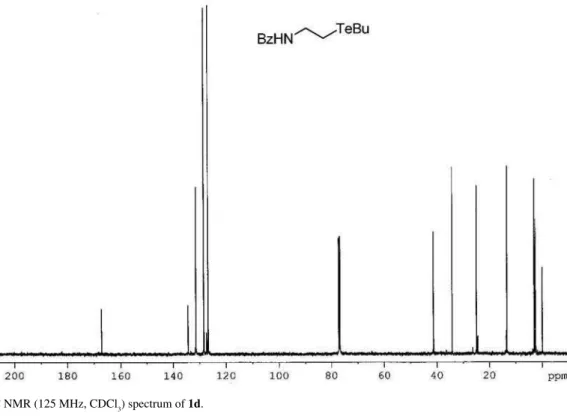
The N-Bz β-telluro amine 1d was prepared according to the general procedure using N-Bz aziridine as starting material. Yield: 82%; yellow oil;IR νmax(ilm)/cm-1: 3308, 2957, 1642, 1306; 1H NMR (CDCl
3, 500 MHz) d 7.79-7.78 (m, 2H), 7.50-7.47 (m, 1H), 7.43-7.39 (m, 2H), 6.80 (br s, 1H), 3.74-3.70 (m, 2H), 2.85 (t, J 7.0 Hz, 2H), 2.67 (t, J 7.0 Hz, 2H), 1.72 (qui, J 7.5 Hz, 2H), 1.36 (sex, J 7.5 Hz, 2H), 0.89 (t, J 7.0 Hz, 3H); 13C NMR (CDCl
3, 125 MHz) d 167.2, 134.4, 131.5, 128.5, 126.9, 41.3, 34.2, 25.0, 13.3, 3.0, 2.6; 125Te NMR (CDCl
3, 157 MHz) d 184.6; HRMS-ESI m/z calculated for C13H19NOTe + Na+ 358.0427, found 358.0407.
BzHN TeBu
N-(3-(Butyltellanyl)propyl)benzamide (1e)
The N-Bz γ-telluro amine 1e was prepared according to the general procedure using N-BzNHCH2CH2CH2OMs as starting material. Yield: 75%; yellow oil;IR νmax(ilm)/cm-1: 3326, 2955, 1650, 1308; 1H NMR (CDCl
3, 500 MHz) d 7.79-7.77 (m, 2H), 7.47-7.44 (m, 1H), 7.39-7.36 (m, 2H), 6.99 (br s, 1H), 3.47 (qua, J 7.0 Hz, 2H), 2.62 (t, J 7.0 Hz, 4H), 2.04 (qui, J 7.0 Hz, 2H), 1.70 (qui, J 7.5 Hz, 2H), 1.36 (sex, J 7.5 Hz, 2H), 0.89 (t, J 7.0 Hz, 3H); 13C NMR (CDCl
3, 125 MHz) d 167.8, 134.6, 131.6, 128.5, 127.0, 42.0, 34.3, 32.0, 25.1, 13.5, 3.0, -1.3; 125Te NMR (CDCl
3, 157 MHz)
d 232.7; HRMS-ESI m/z calculated for C14H21NOTe + Na+ 372.0583, found 372.0577.
BzHN TeBu
N-(4-(Butyltellanyl)butyl)benzamide (1f)
The N-Bz d-telluro amine 1f was prepared according to the general procedure using N-BzNHCH2(CH2)2CH2OMs as starting material. Yield: 80%; yellow oil;IR νmax(ilm)/cm-1: 3318, 2956, 1643, 1308; 1H NMR (CDCl
3, 500 MHz) d 7.77-7.76 (m, 2H), 7.50-7.46 (m, 1H), 7.42-7.39 (m, 2H), 6.41 (br s, 1H), 3.46 (qua, J 7.0 Hz, 2H), 2.66-2.62 (m, 4H), 1.82 (qui, J 7.5 Hz, 2H), 1.74-1.67 (m, 4H), 1.36 (sex, J
7.5 Hz, 2H), 0.90 (t, J 7.5 Hz, 3H); 13C NMR (CDCl 3, 125 MHz) d 167.5, 134.6, 131.3, 128.4, 126.8, 39.3, 34.2, 31.9, 29.5, 25.0, 13.3, 2.7, 1.8; 125Te NMR (CDCl
3, 157 MHz) d 225.4; HRMS-ESI m/z calculated for C15H23NOTe + Na+ 386.0740, found 386.0737.
General procedure for the tellurium/lithium exchange reaction
n-Butyllithium (2 mmol, 1.5 mol L-1 in hexane) was slowly added to a solution of telluro amine (1 mmol) in dry THF (12 mL) at −78 °C. The progress of the tellurium/ lithium exchange reaction was monitorated by TLC. Then, a solution of lithium naphthalenide (LiNp) (2.5 mmol) in THF was added dropwise to the mixture and stirred at −78 °C for 2 h. To the resulting mixture was added a solution of the corresponding electrophile (2 mmol) in THF (1 mL) and then allowed to rise to room temperature overnight. The mixture was quenched with a saturated NH4Cl solution and extracted with CH2Cl2, and the combined organic fractions were collected, dried over MgSO4, and iltered. The solvent was removed in vacuum, yielding the crude products, which were puriied by lash chromatography.
BzHN
OH
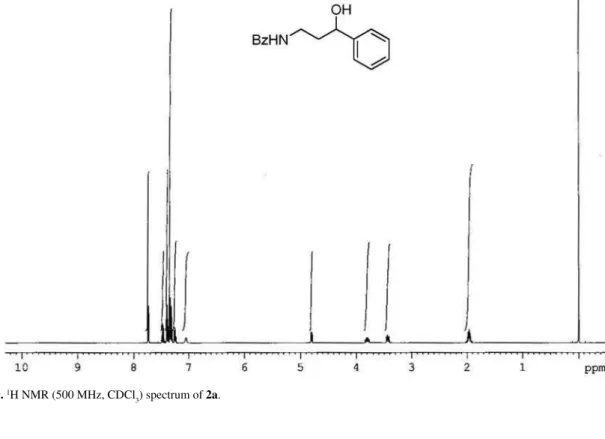
N-(3-Hydroxy-3-phenylpropyl)benzamide (2a)
Yield: 79%; colorless oil; IR νmax(ilm)/cm-1: 3343, 1640, 1541, 1310; 1H NMR (CDCl
3, 500 MHz) d7.75-7.72 (m, 2H), 7.49-7.46 (m, 1H), 7.43-7.37 (m, 2H), 7.35-7.33 (m, 4H), 7.27-7.23 (m, 1H), 7.05 (br s, 1H), 4.80 (dd, J 8.5 Hz, J 4.0 Hz, 1H), 3.84-3.77 (m, 1H), 3.45-3.41 (m, 1H), 1.99-1.93 (m, 2H); 13C NMR (CDCl
BzHN
OH
N-(3-Hydroxy-3-p-tolylpropyl)benzamide (2b)
Yield: 72%; orange solid; mp 89.6-91.2 °C; IR νmax(KBr)/cm-1: 3359, 1639, 1551, 1075, 927; 1H NMR (CDCl3, 500 MHz) d 7.74-7.72 (m, 2H), 7.50-7.46 (m, 1H), 7.42-7.39 (m, 2H), 7.24 (d, J 8.0 Hz, 2H), 7.14 (d, J
8.0 Hz, 2H), 6.90 (br s, 1H), 4.79 (t, J 6.5 Hz, 1H), 3.85-3.78 (m, 1H), 3.48-3.42 (m, 1H), 2.32 (s, 3H), 1.98 (qua, J
6.0 Hz, 2H); 13C NMR (CDCl
3, 125 MHz) d 167.9, 141.1, 137.0, 134.2, 131.3, 129.0, 128.4, 126.8, 125.5, 72.5, 38.3, 37.5, 21.0; HRMS-ESI m/z calculated for C17H19NO2 + Na+ 292.1313, found 292.1314.
BzHN
OH
N-(3-Hydroxy-3-o-tolylpropyl)benzamide (2c)
Yield: 82%; white solid; mp 104-106 °C; IR νmax(KBr)/cm-1 3309, 1628, 1558, 1050; 1H NMR (CDCl
3, 500 MHz) d 7.79-7.77 (m, 2H), 7.56-7.51 (m, 2H), 7.47-7.44 (m, 2H), 7.27-7.24 (m, 1H), 7.21-7.18 (m, 1H), 7.16 - 7.14 (m, 1H), 6.95 (br s, 1H), 5.11 (dd, J 8.8 Hz, J 3.3 Hz, 1H), 3.94-3.91 (m, 1H), 3.53-3.47 (m, 1H), 2.33 (s, 3H), 2.02-1.95 (m, 2H); 13C NMR (CDCl
3, 125 MHz) d 168.1, 142.1, 134.3, 133.9, 131.4, 130.4, 128.5, 127.2, 126.9, 126.3, 125.0, 69.4, 37.8, 36.9, 18.9; HRMS-ESI m/z
calculated for C17H19NO2 + Na+ 292.1313, found 292.1301.
BzHN
OH
N-(3-hydroxy-3-m-tolylpropyl)benzamide (2d)
Yield: 72%; colorless oil; IR νmax(ilm)/cm-1: 3354, 1644, 1538, 1075; 1H NMR (CDCl
3, 500 MHz) d 7.74-7.72 (m, 2H), 7.49-7.46 (m, 1H), 7.40-7.37 (m, 2H), 7.22-7.19 (m, 1H), 7.16-7.12 (m, 2H), 7.07 - 7.06 (m, 1H), 7.03 (br s, 1H), 4.77 (dd, J 8.0 Hz, J 4.5 Hz, 1H), 3.83-3.77 (m, 1H), 3.46-3.43 (m, 1H), 2.32 (s, 3H), 1.98-1.95 (m, 2H); 13C NMR (CDCl
3, 125 MHz) d 168.2, 144.1, 137.9, 134.0, 131.3, 128.3, 128.2, 128.0, 126.9, 126.3, 122.6, 72.3, 38.2, 37.5, 21.3; HRMS-ESI m/z calculated for C17H19NO2 + Na+ 292.1313, found 292.1309.
BzHN
OH
O
N-(3-(4-Ethoxyphenyl)-3-hydroxypropyl)benzamide (2e)
Yield: 70%; yellow oil; IR νmax(ilm)/cm-1: 3341, 1642, 1541, 1512, 1304, 1245, 1047; 1H NMR (CDCl
3, 500 MHz) d 7.75-7.73 (m, 2H), 7.50-7.46 (m, 1H), 7.42-7.39 (m, 2H), 7.28-7.25 (m, 2H), 6.91 (br s, 1H), 6.87-6.85 (m, 2H), 4.77 (t, J 6.5 Hz, 1H), 4.00 (qua, J 7.0 Hz, 2H), 3.85-3.78 (m, 1H), 3.47-3.41 (m, 1H), 1.97 (qua, J 6.5 Hz, 2H), 1.40 (t, J
7.0 Hz, 3H); 13C NMR (CDCl
3, 125 MHz) d 167.9, 158.1, 136.1, 134.1, 131.2, 128.3, 126.8, 126.7, 114.2, 72.1, 63.3, 38.1, 37.4, 14.7; HRMS-ESI m/z calculated for C18H21NO3 + Na+ 322.1419, found 322.1411.
BzHN
OH
O
N-(3-(Furan-2-yl)-3-hydroxypropyl)benzamide (2f)
Yield: 68%; orange oil; IR νmax(ilm)/cm-1: 3335, 1640, 1544, 1310, 1148; 1H NMR (CDCl
3, 500 MHz) d 7.75-7.72 (m, 2H), 7.48-7.45 (td, J 7.0 Hz, J 1.5 Hz, 1H), 7.40-7.36 (m, 2H), 7.32 (s, 1H), 7.07 (br s, 1H), 6.30-6.28 (m, 1H), 6.24-6.23 (m, 1H), 4.81 (t, J 7.0 Hz, 1H), 3.83-3.80 (m, 1H), 3.50-3.44 (m, 1H), 2.12-2.03 (m, 2H); 13C NMR (CDCl
3, 125 MHz) d168.4, 156.2, 141.7, 134.0, 131.4, 128.5, 126.9, 110.1, 105.7, 65.6, 36.9, 34.8; HRMS-ESI m/z calculated for C14H15NO3 + Na+ 268.0950, found 268.0948.
BzHN
OH
N-(3-Hydroxydecyl)benzamide (2g)
Yield: 79%; colorless oil; IR νmax(ilm)/cm-1: 3305, 2922, 1634, 1549; 1H NMR (CDCl
3, 500 MHz) d 7.78-7.76 (m, 2H), 7.49-7.46 (m, 1H), 7.43-7.39 (m, 2H), 7.05 (br s, 1H), 3.86-3.83 (m, 1H), 3.72-3.68 (m, 1H), 3.39-3.34 (m, 1H), 1.77-1.74 (m, 1H), 1.62-1.58 (m, 1H), 1.52-1.41 (m, 3H), 1.27-1.23 (m, 9H), 0.87 (t, J 7.0 Hz, 3H); 13C NMR (CDCl3, 125 MHz) d 168.2, 134.2, 131.4, 128.5, 127.0, 69.9, 37.5, 36.5, 31.8, 29.6, 29.2, 25.8, 22.6, 14.1; HRMS-ESI m/z calculated for C17H27NO2 + Na+ 300.1939, found 300.1949.
BzHN
OH
N-(3-Hydroxyhexyl)benzamide (2h)
1642, 1545; 1H NMR (CDCl
3, 500 MHz) d 7.78-7.76 (m, 2H), 7.49-7.46 (m, 1H), 7.42-7.39 (m, 2H), 7.05 (br s, 1H), 3.87-3.85 (m, 1H), 3.73-3.70 (m, 1H), 3.39-3.34 (m, 1H), 1.76-1.73 (m, 1H), 1.62-1.58 (m, 1H), 1.52-1.42 (m, 4H), 0.91 (t, J 7.0 Hz, 3H); 13C NMR (CDCl
3, 125 MHz) d 168.4, 134.2, 131.4, 128.4, 127.0, 69.4, 39.5, 37.4, 36.4, 18.9, 14.0; HRMS-ESI m/z calculated for C13H19NO2 + Na+ 244.1313, found 244.1307.
BzHN
OH
N-(3-Hydroxy-4,4-dimethylpentyl)benzamide (2i)
Yield: 76%; white solid; mp 143-144 °C; IR νmax(KBr)/cm-1: 3329, 2968, 1637, 1549; 1H NMR (CDCl
3, 500 MHz) d 7.78-7.77 (m, 2H), 7.49-7.48 (m, 1H), 7.44-7.41 (m, 1H), 6.91 (br s, 1H), 3.96-3.93 (m, 1H), 3.37-3.33 (m, 2H), 1.85-1.81 (m, 1H), 1.57-1.55 (m, 1H), 0.92 (s, 9H); 13C NMR (CDCl
3, 125 MHz) d 168.0, 134.4, 131.4, 128.5, 126.9, 78.3, 38.4, 34.8, 30.8, 25.7; HRMS-ESI m/z
calculated for C14H21NO2 + Na+ 258.1470, found 258.1456.
BzHN HO
N-(3-Hydroxy-3-phenylbutyl)benzamide (2j)
Yield: 69%; yellow oil; IR νmax(ilm)/cm-1: 3344, 1642, 1540, 1489, 1445, 1312; 1H NMR (CDCl
3, 500 MHz) d 7.63-7.61 (m, 2H), 7.47-7.42 (m, 3H), 7.37-7.30 (m, 4H), 7.23-7.20 (m, 1H), 6.93 (br s, 1H), 3.59-3.52 (m, 1H), 3.35-3.29 (m, 1H), 2.87 (s, 1H), 2.19-2.13 (m, 1H), 2.09-2.03 (m, 1H), 1.62 (s, 3H); 13C NMR (CDCl
3, 125 MHz) d 167.3, 147.2, 134.4, 131.2, 128.5, 128.3, 126.8, 126.7, 124.6, 74.9, 42.3, 36.3, 31.1. HRMS-ESI m/z calculated for C17H19NO2 + Na+ 292.1313, found 292.1302.
BzHN HO
O
N-(3-Hydroxy-3-(4-methoxyphenyl)butyl)benzamide (2k)
Yield: 65%; orange oil; IR νmax(ilm)/cm-1: 3355, 1643, 1593, 1511, 1299, 1248, 1179; 1H NMR (CDCl
3, 500 MHz) d 7.64-7.61 (m, 2H), 7.46-7.43 (m, 1H), 7.38-7.34 (m, 4H), 6.89 (br s, 1H), 6.86-6.83 (m, 2H), 3.76 (s, 3H), 3.58-3.53 (m, 1H), 3.36-3.32 (m, 1H), 2.74 (br s, 1H), 2.15-2.10 (m, 1H), 2.07-2.01 (m, 1H), 1.60 (s, 3H); 13C NMR (CDCl
3, 125 MHz) d 167.2, 158.1, 139.4, 134.2, 131.1, 128.2, 126.7, 125.7, 113.5, 74.3, 55.1, 42.1, 36.3, 30.9; HRMS-ESI m/z
calculated for C18H21NO3 + Na+ 322.1419, found 322.1420.
BzHN Ph
HO Ph
N-(3-Hydroxy-3,3-diphenylpropyl)benzamide (2l)
Yield: 61%; white solid; mp 149-150 °C; IR νmax(KBr)/cm-1: 3435, 3331, 1650, 1532, 1219; 1H NMR (CDCl3, 500 MHz) d 7.62-7.61 (m, 2H), 7.49-7.45 (m, 5H), 7.40-7.37 (m, 2H), 7.34-7.31 (m, 4H), 7.25-7.22 (m, 2H), 6.74 (br s, 1H), 3.55 (qua, J 6.0 Hz, 2H), 2.65 (t, J
6.0 Hz, 2H); 13C NMR (CDCl
3, 125 MHz) d 167.4, 146.6, 134.3, 131.2, 128.3, 127.0, 126.8, 125.9, 78.2, 40.7, 36.1; HRMS-ESI m/z calculated for C22H21NO2 + Na+ 354.1470, found 354.1458.
BzHN Si
N-(2-(Trimethylsilyl)ethyl)benzamide (2m)
Yield: 67%; yellow oil; IR νmax(ilm)/cm-1: 3316, 2953, 1638, 1543, 1249; 1H NMR (CDCl
3, 500 MHz) d 7.75-7.73 (m, 2H), 7.49-7.46 (m, 1H), 7.42-7.40 (m, 2H), 6.12 (br s, 1H), 3.52-3.47 (m, 2H), 0.93-0.90 (m, 2H), 0.06 (s, 9H); 13C NMR (CDCl
3, 125 MHz) d 167.2, 134.8, 131.2, 128.5, 126.7, 36.5, 17.7, -1.6; HRMS-ESI m/z calculated for C12H19NOSi + Na+ 244.1134, found 244.1136.
BzHN
N-Ethylbenzamide (2n)
Yield: 78%; yellow solid; mp 65.2-65.6 °C; IR νmax(KBr)/cm-1: 1637, 1549, 1310, 1145; 1H NMR (CDCl
3, 500 MHz) d 7.77-7.75 (m, 2H), 7.50-7.46 (m, 1H), 7.43-7.40 (m, 2H), 6.18 (br s, 1H), 3.49 (qui, J 7.0 Hz, 2H), 1.25 (t, J 7.0 Hz, 3H); 13C NMR (CDCl
3, 125 MHz) d 167.4, 134.7, 131.1, 128.3, 126.8, 34.8, 14.7; HRMS-ESI m/z
calculated for C9H11NO + Na+ 172.0738, found 172.0731.
BzHN
OH
N-(4-Hydroxy-4-phenylbutyl)benzamide (2o)
Yield: 72%; white solid; mp 75-76 °C; IR νmax(KBr)/cm-1: 3327, 1638, 1310, 700; 1H NMR (CDCl
3, 500 MHz) d 7.72-7.70 (m, 2H), 7.45-7.42 (m, 1H), 7.36-7.33 (m, 2H), 7.30-7.29 (m, 4H), 7.25-7.21 (m, 1H), 6.79 (br s, 1H), 4.68 (dd, J 7.5 Hz, J 5.0 Hz, 1H), 3.47-3.35 (m, 2H), 1.85-1.52 (m, 4H); 13C NMR (CDCl
OH BzHN
N-(5-Hidroxy-5-phenylpentyl)benzamide (2p)
Yield: 70%; yellow oil; IR νmax(ilm)/cm-1: 3357, 1643, 1310, 701; 1H NMR (CDCl
3, 500 MHz) d 7.70-7.68 (m, 2H), 7.44-7.41 (m, 1H), 7.36-7.33 (m, 2H), 7.28-7.27 (m, 4H), 7.24-7.19 (m, 1H), 6.49 (br s, 1H), 4.62 (dd, J 8.0 Hz,
J 5.5 Hz, 1H), 3.36 (qua, J 7.0 Hz, 2H), 1.81-1.75 (m, 1H), 1.72-1.65 (m, 1H), 1.62-1.52 (m, 2H), 1.51-1.42 (m, 1H), 1.38-1.29 (m, 1H); 13C NMR (CDCl
3, 125 MHz) d 167.7, 144.7, 134.6, 131.2, 128.4, 128.3, 127.3, 126.8, 125.7, 74.1, 39.7, 38.4, 29.2, 23.0; HRMS-ESI m/z calculated for C18H21NO2 + Na+ 306.1470, found 306.1461.
BzHN
N-Phenethylbenzamide (3a)
Yield: 65%; yellowish solid; mp 113-114 ºC; IR νmax(KBr)/cm-1: 3344, 1639, 1544, 1312, 1193, 695; 1H NMR (CDCl
3, 500 MHz) d 7.69-7.67 (m, 2H), 7.49-7.46 (m, 1H), 7.41-7.38 (m, 2H), 7.34-7.31 (m, 2H), 7.26-7.23 (m, 3H), 6.17 (br s, 1H), 3.72 (qua, J 7,0 Hz, 2H), 2.94 (t, J
7;0 Hz, 2H); 13C NMR (CDCl
3, 125 MHz) d 167.5, 138.7, 134.6, 131.3, 128.7, 128.6, 128.5, 126.8, 126.5, 41.1, 35.6; HRMS-ESI m/z calculated for C15H15NO + Na+ 248.1051, found 248.1052.
BzHN
OMe
N-(4-Methoxyphenethyl)benzamide (3b)
Yield: 69%; yellowish solid; mp 123-124 ºC; IR νmax(KBr)/cm-1: 3320, 1635, 1538, 1308, 1243, 693; 1H NMR (CDCl
3, 500 MHz) d 7.70-7.68 (m, 2H), 7.50-7.46 (m, 1H), 7.42-7.39 (m, 2H), 7.17-7.14 (m, 2H), 6.88-6,86 (m, 2H), 6.12 (br s, 1H), 3.80 (s, 1H), 3.69 (qua, J 7.0 Hz, 2H), 2.88 (t, J 7.0 Hz, 2H). 13C NMR (CDCl
3, 125 MHz) d 167.5, 158.3, 134.7, 131.4, 130.9, 129.8, 128.5, 126.8, 114.1; 55.3, 41.3, 34.8; HRMS-ESI m/z calculated for C16H17NO2 + Na+ 278.1157, found 278.1150.
BzHN
N-(4-Metylphenetyl)benzamide (3c)
Yield: 66%; yellowish solid; mp 85-86 ºC; IR νmax(KBr)/cm-1: 3324, 1640, 1544, 1313, 807, 692; 1H
NMR (CDCl3, 500 MHz) d 7.75-7.68 (m, 2H), 7.49-7.46 (m, 1H), 7.42-7.38 (m, 2H), 7.15-7.11 (m, 4H), 6.15 (br s, 1H), 3.70 (qua, J 7.0 Hz, 2H), 2.89 (t, J 7.0 Hz, 2H), 2.33 (s, 3H); 13C NMR (CDCl
3, 125 MHz) d 167.4, 136.0, 135.7, 134.6, 131.3, 129.3, 128.6, 128.4, 126.8, 41.2, 35.2, 21.0; HRMS-ESI m/z calculated for C16H17NO + Na+ 262.1208, found 262.1197.
BzHN
N-(2-Metylphenetyl)benzamide (3d)
Yield: 42%; yellowish solid; mp 76-77 ºC; IR νmax(KBr)/cm-1: 3306, 1632, 1536, 1309, 751, 694; 1H NMR (CDCl3, 500 MHz) d 7.72-7.70 (m, 2H), 7.49-7.46 (m, 1H), 7.43-7.39 (m, 2H), 7.19-7.14 (m, 4H), 6.25 (br s, 1H), 3.68 (qua, J 7.0 Hz, 2H), 2.95 (t, J 7.0 Hz, 2H), 2.37 (s, 3H); 13C NMR (CDCl
3, 125 MHz) d 167.6, 137.0, 136.4, 134.6, 131.4, 130.5, 129.4, 128.5, 126.9, 126.7, 126.1, 40.0, 33.1, 19.3; HRMS-ESI m/z calculated for C16H17NO + Na+ 262.1208, found 262.1214.
BzHN CF3
N-(3-(Triluoromethyl)phenethyl)benzamide (3e)
Yield: 35%; yellowish solid, mp 81-82 ºC; IR νmax(KBr)/cm-1: 3304, 1629, 1555, 1337, 1170, 801, 699; 1H NMR (CDCl
3, 500 MHz) d 7.71-7.69 (m, 2H), 7.50-7.46 (m, 3H), 7.44-7.38 (m, 4H), 6.34 (br s, 1H), 3.70 (qua, J
7.0 Hz, 2H), 2.99 (t, J 7.0 Hz, 2H); 13C NMR (CDCl 3, 125 MHz) d 167.7, 139.9, 134.5, 132.3, 131.6, 131.0 (qua, J
32.0 Hz), 129.2, 128.6, 126.8, 125.6, 125.5, 123.5, 123.4, 41.0, 35.6; HRMS-ESI m/z calculated for C16H14F3NO + Na+ 316.0925, found 316.0927.
BzHN
N-(3-Phenylproyl)benzamide (3f)
Yield: 35%; yellowish oil, IR νmax(ilm)/cm-1: 3318, 1638, 1578, 1309, 1181, 698; 1H NMR (CDCl
3, 500 MHz) d 7.69-7.67 (m, 2H), 7.45-7.41 (m, 1H), 7.36-7.33 (m, 2H), 7.27-7.23 (m, 2H), 7.18-7.16 (m, 3H), 6.43 (br s, 1H), 3.44 (qua, J 6.0 Hz, 2H), 2.67 (t, J 7.5 Hz, 2H), 1.92 (qui, J 7.5 Hz, 2H); 13C NMR (CDCl
Figure S1.1H NMR (500 MHz, CDCl
3) spectrum of 1a.
Figure S2. 13 C NMR (125 MHz, CDCl
Figure S4.1H NMR (500 MHz, CDCl
3) spectrum of 1b.
Figure S3.125 Te NMR (157 MHz, CDCl
Figure S5.13 C NMR (125 MHz, CDCl
3) spectrum of 1b.
Figure S6.125 Te NMR (157 MHz, CDCl
Figure S7.1H NMR (300 MHz, CDCl
3) spectrum of 1c.
Figure S8.13 C NMR (75 MHz, CDCl
Figure S9.125 Te NMR (157 MHz, CDCl
3) spectrum of 1c.
Figure S10.1H NMR (500 MHz, CDCl
Figure S11.13 C NMR (125 MHz, CDCl
3) spectrum of 1d.
Figure S12.125 Te NMR (157 MHz, CDCl
Figure S13.1H NMR (500 MHz, CDCl
3) spectrum of 1e.
Figure S14.13 C NMR (125 MHz, CDCl
Figure S15.125 Te NMR (157 MHz, CDCl
3) spectrum of 1e.
Figure S16.1H NMR (500 MHz, CDCl
Figure S17.13 C NMR (125 MHz, CDCl
3) spectrum of 1f.
Figure S18.125 Te NMR (157 MHz, CDCl
Figure S19.1H NMR (500 MHz, CDCl
3) spectrum of 2a.
Figure S20.13 C NMR (125 MHz, CDCl
Figure S21.1H NMR (500 MHz, CDCl
3) spectrum of 2b.
Figure S22.13 C NMR (125 MHz, CDCl
Figure S23.1H NMR (500 MHz, CDCl
3) spectrum of 2c.
Figure S24.13 C NMR (125 MHz, CDCl
Figure S25.1H NMR (500 MHz, CDCl
3) spectrum of 2d.
Figure S26.13 C NMR (125 MHz, CDCl
Figure S27.1H NMR (500 MHz, CDCl
3) spectrum of 2e.
Figure S28.13 C NMR (125 MHz, CDCl
Figure S29.1H NMR (500 MHz, CDCl
3) spectrum of 2f.
Figure S30.13 C NMR (125 MHz, CDCl
Figure S31.1H NMR (500 MHz, CDCl
3) spectrum of 2g.
Figure S32.13 C NMR (125 MHz, CDCl
Figure S33.1H NMR (500 MHz, CDCl
3) spectrum of 2h.
Figure S34.13 C NMR (125 MHz, CDCl
Figure S35.1H NMR (500 MHz, CDCl
3) spectrum of 2i.
Figure S36.13 C NMR (125 MHz, CDCl
Figure S37.1H NMR (500 MHz, CDCl
3) spectrum of 2j.
Figure S38.13 C NMR (125 MHz, CDCl
Figure S39.1H NMR (500 MHz, CDCl
3) spectrum of 2k.
Figure S40.13 C NMR (125 MHz, CDCl
Figure S41.1H NMR (500 MHz, CDCl
3) spectrum of 2l.
Figure S42.13 C NMR (125 MHz, CDCl
Figure S43.1H NMR (500 MHz, CDCl
3) spectrum of 2m.
Figure S44.13 C NMR (125 MHz, CDCl
Figure S45.1H NMR (500 MHz, CDCl
3) spectrum of 2n.
Figure S46.13 C NMR (125 MHz, CDCl
Figure S47.1H NMR (500 MHz, CDCl
3) spectrum of 2o.
Figure S48.13 C NMR (125 MHz, CDCl
Figure S49.1H NMR (500 MHz, CDCl
3) spectrum of 2p.
Figure S50.13 C NMR (125 MHz, CDCl
Figure S51.1H NMR (500 MHz, CDCl
3) spectrum of 3a.
Figure S52.13 C NMR (125 MHz, CDCl
Figure S53.1H NMR (500 MHz, CDCl
3) spectrum of 2b.
Figure S54.13 C NMR (125 MHz, CDCl
Figure S55.1H NMR (500 MHz, CDCl
3) spectrum of 3c.
Figure S56.13 C NMR (125 MHz, CDCl
Figure S57.1H NMR (500 MHz, CDCl
3) spectrum of 3d.
Figure S58.13 C NMR (125 MHz, CDCl
Figure S59.1H NMR (500 MHz, CDCl
3) spectrum of 3e.
Figure S60.13 C NMR (125 MHz, CDCl
Figure S61.1H NMR (500 MHz, CDCl
3) spectrum of 3f.
Figure S62.13 C NMR (125 MHz, CDCl