
Article
0103 - 5053 $6.00+0.00*e-mail: [email protected]
NaBH
4/[bmim]BF
4: a New Reducing System to Access Vinyl
Selenides and Tellurides
Eder J. Lenardão,* Lóren C. C. Gonçalves, Samuel R. Mendes, Maiara T. Saraiva, Diego Alves, Raquel G. Jacob and Gelson Perin
Instituto de Química e Geociências, LASOL, Universidade Federal de Pelotas (UFPel), CP 354, 96010-900 Pelotas RS, Brazil
Um método simples e geral foi desenvolvido para a síntese de selenetos e teluretos vinílicos a partir de alquinos terminais e dicalcogenetos de diorganoíla usando NaBH4 e [bmim]BF4 como solvente reciclável. Este método eiciente permite a formação preferencial de calcogenetos vinílicos de coniguração Z na maioria dos exemplos estudados. Também foi observado que na reação envolvendo fenilacetileno, (E)-bis-fenilcalcogenoestirenos foram obtidos com bons rendimentos e alta seletividade. O líquido iônico foi reutilizado três vezes sem perda da eiciência.
A general and simple method for the synthesis of vinyl selenides and tellurides starting from terminal alkynes and diorganyl chalcogenides using NaBH4 and [bmim]BF4 as a recyclable solvent
was developed. This eficient and improved method furnishes the corresponding vinyl chalcogenides preferentially with Z coniguration. We also observed that when the same protocol was applied to phenyl acetylene, (E)-bis-phenylchalcogeno styrenes were obtained in good yields and high selectivity. The ionic liquid was reused up three times without lost of eficiency.
Keywords: ionic liquids, hydrochalcogenation, vinyl chalcogenides
Introduction
Vinyl chalcogenides have been found to be a very useful tool in organic synthesis, since they are very versatile intermediates for the selective construction of isolated or conjugated oleins.1-10 Besides, organoselenium and organotellurium compounds have attracted increased interest because of their unique biological and pharmacological properties.11,12 In this way, various methods are mentioned for the preparation of vinyl chalcogenides and the most common protocols involve the addition of organo chalcogenol, or the respective chalcogenolate anions, to terminal or internal alkynes.1-10,13-20 On the other hand, ionic liquids (ILs) are receiving much attention in organic synthesis, both as recyclable solvents and/or catalysts.21-32 Because product isolation or catalyst recycling is very easy in ILs and, in some cases, rate accelerations and/or selectivity improvements are also observed, they are regarded as environmentally friendly green solvents. In despite of the high versatility of vinyl chalcogenides and the green feature of ILs, their use as solvent for
hydrochalcogenation reaction of alkynes was scarcely explored.33 As a continuation of our studies toward the development of new and cleaner methods for the synthesis of organochalcogenides,33-40 we report herein the full results on the hydrochalcogenation of alkynes using NaBH4 and [bmim]BF4 as recyclable solvent for the synthesis of vinyl selenides and tellurides (Scheme 1).
Experimental
General remarks
shifts are reported in ppm, referenced to the solvent peak of CDCl3. Column chromatography was performed using Merck Silica Gel (230-400 mesh) following the standard methods. Thin layer chromatography (TLC) was performed using Merck Silica Gel GF254, 0.25 mm thickness. For visualization, TLC plates were either placed under ultraviolet light, or stained with iodine vapor, or acidic vanillin. The reactions were monitored by TLC for disappearance of starting material. Reactions were conducted in flame-dried glassware equipped with tightly itted rubber septa and under a positive atmosphere of dry nitrogen. Reagents were handled using standard syringe techniques.
General procedure for the synthesis of vinyl chalcogenides
To a mixture of alkyne (2.0 mmol) and diphenyl diselenide (0.156 g; 0.5 mmol) in [bmim]BF4 (0.5 mL) under N2 atmosphere, NaBH4 (0.045 g; 1.2 mmol) was added at room temperature. Then, the temperature was slowly raised to 60 °C. The reaction progress was followed by TLC and after the time described on Table 1 the reaction mixture was extracted using ether (5 × 3 mL). The solvent
was evaporated under reduced pressure and the residue was puriied by column chromatography over silica gel eluting with hexanes or a mixture hexanes/ethyl acetate. For the synthesis of the vinyl tellurides analogs it was used 1.2 mmol of the alkyne. Spectral data of the products prepared are listed below.
(2Z)-3-(Phenylseleno)prop-2-en-1-ol (3a) 33
Yield: 0.135g (63%). 1H NMR (200 MHz, CDCl 3)
d7.54-7.43 (m, 2H); 7.27-7.22 (m, 3H); 6.58 (dt, J 9.4 and 1.4 Hz, 1H); 6.19 (dt, J 9.4 and 6.0 Hz, 1H); 4.24 (dd, J 6.0 and 1.4 Hz, 2H); 3.02 (br s, 1H); 13C NMR (50 MHz, CDCl3) d 134.54, 132.52, 131.81, 129.14, 127.07, 122.83, 61.26.
2-(Phenylseleno)prop-2-en-1-ol (4a)33
Yield: 0.051g (24%). 1H NMR (200 MHz, CDCl 3)
d 7.54-7.43 (m, 2H); 7.27-7.22 (m, 3H); 5.86 (s, 1H); 5.40 (s, 1H); 4.15 (s, 2H); 3.02 (br s, 1H); 13C NMR (50 MHz, CDCl3) d 141.37, 133.83, 129.24, 128.12, 127.72, 118.19, 66.25.
(3Z)-2-Methyl-4-(phenylseleno)but-3-en-2-ol(3b) 41
Yield: 0.150g (62%). 1H NMR (200 MHz, CDCl 3)
d7.57-7.51 (m, 2H); 7.28-7.24 (m, 3H); 6.43 (d, J 10.0 Hz, 1H); 6.00 (d, J 10.0 Hz, 1H); 2.15 (br s, 1H); 1.41 (s, 6H); 13C NMR (50 MHz, CDCl
3) d 136.78, 132.82, 132.63, 128.99, 127.09, 120.59, 72.77, 29.48 (2C).
(1Z)-3-Methyl-1-(phenylseleno)pent-1-en-3-ol(3c)41
Yield: 0.230g (90%). 1H NMR (200 MHz, CDCl 3)
d7.54-7.51 (m, 2H); 7.29-7.25 (m, 3H); 6.48 (d, J 10.1 Hz, 1H); 5.93 (d, J 10.1 Hz, 1H); 2.09 (br s, 1H); 1.66 (q, J 7.5 Hz, 2H); 1.35 (s, 3H); 0.96 (t, J 7.5 Hz, 3H); 13C NMR (50 MHz, CDCl3)d 135.49, 132.95, 132.39, 128.97, 127.03, 121.21, 75.34, 35.00, 27.16, 8.21.
(Z)-(2-Phenylseleno-vinyl)-1-cyclohexanol (3d) 39
Yield: 0.229g (81%). 1H NMR (200 MHz, CDCl 3)
d7.57-7.52 (m, 2H); 7.31-7.26 (m, 3H); 6.47 (d, J 9.8 Hz, 1H); 6.04 (d, J 9.8 Hz, 1H); 1.68-1.51 (m, 10H); 1.83 (br s, 1H); 13C NMR (50 MHz, CDCl
3) d 136.31, 133.02, 132.66, 129.10, 127.21, 121.26, 73.92, 37.42 (2C), 25.31, 22.08.
(2Z)-3-(Phenyltelluro)prop-2-en-1-ol(3h)41
Yield: 0.169g (64%). 1H NMR (200 MHz, CDCl 3)
d7.74-7.69 (m, 2H); 7.29-7.25 (m, 3H); 6.92 (dt, J 9.6 and 1.4 Hz, 1H); 6.53 (dt, J 9.6 and 5.0 Hz, 1H); 4.24-4.22 (m, 2H); 2.50 (br s, 1H); 13C NMR (50 MHz, CDCl
3) d 138.99, 137.38, 136.53, 129.13, 127.50, 107.40, 64.07.
2-(Phenyltelluro)prop-2-en-1-ol(4h) 41
Yield: 0.063g (24%). 1H NMR (200 MHz, CDCl 3)
d7.82-7.76 (m, 2H); 7.33-7.20 (m, 3H); 6.25 (t, J 1.7 Hz, 1 H); 5.57 (t, J 1.7 Hz, 1H); 4.21 (s, 2H); 2.46 (br s, 1H); 13C NMR (50 MHz, CDCl
3) d 138.96, 129.86, 129.33, 127.94, 123.31, 112.06, 69.19.
(3Z)-2-Methyl-4-(phenyltelluro)but-3-en-2-ol(3i) 41
Yield: 0.187g (64%). 1H NMR (200 MHz, CDCl 3)
d 7.81-7.75 (m, 2H); 7.29-7.17 (m, 3H); 6.68 (d, J 9.8 Hz, 1H); 6.43 (d, J 9.8 Hz, 1H); 2.26 (br s, 1H); 1.36 (s, 6H); 13C NMR (50 MHz, CDCl
3) d 141.28, 140.37, 137.75, 129.02, 127.42, 104.45, 73.31, 29.14.
(1Z)-3-Methyl-1-(phenyltelluro)pent-1-en-3-ol(3j) 41
Yield: 0.211g (69%). 1H NMR (200 MHz, CDCl 3)
d7.79-7.74 (m, 2H); 7.27-7.20 (m, 3H); 6.72 (d, J 10.0 Hz, 1H); 6.37 (d, J 10.0 Hz, 1H); 2.04 (br s, 1H); 1.63 (q, J 7.5 Hz, 2H); 1.31 (s, 3H); 0.95 (t, J 7.5 Hz, 3H); 13C NMR (50 MHz, CDCl3) d 140.50, 139.97, 137.60, 128.90, 127.27, 105.15, 75.51, 34.70, 26.79, 7.99.
(Z)-(2-Phenyltelluro-vinyl)-1-cyclohexanol (3k) 39
Yield: 0.222g (67%). 1H NMR (200 MHz, CDCl 3)
d7.79-7.74 (m, 2H); 7.28-7.16 (m, 3H); 6.69 (d, J 9.9 Hz, 1H); 6.47 (d, J 9.9 Hz, 1H); 1.67-1.25 (m, 10H); 1.87 (br s, 1H); 13C NMR (50 MHz, CDCl
(2Z)-1-(Butyltelluro)prop-2-en-1-ol(3n), 2-(Butyltelluro) prop-2-en-1-ol(4n) 42
Yield: 0.207g (85%). 1H NMR (200 MHz, CDCl 3)
d6.77 (ddd, J 9.6, 1.2 and 1.5 Hz, 0.1H); 6.40 (ddd, J 9.6, 5.2 and 5.4 Hz, 0.1H); 6.16 (dd, J 1.6 and 1.5 Hz, 0.9H); 5.52 (dd, J 1.3 and 1.2 Hz, 0.9H); 4.19 (s, 1.8H); 4.11 (dd, J 3.6 and 3.3 Hz, 0.2H); 2.72 (t, J 7.5 Hz, 1.8H); 2.60 (t, J 6.8 Hz, 0.2H); 1.85-1.70 (m, 2H); 1.45-1.25 (m, 2H); 0.96-0.89 (m, 3H); 13C NMR (50 MHz, CDCl
3) d 137.41, 127.11, 122.73, 104.68, 70.12, 64.95, 34.03, 33.72, 25.08, 24.88, 13.39, 7.14, 6.11.
(Z)-(2-Butyltelluro-vinyl)-benzene (3p)43
Yield: 0.232g (80%). 1H NMR (200 MHz, CDCl 3)
d7.35 (d, J 10.6 Hz, 1H); 7.31-7.13 (m, 5H); 6.90 (d, J 10.6 Hz, 1H); 2.62 (t, J 6.7 Hz, 2H); 1.75 (quint, J 6.7 Hz, 2H); 1.32 (sex, J 6.7 Hz, 2H); 0.85 (t, J 6.7 Hz, 3H); 13C NMR (50 MHz, CDCl
3) d 138.89, 136.68, 128.23, 127.46, 127.13, 105.29, 33.87, 24.85, 13.35, 8.95.
(E)-1-Phenyl-1,2-bis-(phenylseleno)ethene(5a)44
Yield: 0.177g (85%). 1H NMR (200 MHz, CDCl 3)
d7.52-7.09 (m, 15H); 7.02 (s, 1H); 13C NMR (50 MHz, CDCl3) d 139.51, 133.01, 132.08, 131.13, 130.62, 130.44, 129.24, 129.15, 128.59, 128.28, 128.24, 127.43, 127.40, 126.04.
(E)-1-Phenyl-1,2-bis-(phenyltelluro)ethene(5b)39
Yield: 0.211g (82%).1H NMR (200 MHz, CDCl
3) d7.73 (d, J 6.8 Hz, 2H); 7.56 (d, J 6.8 Hz, 2H); 7.37 (s, 1H); 7.17-7.33 (m, 11H); 13C NMR (50 MHz, CDCl
3) d 144.61, 139.06, 137.64, 129.67, 129.49, 128.70, 128.30, 128.20, 127.93, 127.61, 120.97, 116.03, 115.76, 115.09.
General procedure for the reuse of ionic liquid
The same procedure as for hydrochalcogenation of alkynes described before was followed. After work-up, [bmim]BF4 was diluted with dichloromethane (3.0 mL) and iltered over Celite. The solution was dried over MgSO4 and the volatiles were removed under vacuum. The recovered ionic liquid was reused for the next reaction.
Results and Discussion
Initially, we chose propargyl alcohol (1a; 2.0 mmol) and diphenyl diselenide (2a; 0.5 mmol) to establish the best conditions for the hydroselenation reaction. We examined the temperature, amounts of IL and NaBH4 and the use of N2 atmosphere. It was found that using 1.2 mmol of NaBH4 and 0.5 mL of IL at room temperature and under N2
atmosphere, the reaction proceeded slowly furnishing the product in 30% yield after stirring for 26 h. However, when the mixture was heated at 60 °C, the desired products 3a and
4a were obtained in good yields (87%) after 6 h (Table 1, entry 1). When the same protocol was performed without N2 it was observed, after 10 h, incomplete consume of 2a and the products were isolated in 48% yield. When the reaction was performed in the presence of [bmim]BF4 alone, without NaBH4, no reaction took place in all conditions tested and the starting materials were recovered. Besides, using a smaller amount of NaBH4 (1.0 mmol), the desired products
3a and 4a were obtained only in 52% yield. The use of a slighter amount of 1a (1.5 mmol) afforded also lower yield of products (68%).
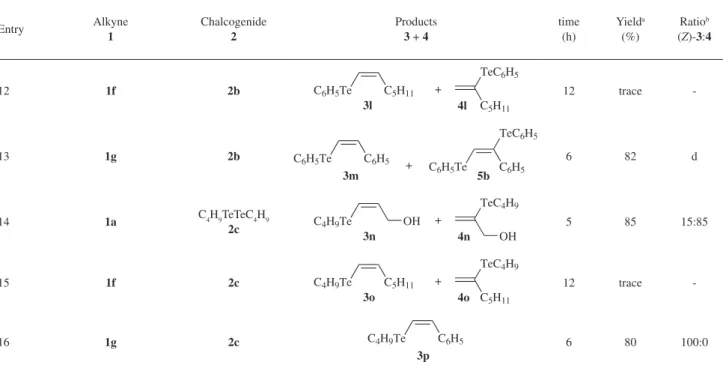
Since the best conditions were established, the protocol was extended to other alkynyl alcohols with diphenyl diselenide (Scheme 1). In all the studied cases, a mixture of (Z)-3 and gem-4 was obtained in good yields (Table 1, entries 1-5) and, except for homopropargyl alcohol 1e, the anti-Markovnikov addut 3 was obtained in higher amount than the Markovnikov one 4 (Table 1, entry 5). For the reaction of phenylselenolate anions with sterically hindered alcohols, it was observed that steric factors are important, because both, the 3:4 ratio and the reaction time, increased with the R group size (Table 1, compare entries 2-4 with 1 and 5). This regioselectivity is similar to that reported for the methods which use organic solvents.1,13-20 When the same protocol was applied to phenyl acetylene 1g, (E)-1,2-bis-phenylseleno styrene 5a was obtained in 85% yield after 3 h at 60 °C (Table 1, entry 7). This result is similar to that obtained under solvent-free conditions.34
Aiming to extend the scope of this new method, we performed the hydrotelluration of terminal alkynes. Thus, when diphenyl ditelluride 2b (0.5 mmol) reacted with propargyl alcohol 1a (2.0 mmol) in the presence of NaBH4 (1.2 mmol) and [bmim]BF4 (0.5 mL), the respective vinyl tellurides 3h and 4h were obtained in 89% yield after stirring at 60 oC for 6.5 h. In contrast to the observed for the hydroselenation reaction, a large excess of alkyne is not necessary. Thus, when 1.2 mmol of propargyl alcohol
1a reacted with 0.5 mmol of C6H5TeTeC6H5 under the same conditions, a mixture of the vinyl tellurides 3h
Table 1. Hydrochalcogenation of alkynes using [bmim]BF4 as recyclable solvent
Entry Alkyne
1
Chalcogenide
2
Products
3 + 4
time (h)
Yielda (%)
Ratiob (Z)-3:4
1
H
HO
1a
C6H5SeSeC6H5
2a
C6H5Se OH +
OH SeC6H5
3a 4a
6 87 72:28
2 HO H
1b
2a C6H5Se OH +
OH SeC6H5
3b 4b 10 62 91:9
3 H
HO
1c
2a C6H5Se OH +
OH SeC6H5
3c 4c 9 90 80:20
4 H
HO
1d
2a
C6H5Se +
SeC6H5
3d 4d
OH
OH
10 81 >95:5
5
H
HO
1e
2a C6H5Se +
SeC6H5
3e OH 4e
OH
6 74 44:56
6
H
C5H11
1f
2a C6H5Se C5H11 +
C5H11 SeC6H5
3f 4f
9 trace
-7
H
C6H5
1g
2a C6H5Se C6H5
+ C6H5
SeC6H5
3g 5a
C6H5Se
3 85 c
8 1a C6H5TeTeC6H5
2b C6H5Te OH
+
OH TeC6H5
3h 4h
7 88 73:27
9 1b 2b C6H5Te OH +
OH TeC6H5
3i 4i 10 64 90:10
10 1c 2b C6H5Te OH +
OH TeC6H5
3j 4j 8 69 93:07
11 1d 2b
C6H5Te +
TeC6H5
3k 4k
OH
OH
11 67 94:06
organochalcogenium source, the results were different of those observed with the diphenyl analogs 2a and 2b. In the reaction with propargyl alcohol 1a, a mixture of vinyl tellurides 3n and 4n was obtained in 85% yield after 5 h at 60 oC, with the Markovnikov addut 4n being predominant (3n:4n ratio = 15:85; Table 1, entry 14).
When 2c reacted with phenylacetylene 1g under the same conditions, only (Z)-(2-butyltelluro-vinyl)-benzene,
3p was obtained in 80% yield (Table 1, entry 16). Unfortunately, no products were isolated when 1-heptyne
1f was used as starting alkyne, with only trace amount being detected by GC (Table 1, entries 6, 12 and 15).
A plausible mechanism for the reaction of phenyl acetylene with diphenyl dichalcogenides using [bmim]BF4 as solvent for formation of bis- and mono-phenylchalcogen alkenes respectively, is depicted on Scheme 2. The formation of bis-phenylchalcogen alkenes 5a and 5b can be attributed probably to the low solubility of the starting
reagents 2a and 2b in the ionic liquid compared with 2c, which makes the reaction behavior like a solvent-free one, with formation of an intermediate analogous to 6
(Scheme 2).34 A free radical chain addition mechanism could also be involved.45 For the propargylic alcohols, however, the formation of the respective bis-chalcogen alkenes were not observed. This fact suggests that in this case, the intermediates 7 and 8 could be involved in the formation of 3 and 4, respectively.46
To check the eficacy of this method, a reuse study of the ionic liquid medium [bmim]BF4 was carried out for the reaction showed in Scheme 3. After completion of the hydroselenation of propargyl alcohol 1a, the reaction mixture was diluted with ethyl ether and the product was isolated. The ionic liquid was recovered, dried under vacuum and reused for further reactions. The ionic liquid maintained its good level of eficiency even after being reused three times (Table 2).
Table 1. Continuation
Entry Alkyne
1
Chalcogenide
2
Products
3 + 4
time (h)
Yielda (%)
Ratiob (Z)-3:4
12 1f 2b C6H5Te C5H11 +
C5H11 TeC6H5
3l 4l
12 trace
-13 1g 2b C6H5Te C6H5
+ C6H5
TeC6H5
3m 5b
C6H5Te 6 82 d
14 1a C4H9TeTeC4H9
2c C4H9Te OH
+
OH TeC4H9
3n 4n
5 85 15:85
15 1f 2c C4H9Te C5H11 +
C5H11 TeC4H9
3o 4o
12 trace
-16 1g 2c C4H9Te C6H5
3p
6 80 100:0
aYields of pure products isolated by column chromatography (hexanes/AcOEt) and identiied by 1H and 13C NMR. bDetermined by GC of the crude reaction mixture and conirmed after isolation of the individual isomers. cObtained as mixture of (Z)-3g and (E)-5a (ratio 26:74). dObtained as mixture of (Z)-3m and (E)-5b (ratio = 5:95).
C6H5 YC6H5
C6H5Y
(E)-5a,b 1a-g R = phenyl, alcohol
R1Y = C6H5Se, C4H9Te, C6H5Te
R YR1
(Z)-3a-p
YR1 R +
4a-o [bmim]BF4/NaBH4
C6H5YYC6H5 (2), 60 oC
R = C6H5 Y = Se 2a Y = Te 2b
[bmim]BF4/NaBH4
R1YYR1 2, 60 °C H
R
Conclusions
We demonstrated the use of NaBH4/[bmim]BF4 as a reducing system for the addition of chalcogenolate anions to alkynyl alcohols and phenylacetylene to give selectively mono- and bis-organochalcogenides alkenes. This improved, simple, fast and clean protocol occurs under mild conditions, with non-aqueous work-up and the ionic liquid can be easily recovered and utilized for further reactions.
Acknowledgments
This project is funded by CNPq, FAPERGS, FINEP and CAPES.
References
1. Perin, G.; Lenardão, E. J.; Jacob, R. G.; Panatieri, R. B.; Chem. Rev. 2009, 109, 1277.
2. Freudendahl, D. M.; Shahzad, S. A.; Wirth, T.; Eur. J. Org. Chem.2009, 1649.
3. Beletskaya, I.; Moberg, C.; Chem. Rev.2006, 106, 2320. 4. Zeni, G.; Lüdtke, D. S.; Panatieri, R. B.; Braga, A. L.; Chem.
Rev.2006, 106, 1032.
5. Back, T. G.; Organoselenium Chemistry. A Practical Approach, Oxford: New York, 2000.
6. Wirth, T.; Organoselenium Chemistry - Modern Developments in Organic Synthesis. Topics in Current Chemistry 208, Springer-Verlag: Heidelberg, 2000.
7. Petragnani, N.; Stefani, H. A.; Tellurium in Organic Synthesis, 2nd ed.; Academic Press: London, 2007.
8. Potapov, V. A.; Elokhina, V. N.; Larina, L. I.; Yaroshenko, T. I.; Tatarinova, A. A.; Amosova S. V.; J. Organomet. Chem.2009,
694, 3679.
9. Saha, A.; Saha D.; Ranu B. C.; Org. Biomol. Chem. 2009, 7, 1652.
10. Alves D.; Luchese, C.; Nogueira, C. W.; Zeni, G.; J. Org. Chem. 2007, 72, 6726.
11. Nogueira, C. W.; Zeni, G.; Rocha, J. B. T.; Chem. Rev.2004,
104, 6255.
12. Mugesh, G.; du Mont, W.-W.; Sies, H.; Chem. Rev.2001, 101, 2125.
13. Zeni, G.; Stracke, M. P.; Nogueira, C. W.; Braga, A. L.; Menezes, P. H.; Stefani, H. A.; Org. Lett.2004, 6, 1135.
14. Dabdoub, M. J.; Baroni, A. C. M.; Lenardão, E. J.; Gianeti, T. R.; Hurtado, G. R.; Tetrahedron2001, 57, 4271.
15. Barros, O. S. D.; Lang, E. S.; de Oliveira, C. A. F.; Peppe, C.; Zeni, G.; Tetrahedron Lett.2002, 43, 7921.
16. Comasseto, J. V.; J. Organomet. Chem. 1983, 253, 131. 17. Dabdoub, M. J.; Cassol, T. M.; Batista, A. C. F.; Tetrahedron
Lett.1996, 37, 9005.
Table 2. Reuse of [bmim]BF4 in hydroselenation of alkyne 1a
Run Yield 3a + 4a (%)c Ionic Liquid recovery (%)
1a 87 99
2b 84 99
3b 83 98
4b 79 97
aReactions were performed using alkyne 1a (2.0 mmol), diphenyl diselenide 2a (0.5 mmol) and NaBH4 (1.2 mmol) in [bmim]BF4 (0.5 mL) under N2 atmosphere at 60 ˚C. bRecovered ionic liquid was used. cObtained as a mixture of (Z)-3a and 4a (ratio = 72:28).
δ
δ
δ C6H5
YC6H5
C6H5Y YC6H5
C6H5 YC 6H5
C6H5Y
YC6H5
δ δ
δ C6H5 YC6H5
C6H5Y
7 6
5a,b
YC6H5
H
O
HO
δ
δ
8 O H
YC6H5
H
δ
Scheme 2.
H
1a
[bmim]BF4/NaBH4, 60 °C
HO
C6H5Se OH +
OH SeC6H5
3a 4a
C6H5SeSeC6H5 (2a)
18. Wang, Z.; Tang, R.; Luo, P.; Deng, C.; Zhong, P.; Li, J.;
Tetrahedron2008, 64, 10670.
19. Troimov, B. A.; Gusarova, N. K.; Tatarinova, A. A.; Potapov, V. A.; Sinegovskaya, L. M.; Amosova, S. V.; Voronkov, M. G.;
Tetrahedron 1988, 44, 6739.
20. Ananikov, V. P.; Malyshev, D. A.; Beletskaya, I. P.; Aleksandrov, G. G.; Eremenko, I. L.; J. Organomet. Chem. 2003, 679, 162. 21. Jain, N.; Kumar, A.; Chauhan, S.; Chauhan, S. M. S.;
Tetrahedron2005, 61, 1015.
22. Dupont, J.; Souza, R. F.; Suarez, P. A. Z.; Chem. Rev.2002,
102, 3667.
23. Dupont, J.; Consorti, C. S.; Spencer, J.; J. Braz. Chem. Soc. 2000, 11, 337.
24. Consorti, C. S.; Souza, R. F.; Dupont, J.; Suarez, P. A. Z.; Quim. Nova2001, 24, 830.
25. Wasserscheid, P.; Welton, T.; Ionic Liquids in Synthesis, Wiley-VCH Verlag: New York, 2002.
26. Welton, T.; Chem. Rev.1999, 99, 2071.
27. Wassercheid, P.; Keim, W.; Angew. Chem. Int. Ed.2000, 39, 3772.
28. Davis Jr, J. H.; Fox, P. A.; Chem. Commun.2003, 1209. 29. Cai, M.; Wang, Y; Hao, W.; Green Chem. 2007, 9, 1180. 30. Pârvulescu, V. I.; Hardacre, C.; Chem. Rev. 2007, 107, 2615. 31. Schrekker, H. S.; Silva, D. O.; Gelesky, M. A.; Stracke, M.
P.; Schrekker, C. M. L.; Gonçalves, R. S.; Dupont, J.; J. Braz. Chem. Soc.2008, 19, 426.
32. Singh, R.; Sharma, M.; Mamgain, R.; Rawat, D. S.; J. Braz. Chem. Soc.2008, 19, 357.
33. Lenardão, E. J.; Dutra, L. G.; Saraiva, M. T.; Jacob, R. G.; Perin, G.; Tetrahedron Lett. 2007, 48, 8011.
34. Perin, G.; Jacob, R. G.; Dutra, L. G.; Azambuja, F.; Santos, G. F. F.; Lenardão, E. J.; Tetrahedron Lett.2006, 47, 935.
35. Perin, G.; Mendes, S. R.; Silva, M. S.; Lenardão, E. J.; Jacob, R. G.; Santos, P. C. S.; Synth. Commun.2006, 36, 2587. 36. Perin, G.; Jacob, R. G.; Botteselle, G. V.; Kublik, E. L.;
Lenardão, E. J.; Cella, R.; Santos, P. C. S.; J. Braz. Chem. Soc. 2005, 16, 857.
37. Perin, G.; Jacob, R. G.; Azambuja, F.; Botteselle, G. V.; Siqueira, G. M.; Freitag, R. A.; Lenardão, E. J.; Tetrahedron Lett.2005,
46, 1679.
38. Lenardão, E. J.; Silva, M. S.; Mendes, S. R.; Azambuja, F.; Jacob, R. G.; Santos, P. C. S.; Perin, G.; J. Braz. Chem. Soc. 2007, 18, 943.
39. Lenardão, E. J.; Silva, M. S.; Sachini, M.; Lara, R. G.; Jacob, R. G.; Perin, G.; ARKIVOC2009, xi, 221.
40. Silveira, C. C.; Perin, G.; Braga, A. L.; J. Chem. Res.-S1994, 492.
41. Silveira, C. C.; Mendes, S. R.; Rosa, D. D.; Zeni, G.; Synthesis 2009, 4015.
42. Raminelli, C.; Silva, N. C.; Santos, A. A.; Porto, A. L. M.; Andrade, L. H.; Comasseto, J. V.; Tetrahedron2005, 61, 409. 43. Dabdoub, M. J.; Dabdoub, V. B.; Comasseto, J. V.; Petragnani,
N.; J. Organomet. Chem.1986, 308, 211.
44. Peppe, C.; Lang, E. S.; Ledesma, G. N.; Castro, L. B.; Barros, O. S. R.; Mello, P. A.; Synlett 2005, 3091.
45. Keppler, A. F.; Cerchiaro, G.; Augusto, O.; Miyamoto, S.; Prado, F.; Di Mascio, P.; Comasseto, J. V.; Organometallics2006, 25, 5059.
46. Dabdoub, M. J.; Dabdoub, V.; Tetrahedron1995, 51, 9839.
![Table 1. Hydrochalcogenation of alkynes using [bmim]BF 4 as recyclable solvent Entry Alkyne 1 Chalcogenide2 Products 3 + 4 time(h) Yield a(%) Ratio b (Z)-3:4 1 HHO 1a C 6 H 5 SeSeC 6 H 52a C 6 H 5 Se OH + OHSeC6H 53a4a 6 87 72:28 2 H HO 1b 2a C 6 H 5 Se O](https://thumb-eu.123doks.com/thumbv2/123dok_br/18993902.461579/4.892.77.797.151.1064/table-hydrochalcogenation-alkynes-recyclable-solvent-alkyne-chalcogenide-products.webp)
![Table 2. Reuse of [bmim]BF 4 in hydroselenation of alkyne 1a](https://thumb-eu.123doks.com/thumbv2/123dok_br/18993902.461579/6.892.173.714.107.453/table-reuse-bmim-bf-hydroselenation-alkyne-a.webp)
