Comparison of Two Multipass Congurations
for Sattered Light Ampliation
M.J.R. Monteiro 1
, M. Mahida 1
, A.M. Daltrini 1
, and L.A. Berni 2
1
InstitutodeFsia\GlebWataghin", UniversidadeEstadualde Campinas
CaixaPostal 6165,13083-970, Campinas,SP,Brazil
2
Assoiated Laboratory ofPlasmas
InstitutoNaionaldePesquisas Espaiais
S~aoJose dosCampos,SP,Brazil
Reeivedon5Marh,2001. Revisedversionreeivedon8May,2001.
Sattered light ampliation by using multipass method is a very useful tehnique to inrease
ThomsonandRayleighsatteringsignalsfor loalplasma eletrontemperatureanddensity
mea-surements. Using Rayleighsatteringinnitrogen neutralgashamber, the well-knowntehnique
ofmultipasssystemwithtwoonentrialspherialmirrorsisomparedwithnewongurationby
usingtwosets of lensand atmirrors. Thefousingapability ofbothongurations makesthe
diereneto straylight and satteredsignal related to spetrometerslit aperture andnumberof
multipass. Forthesamenumberoflaserbeampassandbestslitaperture,thelensandplanmirrors
newongurationpresentedlowerstraylight andhighersatteredsignal,althoughthegainofthe
usualtwospherialmirrorsstillremainshigher.
I Introdution
Thomsonsattering isoftenused tomeasure theloal
eletrontemperature,[1,2℄andeletrondensityanbe
determined if alibration is done by use of Rayleigh
sattering [3,4℄. For this diagnosti method, one of
the ritial issues is the very low sattered light
sig-nal, whih an be inreased by use the of a higher
laser power orby passing the laser beammany times
throughthesameregionin theplasma,knownas
mul-tipasssystem[5-7℄. Mostommonlyusedonguration
istheonewithonelensandtwoonentrialspherial
mirrors(CSM)[8-11℄. Thisongurationhasthe main
disadvantageof notallowing awell-dened spatial
fo-alpointregionin themultipassageofthelaserbeam.
Loosing therefore, not onlyspatial resolution but also
well-dened solid anglefor best olletingpower
spe-trometerinput.
In order to overome these diÆulties we propose
a new onguration with use of two sets of lens and
atmirrors (LFM), whihan dene muh betterthe
foal point region, and therefore an provide a better
spetrometerlightolletionapability.
Although themain purpose ofthisstudy is the
in-rease of signalin the Thomsonsattering diagnosti,
wehaveperformedtheomparisonusingRayleigh
sat-tering on nitrogen neutral gas. At rst beause of
theeasinessandreproduibility,andseondly,beause
Rayleighsatteringisused toalibrateThomson
sat-teringdensitymeasurements. Inourase,wehavebuilt
adummy setorof ourtokamak [12℄,in order to have
thesamesatteringgeometry.
The relationship between Thomson and Rayleigh
sattering an be seenby the followingequations. In
themeasurementstodeterminetheThomsonsattering
prole,itisavoidedtheentralregionofthespetrum
duetothestronginueneofthestray-light.Therefore,
the signalmeasured bya detetor plaed in the N-th
range of the wavelength to be measured, with mean
wavelength
N
,inasolid angle,is[13-15℄
S
N (
N )=R
N B S P i r 2 0 n e L S G 2 p i sen(=2) 1
7(
N i ) 2 i 1 a 1 2 exp 0 0 2 ( N i ) 2
4a 2 2 i sen 2 (=2) 1+ (N i) i 1 A 1 A (1) where P i
is the inident power, R
N
is the alibration
ofthe photo-multiplier intheN-thrange ofthe
slit,isthesatteredangle,r 2
0 =(d
T
=d)isthe
las-sial eletronradiusfor90 Æ
sattering, islight
velo-ity,L
S
is thelengthof thesattering region, and G
are,respetively,thequantumeÆienyandthegainof
thephoto-multiplier, isthetransmissionofthe
spe-trometer, isthelongitudinaldieletrifuntion,and,
nally,a=(2kT
e =m
e )
1=2
istheeletronthermal
ve-loity. Ontheotherhand,theRayleighsignalmeasured
bythephotomultiplier,integratedin thesolidangleof
observation,is[16℄:
S Ray =P i d R d n R L S G or L S = S Ray P i n R dR d G (2)
Substituting eq.(2)intoeq.(1),weobtain:
S
N (
N )=R
N B S n e 2 p i sen(=2) S Ray n R d T =d d R =d 1
7(
N i ) 2 i 1 a 1 2 exp 0 0 2 ( N i ) 2
4a 2 2 i sen 2 (=2) 1+ (N i) i 1 A 1 A (3) where d R
=d is the dierential ross setion of the
gas moleules, n
R
isthe density of thegas moleules,
nitrogenin ourase.
Foreq.(3), theratioS
Ray =n
R
isgiven bythe
inli-natin of thealibration urveobtainedfrom Rayleigh
sattering, and the ratio between the Thomson and
Rayleighrosssetionsisgivenelsewhere[15℄.
II Experimental set up
The experimental set up with dummy sattering
ves-sel isshown in Fig. 1. Thesatteringvessel wasbuilt
exatly with the same geometrial parameters of the
tokamakNOVA-UNICAMP.
Therubylaserin Q-swithedmode,and anenergy
pulse of 3J in 40ns hasbeamdivergene of10 3
rad.
Aftermanypassagesoflaserbeamthroughtheentral
region,itisolletedinabeamdump.
For the alignment, weused twoHe-Ne lasers, one
to aligntherubylaserandtheothertoalignthe
spe-trometer GCA/MPHERSON-2051 with a
fotomulti-plierFOREMITUBE9558QB.
Thebeamsfrom bothHe-Nelasersshould rossat
theenterofthevessel,whihisdenedasthe
satter-fortherubylaser,bytakingtherstreetionfromthe
prism,and forsatteredlightolletiontwolensesare
used with the spetrometerto havea maximum solid
anglemath.
Figure1.Overviewofexperimentalsetupfortwospherial
mirrorsandlens.
Figure2: a)Conentriallyspherialmirrorswithlens
on-guration,CSMsystem,and b)Lensand atmirrors
on-guration, LFM system. Notiethe fousingeet at the
lowerpiture.
In Fig. 2-a) it is shown the onentrial spherial
mirroronguration. CSM,whihonsistsoftwoequal
spherialmirros,withdiameterof6.0mandfoal
dis-tane of 12.5 m, and one fousing lens set outside
dis-isdened basiallybythe beamdiameterand the
dis-tanebetweentheedgeofthespherialmirrorandthe
beamentraneposition,anditanprovideaveryhigh
numberofpassages.
In Fig. 2-b) it is shown the proposed lens and
atmirrorsonguration,LFM, whih onsistsof two
lenses, with diameter of 6.0 m and foal distane of
25.0m, andaoupleof90-degreeplanemirrors,with
4.0mofwidthand5.0mlength. Themaximum
num-ber of multipass is dened by the ratio between lens
andbeamdiameter,inouraseN=6.
As an be seen, CSM presents a very high
num-ber of passages but apoor foal region, whih makes
thealignmentwiththespetometermorediÆultand
ausesthelossoftheapturedsatteredsignals. Onthe
other hand,the LFMpresentsanexellent
onentra-tionofthelaserbeam,althoughithasthedisvantageof
alowernumberof passageapability. Toinreasethe
numberof passages oneshould havesmaller diameter
oftheinputbeamandlargerdiameterlensandmirrors.
Inour ase,wehaveused basially samesizedoptial
omponentsfor both ongurationsfor a omparison,
andsetthenumberof passagesuptosix.
III Results
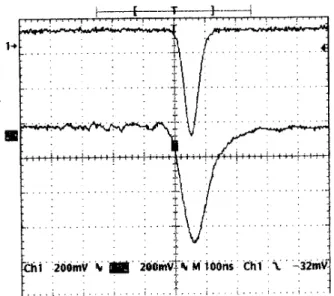
The typial singlepassRayleigh sattering and
moni-tor signalare shown in Fig. 3. The gainof systemis
dened as theratio between the normalizedsattered
signal (Rayleigh sattered light/laser monitor) of the
singlepassandthemultipasssignal. Normalizationby
areaandpeakvalueshowednodiereneforour
alu-lations.
Figure3. Charateristisignalforsinglepassmode,aboveis
lasermonitor;andloweristhesignalforRayleighsattered
light,100ns/div.
The eet of stray light in the sattered signal is
a very important issue to be onsidered, sine it
de-Ineahase,the straylightwasobtainedbypumping
down the hamber up to 10 3
Torr, and for
satter-ing measurements, the N gas was lled in to desired
pressureand leftinrestforaboutonehour.
Theinuene of the spetrometer slit aperture on
thesatteredsignalisveryimportant,sineitontrols
not only the amount of stray light getting into
spe-trometer but also solid angle mathing between
sat-tered regionand spetrometer. Wedeneassattered
signalthetotalsignaltakenintheNgassatteringless
thestraylightsignal.
Figure 4. Stray light variation aording to spetrometer
slitaperturewithN =6.
FromFig. 4,forsixpassages ofthelaserbeam,we
anseebythesloopoftwoongurationsthatCSMis
muhmoresensitiveto straylightthanLFM.
Other interesting fat is the variation of the
sat-tered light signal by spetrometer slit aperture. As
shownbyFig. 5,wenotieasaturationeetforCSM
fromslitaperture of1.5mm, whereasfortheLFMthis
is not seen, and is dened by the spetrometer
maxi-mumslitapertureof2mm.
These eets are relatedto the fousing apability
of the two ongurations and should be more severe,
withaninreaseofthenumberofpassages.
ByxingnowisthebestslitapertureforCSMand
LFM ongurations the values of 1.5mm and 2.0mm
respetively, we have studied the stray and sattered
lightrelatedtothenumberofpassages.
As an be seen on Fig. 6, the stray light is muh
stronger for CSM onguration, mainly for a higher
pass number. This inrease an also be seen on Fig.
4ifwetaketheN=6andproperslitaperture.
Figure6. Straylightvariationaordingtopassagenumber
using best-slitapertureonditionforeahonguration.
Figure7. Satteredsignalvariationagainstnumberof
pas-sageusing bestspetrometerslitapertureforeah
ongu-ration.
Aording to the variation of sattered signal
re-lated to numberof passages,Fig. 7,wenotieamuh
higher signal for LFM onguration. Sine the foal
pointregionisverywelldenedand mathingof solid
angle is also better for LFM, these results seen to be
resonable,exeptforthefatthattheLFMsystemhad
asmallgain,2:960:11,ifomparedtotheCSM
sys-Webelivethat theausewasmainlythelossof
en-ergyontheedgesof thelensused intheLFMsystem,
theanti-reetion oatingfor normalinidene onthe
lensedgesseemtoauseupto10%lossofinputenergy
pulse. But morepreise studiesare neessaryto have
betterunderstanding.
IV Conlusions
Thewell-dened fousingregionandthereforeabetter
optial mathing between sattered region and
spe-trometer etendue for two types of multipass systems
havebeenanalyzed. Forthesamenumberof passages
LFMpresentedhighersatteredlight,lowerstraylight
and no saturation of sattered light signal related to
slitaperturedueto itshigherfousingapability. The
CSMsystemanprovideahighernumberofpassages,
butitisalsoknownthatthereisalimitonpassnumber
toamplifythesattered signal.
OptialassemblyofCSMiseasierthanLFMdueto
feweromponentsutilizedontheCSMsystem.
Never-theless,optialalignmentandmathingwith
spetrom-eter in the LFM is muh easier, sine the foal point
regionisbetterdened.
Therefore,ifenoughspaeforbiggerdiameterlenses
and mirrorsexists, thelens and plane mirror
ongu-rationangivehighersatteredsignalandlowerstray
lightforThomsonsatteringdiagnostis.
A omparison betweenthese twoonguratioins is
nowunderinvestigation,usingHydrogenplasmainour
tokamakNOVA-UNICAMP.
Aknowledgments
Wewouldliketo aknowledgeProf. Dr. Masayuki
Fukao for his eorts to bring NOVA tokamak to our
Lab., and for his preious and ontinuous help in the
researhondued.
Weareindebted toDr. MarioUeda-LAP-INPE
forusefulommentsandorretions.
Author M.J.R. Monteiro aknowledges the
fellow-shipssupportfrom FAPESP.
Thisworkis supportedbyFAPESP-Funda~aode
Amparo aPesquisa do Estado de S~ao Paulo, FINEP,
CNPqandCAPES.
Referenes
[1℄ M.Bassan,R.Bilato,L.Giudiotti,R.Pasqualoto,and
A.Sardella;Ver.Si.Instrum.68,718(1997).
[2℄ A. C^ote, D. Mihaud, N. Rihard,R. Neufeld, and C.
Legros;Ver.Si.Instrum.66,487(1995).
[3℄ L.A.Berni, D.O. Campos, M. Mahida, S.A.
[4℄ D.G.Nilson,D.N.Hill,J.C.Evans,T.N.Calrstrom,C.L.
Hsieh and R.E. Stokdale; Ver. Si. Instrum. 70, 704
(1997).
[5℄ V.N. Boharov and S.D. Kravhenko; Plasma Physis
Reports,20,50(1994).
[6℄ C.J.Barth,C.C.Chu,A.J.H.Donne;Ver.Si.Instrum.
66,501(1995).
[7℄ R.Behn, J.H. Rommers,R.A.Pitts, Z.A. Pietrzyk,R.
Chavan and B. Marletaz; Ver. Si. Instrum. 70, 780
(1999).
[8℄ M.Y.KantorandD. V.Kouprienko;Ver.Si.Instrum.
70,780(1999).
[9℄ M.Y.Kantor;TehnialPhysisLetters,23,671(1997).
[10℄ M.Y.KantorandD.V.Kouprienko;TehnialPhysis
Letters,23,321(1997).
[11℄ M.Y. Kantor; Tehnial Physis Letters, 25, 860
(1999).
[12℄ M. Fukao, K.Mori, T.Tanihara; PlasmaPhys.
Con-trol.Fusion,33,199(1991).
[13℄ J.ShiÆeld;PlasmaSatteringofEletromagneti
Radi-ation,AademiPress,NewYork,(1975).
[14℄ L.A.Berni,\EspalhamentoThomsonnoToroide
Com-patoTC-1";Ph.D.thesis,IFGW,UNICAMP-(1996).
[15℄ H.R. Grien, R.H. Lovberg; Methods of Experimental
Physis;AademiPress,New York,(1970).
[16℄ J.D.Jakson;ClassialEletrodynamis;JohnWiley&