Brazilian Journal of Physics, vol. 33, no. 4, December, 2003 667
Numerical Study of Resistivity Scaling in
π
Junction Granular Superconductors
Enzo Granato
Laborat´orio Associado de Sensores e Materiais,
Instituto Nacional de Pesquisas Espaciais, 12245-970 S ˜ao Jos´e dos Campos, SP Brazil
Received on 23 May, 2003.
Numerical simulations based on Monte Carlo dynamics are used to investigate the resistivity behavior of gran-ular superconductors containing a random distribution ofπ junctions, as in superconducting materials with d-wave symmetry. The presence ofπjunctions leads to quenched in circulating currents (chiralities) and to chiral glass behavior at low temperatures, even without an external magnetic field. An XY spin glass model in the phase representation is used to determine the current-voltage characteristics and critical exponents of the resistivity transition. In two dimensions, the linear resistivity is nonzero at finite temperatures and the dy-namic scaling analysis of the nonlinear resistivity is consistent with a phase transition at zero temperature. In three dimensions, we find a transition at finite temperatures below which the linear resistivity vanishes and the corresponding critical exponents are determined from the scaling analysis. The results are in good agreement with Langevin simulations in the phase representation. The dynamic exponentzis significantly different from previous results obtained in the vortex representation.
Granular superconductors with d-wave symmetry, as some of the unconventional high-Tc superconducting
ma-terials, can be viewed as a network of Josephson junctions with frustration effects even in zero external magnetic field [1]. Frustration arises from the presence of π junctions which introduce a phase shift ofπbetween superconducting regions, and to half-flux quantum vortices on closed loops with an odd number of these junctions [2, 3]. The mag-netic properties of granular samples, arising from the orbital currents of theses vortices , have been extensively studied [1, 4, 5, 6, 7] and provide an explanation of the paramagnetic Meissner effect [8]. Nevertheless, there are also important consequences for the resistivity behavior of theses systems which also deserve detailed investigations.
In a conventional granular superconductor, the phases of neighboring superconducting regions tend to be locked with zero phase shift, and a phase-coherence transition is expected for decreasing temperature into a superconduct-ing state with vanishsuperconduct-ing linear resistivity. The critical be-havior of this resistive transition is reasonable well under-stood both in the two dimensional limit and in three di-mensions. On the other hand, for granular superconduc-tors with a large concentration of π junctions, frustration and disorder effects leads to a vortex glassy phase and the resistive behavior is much less understood. The simplest model of the system is to consider only contributions from the Josephson coupling energy of nearest-neighbor grains,
Hij =−Jocos(θi−θj−tij), whereθiis the phase of the
lo-cal superconducting order parameter,Jo>0andtij = 0or
πcorrespond to the phase shifts of0andπjunctions. This is
equivalent to the interaction of two-component pseudo-spins
~
S= (cos(θ),sin(θ)), coupled by ferro or antiferromagnetic
668 Enzo Granato
the same XY-spin glass model. While the static exponents agree, as expected from the universality of critical behavior, the dynamic exponentz∼4.6obtained from the resistively-shunted-junction (RSJ) model of the dynamics in the phase representation [12] is significantly different from that ob-tained from MC dynamics, z ∼ 3.1, in the vortex repre-sentation [11], suggesting a strong dependence ofzon the details of the dynamics. In view of the absence of precise agreement among these studies, additional numerical results using different dynamics are required to confirm the resistive behavior and determine the critical properties satisfactorily. In this work, we study the resistivity behavior by a driven Monte Carlo dynamics simulation in the phase representa-tion, both in two and three dimensions. The main advantage of this method, compared with previous Langevin dynamics simulations [12, 10], is that much longer time scales can ac-cessed, insuring that the long-time behavior is probed at the lowest temperatures and current densities. The results show that, in two dimensions, the linear resistivity is nonzero at finite temperatures and the dynamic scaling analysis of the nonlinear resistivity is consistent with a phase transition at zero temperature. In three dimensions, we find a resistive transition at finite temperatures and the corresponding criti-cal exponents are determined from the scriti-caling analysis. The dynamic exponentzis essentially the same as that obtained by Langevin dynamics. However,zis significantly different from previous results obtained in the vortex representation by MC dynamics.
We consider granular superconductors withπjunctions, modelled by a three-dimensional XY-spin glass driven by an external current, described by the Hamiltonian
H =−Jo
X
<ij>
cos(θi−θj−tij)−J
X
i
(θi−θi+x) (1)
The first term gives the nearest-neighbor Josephson coupling energy, where the quenched phase shifttij is equal toπor0
with equal probabilities, corresponding to the standard±Jo
XY spin glass model [6, 7, 9, 10, 12, 11]. The second term in Eq. 1 represents the effects of an external driving cur-rent on the superconductor, applied in thex-direction. When
J 6= 0, the total energy is unbounded and the system is out of equilibrium. The lower energy minima occur at increas-ing phase differencesθi−θi+xas a function of time,
lead-ing to a net voltageV proportional to the phase slippage
< d(θi−θi+x)/dt >.
To study the nonequilibrium behavior generated by the driving current densityJ in Eq. 1, we use a driven MC dy-namics method. The time dependence is obtained by identi-fying the MC time as the real timetand we take the unit of timedt= 1, corresponding to a complete MC pass through the lattice. Periodic (fluctuating twist) boundary conditions are used [13] in square and cubic systems of linear sizeL. This boundary condition adds new dynamical variables,uα
(α=x, yandz), corresponding to a uniform phase twist be-tween nearest-neighbor sites along the principal axis direc-tionsx,ˆ yˆandzˆ. A MC step consists of an attempt to change the local phaseθiand the phase twistsuαby fixed amounts,
using the Metropolis algorithm. The external current den-sityJ in Eq. 1 biases these changes, leading to a net phase slippage across the system,d(θ1−θL−uxL)/dt, which is
used as a measure of the voltage in arbitrary units. Using this procedure, the voltageV (electric fieldE =V /L) was computed as a function of the driving current densityJ for different temperatures.
The nonlinear resistivityE/J as a function of current densityJ and temperatureT for the two-dimensional case is shown in Fig. 1a. The ratio E/J tends to a finite value for small J, corresponding to the linear resistivity
ρL = limJ→0E/J, which is nonzero but depends strongly
on the temperature. This can be seen in Fig. 1b, where the linear resistivity shows an exponential decrease with temperature. In Fig. 1a, there is also a smooth crossover to nonlinear behavior that appears at smaller currents for decreasing temperatures. These are the main features ex-pected for a T = 0 superconducting transition [14, 15]. If the transition only occurs at T = 0, then the correla-tion length should diverge for decreasing temperature and a temperature-dependent crossover is expected. The linear resistivityρL is finite at any nonzero temperature but
ther-mally activated,ρL ∝ exp(−Eb/kT), whereEb is an
en-ergy barrier. If one assumes that the correlation length di-verges as a power-lawξ ∝ T−ν, then the behavior of the
nonlinear resistivity normalized toρLcan be cast in to the
scaling form [14]
E JρL
=g( J
T1+ν) (2)
in d = 2 dimensions, whereg is a scaling function with
g(0) = 1. A crossover from linear behavior, wheng(x)∼1,
to nonlinear behavior, wheng(x) >1, should occur when
x∼1. This leads to a characteristic current densityJnl at
which nonlinear behavior sets in that decreases with temper-ature as a power lawJnl∝T1+ν. We now proceed to very
the scaling hypothesis and obtain a numerical estimate of the critical exponentν. Fig. 2a shows a scaling plot according to Eq. 2 obtained by adjusting the single parameterνso that a best data collapse is obtained. The dada collapse supports the scaling behavior and provides an estimate ofν = 0.95. An alternative estimate ofν can also be obtained from the crossover current densityJnl. Fig. 2b shows the
temper-ature dependence of Jnl defined as the value ofJ where
E/JρLstarts to deviate from a fixed value, chosen to be2,
using the data in Fig. 1a. The behavior is consistent with a power-law behaviorJnl ∝T1+ν and givesν = 1.07(8).
Brazilian Journal of Physics, vol. 33, no. 4, December, 2003 669
10-2 10-1
10-5 10-4 10-3 10-2
T=06 T=0.5 T=0.4 T=0.3 T=0.25 T=0.2
E/J
J
2 3 4 5
10-4 10-3 10-2
(b) (a)
ρL
1/T
Figure 1. (a) Nonlinear resistivityE/Jfor different temperatures Tin two dimensions, for a system sizeL= 34; (b) Arrhenius plot for the temperature dependence of the linear resistivityρL.
10-1
100
100 101
1+ν
Tc=0
ν = 0.95
T=0.4 T=0.3 T=0.25 T=0.2
E / JρL
J / T
0.1 1
0.01 0.1 1
1+ν
(b) (a)
ν=1.07
Jnl = C T Jnl
T
Figure 2. (a) Scaling plotE/JρL×J/T1+ ν
for data in Fig. 1a withν= 0.95; (b) Crossover current densityJnlas a function of
temperature from Fig. 1.
10-1 100 101 102 103 104 10-4
10-1 102 105
(b) (a)
Tc=0.41
z=4.6 ν=1.2
T=0.5 T=0.45 T=0.4 T=0.35 T=0.3
(T
E
/ J
)
ξ
z - 1
J ξ2 / T
10-3 10-2 10-1 10-5
10-4 10-3 10-2 10-1
T=0.7 T=0.6 T=0.5 T=0.45 T=0.4 T=0.35 T=0.3 T=0.25
E/J
J
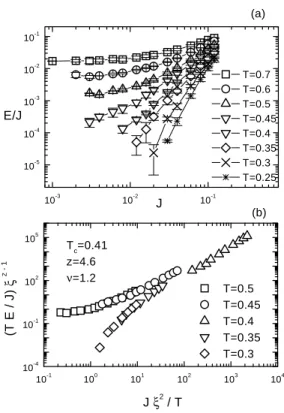
Figure 3. (a) Nonlinear resistivityE/Jfor different temperatures T in three dimensions, for system size L = 12 ; (b) Scaling plot of the data near the transition and for small currents, with ξ∝ |T /Tc−1|−
ν
.
In three dimensions, the resistivity behavior is quite different, as shown in Fig. 3a, for a large system size
L = 12. The behavior is consisting with a resistive tran-sition at an apparent critical temperature in the rangeTc ∼
0.3−0.45. At higher temperatures, the linear resistivity
ρL = limJ→0E/Jis finite while at lower temperatures, it
extrapolates to zero. The phase transition can be confirmed by a scaling analysis of the nonlinear resistivity which as-sumes the existence of a continuous equilibrium transition at a finite temperature [14]. Near the transition, measur-able quantities scale with the diverging correlation length
ξ∝ |T−Tc|
−νand relaxation timeτ ∝ξz, whereνandz
are the correlation-length and dynamical critical exponents, respectively. The nonlinear resistivity should then satisfy the scaling form [14]
T Eξz−1
/J =g±(Jξ2/T) (3)
ind= 3dimensions whereg(x)is a scaling function. The
+and−signs correspond toT > TcandT < Tc,
respec-tively. A scaling plot according to this equation can then be used to verify the scaling arguments and the assumption of an underlying equilibrium transition atJ = 0. The op-timal data collapse provides an estimate ofTc and critical
exponents. Such scaling plot is shown in Fig. 3b, obtained by adjusting the unknown parameters, giving the estimates
Tc = 0.41(2), z = 4.6(3)andν = 1.2(2). The values
ofTc,z andν obtained by this scaling analysis using MC
670 Enzo Granato
RSJ model [12] for the dynamics, clearly showing the exis-tence of a phase-coherence transition at finite temperatures and also showing that the dynamic exponentzis essentially the same. Our estimate ofTcfrom the resistivity scaling is
in good agreement with recent estimate of the critical tem-perature,Tch = 0.38−0.41, for the chiral-glass transition
from MC simulations [7]. The agreement is quite intriguing since it apparently supports the suggestion [12] that chiral-ity and phase variables may order simultaneously. Never-theless, this phase-coherence transition is in sharp contrast with MC simulations of the phase-overlap distribution func-tion [6, 7]. On the other hand, a phase-coherence transifunc-tion atT >0, is consistent with calculations of the spin stiffness exponent in the ground state showing that the lower-critical dimension for spin order in the XY-spin glass model [9] is below3which implies that a phase-coherence transition at finite temperatures is possible in three dimensions. More recent, improved calculations in the vortex representation, also clearly shows a large and positive stiffness exponent [16]. In addition, calculations of the linear resistivityρL
(zero current bias) from MC dynamics simulations in the vortex representation [11], shows an equilibrium resistive transition. The estimate of the static exponentνagrees with the present estimate from the nonlinear resistivity but the dynamic exponent [11]z= 3.1is significantly lower. Sur-prisingly enough, our calculations ofzshow the same result for the MC and RSJ dynamics. Additional calculations us-ing Langevin dynamics with onsite dissipation of the grains in the phase representation give the same result [17]. In spite of that, it is possible that the differentzis a result of the par-ticular dynamics in the vortex representation. In fact, vortex variables are collective excitations in the phase representa-tion and thus lead to long-range correlarepresenta-tions for the phases, suggesting that these representations may belong to different dynamic universality classes.
In conclusion, our driven MC dynamics simulations of the resistivity scaling in πjunction granular superconduc-tors, shows that, in two dimensions, the linear resistivity is nonzero at finite temperatures and the behavior is con-sistent with a phase transition at zero temperature in good agreement with previous calculations [10]. In three dimen-sions, we find a resistive transition at finite temperatures in the chiral glass phase and determine the corresponding critical exponents. This transition should be observable in nonlinear resistivity measurements in bulk samples. In fact, it is consistent with resistivity measurements in ceramic
Y Ba2Cu4O8bulk samples [19] near the onset of the
para-magnetic Meissner effect. The power-law exponent αfor the nonlinear contribution found in these measurements can be related [18] to the dynamic critical exponentzof the tran-sition.
This work was supported in part by computer facilities from CENAPAD and FAPESP (grant nos. 03/00541-0 and 01/03100-9).
References
[1] M. Sigrist and T.M. Rice, Rev. Mod. Phys. 67, 503 (1995).
[2] C.C. Tsuei and J.R. Krtley, Rev. Mod. Phys. 72, 969 (2000).
[3] H. Hilgenkamp et al., Nature 422, 50 (2003).
[4] F.V. Kusmartsev, Phys. Rev. Lett. 69, 2268 (1992).
[5] A. Gardchareon, R. Mathieu, P.E. J ˆonsson, and P. Nordblad, Phys. Rev. B 67, 052505 (2003).
[6] H. Kawamura, J. Phys. Soc. Jpn 64, 711 (1995).
[7] H. Kawamura and M.S. Li, Phys. Rev. Lett. 87, 187204 (2001); Phys. Rev. Lett. 78, 1556 (1997); Phys. Rev. B 54, 619 (1996).
[8] W. Braunisch, N. Kanauf, V. Kataev, S. Neuhausen, A. Gr ¨utz, A. Kock, B. Roden, D. Khomskii, and D. Wohleben, Phys. Rev. Lett. 68, 1908 (1992).
[9] J. Maucourt and D.R. Grempel, Phys. Rev. Lett. 88, 770 (1998).
[10] E. Granato, Phys. Rev. B58 (1998) 11161; B61, 391 (2000).
[11] C. Wengel and A.P. Young, Phys. Rev. B 56, 5918 (1997).
[12] E. Granato, J. Magn. Magn. Matter. 226, 366 (2001).
[13] W. M. Saslow, M. Gabay, and W.-M. Zhang, Phys. Rev. Lett. 68, 3627 (1992).
[14] D.S. Fisher, M.P.A. Fisher, and D.A. Huse, Phys. Rev. B 43, 130 (1991); R.A. Hyman, M. Wallin, M.P.A. Fisher, S.M. Girvin, and A.P. Young, Phys. Rev. B 51, 15304 (1995).
[15] E. Granato, in ”Studies of high-temperature
superconduc-tors”, Ed. A. Narlikar (Nova Science Publishers, New York,
2001), vol. 39, p. 149.
[16] J.M. Kosterlitz and N. Akino, Phys. Rev. Lett. 82, 4094 (1999).
[17] E. Granato, Physica C, to be published.
[18] E. Granato, unpublished.