Medidas de audição de pais de indivíduos com deficiência
auditiva de herança autossômica recessiva*****
Auditory measurements in parents of individuals with autosomal
recessive hearing loss
*Fonoaudióloga. Aprimoranda em Neuro-Geriatria em Fonoaudiologia pelo Hospital das Clínicas da Faculdade de Medicina da Universidade de São Paulo (HC -FMUSP). Endereço para
correspondência: Av. D. Pedro II, 1963 - Rancharia - SP - CEP 19600-000 ([email protected]).
**Bióloga. Doutora em Biologia (Genética) pela USP. Professora Assistente do Departamento de Genética e Biologia Evolutiva do Instituto de Biociências da USP.
***Fonoaudióloga do Departamento de Fisioterapia, Fonoaudiologia e Terapia Ocupacional da FMUSP. Doutora em Ciências pela FMUSP.
****Fonoaudióloga. Livre-Docente do Curso de Fonoaudiologia da FMUSP. Professora Associada do Departamento de Fisioterapia, Fonoaudiologia e Terapia Ocupacional da FMUSP.
*****Trabalho Realizado no Departamento de Fisioterapia, Fonoaudiologia e Terapia Ocupacional da FMUSP.
Artigo Original de Pesquisa
Artigo Submetido a Avaliação por Pares
Conflito de Interesse: não
Recebido em 11.06.2010. Revisado em 02.09.2010.
Aceito para Publicação em 30.11.2010. Larissa Suyama da Silva* Regina Célia Mingroni Netto** Seisse Gabriela Gandolfi Sanches*** Renata Mota Mamede Carvallo****
Abstract
Background: audiological evaluation of parents of individuals with autosomal recessive hearing loss. Aim: to study the audiological profile of parents of individuals with autosomal recessive hearing loss, inferred by family history or by molecular tests that detected heterozygous mutations in the GJB2 gene. This gene codes Connexin 26. Method: participants were 36 subjects, ranging between 30 and 60 years, who were divided into two groups: a control group composed by individuals without auditory complaints and without family history of hearing loss, and a research group composed by heterozygous parents of individuals with autosomal recessive hearing loss or heterozygous for connexin 26 mutations. All subjects underwent pure tone audiometry (0,25 to 8kHz), high frequencies audiometry (9 to 20kHz) and distortion product otoacoustic emissions (DPOAE). Results: there were significant differences between the groups when considering the amplitude of DPOAE in the frequencies of 1001 and 1501Hz. Amplitude was higher in the control group. There was no significant difference between the groups for pure tone thresholds from 0.25 to 20KHz. Conclusion: the DPOAE were more effective, in comparison to the pure tone audiometry, to detect auditory differences between the groups. More studies of this type are necessary to confirm the observed results.
Key Words: Deafness; Audiometry; Spontaneous Otoacoustic Emissions.
Resumo
Tema: avaliação audiológica de pais de indivíduos com perda auditiva de herança autossômica recessiva. Objetivo: estudar o perfil audiológico de pais de indivíduos com perda auditiva, de herança autossômica recessiva, inferida pela história familial ou por testes moleculares que detectaram mutação no gene GJB2, responsável por codificar a Conexina 26. Método: 36 indivíduos entre 30 e 60 anos foram avaliados e divididos em dois grupos: grupo controle, sem queixas auditivas e sem história familiar de deficiência auditiva, e grupo de estudos composto por pais heterozigotos em relação a genes de surdez de herança autossômica recessiva inespecífica ou portadores heterozigotos de mutação no gene da Conexina 26. Todos foram submetidos à audiometria tonal liminar (0,25kHz a 8), audiometria de altas freqüências (9kHz a 20) e emissões otoacústicas produtos de distorção (EOAPD). Resultados: houve diferenças significativas na amplitude das EOAPD nas freqüências 1001 e 1501Hz entre os grupos, sendo maior a amplitude no grupo controle. Não houve diferença significativa entre os grupos para os limiares tonais de 0,25 a 20KHz. Conclusão: as EOAPD foram mais eficazes, em comparação com a audiometria tonal liminar, para detectar diferenças auditivas entre os grupos. Mais pesquisas são necessárias para verificar a confiabilidade destes dados.
Palavras-Chave: Surdez; Audiometria; Emissões Otoacústicas Espontâneas.
Referenciar este material como:
Introduction
Genetic hearing loss is highly heterogeneous and its basis is complex. Hereditary hearing loss may be classified in syndromic (30% of cases), when it co-occurs with several other manifestations (learning difficulties, cognitive disorders, attention disorders, visual disorders, among others)1. Non-syndromic hearing loss, corresponding to 70% of cases, may present several inheritance patterns, including autosomal dominant, autosomal recessive, X-linked inheritance and mitochondrial inheritance 2.
Approximately 80% of cases of nonsyndromic hereditary hearing loss is autosomal recessive 3. Autosomal recessive hearing loss is caused by a combination of two allelic recessive mutations in the same individual, that is, in the same gene or even, in some exceptional cases, in different genes of the same group of functions4. It is believed that 1% of human genes may be involved in the hearing process5.
Hearing loss associated to the autosomal recessive inheritance pattern is usually more severe, caused almost exclusively by cochlear defects6. In these cases, the parents of the hearing impaired individual possess a recessive allele, in heterozygosis, that causes deafness, and they will most likely have normal or near normal hearing.
Mutations in DFNB1 locus, in the chromosomal region 13q11-12, are responsible for approximately half of the cases of autosomal recessive hearing loss7 characterized, in the majority of the congenital cases, by being non-progressive and having a moderate to profound degree. This locus contains two genes, GJB2 and GJB6. The first one encodes the Connexin 268 and the second, the Connexin 309.
Mutations of gene GJB2 accounts for many cases of recessive nonsyndromic hearing loss. The great expression of connexins in the cochlea demonstrates its importance for the hearing process10. Mutation c.35delG is the deletion of one, within six, guanine at the position 35 of the gene that encodes Connexin 26, resulting in a premature interruption of its translation11. It is the most frequent mutation found in patients with hereditary hearing loss, especially in Western countries, and, more recently, also in the population of São Paulo, ethnically heterogeneous12.
The study of hearing measures of these subjects' parents could be useful for the identification of discrete hearing impairments. This characterization could, in the future, indicate families in which subjects are more likely to carry recessive alleles that cause deafness, especially in cases in which molecular tests are not yet available. The purpose of this study is to assess the audiological profile of parents of autosomal recessive hearing impaired subjects, inferred by genealogy or by
molecular tests that detected heterozygous mutations in the GJB2 gene
Methods
All subjects of this research confirmed their participation by signing the Informed Consent Term, approved by the Ethics Committee for Research Projects Analysis - CAPPesq - Hospital das Clínicas of the School of Medicine of University of São Paulo, protocol number 0581/08, in August 06, 2008.
This research was carried out in the Human Hearing Laboratory of the Speech and Hearing Sciences Course of the School of Medicine of the University of São Paulo, from September 2008 to December 2009.
Thirty six individuals ranging in age from 30 to 60 years old took part in the research, composing two different groups:
Research Group (RG): 14 subjects, fathers and mothers of at least one individual with autosomal recessive hearing loss. The children presented moderate to profound prelingual deafness. The inclusion criteria were: consanguineous parents (with at least one child with hearing loss), asymptomatic parents with more than one child with hearing loss or individuals with mutation in the gene of Connexin 26 (GJB2) detected by molecular tests.
All individuals with hearing loss, whose parents were selected to participate in the Research Group, were previously studied regarding the main mutations responsible for hereditary deafness. The mutation c. 35delG in the Connexin 26 gene (GJB2) was studied by the polymerase (PCR) chain reaction, followed by the digestion of DNA with restriction enzyme BstN I13. The mutation c.167delT of the Connexin 26 gene (GJB2) was studied by the polymerase (PCR) chain reaction, followed by the digestion of DNA with restriction enzyme PstI14. The deletion-type mutations, called D13S1830) and ?(GJB6-D13S1854) in the Connexin 30 gene (GJB6) were studied by polymerase (PCR) chain reaction, specific for these deletions15. The mutation A1555G in the gene of the subunit 12S of the ribosome (MT-RNR1) was studied by polymerase (PCR) chain reaction, followed by the digestion of DNA with restriction enzyme Hae III16.
parents of individuals with 35delG in homozygosis and, therefore, carried the 35delG in heterozygosis. The age distribution was: 4 subjects from 30 to 40 years old, 6 subjects from 40 to 50 years old and 4 subjects from 50 to 60 years old.
Control Group (CG): 22 subjects, fathers and mothers of individuals without hearing impairment and without familiar history of hearing loss. The age distribution was: 10 subjects from 30 to 40 years old, 5 subjects from 40 to 50 years old and 7 subjects from 50 to 60 years old.
The exclusion criteria were: presence of acquired hearing loss, history of intense noise exposure without hearing protection equipment, use of alcohol and drugs, and presence of pigmentation disorders, such as vitiligo.
Each participant underwent peak compensated static acoustic admittance (Ytm) tympanometry with a probe tone frequency of 226 Hz; ipsilateral acoustic reflexes testing at 500 Hz, 1000 Hz, 2000 Hz, 4000 Hz and Broad Band Noise stimuli; pure tone audiometry from 250 to 20000 Hz.
The tympanometry and the acoustic reflex testing were necessary in order to eliminate cases of middle ear disorders, not included in this research.
Specific normality criteria for the conventional audiometry17 and a standardization for extended high frequency audiometry18 (9,000 to 20,000 Hz) were adopted.
For the statistical analysis, the parametric test t-Student for paired samples and the non-parametric test Mann-Whitney were used, with supplies from the Software Minitab version 15.1. The significance level adopted was 5%.
Results
Four subjects of the Research Group (all of them in the age group from 50 to 60 years old) presented hearing loss, and therefore, were not submitted to
otoacoustic emission and extended high frequencies thresholds assessment.
The t- Student test for paired samples was used to verify the ear effect at the tested frequencies. It was verified that there was ear effect only at the frequency 9000 Hz, and its analysis was not included in this research.
Since there was no ear effect at the included frequencies, the averages of hearing thresholds were calculated, for the right and the left ears, of individuals from the Control Group and from the Research group from 10,000 to 20,000 Hz, in order to compare them to the distortion product otoacoustic emission results.
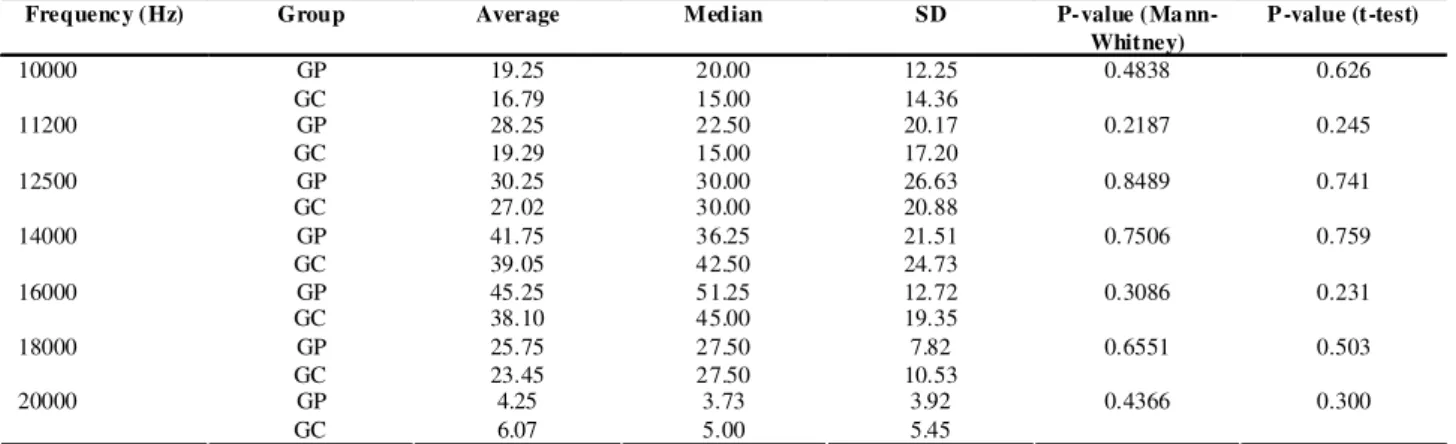
The audiological data regarding the conventional audiometry and the extended high frequency audiometry are presented in Tables 1 and 2, respectively.
Concerning the distortion product otoacoustic emissions, it was calculated the average of signal-to-noise ratio (SNR) of subjects from both groups. Results are presented in Table 3.
It can be verified, by the values with asterisks, that there was statistically significant difference for frequencies 1001 and 1501 Hz.
TABLE 1. Resu lts of the in tergroup analysis for pure tone aud io metry.
uency (Hz) Group Average Median SD P-value
(Mann-Whitney)
P-va lue (t-test)
GP 7 .75 7.50 5.83
GC 5.119 5.000 3.577
0.2373 0.213
GP 7.5 5.00 7.07
GC 5 .00 4.74 4.74
0.4020 0.329
GP 8 .75 7.50 7.00
GC 5.238 5.000 4.176
0.1844 0.168
GP 7 .25 3.75 8.37 GC 5 .00 5.00 5.00
0.7952 0.447
GP 8 .75 6.25 7.00 GC 5 .24 5.00 5.24
0.1845 0.182
GP 8 .75 8.75 6.80 GC 5 .83 5.00 4.63
0.2744 0.241
GP 14.75 16.25 7.21
GC 1 0.595 10.000 3.945
0.1075 0.116
GP 11.75 12.50 6.67
GC 10.71 10.00 6.38
0.7165 0.687
Legend: CG – control group; RG – research group.
TABLE 2. Resu lts of the in tergroup analysis for extended high f requency audiometry.
Frequency (Hz) Group Average Median SD P-value
(Mann-Whitney)
P-value (t-test)
GP 19.25 20.00 12.25
10000
GC 16.79 15.00 14.36
0.4838 0.626
GP 28.25 22.50 20.17
11200
GC 19.29 15.00 17.20
0.2187 0.245
GP 30.25 30.00 26.63
12500
GC 27.02 30.00 20.88
0.8489 0.741
GP 41.75 36.25 21.51
14000
GC 39.05 42.50 24.73
0.7506 0.759
GP 45.25 51.25 12.72
16000
GC 38.10 45.00 19.35
0.3086 0.231
GP 25.75 27.50 7.82
18000
GC 23.45 27.50 10.53
0.6551 0.503
GP 4.25 3.73 3.92 20000
GC 6.07 5.00 5.45
0.4366 0.300
Legend: CG – control group; RG – research group
TABLE 3. Resu lts of the in tergroup analysis for otoacoustic emissions.
Frequency (Hz) Group Average Median SD P-value
(Mann-Whitney)
P -value (t-test)
GP 13.24 12.95 6.54
1001
GC 18.79 19.65 7.41
0.0447* 0 .047 *
GP 13.60 14.25 4.17
1501
GC 21.20 22.25 5.61
0.0013* 0 .000 *
GP 10.78 12.05 9.87
2002
GC 18.05 19.20 5.73
0.0545 0.054
GP 12.12 14.53 8.38
3003
GC 16.51 18.40 7.81
0.0870 0.183
GP 13.64 15.18 6.59
4004
GC 18.70 19.60 18.93
0.0725 0.075
GP 8.87 11.55 11.32
6006
GC 10.78 12.05 9.87
0.4856 0.443
Discussion
The audiological profile (extended high frequency thresholds and otoacoustic emissions) of parents of subjects with hearing impairment of recessive inheritance was assessed, in order to test the hypothesis that they could also present discrete hearing impairment, not evidenced by conventional audiological tests. Such discrete impairment could be due to the fact that they are heterozygotes concerning the genetic mutations that, in homozygosis resulted in their children's autosomal recessive hearing loss.
However, four parents of the research group from 50 to 60 years old (all with the mutation 35delG in heterozygosis), actually presented hearing loss. It is not known whether the hearing loss is due to environmental factors, or if the presence of the allele responsible for deafness in heterozygosis could account for the hearing loss, making the subject more susceptible to presbyacusis or any other environmental factors that are hearing damaging. The environmental factors cannot be disregarded even in cases of genetic hearing loss19. It is also possible to speculate that alleles that cause recessive deafness, in heterozygosis could actually provoke milder hearing loss than the one presented by their homozygous children. A larger sample could confirm this hypothesis. Three studies20,21,22 found significant differences in responses for high frequency audiometry and otoacoustic emissions of subjects, carriers and non carriers, of mutation 35delG in heterozygosis (the most frequent mutation inf Connexin 26 gene ).
Concerning the extended high frequencies, the 9000Hz frequency was unconsidered, since it presented a significant statistical difference (t- Student test) of responses between the ears. Such result may have been a consequence of the order of stimuli presentation, first in the right ears and then in the left one, resulting in a better sensibility of the second ear.
A tendency of better audiometric thresholds in the CG was observed, however with no statistical relevance. A study23 found great variability of ultra-high frequencies thresholds in analysis inter and intra-subjects with normal hearing thresholds. The great variability in pure tone thresholds and the small sample suggest the necessity of studies with larger samples in order to guarantee the precision of audiological data.
Concerning the distortion product otoacoustic emission, a difference was found between the thresholds of CG and RG: the CG presented greater signal-to-noise ratio (SNR) than the RG, indicating a better hearing
regarding the parents of hearing impaired subjects. Such difference was not statistically significant, except for the frequencies 1001 and 1501 Hz.
Some studies investigated the high frequency hearing (9000 to 20,000 Hz) in individuals with tinnitus complaint and normal hearing at 250 to 8000 Hz24,25. The authors found significant difference between the groups for high frequency thresholds (9000 to 20,000 Hz), suggesting that it could be an appropriate instrument for cochlear disorders evaluation before their appearance in the audiogram. In the present study, the high frequency audiometry (9000 to 20,000 kHz) did not differ the groups assessed, only the results obtained at DPOAE.
Another study26 found that subjects from general population with increased ultra-high frequencies thresholds present statistically significant differences for frequencies f2 of 6348 Hz and at the frequency 1001 Hz, being this last finding compatible with the present study. The author reports that such result means the confirmation that the decrease of high frequency thresholds interferes in the amplitude of DPOAE. Literature27,28 states that small alteration in the cochlea's hair cells may influence the response of lower frequencies of otoacoustic emissions that are generated by the basal region of the cochlea. Such results would be highly influenced by ultra-high frequencies, and the same was not observed in this study since there was no significant relationship in any of the ultra-high frequencies. Nevertheless, this result may be justified by the small sample, and thus, further researches with larger samples are necessary.
Population studies analyzing family members of subjects with genetic hearing loss contribute for the advance of knowledge in the area. More specifically, finding indicators to enable the correlation between the phenotype (hearing findings) and the genotype would cause a great impact in the clinical practice and in the genetic counseling of deafness22.
Conclusion
Within the procedures adopted in this research, the DPOAE were more efficient to detect differences between the groups, revealing a greater tendency of alteration in the research group. A tendency for worse results was also verified in audiological tests presented by parents of individuals with autosomal recessive hearing loss, verified in thresholds of 250 to 8000 Hz of conventional audiometry.
References
1. Roush J, Holcomb MA, Roush PA, Escolar, ML. When hearing loss occurs with multiple disabilities. Semin Hear. 2004;25(4):333-45.
2. Van Camp G, Willems PJ, Smith RJ. Nonsyndromic hearing impairment: unparalleled heterogeneity. Am J Hum Genet. 1997;60:758-64.
3. Petersen MB, Willems PJ. Non-syndromic, autosomal-recessive deafness. Clin Genet. 2006;69:371-92.
4. Schrijver I. Hereditary non-syndromic sensorineural hearing loss. J Mol Diagn. 2004;6(4):275-84.
5. Friedman TB, Griffith AJ: Human nonsyndromic sensorineural deafness. Annu. Rev. Genomics Hum Genet. 2003;4:341-402.
6. Petersen MB. Non-syndromic autosomal-dominant deafness. Clin Genet. 2002;62:1-13.
7. Willems PJ. Mechanism of disease: genetic causes of hearing loss. N. Engl. J. Med. 2000;342(15):1101-9.
8. Kelsell DP, Dunlop J, Stevens HP, Lench NJ, Liang JN, Parry G, Mueller RF, Leigh IM. Connexin 26 mutations in hereditary non-syndromic sensorineural deafness. Nature. 1997:387:80-3.
9. Dahl E, Manthey D, Chen Y, Schwarz HJ, Chang YS, Lalley PA, Nicholson BJ, Willecke K. Molecular cloning and functional expression of mouse connexin-30, a gap junction gene highly expressed in adult brain and skin. J. Biol. Chem. 1996;271(30):17903-10.
10. Sabag AD, Dagan O, Avraham KB. Connexins in hearing loss: a comprehensive overview. J Basic Clin. Physiol. Pharmacol. 2005;16(2-3):101-16.
11. Carrasquillo MM., Zlotogora J, Barges S, Chakravarti A. Two different connexin 26 mutations in an inbred kindred segregating non-syndromic recessive deafness: implications for genetic studies in isolated populations. Hum. Molec. Genet. 1997;6:2163-72.
12. Batissoco AC, Abreu-Silva RS, Braga MCC, Lezirovitz K, Della-Rosa V, Tabith A, Otto PA, Mingroni-Netto RC. Prevalence of GJB2 (Connexin-26) and GJB6 (Connexin-30) mutations in a cohort of 300 Brazilian hearing-impaired individuals: implications for diagnosis and genetic counseling. Ear Hear. 2009;30(1):1-7.
13. Wilcox SA, Saunders K, Osborn AH, Arnold A, Wunderlich J, Kelly T, et al. High frequency hearing loss correlated with mutations in the GJB2 gene. Hum. Genet. 2000;106:399-405.
14. Zelante L, Gasparini P, Estivill X, Melchionda S, D'Agruma L, Govea N, Mila M, Monica MD, Lutfi J, Shohat M, Mansfield E, Delgrosso K, Rappaport E, Surrey S, Fortina P. Connexin 26 mutations associated with the most common form of non-syndromic neurosensory autosomal recessive deafness (DFNB1) in Mediterraneans. Hum. Mol. Genet. 1997;6:1605-9.
15. del Castillo FJ, Rodriguez-Ballesteros M, Alvarez A, Hutchin T, Leonardi E, de Oliveira CA, Azaiez H, Brownstein Z, Avenarius MR, Marlin S, Pandya A, Shahin H, Siemering KR, Weil D, Wuyts W, Aguirre LA, Martin Y, Moreno-Pelayo MA, Villamar M, Avraham KB, Dahl HHM, Kanaan M, Nance WE, Petit C, Smith RJH, Van Camp G, Sartorato EL, Murgia A, Moreno F, del Castillo I. A novel deletion involving the connexin-30 gene, del(GJB6-d13s1854), found in trans with mutations in the GJB2 gene (connexin-26) in subjects with DFNB1 non-syndromic hearing impairment. J Med Genet. 2005;42:588-94.
16. Estivill X, Govea N, Barceló E, Badenas C, Romero E, Moral L et al. Familial progressive sensorineural deafness is mainly due to the mtDNA A1555G mutation and is enhanced by treatment of aminoglycosides. Am J Hum Genet. 1998;(62):27-35.
17. Davis H, Silverman SR. Auditory test hearing aids. In: Davis H, Silverman SR (ed.). Holt: Rinehart and Winston Hearing and Deafness; 1970.
18. Carvallo RMM, Koga MC, Carvalho M, Ishida IM. Limiares auditivos para altas freqüências em adultos sem queixa auditiva. Acta - ORL 2007;25(1):62-66.
19. Rabionet R, Gasparini P, Estivill X. Molecular genetics of hearing impairment due to mutations in gap junctions genes encoding beta connexins. Hum Mutat. 2000;16:190-202.
20. Morell RJ, Kim HJ, Hood LJ, Goforth LG, Friderici K, Fisher R, Van Camp G, Berlin CI, Oddoux C, Ostrer H, Keats B, Friedman TB. Mutation in the connexin 26 gene (GJB2) among ashkenazi jews with nonsyndromic recessive deafness. N. Engl. J. Med. 1998;339:1500-5.
21. Engel-Yeger B, Zaaroura S, Zlotogora J, Shalev S, Hujeirat Y, Carrasquillo M, Barges S, Pratt H. The effects of a connexin 26 mutation - 35delG - on oto-acoustic emissions and brainstem evoked potentials: homozygotes and carriers. Hear Res. 2002;163:93-100.
22. Engel-Yeger B; Zaaroura S; Zlotogora J; Shalev S; Hujeirat Y; Carrasquillo M; Saleh B; Pratt H. Otoacoustic emissions and brainstem evoked potentials in compound carriers of connexin 26 mutations. Hear Res. 2003;175:140-15.
23. Sahyeb DR, Costa Filho OA, Alvarenga KF. Audiometria de alta-frequência: estudo com indivíduos audiologicamente normais. Rev. Bras.Otorrinolaringolol. 2003;69(1):93-9.
24. Burguetti FAR, Peloggia AG, Carvallo RMM. Limiares de Audibilidade em Altas Freqüências em Indivíduos com Queixa de Zumbido. Arq. Otorrinolaringol. 2004;8(4):277-83.
25. Sanches SGG, Sanchez TG, Carvallo RMM. Influence of cochlear function on auditory temporal resolution in tinnitus patients. Audiol. Neurootol. 2010;15:273-81
26. Carvallo RMM. Audição em altas freqüências: repercussões no reconhecimento de fala no ruído e nas emissões otoacústicas. Tese de livre docência apresentada à Faculdade de Medicina da Universidade de São Paulo; 2002.
27. Arnold DJ, Lonsbury MBL, Martin GK. High frequency hearing influences lower - frequency distortion - product otoacoustic emissions. Arch. Otolaryngol. Head Neck Surg. 1999;125:215-22.