ABSTRACT
BACKGROUND AND OBJECTIVES:To relate biopsychosocial variables of Research Diagnostic Criteria for Temporomandibular Disorders to groups of patients with temporomandibular disorders, temporomandibular disorders and migraine and a control group. METHODS: his is a cross-sectional observational study where 280 consecutive patients were evaluated and distributed in three groups: group I (140 control individuals); group II (65 individu-als with muscle temporomandibular disorders) and group III (75 individuals with migraine and muscle temporomandibular dis-orders). Exclusion criteria were individuals with clinical history of muscle inlammatory processes, muscle spasms, contractures and acute temporomandibular joint traumatic injury.
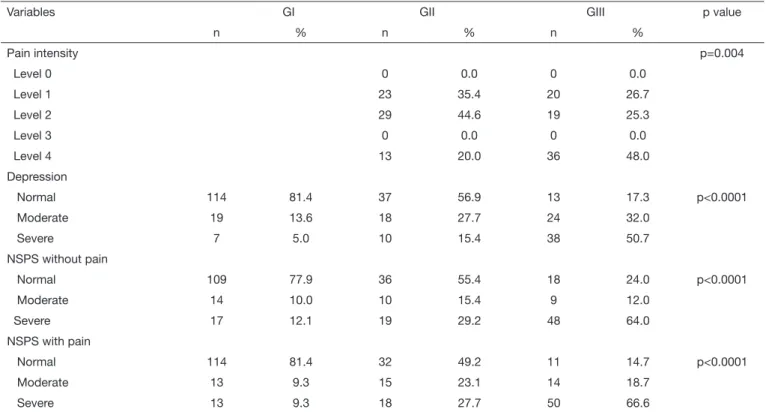
RESULTS: Group III individuals had association with severe de-pression (p<0.001), level 4 in pain severity (p=0.004), unspeciic physical symptoms without severe pain (p<0.0001) and unspe-ciic symptoms with severe pain (p<0.00001). here has been signiicant diference between females and males in group III (Z=2.59; p=0.001), with longer pain duration among females. he percentage of females in group III was signiicantly higher as compared to males (p=0.004).
CONCLUSION: he relationship between variables and the three groups has shown a higher number of individuals with more severe symptoms in group III. So, it is understood that migraine is a morbid condition often associated to
temporo-Biopsychosocial factors of Axis II of the Research Diagnostic Criteria
for Temporomandibular Disorders in individuals with muscular
temporomandibular disorder and migraine
Fatores biopsicossociais do Eixo II dos Critérios de Diagnóstico para Pesquisa das Desordens
Temporomandibulares em indivíduos com disfunção temporomandibular muscular e migrânea
Claudia Branco Battistella1, Thatiana Bastos Guimarães1, Camila Leite Quaglio1, Mariana Brandão Ferreira-Cabrini1, Dinamar Aparecida
Gaspar-Martins1, Neil Ferreira Novo2, Yara Juliano2, Deusvenir de Souza Carvalho3, Antonio Sérgio Guimarães4, Luis Garcia Alonso1
1. Universidade Federal de São Paulo, Escola Paulista de Medicina, Departamento de Mor-fologia e Genética, São Paulo, SP, Brasil.
2. Universidade de Santo Amaro, Faculdade de Medicina da Universidade de Santo Amaro, Departamento de Bioestatística, São Paulo, SP, Brasil.
3. Universidade Federal de São Paulo, Escola Paulista de Medicina, Departamento de Neu-rologia, São Paulo, SP, Brasil.
4. Faculdade São Leopoldo Mandic, Departamento de Disfunção Temporomandibular e Dor Orofacial, Campinas, SP, Brasil.
Submitted in September 29, 2015.
Accepted for publication in February 12, 2016. Conlict of interests: none – Sponsoring sources: CAPES.
Correspondence to: hatiana Bastos Guimarães Rua Botucatu, 740 – Vila Clementino 04023-900 São Paulo, SP, Brasil. E-mail: [email protected]
© Sociedade Brasileira para o Estudo da Dor
mandibular disorders, worsening symptoms referred by patients. here is the need for multidisciplinary evaluation of these indi-viduals to optimize treatment and minimize morbidity, costs and the number of medical visits.
Keywords: Facial pain, Headache, Psychology, Temporoman-dibular joint, TemporomanTemporoman-dibular joint disorders.
RESUMO
JUSTIFICATIVA E OBJETIVOS: Relacionar as variáveis biopsicos-sociais do Research Diagnostic Criteria for Temporomandibular Disor-ders com os grupos de pacientes com disfunção temporomandibular, com disfunção temporomandibular e migrânea e grupo controle. MÉTODOS: Estudo do tipo observacional transversal onde foram avaliados 280 pacientes consecutivos, divididos em 3 gru-pos: grupo I (140 indivíduos controle); grupo II (65 indivíduos com disfunção temporomandibular muscular) e grupo III (75 indivíduos com migrânea e disfunção temporomandibular mus-cular). Os critérios de exclusão foram indivíduos que apresen-taram histórico clínico de processos inlamatórios musculares, espasmos musculares, contraturas e injúria traumática aguda na articulação temporomandibular.
RESULTADOS: Os indivíduos do grupo III apresentaram as-sociação com depressão grave (p<0,0001), grau 4 na variável in-tensidade da dor (p=0,004), sintomas físicos não especíicos sem dor intensa (p<0,0001) e sintomas físicos não especíicos com dor intensa (p<0,0001). Houve diferença signiicativa entre os gêneros feminino e masculino no grupo III (Z=2,59; p=0,001), evidenciando maior tempo de dor no gênero feminino. A por-centagem de mulheres no grupo III foi signiicativamente maior em relação aos homens (p=0,004).
CONCLUSÃO: A relação entre as variáveis e os três grupos mostrou maior número de indivíduos acometidos com maior in-tensidade de sintomas no grupo III. Dessa forma, entende-se que a migrânea é uma condição mórbida frequentemente associada à disfunção temporomandibular, potencializando os sintomas descritos pelos pacientes. Há necessidade de avaliações clínicas multidisciplinares nesses indivíduos para que o tratamento seja otimizado, minimizando a morbidade e diminuindo os custos e o número de consultas prestadas aos pacientes.
Descritores: Articulação temporomandibular, Cefaleia, Dor fa-cial, Psicologia, Transtornos da articulação temporomandibular.
INTRODUCTION
Temporomandibular disorder (TMD) is a term encompassing a broad spectrum of clinical orofacial joint and muscles prob-lems. It is especially characterized by pain, temporomandibu-lar joint (TMJ) noises and irregutemporomandibu-lar or limited jaw function, representing a signiicant reason for non-dental pain in the orofacial region1. It is the third most prevalent chronic pain, being more frequent among youngsters and adults (20 to 50 years of age), afecting predominantly females in a female/ male proportion between 3:1 and 9:12,3. TMD is often associ-ated to other chronic pains, such as headaches, cervical and joint pains, causing major physical and psychological inca-pacity, in addition to high healthcare costs4,5.
The Research Diagnostic Criteria for Temporomandibular Disorders is a valid and reliable method to evaluate and diagnose TMD. It has two axes. Axis I is physical evalu-ation which subdivides TMD in three groups: myofascial pain (group I), disc displacement (group II) and arthralgia and osteoarthritis (group III). Axis II is a biopsychosocial evaluation and was developed to screen psychological status of patients and classify them in a chronic pain scale. These measures are not intended to make a psychiatric diagnosis, but rather to guide the need for multidisciplinary treat-ment6. Important biopsychosocial variables are age, pain, duration, pain intensity, non-specific physical symptoms and depression7.
Most common TMD subtype is muscle TMD (group I)3. Pa-tients with muscle TMD report pain in face, jaw, temporal region and ear and often report headaches8,9. here is a strong association between TMD and headaches, especially migraine (MIG)10,11 and this seems to worsen the disease with more disastrous psychological consequences for patients5,10.
This study aimed at relating RDC axis II variables to groups of patients with TMD, with TMD and migraine and control individuals, aiming at better understanding the importance of migraine in worsening the effects detected by RDC axis II, as well as its importance as coadjuvant factor to temporo-mandibular disorders.
METHODS
This is a case-control study where 280 patients were evalu-ated between January 2013 and January 2014, who were divided in three groups: group I (control) – 140 normal individuals of general population (this population was se-lected in the Blood Center of Escola Paulista de Medicina, Universidade Federal de São Paulo / Hospital São Paulo( (EPM-UNIFESP-HSP); group II (TMD) – 65 individuals with muscle TMD without migraine and followed up by the Temporomandibular Disorder and Orofacial Pain out-patient setting, EPM-UNIFESP-HSP; and group III – 75 individuals with migraine and temporomandibular disorder assisted by the Neuroheadache Outpatient Setting, EPM-UNIFESP-HSP.
Consecutive patients above 18 years of age were included
in the study. Patients were informed about procedures and their voluntary participation in the study and have signed the Free and Informed Consent Term (FICT). Initially, all participants were submitted to the European Academy of Craniomandibular Disorders questionnaire12. Patients with at least one affirmative answer to the questionnaire were in-cluded in the study groups.
For the diagnosis of TMD, patients were evaluated with RDC/TMD7 by a single qualified investigator and had myofascial pain with or without mouth opening limitation. Migraine was diagnosed by International Classification of Headaches – 3rd edition13 criteria, by experienced neurolo-gist being that no individual had chronic migraine.
Exclusion criteria were individuals with previous clinical history of muscle inflammatory processes, muscle spasms, contractures and acute TMJ trauma injury.
Once classified for study groups, patients were submitted to RDC Axes I and II. Axis I involves jaw opening pattern, ver-tical and horizontal incisal openings, joint noises evaluation and masticatory muscles palpation. Then, patients were sub-mitted to RDC Axis II, which is made up of a questionnaire starting with seven specific questions to quantify chronic pain and incapacity levels in the following scale: level 0 – no pain in the last six month; level I – low incapacity and low pain intensity; level II – low incapacity and high pain in-tensity; level III – high incapacity and moderate limitation; level lV – high incapacity and severe limitation. Following, there is a list to evaluate jaw incapacity, that is, the extent to which TMD interferes with jaw functions. Finally, the ques-tionnaire includes a list of symptoms, made up of a series of validated tests to evaluate psychic status of depression, non-specific physical symptoms with or without pain, and to classify them as normal, moderate or severe, according to scores described in that manual7.
Statistical analysis
Mann-Whitney test14 was used to compare genders with re-gard to age in each separate group. Kruskal-Wallis analysis of variance14 was used to compare groups with regard to age in each gender. Mann-Whitney test14 was used to compare groups II and III with regard to pain duration, and pain intensity in both groups was evaluated by Chi-square test14. Finally, Chi-square test was applied to compare the three groups with regard to gender, depression, non-specific phys-ical symptoms with and without pain, income and educa-tion level. Rejeceduca-tion level of null hypothesis was established as 0.05 or 5% and data were analyzed by the software SPSS 11.0 for Windows (SPSS Inc., Chicago, IL, USA).
This study was approved by the Research Ethics Committee, Universidade Federal de São Paulo/Hospital São Paulo, (CEP UNIFESP/HSP) under CAAE: 06026812.0.0000.5505.
RESULTS
in group I, control group (Z=2.24; p=0.025), with older median age for males. In the second stage, Kruskal-Wallis analysis of variance has shown median age of group I males also significantly older as compared to group II (TMD) and group III (MIG/TMD) (Hcalc=10.30; p=0.006). Variables gender, age and pain duration are shown in table 1.
Chi-square test has shown significant difference between genders when compared with regard to the distribution of subjects in the three groups (p=0.004), showing that the percentage of group III components, in females, was signifi-cantly higher as compared to males (Table 1).
Pain duration, evaluated by Mann-Whitney test, has shown
significant differences between females and males in group III (Z=2.59; p=0.001), showing longer pain duration among females. When groups II and III were compared by the same test, there has been significant difference among females, showing that pain duration for group III females was sig-nificantly longer as compared to group II females (Z=5.17; p<0.0001) (Table 1).
For not having detected significant differences between gen-ders for variables pain intensity, depression, non-specific physical symptoms with and without pain, table 2 shows groups I, II and III values considering them integrally and for both genders.
Table 1. Distribution of variables gender, age and pain duration in study and control groups
Variables GI
(n=140)
GII (n=65)
GIII (n=75)
p value
Age (yars)
Female (median/mean) 46/43.5 41/42.0 46/42.0 p=0.751
Male (median/mean) 50/49.5 36/39.0 34/38.1 p=0.006
Gender
Female (n/%) 83 (59.3) 40 (61.5) 61 (81.3) p=0.004
Male (n/%) 57 (40.7) 25 (38.5) 14 (18.7)
Pain duration (months)
Female (median/mean) 24/50.77 120/153.54 p<0.0001
Male (median/mean) 24/91.16 24/70.42 p=0.918
p value p=0.403 p=0.001
GI = control group; GII = muscle temporomandibular disorder; GIII = migraine and muscle temporomandibula disorder.
Table 2. Relationship between control and study grouops and biopsychosocial variables of RDC axis II
Variables GI GII GIII p value
n % n % n %
Pain intensity p=0.004
Level 0 0 0.0 0 0.0
Level 1 23 35.4 20 26.7
Level 2 29 44.6 19 25.3
Level 3 0 0.0 0 0.0
Level 4 13 20.0 36 48.0
Depression
Normal 114 81.4 37 56.9 13 17.3 p<0.0001
Moderate 19 13.6 18 27.7 24 32.0
Severe 7 5.0 10 15.4 38 50.7
NSPS without pain
Normal 109 77.9 36 55.4 18 24.0 p<0.0001
Moderate 14 10.0 10 15.4 9 12.0
Severe 17 12.1 19 29.2 48 64.0
NSPS with pain
Normal 114 81.4 32 49.2 11 14.7 p<0.0001
Moderate 13 9.3 15 23.1 14 18.7
Severe 13 9.3 18 27.7 50 66.6
DISCUSSION
Chronic pain is an important public health issue as reported by Johannes et at.15 who have shown that approximately one third of the American population had some type of chronic pain lasting at least six months. Similar values were also found in Brazil11. RDC has represented a shift in the paradigm of evaluating and diagnosing TMD, because as opposed to previous diagnostic systems, these diagnostic criteria also evaluate biopsychosocial variables in addition to physical aspects7. Our study has evaluated the following TMD-associated biopsychosocial factors: age, gender, pain intensity, depression symptoms and non-specific physical symptoms with and without pain. Table 1 shows that groups are different with regard to age and gender. So, the comparison among groups should be carefully made.
In our sample, even with statistically significant differ-ences with regard to age in group I and when compared to groups II and III, all groups had ages compatible with those described in the literature, showing that the most prevalent age group of affected patients is from 20 to 50 years of age3, corresponding to the period in which peo-ple have higher emotional concerns with financial and family issues. So, we have considered that stress of eco-nomically active age group is a contributing factor for pain worsening.
A common feature of TMD and migraine is the role of female hormones in symptoms duration and severity16-18. There are evidences that the association between migraine and TMD in females may be due to genetic susceptibil-ity factors shared by both conditions or even to biopsy-chosocial factors which, associated to the former, would contribute to make the presentation more evident5,17,19,20. With regard to gender, it was also observed a higher num-ber of females as compared to males in all groups, espe-cially group III.
Groups II and III had higher levels in the pain inten-sity scale and this result is in line with the literature, because the presence of TMD in migraine patients leads to migraine persistence and chronicity, thus increasing pain intensity10. In addition, the presence of primary headache together with TMD negatively influences the management of TMD21. The association between severe depression and non-specific physical symptoms and group II observed in this study is in line with an Italian study which has shown that when there is muscle TMD and migraine, there is major impairment of the psycho-logical status of individuals, determining high levels of somatization22.
By identifying modifiable behavioral factors, such as stress or diet handling, in addition to the evaluation of genetic, environmental, social and cultural factors in-volved in the relationship between TMD and migraine, this might be prevented with management strategies for both conditions5. The coexistence of several pain
condi-tions may explain why 50% of individuals looking for TMD management still report pain 5 years after and 20% have chronic incapacity23.
CONCLUSION
The relationship between RDC axis II variables and the three evaluated groups has led to a larger number of af-fected individuals and more severe symptoms in group III. So, we understand that migraine is a morbid condi-tion often associated to TMD and that, when present, may potentiate symptoms referred by patients. So, we emphasize the need for multidisciplinary clinical evalu-ations in individuals with both conditions to adequately establish diagnosis and that management strategy and time are optimized to minimize morbidity and decrease costs and number of consultations of affected patients.
REFERENCES
1. Carlsson GE, Magnusson T, Guimarães AS. Tratamento das disfunções temporoman-dibulares na clínica odontológica. 1ª. ed. São Paulo: Quintessence; 2006. 2. Köhler AA, Hugoson A, Magnusson T. Clinical signs indicative of
temporomandibu-lar disorders in adults: time trends and associated factors. Swed Dent J. 2013;37(1):1-11.
3. Scrivani SJ, Keith DA, Kaban LB. Temporomandibular disorders. New Engl J Med. 2008;359(25):2693-705.
4. Ballegaard V, hede-Schmidt-Hansen P, Svensson P, Jensen R. Are headache and tem-poromandibular disorders related? A blinded study. Cephalalgia. 2008;28(8):832-41. 5. Plesh O, Noonan C, Buchwald DS, Goldberg J, Afari N. Temporomandibular disor-der-type pain and migraine headache in women: A preliminary twin study. J Orofac Pain. 2012;26(2):91-8.
6. Dworkin SF, Sherman J, Mancl L, Ohrbach R, LeResche L, Truelove E. Reliability, validity, and clinical utility of the research diagnostic criteria for Temporomandibu-lar Disorders Axis II Scales: depression, non-speciic physical symptoms, and graded chronic pain. J Orofac Pain. 2002;16(3):207-20.
7. Dworkin SF, LeResche L. Research diagnostic criteria for temporomandibular disor-ders: review, criteria, examinations and speciications, critique. J Craniomandib Di-sord. 1992;6(4):301-55.
8. Anderson GC, John MT, Ohrbach R, Nixdorf DR, Schifman EL, Truelove ES, et al. Inluence of headache frequency on clinical signs and symptoms of TMD in subjects with temple headache and TMD pain. Pain. 2011;152(4):765-71.
9. Svensson P. Muscle pain in the head: overlap between temporomandibular disorders and tension-type headaches. Curr Opin Neurol. 2007;20(3):320-5.
10. Bevilaqua-Grossi D, Lipton RB, Napchan U, Grosberg B, Ashina S, Bigal ME. Tem-poromandibular disorders and cutaneous allodynia are associated in individuals with migraine. Cephalalgia. 2010;30(4):425-32.
11. Gonçalves DA, Camparis CM, Speciali JG, Franco AL, Castanharo SM, Bigal ME. Temporomandibular disorders are diferentially associated with headache diagnoses: A controlled study. Clin J Pain. 2011;27(7):611-5.
12. De Boever JA, Nilner M, Orthlieb JD, Steenks MH. Educational Committee of the European Academy of Craniomandibular Disorders: Recommendations by the EACD for examination, diagnosis, and management of patients with temporoman-dibular disorders and orofacial pain by the general dental practitioner. J Orofac Pain. 2008;22(3):268-78.
13. Headache Classiication Committee of the International Headache Society (IHS). he International Classiication of Headache Disorders, 3rd ed. (beta version). Cephalalgia.
2013;33(9):629-808.
14. Siegel SE, Castellan JR. Estatística não paramétrica para ciências do comportamento. 2ª. ed. Porto Alegre: Artmed; 2006.
15. Johannes CB, Le TK, Zhou X, Johnston JA, Dworkin RH. he prevalence of chronic pain in United States adults: results of an Internet-based survey. J Pain. 2010;11(11):1230-9.
16. Hassan S, Muere A, Einstein G. Ovarian hormones and chronic pain: a comprehensi-ve review. Pain. 2014;155(12):2448-60.
17. Kang SC, Lee DG, Choi JH, Kim ST, Kim YK, Ahn H J. Association between es-trogen receptor polymorphism and pain susceptibility in female temporomandibular joint osteoarthritis patients. Int J Oral Maxillofac Surg. 2007;36(5):391-4. 18. Licini F, Nojelli A, Segu M, Collesano V. Role of psychosocial factors in etiology
2009;58(11-12):557-66.
19. Cairns BE, Gazerani P. Sex related diferences in pain. Maturitas. 2009;63(4):292-6. 20. Peterlin BL, Gupta S, Ward TN, MacGregor A. Sex matters: evaluating sex and gender
in migraine and headache research. Headache. 2011;51(6):839-42.
21. Porporatti AL, Costa YM, Conti PC, Bonjardim LR, Calderon PD. Primary heada-ches interfere with the eicacy of temporomandibular disorders management. J Appl Oral Sci. 2015;23(2):129-34.
22. Cioi I, Perrotta S, Ammendola L, Cimino R, Vollaro S, Paduano S, et al. Social im-pairment of individuals sufering from diferent types of chronic orofacial pain. Prog Orthod. 2014;15(1):27.