The Nuclear Matter Effects in
π
0Photoproduction at High Energies
T. E. Rodrigues1, J. D. T. Arruda-Neto1, J. Mesa2, C. Garcia1, K. Shtejer1,3, D. Dale4, and I. Nakagawa5
1Physics Institute, University of S˜ao Paulo, P.O. Box 66318, CEP 05315-970, S ˜ao Paulo, Brazil 2Department of Physics and Biophysics - UNESP, Botucatu, SP, Brazil
3Center of Applied Studies for Nuclear Developments (CEADEN), Havana, Cuba 4Department of Physics, Idaho State University, Pocatello ID, 83209, USA and
5RIKEN 2-1 Hirosawa, Wako, Saitama 351-0198, Japan
Received on 18 March, 2006
The in-medium influence onπ0photoproduction from spin zero nuclei is carefully studied in the GeV range using a straightforward Monte Carlo analysis. The calculation takes into account the relativistic nuclear re-coil for coherent mechanisms (electromagnetic and nuclear amplitudes) plus a time dependent multi-collisional intranuclear cascade approach (MCMC) to describe the transport properties of mesons produced in the sur-roundings of the nucleon. A detailed analysis of the meson energy spectra for the photoproduction on12C at 5.5 GeV indicates that both the Coulomb and nuclear coherent events are associated with a small energy trans-fer to the nucleus (5 MeV), while the contribution of the nuclear incoherent mechanism is vanishing small within this kinematical range. The angular distributions are dominated by the Primakoff peak at extreme for-ward angles, with the nuclear incoherent process being the most important contribution aboveθπ020. Such
consistent Monte Carlo approach provides a suitable method to clean up nuclear backgrounds in some recent high precision experiments, such as the PrimEx experiment at the Jefferson Laboratory Facility.
Keywords: Meson photoproduction in-medium effects intranuclear cascade
I. INTRODUCTION
The totalπ0 photoproduction cross section from complex nuclei can be evaluated as a sum of the electromagnetic part, known as the Primakoff effect[1], the nuclear coherent, the interference between the nuclear coherent and Primakoff am-plitude and the nuclear incoherent contribution. The interfer-ence mechanism was neglected in this work since it consists of a genuine quantum process which is out of the context of the present semi-classical cascade calculation. While the elec-tromagnetic part is almost non-sensitive to the Final State In-teractions of the produced pions, the nuclear amplitudes are highly distorted by the medium and the complete nuclear en-semble should be taken into account in a realistic calculation. In this paper we describe a sophisticated Monte Carlo method to address the dynamical evolution of an excited nu-clear system. The calculation takes advantage of the Impulse Approximation (IA) to incorporate the interaction of the in-coming photon with the nucleus in three different ways:
(1) a coherent electromagnetic interaction, where the pion is produced in the nuclear Coulomb field and, consequently, far away from the range of the nuclear potential which results in low Final State Interaction effects;
(2) a coherent nuclear production mechanism, where the pion is produced in the nuclear field and is susceptible to strong Final State Interactions, and;
(3) an incoherent photoproduction mechanism, where the pion is produced nearby a single nucleon, leaving the nucleus in an excited state and being also very sensitive to strong Final State Interactions.
These three scenarios apply, respectively, to the Primakoff, Nuclear Coherent and Nuclear Incoherent contributions for the totalπ0production cross section and are described in more detail below.
The main focus of this work consists in the
determina-tion of the nuclear background in high energy-forward an-glesπ0 photoproduction from spin zero nuclei, such as12C and208Pb. The calculation takes into account multiple scat-tering processes between the produced pions and the bound nucleons during the cascade stage. The Primakoff angular dis-tribution is forward peaked because the Coulomb amplitude (γ∗exchange) goes as 1/t, wheret is the square of the four momentum transfer in theschannel (photoproduction chan-nel) and also scales with the target charge and the square root of theπ0→γγdecay width. The measurement of this decay width, related to theγγ∗π0coupling constant of the Quantum Chromodynamics (QCD) has been the subject of various ex-periments, like the one performed at Cornell[2], and is also a major issue in a recent experiment carried out at the Jeffer-son Laboratory Facility, the PrimEx Collaboration[3]. In this regard, the measurements of theπ0 angular distributions at forward angles, one of the PrimEx Collaboration’s priorities, provide an indirect method to determine such an important and fundamental quantity.
II. THE INTRANUCLEAR CASCADE MONTE CARLO
METHOD
in a recent paper[10] in order to study the incoherentπ0 pho-toproduction both at the∆(1232)resonance energy region, as well as in the 4.0−6.0 GeV range and forward angles[10]. Such work showed the accuracy of the cascade model in predicting recent and intriguing results of theπ0 differential cross section for12C in the Delta region[11]. For details, see ref.[10] and references therein.
The MCMC model is essentially a typical transport calcu-lation with some advantages related with the continuous time dependent structure available in the Monte Carlo analysis. Such an approach does not require a pre-determined time span between two successive collisions, like the well known BUU (Boltzmann-Uehling-Uhlenbeck) transport model [12, 13]. This special feature of the MCMC is related with the constant updating of the relativistic space-time, energy-momentum particle’s four vectors along time.
III. THEπ0PHOTOPRODUCTION MECHANISMS
A. The electromagneticπ0photoproduction mechanism
The differential cross section of the electromagnetic photo-production of a pseudo-scalar mesonPfrom a spin-zero nuclei may be written as[14]:
dσP
dΩ =ΓP→γγ
8παZ2 m3P
β3k4
Q4 |Fel(Q)| 2
sin2θP, (1)
whereΓP→γγ,mP,βandθPare, respectively, the radiative de-cay width, mass, velocity and polar angle of the pseudo-scalar mesonP. Z is the charge of the nucleus,Fel(Q)the nuclear electromagnetic form factor,kthe incident photon energy and Qthe four momentum transfer to the nucleus, withα= 1
137. Eq.(1) indicates that the Coulomb production is forward peaked with its maximum atθpeak∼ m
2
P
2k2. Such kinematical characteristic makes is possible to disentangle different pro-duction mechanisms in nuclei, shedding light to determine
ΓP→γγvia angular distribution measurements.
Since the main subject on this paper is the nuclear contri-bution of the totalπ0photoproduction, we have neglected the FSI effects in the Coulomb contribution wherever it appears. The relativistic nuclear recoil was taken into account apply-ing the relativistic energy and momentum conservation to the photon−nucleus system, with the assumption that the whole nucleus has absorbed the momentum transfer Q, as it does in a coherent mechanism. With this approach, the complete kinematics of the interaction were determined by the meson polar angle, which was sampled in the Monte Carlo routine in accordance with eq.(1).
B. The nuclear coherentπ0photoproduction mechanism
Following the steps elegantly delineated in ref.[14], we may write the nuclear coherent cross section as:
dσNC dΩ =L
2A2|F
N(Q)|2sin2θP, (2) whereL is an angular-independent constant, A the nuclear mass andFN(Q) the strong nuclear form factor. The con-stantLcan be interpreted as a free parameter and was taken asL≈12.2kfollowing the parameterization achieved for the Cornell data[2]. The nuclear coherent cross section peaks at approximatelyθpeak∼kR2,whereRis the nuclear radius.
After being produced in the nuclear field, the pions are highly susceptible to FSI effects and may re-scatter in the nu-clear matter, bringing the nucleus to an excited state. This process significantly changes the pion energies and angular distributions, attenuating eq.(2). Such a complex mechanism is out of the range of the conventional scattering theories, since various diagrams are relevant with the additional diffi-culty of dealing with many coupled channels. For this reason, the Monte Carlo method described here provides a powerful technique to address the correlation between coherent and in-coherent processes via FSI.
The distortion effects on eq.(2) depend significantly on the nuclear volume and pion production energy. Besides it, nucleon-nucleon correlations due to the Pauli principle and the momentum distribution of the nucleons at the nuclear ground state play a key role for pion-nucleon scatterings at low polar angles (low momentum transfer).
C. The nuclear incoherentπ0photoproduction mechanism
The total incoherent production amplitude is characterized by a sum of single nucleon amplitudes. The photon probes a high density nuclear environment and is supposed to inter-act with a single nucleon, bringing the nucleus to an excited state. The fundamental property of such mechanism is that no interference occurs between the accessible states and the nu-clear cross section simply scales with the nunu-clear mass. So, the total incoherent cross section may be written as:
dσNI
dΩ =Aξ(k,θ)f(Q) dσN
dΩ(k,θ) [1+λ(k,θ)], (3)
whereξis theπ0nuclear absorption, f is the Pauli-blocking suppression factor for smallQ, dσN
dΩ is the photoproduction
from the nucleon andλis a factor accounting for theπ0 sec-ondary production and re-scattering. The elementary photo-production cross section dσN
dΩ can be written in terms of the
helicity amplitudes, which are calculated in the context of the Regge theory under the assumption that the production process is largely dominated by vector meson(ρandω) ex-change for lowt. Such elementary operator was calculated in ref.[10], reproducing quite succesfully the proton data at few GeV[15, 16]. For details on the calculations of the helicity amplitudes see ref.[10] and references therein.
eq.(3) for low momentum transfer and is the crucial step in reproducing the structures on theπ0differential cross section for12C near the Delta resonance[10, 11].
IV. THE TRANSPORT OF PIONS THROUGH THE
NUCLEAR MATTER
To access the Final State Interactions between the produced pions on their way out of the nucleus it is important to take into account the most relevant scattering processes for a given
πN channel. This analysis was already performed in a pre-vious work[10], where we have included the following πN channels forEπ≤6.0 GeV:i) elastic scattering;ii) resonance
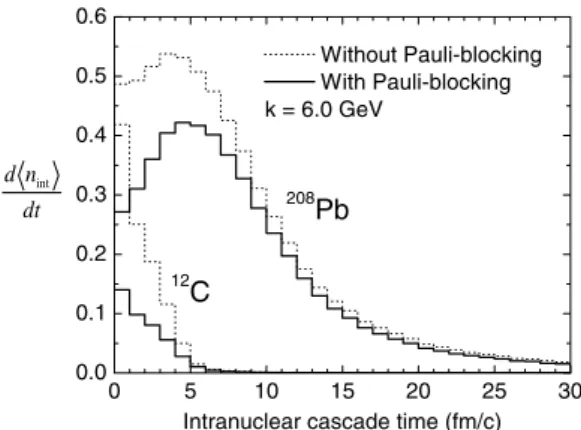
production and decay;iii) charge exchange processes;iv) pion re-absorption by a nucleon pair, andv) multiple pion produc-tion processes (up to seven particles in the final state). Such multiple scattering scenario dictates how the initialπ0flow is distributed among the available channels. In order to illus-trate the rigorous Monte Carlo method to describe multiple pion-nucleon scatterings, we show in Fig. 1 the time deriva-tive of the average number of pion-nucleon scatteringsnint with and without the Pauli-blocking for a typical cascade at 6.0 GeV for12C and208Pb. The dependence of dnint
dt on the nuclear volume is evident, showing that secondary scatterings are not relevant in light nuclei. The result for12C exhibits a peak at the earliest cascade stages falling rapidly to zero around 5 fm/c. This gives a nice estimate (∼5 fm) of the nuclear dimensions for a pion traveling at the speed of light. For the208Pb, however, we obtained a much broader distrib-ution with a maximum shifted towards∼5 fm/c, indicating that secondary scatterings with multiple pion productions are likely to occur for heavier systems.
0 5 10 15 20 25 30
0.0 0.1 0.2 0.3 0.4 0.5 0.6
dt n d
int
208 Pb
12 C
Intranuclear cascade time (fm/c) Without Pauli-blocking With Pauli-blocking k = 6.0 GeV
FIG. 1: Time derivative of the average number of pion-nucleon in-teractions during the cascade stage for12C and208Pb at 6 GeV. The dotted/solid histogram represents all the collisions without/with the Pauli exclusion principle.
V. RESULTS
A. π0angular distributions for12C at the GeV range and
forward angles
With the prescriptions outlined above, we can calculate the angular distributions of neutral pions in the GeV range for the Primakoff, Nuclear Coherent and Nuclear Incoherent mecha-nisms. The results for12C atk=5.5 GeV in the laboratory frame are shown in Figs. 2, 3 and 4. Kinematical cuts on the totalπ0energy were applied in order to estimate the nu-clear background at different kinematical domains. The quan-tity∆Erepresents the energy difference between the incoming photon and the outgoing pion: ∆E=k−Eπ0.While for the coherent mechanisms (electromagnetic/nuclear) most of the pions have the total energy very close to the incident photon energy(∆E3 MeV), for the incoherent process (figure 4) there is a significant lowering on the pion energies caused by the requirement of a higher momentum transfer to excite the nucleus.
FIG. 2: Primakoffπ0photoproduction cross section from12C at 5.5 GeV in the PWIA. The kinematical cuts are as follows:∆E<1 MeV (solid),∆E<2 MeV (dashed),∆E<3 MeV (dotted),∆E<4 MeV (dashed-dotted) and∆E<5 MeV (dashed-dotted-dotted).
The Primakoff cross section (Fig. 2) exhibits a peak around
m2π
2k2 ∼0.017 degrees and falls rapidly to zero because of the 1
Q4 dependence. It is interesting to note that almost all the pions have total energy betweenkandk−1 MeV. This result reflects the forward peak constraint imposed by eq.(1).
The nuclear coherent cross section (Fig. 3) peaks at ap-proximately kR2 ∼1.49 degrees, falling to zero forθπ0 3.5 degrees. Most of the pions produced via the nuclear coher-ent mechanism have total energy betweenkandk−3 MeV, in accordance with the kinematical characteristic inherent to eq.(2). The solid line of figure 3 represents the Plane Wave Impulse Approximation (PWIA), while the dashed line also includes the FSI effects of the produced pions.
FIG. 3: Nuclear coherentπ0photoproduction cross section from12C at 5.5 GeV. The solid histogram is the PWIA and the dashed his-togram includes the FSI effects of the produced pions. The kine-matical cuts are as follows: ∆E<1 MeV (dotted),∆E<2 MeV (dashed-dotted),∆E<3 MeV (dashed-dotted-dotted),∆E<4 MeV (short-dashed) and∆E<5 MeV (short-dashed-dotted).
FIG. 4: Nuclear incoherentπ0photoproduction cross section from 12C at 5.5 GeV. The solid histogram is the PWIA, the dashed line
takes into account the Pauli exclusion principle and the dotted line represents the full calculation with FSI. The kinematical cuts are as follows:∆E<3 MeV (dashed-dotted),∆E<4 MeV (dashed-dotted-dotted) and∆E<5 MeV (short-dashed).
The PWIA is the solid line and the dashed line represents the calculations including the Pauli exclusion principle. The full calculation is the dotted line and takes into account the FSI effects. The structures of the cross section for low polar an-gles are attributed to the kinematics of the photoproduction channel, which takes into account the Pauli principle and a re-alistic momentum distribution of the nucleons at the ground state based on the shell model. For details on the momentum distributions see ref.[10]. The kinematical cuts on the inco-herent cross section are very effective, showing that only few
5.480 5.485 5.490 5.495 5.500
100 101 102 103
12
C(γ,π0)X k = 5.5 GeV
d
σ
/d
E0π
(
µ
b/GeV)
π0energy, lab frame (GeV)
Primakoff Nuclear Coherent Nuclear Incoherent All
FIG. 5: π0energy spectra for 12C at 5.5 GeV and its Primakoff
(dotted), nuclear coherent (dashed) and nuclear incoherent (dashed-dotted-dotted) contributions.
events can survive after a typical cut∆E<5 MeV.
B. π0energy spectra for12C at the GeV range and forward
angles
The neutral pion energy spectra can be combined with the angular distributions to disentangle the different production processes in nuclei. The structure of the MCMC model per-mits a continuous evaluation of particle’s energies along time, propitiating an accurate method to access information of an excited nuclear system.
Figure 5 shows the normalizedπ0 energy spectra for12C
atk=5.5 GeV for the three different production channels. The Primakoff contribution (dotted line) exhibits a remarkable peak at∆E<1 MeV, as suggested by the angular distribution results. The nuclear coherent processes (dashed line) is also concentrated at the higher energy region, typically∆E<5 MeV, and dominates the photoproduction mechanism due to the small fraction of Primakoff events on the total (integrated) cross section. Both of the coherent processes are not relevant above∆E∼6 MeV, since the respective form factors vanish at this kinematical domain (”high” momentum transfer region). The nuclear incoherentπ0 energy spectrum
VI. CONCLUSIONS
A Monte Carlo method has been applied to study both co-herent (Primakoff/nuclear) and incoco-herent π0 photoproduc-tion mechanisms at the GeV range and forward angles from spin zero nuclei. The Coulomb process was analyzed taking into account the exact relativistic recoil of the nucleus and ne-glecting FSI effects of the produced pions (PWIA). The other processes, namely, the nuclear coherent and incoherent con-tributions were analyzed in the context of the MCMC intranu-clear cascade model including full FSI effects.
The differential cross sections for 12C at 5.5 GeV are largely dominated by the Primakoff peak up to θπ0 0.50, with the nuclear coherent mechanism being the most relevant contribution in the range 0.50θ
π02.00. The nuclear
inco-herent part is Pauli-suppressed at lower angles and becomes the largest contribution for higher anglesθπ02.00.The en-ergy spectra of the pions indicate that both the Coulomb and nuclear coherent processes are concentrated within a narrow energy range(∆E5 MeV)in contrast to the nuclear inco-herent part, which is greatly inhibited in this energy gap due to a much larger momentum transfer to the nucleus.
In conclusion, a careful kinematical analysis using the MCMC model was performed to establish an efficient method of background subtraction for future reference in high energy
π0photoproduction experiments, such as the PrimEx Collab-oration at the Jefferson Laboratory.
The authors thank the Brazilian agencies FAPESP and CNPq, and the Latin-American Physics Center (CLAF) for partial support to this work.
[1] H. Primakoff, Phys. Rev.81, 899 (1951).
[2] A. Browman, J. De Wire, B. Gittelman, K. M. Hanson, D. Lar-son, E. Loh, and R. Lewis, Phys. Rev. Lett.33, 1400 (1974). [3] http://www.jlab.org/primex/primex notes/PR99-014.ps
(PrimEx Proposal, accessed in Aug-2006)
[4] M. G. Gonc¸alves, S. de Pina, D. A. Lima, W. Milomen, E. L. Medeiros, and S. B. Duarte, Phys. Lett. B406, 1 (1997). [5] M. G. Gonc¸alves, E. L. Medeiros, and S. B. Duarte, Phys. Rev.
C55, 2625 (1997).
[6] S. de Pina, E. C. Oliveira, E. L. Medeiros, S. B. Duarte, and M. Gonc¸alves, Phys. Lett. B434, 1 (1998).
[7] S. B. Duarte (private communication).
[8] T. E. Rodrigues, J. D. T. Arruda-Neto, A. Deppman, V. P. Likhachev, J. Mesa, C. Garcia, K. Shtejer, G. Silva, S. B. Duarte, and O. A. P. Tavares, Phys. Rev. C69, 064611 (2004). [9] T. E. Rodrigues, PhD thesis, University of S˜ao Paulo (2005).
[10] T. E. Rodrigues, J. D. T. Arruda-Neto, J. Mesa, C. Garcia, K. Shtejer, D. Dale, and I. Nakagawa, Phys. Rev C71, 051603(R) (2005).
[11] B. Krusche et al., Eur. Phys. J. A22, 277 (2004).
[12] M. Effenberger, E. L. Bratkovskaya, and U. Mosel, Phys. Rev.
C60, 044614 (1999).
[13] J. Lehr, M. Effenberger, and U. Mosel, Nucl. Phys. A671, 503 (2000).
[14] C. A. Engelbrecht, Phys. Rev.133, B988 (1964).
[15] M. Braunschweig, W. Braunschweig, D. Husmann, K. L¨ubelsmeyer, and D. Schmitz, Nucl. Phys. B20, 191 (1970). [16] R. L. Anderson, D. B. Gustavson, J. R. Johnson, I. D. Overman,