Printed in Brazil - ©2005 Sociedade Brasileira de Química 0103 - 5053 $6.00+0.00
Article
* e-mail: [email protected]
Iodide-Selective Membrane Electrode Based on Salophen Complex of Cobalt (III)
Hamid R. Zare*, Farkhondeh Memarzadeh, Alireza Gorji and Mohammad Mazloum Ardakani
Department of Chemistry, Yazd University, Yazd, 89195-741, Iran
Neste trabalho foi preparado um eletrodo altamente seletivo de membrana de PVC com o complexo cobalto-salofen. O sensor mostra uma seqüência seletiva anti-Hofmeister, com preferência por íons iodeto sobre vários anions comuns. O eletrodo apresentou uma dinâmica linear na faixa de 5,0×10⁻⁷ a 1,0×10⁻¹ mol L-1, com uma inclinação Nernstiana de –58,9 mV com um limite de detecção
de 3,0×10⁻⁷ mol L-1. A região de pH de trabalho do sensor é de 3,1 a 9,8. A leitura rápida é de 15 s,
e tem uma vida útil de 2 meses. Os coeficientes de seletividade para o eletrodo proposto foram melhorados para alguns interferentes, se comparado com os eletrodos de membrana de iodeto disponíveis. O eletrodo proposto foi aplicado com sucesso na determinação direta de iodeto em sal comestível e como eletrodo indicador na titulação potenciométrica de I– contra Ag+.
A highly selective PVC membrane electrode based on a cobalt-salophen complex was prepared. The sensor displays an anti-Hofmeister selectivity sequence with a preference for iodide ion over many common anions. The electrode has a linear dynamic range between 5.0×10⁻⁷ to 1.0×10⁻¹mol L-1,
with a Nernstian slope of -58.9 mV decade-1 and a detection limit of 3.0×10⁻⁷ mol L-1. The working
pH range of the sensor is 3.1-9.8. It exhibits of a fast as 15 s and has a lifetime of about 2 months. The selectivity coefficients for the proposed electrode were improved for some interferences, when compared with those of available iodide membrane electrode. The proposed electrode was successfully applied for the direct determination of iodide in edible salt and as an indicator electrode in potentiometric titration of I– against Ag+.
Keywords: iodide ion-selective electrode, anti-Hofmeister, cobalt-salophen complex, potentiometry, anion sensor
Introduction
Potentiometric determination based on ion selective electrodes (ISEs) of minute quantities of ion species offers great advantages such as adaptable to small sample volume, speed and ease of preparation and procedures, relatively fast response, non-destructive, reasonable selectivity through judicious choice of the membrane active material, low cost, wide linear dynamic range and possible of on line monitoring. These characteristics have inevitably led to sensors ionic species, and the list of available electrode
has grown substantially over the past year.1 However, the
design of anion selective electrodes is far less advanced
than the field of their cation counterparts.1,2 It has been
proven difficult to control selectivity among anions, due to low charge to radii ratios, sensitivities to pH and high
solvation energies.3,4
At first, anion selective membranes electrodes prepared with conventional ion exchangers such as quaternary
ammonium or phosphonium salts,5-7 which interact with
the target anion through electrostatic attraction and induce a selectivity sequence governed by anion’s enthalpy of hydration.
This results in a selectivity order very well known as the
Hofmeister selectivity sequence8 (Organic ions > ClO
4 – >
SCN– > I– > Sal– > NO 3
– > Br– > NO 2
– > Cl– > HCO 3
– > OAC–
> SO42– > HPO 4
2–) which reflects the order of decreasing
hydrophobicity.9 A very interesting development in the field
ISEs is the construction of electrodes that can chemically recognize specific anions and offer potentiometric responses that differ from classical anion exchanger-based membranes. One of the most important recognition elements that can be utilized in the development of anion-selective electrodes
involves specific metal-ligand interactions.10 For the
development of a truly anion-selective electrode, a relatively strong interaction between the ionophore and the anions is required in order to complex anions in a selective fashion. There are several literature reports on the anion
metallophthalocyanines14-17 and some lipophilic
organometallic compounds,17-23 which show anion
selectivity in the membranes that differ from the Hofmeister selectivity sequence. The observed anti-Hofmeister behavior arises from a strong interaction between anions and the ionophores used. It has been show that the anion selectivity behavior of membrane electrodes based on different transition metal complexes is influenced by both the properties of the central metal ions and the structure of
organic ligands.7,20,24-27 The salophen
(N,N’-disalicylidene-1,2-phenylendiamine dianion) as a polydentate ligand are well know to form very stable complexes with transition
metal ions.28,29 However, very little is known about the use
of their complexes as carrier in ion-selective electrodes.
Recently, Amini et al. have reported cysteine-selective
carbon paste electrode based on Cobalt (II) Salophen.30 Also,
Wróblewski et al. prepared nitrite-selective ISE based on
uranyl Salophen.31 Due to the important of selective iodide
determination in different samples, especially in food and biological samples, varieties of ionophores have been used in the preparation of iodide ion-selective
electrodes.20,22,26-28,32-34 In recent years, we have reported new
ion-selective membrane electrodes for Pb2+, Ni2+, and Hg2+
ions.35-37 The main aim of the present work was the
development of a highly selective membrane electrode for iodide based on PVC membranes containing [Co(III)(salophen) (piperidine)
2]ClO4 complex (CoSPPClO4),
(Scheme 1) as a suitable sensing material. In the present study, the membrane compositions were optimized. Their optimum working conditions were investigated and interference studies have been made. The prepared membrane electrode displays a low detection limit and high selectivity and sensitivity to iodide determination.
Experimental
Apparatus and reagents
Potential measurements were made with a Metrohm ion analyzer model 691 at 25 °C, by setting up the following assembly:
Ag/AgCl, KCl (3.0 mol L-1)/test solution/ membrane/KI
(1.0×10⁻² mol L-1)/Ag
The steady-state potentials (± 0.1 mV) were recorded relative to an Azarelectrode silver-silver chloride electrode
containing 3.0 mol L-1 potassium chloride. Electronic
absorption, UV-Vis, spectra were recorded on a Jasco spectrometer model 7800.
[Co(III)(salophen)(piperidine)
2]ClO4 (CoSPPClO4), was
prepared and purified as we described before.28 Poly(vinyl
chloride) (PVC) of high molecular weight, Bis(2-ethylhexyl) phthalate (BEHP), Dibutyl phthalate (DBP), Benzyl acetate (BA) and Acetophenone (AP) were used as received from Fluka. Tetrahydrofuran (THF), Hexadecyltrimethyl ammonium bromide (HTAB) and other chemicals were of the highest purity available from Merck and were used without further purification. All aqueous solutions were prepared with doubly distilled water.
Electrode preparation
All the membranes examined had the following composition: 30% of PVC, 59% of BEHP (as plasticizer),
5% of CoSPPClO4 (as ionophore) and 6% of HTAB (as
additive), unless stated otherwise. The mixture of the components (100 mg) was dissolved in 3.0 mL of THF. The resulting clear mixture was evaporated slowly until an oily concentrated mixture was obtained. A Pyrex tube (3.0 mm i.d.) was dipped into the mixture for a bout 5 s, so that a nontransparent membrane is formed. The tube was then pulled out from the mixture and kept at room temperature for about 1 h. The tube was then filled with an
internal solution (1.0×10⁻² mol L-1 KI). The electrode was
finally conditioned for 24 h by soaking in a 1.0×10⁻² mol
L-1 KI solution.
Results and Discussion
Potential responses of the sensors
In preliminary experiments, the CoSPPClO4 was used
to prepare a PVC membrane ISE for a variety of anions. The potential response of the electrodes based on
CoSPPClO4 for different anions are shown in Figure 1. As
seen, except for I–, SCN–, CN–, and all other anions studied
show a non-Nernstian response in the concentration range
1.0×10⁻⁶ to 1.0×10⁻¹ mol L-1 due to their very weak
interaction with the membrane. However, the electrode possesses much better sensitivity, response time and linear
range for I– than for the SCN– and CN– ions. We therefore,
studied in detail the properties of the electrode for iodide
Scheme 1. [Co(III)(salophen)(piperidine) 2]
ion. As it is obvious from Figure 1, membrane electrode
based on ionophore CoSPPClO4 gave selectivity patterns
that deviate the Hofmeister series. Thus, the order of selectivity observed for the ionophore studied in this work was I– > SCN– > CN– > NO
additives may catalyze the exchange kinetics at the
sample-membrane interface.40 Further investigations were carried
out to optimize the membrane ingredients by varying the amount of the ionophore. It is seen from Table 1 that membrane electrode with 5% of the ionophore (No. 5) has the best performance. As is obvious, the best response characteristics are obtained with a membrane composition
of 59% BEHP, 30% PVC, 5% CoSPPClO4 and 6% HTAB
(No. 5).
Electrode response characteristics
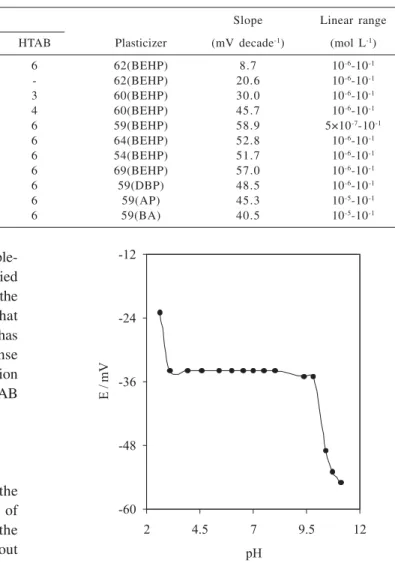
One of the ions present in aqueous solution is the hydrogen ion. It possible interferes with functioning of the sensor. In view of this, it is necessary to find the optimum pH range where the sensor functions without interference from the hydrogen ions. The influence of pH of the test solution on the potential response of the membrane sensor was tested over the range 2.6-11.1 at
fixed concentration of 1.0×10⁻³ mol L-1 iodide ions (Figure
3). The pH of the solutions was adjusted by the addition of
HNO3 or KOH. It is clear from Figure 3 that the useful pH
range is 3.1-9.8 as the pH dependence of the electrode response was not significant in this range. However, the potential of the sensor was significantly affected below pH 3.1 and above pH 9.8. In the solution with pH>10.0, the potentiometric response properties of the electrode slightly deteriorated and the observation can be explained by hydroxide-coordinated central metal interference.
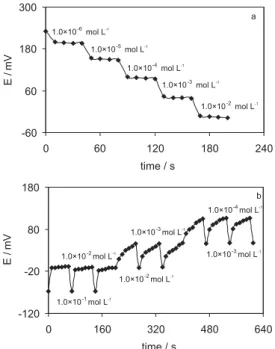
For analytical applications the dynamic response time of a sensor is an important factor. Typical dynamic response
of CoSPPClO4membrane sensor for iodide ion is shown in
Figure 4. In Figure 4a, the practical response time was recorded by changing solutions with different iodide concentrations. The measurements sequence was the low
(1.0×10⁻⁶ mol L-1) to the high (1.0×10⁻² mol L-1)
concentrations. As can be seen, in whole the concentration
range the electrode reaches the equilibrium response in a short time (<15 s). To evaluate the reversibility of the electrode, a similar procedure at the opposite direction was adopted. Figure 4b shows the recorder tracings for a series of replicate concentration of iodide at
concentrations ranging from 1.0×10⁻¹ mol L-1 to 1.0×10⁻⁴
mol L-1. It is clear that the potentiometric response of the
sensor was reversible, although the time needed to reach equilibrium values were longer than that for the low-to-high sample concentrations.
The concentration of the internal KI solution in the
electrode was changed from 1.0×10⁻²to 1.0×10⁻⁴ mol L-1
and the potential response of the iodide selective electrode were measured. It was found that the variation of the concentration of the internal solution does not cause any significant difference in the potential response, except for an expected change in the intercept of the resulting Nernstian
plots. A 1.0×10⁻² mol L-1 KI solution was found quite
Table 1. Composition of membranes and response characteristics of the electrodes
Membrane Composition (%) Slope Linear range
No. CoSPPClO4 PVC HTAB Plasticizer (mV decade-1) (mol L-1)
1 - 3 2 6 62(BEHP) 8.7 10-6-10-1
2 5 3 3 - 62(BEHP) 20.6 10-6-10-1
3 7 3 0 3 60(BEHP) 30.0 10-6-10-1
4 6 3 0 4 60(BEHP) 45.7 10-6-10-1
5 5 3 0 6 59(BEHP) 58.9 5×10⁻⁷-10-1
6 5 2 5 6 64(BEHP) 52.8 10-6-10-1
7 5 3 5 6 54(BEHP) 51.7 10-6-10-1
8 5 2 0 6 69(BEHP) 57.0 10-6-10-1
9 5 3 0 6 59(DBP) 48.5 10-6-10-1
1 0 5 3 0 6 59(AP) 45.3 10-5-10-1
1 1 5 3 0 6 59(BA) 40.5 10-5-10-1
Figure 3. Effect of pH of the test solution (1.0×10⁻³ mol L-1 of I–) on
appropriate for smooth functioning of the electrode system. The optimum response of the electrode was tested after
conditioning for different periods time in a 1.0×10⁻² mol
L-1 KI solution. The optimum equilibration time for the
membrane electrode in the presence of a 1.0×10⁻² mol L-1
KI solution was 24 h, after which it would generate stable potential in contact with iodide solutions. Using the optimized membrane composition and conditions described above, the potentiometric response of the most sensitive sensor system (No. 5) was studied in the iodide
concentration range of 1.0×10⁻⁷ to 5.0×10⁻¹ mol L-1. The
emf values of the membrane sensor at varying concentration of iodide ion (Figure 5) indicate a rectilinear range from
5.0×10⁻⁷ to 1.0×10⁻¹ mol L-1. The slope of the calibration
curve was -58.9 mV per decade of I– ion concentration.
The limit of detection, as determined from the intersection of the two extrapolated segments of the calibration graph,
was 3.0×10⁻⁷ mol L-1. The standard deviation of the
potential response for the membrane electrode dipped
alternatively into solutions of 1.0×10⁻², 1.0×10⁻³ and
1.0×10⁻⁴ mol L-1 of I– ion were ±0.4, ±0.8 and ±1.2 mV
(n=14). The electrodes prepared could be used for at least 2 months without any measurable divergence.
Interference studies
The most important characteristic of a membrane sensor is its response for primary ion in the presence of other anions in solution, which is usually expressed in terms of
the potentiometric selectivity coefficient ( ). The
methods based on the Nicolsky-Eisenman equation for determining the potentiometric selectivity coefficient (e.g. the fixed primary method and the fixed interference method) suffer some limitations in terms of values for ions of unequal charges, non-Nernstian behavior of interfering
ions and activity dependence of values.41,42 Thus, in this
study, the recommended matched potential method
(MPM)41-43 which is totally independent of the
Nicolsky-Eisenman equation was used to overcome the above-mentioned difficulties. According to this method, the selectivity coefficient is defined as the activity
(concentration) ratio of the primary ion (I–) to the interfering
ion (An–), , that give the same potential
change in a reference solution potential. The experimental conditions employed and the resulting selectivity coefficients values are summarized in Table 2. The
corresponding values reported for other I– ion-selective
electrodes are also included in Table 2. The potentiometric selectivity patterns clearly indicate that the proposed sensor is highly selective toward iodide over a number of other anions. In Table 2, the analytical performance and selectivity coefficients for diverse anions of the proposed electrode are compared with the corresponding values previously reported for iodide ion-selective membrane
electrodes.20,22,25-27,33,34,44,45 The data given in Table 2
indicate that, the selectivity coefficients, linear range, response time, pH range and slope of calibration graphs somewhat similar, in some case, or even superior, in most cases, to the sensors prepared previously. Therefore, on the basis of these data, we may conclude that the membrane sensor, proposed in this work is among the most selective and sensitive electrodes reported thus far for iodide ion.
Practical application
The proposed iodide membrane electrode (No. 5) was found to work well under laboratory conditions. It was applied successfully as an indicator electrode in the
Figure 4. Potentiometric dynamic response of CoSPPClO4 mem-brane electrode for step changes of from (a) low-to-high and (b) high-to-low iodide concentrations.
potentiometric titration of 20 mL of 1.0×10⁻⁴ mol L-1 KI
with 1.0×10⁻² mol L-1 AgNO
3 and the resulting titration curve
are shown in Figure 6. As can be seen, the amount of iodide can be determined with electrode. To assess the applicability of the proposed electrode to real sample, an attempt was made to recovery of iodide in edible salt solutions. For this purpose, a new calibration graph has been prepared in a
solution containing 3.5 mol L-1 NaCl which is the
concentration of edible salt when 20 g of it dissolved in 100
mL water. This has to be done because of the very high concentration of chloride in edible salt. Then, 20 g of edible salt was dissolved in 100 mL of water and the potential measurements were made using the proposed electrode. The resulting data are shown in Table 3. Satisfactory recovery of the iodide ion added to edible salt samples was achieved without any prior treatment of the samples.
Conclusions
A highly selective membrane electrode for iodide ions
based on CoSPPClO4 as ionophore was investigated. The
optimized formulation of the membrane (i.e. 59% BEHP,
30% PVC, 5% CoSPPClO4, 6% HTAB) shows a linear
concentration range of 5.0×10⁻⁷ to 1.0×10⁻¹ mol L-1 with a
slope of -58.9 mV per decade and limit of detection of
3.0×10⁻⁷ mol L-1. The selectivity coefficient data for iodide
ion relative to most of interfering ions are negligibly small. The electrode has a fast response time and good reproducibility. The analytical applications of the proposed electrode were successfully checked.
Table 2. Selectivity coefficient values (log KP I o
–t.
References
1. Bühlmann, P.; Pretsh, E.; Bakker, E.; Chem. Rev. 1998, 98,
1593.
2. Schmidtchen, F.P.; Berger, M.; Chem. Rev.1997,97, 1609. 3. Beerand, P.D.; Gale, P.A.; Angew. Chem. Int. Ed. 2001,40,
486.
4. Dietrich, B.; Pure Appl. Chem.1993,65, 1457. 5. Arnold, M.A.; Solsky, R.L.; Anal. Chem.1986,58, 84R. 6. Yu, R.Q.; Ion Selective Electrode Rev.1986,3, 153. 7. Wotring, V.J.; Johnson, D.M.; Bachas, L.G.; Anal. Chem.1990,
62, 1506.
8. Wuthier, U.; Pham, H.V.; Zund, R.; Welti, D.; Funck, R.J.J.; Bezegh, A.; Ammann, D.; Pretsch, E.; Simon,V.; Anal. Chem.
1984,56, 535.
9. Schulthess, P.; Ammann, D.; Krautler, B.; Caderas, C.; Stepane, K.R.; Simon, W.; Anal. Chem.1985,57, 1397.
10. Hutchins, R.S.; Bachas, L.G.; Anal. Chem.1995,67, 1654. 11. Ammann, D.; Huster, M.; Kräutler, B.; Rusterholz, B.;
Schulthess, P.; Lindemann, B.; Halder, E.; Simon, W.; Helv.
Chim. Acta1986,69, 8749.
12. Chang, Q.; Meyerhoff, M.E.; Anal. Chim. Acta1986,186,
81.
13. Hodinar, A.; Jyo, A.; Anal. Chem.1989,61, 1169.
14. Lui, J.; Masuda, Y.; Sekido, E.; Wakida, S.; Hiiro, K.; Anal.
Chim. Acta1989,224, 1145.
15. Liu, I.; Masuda, Y.; Sekido, E.; J. Electroanal. Chem.1990,
291, 67.
16. Tse, Y.H.; Janda, P.; Lever, A.B.P.; Anal. Chem.1994, 66,
384.
17. Allen, J.R.; Florido, A.; Young, S.D.; Daunert, S.; Bachas, L.G.;Electroanalysis1995,7, 710.
18. Wathier, U.; Ammann, D.; Pretsch, E.; Simon, W.; Anal. Chem.
1984,56, 535.
19. Shamsipur, M.; Khayatan, G.; Tangestaninejad, S.;
Electroanalysis1999, 11, 1340.
20. Yuan, R.; Chai, Y.-Q.; Liu, D.; Gao, D.; Li, J.-Z.; Yu, R.-Q.;
Anal. Chem.1993,65, 2572.
21. Florido, A.; Bachas, L.G.; Valiente, M.; Yillascusa, I.; Analyst
1994,119, 2421.
22. Ganjali, M.R.; Poursaberi, T.; Hosseini, M.; Salavati-Niasary, M.; Yousefi, M.; Shamsipur, M.; Anal. Sci. 2002,18, 289. 23. Liu, D.; Chen, W.C.; Shen, G.L.; Yu, R.Q.; Analyst1996,121,
1495.
24. Ying, M.; Yuan, R.; Zhang, X.-M.; Song, Y.-Q.; Li, Z.-Q.; Shen, G.-L.; Yu, R.-Q.; Analyst1997,122, 1143.
25. Li, Z.-Q.; Yuan, R.; Ying, H.; Song, Y.-Q.; Shen, G.L.; Yu,
R.-Q.;Anal. Lett.1997,30, 1455.
26. El Aamrani, F.Z.; Garcia-Raurich,V.; Sastre, A.; Beyer, L.; Florido, A.; Anal. Chim. Acta1999,402, 129.
27. Shamsipur, M.; Sadeghi, S.; Naeimi, H.; Sharghi, H.; Polish J.
Chem.2000,74, 231.
28. Amirnasr, M.; Schenk, K.J.; Gorji, A.; Vafazadeh, R.;
Polyhedron2001,20, 695.
29. Verboom, W.; Rudkevich, D.M.; Reinhoudt, D.N.; Pure Appl.
Chem.1994,66, 679.
30. Amini, M.K.; Khorasani, J.H.; Khaloo, S.S.; Tangestaninejad,
S.;Anal. Biochem.2003,320, 32.
31. Wróblewski, W.; Brzózka, Z.; Rudkevich, D.M.; Reinhoudt, D.N.;Sens. Actuators B1996,37, 151.
32. Coetzee, C.J.; Freser, H.; Anal. Chem.1969,41, 1128. 33. Yuan, R.; Song, Y.; Chai, Y.Q.; Xia, S.X.; Zhong, Q.Y.; Yi, B.;
Ying, M.; Shen, G.; Yu, R.; Talanta1999,48, 649.
34. El Aamrani, F.Z.; Sastre, A.; Aguilar, M.; Beyer, L.; Florido,
A.;Anal. Chim. Acta1996,329, 247.
35. Amini, M.K.; Mazloum, M.; Ensafi, A.A.; Fresenius J. Anal
Chem.1999,364, 690.
36. Mazloum, M.; Salavati-Niassary, M.; Amini, M.K.; Sens.
Actuators B 2002,82, 259.
37. Mazloum, M.; Amini, M.K.; Mohammadpoor-Baltork, I.; Sens.
Actuators B2000,63, 80.
38. Ammann, D.; Pretsch, E.; Simon, W.; Lindner, E.; Bezegh, A.; Pungor, E.; Anal. Chim. Acta1985,171, 119.
39. Rosatzin, T.; Bekker, E.; Suzuki, K.; Simon, W.; Anal. Chim.
Acta1993,280,197.
40. Gering, P.M.; Morf, W.E.; Welti, M.; Pretsch, E.; Simon, W.;
Helv. Chim. Acta1990,73, 203.
41. Umezawa, Y.; Umezawa, K.; Sato, H.; Pure Appl. Chem.1995,
67, 507.
42. Bakker, E.; Electroanalysis1997,9, 7.
43. Gadzekpo, V.P.Y.; Christian, G.D.; Anal. Chim. Acta1984,
164, 279.
44. Shamsipur, M.; Soleymanpour, A.; Akhond, M.; Sharghi, H.; Naseri, M.A.; Anal. Chim. Acta2001,450, 37.
45. Somer, G.; Kalayci, S.; Ekmekci, G.; Sens. Actuators B2001,
81, 122.