Taking into account an importance of rapeseed as agricultural crop, creation of new transgenic lines with improved properties is a timely task. Rapeseed (Brassica napus L.) is one of the most important oilseed crops. Rape oil is on the third place after palm oil and soybean oil on a scale of world production, and by import and export scales it takes the fourth place. Rape oil processing products have their use at food, medical, chemical, paint, fuel, printing, textile, metallurgy, machinery industries. The percentage of vegetable-based fuel derived from rape oil is 5.8% of the total scale, and till 2015 this index can increase to 8%. Rape oil meal after oil removing is a valuable component of cattle feed, because it contents about 32% of protein, 9% of fat, 30% of nonnitrogenous extractive substances. Digestive coefficient of those compounds is achieving to 70%. Green plant biomass also fits to be cattle feed starting from the middle spring.
Rapeseed is an important nectariferous plant too. During the flowering period honey production is about 80 kg from 1 hectare.
Rapeseed is an optimal predecessor for cereal crops, because it improves the phytosanitary conditions of soil. Rapeseed biomass during its decomposition is producing glycosinolates — sulfuric compounds reducing weakness of following crops to fusariosis, black spot, septospyrosis and bacterial stem diseases [1].
Up to 2012 the leaders of world rapeseed production were China, Canada, European Union, India and United States [2].
The great importance of rapeseed as an agricultural crop stimulates for developing the new transgenic lines — as with changed biochemical characteristics, also with added mechanisms of resistance to multiple biotic and abiotic factors. In other way, the development of new methods for detection of transgenic sequences in plant material is no doubt an important direction.
Herbicides used to struggle the weeds in crop fields treatment, significantly harm to agricultural plants. Consequently the priority task is the development of rapeseed lines, resistant to herbicides, as an example — to glyphosate. Two lines with same resistance UDC 577.21+604.6:582.983.2+631.348 doi: 10.15407/biotech8.02.052
COMPARATIVE MOLECULAR GENETIC ANALYSIS
BETWEEN UKRAINIAN AND EU REGISTRATED
GLYPHOSATE-TOLERANT RAPESEED
TRANSGENIC PLANTS
Кey words:rapeseed, glyphosate, genetic transformation, CP4 epspsgene.
A. M. Taranenko
L. O. Sakhno Institute of Cell Biology and Genetic Engineering
B. V. Morgun of the National Academy of Sciences of Ukraine, Kyiv
M. V. Kuchuk
E-mail: [email protected]
Received 28.10.2014
The purpose of research was to analyze 10 developed at the Institute of Cell Biology and Genetic Engineering lines of rapeseed to confirm the presence and functionality of the transferred transgene CP4 epsps, as well as the differences among those lines from registered transformation events GT73 and GT200 (Monsanto).
During the study extraction of total rapeseed DNA, PCR analysis, electrophoretic separation and visuali-zation of amplicons in agarose gel were conducted, as well as testing of green plants for resistance to glyphosate in greenhouse. The structural difference among 7 transgenic lines from registered transfor-mation events GT73 and GT200 was revealed. Plants showing the presence of synthetic CP4 epsps sequence were resistant to the herbicide in a closed soil. The uniqueness of the obtained transformation events was confirmed, as well as the prospect of using them in breeding.
were developed and commercialized by Monsanto Company. Now they are known as GT73 (RT73) and GT200. These lines were obtained by Agrobacterium-mediated transformation of B. napus cultivar Westar with vectors pMON17327 and pMON17209 correspondingly. The vectors contained the sequences encoding such enzymes as 5-enolpyruvylshikimate-3-phosphate synthase (epsps gene taken from Agrobacterium tumefaciens strain СР4) and glyphosate oxidase (gox gene taken from Ochrobacterium anthropi) [3].
In transformation event MON-ØØØ73-7, also known as GT73 and RT73 [4], the synthetic СР4 epsps gene is associated with regulatory sequences: 35S promoter taken from cauliflower mosaic virus (P-CmoVb), 3-end of rbcS E9 gene taken from pea (E9 3) as terminator, and sequence of chloroplast signal AEPSPS/CTP2, which directs a newly synthesized polypeptide to higher plant’s chloroplasts. The expression of gox gene is controlled by the similar sequences.
The T-DNA of transformation event GT200 had the resembling structural plan, differing in chloroplast signal peptide sequence only — for this purpose the AEPSPS/CTP1 was used [3, 5].
Methods for rapeseed transformation were formerly developed and adapted at the Institute of Cell Biology and Genetic Engineering of the National Academy of Sciences of Ukraine [6]. Basing to this technology rapeseed transformation with a construct, containing synthetic CP4 epsps gene, was carried out. Eventually some potentially tolerant to glyphosate transgenic lines were regenerated [7, 8].
The purpose of our work was to analyze comparatively transgenic rapeseed lines T215/133/2/9, T215/133/2/3, T115/133/2/10, T015/133/5, T017/133/4, 18а/2, 18b/25, and to confirm the difference among these lines from the registered transformation events GT73 and GT200 (Monsanto).
Materials and Methods
Plant material. The particular genetic constructs with CP4 epsps gene giving resistance to glyphosate in model Nicotiana tabacumplants were developed at the Institute of Cell Biology and Genetic Engineering of NAS of Ukraine.
Genetic construct pCB133, developed at the Institute of Cell Biology and Genetic Engineering of NAS of Ukraine, was used
to transform the spring rapeseed plants. The construct consisted of the following sequences: Tnos — nopaline synthase gene terminator, Рnos — nopaline synthase gene promoter, Р35S — cauliflower mosaic virus gene promoter, Тocs — octopine synthase gene terminator, ТР — transit peptide, epsps — 5-enolpyruvylshikimate-3-phosphate synthase synthetic gene, bar — phosphinothricin acetyl transpherase gene as selective one [7, 8]. Transformational frequency for the basic procedure reached 8–9% [6].
For the current study transgenic lines showing 3:1 mendelian segregation after self-pollination were taken on the basis of resistance to the selective agent, indicating that the gene insertion is a single copy [6–10].
For the analysis, leaf explants taken from 3-week old B. napus plants [7, 8], raised in vitroon MS medium [9] were used. A referent sample of rapeseed DNA with transformation event GT73 was used as a positive control in PCR tests [11].
Extraction of plant DNA was carried out according to the procedure [12, 13] using CTAB buffer (20 g/l CTAB (Serva), 1.4 M NaCl (Alfarus), 0.1 M Tris-HCl pH 8.0 (Merck), 20 мМ Na2EDTA (Serva), 1,4 μl/ml -mercaptoethanol (Sigma-Aldrich)), with following extraction of total proteins by chloroform:isoamyl alcohol (24:1) mixture, RNase A (Thermo Scientific) hydrolysis, dissolving of nucleic acids, and, finally, washing with 70% ethanol. The DNA sediment was diluted in 50 μl of TE buffer pH 8.0.
Evaluation of DNA purity. The fractionation of purified total DNA was confirmed by electrophoresis in 0.8% agarose gel with TBE buffer. The concentration of DNA in solution was determined spectrophotometrically by measuring the absorption of UV light at a wavelength of 260 nm (A260) on BioPhotometer v. 1.35 (Eppendorf). The purity of DNA was evaluated by the ratio А260/А230 and А260/А280.
The DNA concentration for all samples was normalized to 30 μg/ml with TE buffer.
The primary PCR reaction was targeted to detect cruA gene sequence, encoding the B. napusreserve protein cruciferin A (GenBank accession X14555) [14]. The following reactions were directed to detect CP4 epsps sequences (GenBank accession JF445290) [15], GT73 and GT200 events.
The amplification program for cruciferin Agene sequence was: primary denaturation — at 94 С for 4 min; 35 cycles: 94 С for 30 s, 55 С for 30 s, 72 С for 16 s; final elong a-tion — at 72 С for 10 min, with following cooling to 22 С.
The amplification program for GT73 sequence was: primary denaturation — at 94 С for 4 min; 35 cycles: 94 С for 30 s, 57 С for 30 s, 72 С for 30 s; final elongation — at 72 С for 10 min, with following cooling to 22 С.
The amplification program for GT200 sequence was: primary denaturation — at 94 С for 4 min; 35 cycles: 94 С for 30 s, 57 С for 30 s, 72 С for 17 s; final elongation — at 72 С for 10 min, with following cooling to 22 С.
The amplification program for CP4 epsps sequence was: primary denaturation — at 94 С for 4 min; 35 cycles: 94 С for 30 s, 59 С for 30 s, 72 С for 32 s; final elongation — at 72 С for 10 min, with following cooling to 22 С.
Agarose gel electrophoresis.PCR products were loaded into 1.2% agarose gel (MO BIO Laboratories) in ТВЕ buffer with 5 μg/ml of ethidium bromide, with following separation at 5 V/cm for 45 min. The images of gels were taken in UV light using мLKB Bromma 2011 Macrovue Transilluminator with the digital camera Canon EOS 600D. The visual documents of electrophoresis were processed with the raster graphical redactor GIMP, additionally using Microsoft PowerPoint.
Glyphosate-tolerance testing. Spraying of 3-week old adapted plants was provided
in a closed soil with «Hurricane Forte 500 SL, v.р.k.» commercially available herbicide (Syngenta). The concentration of its active component, potassium salt of glyphosate was 500 g/l. Plant treatment was processed with 2.5 μg/l working solution of glyphosate according to the producer’s recommendations. The effect of treatment was evaluated in one week.
Results and Discussion
Young rapeseed leaves, taken from 3-week old rapeseed transgenic plants for lines 18а/2 (sample 4), 18b/25 (sample 8) [7], T215/133/2/9 (sample 1), T215/133/2/3 (sample 2), T115/133/2/10 (sample 5), T015/133/5 (sample 6), T017/133/4 (sample 9) [8], T212b (sample 10) [10], Bn12 (cultivar Mariya, sample 3), Bn15 (cultivar Exgold, sample 7), were used for the extraction of DNA. The quality of purified total DNA was determined with spectrophotometer.
Measurements showed that total DNA concentration in the samples fluctuated from 38.0 μg/ml (T215/133/2/3) to 362.8 μg/ml (T015/133/5), and the quantity varied from 1.9 μg (T215/133/2/3) to 18.14 μg (T015/133/5).
The correlations А260/А280 and А260/А230 showed the purity of DNA solutions was quite acceptable. Samples 2, 3, 7, and 10 showed some partial contamination of preparations of nucleic acids with proteins.
The pilot polymerase chain reaction was conducted for the evaluation of DNA quality with the purpose to determine cruA referent gene, which is known to be responsible for cruciferin A synthesis.
All analyzed samples showed the presence of a fragment, equal to the expected amplicon with all its characteristics (258 b.p. — Fig. 1).
The next stage of molecular genetic research was to confirm the presence of transferred CP4 epsps transgene in the DNA
Specifications of primers used in PCR
Name Gene/event Sequence length, b.p. ReferenceAmplicon
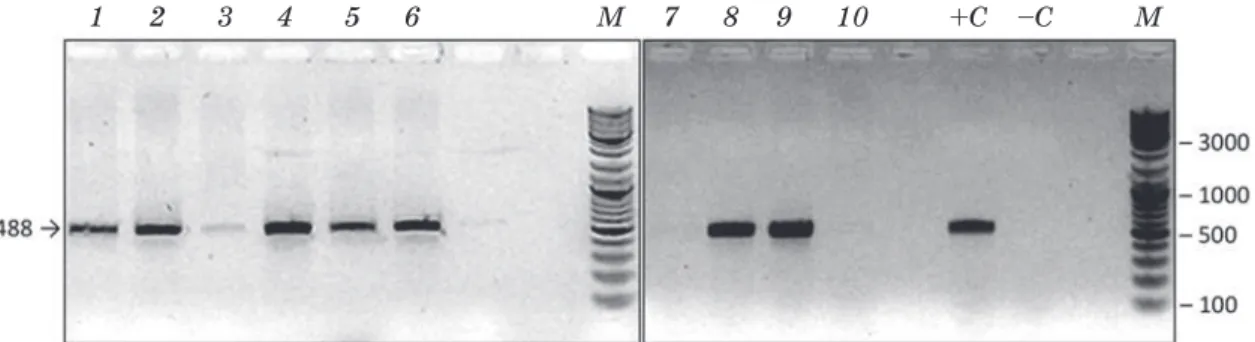
of the studied lines. The DNA of transgenic Zea mays GA21 line was used as the positive control. In transgenic lines T215/133/2/9, T215/133/2/3, T115/133/2/10, T015/133/5, T017/133/4, 18а/2 the presence of the expected fragment with the length of 488 b.p. was noted (Fig. 2).
An arrow indicates the location of expected product and its length in b.p.
The next step was to confirm the difference between the inspected transgenic lines and registered transformation events GT73 together with GT200 developed by Monsanto Company.
Fragment with the length of 522 b.p. was not indicated in gel, which is pointing to the structural difference between the analyzed rapeseed lines and the transformation event GT73, developed by Monsanto Company (Fig. 3).
A DNA fragment with the length of 274 b.p. was not detected in agarose gel during the analysis of the samples for their possible
similarity to the transformation event GT200 (the data is not shown). That testified about the non-similarity of analyzed lines to abovementioned transformation event.
Presence of the small-weight DNA fragments could be observed in both cases, pointing on the mutual activity of primers, which is usually typical for PCR.
Thus, the molecular genetic research had confirmed the uniqueness of the developed at the Institute of Cell Biology and Genetic Engineering of NAS of Ukraine glyphosate-tolerant rapeseed lines. The lines T215/133/2/9, T215/133/2/3, T115/133/2/10, T015/133/5, T017/133/4, 18а/2 showed the presence of CP4 epspstransgene in their genome. The difference among analyzed lines from registered foreign transformation events GT73 and GT200 had been proved.
The testing of transgenic plants for the resistance to glyphosate was conducted in greenhouse (Fig. 4). We revealed that transgenic plants remained green and vegetating, at the same time as control plants were turning yellowish and withering. That experimental data remained reliable during all time of observation.
Consequently this transgenic status of analyzed rapeseed plants was revealed. Structural difference between the analyzed l i n e s T21 5 / 1 3 3 / 2 / 9 , T21 5 / 1 3 3 / 2 / 3 , T115/133/2/10, T015/133/5, T017/133/4, 18а/2 and the registered in European Union transformation events GT73, GT200 (Monsanto) was reliably proved. The expression of tolerance to «Hurricane Forte 500 SL, v. р. k.» herbicide, containing 2,5 μg/l potassium salt of glyphosate, was detected in greenhouse. For the purpose of future research we consider to evaluate the tolerance level of selected lines in opened soil, and to use the best forms for breeding work.
Fig. 1. Electrophoregramm of the amplification products, directed to indicate cruA gene:
Lanes 1–10, DNA samples extracted from lines
1–10, respectively; C — negative control, ТЕ buf-fer; М — molecular weight marker GeneRuler™ DNA Ladder Mix. An arrow shows the location of
expected product and its length
1 2 3 4 5 6 7 8 9 10 C M
Fig. 2. Electrophoregramm of the amplification products to indicate the presence of CP4 epsps gene.
Lanes 1–10, DNA samples extracted from lines 1–10, respectively; +C — positive control Z. mays GA21; –C — negative control, TE buffer; М — molecular weight marker GeneRuler™ DNA Ladder Mix
This research was financially supported with the project «Getting and studying of molecular biological and genetic peculiarities of glyphosate-tolerant agricultural crops» (state registration № 0110U006082) being part of the complex cross-disciplinary program of scientific research of the NAS of Ukraine «The fundamental bases of molecular and cellular biotechnologies».
Fig. 3. Electrophoregramm of the amplification products, directed to indicate GT73 transformation event:
Lanes 1–10, DNA samples of lines 1–10, respectively; +C — positive control; –C — negative control, ТЕ buffer;
М — molecular weight marker GeneRuler™ DNA Ladder Mix. Unmarked tracks were left empty on purpose as the buffer zone.
An arrow shows the location of the expected product and its length
1 2 3 4 5 6 M 7 8 9 10 +C –C M
Fig. 4. The testing of rapeseed plants to glypho-sate tolerance in greenhouse:
the plants of non-transformed original Obriy cultivar (Bn18, on the left) and obtained on its base transgenic line 18а (on the right) after the spraying with «Hurricane Forte 500 SL, v.р.k.» herbicide
REFERENCES
1. Pests and diseases of rape. Available at http:// www.agrocounsel.ru/vyraschivanie-rapsa 2. Rape supply and demand balances,
February 2012. Available at http://www. ukragroconsult.com/data/analytics/balansy-sprosa-i-predlozheniya-rapsa-fevral-2012g 3. Opinion of the Scientific Panel on Genetically
Modified Organisms on a request from the Commission related to the Notification (Reference C/NL/98/11) for the placing on the market of herbicide-tolerant oilseed rape GT73, for import and processing, under Part C of Directive 2001/18/EC from Monsanto. EFSA J., 2004, V. 29, P. 1–19.
4. GMO Detection method Database (GMDD) — Event Information GT73. Available at http:// www.gmdd.shgmo.org/event/view/109 5. GMO Detection method Database (GMDD) —
Event Information GT200. Available at http:// www.gmdd.shgmo.org/event/view/108 6. Sakhno L. A., Gocheva E. A., Komarnitsky I. K.,
Kuchuk N. V.Stable expression of promoterless bar gene in transgenic rape plants. Tsitol. Genet.2008, 42 (1), 21–28. (In Russian).
7. Sakhno L. O., Gerasymenko I. M., Komarnits-skii I. K., Sheludko Y. V., Goldenkova-Pavlo-va I. V. Creation of glyphosate-resistant Brassica napus L. plants expressing DesC desaturase of cyanobacteriumSynechococcus vulcanus.Biopolymers and Cell.2012, 28 (6), 449–455. (In Russian).
8. Sakhno L. O., Komarnitsskii I. K., Mayst -rov P. D., Kuchuk M. V.Creation of rapeseed plants resistant to glyphosate-based herbicides by introduction a synthetic geneepsps.Factors in Experimental Evolution of Organisms. Collected Works, edited by Kunah V. A. Kyiv: Lohos, 2011, V. 11, P. 388–393. (In Ukrainian).
9. Murashige T., Skoog F. A revised medium for rapid growth and bioassays with tobacco tissue cultures. Physiol. Plant.1962, V. 15, P. 473–497. 10. Sakhno L. O., Morgun B. V., Kvasko E. J.,
11. Morgun B. V., Stepanenko O. V., Stepanen-ko A. I. Method for detecting the rapeseed transformation event GT73 by multiplexed PCR. Ukraine Patent 2013 09296, July 24, 2013.
12. Somma M. Extraction and Purification of DNA. Session 4. In: Training Course on the Analysis of Food Samples for the Presence of Genetically Modified Organisms — User Manual. Edited by M. Querci, M. Jermini, G. Van den Eede. European Commission, DG Joint Research Centre, Institute for Health and Consumer Protection. Luxembourg, 2006, 229 p.
13. Sambrook J., Fritsch E. F., Maniatis T. Molecular cloning: a laboratory manual. Cold Spring Harbor Laboratory, Cold Spring Harbor, NY. 1989, 1626 p.
14. NCBI database. Brassica napuscruAgene for cruciferin. Available at http://www.ncbi. nlm.nih.gov/nuccore/X14555.
15. NCBI database. Synthetic construct CP4 EPSPS glyphosate tolerance protein gene. Available at http://www.ncbi.nlm.nih.gov/ nuccore/JF445290.
ПОРІВНЯЛЬНИЙ МОЛЕКУЛЯРНО-ГЕНЕ ТИЧ НИЙ АНАЛІЗ МІЖ УКРАЇНСЬКИМИ ТА ЗАРЕЄ
СТРО-ВАНИМИ В ЄС ГЛІФОСАТ-ТОЛЕРАНТНИМИ ТРАНСГЕННИМИ
РОСЛИНАМИ РІПАКУ
А. М. Тараненко Л. О. Сахно Б. В. Моргун
М. В. Кучук
Інститут клітинної біології та генетичної інженерії НАН України, Київ
E-mail: [email protected]
Метою дослідження було здійснення аналізу 10 ліній ріпаку, створених в Інституті клітинної біології та генетичної інженерії НАН України, для підтвердження наявності та функціональності перенесеного трансгена CP4 epsps, а також відмінності цих ліній від зареєстрованих трансформаційних подій GT73 і GT200 (Monsanto).
Проведено виділення загальної ДНК ріпаку, аналіз методом полімеразної ланцюгової реакції, електрофоретичне розділення та візуалізацію ампліконів у агарозному гелі, а також тестування зелених рослин на стійкість до гліфосату в умовах теплиці. Виявлено структурну відмінність 7 трансгенних ліній від зареєстрованих трансформаційних подій GT73 та GT200. У рослин, які містили синтетичну послідовність CP4 epsps відзначено стійкість до гербіциду за умов закритого ґрунту. Підтверджено унікальність новоотриманих трансформаційних подій і перспективність їх використання в селекційній роботі.
Ключові слова: ріпак, гліфосат, генетична трансформація, ген CP4 epsps.
СРАВНИТЕЛЬНЫЙ МОЛЕКУЛЯРНО-ГЕНЕТИЧЕСКИЙ АНАЛИЗ МЕЖДУ
УКРАИНСКИМИ И
ЗАРЕГИСТРИРОВАННЫМИ В ЕС ГЛИФОСАТ-ТОЛЕРАНТНЫМИ ТРАНСГЕННЫМИ РАСТЕНИЯМИ РАПСА
А. М. Тараненко Л. О. Сахно Б. В. Моргун
М. В. Кучук
Институт клеточной биологии и генетической инженерии НАН Украины, Киев
E-mail: [email protected]
Целью исследования было осуществление анализа 10 линий рапса, созданных в Институте клеточной биологии и генетической инженерии НАН Украины, с целью подтверждения п р и с у т с т в и я и ф у н к ц и о н а л ь н о с т и перенесенного трансгена CP4 epsps, а также отличия этих линий от зарегистрированных трансформационных событий GT73 и GT200 (Monsanto).
Проведены выделение общей ДНК рапса, анализ методом полимеразной цепной реакции, электрофоретическое разделение и визуализация ампликонов в агарозном геле, а также тестирование зеленых растений на устойчивость к глифосату в условиях теплицы. Выявлено структурное отличие 7 трансгенных линий от зарегистрированных трансформационных событий GT73 и GT200. У растений, содержавших синтетическую последовательность CP4 epsps, отмечена устойчивость к гербициду в условиях закрытого грунта. Подтверждена уникальность вновь полученных трансформационных событий и перспективность их использования в селекционной работе.