AR
TICLE
1 Faculdade de Enfermagem e Obstetrícia, Universidade Federal de Pelotas (UFPel). R. Gomes Carneiro 1, Centro. 96010610 Pelotas RS Brasil.
[email protected] 2 Faculdade de Nutrição, UFPel. Pelotas RS Brasil.
Functional capacity to perform activities of daily living
among older persons living in rural areas registered
in the Family Health Strategy
Abstract This article describes the socioeco-nomic profile and functional capacity of older persons living in rural areas in the Municipality of Pelotas-RS, Brazil based on the following so-ciodemographic characteristics: age, sex, income, schooling and chronic diseases. A cross-sectional analytical study was conducted between July and October 2014 using a sample of 820 older persons. We used the Pearson chi square test of homoge-neity for nominal variables and the test for trend for ordinal variables. The majority of the sample was made up of women aged,60-69 years, who were white and living with a partner. With regard to functional capacity to perform basic activities of daily living (BADL), 81.8% of individuals were classified as independent, while 54.6% were deemed completely independent for performing instrumental activities of daily living (IADL). Variables such as sex (male), age (60-69 years age group) and not having any heart problems were closely associated with the ability to perform BADL , while the ability to perform IADL was associated with age (60-69 years age group), in-come (1-2 salaries), education (5-8 years), and no osteoporosis. The majority of the people assessed by this study were able to perform both basic and instrumental activities of daily living.
Key wordsPrimary Health Care, Health of the
elderly, Rural population, Family health Andressa Hoffmann Pinto 1
Celmira Lange 1
Carla Albereci Pastore 2
Patricia Mirapalheta Pereira de Llano 1
Denise Przylynski Castro 1
Pint
Introduction
Brazil’s population is aging rapidly. The number of older persons in the country is expected to in-crease to 30.9 million by 2020, which is equiva-lent to 14% of the overall population, meaning that Brazil will soon occupy sixth place among the countries with the largest population of old-er pold-ersons. According to the Brazilian Institute of Geography and Statistics (Instituto Brasileiro de Geografia e Estatística – IBGE), the number of people aged 60 years or over will rise to 58.4 mil-lion (26.7% of total population) by 2060, over-taking the number of children up to the age of 14 years1.
Given the exponential growth in the number of older persons in the country, multiple con-cerns have arisen regarding functional capacity; defined as the ability to perform activities that enable self-care and independent living2. Since it
assesses quality of life, functional capacity eval-uation provides more comprehensive health in-dicators than purely assessing morbidity3 and is
therefore essential for defining the most appro-priate interventions and monitoring the clinical and functional status of older persons4.
Functional capacity is evaluated based on the ability to perform basic activities of daily living (BADLs), such as bathing, dressing, eating, and toileting5, and instrumental activities of daily
liv-ing (IADLs), includliv-ing shoppliv-ing, usliv-ing the tele-phone, driving and using public transport6.
Individual factors directly associated with the loss of functional capacity among older persons include age and socioeconomic and health status3.
A study conducted in the south of Brazil comparing levels of independence related to ac-tivities of daily living (ADLs) among people aged 80 years or over in three separate regions showed that independence was greatest among individ-uals from rural areas7. Another study
regard-ing the health of elderly people livregard-ing in a rural community in the south of the country observed that levels of independence were highest among women and that a significant portion of individ-uals (52.9%) were slightly dependent, suggesting that older persons in the community were in the early stages of functional decline8.
Another study carried out in a rural area in the State of Minas Gerais explored the association between age, socioeconomic status and quality of life and functional capacity among older persons, showing that 99.8% of the sample were indepen-dent when it came to performing BADLs. The study also identified an association between low
levels of schooling, older age and morbidity and the inability to perform IADLs9.
Despite the fact that the health and socio-economic status of people living in rural areas in Brazil is generally poorer than that of people living in urban areas10, little research has been
carried out into the factors associated with lack of functional capacity among older persons liv-ing in rural areas. The State of Rio Grande do Sul accounts for 13.65% of the country’s population of people aged 60 years or over and occupies fourth place among the states with the largest population of older persons. In the municipality of Pelotas, 15.8% of older persons live in rural ar-eas1. The present study therefore aims to describe
the socioeconomic profile of older persons living in the rural areas of this municipality, their func-tional capacity to perform basic and instrumen-tal daily activities and the association between functional capacity and age, sex, income, school-ing and chronic non-communicable diseases.
Methodology
A cross-sectional analytical study was conducted using a representative sample of older persons living in rural areas of the municipality of Pelotas registered in the Family Health Strategy ( Estraté-gia de Saúde da Família - ESF). Pelotas has a rural population of 22,082 people, of which 15.8% are aged 60 years or over1.
The sample size was calculated based on the number of older persons living in rural areas reg-istered in the ESF (2,920 individuals), a 95% con-fidence interval, an estimated prevalence of the outcome of 60% and acceptable margin of error of 3 percentage points, as adopted by Del Duca GF et al. in a study conducted in Pelotas in 20095.
aúd
e C
ole
tiv
a,
21(11):3545-3555,
2016
111; Grupelli, 94; Monte Bonito, 54; Cordeiro de Farias, 82; Osório, 73; Corrientes, 72; Pedreira, 80; Maciel, 78; Triunfo, 70; and Cerrito Alegre, 122.
Participants had to meet the following inclu-sion criteria: be aged 60 years or over, be living in a rural area in the Municipality of Pelotas, have been randomly selected by the team of re-searchers, have accepted to participate in the study. Exclusion criteria were: away at the time of data collection, person subject to an authorized deprivation of liberty, moved house, institution-alized/in hospital, and the old person and person responsible/helper is physically, cognitively and emotionally unable to participate in the study. A maximum of three attempts were made to inter-view the older person, after which the interinter-view was considered a loss.
The participants were interviewed by five postgraduate and five graduate students from the Faculty of Nursing who received 30 hours of training over a period of five days.
Functional capacity was measured using the Katz index of independence in activities of daily living and the Lawton Brody Instrumental Activ-ities of Daily Living Scale. The Katz & Akpom11
index scores were grouped and the older persons were classified as follows: independent (does not need help to carry out any activity), moderately dependent (needs help to carry out between one and three activities), and dependent (needs help to carry out between four and six activities). For the Lawton & Brody6 scale older persons were
grouped as follows: independent (27 points), partially dependent (26 to 18 points), and depen-dent (under 18 points).
The information was provided by the old person or, in cases where the interviewee was unable to respond, by the person responsible/ helper. The following independent variables were considered: sex (male/female), age (60-69 years, 70-79 years, and 80 years or over), skin color (white/not white), marital status (living with or not living with a partner), lives alone (yes/no), went to school (yes/no), years of schooling (< 1 year, 1-3 years, > 3 years) , profession (farmer, other), monthly income (< 1 minimum salary, 1-2 minimum salaries, > 2 minimum salaries) and whether he/she has a chronic non-commu-nicable disease (arterial hypertension; diabetes mellitus; rheumatism; osteoporosis; circulatory, respiratory and heart disorders; stroke).
Prevalence of the categorical variables and the mean and standard deviation of continuous variables were calculated. The association be-tween functional capacity and the independent
variables was tested using the Pearson chi square test of homogeneity for nominal variables and the test for trend for ordinal variables.
The study was carried out between July and October 2014. After completing the interviews, 3% of the interviewees were re-interviewed by telephone to assure the quality of data.
The research project was approved by the Research Ethics Committee. The study strictly complied with the guidelines and norms set out in the National Health Council Resolution N°. 466/201212 and the informed consent of research
participants was obtained. The authors declare that there are no conflicts of interest.
Results
There were a total of nine refusals and five loss-es, because the older persons were not at home, meaning that a total of 820 older persons were interviewed.
The majority of the sample were female (n = 460, 56.1%). Average age was 70 years, with a stan-dard deviation of 7.6 years and a minimum age of 60 and maximum of 95 years. The large majority of the sample were white (n = 740, 90.2%), while 71.5% (n = 586) had a partner. Average number of years of schooling was four years, with a stan-dard deviation of 2.4 years and minimum of zero years (where the older person stated not having concluded the first year of primary school) and maximum of 23 years. The majority of the inter-viewees (n = 746, 91%) lived with somebody. The average number of people living with the older persons was two, with a standard deviation of one person and a minimum of one person and maxi-mum of 15. The large majority of interviewees (n = 793, 91.8%) were retired; however, 35.5% still practiced some kind of work activity. The most common profession was “agriculture” (n = 574, 72%) and 80.1% of participants (n = 653) had a monthly income of between one and two mini-mum salaries (Table 1).
With respect to the Katz index of indepen-dence in activities of daily living, 81.8% (671) of older persons did not need help to perform any activity, while 14.2% (117) needed help to perform one or two activities, considered mod-erately dependent. Only 2% (16) were classified as totally dependent.
Pint
With regard to the basic activities of daily living, the prevalence of “lack of independence” was highest for the activity toileting, where 14.5% of participants needed help (n = 119), while the prevalence of “independence” was highest for the activity eating, where 98.2% (n = 805) of par-ticipants stated that they did not need any help (Table 2).
With regard to instrumental activities, 27.4% (n = 225) and 33.9% (n = 378) of older persons stated that they were unable or required partial assistance to perform the activities getting to places beyond walking distance and administering finances, respectively. The interviewees showed greatest independence with the activity prepar-ing own meals (n = 747, 91.1%), Table 3.
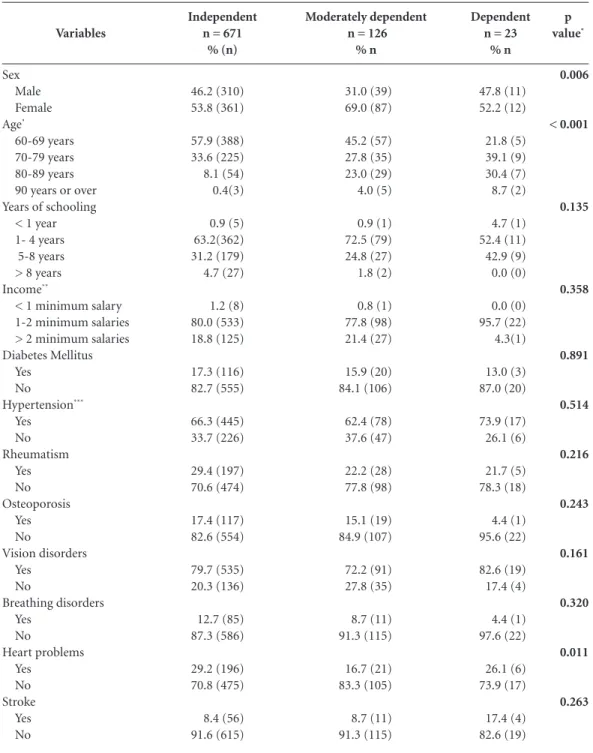
With respect to BADLs, it was found that 46.2% (n = 310) of the older persons classified as totally independent were women and 53.8% (n = 361) were men (p= 0.006), while 69% (87) of moderately dependent participants were women, showing that being male is a protective factor for the maintenance of functional capacity.
The prevalence of independence among participants aged between 60 and 69 years was 57.9% (338), while among the 90 year and over age group it was only 0.4% (3). The prevalence of lack of functional capacity was greatest among the 70 to 79 and 80 to 89 years age groups, which together accounted for 69.5% (n = 16) of all de-pendent individuals.
No significant association was found be-tween the variables schooling and income and functional capacity. However, it is worth noting
that the majority of independent individuals (n = 362, 63.3%) had between one and four years of schooling, which was also the average of the other categories. In all categories the majority of individuals had a monthly income of one to two minimum salaries: 80% (n = 553) in the inde-pendent category, 77.8% (n = 98) in the mod-erately dependent category, and 95.7% (n = 22) among the dependent category.
No association was found between chronic non-communicable diseases and functional ca-pacity to perform BADLs, expect for heart prob-lems (p = 0.011), despite the significant preva-lence of arterial hypertension and vision disor-ders in all categories (Table 4).
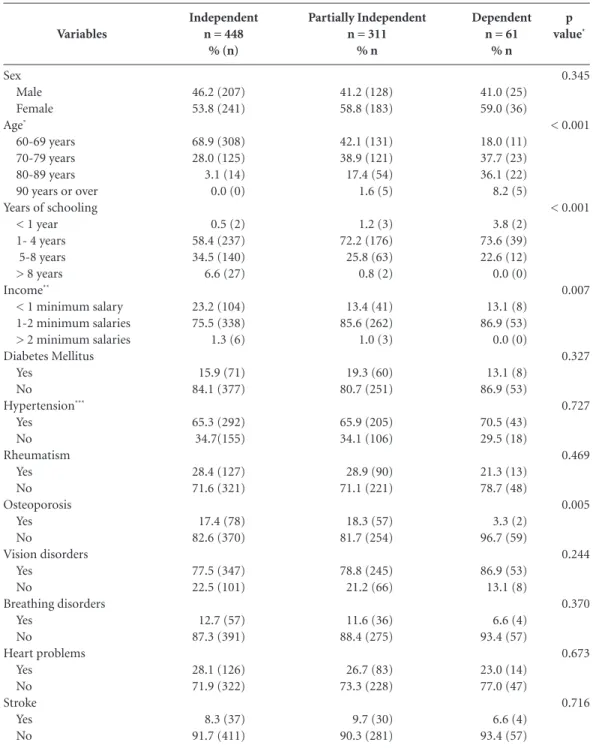
No significant association was found between functional capacity to perform instrumental ac-tivities and sex. Age was a relevant factor with respect to IADLs (p < 0.001): the 60 to 69 years age group accounted for 68.9% (308) of all in-dependent individuals. A significant association was also found between functional capacity for instrumental activities and schooling (p < 0.001).
Basic activity of daily living
Bathing Help needed
Yes No Dressing
Help needed Yes No Using the toilet
Help needed Yes No Transferring
Help needed Yes No Toileting
Help needed Yes No Eating
Help needed Yes No
Total
%
6.1 93.9
6.0 94
2.8 97.2
2.9 97.1
14.5 85.5
1.8 98.2
100.0 n
50 770
49 771
23 797
24 796
119 701
15 805
820 Table 2. Prevalence of functional capacity to perform basic activities of daily living by activity according to the Katz index. Pelotas, 2014.
Katz index*
0 1 2 3 4 5 6
Lawton-Brody score Independent Partially dependent Dependent
Total
%
81.8 12.4 1.8 1.1 0.9 0.4 1.6
54.6 37.9 7.5
100
n
671 102 15 9 7 3 13
448 311 61
820 Table 1. Prevalence of functional capacity according to the Katz index of independence in activities of daily living and Lawton Brody Instrumental Activities of Daily Living Scale. Pelotas, 2014.
aúd e C ole tiv a, 21(11):3545-3555, 2016
In each category the large majority of individu-als had between one and four years of schooling, while the proportion of individuals with between five and eight years of schooling was greatest among individuals in the independent category (34.5%, 140). A significant association was also found between functional capacity and income (p = 0.007).
Among the chronic non-communicable dis-eases (CNCDs), only osteoporosis was found to be significant at p = 0.005: among the
indepen-dents it was found to have a prevalence of 82.6% (370) and among the dependents, 96.7% (59). It is important to note that, although no significant association was found between the variables hy-pertension and vision disorders and functional capacity, the prevalence of these conditions was high in all categories (Table 5).
Discussion
The results of this study are similar to the find-ings of a study conducted in the rural area of the Municipality of Uberaba in the State of Minas Gerais9, where the majority of people in the 60 to
69 years age group were women (63.6%). These findings contrast with the results of the 2013 National Household Survey (PNAD, acronym in Portuguese) carried out by the IBGE13, which
provides a different picture of older persons liv-ing in rural areas in Brazil, showliv-ing that there are 1.3 million more men than women (15.29 mil-lion older men compared to 14.08 milmil-lion older women). This fact however should be relativized, since the PNAD is a national survey and this dif-ference may be accounted for by regional differ-ences.
With respect to skin color, the majority of participants stated that they were white while over half the rural population in Brazil consid-er themselves brown13. However, the findings of
the present study simply confirm the history of colonization of the south of Brazil, first through mainly German families and later Italian, French, Austrian, Portuguese and Spanish14.
The majority of participants stated having gone to school, which differs from the findings of a study carried out in a rural community in the northeast that showed that 61.33% of older persons were illiterate15. This discrepancy may
be due to a number of factors. One possible ex-planation is that during the post-war period in the 1950s when these older persons were begin-ning their studies, Brazil underwent a number of changes in relation to education due to the large contingent of immigrants. At the time, the gov-ernment aimed to homogenize schools to build a white, Western and Christian country that excluded people of African descent, explaining the high levels of illiteracy among older persons in the State of Bahia in the Northeast of Brazil, which was colonized mainly by Negros brought from Africa by the slave trade16. The situation was
similar between the Germans and Italians. How-ever, due to the strong links between culture,
re-Instrumental activity
Using the telephone Unable
Partial assistance required No assistance required
Getting to places beyond walking distance Unable
Partial assistance required No assistance required Shopping
Unable
Partial assistance required No assistance required Preparing meals
Unable
Partial assistance required No assistance required Cleaning
Unable
Partial assistance required No assistance required Manual work
Unable
Partial assistance required No assistance required Washing and ironing
Unable
Partial assistance required No assistance required Taking medication
Unable
Partial assistance required No assistance required Administering finances
Unable
Partial assistance required No assistance required
Pint
ligion and education, they organized themselves and, in the face of the indifferent attitude of the Brazilian government towards their demands, started to create community schools that provid-ed the community with basic provid-education17. Thus it
is assumed that, despite the difficulties imposed
by the state, German children at the time had greater access to basic education, in contrast to children of African descent, which explains why the level of schooling among older persons in ru-ral areas of Pelotas is higher than the norm of the time. p value* 0.006 < 0.001 0.135 0.358 0.891 0.514 0.216 0.243 0.161 0.320 0.011 0.263 Variables Sex Male Female Age* 60-69 years 70-79 years 80-89 years 90 years or over Years of schooling
< 1 year 1- 4 years 5-8 years > 8 years Income**
< 1 minimum salary 1-2 minimum salaries > 2 minimum salaries Diabetes Mellitus Yes No Hypertension*** Yes No Rheumatism Yes No Osteoporosis Yes No Vision disorders Yes No Breathing disorders Yes No Heart problems Yes No Stroke Yes No
Table 4. Prevalence of functional capacity to perform BADLs by age, sex, income, schooling and chronic non-communicable diseases. Pelotas, 2014.
Moderately dependent n = 126
% n 31.0 (39) 69.0 (87) 45.2 (57) 27.8 (35) 23.0 (29) 4.0 (5) 0.9 (1) 72.5 (79) 24.8 (27) 1.8 (2) 0.8 (1) 77.8 (98) 21.4 (27) 15.9 (20) 84.1 (106) 62.4 (78) 37.6 (47) 22.2 (28) 77.8 (98) 15.1 (19) 84.9 (107) 72.2 (91) 27.8 (35) 8.7 (11) 91.3 (115) 16.7 (21) 83.3 (105) 8.7 (11) 91.3 (115) Independent n = 671
% (n) 46.2 (310) 53.8 (361) 57.9 (388) 33.6 (225) 8.1 (54) 0.4(3) 0.9 (5) 63.2(362) 31.2 (179) 4.7 (27) 1.2 (8) 80.0 (533) 18.8 (125) 17.3 (116) 82.7 (555) 66.3 (445) 33.7 (226) 29.4 (197) 70.6 (474) 17.4 (117) 82.6 (554) 79.7 (535) 20.3 (136) 12.7 (85) 87.3 (586) 29.2 (196) 70.8 (475) 8.4 (56) 91.6 (615) Dependent n = 23
% n 47.8 (11) 52.2 (12) 21.8 (5) 39.1 (9) 30.4 (7) 8.7 (2) 4.7 (1) 52.4 (11) 42.9 (9) 0.0 (0) 0.0 (0) 95.7 (22) 4.3(1) 13.0 (3) 87.0 (20) 73.9 (17) 26.1 (6) 21.7 (5) 78.3 (18) 4.4 (1) 95.6 (22) 82.6 (19) 17.4 (4) 4.4 (1) 97.6 (22) 26.1 (6) 73.9 (17) 17.4 (4) 82.6 (19)
aúd e C ole tiv a, 21(11):3545-3555, 2016
The majority of the participants stated that they were retired; however, 35% also affirmed that they continue to practice some kind of work activity. This is a common trend in rural settings in Brazil. The results of a study regarding the impact of the determinants of the work and
re-tirement situation of the elderly suggest that the likelihood of older people undertaking manual activities decreases with age, as physical capac-ity declines16. The findings of the present study
confirm this, since 75.3% of the participants that stated they undertake manual activities were
p value* 0.345 < 0.001 < 0.001 0.007 0.327 0.727 0.469 0.005 0.244 0.370 0.673 0.716 Variables Sex Male Female Age* 60-69 years 70-79 years 80-89 years 90 years or over Years of schooling
< 1 year 1- 4 years 5-8 years > 8 years Income**
< 1 minimum salary 1-2 minimum salaries > 2 minimum salaries Diabetes Mellitus Yes No Hypertension*** Yes No Rheumatism Yes No Osteoporosis Yes No Vision disorders Yes No Breathing disorders Yes No Heart problems Yes No Stroke Yes No
Table 5. Prevalence of functional capacity to perform IADLs by age, sex, income, schooling and chronic non-communicable diseases. Pelotas, 2014
Partially Independent n = 311
% n 41.2 (128) 58.8 (183) 42.1 (131) 38.9 (121) 17.4 (54) 1.6 (5) 1.2 (3) 72.2 (176) 25.8 (63) 0.8 (2) 13.4 (41) 85.6 (262) 1.0 (3) 19.3 (60) 80.7 (251) 65.9 (205) 34.1 (106) 28.9 (90) 71.1 (221) 18.3 (57) 81.7 (254) 78.8 (245) 21.2 (66) 11.6 (36) 88.4 (275) 26.7 (83) 73.3 (228) 9.7 (30) 90.3 (281) Independent n = 448
% (n) 46.2 (207) 53.8 (241) 68.9 (308) 28.0 (125) 3.1 (14) 0.0 (0) 0.5 (2) 58.4 (237) 34.5 (140) 6.6 (27) 23.2 (104) 75.5 (338) 1.3 (6) 15.9 (71) 84.1 (377) 65.3 (292) 34.7(155) 28.4 (127) 71.6 (321) 17.4 (78) 82.6 (370) 77.5 (347) 22.5 (101) 12.7 (57) 87.3 (391) 28.1 (126) 71.9 (322) 8.3 (37) 91.7 (411) Dependent n = 61
% n 41.0 (25) 59.0 (36) 18.0 (11) 37.7 (23) 36.1 (22) 8.2 (5) 3.8 (2) 73.6 (39) 22.6 (12) 0.0 (0) 13.1 (8) 86.9 (53) 0.0 (0) 13.1 (8) 86.9 (53) 70.5 (43) 29.5 (18) 21.3 (13) 78.7 (48) 3.3 (2) 96.7 (59) 86.9 (53) 13.1 (8) 6.6 (4) 93.4 (57) 23.0 (14) 77.0 (47) 6.6 (4) 93.4 (57)
Pint
from the 60 to 69 years age group (p < 0.0001). Another likely factor is that average income is a minimum salary (base year 2014), which often does cover the main household outgoings. Fur-thermore, it is important to consider the fact that the old notion of ‘rural’ has always been rooted in agriculture and therefore economic activity. Traditionally, rural settings have been strictly and restrictively seen as places of economic ex-ploitation17. Therefore, it could be assumed that,
despite being retired, the participants continue to work because they feel, and are, functionally capable of doing so.
The results of the present study show that the majority of participants were totally independent when it comes to basic activities of daily living, compared to 99.8% of participants in the study undertaken in Minas Gerais9. This difference may
be explained by the inclusion criteria adopted in the latter study that encompassed only old-er pold-ersons who had attained a minimum score of 13 points in Mini Mental State Examination (MMSE). Another study conducted in a rural community in the northeast showed that 78% of the older persons assessed using the Barthel scale were dependent in some way.
The difference between functional capacity between older persons in the south and northeast may be explained by the fact that the average age of the participants in the south was around four years younger and average level of schooling was also higher. It is also important to note however that the tests used to measure functional capacity were different, which hinders comparisons.
The results of the present study also showed that men were more independent than women in performing BADLs, corroborating the findings of a study conducted in Nova Roma in the south-ern state of Rio Grande do Sul8, and a study
un-dertaken in an urban are in Pelotas that observed an association between sex and age and function-al capacity (p = 0.05 and p < 0.001, respectively)5.
This reaffirms that it is important for health pro-fessionals to pay special attention to older wom-en. One factor that may have influenced this vari-able is that the majority of research participants were women, particularly in the older age groups.
Toileting (urinary and fecal incontinence) appeared to be the most difficult activity for old-er pold-ersons, which is consistent with the findings of two other studies carried out in urban areas, one of which in Pelotas, where the prevalence of inability to perform this activity was found to be 28.6%15 and 21.3%5. This finding shows the
im-portance of intervening early in such situations
in order to help older people maintain bladder and bowel control. Incontinence can often be an embarrassing and awkward problem to deal with. Health professionals should therefore first create a bond of trust with the older person to make him/her feel at ease in talking about such problems and follow appropriate advice.
The only chronic non-communicable disease associated with functional capacity to perform BADLs was heart problems, despite other stud-ies that have shown an association between dis-eases such as arterial hypertension and diabetes mellitus18. The effects of aging on the circulatory
system facilitate the development of a variety of cardiovascular diseases that influence function-al capacity. One of the limitations of this study was the fact that the type of heart disease was not identified19. Heart disease can directly influence
the ability to perform simple daily activities such as dressing and transferring, depending on the degree of cardiovascular impairment.
The most prevalent chronic non-communi-cable disease among the study sample was arteri-al hypertension and the rate was highest among older persons classified as dependent. It can be assumed that chronic non-communicable disease did not influence the ability to perform activities because they had not yet reached a stage that se-riously affects functional capacity, which demon-strates that it is fundamentally important that health professionals assist patients to control these diseases, particularly through changes in habits.
Over 50% of the participants of the current study were considered independent when it comes to performing IADLs, in contrast to the findings of a study carried out in Goiânia20 that
showed that 58.1% (61) of older persons had some level of dependence. A study undertaken in inland Bahia15 observed that 65.3% (98) of the
research participants were dependent, showing that older persons are more dependent when it comes to performing IADLs. Instrumental activ-ities have greater cognitive demands and require greater social resourcefulness and the capacity to deal with adversities, which is influenced by level of schooling. It is therefore assumed that, given the high p-value, level of schooling is one of the key factors affecting functional capacity in the current study.
aúd
e C
ole
tiv
a,
21(11):3545-3555,
2016
activities. Health professionals can facilitate drug therapy using clinically relevant teaching resourc-es, adapted according to the older person’s level of understanding, and by providing guidance as to dosage and frequency. With respect to diet, it is important to highlight that older persons who are able to prepare their own meals are also able to determine their own food choices. It is also important to note that the percentage of partic-ipants that needed help was particularly high for the activity getting to places beyond walking dis-tance. These results seem to be consistent with the findings of a study5 carried out in the urban area,
which found that around 43% of older persons experienced difficulties in using means of trans-port. These findings show that the fact that the participants in the current study live in rural areas does not hinder their access to other places.
The prevalence of dependence was highest for the activity administering finances, which dif-fers from the findings of a study carried out with older persons from the same region but living in urban areas, which showed that only 11.8% (70)5
of individuals experienced some kind of difficul-ty with this actividifficul-ty, despite having similar levels of schooling. It could be said that the fact of liv-ing in a rural area, and theoretically havliv-ing less access to technology, means that older persons feel more insecure in relation to performing ac-tivities related to financial matters.
Age, income and schooling were factors that influenced functional capacity for performing IADLs. These findings are in agreement with a study carried out with older persons living in urban areas5 and reaffirms that older persons of
a more advanced age with low income and level of schooling are more vulnerable to loss of func-tional capacity. As a result, this group needs direct care, not only from health professionals, given that functional capacity involves other dimen-sions such as education and socioeconomic status.
Despite the fact that arterial hypertension, rheumatism and vision disorders were the most prevalent chronic non-communicable diseases in
all groups, osteoporosis - a metabolic bone dis-ease caused by the loss of mineral content and the microarchitectural deterioration of bone tis-sue that results in bone fragility21 – was the only
disease that had a significant association with functional capacity. Osteoporosis can directly in-fluence functional capacity for activities that re-quire greater agility such as shopping and getting to places beyond walking distance.
One of the limitations of the study was the ex-clusion of two areas that are not part of the ESF. These areas were excluded due to difficulties in identifying and contacting the older persons liv-ing these areas given that the study did not have the necessary resources to carry out a survey. However, this study makes a particularly import-ant contribution to research in this field since it assessed people living in rural areas, confirming that these areas present considerably different risk factors and protective factors to those of urban areas, which should equally be taken into account when designing prevention strategies.
Conclusion
Pint
Collaborations
aúd
e C
ole
tiv
a,
21(11):3545-3555,
2016
Programa Nacional por Amostra de Domicílios (PNAD). 2010 [ acessado 2015 fev 10] Disponível em: http://www.ibge.gov.br/home/estatistica/pesquisas/ pesquisa_resultados.php?indicador=1&id_pe squi-sa=149
Teixeira RC. Zona Rural de Pelotas: Desenvolvimento para o Turismo. CVT 2004; 4(3):1-13.
Torres, GV, Reis LAR, Reis LAR. Assessment of func-tional capacity in elderly residents of an outlying area in the hinterland of Bahia/Northeast Brazil. Arq
Neu-ropsiquiatr 2010; 68(1):39-43.
Consorte JG. Culturalismo e educação nos anos 50: O desafio da diversidade. Cad CEDES [periódico da Internet]. 1997 [acessado 2015 jan 11];18(43). Dispo-nível em: http://dx.doi.org/10.1590/S0101-32621997 000200003
Lima CRR. Ruralidade: o debate sobre o velho e o novo no meio rural. XIII Congresso Brasileiro de Socio-logia; 2007; Recife, Brasil. [acessado 2010 fev 1]. Dis-ponível em: http://www.sbsociologia.com.br/portal/ index.php?option=com_docman&task=cat_view&gi-d=48&Itemid=171
Santos Júnior EB, Oliveira LPAB, Silva RAR. Doenças crônicas não transmissíveis e a capacidade funcional de idosos. R pesq cuid fundam online 2014; 6(2):516-524. Wajngarten M. O coração no idoso. Jornal Diagnósticos
em Cardiologia 2010;13(43):1-9.
Nunes DP, Nakatani AYK, Silveira EA, Bachion MM, Souza MR. Capacidade funcional, condições socieco-nômicas e de saúde de idosos atendidos por equipes de Saúde da Família de Goiânia (GO-Brasil). Cien Saude
Colet 2010; 15(6)2872-2898.
Porto CC. Vadecum de Clínica Médica. Rio de Janeiro: Porto; 2014.
Article submitted 01/07/2015 Approved 01/02/2016
Final version submitted 03/02/2016 13.
14. 15.
16.
17.
18.
19. 20.
21. References
Instituto Brasileiro de Geografia e Estatística (IBGE). Distribuição da população por sexo segundo os grupos de idade Brasil (RS). 2010 [acessado 2013 dez 17] Dis-ponível em: http://www.censo2010.ibge.gov.br/sinop- se/webservice/frm_piramide.php?codigo=431440&-corhomem=3d4590&cormulher=9cdbfc
Alves LC, Leimann BCQ, Vasconcelos MEL, Carvalho MS, Vasconcelos AGG, Fonseca TCO, Lebrão ML, Lau-renti R. A influência das doenças crônicas na capaci-dade funcional dos idosos do Município de São Paulo, Brasil. Cad Saude Publica 2007; 8(23):1924-1930. Aires M, Paskulin LM, Morais EP. Capacidade funcio-nal de idosos mais velhos: estudo comparativo entre três regiões do rio Grande do Sul. Rev Lat Am Enferma-gem2010; 18(1):11-17.
Brasil. Ministério da Saúde (MS). Secretaria de Aten-ção à Saúde. Departamento de AtenAten-ção Básica.
Enve-lhecimento e saúde da pessoa idosa. Brasília: MS; 2006.
Cadernos de Atenção Básica nº 19.
Del Duca GF, Silva MC, Halall PC. Incapacidade fun-cional para atividades básicas e instrumentais da vida diária em idosos. Rev Saude Publica 2009; 43(5):796-805.
Lawton MP, Brody EM. Assessment of older people: self maintaining and instrumental activities of daily living. Gerontologist 1969; 9(3):179-186.
Inouke K, Pedrazzani ES, Pavarini SCI. Octogenários e cuidadores: perfil sócio-demográfico e correlação da variável qualidade de vida. Texto & contexto
enferma-gem / UFSC 2008; 17(2):350-357.
Rigo II, Paskulin LMG, Morais EP. Capacidade funcio-nal de idosos de uma comunidade rural do rio grande do sul. RevGaucha Enferm2010; 21(2):245-261. Tavares DM, Gávea Júnior SA, Dias FA, Santos NM, Oliveira B. Qualidade de vida e capacidade funcional de idosos residentes na zona rural. Rev Rene 2011; 12(Esp):895-903.
Ando NM, Targa LV, Almeida A, Silva DHS, Barros EF, Schwalm FD, Savassi LCM, Breunig M, Lima MC, Amaral R, Horta TCG. Declaração de Brasília. O con-ceito de rural e o cuidado à saúde. Revista brasileira de
medicina de familia e comunidade 2011; 6(19):142-144.
Katz S, Akpom CA. A measure of primary sociobiologi-cal functions. Int J Health Serv 1976; 6(3):493-508. Brasil. Resolução 466, de 12 de dezembro de 2012. Dis-põe sobre as diretrizes e normas regulamentadoras de pesquisas envolvendo seres humano. Diário oficial da
União 2012; 12 dez.
1.
2.
3.
4.
5.
6.
7.
8.
9.
10.