Original Article
Artigo Original
Alessandra Giannella Samelli1 Clayton Henrique Rocha1 Patrícia Theodósio1 Renata Rodrigues Moreira2 Ivone Ferreira Neves-Lobo1
Descritores
Perda Auditiva Provocada por Ruído Dispositivos de Proteção Auditiva Capacitação em Serviço Saúde Ocupacional Audição Keywords
Noise-induced Hearing Loss Ear Protective Devices
Inservice Training Occupational Health Hearing
Correspondence address:
Professor Alessandra G. Samelli School of Medicine
Universidade de São Paulo
Rua Cipotânea, 51, Cidade Universitária, São Paulo (SP), Brazil, CEP: 05360-160. E-mail: [email protected]
Received: 08/12/2014
Accepted: 04/30/2015
Study carried out at the Department of Physical Therapy, Speech-Language Pathology and Audiology, and Occupational Therapy, School of Medicine, Universidade de São Paulo – FMUSP – São Paulo (SP), Brazil. (1) Department of Physical Therapy, Speech-Language Pathology and Audiology, and Occupational Therapy, School of Medicine, Universidade de São Paulo – FMUSP – São Paulo (SP), Brazil.
(2) University Hospital of Universidade de São Paulo – USP – São Paulo (SP), Brazil.
Conlict of interests: nothing to declare.
Training on hearing protector
insertion improves noise attenuation
Atenuação do protetor auditivo
após treinamento para colocação
ABSTRACT
Purpose: To determine the eficacy of hearing protector insertion by comparing attenuation values measured by objective (MIRE) and subjective (REAT) methods in groups with and without training. Methods: The study included 80 male subjects assigned to experimental (with training) and control (without training) groups. The following procedures were performed: occupational history, objective and subjective assessment of hearing protectors. Only subjects in the experimental group received training and guidance on proper hearing protector insertion. Results: Attenuation values were signiicantly higher in the experimental group than in the control group at all frequencies (500, 1000, 2000, and 4000 Hz) investigated through the objective (MIRE) and subjective (REAT) methods. In addition, attenuation values in the control group were lower than those provided by the hearing protector manufacturer. Conclusion: Both objective and subjective attenuation tests demonstrated the eficacy of training on insertion of hearing protectors because the group that received training on proper hearing protection insertion exhibited higher attenuation values than the untrained group.
RESUMO
Objetivo: Determinar a eicácia da colocação do protetor auditivo comparando os valores de atenuação obtidos pelos métodos objetivo (MIRE) e subjetivo (REAT) em grupos com e sem treinamento. Métodos: Participaram do estudo 80 indivíduos do sexo masculino, separados em grupo pesquisa (com treinamento) e controle (sem treinamento). Os procedimentos realizados foram: anamnese e avaliações objetiva e subjetiva do protetor auditivo. Apenas os indivíduos do grupo pesquisa receberam treinamento e orientações para colocar corretamente o protetor auditivo. Resultados: Os valores de atenuação no grupo pesquisa foram maiores com diferenças estatisticamente signiicantes em relação ao grupo controle em todas as frequências (500, 1000, 2000 e 4000 Hz) investigadas por meio dos métodos objetivo (MIRE) e subjetivo (REAT). Além disso, os valores de atenuação no grupo controle foram menores do que as previstas pelo fabricante do protetor auditivo.
INTRODUCTION
Noise-induced hearing loss (NIHL) is a hearing disorder that results from exposure to high-intensity sound. Even though preventable, NIHL is an increasingly prevalent occupational health problem(1).
Noise reduction or elimination is the best strategy to elim-inate or minimize the risk of hearing loss from exposure to high-intensity sound. However, the use of individual hearing protection has been the strategy used by most employers, as it is simpler and less costly in the short term(1,2).
Hearing protection devices (HPDs) are noise barriers which have to be used to protect the user’s hearing; however, its effec-tiveness depends on a wide range of intrinsic characteristics and also physiological and anatomical individual features. The selection of a particular device type should consider the working environment of the user in addition to comfort and acceptance, cost and durability, communication problems dur-ing use, safety, and hygiene(3,4). Moreover, the hearing protec-tors selection should consider mainly the attenuation provided by the device, which should be enough to protect user’s hear-ing while preventhear-ing overprotection and negative effects such as communication isolation and increased risks caused by the inability to hear alert sounds(5,6).
In order to ensure the effectiveness of using a HPD, it is necessary to provide guidance and training for workers, regard-ing the suitable position, cleanregard-ing and exchange of HPD. These actions may be done through illustrative handouts and presen-tations. Also, it is important to consider the worker’s function, encouraging them to use HPD in all situations and also provide regular warning concerning possible damages that may happen whether the HPD is not used properly(7).
Commonly the employee receives the HPD, however do not receive instructions about the proper use of it as well as regarding risks that my happen due to its misuse. In the absence of orientations, fails in checking the HPD may rise the number of NIHL cases(8).
The selection of HPDs is also based on Noise Reduction Ratings (NRRs) provided by manufacturers in accordance with environmental protection agency regulations(2,9). In general, the sound attenuation provided by a HPD can be deined as the dif-ference between sound pressure levels that reach the ear canal (near the eardrum) with and without the device(5).
NRRs are based on noise reduction obtained in labora-tory conditions according to ANSI and/or ISO guidelines that check noise attenuation levels provided by hearing protectors. However, laboratory conditions differ considerably from typi-cal occupational environments, which can lead to substantial differences in the attenuation provided by HPDs in real-world situations, resulting in signiicant health effects on workers exposed to noise. This problem can be solved by conducting individual it testing of HPDs(2,10-12).
Methods that assess hearing protector insertion in real-world situations are essential to determine if the protection provided by the HPD is appropriate to a particular individual. Moreover, improving HPD insertion should help to increase hearing pro-tection eficacy, as some studies have shown that the lack of training and education among workers exposed to occupational
noise impairs the establishment of effective hearing conservation programs (HCPs) and contributes to high NIHL prevalence(3,4). Two methods have been used to measure the attenuation of HPDs in real-world situations. Real-ear attenuation at thresh-old (REAT), a subjective method, performed in a soundproof booth or circumaural headphones, which measures thresholds in the sound ield with and without the HPD; and Microphone-in-real-ear (MIRE), an objective method in which measure-ments are obtained using two microphones (one inside the ear canal and another for recording external sound ield)(2,9,10,13-15).
The use of hearing protectors and training regarding the proper use of HPD are both in the laws, but, contrarily, assess-ment of the effectiveness of the training and the real eficacy of hearing protectors are not mentioned in the workers’ health laws. This study aimed to determine the eficacy of training on the insertion of hearing protectors, comparing attenuation values measured by objective (MIRE) and subjective (REAT) methods in groups with and without training. In addition, we compared the attenuation values found in this study to those provided by a hearing protector manufacturer.
Thus, the results of this study may provide future shifts in the current health and safety legislation and also stimulate the acquire-ment of proper instruacquire-ments which will enable professionals to best check the eficacy of training HPDs placing, develop hear-ing conservation programs, and in the establishment of fast and objective measurements of HPD’s attenuation in the workplace.
METHODS
This study was designed as cross sectional, and counted on 80 voluntary male participants aged between 18 and 53 years (mean age of 32 years) who were divided into two groups. The experimental group (EG) is composed of 40 workers from a public university (University of São Paulo), exposed to occupational noise who participated in a hearing conservation program that included guidance on proper hearing protector insertion. The control group (CG) consisted of 40 students and workers from a public university (University of São Paulo), with no occupational noise exposure and no training on hear-ing protector insertion. Durhear-ing a period of three months within the routine care of periodic audiometric tests, the subjects were invited to participate in the study, which characterizes it as a convenience sample.
All subjects were informed about the study and signed an informed consent form before participation in the study, which was approved by the Ethics Committee of the Institution, under protocol N°. 858/08.
The exclusion criteria in both groups was the occurrence of any changes to the external ear such as cerumen, abnormali-ties in the ear canal, and foreign bodies that could prevent the completion of tests or insertion of hearing protectors. Three subjects of EG were excluded from the initial sample because of excessive cerumen.
The following procedures performed in all individuals: 1. Otologic and occupational history.
3. Microphone-in-real-ear (MIRE) objective test: using
Interacoustics MS40 Hearing Aid Analyzer insertion gain analyzer (this equipment is commonly used to measure gain of hearing aids). The analyzer scans frequencies from 125 to 8000 Hz using a warble tone at an intensity range of 40–140 dB SPL (Sound Pressure Level). A 70 dB SPL input was used for data collection and frequencies from 500 to 6000 Hz were analyzed. The subjects were seated in a chair in the soundproof booth and instructed to remain during the entire procedure, at a distance of 40 cm from the loudspeaker positioned at 0º/0º azimuth. Two measurements were taken in the following order:
a. REUR – Real Ear Unaided Response “as a function of frequency, at a speciied measurement point in the ear canal, for a speciied sound ield, with the ear canal unoccluded” (16).
b. REOR – Real Ear Occluded Response “as a function of frequency, at a speciied measurement point in the ear canal, for a speciied sound ield, with the hearing aid (and its acoustic coupling) in place and turned off”(16). In this study, it was placed the earplug instead the hear-ing aid.
To determine REOR, the HPD was placed by all individu-als in the same ear as the probe microphone, in both groups, after REUR measurement. The silicone tube measured 58 mm, however only 28 mm were inserted into the ear canal of partici-pants, value adopted by the geometric method(17,18). This method guarantees that the probe will not be disrupted by the HPD. It is important to point out that before each trial the probe was measured to check its size. To assist proper placement of the probe in the ear canal, we used an otoscope and a lashlight to pre mold.
The probe was marked in red, which allowed standardiz-ing the size to be inserted into the ear canal. In the study, the red mark was positioned towards the antitragus, in order to ensure that they were in the same deepness into the ear canal of all individuals.
The control group (CG) did not receive training on proper hearing protector insertion. These subjects itted the protec-tors as they thought appropriate following the instructions pro-vided on the hearing protector packaging, in accordance with ANSI 12.6-1997 (Method B – Subject it)(19), which determines that itting of the protectors is done by the subject, according to his interpretation of instructions for use provided by the manufacturer, and without external help. Conversely, indi-viduals in the EG had received previous training and guid-ance on proper hearing protection insertion. The researcher showed the adequate procedure to place the HPD properly, which included performing its correct rolling movement and positioning using hands to improve the ear canal to open, the placement of the HPD and the perception of attenuation pro-vided in the occluded ear when comparing it to the free ear. After the presentation, the participant was asked to put the HPD, supervised by the researcher.
4. Real-ear attenuation at threshold (REAT) subjective test: in this test, the probe microphone was removed and the
HPD was kept in the same position as in the previous test. Subsequently, pure tone audiometry was conducted with and without the HPD using a GSI-61 audiometer with GSI speakers. The subjects were instructed to keep their head directed to the loudspeaker at 0º/0º azimuth and at a distance of 60 cm, and were instructed to signal when-ever they heard a sound stimulus. Hearing thresholds were determined with (occluded ear) and without (unoccluded ear) hearing protectors at frequencies ranging from 500 to 6000 Hz using a warble tone. Additionally, narrow band noise masking was used in the non-tested ear (without hearing protector), using a TDH-39 headphone, at 40 dB SL to prevent it from responding to the signal presented to the test ear.
The objective and subjective tests were performed in one ear only, which was selected according to the best manual dexter-ity presented by the individual in inserting the HPD, once that several studies reported differences in attenuation between the ears due to the manual dexterity of the individual.
The hearing protectors used by all individuals were dispos-able earplugs from a well-known brand.
HPD attenuation measurements were calculated by the dif-ference between REUR and REOR in the MIRE method, and between hearing thresholds values with and without the HPD in the REAT method.
All results (differences between values recorded for each method) were expressed as mean ± standard deviation. All anal-yses were performed using one-way analysis of variance (ANOVA) with signiicance level set at p≤0.05.
RESULTS
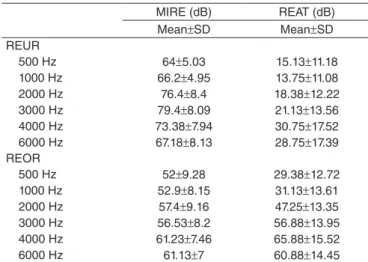
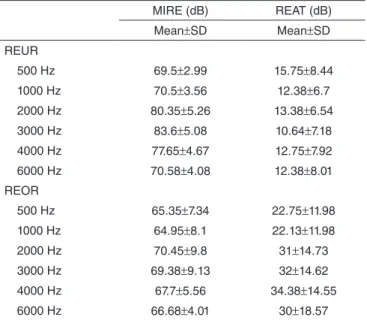
Results in Tables 1 and 2 show the values obtained by the experimental and control groups (respectively) when
Table 1. Values of real ear unaided response and real ear occluded response obtained by the Microphone-in-real-ear and Real-ear attenuation at threshold in the Experimental Groups at frequencies from 500 to 6000 Hz (n=40)
Caption: MIRE = Microphone-in-real-ear; REAT = Real-ear attenuation at threshold; REUR = real ear unaided response; REOR = real ear occluded response; SD = standard deviation
MIRE (dB) REAT (dB) Mean±SD Mean±SD REUR
500 Hz 64±5.03 15.13±11.18 1000 Hz 66.2±4.95 13.75±11.08 2000 Hz 76.4±8.4 18.38±12.22 3000 Hz 79.4±8.09 21.13±13.56 4000 Hz 73.38±7.94 30.75±17.52 6000 Hz 67.18±8.13 28.75±17.39 REOR
assessed by MIRE and REAT methods, with free ear (REUR) and occluded (REOR). It is important to point out that MIRE method assess the level of sound pressure in the ear canal with and without HPD, whereas REAT investigates the hear-ing threshold at the sound ield of participants with and with-out HPD.
Sound attenuation was higher in the EG than in CG at all frequencies measured by the MIRE method; the difference in attenuation was statistically signiicant at 500–3000 Hz and 6000 Hz frequencies (Table 3).
Attenuation of the hearing protector was significantly higher in the EG at all frequencies measured by the REAT method (Table 4). In addition, REAT values in the CG were lower than the values provided by the hearing protector manu-facturer (Table 5).
DISCUSSION
We aimed to determine the eficacy of training on inser-tion of hearing protectors and compare the attenuainser-tion values found in this study to those provided by a hearing protector manufacturer.
There were signiicant differences in attenuation values between the EG and CG measured by the MIRE and REAT methods. The EG, who had received training on the use of HPDs, exhibited signiicantly greater attenuation values than the CG, indicating that the training improves hearing protec-tion, insertion and provides best hearing protection as observed in other studies(2,8,20,21).
The attenuation values measured by the REAT method in the CG were lower than those provided by the hearing protec-tor manufacturer even when the same technique described by the manufacturer for determining frequency attenuation values was used(11,13,22), i.e., using untrained individuals who relied on the instructions provided on the hearing protector packaging for itting the protectors.
This fact shows that attenuation values indicated by the manufacturer are overestimated for real-life situations, and if a Hearing Conservation Program uses these values for the selec-tion of hearing protectors, the employees exposed to noise not will be protected, depending on the level of exposure. However, if we observe attenuation values obtained for the group who
Table 5. Attenuation values of hearing protectors measured by the Real-ear attenuation at threshold method in the Control Group (n=40) and manufacturer values (n=20) at frequencies from 500 to 4000 Hz
Manufacturer: values provided by the hearing protector manufacturer (according to ANSI [1]). ANOVA (5% significance level).
Caption: REAT = Real-ear attenuation at threshold; CG: control group; freedom; SD = standard deviation
CG (dB) Manufacturer (dB) p-value Mean±SD Mean±SD
REAT
500 Hz 7.0±9.11 22.1±8.1 <0.001 1000 Hz 9.75±9.80 22.6±7.2 <0.001 2000 Hz 17.62±12.60 29.9±6.1 <0.001 4000 Hz 21.62±13.02 37.8±6.7 0,05
Table 2. Values of real ear unaided response and real ear occluded response obtained by the Microphone-in-real-ear and Real-ear attenuation at threshold in the Control Groups at frequencies from 500 to 6000 Hz (n=40)
Caption: MIRE = Microphone-in-real-ear; REAT = Real-ear attenuation at threshold; REUR: real ear unaided response; REOR: real ear occluded response; SD = standard deviation
MIRE (dB) REAT (dB) Mean±SD Mean±SD REUR
500 Hz 69.5±2.99 15.75±8.44 1000 Hz 70.5±3.56 12.38±6.7 2000 Hz 80.35±5.26 13.38±6.54 3000 Hz 83.6±5.08 10.64±7.18 4000 Hz 77.65±4.67 12.75±7.92 6000 Hz 70.58±4.08 12.38±8.01 REOR
500 Hz 65.35±7.34 22.75±11.98 1000 Hz 64.95±8.1 22.13±11.98 2000 Hz 70.45±9.8 31±14.73 3000 Hz 69.38±9.13 32±14.62 4000 Hz 67.7±5.56 34.38±14.55 6000 Hz 66.68±4.01 30±18.57
Table 3. Attenuation values of hearing protectors measured by the Microphone-in-real-ear method in the Experimental and Control groups at frequencies from 500 to 6000 Hz (n=80)
ANOVA (5% significance level).
Caption: MIRE = Microphone-in-real-ear; EG = experimental group; CG = control group; Df = Degree of freedom; SD = standard deviation
EG (dB) CG (dB)
Df F-test p-value Mean±SD Mean±SD
MIRE
500 Hz 12±9.54 4.15±6.76 1 18 <0.001 1000 Hz 13.3±7.80 5.55±8.28 1 18,52 <0.001 2000 Hz 19±8.32 9.9±10.28 1 18,9 <0.001 3000 Hz 22.87±8.37 14.22±9.77 1 18,06 <0.001 4000 Hz 12.15±7.20 9.95±5.65 1 2,308 0,132 6000 Hz 6.05±4.85 3.90±4.32 1 4,372 0,039
Table 4. Attenuation values of hearing protectors measured by the Real-ear attenuation at threshold method in the Experimental and Control groups at frequencies from 500 to 6000 Hz (n=80)
ANOVA (5% significance level).
Caption: REAT = Real-ear attenuation at threshold; EG = experimental group; CG = control group; Df = Degree of freedom; SD = standard deviation
EG (dB) CG (dB)
Df F-test p-value Mean±SD Mean±SD
REAT
participated in training on the insertion of hearing protectors (EG), we found that the attenuation values obtained are close to the values provided by the manufacturer. This emphasizes the importance of training in a Hearing Conservation Program(23) to the reduction of the discrepancy between laboratory and real life. Studies that compared the attenuation values of the hearing protectors by MIRE and REAT showed differences between measurements and the values obtained by REAT were larger than those obtained by MIRE(21,24,25). This study also found dif-ferent values obtained by REAT and MIRE and this difference may be due to two factors: background noise and physiological masking effects, especially in lower frequencies(24,26), as well as due to variability in the response caused by subjectivity of the procedure of REAT method.
In addition, it have been repeatedly demonstrated that ear-plugs have greater variation in attenuation than earmuffs and the fact that the current study tested only earplugs can also explain the variability in the REAT values , especially with regard to the greater variability of standard deviations, which are also inluenced by the subjective nature of psychophysical of evaluation(11,24,26).
As limitations of the present study, we may cite the sample size and the equipment used to assess through the MIRE method. We suggest that, in future studies, the objective evaluations of HPD attenuation may be conducted with larger samples and with equipment which allows the measurement of MIRE in the work environment. Further, it would be also important to determine whether manual dexterity inluences on the correct placement of hearing protectors.
Based on the results found in this study, two aspects should be reviewed in occupational audiology:
• Hearing protectors recommended to a person should be tested for attenuation provided because the devices may not be suited to the noise levels to which the person is exposed and attenuation values provided by manufacturers do not always correspond to the reality of all persons due to physi-ological and anatomical differences and individual needs in different workplaces;
• Training on the insertion of hearing protectors is essential in hearing conservation programs to ensure proper device insertion; proper insertion should be veriied to ensure the eficacy of training.
CONCLUSION
Our results showed that both objective and subjective attenu-ation tests demonstrated the eficacy of training on the insertion of hearing protectors. The group (EG) that received training on proper hearing protection insertion exhibited higher attenua-tion values than the untrained group. Moreover, the attenuaattenua-tion values measured in the CG were not in accordance with those provided by the hearing protector manufacturer.
Finally, we emphasize the importance of conducting practi-cal and easy training for placement of the HPD by the employee for better attenuation, which would also be useful as a way to evaluate the effectiveness of HCP.
*CHR and PT were in charge of data collection and tabulation; RRM and IFN-L collaborated with data analysis and writing; AGS accompanied collection and was responsible for data analysis, as well as general orientation of execution stages and writing.
REFERENCES
1. Daniell WE, Swan SS, McDaniel MM, Camp JE, Cohen MA, Stebbins JG. Noise exposure and hearing loss prevention programmes after 20 years of regulations in the United States. Occup Environ Med. 2006; 63(5):343–51.
2. Nélisse H, Gaudreau MA, Boutin J, Voix J, Laville F. Measurement of Hearing Protection Devices Performance in the Workplace during Full-Shift Working Operations. Ann OccupHyg. 2012; 56(2):221-32.
3. Neitzel R, Meischke H, Daniell WE, Trabeau M, Somers S, Seixas NS. Development and Pilot Test of Hearing Conservation Training for Construction Workers. Am J Ind Med. 2008;51(2):120-9.
4. Nor Saleha IT, Noor Hassim I. A study on compliance to hearing conservation programme among industries in Negeri Sembilan, Malaysia. Ind Health. 2006;44(4):584-91.
5. Behar A. Hearing Protection Devices: Do We Choose and Use Them Properly? Hearing Review;2007.
6. Zheng Y, Giguère C, Laroche C, Sabourin C, Gagné A, Elyea M. A Psychoacoustical Model for Specifying the Level and Spectrum of Acoustic Warning Signals in the Workplace. J Occup Envir Hyg. 2007; 4(2):87-98.
7. Bramatti L, Morata TC, Marques JM. Ações educativas em Programa de Conservação Auditiva. Rev CEFAC. 2008;10(3):398-408.
8. Gonçalves CGO, Couto CM, Carraro JM, Leonelli BS. Avaliação da colocação de protetores auriculares em grupos com e sem treinamento. Rev CEFAC. 2009;11(2):345-52.
9. Berger EH. Preferred Methods for Measuring Hearing Protector Attenuation In: Internoise – environmental Noise control; 2005 Aug 7-10; Rio de Janeiro.
10. Berger EH. Introducing F-MIRE Testing - Background and Concepts. Indianapolis: E•A•R / Aearo Technologies, E•A•RCALSM
Laboratory; 2007.
11. Casali JG, Park MY. Laboratory versus ield attenuation of selected hearing protectors. J SoundVib. 1991;25:28-38.
12. Samelli AG, Fiorini AC. Saúde Coletiva e Saúde do Trabalhador: prevenção de perdas auditivas. In: Bevilacqua MC, Martinez MAN, Balen AS, Pupo AC, Reis ACM, Frota S, eds. Tratado de Audiologia. São Paulo: Ed. Santos; 2011.
13. Berger EH, Voix J, Hager LD. Methods of fit testing hearing protectors, with representative ield test data In: Hearing loss: 9th International Congress on Noise as a Public Health Problem (ICBEN). Foxwoods, CT; 2008.
14. Vergara EF, Steffani J, Gerges SNY, Pedroso M. Avaliação da exposição de operadores de teleatendimento a ruído. Rev Bras S Ocupac. 2006; 31(114):161-72.
15. Voix J, Hager LD, Zeidan J. Experimental validation of the objective measurement of individual earplug ield performance. Euronoise. 2006; 1-6.
16. American National Standards Institute. (1997). Methods of Measurement of Real-Ear Performance Characteristics of Hearing Aids. ANSI S3.46-1997. New York: Acoustical Society of America. 17. Silva APR, Blasca WQ, Lauris JRP, Oliveira JRM. Correlação entre as
características da ressonância e o envelhecimento da orelha externa. CoDAS. 2014;26(2):112-6.
18. Bastos BG, Ferrari DV, Blasc WQ. Ressonância natural da orelha e sua relação com os volumes equivalentes das orelhas externa e média. Int Arch Otorhinolaryngol. 2012;16(3):365-70.
20. Casali JG, Park MY. Attenuation performance of four hearing protectors under dynamic movement and different user itting conditions. Hum Factors. 1990;32(1):9-25.
21. Toivonen M, Pääkkönen R, Savolainen S, Lehtomäki K. Noise Attenuation and Proper Insertion of Earplugs into Ear Canals. Ann Occup Hyg. 2002;46(6):527-30.
22. Royster JD, Berger EH, Merry CJ, Nixon CW, Franks JR, Behar A, et.al. Development of a new standard laboratory protocol for estimating the ield attenuation of hearing protection devices. Part 1. Research of Working Group 11, Accredited Standards Committee S12, Noise. J Acoust Soc Am. 1996;99(3):1506-26.
23. Reddy R, Welch D, Ameratunga S, Thorne P. Development of the hearing protection assessment (HPA-2) questionnaire. Occup Med-Oxford. 2014; 64:198-205.
24. Neitzel R, Somers S, Seixas N. Variability of Real-World Hearing Protector Attenuation Measurements. Ann Occup Hyg. 2006;50(7):679-91. 25. Berger EH, Voix J, Kieper RW, Le Cocq C. Development and validation
of a field microphone-in-real-ear approach for measuring hearing protector attenuation. Noise & Health. 2011;13(51):163-75.