Prevalence of metabolic syndrome and related
factors in bank employees according to different
defining criteria, Vito´ria/ES, Brazil
Luciane Bresciani Salaroli,IRenata Aubin Dias Saliba,I Eliana Zandonade,IIMaria del Carmen Bisi Molina,II Nazare´ Souza BissoliI
IFederal University of Espı´rito Santo, Physiological Sciences, Postgraduate Program, Vito´ria/ES, Brazil.IIFederal University of Espı´rito Santo, Public Health,
Postgraduate Program, Vito´ria/ES, Brazil.
OBJECTIVE:To determine the prevalence of metabolic syndrome and related factors in bank employees in the city of Vitoria/ES, Brazil.
METHODS: This was a cross-sectional study that included 521 working men and women $20 years of age. Sociodemographic, lifestyle, anthropometric, biochemical, and hemodynamic characteristics were collected. Metabolic syndrome was diagnosed using the criteria of the National Cholesterol Education Program-ATPIII and the International Diabetes Federation. A logistic regression model was used to calculate the crude and adjusted OR of the variables, and the statistical level of significance was set at 5.0%.
RESULTS:We identified 86 (17.2%) and 113 (22.6%) subjects with metabolic syndrome according to the criteria of the National Cholesterol Education Program-ATPIII and the International Diabetes Federation, respectively. The risk of developing metabolic syndrome was higher in individuals with a high school education (OR 2.6 [CI95%, 1.1-6.1]). In overweight and obese subjects, the risks were also higher (OR 12.6 [CI95%, 4.8-33.2,p= 0.000]
and OR 43.7% [CI95%, 16.1-118.9,p= 0.000], respectively).
CONCLUSION:A large number of bank employees have metabolic syndrome, which can be associated with an increased risk of developing cardiovascular disease. Individuals who had college degrees had a higher prevalence of metabolic syndrome; this finding can be explained by the high rates of overweight and obesity found in subjects with college and graduate school educations.
KEYWORDS: Metabolic Syndrome; Employees; Obesity; Insulin Resistance.
Salaroli LB, Saliba RA, Zandonade E, Molina MC, Bissoli NS. Prevalence of metabolic syndrome and related factors in bank employees according to different defining criteria, Vito´ria/ES, Brazil. Clinics. 2013;68(1):69-74.
Received for publication onJune 13, 2012;First review completed onJuly 18, 2012;Accepted for publication onAugust 31, 2012
E-mail: [email protected]
Tel.: 55 27 3335-7223
& INTRODUCTION
Metabolic syndrome (MS) is a growing concern worldwide because it is associated with cardiovascular co-morbidities (1). MS is characterized by the presence of dyslipidemia, glucose intolerance, hypertension, overweight, abdominal obesity, and other abnormalities; the association of MS with type 2 diabetes mellitus and cardiovascular disease (CVD) is also important (2). According to multiple researchers, insulin resistance appears to link the alterations present in MS (3,4) and increased abdominal adiposity. Although individual lifestyle factors, such as a lack of regular exercise, smoking,
and diet, are determinants of cardiovascular diseases (5), little attention has been paid to the risk factors inherent in work activities. The substantial increase of acute and chronic circulatory system disorders in the population warrants further research on these diseases.
The worldwide prevalence of MS varies from 13.6% to 46% (6-9), depending on the diagnostic criteria being applied and the population being evaluated. MS research in workers has been rare in Brazil (10,11); to date, MS studies, specifically of bank employees in Brazil, have not been found in the literature. Cavagione et al. (2008) (10) studied 258 men who were professional long-haul drivers and found an MS prevalence of 24%, according to the NCEP-ATP III criteria. A study of administrative officials from the petroleum industry used the NCEP-ATP III criteria and found the MS prevalence to be 15% and determined that sex, age, and smoking were associated with the presence of MS in the study population (11). In this context, occupation might correlate with MS development (12). This study aimed to determine the prevalence of MS in bank
Copyrightß2013CLINICS– This is an Open Access article distributed under the terms of the Creative Commons Attribution Non-Commercial License (http:// creativecommons.org/licenses/by-nc/3.0/) which permits unrestricted non-commercial use, distribution, and reproduction in any medium, provided the original work is properly cited.
No potential conflict of interest was reported.
employees and identify the risk factors associated with developing MS in a large banking network in Vitoria, ES, Brazil.
& METHODS
We conducted an observational, cross-sectional study of employees, aged 20 to 64 years, from a state-owned banking network located in southeastern Brazil. Data were collected from August 2008 to August 2009. The study was approved by the Research Ethics Committee (no. 059/08) of the Center for Health Sciences, Federal University of Espirito Santo. The sample size was calculated to estimate the prevalence of MS in a population of 1,410 bank employees. We used simple random sampling for a prevalence of 20%, a 3% level of error and a 95% significance level. The quotas were calculated based on occupation (general direction and agency), sex, and age. Thus, the minimum sample size was 461 bank employ-ees. Because of a possible low response rate, 525 bank employees were invited to participate. The data were collected at the workplace, and the employees were relieved of their duties during the data collection. Socioeconomic status was determined according to the Brazilian Economic Classification (13). Ethnicity was self-identified as black, brown, white, yellow, or indigenous, according to the IBGE (14).
Systolic blood pressure (SBP) and diastolic blood pressure (DBP) measurements were performed during the inter-views, three times in each individual; the first SBP and DBP
measurements were discarded. The digital OMRON 742H
(OMRON Healthcare Inc, China) calibrated and validated by Inmetro, was used for blood pressure measurements. Prior to the measurements and after having been asked to empty their bladders, the participants remained seated and at rest for approximately five minutes. They refrained from consuming food, alcohol, coffee, or cigarettes during the previous 30 minutes. For the data analysis, the mean value of the two measurements was considered. Blood pressure was measured again if the difference between the readings was greater than 4 mm Hg. The blood pressure levels were measured according to the VII Joint National Committee criteria (15). Clamps suitable for obese patients were used when needed.
All of the anthropometric measurements were performed by trained researchers. Body weight was obtained using a
TANITAH electronic scale, which was accurate to within
0.1 kg, and the individuals were asked to be weighed with empty bladders and wearing only underwear. Height was
measured in meters using a SannyHstadiometer, which was
accurate to 0.1 cm, while the subjects were barefoot with their arms along their bodies and their eyes fixed on a spot on the horizon. The body mass indices were calculated
(BMI = weight/height2) as recommended by the World
Health Organization (16) to assess nutritional status. The following cutoff points were used to classify individuals
according to BMI (kg/m2): underweight BMI,18; normal
$18.5 and,25; pre-obese$25 and,30; and obese$30. The
types of obesity, including grades I to III, were pooled in the analysis to ensure that the groups would be more representative. Waist and hip measurements were obtained using a metal tape. To measure the waist circumference (WC), the tape was positioned at the natural waist or at the lower curvature located between the last rib and the iliac crest (17). Biochemical tests were performed in the reference
laboratory using commercial kits (Roche Diagnostics Ltd.,
with the COBAS e601 analyzer, Roche, Rotkreuz,
Switzerland) to measure the levels of glucose, total cholesterol, HDL cholesterol, VLDL cholesterol, triglycer-ides, uric acid, and ultra-sensitive CRP. The LDL cholesterol level was calculated using the Friedewald formula (18). The insulin dosage was determined using a commercial kit from
Siemens with the IMMULITEH 2000 analyzer (Siemens
Healthcare Diagnostics Inc., NY, USA).
Five parameters were used to characterize MS: waist circumference, blood pressure, serum concentrations of fasting glucose, TG, and HDL-C. Moreover, the parameters were characterized according to two different sets of criteria. The first set of criteria, initially proposed by the NCEP-ATPIII (2001) (19), described the diagnosis of MS in the presence of at least three of the following criteria: waist
circumference .88 cm for females or .102 cm for males;
HDL-C,50 mg/dL for females or,40 mg/dL for males;
TG.150 mg/dL; blood pressure values .130/85 mm Hg;
and fasting glucose.110 mg/dL. The second set of criteria,
proposed by the IDF (20), reduced the threshold values for
fasting glucose (.100 mg/dL) and waist circumference
(.80 cm for women and.90 cm for men); however, these
parameters were established by South Asians and not for individuals from South or Central America.
Statistical analyses were conducted using SPSS for Windows, version 15.0 (SPSS Inc., Chicago, USA). The mean values were compared using Student’s T-test for independent samples, and when the normality was not verified by the Kolmogorov-Smirnov test, we used the nonparametric Mann-Whitney U-test. To analyze the
differ-ences in proportions, we used the chi-squared test (X2). The
level of significance for all tests was set ata= 0.05. After a
bivariate analysis, a logistic regression analysis was per-formed using a dependent variable in the presence of MS according to the NCEP-ATP III criteria. Crude and adjusted OR were calculated from the variables that were entered
into the logistic regression model. All variables withp,0.20
in the bivariate analysis were inserted into the regression model. In the final model, only those variables that retained
p,0.05 were determined to be significant.
& RESULTS
Of the 525 individuals who were invited to participate in the study, 521 attended the interviews; however, 20 did not submit to the biochemical tests and were excluded from the analysis. Therefore, the dataset included 501 subjects, 255 (50.9%) men and 246 (40.1%) women; the representative percentages were similar to the overall study population.
Table 1 shows the prevalence of MS by sex, age, occupation, social status, education, race/ethnicity, and marital status, based on the NCEP-III and IDF criteria. We
identified 86 (17.2% CI95%, 13.8-20.6) and 113 (22.6% CI95%,
18.8-26.3) individuals with MS based on the criteria from the NCEP and IDF, respectively. MS prevalence varied by sex according to the IDF criteria (males 27.8% vs. females 17.1%,
p= 0.004). An increase in age correlated with an increase in
MS using both sets of criteria (NCEP and IDF,p= 0.004 and
p= 0.001, respectively). Individuals who worked in agencies
or in customer service in banks showed a higher prevalence
of MS compared with the general rate (p= 0.034),
education level affected the distribution of MS according to
the NCEP criteria (p= 0.016). Marital status had a significant
influence on the prevalence of MS according to both sets of
criteria (p= 0.005).
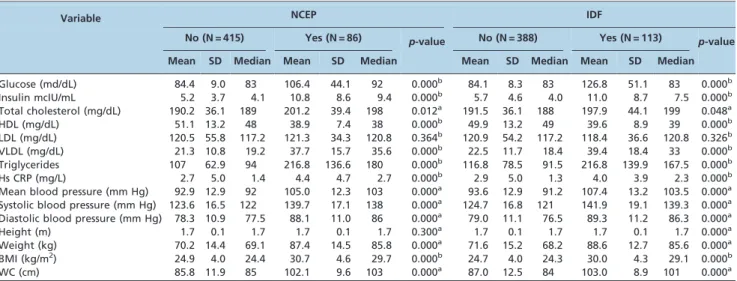
The biochemical, anthropometric, and hemodynamic indicators for individuals with and without MS are shown in Table 2. Individuals with and without MS syndrome showed higher mean values of fasting plasma glucose according to both sets of criteria, whereas individuals diagnosed using the IDF criteria showed higher insulin levels. Those subjects with MS according to the NCEP criteria had the highest average total cholesterol as well as lower HDL levels. The CRP levels were significantly elevated in the individuals with MS, according to both sets of criteria. The anthropometric indicators were similar using either criteria; the average WC values were slightly higher in those subjects who were diagnosed with the IDF criteria; and higher levels of hemodynamic indicators were also identified in those subjects diagnosed using the IDF criteria. Figure 1 shows the relative contributions of the five criteria to the diagnosis of MS, according to the NCEP-ATPIII and the IDF. The parameters we assessed included high blood pressure, triglycerides, and HDL cholesterol, which yielded similar results. High fasting glucose levels and large waist circumferences were more prevalent in those subjects diagnosed using the IDF criteria, whereas
large waists showed a significant difference (p= 0.001).
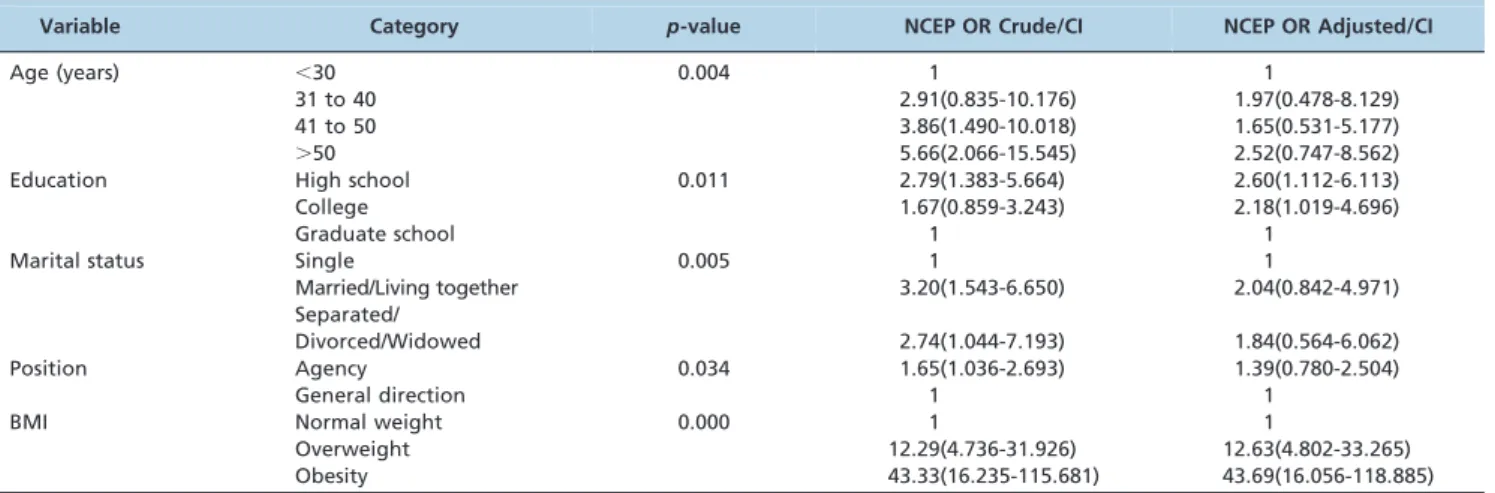
Table 3 shows the crude and adjusted OR of the variables that were entered into the logistic regression model. The risk of MS, according to the NCEP ATP III criteria, was 2.6 times higher in the individuals who had only a high school education, compared to those with college degrees. Overweight and obese subjects were 12.6 and 43.7 times,
respectively, more likely to develop MS compared with normal-weight individuals.
& DISCUSSION
To the best of the authors’ knowledge, this was the first study of MS prevalence of in bank employees. The lack of studies is concerning because MS patients have clinical and laboratory results that strongly indicate other health problems, particularly cardiovascular issues. Additionally, the lack of unanimity of the MS diagnostic criteria should be highlighted because it complicates the comparisons between studies. To narrow this gap, two diagnostic criteria were used in the present investigation; these criteria were established by the NCEP-ATPIII (19) and the IDF (20); the number of cases of MS found using the NCEP-ATPIII and
IDF criteria were 86 (17.2% CI95%13.8-20.6) and 113 (22.6%
CI95%18.8-26.3), respectively. The prevalence of MS in this
study was similar to that found by Felipe-de-Melo et al. (15%) (11) in administrative workers from the Brazilian oil industry but lower than that found in an urban population in the Brazilian capital (29.8%) from our previous study (9). Cavagione (2008) (10) assessed 258 long-haul drivers and observed an MS prevalence 24% using the NCEP-ATP III criteria.
In other countries, we found diverse results for the prevalence of MS in other occupations, including 23.5% in the German chemical industry (21), 10% in different categories of the Spanish population (22), and 8.2% in Taiwanese high-tech workers (23). A Spanish study found that of ten active workers from an automobile company, only one had MS, and managers had a more favorable profile when compared with other workers (24). These
Table 1 -Prevalence of MS according to the NCEP-III and IDF criteria by gender, sex, age, position, social status, education level, race/ethnicity and marital status of the study population.
Variable Category Total (N = 501) NCEP N (%) p-value IDF N (%) p-value
Sex Male 255 50(19.6) 0.140 71(27.8) 0.004
Female 246 36(14.6) 42(17.1)
Total 86(17.2) 113(22.6)
Age ,30 years 90 5(5.6) 0.004 8(8.9) 0.001
31 to 40 years 41 6(14.6) 5(12.2)
41 to 50 years 270 60(18.5) 68(25.2)
.50 years 100 25(25.0) 32(32.7)
Position General direction 279 39(14.0) 0.034 56(20.1) 0.113
Agencies 222 47(21.2) 57(26.0)
Social status A1+A2 10 1(11.1) 0.680 1(11.1) 0.74
B1 80 16(20.0) 20(25.0)
B2 189 30(15.9) 44(23.7)
C 204 38(18.6) 46(22.5)
D 18 1(5.6) 2(11.1)
Education* Junior high 6 - 0.016 1(0.9) 0.156
High school 123 31(36.0) 36(32.5)
College 241 42(48.8) 55(48.2)
Graduate school 121 13(15.1) 21(18.4)
Ethnicity Black 26 7(26.9) 0.291 8(30.8) 0.109
Mixed 168 28(16.7) 32(19.0)
White 292 51(17.5) 73(25.3)
Yellow 10 -
-Indian 5 -
-Marital status** Single 120 9(10.5) 0.005 15(12.5) 0.005
Married/Live together 325 67(77.9) 87(26.8)
Separated/Divorced/Widowed 55 10(11.6) 11(20)
p,0.05, Chi-squared test * N = 491 ** N = 500.
results were similar to those found in the present study, which showed a difference in MS rates between the general officers and agency employees using the NCEP-ATPIII criteria. The prevalence of MS was higher in individuals working in agencies, demonstrating that in bank employees, MS might be associated with the nature of their jobs.
Using the IDF criteria, the results indicated that the prevalence of MS varied according to sex: the prevalence was higher in males than females. The IDF criteria for defining central obesity seemed to explain much of this difference: the limits of the NCEP waist circumference were 102 cm for men and 88 cm for women, reflecting different population percentiles compared with the limits set by the IDF criteria, which were 90 cm for males and 80 cm for
females. In particular, men tended to accumulate visceral fat deposits, a condition that increases with age and with increased BMI; this condition is associated with MS (5). Similarly, the rigidity of the cohort, particularly based on the IDF criteria, encompasses most individuals with risk factors for the syndrome. In this study, waist circumference and blood glucose changes appeared more frequently in individuals when the IDF criteria were used as the diagnostic criteria for SM. Similar results were observed by Gu¨ndogan (25) in the Mediterranean region of Turkey. Additionally, the distribution of body fat could have strongly influenced metabolic abnormalities in the lipid profiles and glucose levels (26). Our study showed that higher levels of insulin and triglycerides and lower HDL-C
Table 2 -Biochemical, anthropometric and hemodynamic parameters in the study population, according to the diagnostic criteria and presence of MS.
Variable NCEP IDF
No (N = 415) Yes (N = 86) p-value No (N = 388) Yes (N = 113) p-value
Mean SD Median Mean SD Median Mean SD Median Mean SD Median
Glucose (md/dL) 84.4 9.0 83 106.4 44.1 92 0.000b 84.1 8.3 83 126.8 51.1 83 0.000b
Insulin mcIU/mL 5.2 3.7 4.1 10.8 8.6 9.4 0.000b 5.7 4.6 4.0 11.0 8.7 7.5 0.000b
Total cholesterol (mg/dL) 190.2 36.1 189 201.2 39.4 198 0.012a 191.5 36.1 188 197.9 44.1 199 0.048a
HDL (mg/dL) 51.1 13.2 48 38.9 7.4 38 0.000b 49.9 13.2 49 39.6 8.9 39 0.000b
LDL (mg/dL) 120.5 55.8 117.2 121.3 34.3 120.8 0.364b 120.9 54.2 117.2 118.4 36.6 120.8 0.326b VLDL (mg/dL) 21.3 10.8 19.2 37.7 15.7 35.6 0.000b 22.5 11.7 18.4 39.4 18.4 33 0.000b Triglycerides 107 62.9 94 216.8 136.6 180 0.000b 116.8 78.5 91.5 216.8 139.9 167.5 0.000b
Hs CRP (mg/L) 2.7 5.0 1.4 4.4 4.7 2.7 0.000b 2.9 5.0 1.3 4.0 3.9 2.3 0.000b
Mean blood pressure (mm Hg) 92.9 12.9 92 105.0 12.3 103 0.000a 93.6 12.9 91.2 107.4 13.2 103.5 0.000a Systolic blood pressure (mm Hg) 123.6 16.5 122 139.7 17.1 138 0.000a 124.7 16.8 121 141.9 19.1 139.3 0.000a Diastolic blood pressure (mm Hg) 78.3 10.9 77.5 88.1 11.0 86 0.000a 79.0 11.1 76.5 89.3 11.2 86.3 0.000a
Height (m) 1.7 0.1 1.7 1.7 0.1 1.7 0.300a 1.7 0.1 1.7 1.7 0.1 1.7 0.000a
Weight (kg) 70.2 14.4 69.1 87.4 14.5 85.8 0.000a 71.6 15.2 68.2 88.6 12.7 85.6 0.000a BMI (kg/m2) 24.9 4.0 24.4 30.7 4.6 29.7 0.000b 24.7 4.0 24.3 30.0 4.3 29.1 0.000b
WC (cm) 85.8 11.9 85 102.1 9.6 103 0.000a 87.0 12.5 84 103.0 8.9 101 0.000a
The values are given as the means, medians and SDs (standard deviations). N = number of individuals. a - Student’s t-test.
b - Mann-Whitney- U-test.
p,0.05.
levels were found in individuals with MS. Changes in the lipid metabolism of subjects with insulin resistance (IR) are triggered by excessive levels of circulating fatty acids that are derived from visceral adipose tissue in the liver, which increases the production of triglycerides and lowers HDL-C. These excessive levels of circulating fatty acids also affect insulin sensitivity in muscle tissue by inhibiting glucose uptake. Hyperglycemia and excessive fatty acids can both result in hyperinsulinemia (27).
In our study, the high percentage of hypertensive subjects (32.5%) was remarkable. A population study in Vitoria-ES, Brazil, indicated a prevalence of hypertension 38% (28), which was higher than the 25% to 30% estimated prevalence in the adult Brazilian population (29). In the 1990s, a study of state bank employees in Rio de Janeiro, Brazil, estimated hypertension prevalence as 18.3% in the subjects. The subjects were the same ages as those in this study; the prevalence of hypertension was higher in males (22.3%)
than females (12.6%) (p,0.001), and the prevalence
increased with age (30).
Chronic inflammation plasma markers are associated with risk for coronary artery disease; hsCRP has been the most studied marker (31), and in our study, it was higher in the individuals with MS. This result was similar to that of another study of various professional categories (10). Studies conducted in apparently healthy young adults have shown the potential of hsCRP in predicting future coronary events and its role as an important marker for this purpose (32-33), which demonstrates that individuals with MS have additional risk factors for CVD.
Social determinants are strongly correlated with MS, but the contribution of these determinants has not been fully elucidated. For example, individuals with higher education levels and greater access to information have greater opportunities in the labor market and, consequently, higher purchasing power; these individuals usually have a lower prevalence of MS (34). However, in our study, the individuals who had college degrees had a higher pre-valence of MS compared with those who had only completed high school. This finding can be explained by the high rates of overweight and obesity found in popula-tions with higher education levels. Thus, the increased
adiposity in both low-income individuals and those with higher education levels supports the hypothesis that obesity could be a causative factor for MS in this population. Obesity has appeared to be a risk factor for MS because obese individuals have a 43.3 times higher risk of develop-ing MS compared with normal-weight subjects. The population in this study showed a high prevalence of overweight (36.9%) and obesity (17.9%), which might be related to the physical inactivity that is also prevalent in this group, as well as the sedentary type of work performed by the subjects. A 1994 epidemiological study of bank employ-ees in Rio de Janeiro has already demonstrated the rates of overweight and obesity in this population: 27.8% and 6.4%, respectively (35). Our results showed a large number of workers with MS and high levels of PCR; therefore, these subjects had increased risks of developing cardiovascular disease, although they did not have low education levels. In the studied population, obesity emerged as a risk factor for MS, and it should be the subject of further research. Furthermore, these findings support the need for programs to promote employee health, to facilitate the monitoring of the magnitude and temporal trends of these factors and to assess the actions that are directed toward this population group.
& ACKNOWLEDGMENTS
The authors acknowledge the State Bank of Espirito Santo, Brazil, for its financial support in all phases of this study.
& AUTHOR CONTRIBUTIONS
All of the authors participated appropriately in the study conception and design, data acquisition, analysis and interpretation, and the final approval of the published version.
& REFERENCES
1. Lakka HM, Laaksonen DE, Lakka TA, Niskanen LK, Kumpusalo E, Tuomilehto J. et al. The metabolic syndrome and total and cardiovas-cular disease mortality in middle-age men. JAMA. 2002;288(21):2709-16, http://dx.doi.org/10.1001/jama.288.21.2709.
2. Boyko EJ, Fujimoto WY, Leonetti DL, Newell-Morris L. Visceral adiposity and risk of type 2 diabetes: a prospective study among
Table 3 -Logistic regression analysis, including the crude and adjusted OR for MS according to the NCEP-diagnosed employees of a state bank in Vito´ria/ES.
Variable Category p-value NCEP OR Crude/CI NCEP OR Adjusted/CI
Age (years) ,30 0.004 1 1
31 to 40 2.91(0.835-10.176) 1.97(0.478-8.129)
41 to 50 3.86(1.490-10.018) 1.65(0.531-5.177)
.50 5.66(2.066-15.545) 2.52(0.747-8.562)
Education High school 0.011 2.79(1.383-5.664) 2.60(1.112-6.113)
College 1.67(0.859-3.243) 2.18(1.019-4.696)
Graduate school 1 1
Marital status Single 0.005 1 1
Married/Living together 3.20(1.543-6.650) 2.04(0.842-4.971)
Separated/
Divorced/Widowed 2.74(1.044-7.193) 1.84(0.564-6.062)
Position Agency 0.034 1.65(1.036-2.693) 1.39(0.780-2.504)
General direction 1 1
BMI Normal weight 0.000 1 1
Overweight 12.29(4.736-31.926) 12.63(4.802-33.265)
Obesity 43.33(16.235-115.681) 43.69(16.056-118.885)
Japanese Americans. Diabetes Care. 2000;23(4):465-71, http://dx.doi. org/10.2337/diacare.23.4.465.
3. Ferranini E, Haffner SM, Mitchell BD, Stern MP. Hyperinsulinemia: The key feature of cardiovascular and metabolic syndrome. Diabetologia. 1991;34(6):416-22, http://dx.doi.org/10.1007/BF00403180.
4. DeFronzo RA, Ferranini E. Insulin resistance: A multifaceted syndrome responsible for NIDDM, obesity, hypertension, dyslipidemia and atherosclerotic cardiovascular disease. Diabetes Care. 1991;14(3):173-94, http://dx.doi.org/10.2337/diacare.14.3.173.
5. Buttar HS, Li T, Ravi N. Prevention of cardiovascular diseases: Role ofexercise, dietary interventions, obesity and smoking cessation. Exp Clin Cardiol. 2005;10(4):229-49.
6. Aguilar-Salinas CA, Rojas R, Go´mez-Perez FJ, Valles V, Rios-Torres JM, Franco A. et al. High prevalence of metabolic syndrome in Mexico. Arch Med Res. 2004;35(1):76-81, http://dx.doi.org/10.1016/j.arcmed.2003.06. 006.
7. Ford ES. Prevalence of the metabolic syndrome defined by internacional Diabetes Federation among adults in the US. Diabetes Care. 2005;28(11): 2745-9, http://dx.doi.org/10.2337/diacare.28.11.2745.
8. He Y, Jiang B, Wang J, Feng K, Chang Q, Fan L, et al. Prevalence of the metabolic syndrome and its relation to cardiovascular disease in an elderly Chinese population. J Am Coll Cardiol. 2006;47:1588-94, http:// dx.doi.org/10.1016/j.jacc.2005.11.074.
9. Salaroli LB, Barbosa GC, Mill JG, Molina MCB. Prevaleˆncia de Sı´ndrome Metabo´lica em estudo de base populacional Vito´ria, ES-Brasil. Arq Bras Endocrinol Metab. 2007;51(7):1143-52.
10. Cavagioni LC, Benseno˜r IM, Halpern A, Pierin AMG. Sı´ndrome metabo´lica em motoristas profissionais de transporte de cargas da rodovia BR-116 no trecho Paulista-Re´gis Bittencourt Arq Bras Endocrinol Metab. 2008;52(6):1015-23.
11. Felipe-de-Melo ERT, Silva RCR, Assis AMO, Pinto EJ. Fatores associados a` sı´ndrome metabo´lica em trabalhadores administrativos de uma indu´stria de petro´leo. Cieˆnc. sau´de coletiva. 2011;16(8):3443-52, http:// dx.doi.org/10.1590/S1413-81232011000900012.
12. Davila EP, Florez H, Fleming LE, Lee DJ, Goodman E, LeBlanc WG, et al. Prevalence of Metabolic Syndrome Among U.S Workers. Diabetes Care. 2010; 33(11):2390-5, http://dx.doi.org/10.2337/dc10-0681.
13. Associac¸a˜o Brasileira de Institutos de Pesquisa e Mercado. Crite´rio de classificac¸a˜o socioeconoˆmica: crite´rio ABIPEME. Reformulac¸a˜o do crite´rio anterior. http://www.anep.org.br/mura1/anep/(accessed 25/ Ago/2010).
14. Fundac¸a˜o Instituto Brasileiro de Geografia e Estatı´stica. Populac¸a˜o estimada por idade, revisa˜o 2004. Rio de Janeiro: IBGE 2004.
15. Joint National Committee on Prevention, Detection, evaluation and treatment of high blood pressure. The Seventh Report. JAMA. 2003;289 (19):2560-72.
16. World Health Organization. 1995. Physical status: the use and interpretation of anthropometry indicators of nutritional status. Geneva: World Health Organization; (Technical Report Series, 854). 17. World Health Organization. Physical status: the use and interpretation of
anthropometric indicators of nutritional status. Geneva: World Health Organization; 1995. (WHO Technical Report Series, 854).
18. Friedwald WT, Levy R, Fredrickson DS. Estimations of serum low density lipoprotein cholesterol without use of preparative ultracentri-fuge. Clin Chem. 1972;18(6):499-502.
19. Expert Panel on Detection, Evaluation, and Treatment of High Blood Cholesterol in Adults. Executive Summary of The Third Report of The National Cholesterol Education Program (NCEP) Expert Panel on
Detection, Evaluation, And Treatment of High Blood Cholesterol In Adults (Adult Treatment Panel III). JAMA. 2001;285(19):2486-97. 20. International Diabetes Federation (IDF). International Diabetes Federation
consensus worldwide definition of the metabolic syndrome. 2008. Available at http://www.idf.org/webdata/docs/IDF_Metasyndrome_ definition.pdf. Accessed January 05, 2011.
21. Oberlinner C, Humpert PM, Nawroth PP, Zober A, Morcos M. Metabolic syndrome in a large chemical company: prevalence in a screened worksite sample. Acta Diabetol. 2008;45(1):31-5, http://dx.doi.org/10. 1007/s00592-007-0015-6.
22. Sanchez-Chaparro MA, Calvo-Bonacho E, Gonzalez-Quintela A, Fernandez-Labandera C, Cabrera M, Sainz JC, et al. Occupation-related differences in the prevalence of metabolic syndrome. Diabetes Care. 2008;31(9):1884-5, http://dx.doi.org/10.2337/dc08-0431.
23. Tsai TY, Cheng JF, Lai YM. Prevalence of metabolic syndrome and related factors in Taiwanese high-tech industry workers. Clinics. 2011;66(9):1531-5, http://dx.doi.org/10.1590/S1807-59322011000900004. 24. Alegrı´a E, Cordero A, Laclaustra M, Grima A, Leo´n M, Casasnovas JA,
et al. Prevalence of metabolic syndrome in the Spanish working population: MESYAS Registry. Rev Esp Cardiol. 2005;58(7):797-806, http://dx.doi.org/10.1157/13077231.
25. Gu¨ndogan K, Bayram F, Capak M, Tanriverdi F, Karaman A, Ozturk A, et al. Prevalence of Metabolic Syndrome in the Mediterranean Region of Turkey. Evaluation of Hypertension, Diabetes Mellitus, Obesity, and Dyslipidemis. Metab Syndr Relat Disord. 2009;7(5):427-33, http://dx.doi. org/10.1089/met.2008.0068.
26. Palaniappan L, Carnethon M R, Wang Y, Hanley AJ, Fortmann SP, Haffner SM, et al. Predictors of the incident metabolic syndrome in adults: The Insulin Resistance Atherosclerosis Study. Diabetes Care. 2004;27(3):788-93, http://dx.doi.org/10.2337/diacare.27.3.788. 27. Pajuelo J, Pando R, Leyva M, Herna´ndez K, Infantes R. Resistencia a la
insulina en adolescentes con sobrepeso y obesidad. Anais da Faculdade Medicina de Lima. 2006;67(1):23-9.
28. Mill JG, Molina MDC, Silva IO, Marquezine AL, Ferreira AVL, Cunha RS, et al. Epidemiologia da hipertensa˜o arterial na cidade de Vito´ria, Espı´rito Santo. Rev. Hipertensa˜o Arterial. 2004;7(3):109-16.
29. LESSA I. Epidemiologia da hipertensa˜o arterial sisteˆmica e da insuficieˆncia cardı´aca no Brasil. Rev. Brasileira de Hipertensa˜o. 2001; 8(4):383-92.
30. Chor D. Hipertensa˜o Arterial Entre Funciona´rios de Banco Estatal No Rio de Janeiro: Ha´bitos de Vida e Tratamento. Arq Bras Cardio. 1998;71(5):653-60.
31. Yu H, Rifai N. High-sensitivity C-reactive protein and atherosclerosis: from theory to therapy. Clin Biochem. 2000;33(8):601-10, http://dx.doi. org/10.1016/S0009-9120(00)00186-7.
32. Rifai N, Ridker PM. High-sensitivity C-reactive protein: a novel and promising marker of coronary heart disease. Clin Chem. 2001;47(3):403-11.
33. Ridker PM, Rifai N, Rose L, Buring JE, Cook NR. Comparison of C-reactive protein and low- density lipoprotein cholesterol levels in the prediction of first cardiovascular events. N Engl J Med. 2002;347(20):1557-65. 34. Nayga RM Jr. A note on schooling and obesity. J Health Soc Policy.
2000;12(2):65-72, http://dx.doi.org/10.1300/J045v12n02_04.