978
Original Articles
Factors associated with metabolic syndrome among the elderly in the
northeast of Brazil
Fabiana Lucena Rocha1
Rômulo Lustosa Pimenteira de Melo2
Tarciana Nobre de Menezes3
1 Universidade Federal de Campina Grande, Unidade Acadêmica Escola Técnica de Saúde de Cajazeiras. Cajazeiras, Paraíba, Brasil.
2 Universidade Federal da Paraíba, Centro de Ciências Humanas, Letras e Artes, Programa de Pós-graduação em Psicologia Social. João Pessoa, Paraíba, Brasil.
3 Universidade Estadual da Paraíba, Programa de Pós-graduação em Saúde Pública, Departamento de Fisioterapia. Campina Grande, Paraíba, Brasil.
Research funding: Conselho Nacional de Desenvolvimento Científico e Tecnológico (National Council for Scientific and Technological Development) (CNPq) and Ministério da Ciência e Tecnologia (Ministry of Science and Technology) (MCT). Process No. 479579/2007-5. Bid Application Process MCT/CNPq 15/2007.
Correspondence Fabiana Lucena Rocha
E-mail: [email protected]
Abstract
Objective: To determine the prevalence of metabolic syndrome (MS) and associated factors in 348 elderly residents of Campina Grande, Paraíba. Method: A household survey and clinical/laboratory assessment was conducted. The diagnosis of MS was based on the criteria of the Third Report of the National Cholesterol Education Program Expert Panel on the Detection, Evaluation and Treatment of High Blood Cholesterol in Adults (NCEP-ATP III). The association between MS and socio-demographic factors, health status and lifestyle habits was investigated. The crude and adjusted prevalence ratios were obtained by Poisson regression. Variables with a significance lower than or equal to 0.2 (20%) were tested in a multivariate model. A p value≤0.05 was adopted for the acceptance of the associations in the final model. Results: MS was more prevalent among women (64.7%) and those with heart trouble. It was also found that, specifically for women, there was a higher prevalence of MS among those with osteoarthritis. Conclusion: The higher prevalence of MS among women and the association of MS with osteoarthritis in this group deserves attention, as this condition can cause functional limitation, affecting the quality of life of the elderly.
979
INTRODUCTION
Noncommunicable chronic diseases such as heart disease, strokes, diabetes mellitus and cancer account for two-thirds of total global deaths. This is mainly due to an aging population and the clustering of risk
factors associated with globalization and urbanization1.
The physiological changes that occur during the aging process favor the emergence of alterations that make up metabolic syndrome (MS), such as high blood pressure, the abnormal deposition of abdominal fat, changes in lipid levels and, in some cases, blood
sugar levels2,3. These changes may be associated
with a prothrombotic and proinflammatory state3,4.
Due to the chronicity of the condition, early identification and preventive intervention against risk factors is important in individuals with MS or its components to reduce morbidity and mortality
and promote a change in lifestyle3,4.
In a systematic review, which aimed to determine the prevalence of metabolic syndrome in the elderly, the lowest overall prevalence was 23.2% among elderly Chinese individuals, while the highest prevalence recorded was 67.9% in Mexican elderly persons. Studies have shown a higher prevalence in
women and among older elderly persons5.
Vidigal et al.6, in a systematic review of different
MS prevalence rates in Brazil, found that such rates varied depending on the characteristics of the groups studied, based on the ethnic, cultural and epidemiological variability of the country. The authors found that the overall weighted average for the prevalence of MS was between 28.9 and 29.6%, according to the criteria used to define metabolic syndrome. Specific data on the prevalence of this condition among the elderly population is still scarce in Brazilian studies.
Epidemiological studies on adults and elderly persons have found that MS is associated with
age, gender, educational level3,7, race or ethnicity,
hypercholesterolemia, high concentrations of C-reactive protein (CRP), microalbuminuria
and hyperinsulinemia7. In addition, MS impacts
health spending, as its components lead to chronic
conditions, burdening the health system8. This makes
it important to ensure the adequate treatment and
control of risk factors, as the chronicity of their
components causes irreversible consequences9.
Given the importance of MS as a risk factor for cardiovascular disease, and as differences in the different population groups surveyed make it difficult to compare results, there is a clear need for further studies on the prevalence of MS, not only among the general population, but especially among elderly people in Brazil. Therefore, the present study aimed to determine the prevalence of metabolic syndrome and associated factors in elderly persons enrolled in the Estratégia Saúde da Família (the Family Health Strategy) in a municipality in the northeast of Brazil.
METHOD
This study is part of a larger study entitled "Multidimensional evaluation of the health of elderly persons attended by the Family Health Strategy in the city of Campina Grande, Paraíba, and degree of satisfaction with the services offered." A cross-sectional home-based study was performed.
The sample was calculated by estimating the prevalence of outcomes of at least 25%. To calculate
the sample, the following equation was used: {[E2x
p (1-p)] x c} / A2, where E is the level of confidence
(1.96), c is the sample correction coefficient (2.1) for sample by clustering, and A is the acceptable precision for the estimated prevalence (6%). The sample was proportional to each health district of the city and constituted 420 elderly persons. Elderly individuals who did not attend blood collection sessions were excluded from the study, resulting in a sample of 348 elderly persons. A confidence interval of 95% was applied.
980
the interview. This step was repeated successively for improved distribution and to ensure that the entire list was covered.
Individuals aged 60 or older of both genders were selected for the sample. Excluded from the study were elderly persons with a severely debilitated clinical state without treatment possibilities, namely those in the terminal stage of disease. Elderly persons without assistants, if assistance was required when answering questions; and those who were absent during the field research in the catchment area of the BFHU where they were registered were also removed from the sample. Those excluded were replaced by the next elderly person in the systematic selection.
Data was collected between August 2009 and May 2010 by three pairs of interviewers who were trained and calibrated in the pilot study. After signing a Free and Informed Consent Form the participants were interviewed at home and were instructed to attend the BFHU at a predetermined time and date for the collection of blood for biochemical assessment. They were also told to fast for 12 hours before blood collection.
The diagnosis of MS was based on the criteria of the revised Third Report of the National Cholesterol Education Program Expert Panel on Detection, Evaluation and Treatment of High Blood Cholesterol
in Adults (NCEP–ATP III)10, which involves the
presence of three or more of the following factors: abdominal obesity, hypertriglyceridemia, low levels of high density lipoproteins (HDL), hypertension
and high fasting glucose4. Abdominal obesity was
verified by abdomen circumference (AC), measured
using the techniques of Callaway et al11. Biochemical
evaluation consisted of the analysis of lipid profile and fasting glucose.
In addition to this information, data was collected on gender, skin color/ethnicity (white or non-white), socioeconomic status (A/B, C, D/E), marital status (single, married, widowed, separated), age group (60 to 69 years, 70-79 years or 80 years or more), self-rated health, morbidities (heart problems, osteoporosis, osteoarthritis, chronic lung disease, cancer), smoking (never smoked, smoker, ex-smoker) and regularly practiced exercise (yes, no).
Socioeconomic status was verified by the Critério de Classificação Econômica Brasil of the Associação
Brasileira de Empresas de Pesquisa (ABEP) (the Brazilian Economic Classification Criterion of the
Brazilian Association of Research Companies)12
which consists of information on the educational level of the elderly person and family ownership of consumer goods. Each piece of information is related to points which are added to generate a score on the economic stratification scale, corresponding to the economic class to which the elderly person belongs. The elderly persons were classified as belonging to class A/B (17-34 points), C (11-16 points) and D/E (0 to 10 points).
For the self-reported health variable, the elderly individuals were asked how they considered their health and, based on the Likert scale, responded excellent, very good, good, fair and poor. The variable was dichotomized into good (excellent, very good, good) or poor (fair and poor) self-evaluation of health. For the physical exercise variable, an elderly person was considered physically active if he or she regularly performed physical activity for at least thirty
minutes three times a week or more13,14.
The data was tabulated and analyzed using Poisson regression, with the calculation of Exp(B)
interpreted as the prevalence ratio (PRgross for
bivariate and PRadjusted for the multivariate model)
with 95% confidence intervals. For this, the robust estimator in the covariance matrix was used to obtain more robust standard errors. In bivariate analysis, variables with a significance of lower than or equal to 0.2 (20%) were tested in a multivariate model. Finally, a moderation model was used to test the
prevalence ratio (RPcontrolled) between osteoarthritis
and a change in MS based on gender. A value of p<0.05 was adopted for the acceptance of the associations investigated in the multivariate and moderation models.
The study was approved by the Ethics Research Committee of the Universidade Estadual da Paraíba (Paraiba State University) (CAAE: 0228.0.133.000-08).
RESULTS
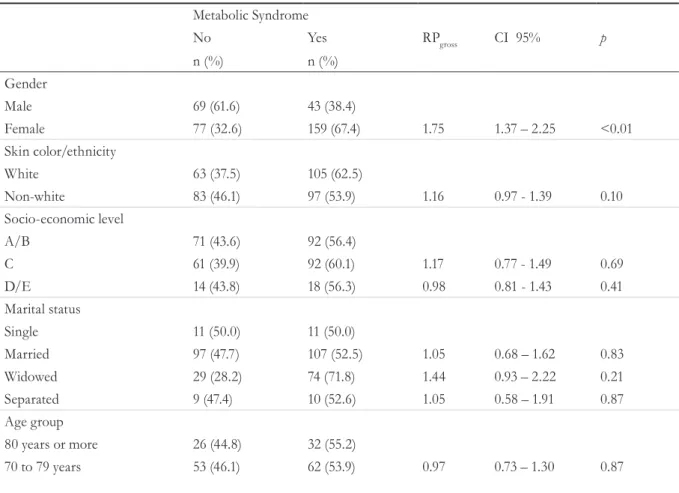
981 showed the prevalence of MS and its association
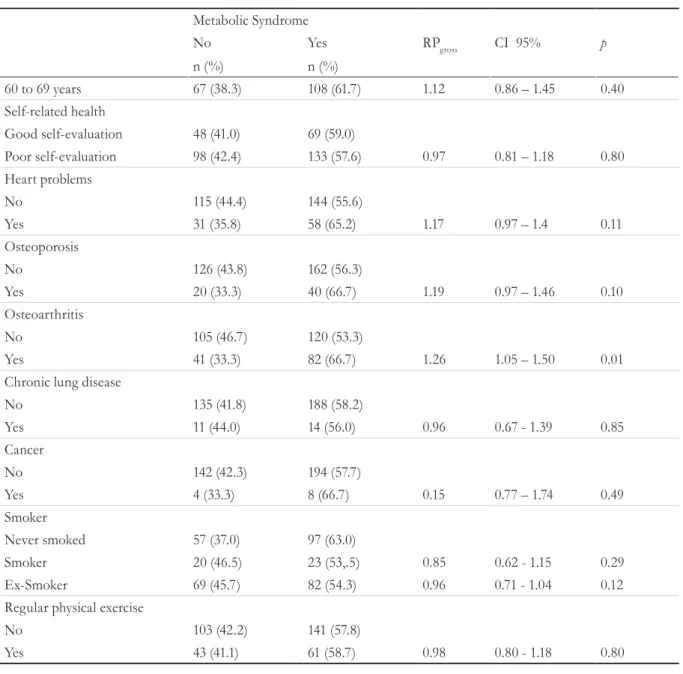
with the variables studied. There was a statistically significant association between MS and gender and MS and reports of osteoarthritis. The prevalence of MS was greater among women (PRgross=1.75; CI95%=1.37-2.25) and among elderly persons who reported suffering from osteoarthritis (PRgross=1.26; CI95%=1.05–1.50) (Table 1).
Variables included in the multivariate model were those with a significance of less than or equal to 0.2 in bivariate analysis. These were sex, skin color/ ethnicity, heart problems, osteoporosis, osteoarthritis and smoking. Analysis of the results presented in Table 2 shows that only the variables gender and reports of a heart condition were statistically significant for MS. The highest prevalence of MS was found among women (PRadjusted = 1.71, 95% CI 1.31 to 2.22) and among elderly persons who reported a heart problem (PRadjusted=1.20; 95% CI = 1-1,44). In the multivariate model osteoarthritis ceased to have a
significant effect. A third model was therefore created to verify that the initial effect of the osteoarthritis variable was due to gender.
An interaction term was therefore created between the variables osteoarthritis and gender (an interaction term is performed by multiplying the two variables)15 and inserted in the multivariate regression together with the variables osteoarthritis and gender. The results showed that only the interaction and the osteoarthritis variable had a significant effect (p<0.05), suggesting the lack of significance of osteoarthritis presented in the multivariate model was due to the variable gender.
Table 3 presents a moderation model between osteoarthritis and metabolic syndrome, verifying that the prevalence ratio of osteoarthritis (PRcontrolled) changes depending on gender. The results show that among elderly women only, the osteoarthritis variable demonstrated statistically significant results for the occurrence of MS (PRcontrolled=1.23; 95% CI=1.03 to 1.46).
Table 1. Bivariate Poisson Regression (PRgross) in relation to the outcome of metabolic syndrome and associated factors. Campina Grande, Paraíba, 2010.
Metabolic Syndrome
No Yes RPgross CI 95% p
n (%) n (%)
Gender
Male 69 (61.6) 43 (38.4)
Female 77 (32.6) 159 (67.4) 1.75 1.37 – 2.25 <0.01
Skin color/ethnicity
White 63 (37.5) 105 (62.5)
Non-white 83 (46.1) 97 (53.9) 1.16 0.97 - 1.39 0.10
Socio-economic level
A/B 71 (43.6) 92 (56.4)
C 61 (39.9) 92 (60.1) 1.17 0.77 - 1.49 0.69
D/E 14 (43.8) 18 (56.3) 0.98 0.81 - 1.43 0.41
Marital status
Single 11 (50.0) 11 (50.0)
Married 97 (47.7) 107 (52.5) 1.05 0.68 – 1.62 0.83
Widowed 29 (28.2) 74 (71.8) 1.44 0.93 – 2.22 0.21
Separated 9 (47.4) 10 (52.6) 1.05 0.58 – 1.91 0.87
Age group
80 years or more 26 (44.8) 32 (55.2)
70 to 79 years 53 (46.1) 62 (53.9) 0.97 0.73 – 1.30 0.87
982
Metabolic Syndrome
No Yes RPgross CI 95% p
n (%) n (%)
60 to 69 years 67 (38.3) 108 (61.7) 1.12 0.86 – 1.45 0.40
Self-related health
Good self-evaluation 48 (41.0) 69 (59.0)
Poor self-evaluation 98 (42.4) 133 (57.6) 0.97 0.81 – 1.18 0.80
Heart problems
No 115 (44.4) 144 (55.6)
Yes 31 (35.8) 58 (65.2) 1.17 0.97 – 1.4 0.11
Osteoporosis
No 126 (43.8) 162 (56.3)
Yes 20 (33.3) 40 (66.7) 1.19 0.97 – 1.46 0.10
Osteoarthritis
No 105 (46.7) 120 (53.3)
Yes 41 (33.3) 82 (66.7) 1.26 1.05 – 1.50 0.01
Chronic lung disease
No 135 (41.8) 188 (58.2)
Yes 11 (44.0) 14 (56.0) 0.96 0.67 - 1.39 0.85
Cancer
No 142 (42.3) 194 (57.7)
Yes 4 (33.3) 8 (66.7) 0.15 0.77 – 1.74 0.49
Smoker
Never smoked 57 (37.0) 97 (63.0)
Smoker 20 (46.5) 23 (53,.5) 0.85 0.62 - 1.15 0.29
Ex-Smoker 69 (45.7) 82 (54.3) 0.96 0.71 - 1.04 0.12
Regular physical exercise
No 103 (42.2) 141 (57.8)
Yes 43 (41.1) 61 (58.7) 0.98 0.80 - 1.18 0.80
continued from table 1
Table 2. Multivariate Poisson Regression (PRadjusted) in relation to the outcome of metabolic syndrome and associated factors. Campina Grande, Paraíba, 2010.
RPadjusted CI 95% p
Gender
Male
--Female 1.71 1.3 - 2.22 <0.01
Skin color/ethnicity
White
--Non-white 1.10 0.92 – 1.31 0.28
Heart problems
No
--Yes 1.20 1.00 – 1.44 0.05
983
DISCUSSION
A SSM comprises the pathophysiological changes related to the metabolic disorders that have a major influence on the life of the elderly, due to the impairment caused by the limitations imposed by its components. These can directly impact the quality of life of elderly individuals through the emergence
of associated chronic conditions16.
Among the main factors associated with MS are obesity, diabetes mellitus, cardiovascular diseases, renal diseases, osteoarticular diseases and hypertension. The combination of these factors and metabolic syndrome among the elderly has so far
been investigated both in Brazil9,16,17 and in other
countries18,19 in an incipient manner, as the studies
in question considered heterogeneous age samples. There is therefore a lack of scientific evidence about the role of MS in different health outcomes in the elderly population.
In the present study, there were no significant associations between MS and socioeconomic status, marital status, age group, health self-assessment, chronic pulmonary disease, reports of cancer or
regular physical exercise. However, surveys of the elderly have described the importance of some of
these variables as risk factors for MS3,9,17.
It is therefore advisable to encourage health education strategies for self-care, including the adoption of a healthy diet and changes in lifestyle, such as stopping smoking, for the prevention of the individual components of MS.
The results of multivariate analysis showed a higher prevalence of MS in women and elderly persons who reported heart problems. Other studies of the elderly have also found a higher prevalence of MS among
women with20 and without cardiac problems21 and
differences btween genders when considering the components of the syndrome either in isolation or in
combination with other cardiovascular risk factors22.
This higher prevalence of MS among elderly women may be due to the fact they have a greater deposition of body fat, which, in addition to the reduction in estrogen levels that comes with advancing age, influences the onset of dyslipidemia and abdominal
fat23. The termination of the production of estrogen
causes physiological changes, raises levels of lipids and provides a risk for certain diseases. It can therefore
Table 3. Poisson Regression Analysis (PRcontrolled). Campina Grande. Paraíba. 2010.
Gender Osteoarthritis RRPcontrolled CI 95% P
Male No
Yes 0.66 0.32 – 1.37 0.27
Female No
Yes 1.23 1.03 – 1.46 0.02
Osteoporosis
No
--Yes 0.92 0.73 – 1.15 0.45
Osteoarthritis
No
--Yes 1.15 0.96 – 1.38 0.14
Smoker
Never smoked
--Smoker 0.92 0.68 – 1.26 0.61
Ex-Smoker 0.96 0.80 – 1.16 1.16
984
impact on health, compromising the quality of life
of women24.
As the deposition of body fat, hyperglycemia and dyslipidemia are significant for the involvement of MS, actions of prevention and control are encouraged, including physical exercise and the adoption of healthy eating habits, which impact on reducing weight and levels of lipids and glucose. Thus, in addition to preventive aspects, the evaluation of patients based on their metabolic profile, with early recognition of risk factors, is desirable to identify and treat patients
at high cardiovascular and metabolic risk3.
The present study verified an association between heart problems and MS. In general, MS is associated with twice the risk for cardiovascular diseases such as myocardial infarction, strokes and cardiovascular mortality, as well as resulting in a 1.5 times greater
risk for all-cause mortality3.
The relationship between the pathophysiology of MS and increased cardiovascular risk is not conclusive, but there is evidence that insulin resistance is the main factor behind the progression of the condition to hyperinsulinemia and hyperglycemia, causing peripheral vasoconstriction and sodium retention. Furthermore, the development of the pathophysiology of MS brings increased production of triglycerides, cholesterol, low density lipoprotein (LDL) and apolipoprotein B, predisposing the individual to the onset of atherosclerosis, as well as
hypertension and hyperlipidemia3.
A systematic review found that the components of MS are independent risk factors for the development of atherosclerotic cardiovascular disease. The diagnostic criteria of this syndrome are based on the principle that its risk factors can interact synergistically, or increase the risk of coronary artery
disease and atherosclerosis16.
As the morbidity and mortality caused by these diseases have repercussions on the epidemiological profile of Brazil and, consequently, represent a financial cost to the health system, there is a need for monitoring and prevention of MS through intervention actions in the health sector and specific programs of the Sistema Único de Saúde, aimed at reducing risk factors through the control of obesity, regular physical exercise, improvements
in the lipid and glucose profile and control of blood pressure levels.
The alteration in the prevalence ratio due to gender was observed in these results after the inclusion of the interaction term in the analysis, with the osteoarthritis variable found to have a significant effect on the presence of MS among women. Studies show that osteoarticular diseases, including osteoarthritis, are comorbidities that are
associated with MS18,19. This is the most prevalent
form of arthritis and a leading cause of disability in people aged 65 or more. Its symptoms appear after 40 years of age and affect more women than men
after 50 years of age25.
It is believed that its relationship with MS is due to alterations in metabolism and inflammation, as the pathogenesis of the diseases involves common metabolic abnormalities, including low grade inflammatory conditions with the elevation of systemic inflammatory markers. There are clear pathogenic roles for inflammatory mediators such as tumor necrosis factor alpha (TNFalfa) and interleukin
1 beta (IL1β) in both MS and osteoarthritis.
Leptin, a pro-inflammatory hormone produced by macrophages in adipose tissue, is a key mediator of metabolic dysregulation associated with obesity and has also been associated with the pathogenesis
of osteoarthritis18.
These findings are relevant because the chronic outcomes reported by the elderly are causes of functional limitations, which are common at this stage of life, yet preventable. In addition to the risk related to metabolic disorders and to the associated factors investigated here, the functional limitations caused by osteoarthritis, which greatly affects this age group, lead to an impaired quality of life and functional capacity.
985
CONCLUSION
The association of metabolic syndrome with osteoarthritis among women suggests a need to focus more closely on prevention, considering the differences observed between the genders and the prevalence and the severity of the associated problems.
There are many issues involving metabolic syndrome that remain unclear, including the importance of early diagnosis, studies that compare the difficulty of using different diagnostic criteria, the characteristics of the population and the different clinical aspects involving the syndrome in both the
REFERENCES
1. World Health Organization. World Health Statistics. Geneva: WHO; 2011.
2. Gravina CF, Rosa RF, Franken RA, Freitas EV, Liberman A, Rich M, et al. II Diretrizes em Cardiogeriatria da Sociedade Brasileira de Cardiologia. Arq Bras Cardiol. 2010;95(3 supl 2):1-112.
3. Simão AF, Precoma DB, Andrade JP, Correa Filho H, Saraiva JFK, Oliveira GMM, et al. I Diretriz Brasileira de Prevenção Cardiovascular. Arq Bras Cardiol. 2013;101(6 Supl 2):1-63.
4. Sociedade Brasileira de Cardiologia. I Diretriz Brasileira de Diagnóstico e Tratamento da Síndrome Metabólica. Arq Bras Cardiol. 2005;84(Supl 1):5-28.
5. Fogal AS, Ribeiro AQ, Priore SE, Franceschini SCC. Prevalência de síndrome metabólica em idosos: uma revisão sistemática. Rev Assoc Bras Nutr. 2014;6(1):29-35.
6. Vidigal FC, Bressan J, Babio N, Salas-Salvadó J. Prevalence of metabolic syndrome in Brazilian adults: a systematic review. BMC Public Health. 2013;13(1):1198.
7. Ford ES, Li C, Zhao G. Prevalence and correlates of metabolic syndrome based on a harmonious definition among adults in the US. J Diabetes. 2010;2(3):180-93.
8. Brasil. Ministério da Saúde, Secretaria de Vigilância em Saúde, Departamento de Análise de Situação de Saúde. Plano de ações estratégicas para o enfrentamento das doenças crônicas não transmissíveis (DCNT) no Brasil 2011-2022. Brasília, DF: Ministério da Saúde; 2011.
9. Sá NNB, Moura EC. Fatores associados à carga de doenças da síndrome metabólica entre adultos brasileiros. Cad Saúde Pública. 2010;26(9):1853-62.
10. Grundy SM, Cleeman JI, Daniels SR, Donato KA, Eckel RH, Franklin BA, et al. Diagnosis and management of the metabolic syndrome. Circulation. 2005;112(17):2735-52.
11. Callaway CW, Chumlea WC, Bouchard C, Himes JH, Lohman TG, Martin AD, et al. Circumferences. In: Lohman TG, Roche AF, Martorell R, editors. Anthropometric standardization reference manual. Champaign, IL: Human Kinetics Books; 1988. p.39-54.
12. Associação Brasileira de Empresas de Pesquisa. Critério de Classificação Econômica Brasil: ABEP. 2008.São Paulo: ABA, ANEP, ABIPEME; 2000.
13. Haskell WL, Lee IM, Pate RR, Powell KE, Blair SN, Franklin BA, et al. Physical activity and public health: updated recommendation for adults from the American College of Sports Medicine and the American Heart Association. Circulation. 2007;116:1081-93.
14. Nelson ME, Rejeski WJ, Blair SN, Duncan PW, Judge JO, King AB, et al. Physical activity and public health in older adults: recommendation from the American College of Sports Medicine and the American Heart Association. Circulation. 2007;116:1094-105.
15. Hair JF, Black WC, Babin BJ, Anderson RE, Tatham RL. Análise de dados multivariada. 6ª ed. Porto Alegre: Bookman; 2009.
young and the elderly. It is therefore suggested that studies with more representative samples of the Brazilian elderly population are carried out, including of population groups from different regions of the country, as the aging of the Brazilian population occurs in different manners, being either slow or fast depending on the level of development of the region in question.
986
Received: March 6, 2016 Reviewed: August 17, 2016 Accepted: October 11, 2016
16. Farias DRE, Pereira AF, Rosa G. Síndrome metabólica na doença arterial coronariana e vascular oclusiva: uma revisão sistemática. Arq Bras Cardiol. 2010;94(6):150-78.
17. Leitão MPC, Martins IS. Prevalência e fatores associados à síndrome metabólica em usuários de Unidades Básicas de Saúde em São Paulo-SP. Rev Assoc Med Bras. 2012;58(1):60-9.
18. Huffman KM, Kraus WE. Osteoarthritis and the metabolic syndrome: more evidence that the etiology of OA is different in men and women. Osteoarthr Cartil. 2012;20(7):603-4.
19. Kole AK, Roy R, Kole DC. Metabolic abnormalities observed in osteoarthritis of knee: a single center experience. Apollo Med. 2015;12(4):257-9.
20. Sun DL, Wang JH, Jiang B, Li LS, Li LS, Wu L, et al. Metabolic syndrome vs. its components for prediction of cardiovascular mortality: a cohort study in chinese elderly adults. J Geriatr Cardiol. 2012;9:123-9.
21. Saad MAN, Cardoso GP, Martins WA, Velarde LGC, Cruz Filho RA. Prevalência de síndrome metabólica em idosos e concordância entre quatro critérios diagnósticos. Arq Bras Cardiol. 2014;102(3):263-9.
22. Lee S, Ko Y, Kwak C, Yim E. Gender differences in metabolic syndrome components among the korean 66-year-old population with metabolic syndrome. BMC Geriatrics. 2016;16:27.
23. Vanhoni LR, Xavier AJ, Piazza HE. Avaliação dos critérios de síndrome metabólica nos pacientes atendidos em ambulatório de ensino médico em Santa Catarina. Rev Bras Clin Med. 2012;10(2):100-5.
24. Rocha FL, Menezes TN, Melo RLP, Pedraza DF. Correlação entre indicadores de obesidade abdominal e lipídeos séricos em idosos. Rev Assoc Med Bras. 2013;59(1):48-55.